


Speed & Response
Why Hotels Lose Group Business in the First 60 Minutes | Hippo Rev
Group deals are rarely lost on price or product. They are lost on speed. Here is what the first hour actually costs a hotel sales team, and how the winning properties are closing the gap.



.png)
Why Hotels Are Losing Group Business in the First 60 Minutes
A meeting planner sends out four RFPs on a Tuesday morning. She books the first hotel that sends a complete, professional proposal. You were second, by 47 minutes. You never found out, because "second" in group sales looks exactly like silence.
In demo after demo with sales teams across the US, Canada, and Australia, from independent boutique properties to branded portfolios, the same story surfaced. The RFP arrives through Cvent or a brand portal. The sales manager is mid-shift on operations or stuck in a site visit. By the time a proposal goes out, the planner has already shortlisted someone else. The deal was decided in the first hour, and the hotel was not in the room.
How fast do you actually have to respond to an RFP?
Fast enough to be first, which in practice means minutes, not hours. Research shows most buyers sign with the company that responds first, and hotels that reply to an RFP within 24 hours are far more likely to win. In competitive group sales, the realistic target is a complete first response inside the first 60 minutes.
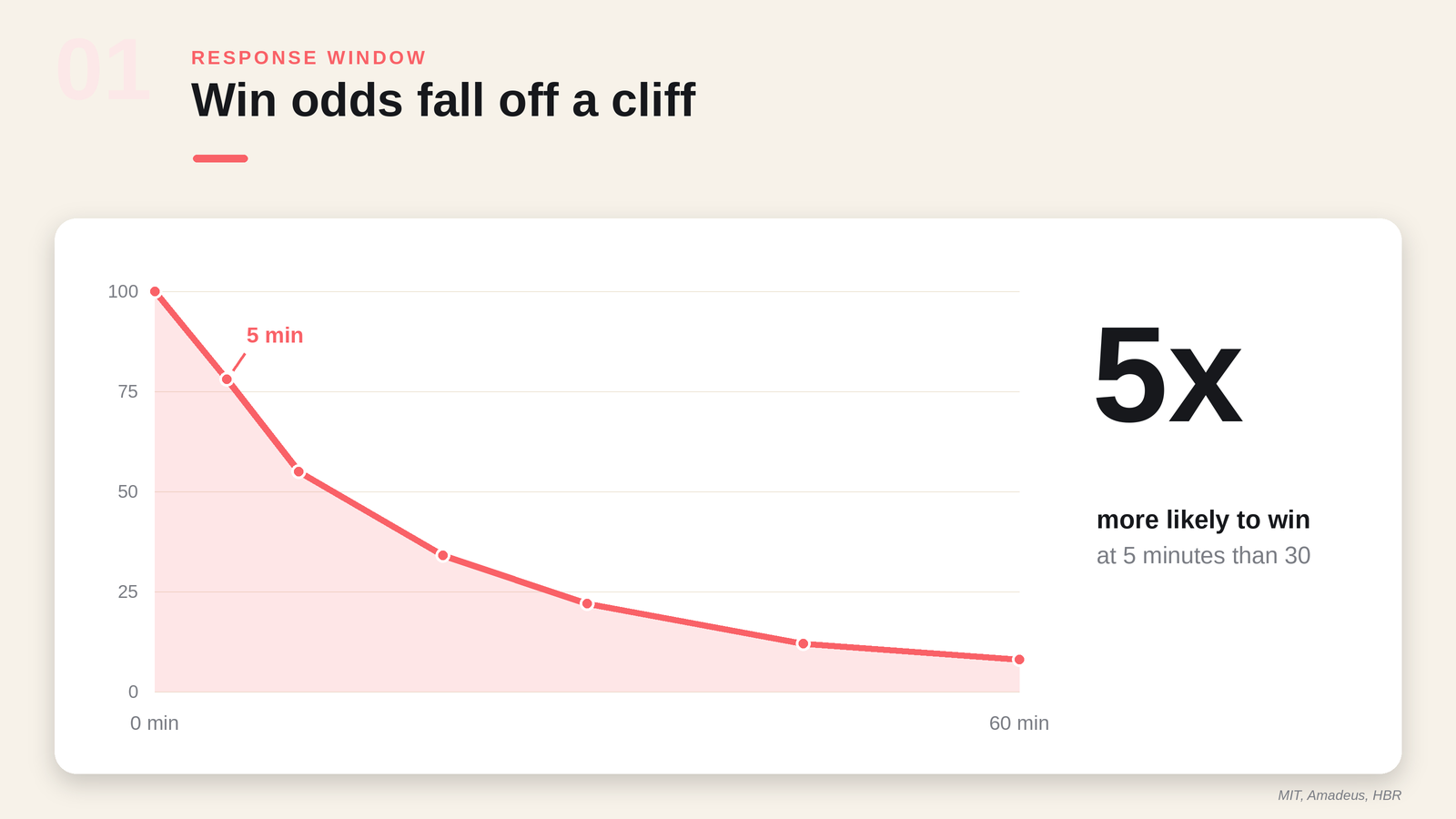
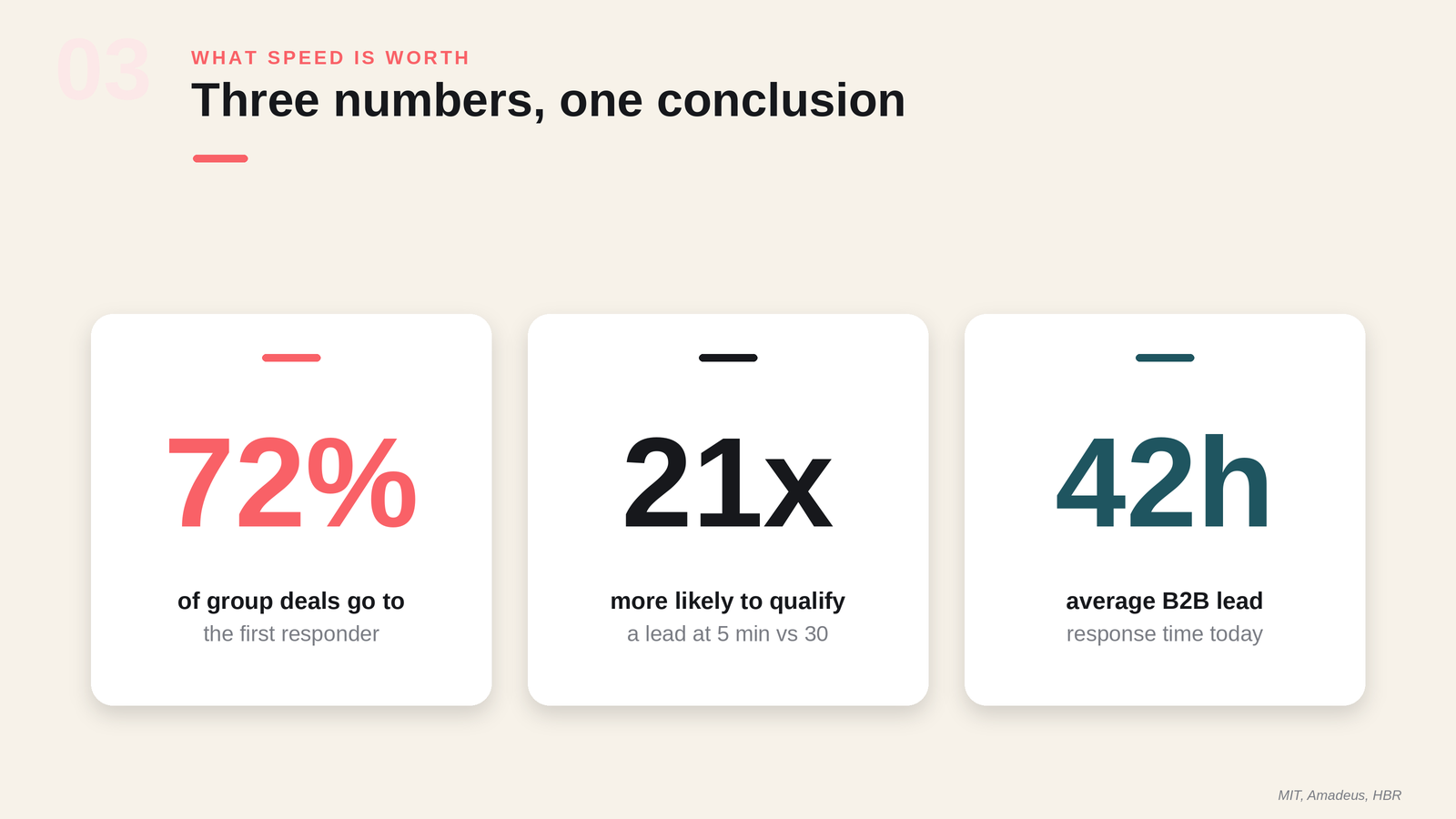
The benchmark study on this is the Lead Response Management Study from Dr. James Oldroyd at MIT and InsideSales.com, which analyzed more than 15,000 leads and 100,000 call attempts. Contacting a lead within five minutes rather than thirty makes you 21 times more likely to qualify that lead. After the first five minutes, the odds of meaningful contact drop roughly tenfold within the hour. The planner has not disappeared. She has just moved on to the next tab, the next vendor, and the rest of her day.
On the hospitality side, Amadeus reports that 72% of first responders win the business, and Thynk finds 79% of RFPs are won by one of the first three hotels to respond. The directional truth is the same everywhere you look: speed is the highest-leverage variable in the entire funnel, and it sits at the very top of it.
Why are hotel sales teams so slow to respond?
Because the response is not one task, it is a chain. A dual-role manager has to notice the RFP, gather missing details, look up live pricing across systems, build a proposal from a template, and update the CRM. Each handoff leaks time, and the person doing it is usually also running operations.
Slow responses are almost never a motivation problem. They are a structure problem. The typical sales manager wears two hats, sales and operations, and the RFP lands while they are covering the floor. Then the real delay begins:
- Noticing. RFPs arrive scattered across Cvent, email, phone, web forms, and CVB portals. Hours are lost simply spotting that a new one came in.
- Gathering. Event dates, attendee counts, room-block needs, and F&B details arrive incomplete, so the rep chases the planner before they can even start.
- Pricing. Live rates and availability live in Opera, Delphi, or a spreadsheet, and often need revenue-management sign-off.
- Building. The proposal is reformatted from scratch, one prospect at a time.
Meanwhile, Salesforce finds salespeople spend only about 29% of their time actually selling. The rest is the admin tax described above.

What does a slow first hour actually cost?
Enough to change your year. If you receive 100 RFPs a month at an $8,000 average deal value, and responding within 24 hours lifts your win rate by roughly 3.5 points, that is close to $19,600 in recoverable revenue every month, or more than $235,000 a year lost purely to slow replies.
Back-of-the-envelope math makes the leak visible. Harvard Business Review audited 2,241 US companies and found the average response time to a web lead was 42 hours, with 23% never responding at all. On the hotel side, Groups360 platform data has shown that a large share of hotel RFPs go completely unanswered. Every unanswered RFP is not a lost bid, it is a deal that never entered your pipeline, and if those leads cost marketing money to generate, it is wasted spend on top of lost revenue.
What do the hotels that win the first hour do differently?
They treat response time as a tracked KPI, not a vibe. The top performers use dedicated sales coverage, template-based proposals with pre-approved pricing, and a defined response SLA with alerts the moment an RFP lands. They remove the manual steps between RFP arrives and proposal sent.
The pattern is consistent. Winning teams stop treating the RFP response as an artisanal effort and start treating it as a repeatable operation. They map their four-stage response chain, find the bottleneck, and automate it. They know their first-three-responder rate the way they know their RevPAR. Our deep dive on speed-to-lead and the first-responder advantage breaks down the psychology of why the first complete proposal anchors the planner's entire evaluation.
You can also read how Wyndham Indianapolis West took its RFP response from 33 minutes to 5 and hit 100% Cvent capture within SLA.
How does automation cut response time without replacing the salesperson?
It removes the mechanical work, not the human one. AI can capture the RFP the instant it arrives, fill in missing event details, pull live pricing, and draft a complete proposal in minutes, so the salesperson spends their time on relationship, negotiation, and the final call instead of data entry and formatting.
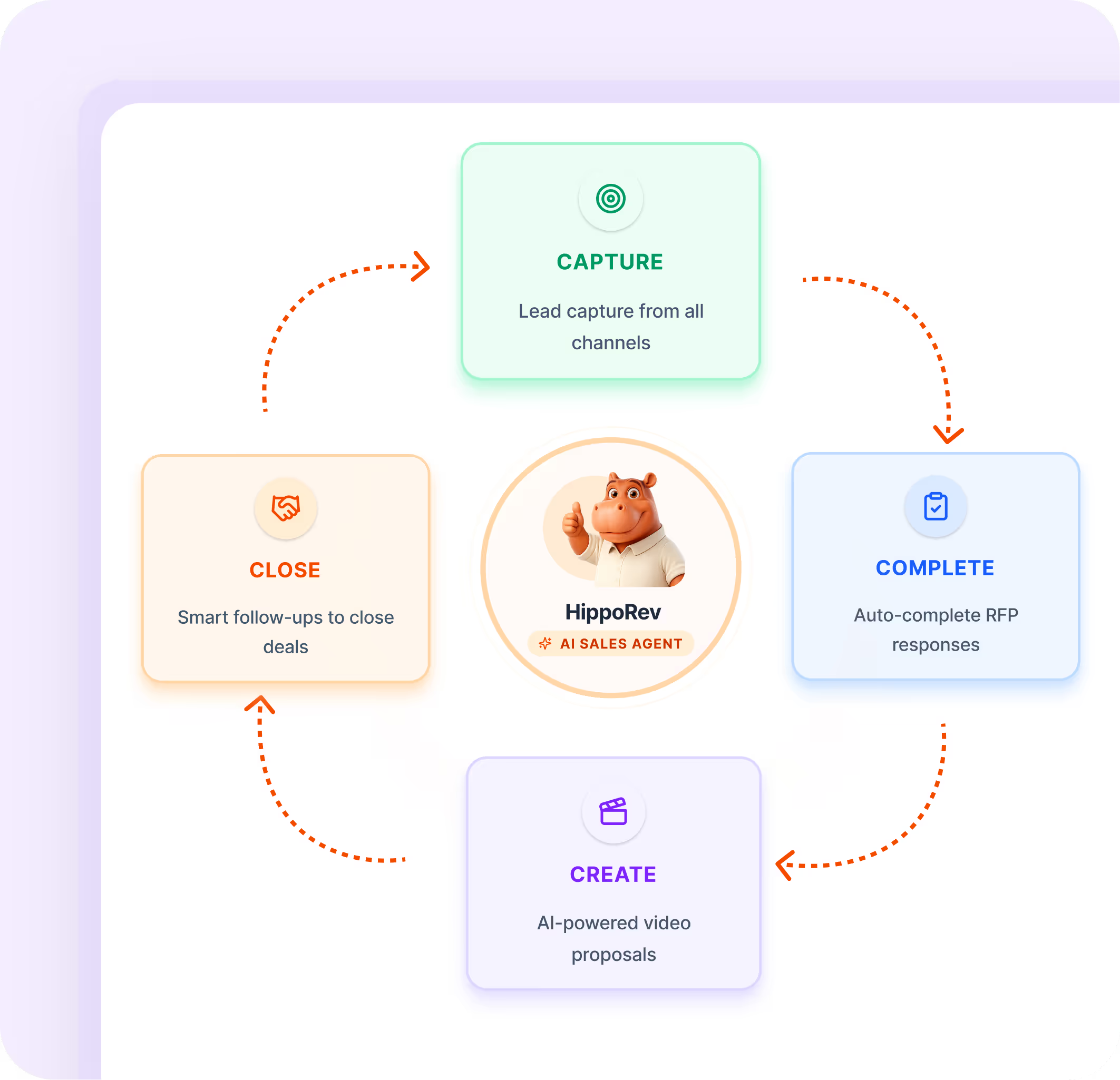
This is the core idea behind Hippo Rev. The Lead Catcher Agent captures every inquiry across channels, and the RFP Response Agent gathers missing details and generates a branded proposal with accurate pricing, often taking a 45-minute manual scramble down to under five. The judgment stays human. The drudgery disappears.
As Hippo Mate puts it: "Take your coffee. I've got the first hour."
You do not have to be the best hotel on the shortlist to win. You have to be the first complete, professional answer in the planner's inbox. Speed gets you in the room. Everything else you are already good at.
See how Hippo Rev handles the first response in under three minutes, even after hours.
Frequently Asked Questions
What is the 60-minute rule in hotel group sales?
It is the working benchmark that a complete first response to a group RFP should go out within the first hour of arrival. Research shows first responders win the majority of deals, so the practical goal is to be the first hotel with a professional proposal in the planner's inbox.
Does responding faster really beat responding better?
The two are not in conflict. Planners define a quality response as accurate, complete, and fast. A first proposal that answers their specific questions anchors the comparison, and later responses are judged against it. Speed and quality reinforce each other, as covered in the speed vs quality myth.
How can a small sales team respond to RFPs faster?
By removing manual steps rather than adding people. Automated intake, missing-detail collection, live pricing lookup, and template-based proposal generation let a lean team respond in minutes. That is the workflow Hippo Rev is built to run.
Share this post
Ready to close more group business?
See how HippoRev can transform your hotel sales workflow in 15 minutes.

Follow us


.svg)