


Scaling Group Sales Across a Multi-Property Hotel Portfolio

Group sales break down as a hotel portfolio grows, with lost overflow leads, cross-property bidding wars, and inconsistent contract terms. This article covers how to treat group demand as a portfolio-wide asset with lead sharing, fit-based routing, displacement-driven pricing, and one connected pipeline with shared KPIs.
Scaling Group Sales Across a Multi-Property Hotel Portfolio
Revenue management gets harder as a hotel portfolio grows, and most of the industry conversation about that problem focuses on pricing and forecasting: keeping rate strategy consistent across properties, centralizing demand data, coordinating a revenue management system at portfolio scale. That's a real and well-documented challenge. It's also not the only place multi-property growth breaks down, and it's arguably not the place breaking down fastest right now.
Group and event sales has its own version of the multi-property problem, and it gets far less attention. A single group RFP can land at three or four properties in the same market on the same day, handled by three or four different salespeople who have no idea they're quoting the same planner. A 200-room RFP that one property can't accommodate often just gets declined, rather than routed to a sister property down the road that could have taken it. Contract terms drift property to property until a customer plays one hotel against another inside the same ownership group. And a management company running twenty properties often has no reliable way to see, across the whole portfolio, which RFPs are stalling, which properties are responding fast, and which are quietly losing business nobody's tracking. That's a distinct problem from pricing consistency, and it compounds just as fast.
Why Multi-Property Group Sales Breaks Down Differently Than Pricing Does
Revenue management strategy typically fragments across a growing portfolio because pricing guidelines get set centrally while day-to-day rate decisions get made locally, with uneven tooling and manual overrides pulling execution away from intent. Group sales fragments for a related but distinct reason: RFPs arrive at individual properties through separate inboxes, so a planner sourcing three markets in the same portfolio gets treated as three unconnected leads, handled by three sales managers who never compare notes.
Each property typically configures its own sales process, its own pipeline stages, its own response habits, so portfolio-level reporting becomes an exercise in reconciling mismatched exports rather than reading a single dashboard. Response speed varies wildly by property staffing and workload, which means from a planner's perspective, the entire portfolio can look disorganized even when most individual properties are actually performing well. Hotels relying on manual lead tracking see sales cycles run 35 to 40 percent longer than teams using purpose-built group sales software, and at portfolio scale, that gap doesn't stay isolated to one property. It compounds across every property running the same manual process.
Treating Group Demand as a Portfolio Asset, Not a Property Asset
The fundamental shift that separates high-performing management companies from the rest is a change in the question being asked. A single hotel asks "how do I fill my rooms." A portfolio should be asking "how do I maximize the value of every group lead across every hotel we operate." Those are different questions with different answers, and the gap between them is where a meaningful amount of group revenue quietly disappears.
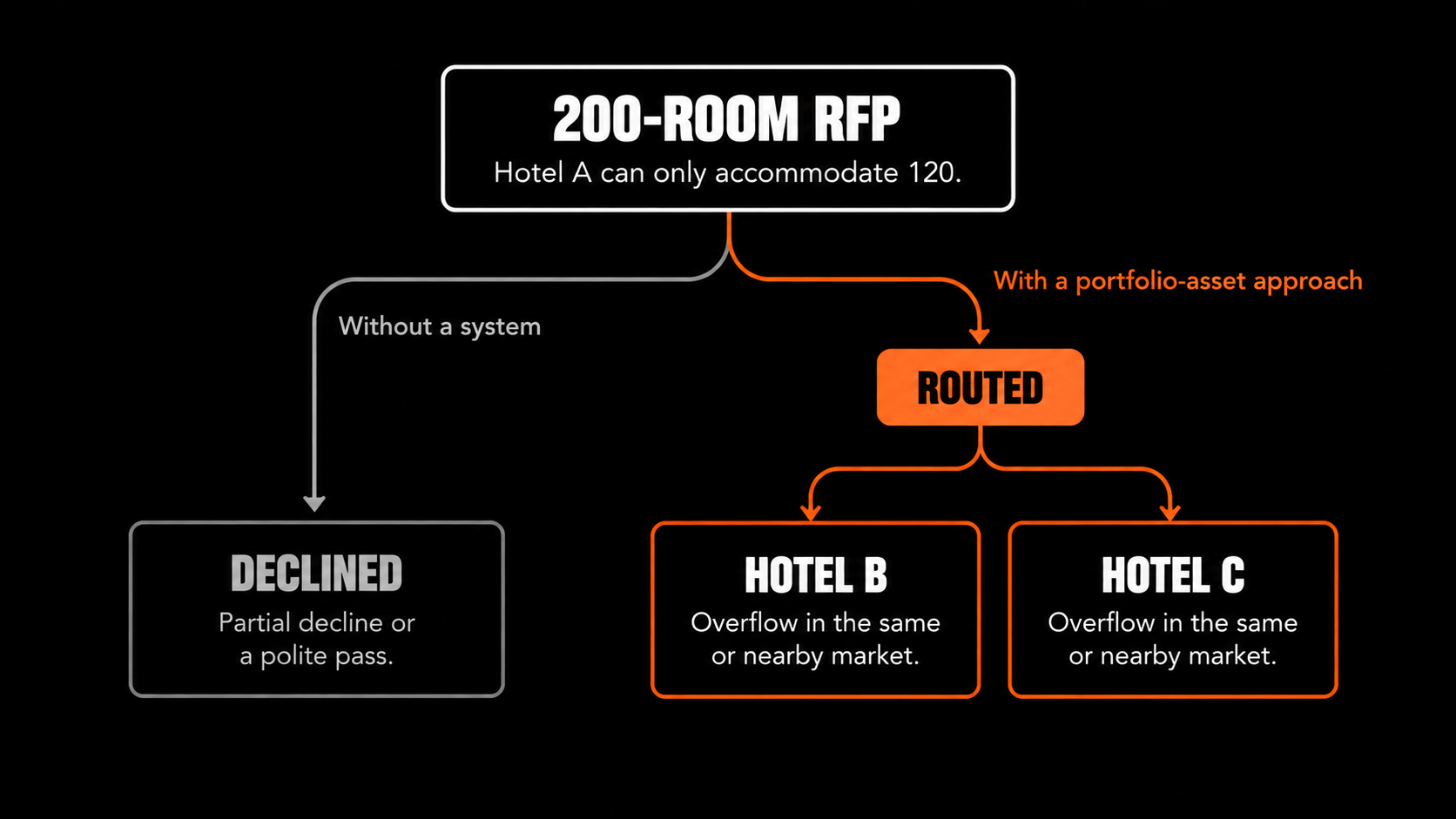
The clearest example is overflow. If Hotel A receives an RFP for 200 rooms but can only accommodate 120, the default outcome at most portfolios is a partial decline or a polite pass, full stop. A portfolio treating group demand as a shared asset instead routes the overflow, or the whole opportunity, to Hotels B and C in the same market or a nearby one. That sounds obvious stated plainly, but most management companies have historically lacked any centralized process for actually doing it, which is why portfolio-level lead sharing keeps showing up in industry analysis as an underused opportunity rather than a solved problem.
Making that work requires tracking more than just the RFP itself: the lead source, the account or planner identity, dates and room-night requirements, which hotels were considered, which ones declined and why, what revenue was ultimately booked, and whether the lead was successfully referred cross-property. Without that record, "we'll pass it to another property" is a one-off favor between sales managers who happen to know each other, not a repeatable system. With it, the operating principle becomes explicit: never lose a qualified group simply because the first property a planner happened to contact couldn't take it.
Centralizing Strategic Accounts Without Losing Local Relationships
A related inefficiency shows up on the outbound side. When twenty individual hotels are each independently prospecting the same category of accounts, national corporate clients, association meetings, sports groups, multi-city conference series, a portfolio is spending redundant effort chasing overlapping business rather than coordinating a single, better-resourced push.
The structure that solves this without flattening local expertise looks like a funnel: a corporate account or large-group opportunity gets identified at the portfolio level, portfolio sales matches it to the best-fit hotel or hotels, and the local property team takes over relationship management and day-to-day execution from there. National accounts, associations, sports groups, SMERF business, weddings, tour and travel, government, and large conferences are all reasonable categories for centralized prospecting, while the actual site visits, contract negotiation nuance, and ongoing relationship stay with the people who know the property. That combination, centralized intelligence and prospecting paired with decentralized relationship ownership, is generally where a management company can produce revenue an individual property working alone simply couldn't reach on its own.
Routing by Fit, Not Just by Whoever Has Availability
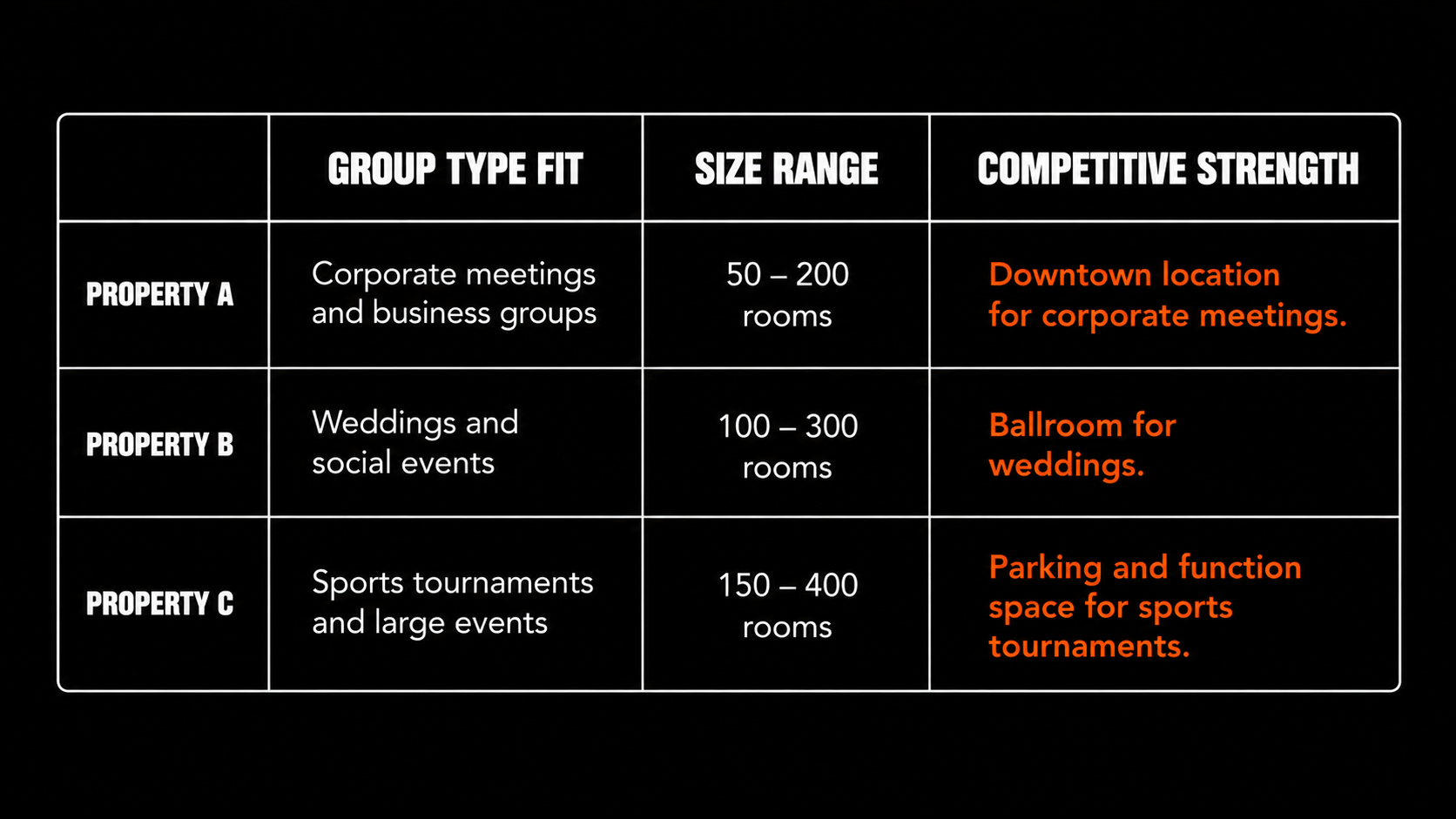
Even with lead sharing and centralized prospecting in place, a portfolio still needs a disciplined way to decide which property a given opportunity should actually go to. The instinct is to route by geography or plain availability, whichever hotel happens to have open dates. That's a weaker filter than routing by fit.
A useful tool here is a simple hotel-by-hotel group positioning matrix: for each property, its strongest group types, its ideal group size range, and its real competitive strength, whether that's a downtown location suited to corporate meetings, a ballroom suited to weddings, ample parking and large function space suited to sports tournaments, or dedicated meeting space suited to association business. Routing an RFP against that matrix, rather than against a simple availability calendar, tends to produce both a better guest experience and a better-fitting group for the property's actual product, which matters for repeat business as much as for the initial booking.
Why Group ADR Is the Wrong Number to Chase
This is probably the single most consequential revenue-management lever in portfolio group sales, and it's a decision that should sit with a property's revenue management discipline, not with the group sales process itself. A $150 group rate isn't inherently good or bad in isolation. The real question is what those rooms would have generated if the group hadn't taken them, which is displacement analysis: comparing the group's total value against expected transient demand for the same dates, accounting for room revenue plus food and beverage, meeting space, and ancillary spend, against the relevant costs of servicing the group.
That analysis is what lets a portfolio set real, defensible parameters: a minimum acceptable group rate, a maximum group size for a given property and date range, blackout dates where group business should never be accepted regardless of rate, shoulder-night requirements, minimum food and beverage spend thresholds, and attrition or cancellation terms that protect the property rather than just the booking. Sales, under this model, isn't rewarded simply for filling rooms. It's rewarded for producing profitable group revenue, which is a meaningfully different incentive and, over a full year, a meaningfully different number.
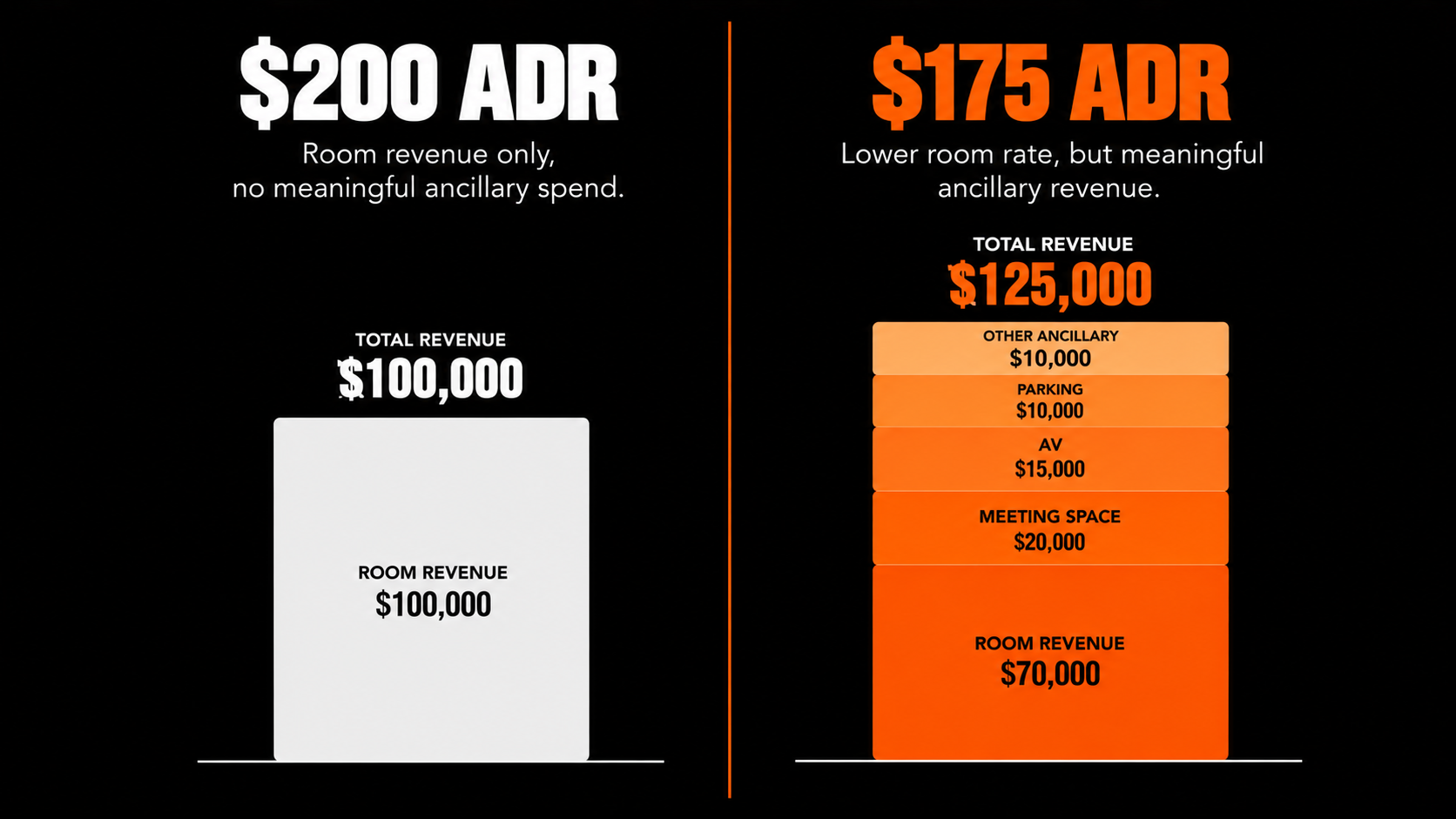
The related discipline is measuring the right total. A group paying $175 average daily rate can easily be worth more than one paying $200, if the first group is also producing meaningful food and beverage spend, meeting room rental, AV revenue, parking, and other ancillary income the second group isn't. Portfolio reporting that only tracks group ADR misses this consistently, which is why the more useful figure is something closer to total group revenue, rooms plus F&B plus meeting space plus ancillary spend, and ultimately group contribution once incremental costs are subtracted out. Chasing the highest room rate alone, without that fuller picture, routinely leads a portfolio to prefer the less profitable group.
Selling Shoulder Nights and Cross-Selling the Relationship
Group business can do more than fill rooms on the nights a planner originally requests. If a group wants Thursday through Saturday but Saturday is already projected to sell out on its own, the useful move isn't a flat yes or no. It's a negotiation: offering the group's preferred rate contingent on the block extending to include Wednesday and Thursday, with a smaller commitment on the already-strong Saturday night. Used deliberately, group sales becomes a tool for shaping demand on a property's actual weak nights, rather than simply accepting whatever dates a planner happens to name.
A second lever available only to multi-property operators, not independent hotels, is cross-selling the relationship rather than just the property. An account producing 300 room nights in one market, 150 in a second, and 100 in a third can be managed as a single portfolio relationship rather than three disconnected bookings, with the management company negotiating multi-property volume terms, preferred rates tied to portfolio-wide commitment, annual room-night targets, and a repeat-event calendar across markets. That increases share of wallet with an account that already trusts the brand, while reducing the cost of acquiring the next comparable account from scratch.
Standardizing the Commercial Playbook
Just as pricing guardrails set centrally tend to drift into inconsistent local execution across a growing portfolio, group sales contract terms and process drift the same way without active management. One property might charge attrition penalties a sister property waives entirely. One might bundle meeting room rental into a package while another charges separately for the identical thing. Planners working with a portfolio across multiple properties notice this quickly, and it erodes trust in the same way inconsistent pricing does: it signals the organization doesn't actually operate as one coordinated group, whatever its brand story claims.
The strongest management companies turn what already works at their best-performing properties into portfolio-wide standards rather than leaving each hotel to reinvent its own version: standard RFP response time targets, standard group pricing rules and displacement thresholds, sales-call activity targets, consistent account-management procedures, shared lead-routing rules, common proposal templates, clear concession guidelines, and consistent group cancellation and attrition standards, reinforced with a regular cross-property sales and revenue meeting. This matters more, not less, as a portfolio grows, since forecasting, pricing, and visibility all get structurally harder to manage consistently the more properties are added.
Building One Pipeline and One Set of KPIs
None of the levers above work well in isolation if group sales and revenue management are running from separate pipelines that don't talk to each other. Every opportunity in a portfolio's group pipeline should move through a consistent set of stages, inquiry, tentative, proposal, negotiation, definite, pickup, and actual, with probability of conversion, expected room nights, expected ADR, expected F&B and meeting-room revenue, wash, cancellation risk, displacement impact, and expected contribution attached at each stage. Sales pipeline information materially improves revenue forecasting and pricing decisions specifically when sales and revenue management are connected on shared data rather than working from separate systems and reconciling numbers after the fact.
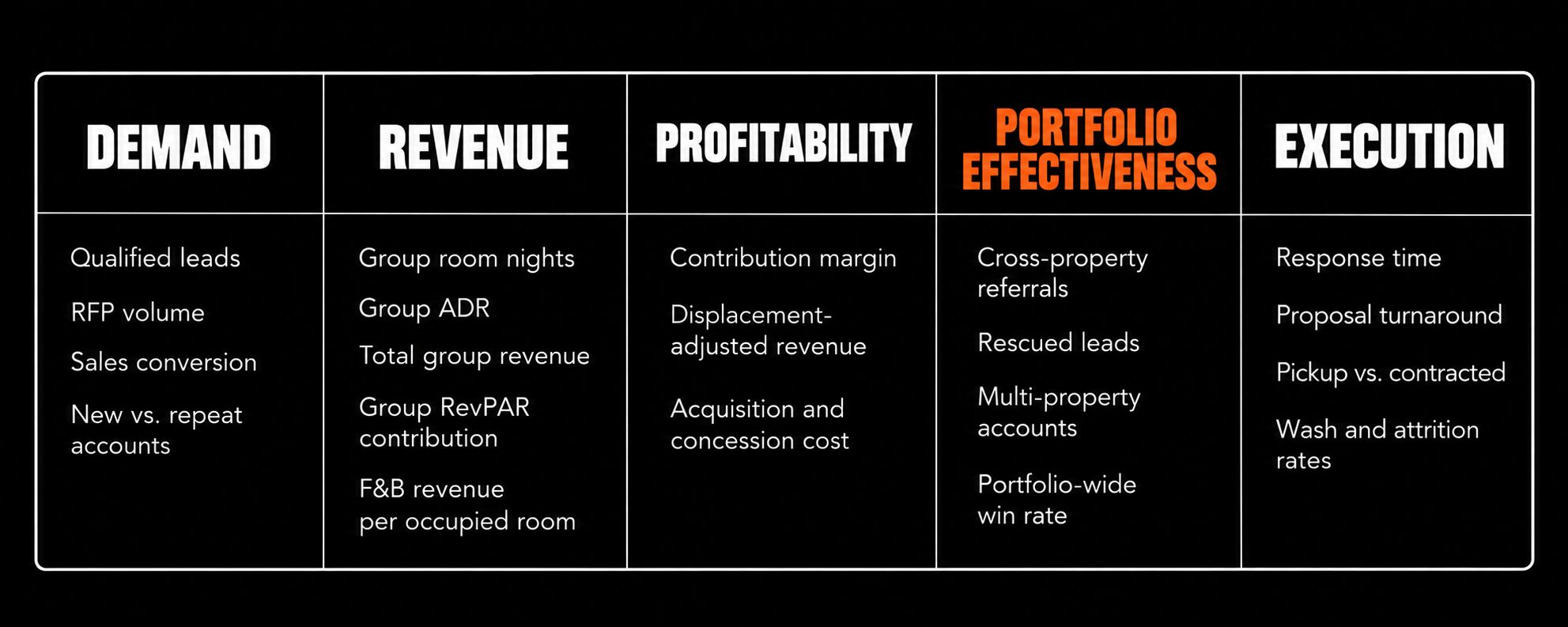
At the reporting level, a portfolio group sales dashboard is generally more useful organized around five distinct buckets rather than one long list of metrics. Demand generation covers qualified leads, RFP volume, sales conversion, and new versus repeat accounts. Revenue covers group room nights, group ADR, total group revenue, group RevPAR contribution, and F&B revenue per occupied room. Profitability covers contribution margin, displacement-adjusted revenue, and acquisition and concession cost. Portfolio effectiveness, the bucket most property-level reporting misses entirely, covers cross-property referrals, leads rescued from a property that couldn't take them, multi-property accounts, and portfolio-wide win rate. And execution covers response time, proposal turnaround, pickup versus what was originally contracted, and wash and attrition rates.
That "portfolio effectiveness" bucket is worth calling out specifically, because it's the one most directly tied to whether the lead-sharing and cross-selling levers above are actually working, rather than existing as policy on paper. A portfolio can look busy on demand generation and revenue metrics while its cross-property referral rate sits at zero, which is a strong signal that group demand is still being treated as a property-level asset in practice, whatever the strategy document says.
The Cross-Property Bidding Problem
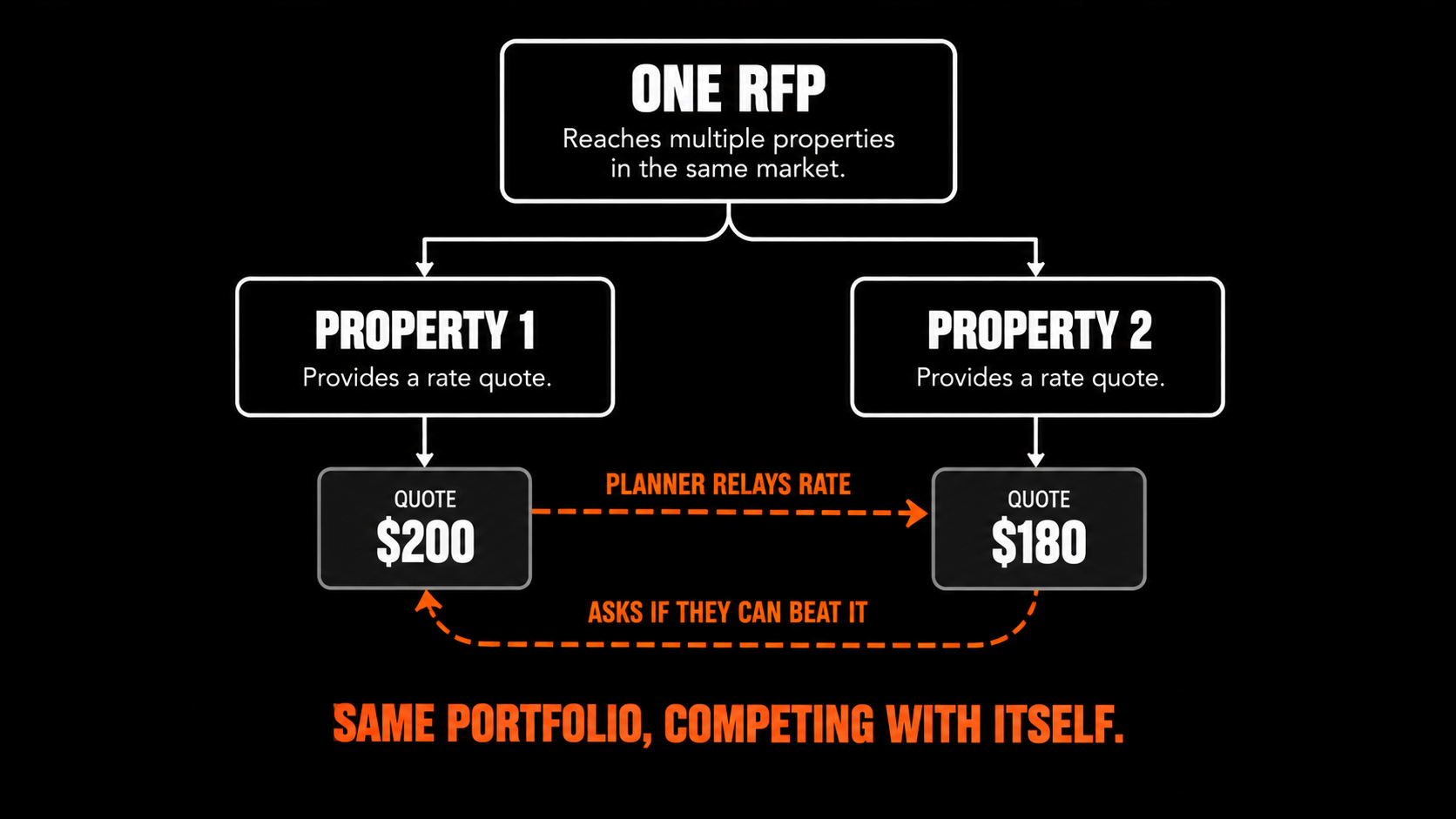
One failure mode is specific to multi-property groups and rarely comes up in single-hotel discussions of group sales: internal competition. When a brand distributes a group RFP to every property it operates in a market, and a portfolio owner has three or four hotels clustered within a mile of each other, that single inquiry can quietly become an internal bidding war. One property quotes a rate. The planner, working several venues at once as planners typically do, mentions that rate to a sister property down the street and asks if they can beat it. Neither sales manager realizes they're competing against their own portfolio, and the group's average daily rate erodes against itself rather than against any actual competitor.
That failure isn't a training problem or a discipline problem at the property level. It's a structural visibility gap, the same one that makes overflow lead sharing and cross-property routing difficult: nothing in most portfolios flags that two properties are working the same account at the same time, because each property's pipeline lives in its own version of the sales system, checked by its own sales manager, with no shared view across the group.
Why More Tools Rarely Solves This
The instinct at portfolio scale, in both revenue management and group sales, is often to add more reporting, more oversight, more manual reconciliation between disconnected systems. That approach reliably increases operational burden rather than reducing it, because it doesn't address the underlying structural problem: each property's tools were adopted independently to solve a local problem, not designed to coordinate across a portfolio.
A technology stack for group sales that was never built to work across multiple properties struggles for the same reasons a single-property revenue management system struggles at portfolio scale: it assumes decisions can be made independently, with limited coordination between hotels, and that assumption breaks down as soon as the same customer, the same market, or the same brand-distributed RFP touches more than one property in the group.
What a Portfolio-Ready Group Sales Approach Actually Requires
A scalable approach to multi-property group sales needs a small number of things working together rather than a longer list of individual tools.
Centralized intake across every property, so an RFP arriving at one hotel and a related inquiry arriving at a sister property in the same market can actually be recognized as connected rather than processed as unrelated leads, and so overflow business has somewhere real to go instead of a default decline.
Shared account records, so a planner's history with one property in a portfolio is visible to sales managers at other properties working the same account, and a multi-property relationship can be managed as one account rather than three coincidental bookings.
Consistent pipeline stages and standardized response templates and contract terms, so portfolio-level reporting reflects real performance differences rather than differences in how each property happens to label its own process.
Cross-property lead routing, so a multi-market RFP reaches the right person at each relevant property rather than defaulting to whichever sales manager happened to open the email first.
And portfolio-level reporting that surfaces response time, conversion, cross-property referral activity, and pipeline health by property without requiring someone to manually reconcile mismatched exports every month.
None of that requires replacing whatever system of record a portfolio already runs on, whether that's a brand-mandated CRM like Delphi or a property-by-property mix of tools inherited through acquisition. It requires a layer that coordinates across those systems rather than adding another disconnected one on top.
Hippo Rev: A Revenue Capture Platform for Group Sales Across a Portfolio
Hippo Rev is a revenue capture platform for hotel group sales, designed to sit on top of the systems a property or portfolio already runs, Cvent, Delphi, Meeting Broker, Lighthouse, and a property's PMS, rather than replacing any of them. It organizes the group sales lifecycle into three stages: Capture, which brings inbound RFPs and inquiries in from every channel a property uses (Cvent, direct email, phone, and other RFP portals) into a single point of visibility instead of scattered property-by-property inboxes; Convert, which helps a sales manager assemble a complete, accurately priced proposal faster by pulling rate, availability, and space data from a property's existing systems into one review window rather than requiring manual lookups across several tools; and Grow, which keeps a record of proposal engagement and follow-up so deals don't stall silently once they've been sent.
At single-property scale, that combination addresses the manual coordination tax on an individual sales team. At portfolio scale, it's the same underlying architecture that makes real coordination possible: because inquiries can be captured and tracked in one connected system rather than reconstructed after the fact from separate property exports, a portfolio gains the kind of shared visibility that group demand sharing, cross-property lead routing, and consistent response-time reporting all depend on.
It's worth being precise about scope here: the strategic decisions, which groups to accept based on displacement value, what the positioning matrix looks like property by property, where the minimum acceptable group rate sits, stay with a portfolio's sales and revenue leadership. What Hippo Rev addresses is the execution layer underneath those decisions: getting every inquiry captured and visible across the properties that could serve it, keeping proposals accurate and fast regardless of which property is responding, and giving leadership a real-time view of where the pipeline is stalling rather than a monthly reconciliation exercise. A sales manager still makes every pricing and space decision, and nothing goes out to a planner without their review.
If cross-property visibility, inconsistent execution across properties, or the kind of internal bidding that comes from running group sales property by property is a problem your portfolio is dealing with, you can see how Hippo Rev works by booking a Capture Audit with us here.
Frequently Asked Questions
Why does group sales get harder to manage as a hotel portfolio grows, separately from pricing and revenue management?
Because RFPs and planner relationships increasingly span multiple properties in a portfolio, while each property's sales process, pipeline, and reporting typically remain independent, creating coordination gaps that don't show up in single-property sales operations.
What is portfolio-level lead sharing, and why do most management companies struggle to do it?
It's the practice of routing a group RFP a property can't fully accommodate, or can't accommodate at all, to a sister property rather than declining it outright. Most portfolios lack a centralized system for tracking which hotels were considered for a lead, which declined, and why, which makes lead sharing an occasional favor between sales managers rather than a repeatable process.
Why is group ADR the wrong metric to optimize for a hotel portfolio?
Because it ignores displacement value and total group revenue. A lower-ADR group generating strong food and beverage, meeting space, and ancillary spend can be substantially more valuable than a higher-ADR group without that spend, and a portfolio optimizing purely for room rate will systematically prefer the less profitable option.
What is cross-property bidding, and how common is it in multi-property hotel groups?
It happens when the same group RFP reaches multiple properties within one ownership or management group, and sales managers at each property, unaware they're competing against their own portfolio, quote against each other and erode rate rather than compete against an actual outside competitor. It's a specific and recurring risk wherever properties are clustered in the same market.
Boutique Hotel Group Sales: Close the Capacity Gap in 2026
Corporate travel budgets and planner preference are shifting toward boutique and independent hotels in 2026, but most aren't equipped to capture that demand. This article breaks down the sales-capacity gap behind lost group business and what independents need: speed, RFP qualification, stall visibility, and a record that survives staff turnover.
What Boutique Hotels Need to Win More Group Business
Group business for boutique hotels comes down to three things most independent properties currently lack: a fast, consistent RFP response process, a way to qualify which group leads are actually worth chasing, and a system that survives a sales manager also handling front desk, revenue, and marketing on the same day. Boutique and independent properties are not losing group business because planners prefer chain hotels. They're losing it because chain competitors have sales infrastructure that most independents were never built with.
That gap matters more in 2026 than it has in years. Corporate travel budgets are projected to rise by around 5% in 2026, according to Morgan Stanley research cited in Cloudbeds' 2026 hotel group business guide, and small and mid-sized companies are increasingly choosing boutique or independent properties over brand-flag hotels for the more personal experience they offer. The demand is shifting in boutique hotels' favor. The question is whether the sales process behind the front desk can actually capture it.
Why Boutique Hotels Are Positioned to Win More Group Business Right Now
Group travel fully recovered to 2019 levels by 2023 and has kept growing since, and several trends in 2026 specifically favor independent and boutique properties over large chains. Corporate clients increasingly choose independents on purpose: they want distinctive food and beverage, design, and personalized service rather than a standardized experience, and smaller companies in particular are more likely to select boutique properties for that reason. Meeting and event demand is also spreading into secondary markets, smaller cities, and outer-borough or regional destinations that previously couldn't compete for group business against major convention hubs, opening the door for boutique properties in markets that used to be overlooked entirely.
This is a real structural shift, not a marketing narrative. But demand shifting toward a category of hotel doesn't automatically mean any individual property captures its share of it. That depends on what happens after the RFP lands in the inbox.
The Real Obstacle Isn't Charm, It's Sales Capacity
The advantages boutique hotels bring to group sales conversations (distinctive space, flexible service, a story planners can sell to their own stakeholders) are real. What's usually missing is the operational infrastructure that turns those advantages into won business.
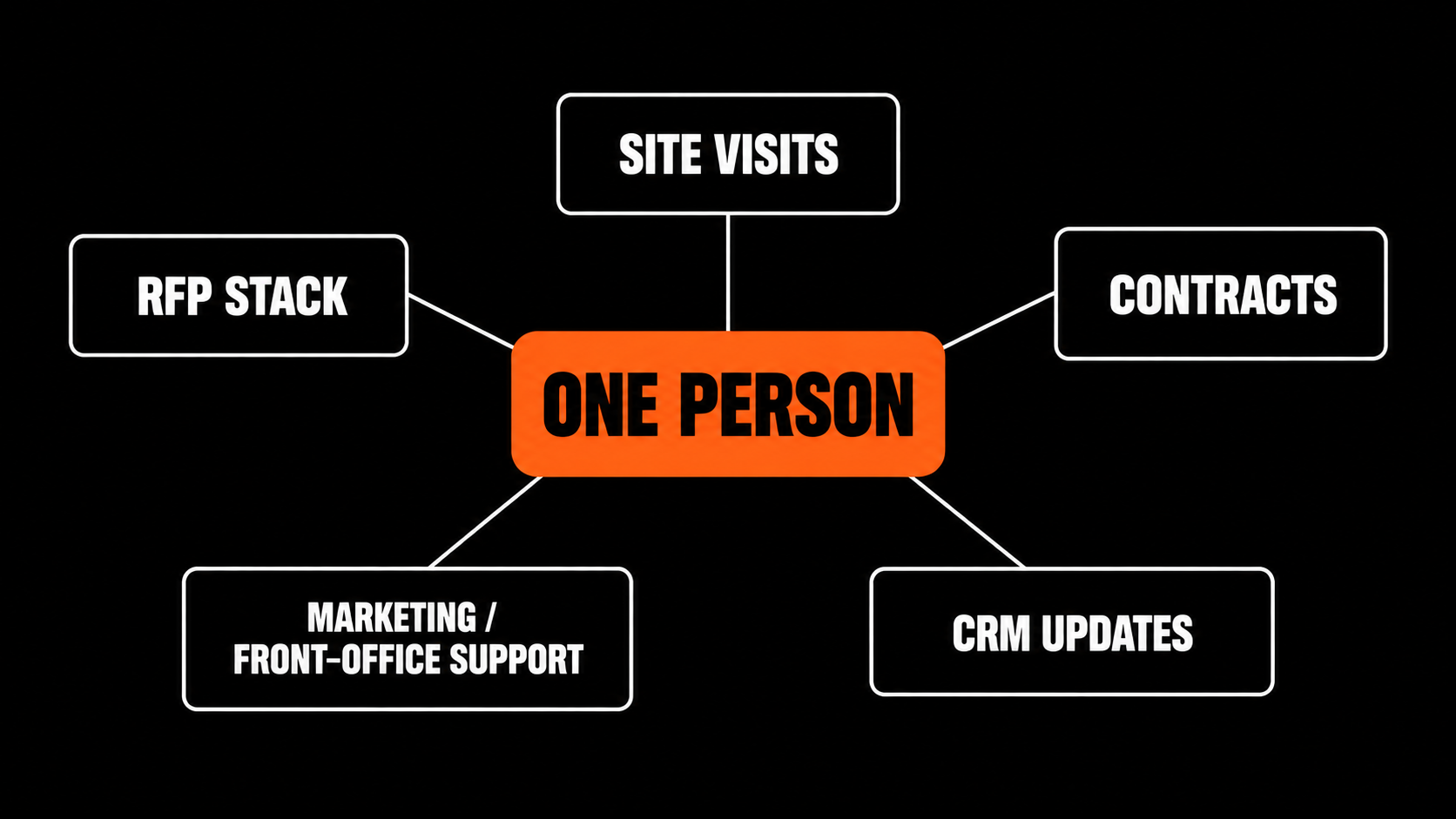
Independent hotels compete without a brand sales team, brand RFP tools, or the shared systems that chain properties draw on by default. A group sales manager at a boutique property is frequently the same person handling site visits, contract negotiation, CRM updates, and often marketing or front-office support, all while trying to work through a stack of inbound RFPs. Industry research on independent hotel revenue strategy has flagged this directly: without a brand sales team and the tools that come with it, independent hotels have to be deliberate about which channels and processes they invest in, because there's no larger system compensating for gaps.
That capacity gap shows up most clearly in RFP volume. A single group RFP is typically sent to around ten competing properties at once, according to Cvent's hospitality RFP research, which means every incoming request is already a competitive race before a boutique property's one-person sales team has even opened the email. Across the industry, roughly 36% of group RFPs go unanswered by hotels altogether, not because those hotels don't want the business, but because manual RFP processing, industry estimates put at roughly 37 minutes per response when done by hand, consumes time that a stretched sales team doesn't have. Hotel sales teams lose an estimated $500,000 in annual revenue per salesperson to process gaps like this, and sellers spend roughly 71% of their time on non-selling administrative tasks rather than the relationship-building and negotiation that actually wins group deals. For a boutique property with one or two people covering group sales, that ratio is often worse, not better, than the industry average.
What Boutique Hotels Actually Need to Compete for Group RFPs
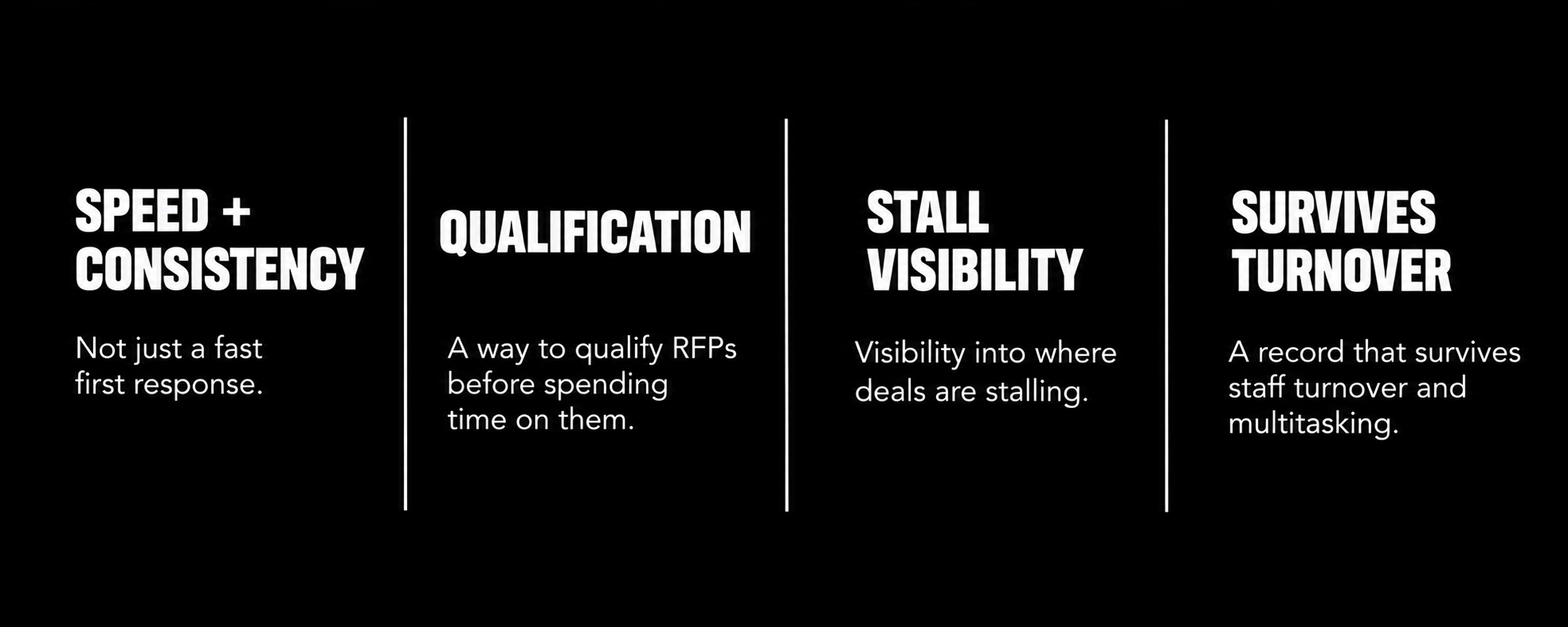
Speed and consistency, not just a fast first response
Planners equate responsiveness with the quality of service they'll get once the group actually arrives, and 80% of planners expect a response within four days, according to hospitality RFP research on response benchmarks. But speed on its own isn't the full requirement. Consistency matters just as much: a property that responds quickly to some RFPs and misses others looks less reliable than one that responds a little slower but always responds. Boutique properties without dedicated RFP software are more prone to inconsistency simply because response quality depends entirely on whichever team member happens to be free that day.
A way to qualify RFPs before spending time on them
Not every inbound group RFP is worth a boutique property's limited sales hours. Larger hotels can afford to triage aggressively and still respond to enough volume to hit their numbers; a boutique property usually can't. That makes qualification, deciding quickly whether an RFP's dates, group size, and budget genuinely fit the property, more important for independents than for chain competitors with bigger teams. Sales teams that lack a fast qualification step tend to spend proposal-writing time on RFPs that were never a realistic fit, which is time taken directly away from the RFPs that are.
Visibility into where deals are stalling
Group sales cycles don't fail in one dramatic moment. They fail in small stalls: a proposal that goes unanswered for a week, a rate hold that expires without follow-up, a site visit that never gets scheduled. Proposals that sit unanswered for 5 to 7 days need a follow-up touch, and most hotel sales teams, including boutique ones, under-follow-up on group proposals rather than over-follow-up, according to hotel sales pipeline research. Without a system that surfaces which proposals have gone quiet, a solo or two-person sales team has to remember every stalled deal manually, on top of everything else on their desk.
A record that survives staff turnover and multitasking
Because boutique hotel group sales roles are frequently combined with other responsibilities, and turnover in these roles is common, deal history often lives in one person's inbox and memory rather than in a shared system. When that person is out, or leaves, the details of an in-progress group negotiation, what was quoted, what was promised, what the planner's real deadline is, can disappear with them. A rooms-to-space ratio, a negotiated F&B minimum, or a planner's stated internal approval timeline are the kind of details that matter enormously to closing a deal and are easy to lose without a shared record.
Common Mistakes Boutique Properties Make in Group Sales
Independent hotels often default to treating every RFP the same way, applying the same effort to a 10-room social block and a 200-room corporate conference, rather than triaging by fit and probability of winning. Many also under-invest in follow-up discipline specifically because the team is stretched thin on new inbound requests, when in reality a proposal that's already 80% negotiated is usually a better use of an hour than a brand-new RFP that hasn't been qualified yet. And because boutique properties often lack a CRM built for group sales specifically, account history and past group relationships (the kind of repeat business that compounds over time for independents) frequently isn't tracked well enough to be reused for the next RFP from the same company.
Building a Repeatable Group Sales Process Without a Brand Behind You
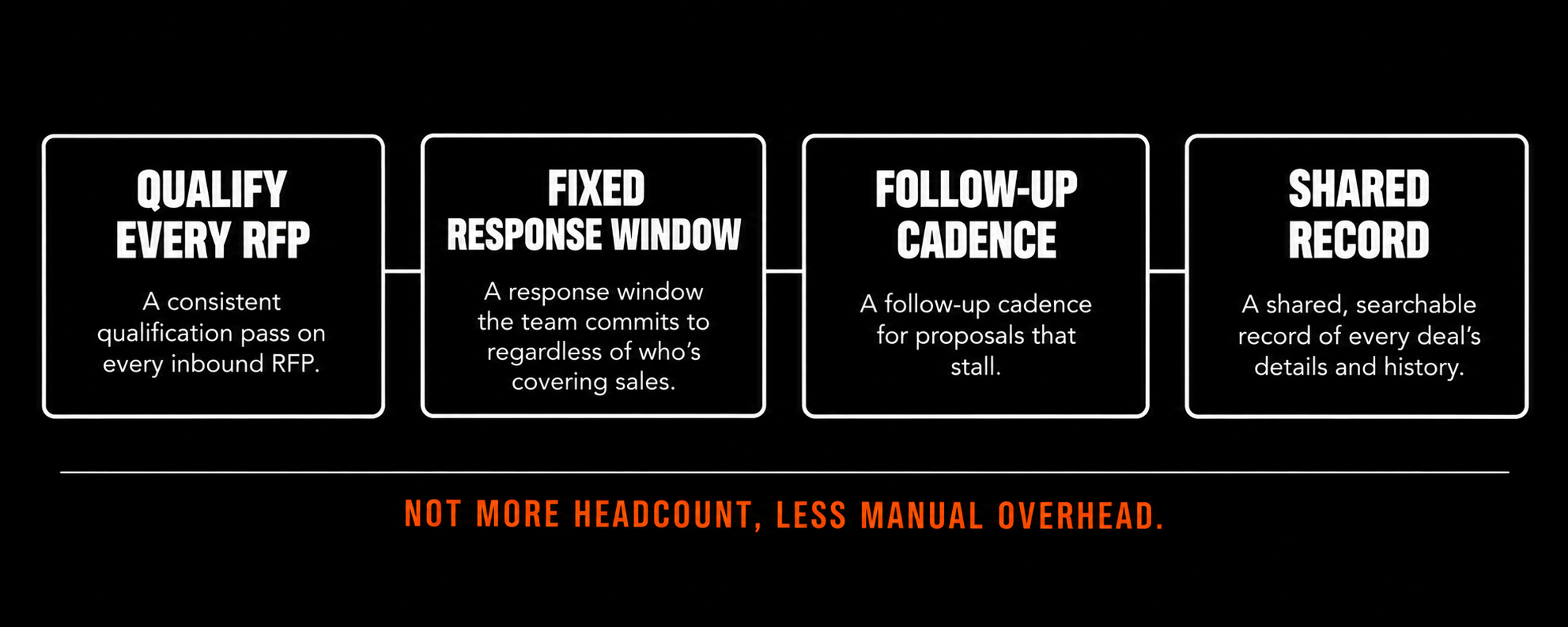
None of this requires a boutique property to imitate a large chain's sales department. It requires treating group sales as a process with defined steps, rather than a set of tasks one person handles reactively as RFPs arrive. That means a consistent qualification pass on every inbound RFP before proposal time gets spent, a fixed response window the team commits to regardless of who's covering sales that week, a follow-up cadence for proposals that stalls, and a shared, searchable record of every deal's details and history that doesn't live only in one person's head or inbox.
Properties that build this structure deliberately tend to compete for group business closer to how larger hotels do, not because they've added headcount, but because they've removed the manual overhead that was consuming the sales capacity they already had.
What This Means for Boutique Hotel Revenue
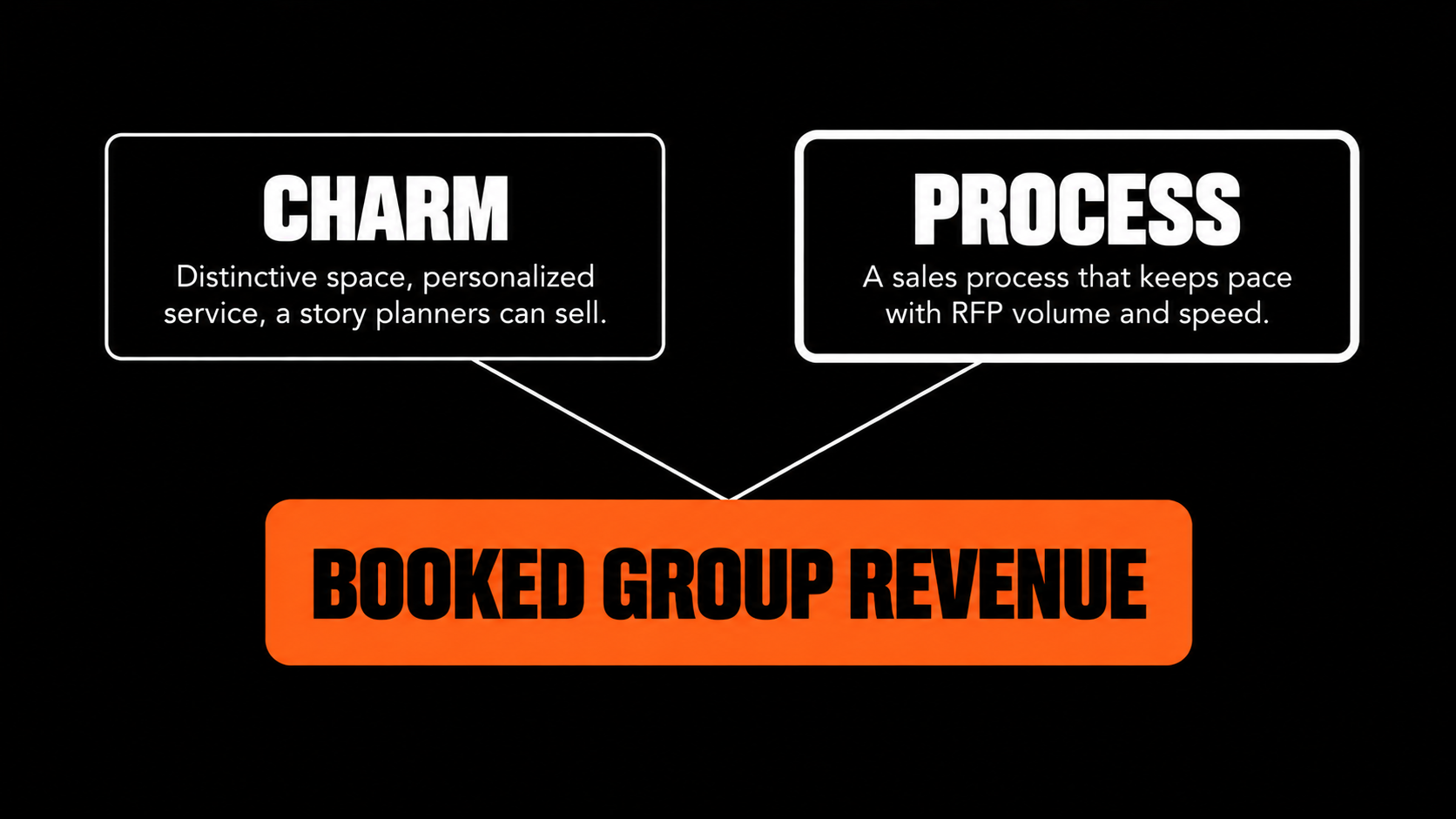
The demand-side conditions favoring boutique and independent hotels in 2026 (rising corporate travel budgets, a preference for personalized experiences, and growth in secondary markets) create a real opportunity. But opportunity only converts into booked group revenue when the property's sales process can actually keep pace with the volume and speed the RFP process demands. For most boutique hotels, the constraint isn't the property's appeal to planners. It's the hours in the day available to qualify, respond to, and follow up on group business consistently, without a brand sales team behind the effort.
The boutique hotels that win more group business in the years ahead won't be the ones with the most charm. They'll be the ones whose sales process can keep up with an RFP cycle built for teams with far more headcount, without losing the personalized service that made planners consider them in the first place.
If limited sales capacity is the bottleneck between your boutique property and more group business, Hippo Rev is built around that exact problem: it helps surface and qualify incoming RFPs, keeps deal details in a shared record so nothing depends on one person's inbox, and flags proposals that have gone quiet so follow-up doesn't fall through the cracks on a busy week. You can see how it works by booking a Capture Audit with us here.
Frequently Asked Questions
Why are boutique hotels losing group business to chain properties?
Usually not because planners prefer chain properties, but because chain hotels have dedicated sales teams, RFP tools, and brand-level systems that most boutique properties don't, which shows up as slower or less consistent RFP response.
How fast should a boutique hotel respond to a group RFP?
Industry benchmarks put planner expectations at a response within four days, though faster, same-day acknowledgment followed by a complete proposal within 24 to 48 hours performs best when a property can manage it.
Should a boutique hotel respond to every group RFP it receives?
No. Qualifying RFPs by fit, group size, dates, and realistic probability of winning before committing proposal time is more important for a resource-constrained boutique sales team than for a larger chain property that can afford to respond broadly.
What tools do independent hotels need for group sales if they don't have brand systems?
At minimum, a CRM or sales and catering system that tracks account history and deal details, a defined RFP qualification and response workflow, and a way to see which proposals have gone quiet so follow-up doesn't depend entirely on one person's memory.
Is group business actually growing for boutique hotels in 2026?
Yes. Group travel has fully recovered from pandemic-era declines, corporate travel budgets are projected to rise roughly 5% in 2026, and small and mid-sized companies are increasingly choosing boutique and independent properties over brand-flag hotels.
How to Reopen a Silent Hotel Group Proposal

A planner goes quiet after receiving a hotel group proposal, and most sales teams don't know when or how to follow up. This guide breaks down why proposals stall, a four-touch reopening cadence with exact timing, and ready-to-adapt email templates for each stage.
How to Reopen a Silent Hotel Group Proposal
A meeting planner asked for a proposal, you sent one, and then nothing. No confirmation, no questions, no "thanks, going another direction." The fastest way to reopen a silent hotel group proposal is a short, specific email that references one detail from the original RFP rather than asking a generic "just checking in" question, sent 3 to 5 business days after your proposal went out, followed by a second, different-angle touch a week later.
Silence after a proposal is one of the most common failure points in hotel group sales, and it's rarely about your rate. Understanding why planners go quiet, and building a deliberate reopening sequence around that reason, is what separates properties that recover stalled business from properties that just lose it to a faster-moving competitor down the street.
Why Hotel Group Proposals Go Silent
A planner going quiet after receiving your proposal is not usually a rejection. It is more often a sign that the decision has stalled somewhere you can't see.
The RFP was sent to multiple properties at once. Planners typically send a single group RFP to around ten venues, according to Cvent research shared in its hospitality RFP guidance. Your proposal is one of a stack, and the planner is often waiting to collect every response before comparing any of them line by line.
An internal stakeholder hasn't signed off yet. Group bookings, especially corporate ones, usually need budget approval, a site visit, or sign-off from someone who wasn't on your original call. The planner may be waiting on that person, not ignoring you.
Something in the proposal raised a question the planner hasn't asked yet. A rate that doesn't match their budget assumption, an F&B minimum they need to check with finance, or attrition terms that need legal review can all stall a reply without the planner ever telling you why.
The proposal simply got buried. Group sales inboxes on both sides are heavy. A proposal sent on a Thursday afternoon competes with the rest of the planner's week.
None of these reasons mean the deal is dead. They mean the ball is sitting somewhere it shouldn't be, and a well-timed follow-up is what moves it.
What a Good Follow-Up Cadence Looks Like
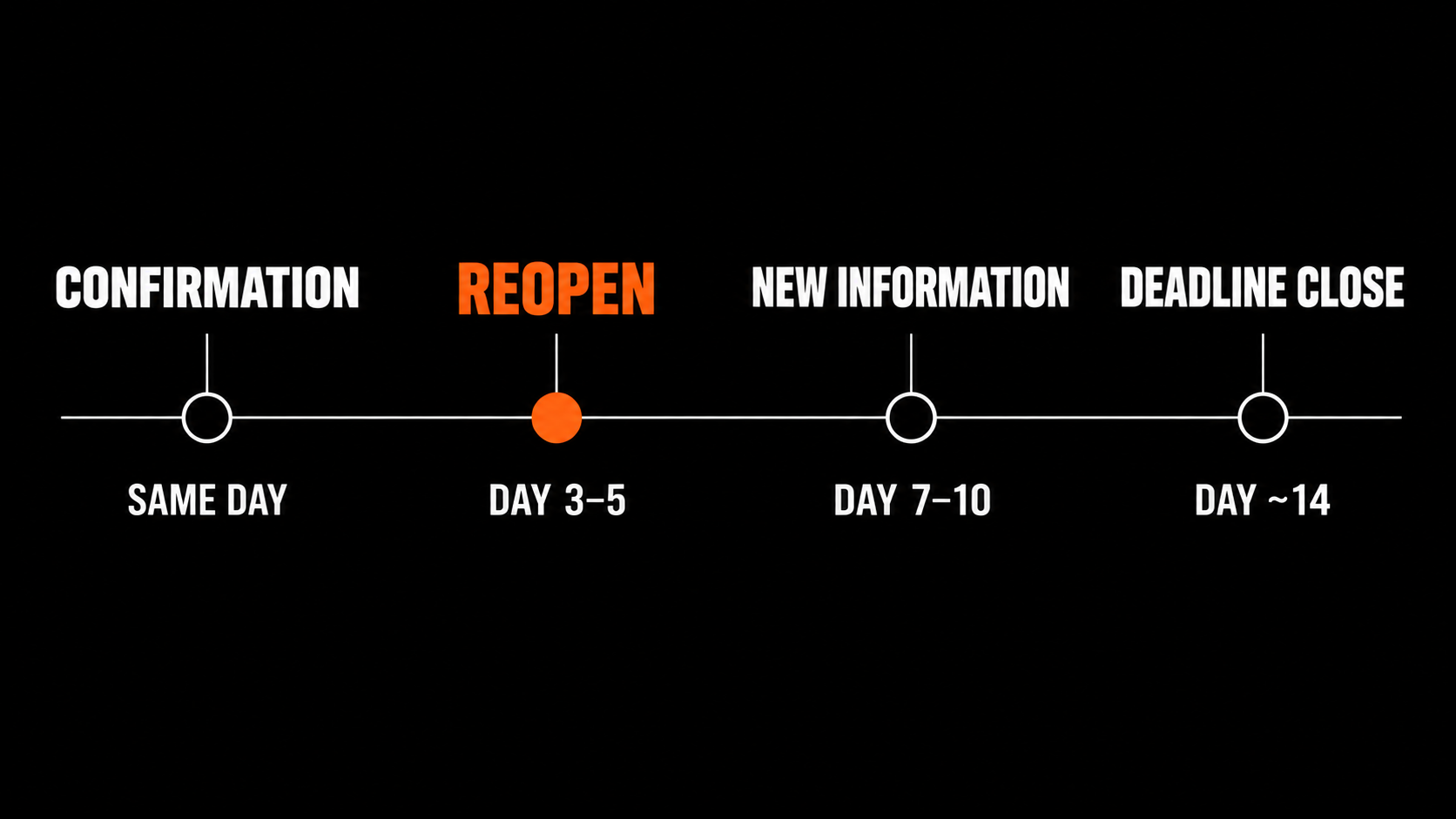
Hospitality sales research consistently points to the same window: proposals that go unanswered for 5 to 7 days need a follow-up touch, and most hotel sales teams under-follow-up on group proposals rather than over-follow-up, according to group sales pipeline research from M1 Intel. That matters, because the instinct after silence is often to wait longer out of politeness. In practice, waiting longer just gives the planner more time to finalize with a competitor who followed up sooner.
A workable cadence for a group proposal looks like this:
The shape matters more than the exact day count. Each touch should give the planner a new reason to reply, rather than repeating "just following up" language that adds no information and signals that you have nothing else to offer.
What to Actually Send: Four Reopening Templates
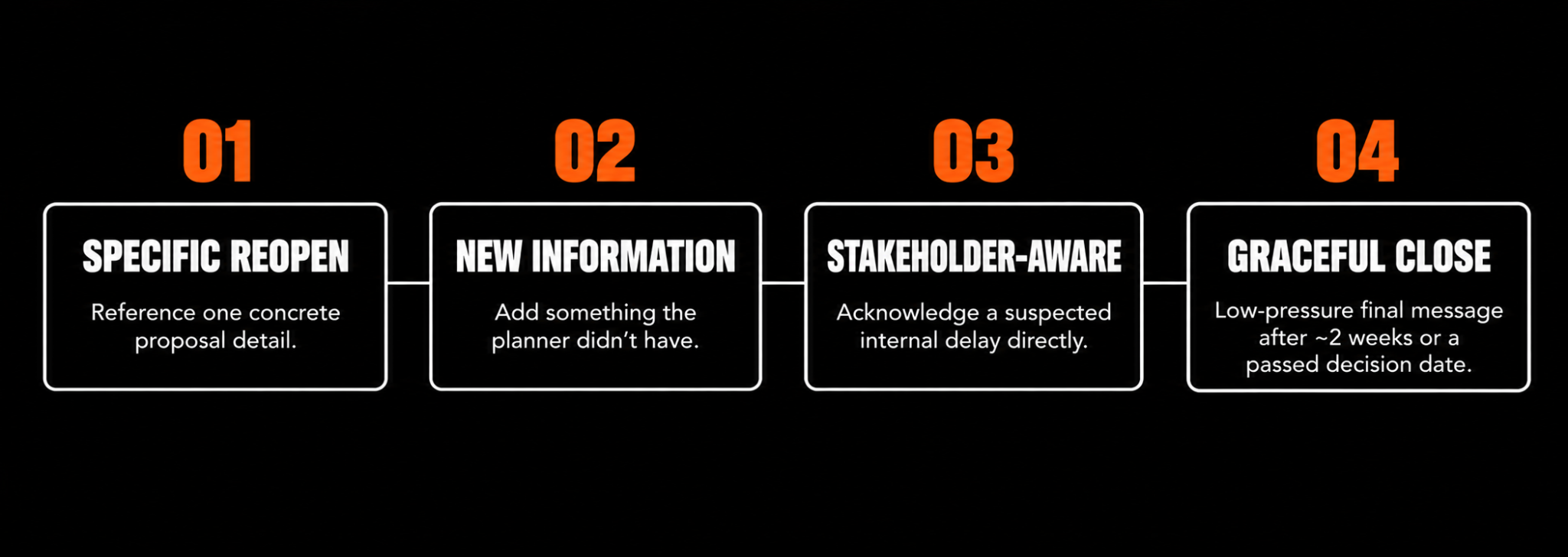
1. The specific reopen (Day 3 to 5)
The single biggest mistake in a reopening email is asking "did you get a chance to review our proposal?" It puts the entire burden of moving the deal forward on the planner and gives them nothing to react to. A stronger reopen references one concrete element of the proposal itself.
For example, instead of a generic check-in, reopen the attrition clause, a specific room block hold date, or a food and beverage minimum, and ask a direct question about that one item. This does two things: it proves you remember the details of their specific event rather than treating it as one of many RFPs, and it gives the planner something narrow and easy to answer, rather than a broad "any updates?"
2. The new-information touch (Day 7 to 10)
If the reopen doesn't get a reply, the next touch should add something the planner didn't already have. That could be an updated hold on the room block, a comparable group you've hosted recently in the same space, or a flexible date range if their original dates are tightening availability elsewhere. New information gives the planner a reason to open the email that isn't just persistence.
3. The stakeholder-aware touch
If you know or suspect the delay is on the planner's side (a budget approval, a committee decision, a site visit still pending) acknowledge that directly rather than pretending you don't know it exists. A line like "I know these often need sign-off from a few people on your end. Happy to put together a one-page summary you can forward internally if that's useful" respects the planner's actual bottleneck instead of adding pressure to a conversation they can't control.
4. The graceful close
If a stated decision date has passed, or if it has been roughly two weeks with no reply across two or three touches, send a final, low-pressure message that gives the planner an easy way to say no, hold, or yes. This is not a "breakup" in the aggressive sense. It's an honest acknowledgment that plans change, paired with an open door: hold the date a few more days if useful, or close the file and stay in touch for future business. Planners remember which properties respected their time when a deal didn't move forward, and that memory often resurfaces on the next RFP.
How Many Touches Is Too Many
Across proposal follow-up research outside hospitality specifically, three to four well-spaced touches over roughly two weeks is the general ceiling before a lead should move to long-term nurture rather than active daily follow-up. Beyond that point, continued weekly emails tend to read as pressure rather than diligence, and can hurt deliverability into a planner's inbox for future RFPs from the same address.
For hotel group sales specifically, the RFP-crowded nature of the process makes this even more important. Planners are managing responses from roughly ten properties at once. A hotel that sends four thoughtful, spaced-out touches looks organized. A hotel that sends six identical "just checking in" emails looks like it has nothing else going on, which is a worse signal than silence.
Why Speed and Follow-Up Discipline Matter More Than They Used To
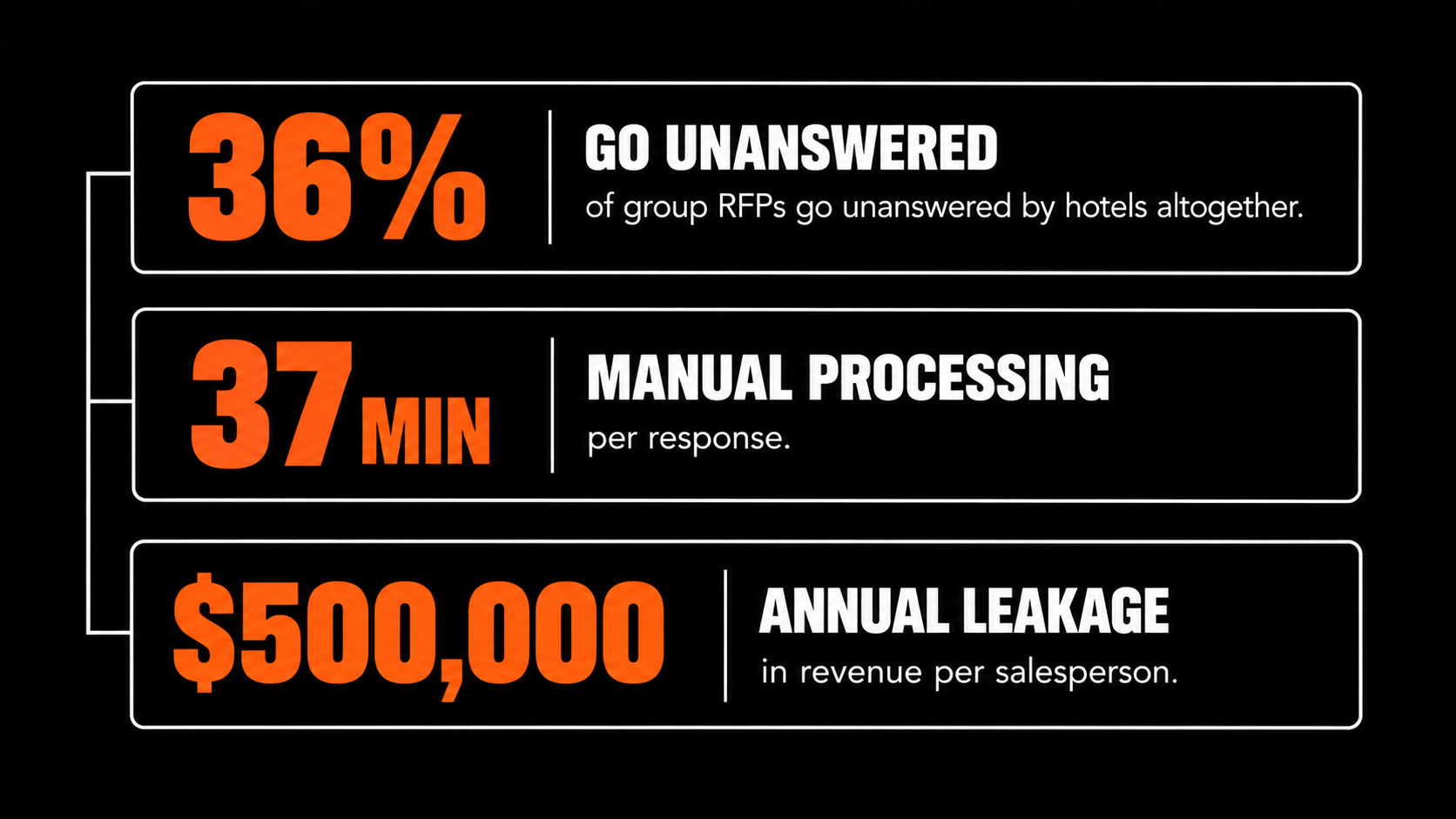
The competitive backdrop for this is worth naming directly, because it changes how much a stalled proposal actually costs. Roughly 36% of group RFPs go unanswered by hotels altogether, a gap that has less to do with hotels lacking demand and more to do with sales teams being buried in manual RFP processing. On top of that, planners increasingly favor whichever property responds fastest and follows up most consistently, since a slow or inconsistent process reads as a signal of how the group's actual event will be handled.
That combination, high RFP volume per planner and inconsistent hotel follow-through, is exactly why proposals stall in the first place. A sales manager juggling a full desk of RFPs, proposals, and site visit requests will naturally let a quiet proposal slip past the 5-to-7-day window where a reopen is still easy. Industry estimates put manual RFP processing at roughly 37 minutes per response when handled by hand, time a sales manager doesn't have to spend chasing the reopen email on top of everything else on their desk. Across a full pipeline, that adds up: unfollowed proposals and unanswered RFPs are a meaningful share of the estimated $500,000 in annual revenue leakage per salesperson that hotel sales teams lose to process gaps rather than lost bids.
What This Means for How You Structure Follow-Up
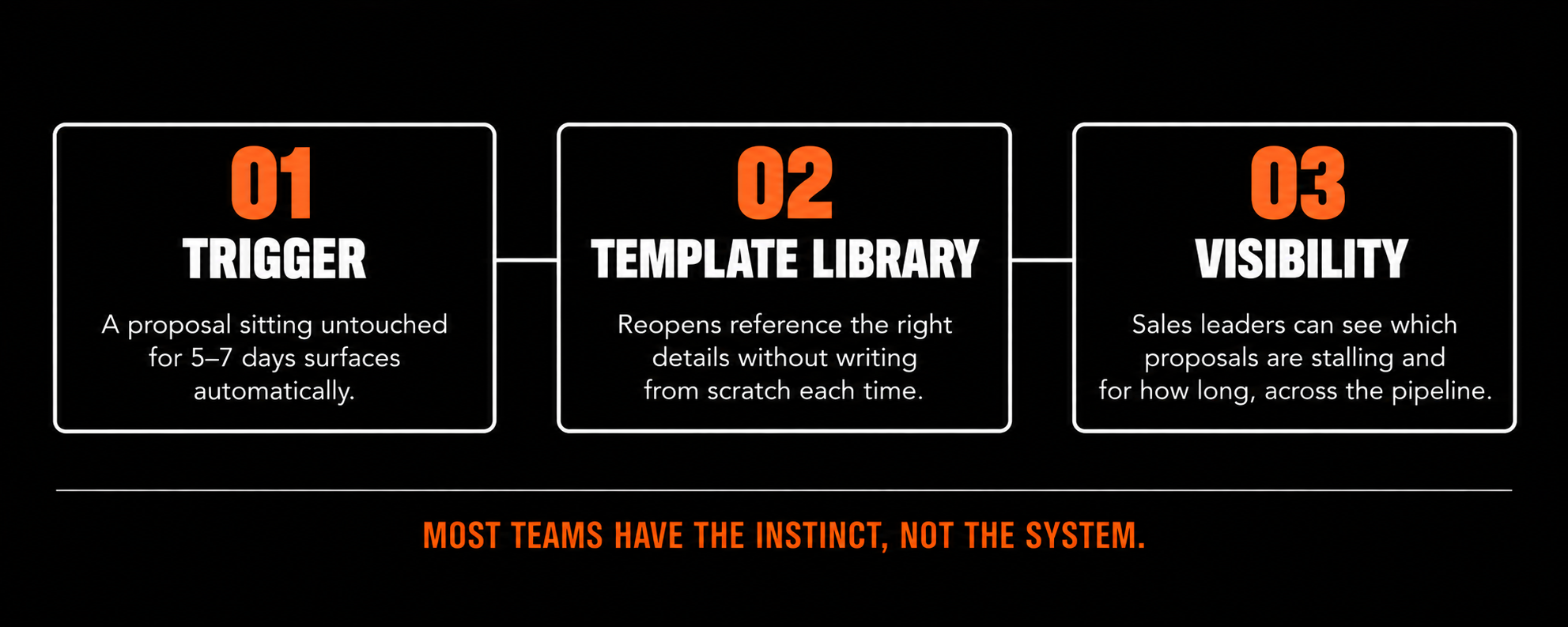
The practical takeaway is that reopening a silent group proposal works best as a system, not a one-off email someone remembers to send when they happen to notice a stalled deal. That system needs three things: a trigger (a proposal sitting untouched for 5 to 7 days should surface automatically, not depend on someone remembering), a template library (so the reopen references the right details without a sales manager writing from scratch each time), and visibility (someone should be able to see, across the whole group sales pipeline, which proposals are stalling and for how long).
Most hotel sales teams have the first instinct right (follow up, don't wait) but lack the second and third. Proposals live in inboxes and sales and catering systems that don't automatically flag a stall, so the reopen email depends entirely on a busy sales manager's memory during the same week they're also processing four new RFPs.
If stalled proposals are a recurring problem for your group sales team, Hippo Rev is built around that execution gap: surfacing RFPs and proposals that have gone quiet, keeping the details of each deal in a shared deal room so a reopening email can reference specifics without digging back through email threads, and giving sales leaders visibility into where proposals are stalling across the whole pipeline. You can see how it works by booking a Capture Audit here.
Frequently Asked Questions
How long should I wait before following up on a hotel group proposal?
Send a specific reopen 3 to 5 business days after the proposal goes out, and treat 5 to 7 days of total silence as the point where a proposal needs active follow-up rather than continued waiting.
What should the subject line of a reopening email say?
Reference the specific event or dates rather than a generic phrase like "Following up." A subject line tied to the planner's own event (dates, group name, or space) is more likely to get opened in an inbox that's also holding nine other venue responses.
Is it ever too late to reopen a group proposal?
Not usually. Because planners are often waiting on internal approvals rather than actively deciding against your property, a graceful reopen even 2 to 3 weeks after the original proposal can still land, particularly if their stated dates haven't been finalized elsewhere.
Should I offer a discount to get a response?
No. Dropping rate inside a follow-up touch, unprompted, tends to signal panic rather than confidence, and it resets the negotiation floor before the planner has even engaged with the rest of the proposal. Add information or value instead.
How many follow-up emails are appropriate before I stop?
Three to four spaced touches over about two weeks is a reasonable ceiling for a group proposal. After that, a graceful close and a move to periodic, lower-frequency contact protects the relationship for future RFPs.
The proposals that get reopened successfully are the ones where the follow-up itself signals how organized your property's sales process is, and the ones that die in silence are usually a process gap, not a rejection.
.png)
Real Hotel AI Applications Behind the 2026 Hype

Nearly every hotel owner says they use AI, but only a third have it embedded across most of their operations. This article looks at five specific applications actually delivering value in 2026, and the operational gap AI hasn't closed yet, i.e; group sales.
How Hotels Are Actually Using AI in 2026: Real Applications Behind the Headlines
Nearly every hotel owner now says they use AI in some form. Almost none of them have it running across most of their operation. That gap between adoption and actual use is the real story of AI in hospitality this year, and it explains why so many "AI in hotels" articles feel simultaneously overhyped and vague.
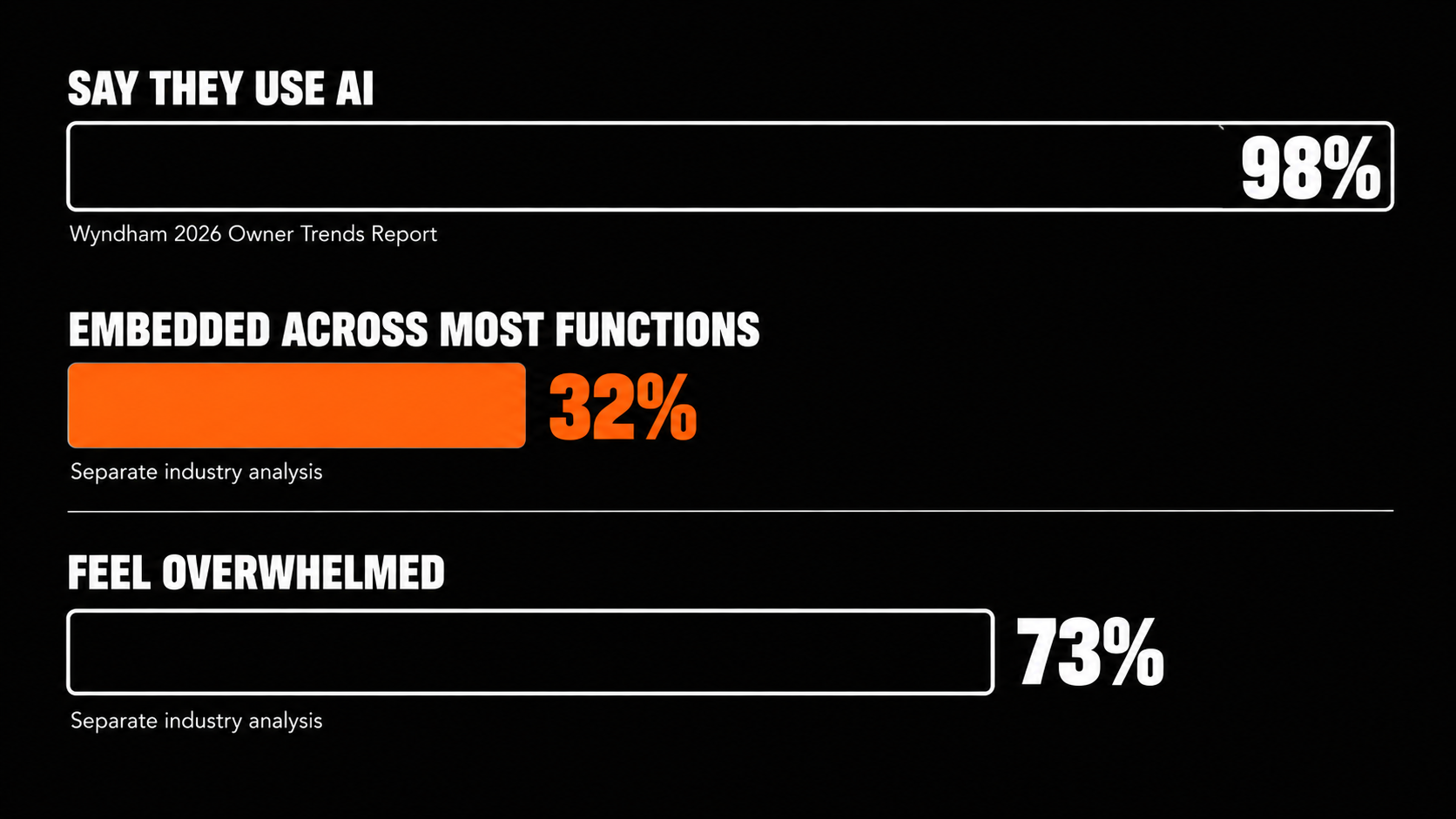
The Wyndham 2026 Owner Trends Report puts hotel AI adoption at 98%. A separate industry analysis of that same data found that only 32% of owners have AI embedded across most of their functions, and 73% say they want to do more but feel overwhelmed by where to start. So the honest answer to "how are hotels using AI" isn't a single number. It's a set of specific, narrow applications, each solving a specific operational problem, most of them still running alongside — not instead of — the people who did the job before.
This article looks at some of those applications in detail: dynamic pricing built on forward-looking demand data, AI-driven travel search, an AI commerce layer for guest interactions, back-office procurement automation, robotic housekeeping & revenue capturing execution layer. Together they show where AI in hospitality is actually delivering value in 2026, and where it still isn't.
Why Hotel AI Adoption Looks Bigger Than It Is
A hotel "using AI" can mean anything from a chatbot bolted onto a website to a fully automated revenue management system making live pricing decisions. That range is why adoption statistics vary so widely depending on how the question is asked.
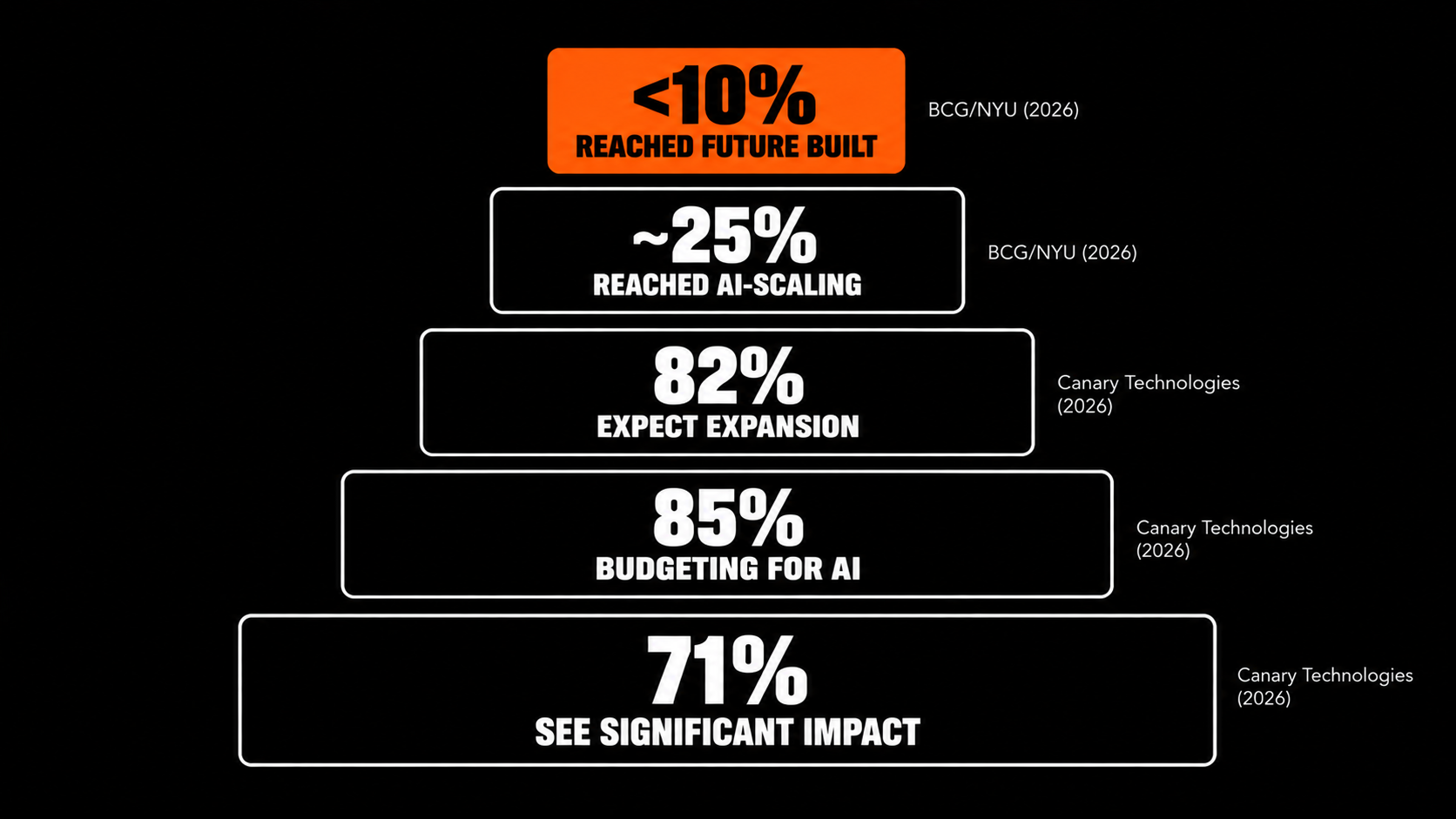
Canary Technologies' 2026 industry study, based on a survey of more than 400 hospitality technology decision-makers across North America, EMEA, and APAC, found that 71% of hospitality professionals say AI is already having a significant or transformative impact on their business, and 85% plan to allocate at least 5% of their IT budget to AI tools this year. Eighty-two percent expect their organization's AI usage to expand further within the next year. Separately, Boston Consulting Group's 2026 analysis with NYU found that fewer than 10% of hospitality companies had reached what it calls "future built" status — meaning AI capabilities mature enough to generate substantial, measurable value across the business. Only about a quarter had reached the earlier "AI-scaling" stage.
Read together, these numbers describe an industry that has decided AI matters and is spending accordingly, but where most of the actual value is still concentrated in a handful of well-defined use cases rather than spread evenly across the operation. That's consistent with what's happening on the ground at individual technology vendors serving hotels, several of which are worth examining in detail because they show what "AI in hospitality" looks like when you get past the marketing language.
Where Hotels Are Actually Deploying AI Right Now
Turning Booking Data Into Pricing Decisions
Revenue management has quietly become one of the most AI-saturated functions in a hotel, mostly because it depends on exactly the kind of structured, historical data that machine learning models handle well. Amadeus, long known as a global distribution system provider, has built much of its more recent hospitality product suite around this idea. Its Demand360 platform gives hotels forward-looking booking data to inform pricing strategy, and now includes a generative AI chatbot layer that lets revenue managers ask natural-language questions about that data and get answers back immediately, rather than building a report by hand.
"Repeatable processes are prime for AI automation, which creates an opportunity for hoteliers to redefine how they work," said Jill Boegel, head of sales, North America, hospitality, at Amadeus. She frames the shift in terms of what AI takes off a revenue manager's plate rather than what it replaces: the differentiation, in her view, still comes from human expertise and instinct applied to guest experience and loyalty, with AI handling the digital drudgery underneath it.
This is a useful pattern to notice early, because it repeats across nearly every credible AI application in hospitality: the technology is doing the data-processing work a person used to do manually, freeing that person to spend more time on judgment calls a machine can't make.
Rewriting the Front Door of Travel Search
Before a guest ever reaches a hotel's booking engine, they're increasingly starting their search inside a conversational AI interface rather than a traditional search bar. Mobi, a company founded at MIT, builds natural-language search, virtual concierge tools, and the underlying infrastructure that connects supplier content to AI-powered interfaces across travel, transportation, and logistics.
That shift matters commercially because it changes where in the travel journey a hotel or supplier can reach a traveler. "Suppliers who have typically been at the end of the travel planning journey now have the opportunity to provide travel inspiration and discovery at the beginning of the planning process," said Harriet Brown, Mobi's chief product officer. Brown also notes that conversational AI interfaces are improving quickly enough that partner platforms are already seeing first bookings originate through AI channels rather than traditional search or OTA listings.
The practical implication for hotels is less about replacing a booking engine and more about making sure a property's content, rates, and availability are structured in a way that AI systems can actually read, interpret, and recommend — a discovery-layer problem that didn't really exist five years ago.
Building an AI-Native Commerce Layer Inside the Guest Journey
A related but distinct application is happening after a guest has already engaged with a hotel directly. Agentic Hospitality has built what it calls a travel-centric Model Context Protocol (MCP) adapter, designed to connect previously siloed hotel systems — the central reservation system, property management system, point of sale, CRM, loyalty platform, and web analytics — into a single layer that can respond to guest intent in real time.
"Not every interaction leads to a funnel step, and that's the point," said Brad Brewer, founder and CEO of Agentic Hospitality. The system is built to deliver context-aware touchpoints that adapt to what a guest actually needs at that moment, rather than steering every interaction toward an immediate booking. Brewer's broader argument is that hotels which build this kind of AI-native commerce layer into their own systems now will retain more control over the guest relationship; those that don't will effectively hand that relationship off to whichever third-party AI assistant the guest happens to be using.
Whether or not that specific prediction plays out, the underlying operational challenge it points to is real and widely shared across hospitality technology: most hotels' systems of record — the PMS, the CRS, the CRM — were built to store and manage data, not to act on it in real time. Making AI genuinely useful inside a hotel almost always requires connecting those systems first.
Automating the Back Office: Procure-to-Pay
Guest-facing AI gets most of the attention, but some of the more measurable returns are showing up in back-office functions that guests never see. Reeco has focused specifically on procure-to-pay, the process by which a hotel or hotel group manages purchasing, invoicing, and payment for goods and services — one of the more fragmented and manual workflows in hospitality finance.
Reeco's accounts payable module uses optical character recognition and machine learning to extract, validate, and auto-code invoices, improving accuracy as it processes more documents over time. The platform also connects real-time inventory data to recipes, prices, and vendor catalogs, which lets hotels spot waste and overstocking and manage food costs at the menu level. "For hotels, the value is both operational and financial: tighter controls, faster workflows, and significantly improved decision-making at scale," said Omri Shalev, Reeco's co-founder and CTO. According to Shalev, hotels using the platform have reported procurement cycle times dropping by as much as 60%, with meaningful reductions in invoice-handling time as well — gains that come from removing manual data entry rather than from any guest-facing feature.
Shalev's description of how the tool actually gets adopted is instructive: "It works quietly to automate and streamline tasks, while teams continue with their familiar workflows." That's a common thread among the AI tools gaining real traction in hospitality operations — they slot into an existing workflow rather than asking staff to learn an entirely new system, which lowers the barrier to adoption considerably.
Physical Automation on the Property
Not every hospitality AI application lives in software. Tailos makes Rosie, an AI-powered commercial robot vacuum built to operate in hotel environments — navigating tight corridors, recognizing high-traffic areas, and adjusting its cleaning routes based on real usage patterns. "Think of Rosie as a mini-Waymo car that happens to focus on vacuuming," said Micah Green, Tailos's founder and CEO.
Labor cost and availability remain one of the most persistent pressures in hotel operations, and Green frames Rosie's value in exactly those terms. "In a labor-constrained industry, we're helping properties reallocate human effort toward higher-value tasks while ensuring consistency in daily cleanliness," he said. Properties using the platform have reported reductions in overtime and outsourced labor costs, faster room turnover, and more consistent adherence to brand cleanliness standards. There's also an unplanned guest-experience benefit: guests photograph the robot as it works, which Green notes tends to happen in corridors that are now, in fact, cleaner.
What These Five Applications Have in Common
Looking at pricing automation, travel search, guest commerce, procurement, and housekeeping side by side, a consistent pattern emerges. In every case, AI is applied to a repeatable, data-heavy process rather than to a judgment call. In every case, the stated goal is reallocating staff time toward higher-value work, not eliminating roles outright. And in every case, the tool is designed to sit inside an existing workflow rather than replace it wholesale — which is very likely why these particular applications are showing measurable results while broader, more ambitious "AI transformation" efforts are still stuck at the pilot stage for most hospitality companies.
This matters for any hotel or hotel group evaluating where to apply AI next. The applications delivering real returns right now share three characteristics: they operate on structured data that already exists somewhere in the business, they automate a task that is repetitive and rules-based rather than purely relational, and they're built to integrate with — not replace — the systems a property is already running.
The Operational Gap AI Hasn't Closed Yet
Revenue management, guest messaging, procurement, and housekeeping have all attracted significant AI investment because they're high-volume, data-rich, and relatively contained. Group and event sales has generally not attracted the same level of attention, despite sharing many of the same characteristics: a hotel group sales team fields a high volume of structured requests — RFPs, rate inquiries, availability checks — that follow a repeatable process and depend on data the hotel already holds in its CRS, PMS, and CRM.
That gap shows up in the numbers. Roughly 36% of group RFPs go unanswered altogether, and the sales team's win rate correlates heavily with speed: responding within four hours of receiving an RFP is associated with a 20 to 30 point advantage in win rate over slower responses, and 61% of won deals go to one of the first three properties to respond. Processing a single RFP manually — pulling availability, checking rates, drafting a proposal — typically takes a sales manager somewhere around 37 minutes, multiplied across every inquiry a property or group receives. Industry estimates put the resulting revenue leakage, across missed and slow-handled RFPs, at roughly $500,000 per salesperson per year, while surveys of hospitality sales teams suggest more than 70% of a seller's time goes to administrative and non-selling tasks rather than actual selling.
In other words, group sales has the same underlying shape as the workflows where AI is already succeeding elsewhere in hospitality — structured, high-volume, and data-dependent — but it has largely been left out of the current wave of hotel AI adoption, which has concentrated on guest-facing and pricing use cases first.
What to Look for When Evaluating an AI Tool for Hotel Operations
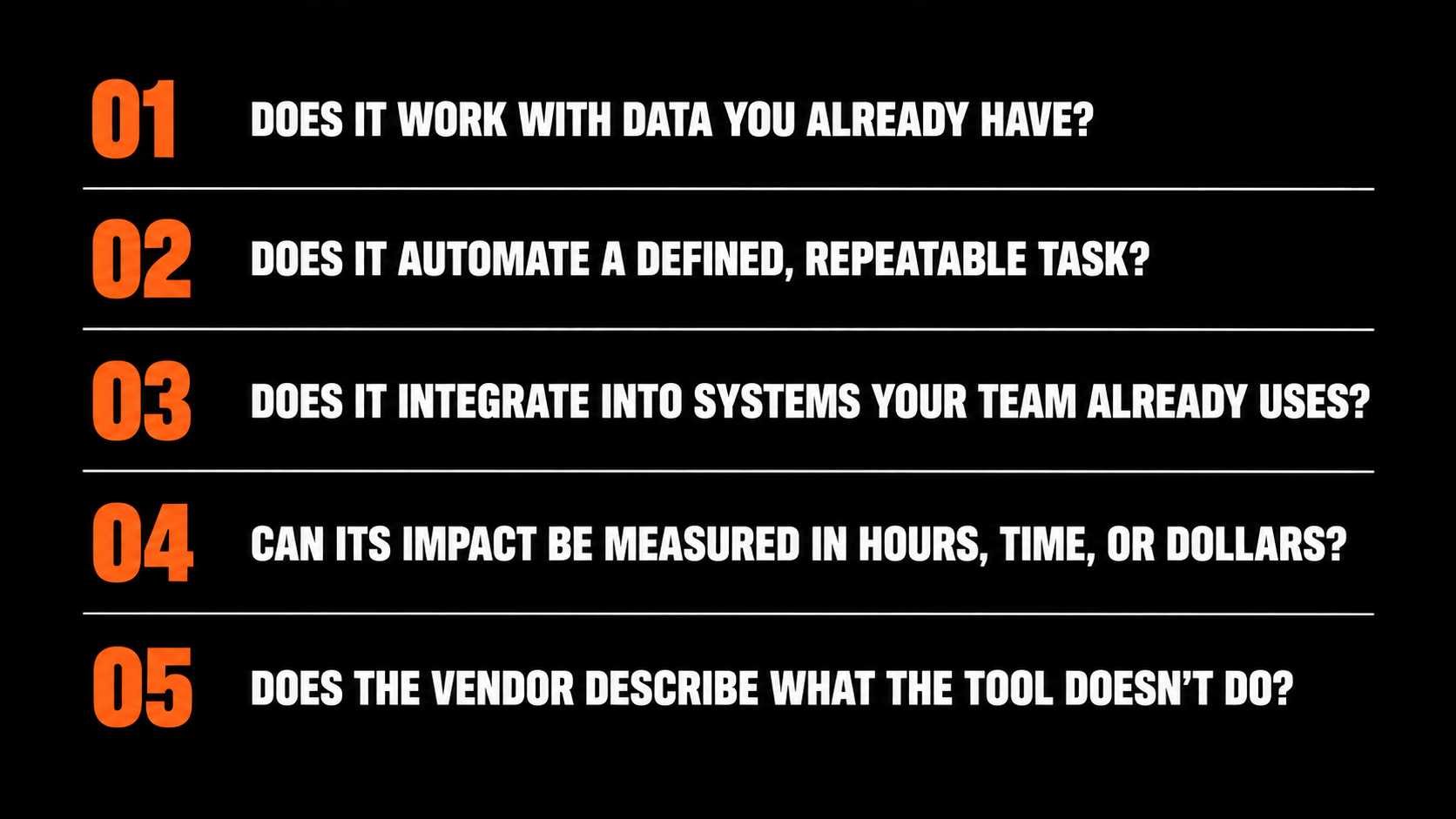
Given how uneven the results have been across the industry, a few criteria are worth applying to any AI tool under consideration, regardless of which function it targets:
- Does it work with the data you already have, or does it require a separate data-cleanup project before it delivers any value?
- Does it automate a defined, repeatable task, or is it attempting something more open-ended that's harder to measure and harder to trust?
- Does it integrate into the systems your team already uses daily — PMS, CRS, CRM — rather than asking staff to adopt an entirely new interface?
- Can its impact be measured in hours saved, response time, or dollars recovered, rather than only in vague terms like "efficiency" or "personalization"?
- Does the vendor describe what the tool doesn't do, as well as what it does? The strongest AI applications in hospitality, across every example above, are narrow by design rather than broadly promising to "transform" the business.
Those questions apply just as well to group sales technology as they do to revenue management or procurement software, and they're a reasonable filter for separating tools built around a specific operational problem from tools built primarily around the word "AI."
The Takeaway
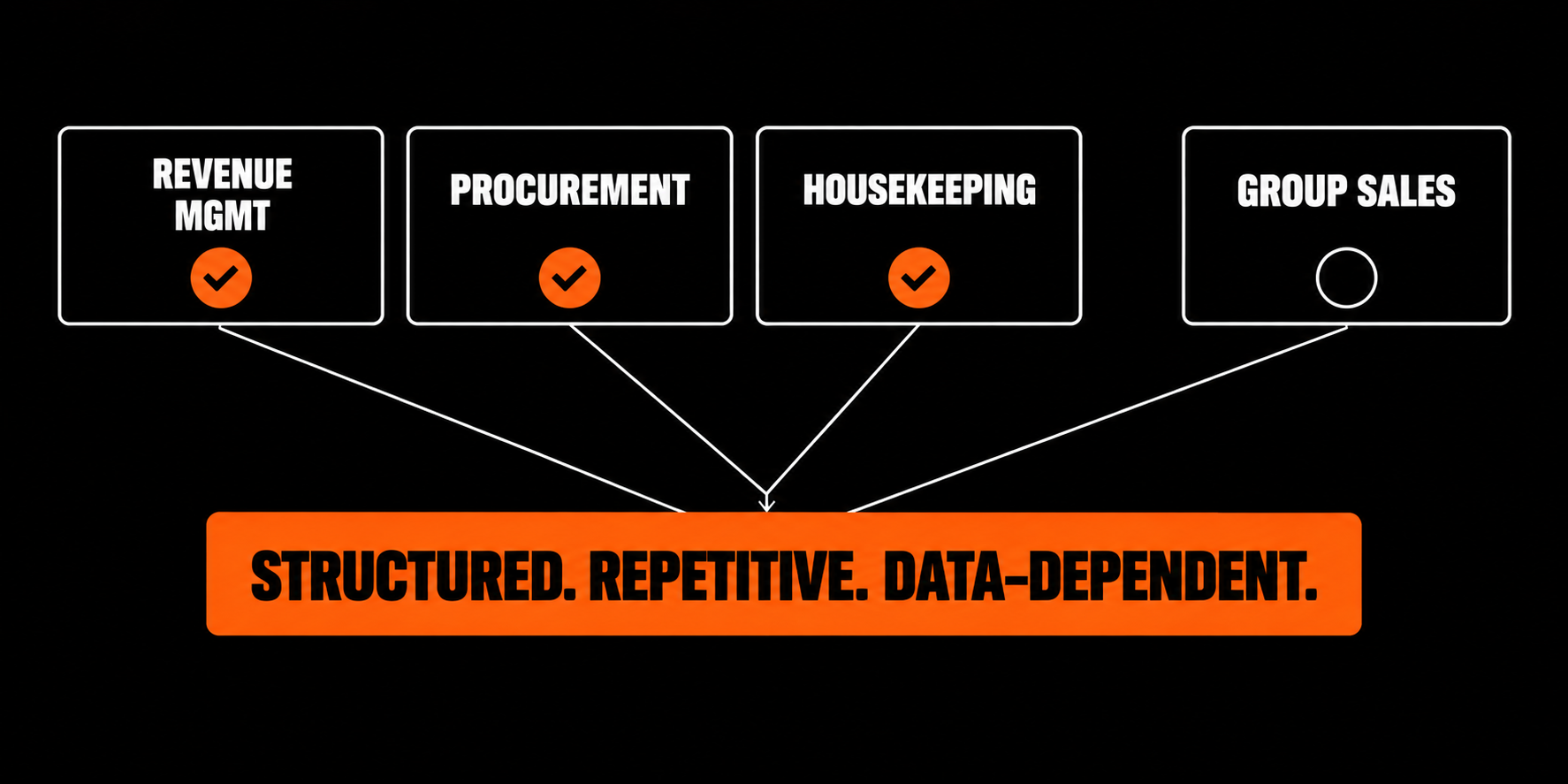
The headline number — hotels are "using AI" almost universally — obscures a more useful and more interesting reality: a small number of specific, well-defined applications are producing real operational gains, built by companies that understood exactly which repetitive, data-heavy task they were automating. Revenue management, travel search, guest commerce, procurement, and housekeeping have all been reshaped by this approach in 2026. Group and event sales, with its high volume of structured, time-sensitive requests, fits the same pattern and represents one of the more clearly underserved areas of hospitality AI adoption today.
If your team is sitting on the same kind of repetitive, data-dependent workload in group sales — RFP intake, pricing lookups, follow-up, and proposal assembly — that AI has already streamlined in revenue management and procurement, Hippo Rev is built to address that specific gap. It works as a system of execution alongside your existing CRS and PMS, with Hippo Mate handling RFP intake, follow-up, and pricing so response times stop depending on how many other requests are already in a salesperson's queue. You can see how it fits into an existing sales workflow by booking a Capture Audit, a free 20-minute session built around your team's own numbers.
Frequently Asked Questions
What are hotels actually using AI for in 2026, beyond chatbots?
The most measurable applications are revenue management (using AI to interpret forward-looking booking data for pricing), procure-to-pay automation (invoice extraction and vendor management), AI-driven travel search and discovery, connected "commerce layer" systems that unify guest data across the PMS, CRS, and CRM, and physical automation like AI-guided cleaning robots.
Why is there such a big gap between hotel AI "adoption" and actual AI use?
Most adoption statistics count any use of AI, including a single chatbot or a basic automation, as "adoption." Analyses that look at how deeply AI is embedded across a hotel's operations — such as BCG's 2026 research with NYU — find that fewer than 10% of hospitality companies have reached a mature stage where AI is generating substantial, measurable value across multiple functions.
Is AI actually reducing hotel labor costs, or just shifting tasks around?
Both, depending on the function. In procurement, AI has cut invoice-processing and cycle times substantially by removing manual data entry. In housekeeping, AI-guided robots have reduced overtime and outsourced labor costs while improving consistency. In most cases, hotels report reallocating staff time toward guest-facing or higher-judgment work rather than reducing headcount outright.
Which hotel functions have seen the least AI investment so far?
Group and event sales is one of the more notable gaps. Despite handling a high volume of structured, repeatable requests — RFPs, rate checks, proposal drafting — that resemble the workflows AI has already automated in revenue management and procurement, group sales has generally not received the same level of AI investment, leaving a substantial amount of manual work and missed response-time opportunity in place.
Do hotels need to overhaul their existing systems to use AI effectively?
Not necessarily. The AI applications showing the strongest results in 2026 are generally designed to connect with a hotel's existing PMS, CRS, and CRM rather than replace them, which lowers the barrier to adoption and shortens the time to measurable results.
.png)
Hotel RFP Response Time: 7 Ways to Work Faster
Hotel sales teams can cut RFP completion time by fixing the workflow before simply adding more tools. These strategies cover intake, lead triage, content libraries, pricing approvals, templates, and intelligent AI automation.
How Do Hotel Sales Teams Reduce Time Spent Completing RFPs?
Hotel sales teams reduce time spent completing RFPs by doing seven things:
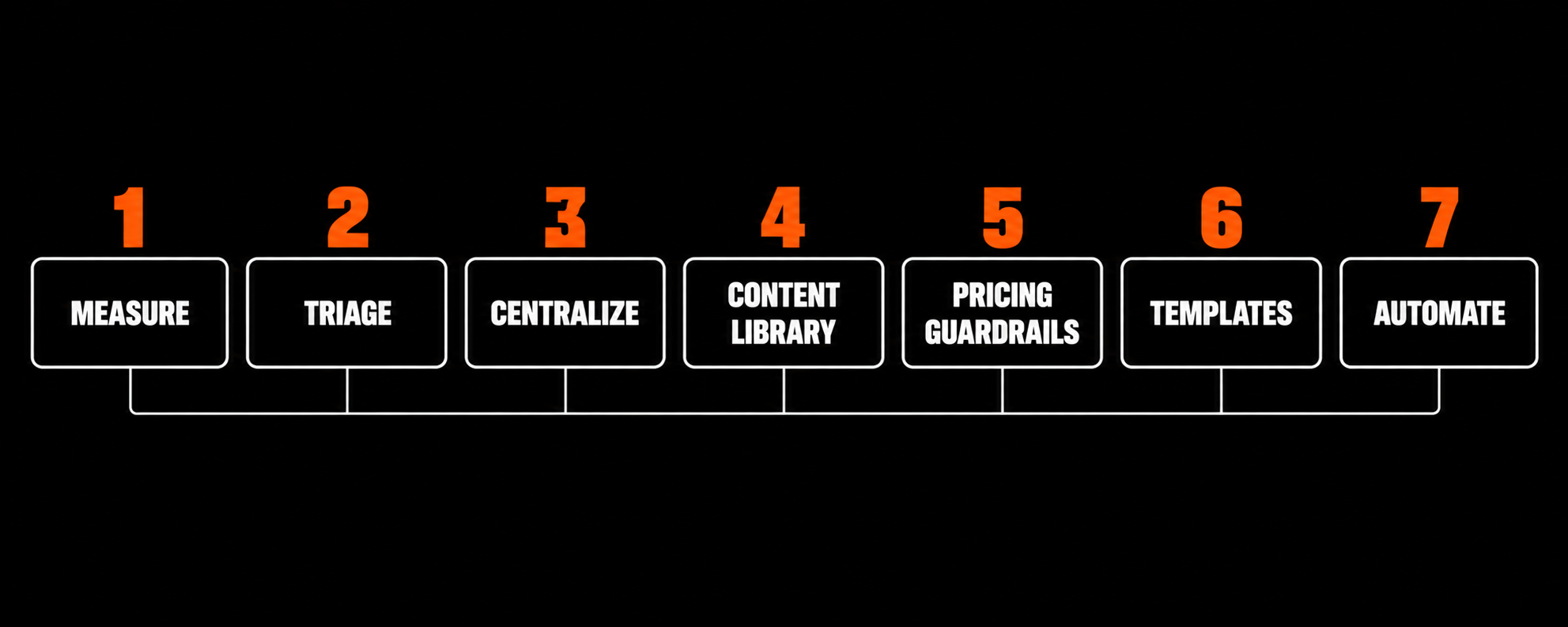
- Measure your current RFP workflow to identify the real bottlenecks.
- Triage leads before investing time in every RFP.
- Centralize all RFP intake into a single queue.
- Build a pre-approved content library for common responses.
- Set pricing guardrails to eliminate approval loops.
- Use master templates with dynamic fields.
- Automate repetitive RFP assembly work with AI.
Done together, these steps compress RFP processing from days to minutes. Done selectively, they still recover hours per response.
The time problem is worth stating precisely, because most teams underestimate it. Sellers spend roughly 71 percent of their day on non-selling tasks, and a single manual RFP response commonly consumes 37 minutes of pure processing, before counting the waiting: rate approvals over email, space checks with catering, and content hunted across shared drives. Meanwhile, over 60 percent of planners expect responses within four days, and 61 percent of won deals go to one of the first three responders. Every hour trimmed from RFP completion is not just efficiency. It is win probability. Here is how the fastest teams do it.
1. Measure the Workflow Before Changing It
You cannot compress what you have not mapped. Start by documenting every step from RFP receipt to proposal send: every touchpoint, approval, and handoff. Then time each one for a week. Most teams discover the same pattern: the writing itself is a minority of the total, and the majority is waiting and hunting. Waiting for a rate approval. Hunting for the current capacity chart. Re-checking space holds. Establish a baseline on five numbers: RFPs received, RFPs answered, average response time, proposal turnaround, and win rate. These become the scoreboard for everything that follows.
2. Triage Before You Invest Effort
Not every RFP deserves equal time, and treating them equally is itself a time sink. Group sourcing volume has hit record levels, so the fastest teams score every inquiry quickly on fit, margin potential, and decision timeline before committing to a full proposal. A standard operating procedure for qualification, applied in minutes, protects your hours for the business you can actually win. Pair it with a one-hour holding reply: even when the full proposal will take a day, an immediate acknowledgment that confirms receipt and sets expectations keeps you in the conversation while competitors sit silent. Harvard Business Review research on lead response shows the odds of qualifying a lead drop sharply as minutes pass, and the principle carries into group business.
3. Centralize Intake Into One Queue
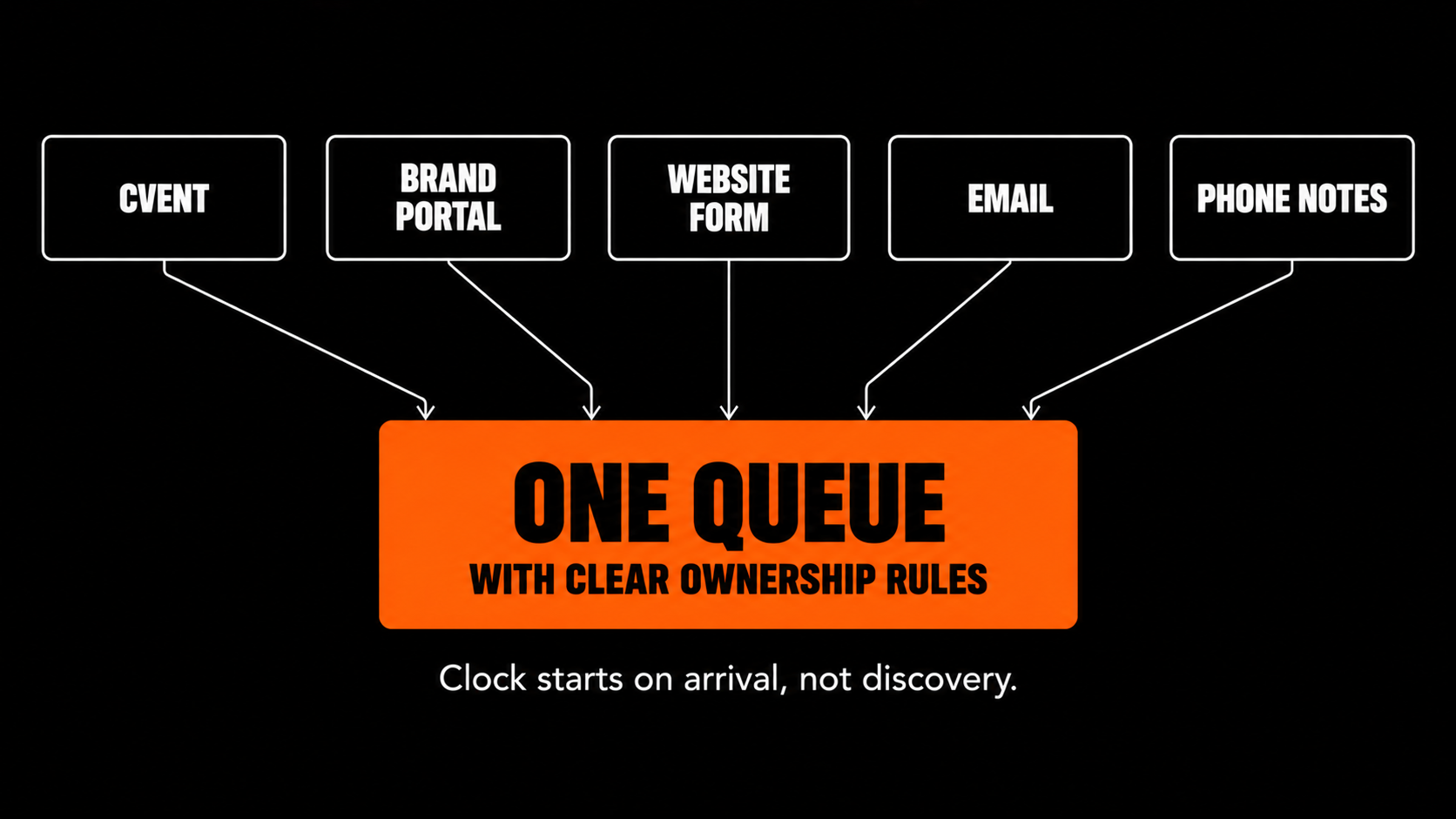
When RFPs arrive through Cvent, brand portals, website forms, direct emails, and phone notes, time dies in the gaps between channels. Leads get discovered late, claimed by nobody, or worked twice. Consolidating every source into one queue, with clear ownership rules for who claims what, removes the discovery lag entirely and gives managers visibility into what is aging. Teams that centralize consistently report faster response times for a simple reason: the clock now starts when the RFP arrives, not when someone happens to notice it. Be thorough when mapping sources, because hidden channels are common. Talk to the whole team; the catering manager who occasionally fields event inquiries by phone is an intake channel too, and every unmapped channel is a place where a lead can sit for days unseen.
4. Build a Pre-Approved Content Library
The single biggest writing-time saver is never writing the same thing twice. Assemble a version-controlled library of everything proposals reuse: floor plans, capacity charts, menus, AV kits, image sets, sustainability policies, and, critically, pre-written clauses for attrition, deposits, and blackout dates that legal and leadership have already approved. With the core content ready and current, sellers personalize instead of composing, and review cycles shrink because reviewers are checking customization, not boilerplate. One warning from our earlier work on data consistency applies here: audit the library quarterly, because a stale capacity chart replicated across every proposal is speed in the wrong direction.
5. Set Pricing Guardrails to Kill the Approval Loop
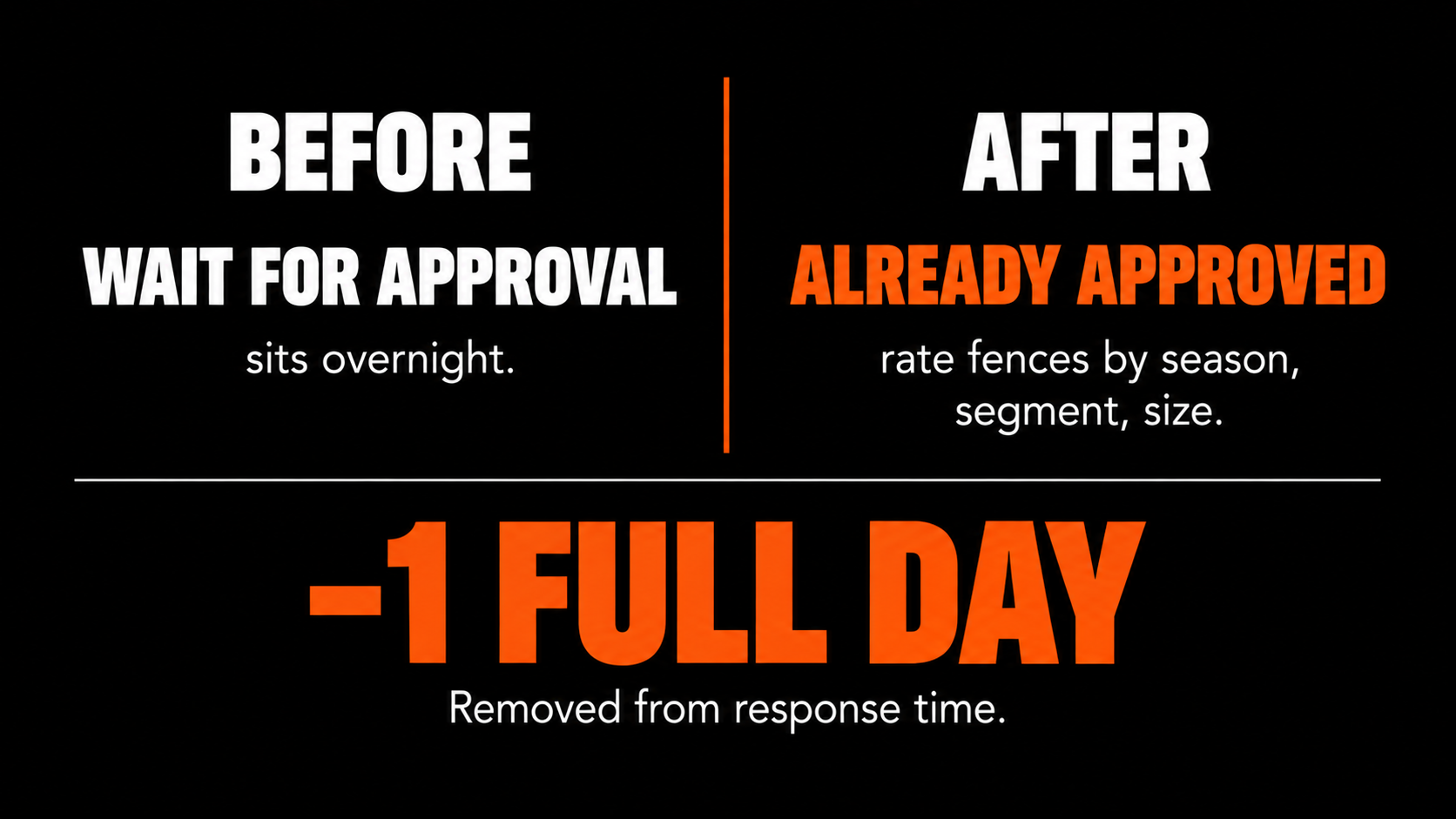
The slowest step in most RFP workflows is not writing. It is the rate approval that sits in a revenue manager's inbox overnight. The fix is pre-agreed pricing guardrails: rate fences by season, segment, and group size within which sellers can quote immediately, with approval reserved only for exceptions. This one change routinely removes a full day from response time, because it converts the most common case from "wait for approval" to "already approved."
6. Use Master Templates With Dynamic Fields
Replace the folder of forty slightly different proposal documents with a small set of master templates built around your top meeting archetypes: corporate training, association annual, SMERF weekend, wedding block. Dynamic fields pull dates, room blocks, and rates into every element at once, so the email, the PDF, and the cover note always agree, and nobody spends twenty minutes reconciling a date that was updated in one place but not another. Standardized formatting also speeds internal review, because reviewers know exactly where to look.
7. Automate the Repetitive Layer With AI
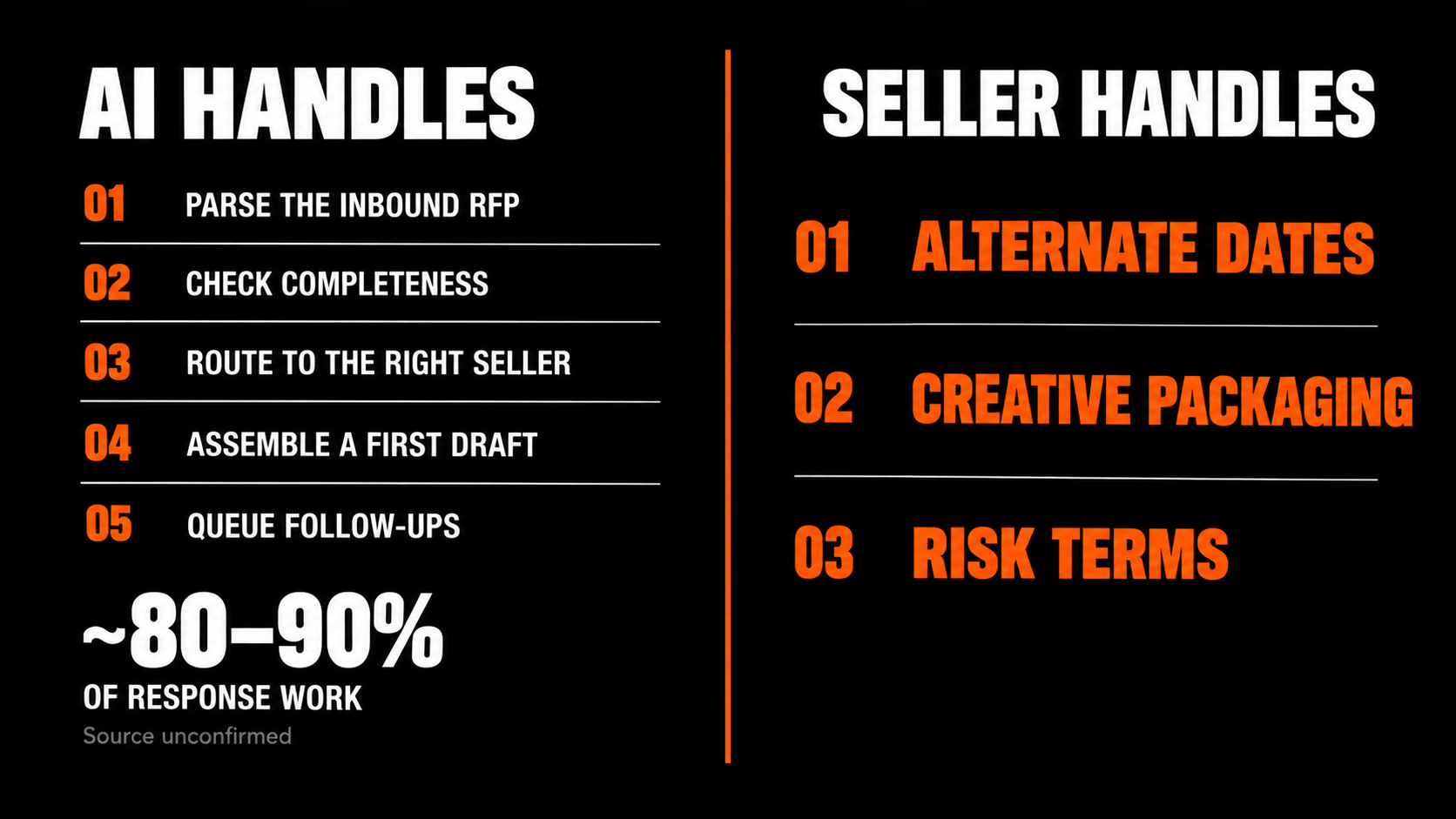
Everything above prepares you for the step that changes the scale of the number: automation. Modern AI tooling parses the inbound RFP, checks it for completeness, routes it to the right seller, assembles a first draft from your content library and live availability, and queues the follow-ups. Analysis of AI proposal workflows suggests about 80 percent of the response work can be handled automatically, leaving the seller to add judgment: the alternate-date offer, the creative packaging, the risk terms. This is the division of labor that actually protects the personal touch. The machine does the paste work. The human does the selling.
This is the layer Hippo Rev provides. It centralizes intake, grounds AI-drafted responses in your actual property data, and cuts RFP processing from roughly 37 minutes to about 4 minutes per response, which is the difference between answering everything and quietly filtering your own pipeline. The steps above are worth doing even without us; they are also exactly what makes any automation, ours included, work at full value. To find out where your hours are going today, book a Capture Audit: 20 minutes against your own numbers, no deck.
Why the Time Matters More Than the Effort
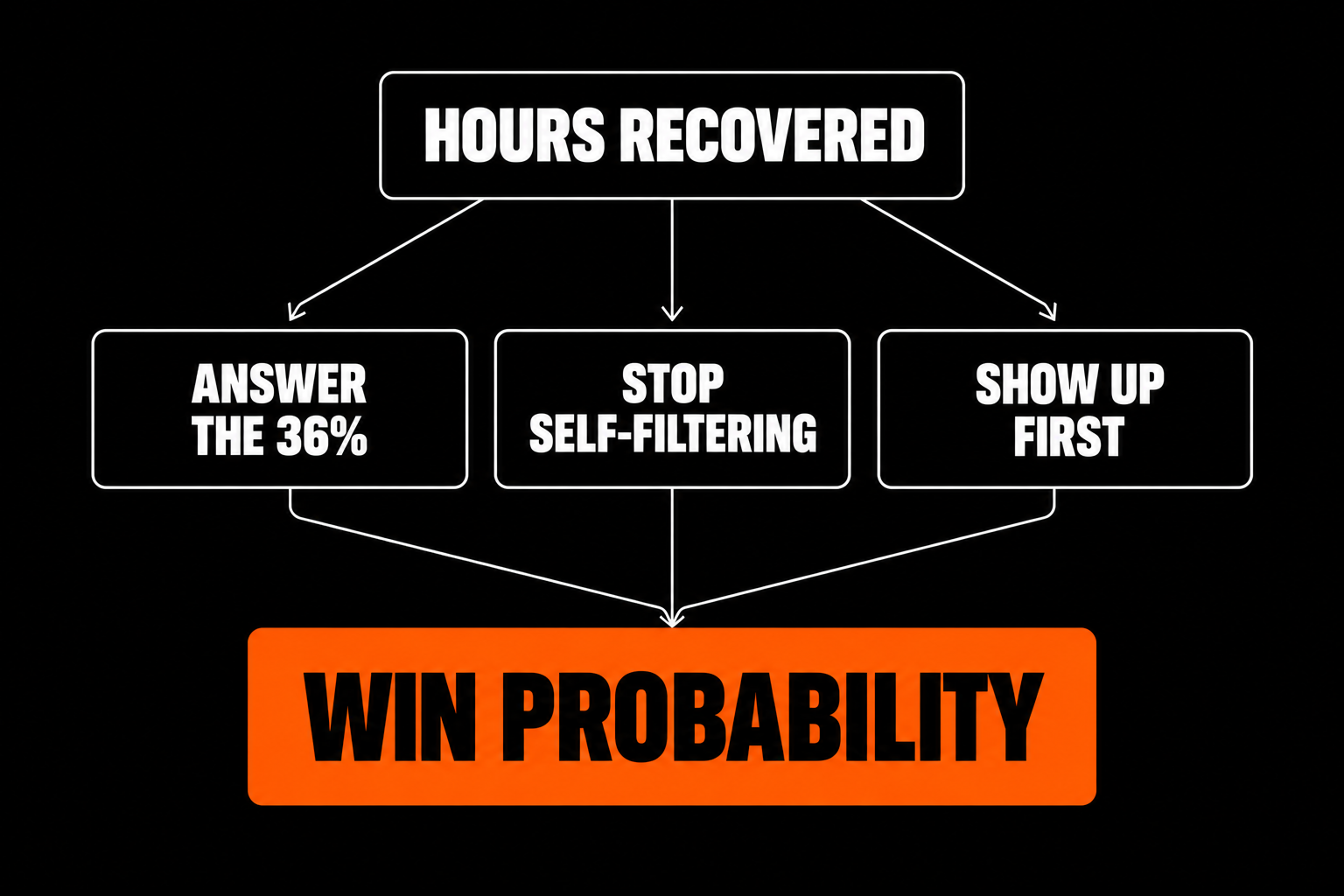
Reducing RFP completion time is not about working less. It is about where the recovered hours go. A team that answers in hours instead of days responds to the 36 percent of RFPs that currently go unanswered industry-wide, stops self-filtering the pipeline, and shows up first often enough to matter, since first responders take a disproportionate share of wins. The teams that treat speed as a system, measured, triaged, templated, and automated, convert time saved directly into group revenue.
RFP speed is a system, not a single fix. Measuring the workflow, triaging leads, centralizing intake, and setting pricing guardrails all compound before AI ever enters the picture, and they're what make automation worth trusting once it does. Hippo Rev is built on that foundation: it centralizes intake across channels, grounds every AI-drafted response in your actual property data, and cuts RFP processing from roughly 37 minutes to about 4 minutes per response, so your team spends its time on the leads worth winning instead of the paperwork around them. Book a Capture Audit to see where your hours are going today.
Frequently Asked Questions
1. How long does it take a hotel sales team to complete an RFP manually?
Pure processing commonly runs around 37 minutes per response, but the full cycle including rate approvals, space checks, and content hunting frequently stretches to two to four days.
2. What is the fastest single change to reduce RFP completion time?
Pricing guardrails. Pre-approving rate ranges by season, segment, and group size removes the overnight approval loop, which is usually the longest wait in the workflow.
3. How fast should a hotel respond to an RFP?
Acknowledge within hours and deliver a complete proposal within 24 to 48 hours where feasible. Over 60 percent of planners expect responses within four days, and early responders win disproportionately.
4. Should hotels respond to every RFP?
Every RFP deserves a response, but not a full proposal. Triage on fit, margin, and timeline, send full proposals to qualified fits, and decline the rest quickly and politely, which protects the relationship for future dates.
5. What belongs in an RFP content library?
Floor plans, capacity charts, menus, AV specifications, image sets, policies, and pre-approved clauses for attrition, deposits, and blackout dates, all version-controlled and audited quarterly.
6. How much of the RFP response can AI handle?
Analyses of AI proposal workflows put it at 80 to 90 percent of the assembly work: parsing, drafting, formatting, and follow-up scheduling. Judgment calls like alternate dates, packaging, and risk terms stay with the seller.
7. Does responding faster mean lower-quality proposals?
No, provided speed comes from removing waiting and re-work rather than skipping personalization. Templates and libraries handle accuracy; the seller's saved time goes into tailoring.
8. How do holding replies help if the full proposal still takes a day?
An immediate acknowledgment confirms receipt, sets a delivery expectation, and keeps your property in the planner's active consideration while slower competitors remain silent.
9. What metrics should sales leaders track for RFP speed?
RFPs received, response rate, average time to first response, proposal turnaround time, and win rate by segment, reviewed weekly against the baseline.
10. What should a team fix before adding RFP automation?
Map the workflow, centralize intake, and clean the content library first. Automation multiplies whatever process it is given, so a measured, centralized foundation is what turns minutes-level processing into real revenue.
.png)
Hotel Marketing Burnout: The Real Cause and the Fix
Hotel sales and marketing leaders face record burnout, driven less by workload than by fragile, manual processes that require constant intervention. This article breaks down the data behind the crisis and outlines what a resilient, system-based approach to RFP handling and demand capture actually looks like.
Why Hotel Sales and Marketing Teams Keep Burning Out (and How the Best Ones Stop)
A director of sales and marketing at a 100-room hotel is not short on tasks. She is bidding on Google Ads, chasing OTA sponsored placement, answering reviews across six or seven platforms to stay compliant with brand standards, working the phones for group leads, and now being told to "do more with less" using AI tools she barely has time to learn. None of this is imagined. It is the daily operating reality for most hotel sales and marketing leaders in 2026, and it is producing a burnout problem that is now well documented in hospitality data.
The dominant explanation for this exhaustion is usually workload. That explanation is incomplete. The deeper issue is structural: most hotel sales and marketing operations run on fragile, manual processes that require constant human intervention to keep from breaking. The fix is not longer hours or more willpower. It is building a system that holds up on its own, so the team spends its energy on judgment and relationships instead of patching leaks.
How Widespread Is Burnout in Hotel Sales and Marketing Right Now?
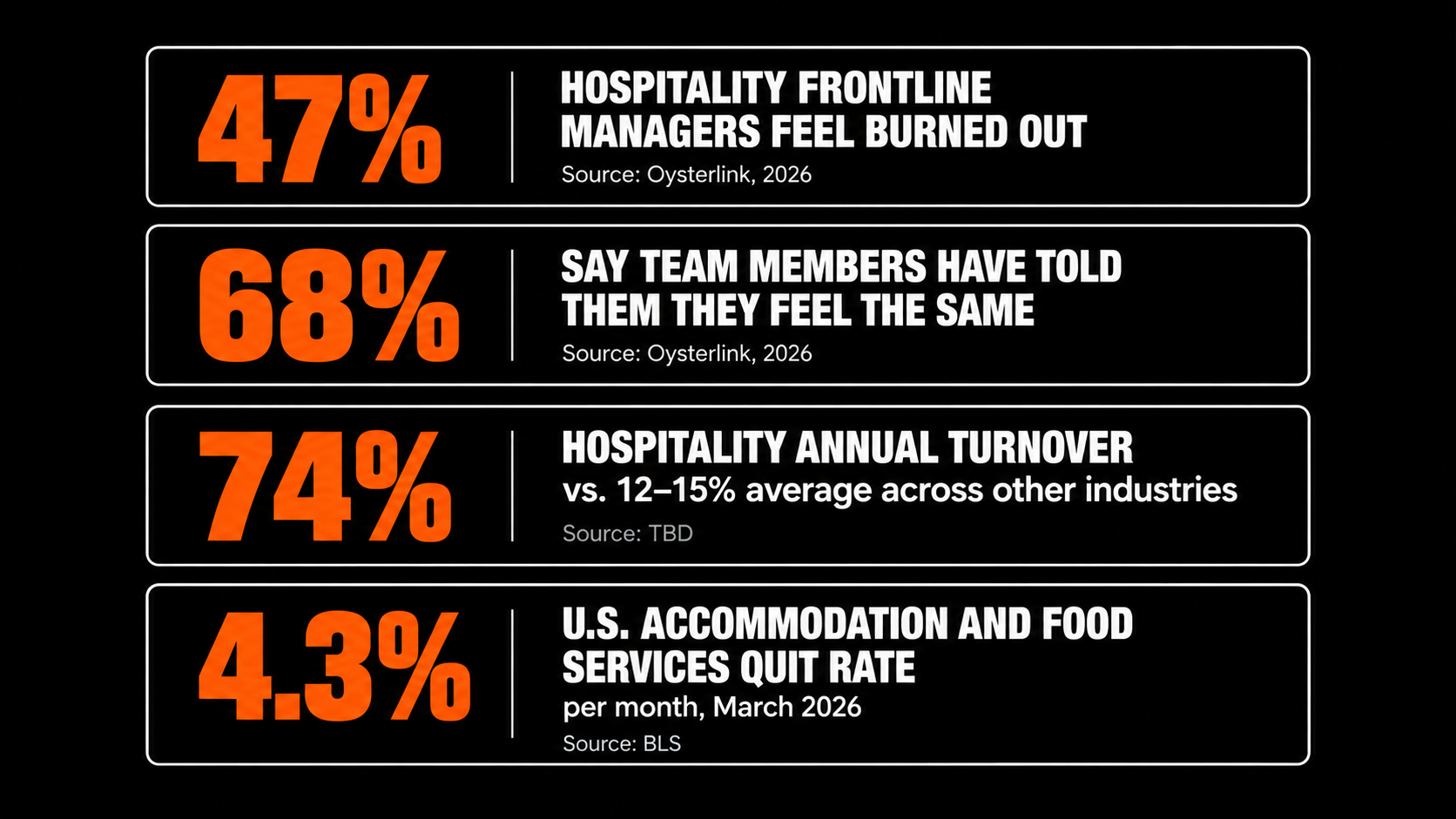
Burnout in hospitality is not anecdotal. Nearly half of hospitality frontline managers in the United States, 47%, report feeling burned out, and 68% of those managers say their own team members have told them directly that they feel the same way, according to a 2026 industry analysis from Oysterlink. The consequences show up in retention: hospitality's annual turnover rate runs around 74%, roughly five times the 12–15% average seen across most other industries, and hotels specifically face an even steeper churn rate near 105%. The U.S. Bureau of Labor Statistics tracked the accommodation and food services quit rate at 4.3% per month in March 2026, the highest of any industry it measures.
Sales and marketing roles carry a particular version of this strain. A 2025 Marketing Week survey found 58% of marketers felt overwhelmed and 50.8% reported emotional exhaustion, and earlier research cited by 11outof11 found marketers reported the highest burnout rate of any profession studied, ahead of sales, HR, and finance. Layer hotel-specific pressures on top of general marketing fatigue, such as lean staffing models that make a single director responsible for demand generation, reputation management, and revenue pacing simultaneously, and the exhaustion compounds. Industry commentary on hotel sales leadership in 2026 has flagged rejection fatigue as a growing factor: when a director of sales is already running on empty from administrative overload, every unanswered outreach attempt lands harder.
What Is Actually Driving the Exhaustion?
Most explanations for hotel marketing burnout point to workload volume. The more precise diagnosis is that the underlying systems are fragile, so every day involves patching something that broke rather than executing a plan that holds.
Consider what a typical week actually contains. A director of sales and marketing is expected to bid more aggressively on paid search and OTA placement to defend visibility, while simultaneously discounting rates to stay competitive, all in a category where every tactic is visible and copyable by the property down the street. There is no durable moat in outbidding a competitor on Google Ads this week, because they can outbid back next week. The same is true of rate cuts: they are easy to match and hard to reverse without losing the business they were meant to protect.
Reputation management adds another layer. Brand standards typically require timely responses across multiple review platforms, often six or seven at once, which means a sales and marketing leader is also functioning as a customer service and PR operation without dedicated headcount for either. And now AI tools are being introduced with an implicit expectation that "do more with less" becomes achievable through better technology alone, even though the underlying workflow the technology is bolted onto is still manual.
Group and RFP business shows this most clearly. Independent research on hotel and venue RFP handling found that manual RFP management, using email threads and spreadsheets, typically consumes 8 to 15 hours of staff time per proposal cycle across drafting, sending, chasing, and comparing responses. Meanwhile, group booking windows have compressed to as little as 30 days in 2026, according to hotel sales industry reporting, which means the margin for slow, manual handling keeps shrinking even as the manual burden stays the same.
Hippo Rev's own analysis of hotel group sales operations found that roughly 36% of RFPs go completely unanswered, not lost to a competitor, simply never responded to. Among RFPs that do get a response, 61% of won deals go to whichever hotel was among the first three to reply. Response speed alone accounts for a 20 to 30 point win-rate advantage when a hotel replies within four hours versus responding later. The same analysis found that manual RFP processing takes an average of roughly 37 minutes per proposal, and that sellers spend about 71% of their time on non-selling administrative tasks rather than on the relationship-building and negotiation that actually close business. Left unaddressed, that gap in speed and follow-through was estimated to cost roughly $500,000 in annual revenue leakage per salesperson.
None of these numbers describe a team that is lazy or under-skilled. They describe a team executing a fragile process that depends entirely on constant human attention to function at all.
Why Working Harder Doesn't Fix a Fragile System
There is a pattern worth naming directly: the more comfortable a piece of work feels, the more consistently it tends to produce results, and the discomfort in hotel sales and marketing usually traces back to a decision-quality problem rather than an effort problem. Exhaustion accumulates when a team is constantly reacting to whatever broke that day. Ease comes from having already thought through the failure points in advance and built something that does not require daily rescue.
This distinction matters because the instinct under pressure is almost always to add more effort to the existing process: answer faster, work later, respond to more channels. That approach can hold a fragile system together for a while, but it does not change its fragility. The moment the person holding it together is out sick, on vacation, or simply reaches capacity, the system breaks, and whatever revenue depended on it disappears with it. A manually chased RFP that only gets answered because a director of sales happened to notice the email that day is not a repeatable process. It is a single point of failure wearing the appearance of a process.
From Firefighter to Architect: What Building a System Actually Means
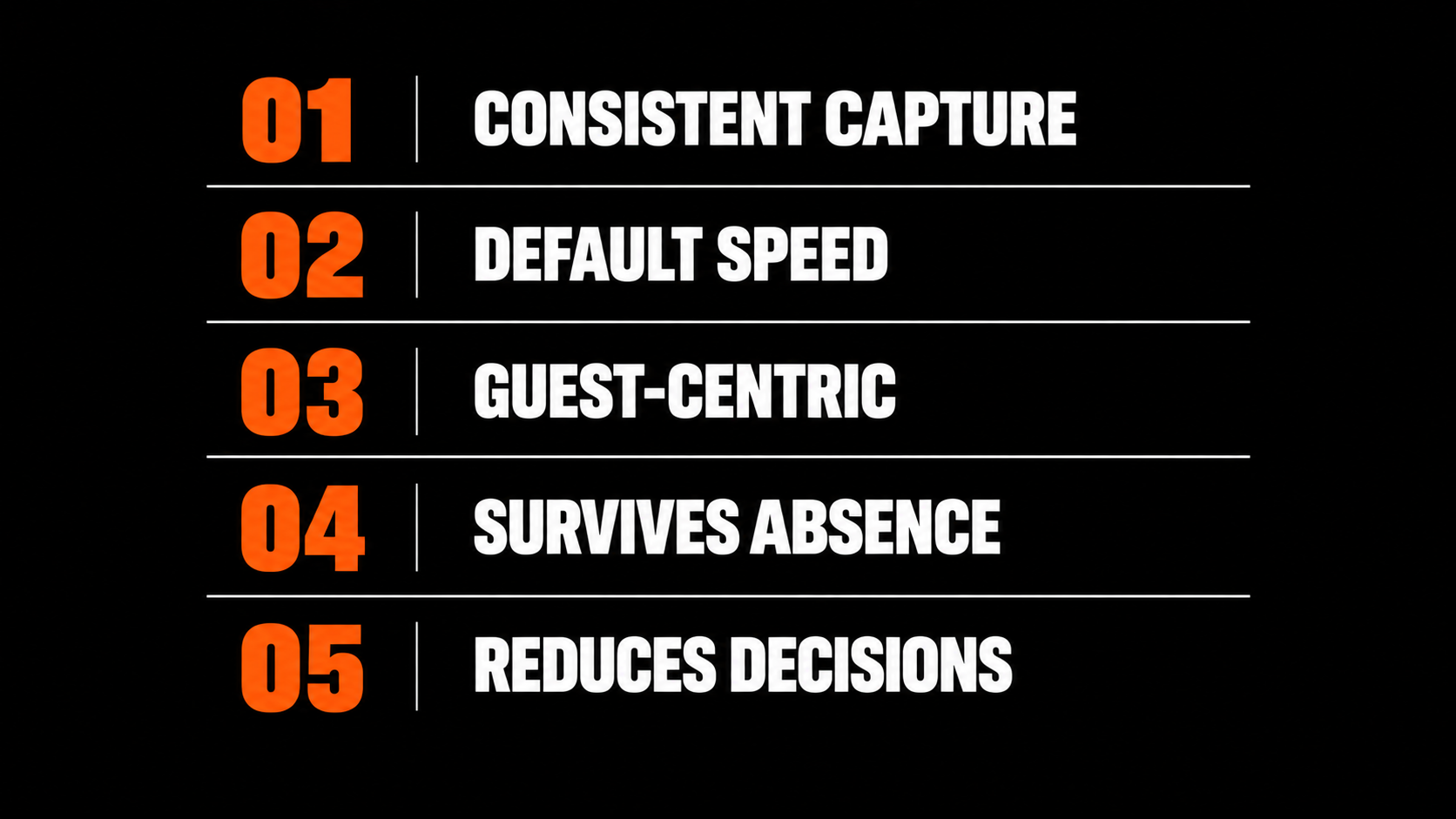
The alternative to constant firefighting is not doing less. It is redesigning the underlying workflow so that fewer things require manual intervention to happen correctly in the first place. This is a shift in role as much as tactics: from firefighter, who responds to whatever is currently on fire, to architect, who designs a structure that rarely catches fire to begin with.
A genuinely durable system in hotel sales and marketing tends to share a few characteristics regardless of which specific tools support it:
It captures demand consistently, not opportunistically. Every inbound RFP, web inquiry, or phone lead gets logged and triaged the same way every time, regardless of who is on shift or how busy the property is that week. When capture depends on a specific person noticing a specific email, the system has already failed before anyone responds.
It responds fast enough to matter, by default. Given that first-three-responder status determines the majority of won group deals, and that sub-four-hour response correlates with a 20 to 30 point swing in win rate, speed cannot be a matter of individual hustle on a good day. It has to be structurally guaranteed, which typically means some form of automated intake and triage sits ahead of the human follow-up.
It is guest-centric rather than channel-centric. Instead of treating paid search, OTA placement, review management, and group sales as separate fire hydrants to be manned individually, a system-based approach treats them as inputs into a single flywheel: better guest experience drives better reviews, better reviews reduce dependence on paid acquisition, and freed-up budget and staff time go toward higher-margin group and direct business. Each part reinforces the others instead of competing for the same exhausted person's attention.
It survives the absence of any single person. The clearest test of whether a process is actually a system, rather than a habit one employee has developed, is whether it keeps functioning when that employee is out of the building. If group RFP follow-up stops the moment the director of sales takes a day off, that is not a system. It is dependency dressed up as a workflow.
It reduces decision fatigue instead of adding to it. Adding an AI tool on top of a broken manual process usually creates a new form of exhaustion: the tool produces a recommendation, but the human still owns the outcome and often does not fully understand the reasoning behind the suggestion. Research on marketing burnout in 2026 has identified this "decision anxiety" as a distinct and underdiscussed stressor. A well-designed system reduces the number of judgment calls a person has to make under time pressure, rather than simply reducing the number of clicks.
What This Looks Like Applied to Group Sales
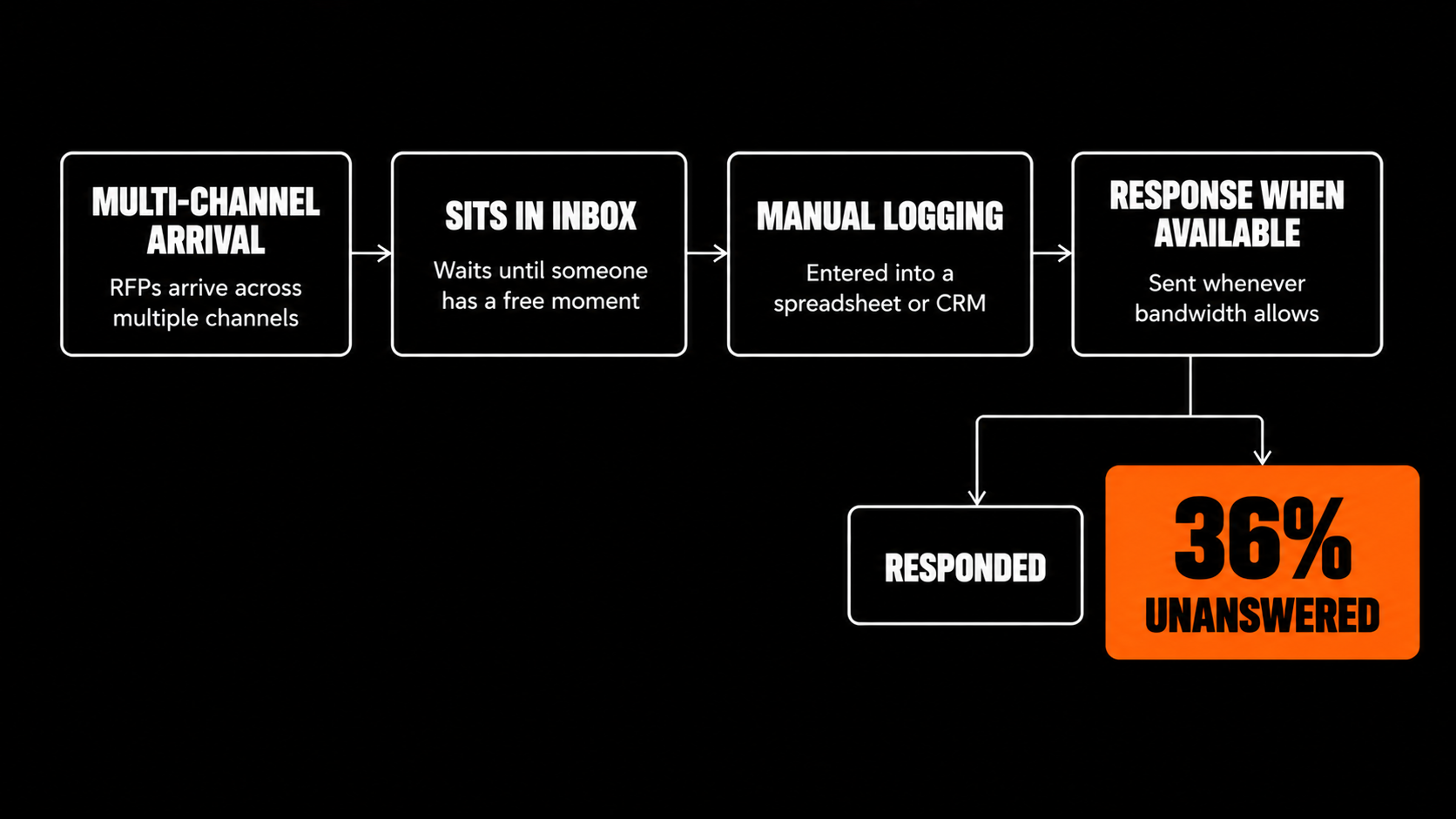
Group and RFP business is a useful place to see the difference between firefighting and system design, because the financial stakes are explicit and the timeline pressure is unforgiving. In a firefighting model, RFPs arrive across multiple channels, sit in an inbox until someone has a free moment, get manually logged into a spreadsheet or CRM, and receive a response whenever bandwidth allows, which explains why over a third go unanswered entirely.
In a system-based model, RFP intake, triage, and initial follow-up happen on a consistent, fast timeline regardless of staffing gaps, so the sales team's time is spent on the parts of the job that actually require judgment: pricing strategy, relationship building, and closing. This is not a claim that technology replaces the salesperson. The site visit, the contract review, and the relationship with the meeting planner still matter, and no system replaces that expertise. What a system changes is how much of a seller's day gets consumed by the administrative work sitting in front of those higher-value activities.
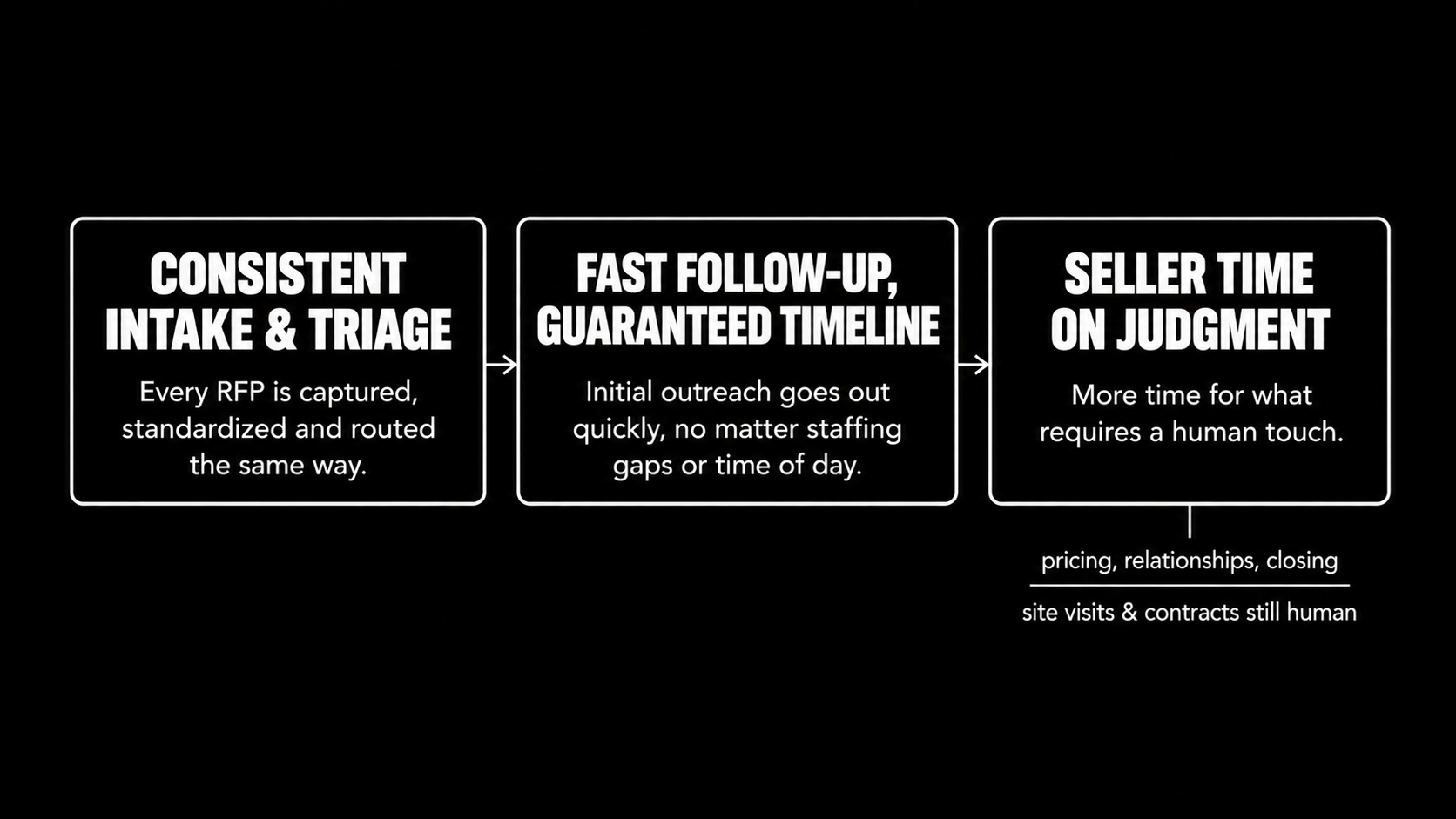
Building a System That Doesn't Break When You're Not in the Room
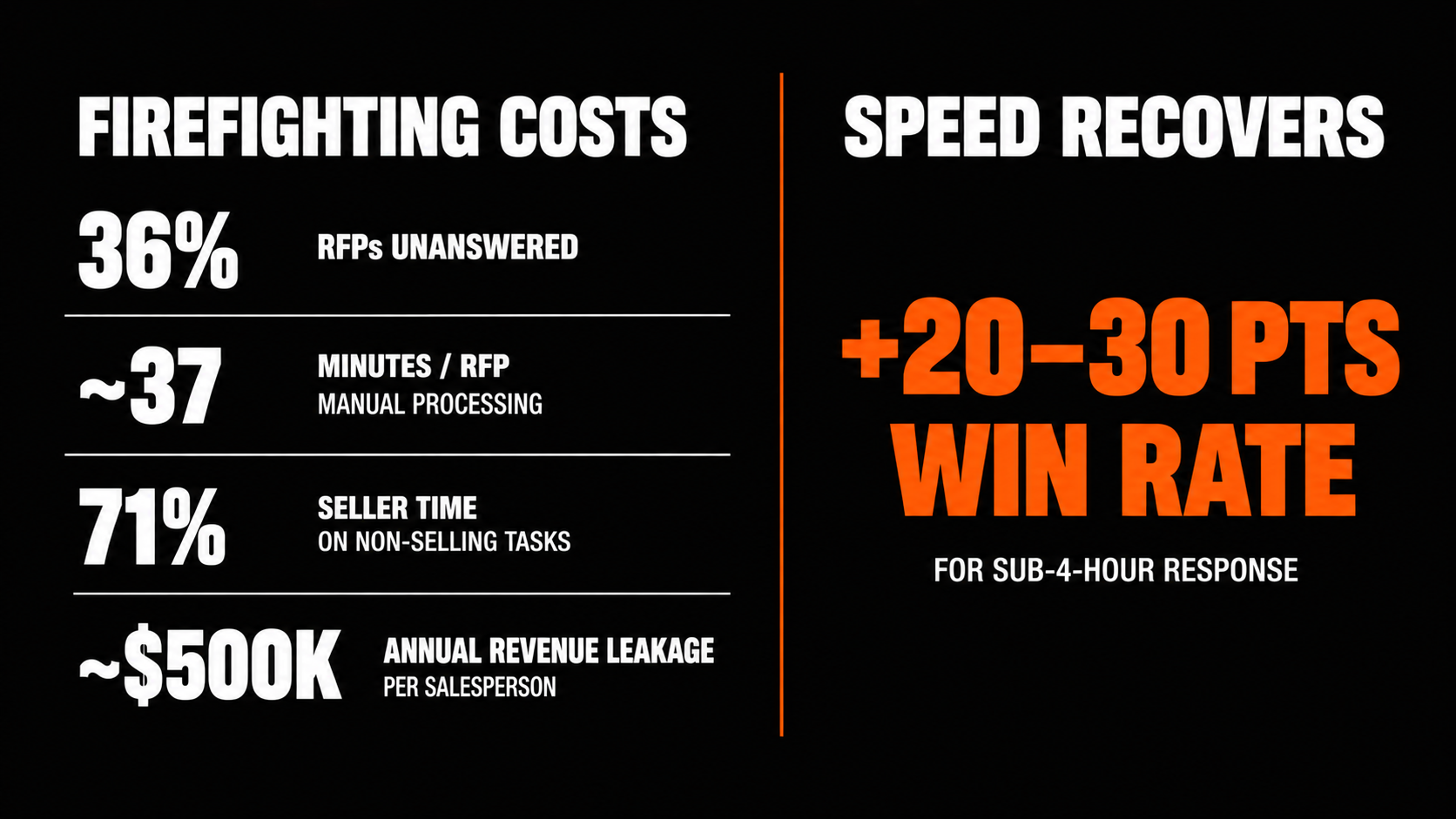
The strongest hotel sales and marketing operations in 2026 are not the ones working the hardest. They are the ones that have stopped treating every day as a series of separate emergencies and instead built a structure that catches most of what would otherwise become an emergency. That shift starts with an honest audit of where a property's current process depends entirely on one person's memory, attention, or willingness to work late, and then closing those gaps one at a time: consistent capture, guaranteed response speed, centralized visibility, and a workflow that keeps functioning whether or not any specific person is at their desk.
None of this requires abandoning the channels a property already relies on for demand, whether that is paid search, OTA distribution, or direct group outreach. It requires making the follow-through on that demand structurally reliable instead of personally exhausting.
Sustainable performance in hotel sales and marketing is less about finding more hours in the day and more about building a system that makes most of those hours unnecessary in the first place. RFP response speed and follow-through consistency are where that difference between firefighting and system design shows up most directly in group sales, since roughly 36% of RFPs go unanswered altogether and the majority of won deals go to whichever property responded first. Hippo Rev is built specifically to close that gap: it functions as a system of execution that sits alongside a hotel group sales team's existing CRM and PMS tools, capturing and triaging incoming RFPs consistently and helping teams respond fast enough to compete for the first-mover advantage, without adding another manual layer on top of an already stretched team. If slow or inconsistent RFP follow-through is a pattern your team recognizes, you can see how Hippo Rev approaches it by booking a Capture Audit, a free 20-minute review of your own numbers, no deck required.
Frequently Asked Questions
What is the main cause of burnout among hotel sales and marketing directors?
The primary driver is not workload volume alone but process fragility: manual, single-person-dependent workflows for RFP handling, review response, and demand generation that require constant intervention to avoid breaking, rather than the workload itself being unmanageable.
How much time does manual RFP handling actually take?
Independent research on hotel and venue RFP management found manual processes, using email and spreadsheets, typically take 8 to 15 hours of staff time per proposal cycle, and Hippo Rev's analysis of group sales operations found average manual RFP processing time runs approximately 37 minutes per response when accounting for the full intake-to-reply workflow.
Why does response speed matter so much in hotel group sales?
61% of won group deals go to one of the first three hotels to respond, and a response delivered within four hours correlates with a 20 to 30 point higher win rate compared to slower responses. Speed functions as a structural advantage independent of price or property quality.
Can AI tools alone solve hotel marketing burnout?
Not by themselves. Adding automation on top of an already broken manual process can introduce a new stressor known as decision anxiety, where a team owns the outcome of an AI recommendation without fully understanding its reasoning. Reducing burnout requires redesigning the underlying workflow, not just layering a tool onto it.
What does a "system" mean in the context of hotel sales and marketing?
A system is a workflow that continues to function correctly without requiring one specific person's constant attention. In practice, this means consistent lead capture, guaranteed response speed, centralized visibility across channels, and a structure that does not collapse when a key team member is unavailable.
.png)
AI RFP Automation for Hotels: Standardize Group Data
AI RFP automation can standardize group inquiries from Cvent, Delphi, email, PDFs, and phone-based intake into one consistent data structure. The article explains why standardized intake improves response speed, portfolio reporting, forecasting, and group sales execution across multi-property hotel organizations.
Which AI RFP Automation Helps Hotels Standardize Group Inquiry Data?
A group inquiry for the same 150-room, two-day citywide event can arrive at a hotel portfolio's front door looking like three completely different documents. One property gets it through Cvent, pre-structured with named fields. Another gets a PDF attachment in a planner's email, with room block, F&B minimums, and meeting space requirements buried in paragraph form. A third gets it as a phone call that a sales manager types into notes after the fact. By the time all three versions land somewhere a regional director can see them, they no longer look like the same opportunity. Room counts are formatted differently, budget ranges are missing from one and estimated from another, and the decision date might not be captured at all.
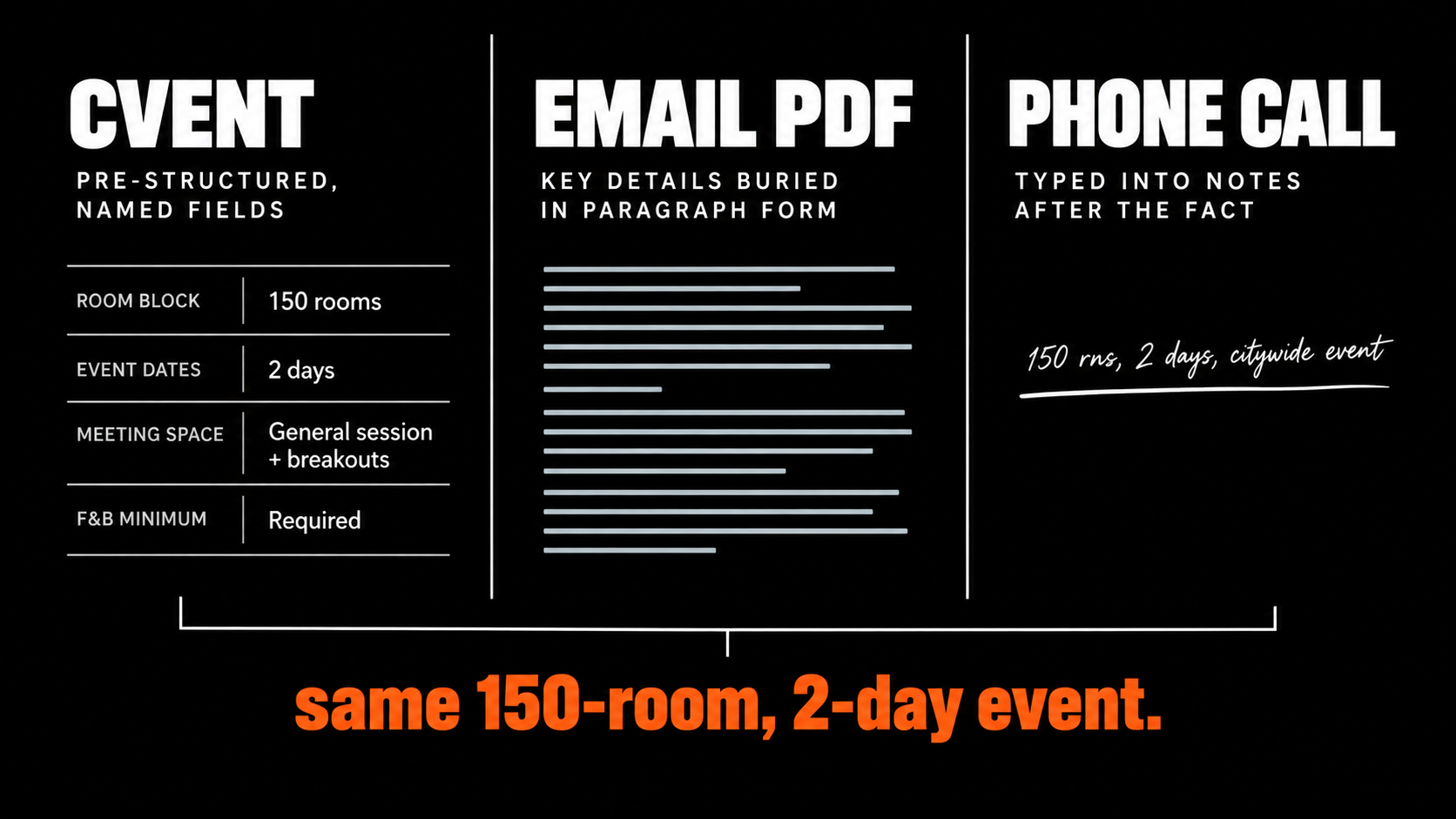
This is the standardization problem, and it sits underneath most of the reporting, forecasting, and follow-up failures that multi-property hotel groups experience during group sales. The question worth answering isn't whether AI can respond to an RFP faster. It's whether AI RFP automation can take inconsistent inputs from Delphi, Cvent, email, and phone, and turn them into a single, comparable data structure that a hotel group can actually manage, report on, and act on at scale.
What "Standardized Group Inquiry Data" Actually Means
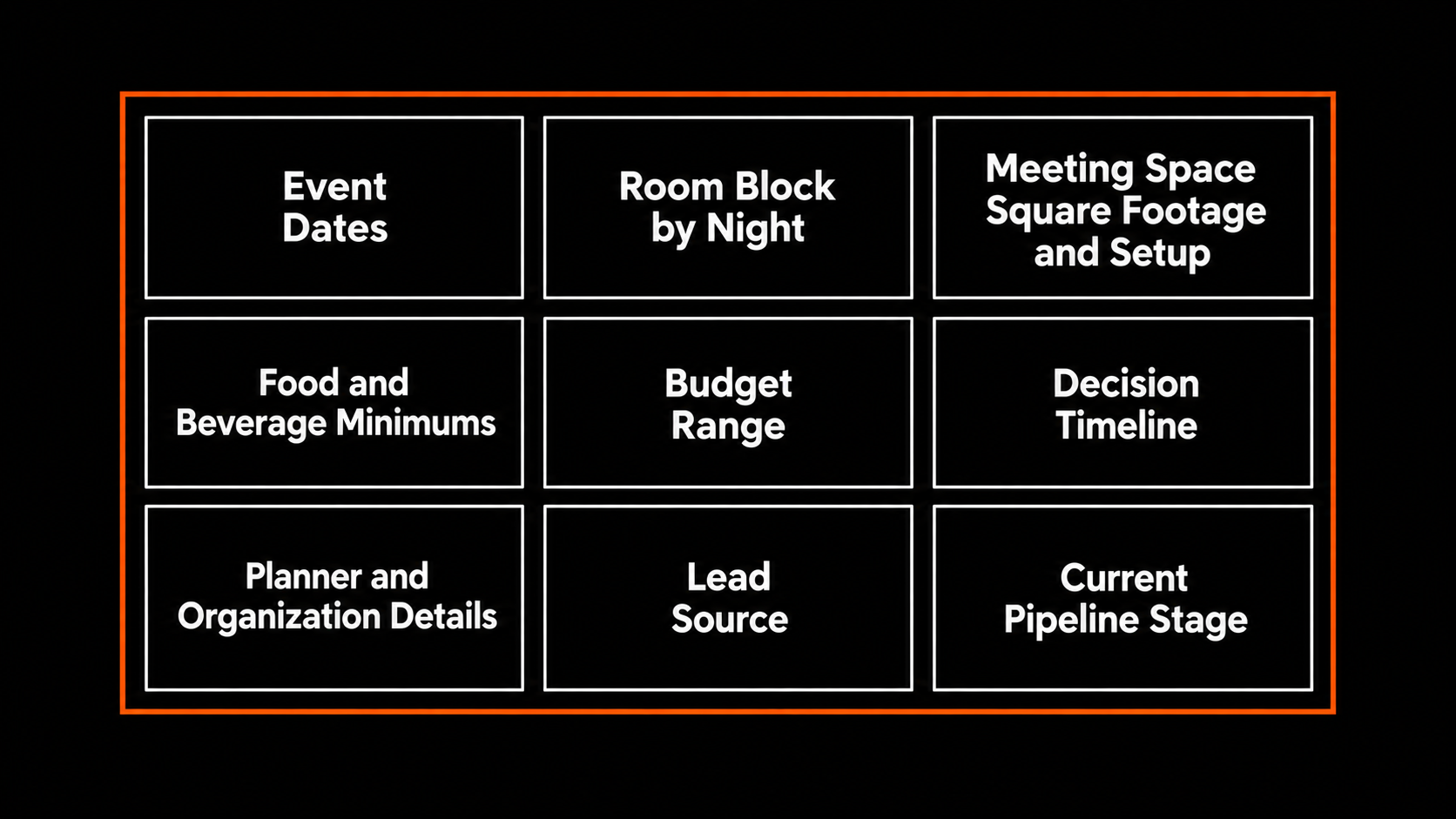
Standardization is often used loosely in hospitality technology conversations, so it's worth being precise. A standardized group inquiry record means every RFP, regardless of source or property, resolves to the same underlying schema: event dates, room block by night, meeting space square footage and setup, food and beverage minimums, budget range, decision timeline, planner and organization details, lead source, and current pipeline stage. It also means the vocabulary is consistent. If one property calls a stage "Tentative" and another calls the same status "Definite Pending," a portfolio-level report can't tell owners anything reliable about pipeline health.
This gap is well documented at the portfolio level. Hospitality data teams have flagged that when different properties in a management company run their own naming conventions, sales stages, and lead-source taxonomies, there is no apples-to-apples comparison between properties, and that gap tends to compound the longer a portfolio has grown through acquisition rather than organic buildout. Multi-property operators report the same pattern from the revenue side: with different properties using different systems, data consolidation across the portfolio becomes difficult, and inconsistent coding standards make it hard to get a holistic performance view.
Why Unstandardized Intake Is a Revenue Problem, Not a Reporting Problem
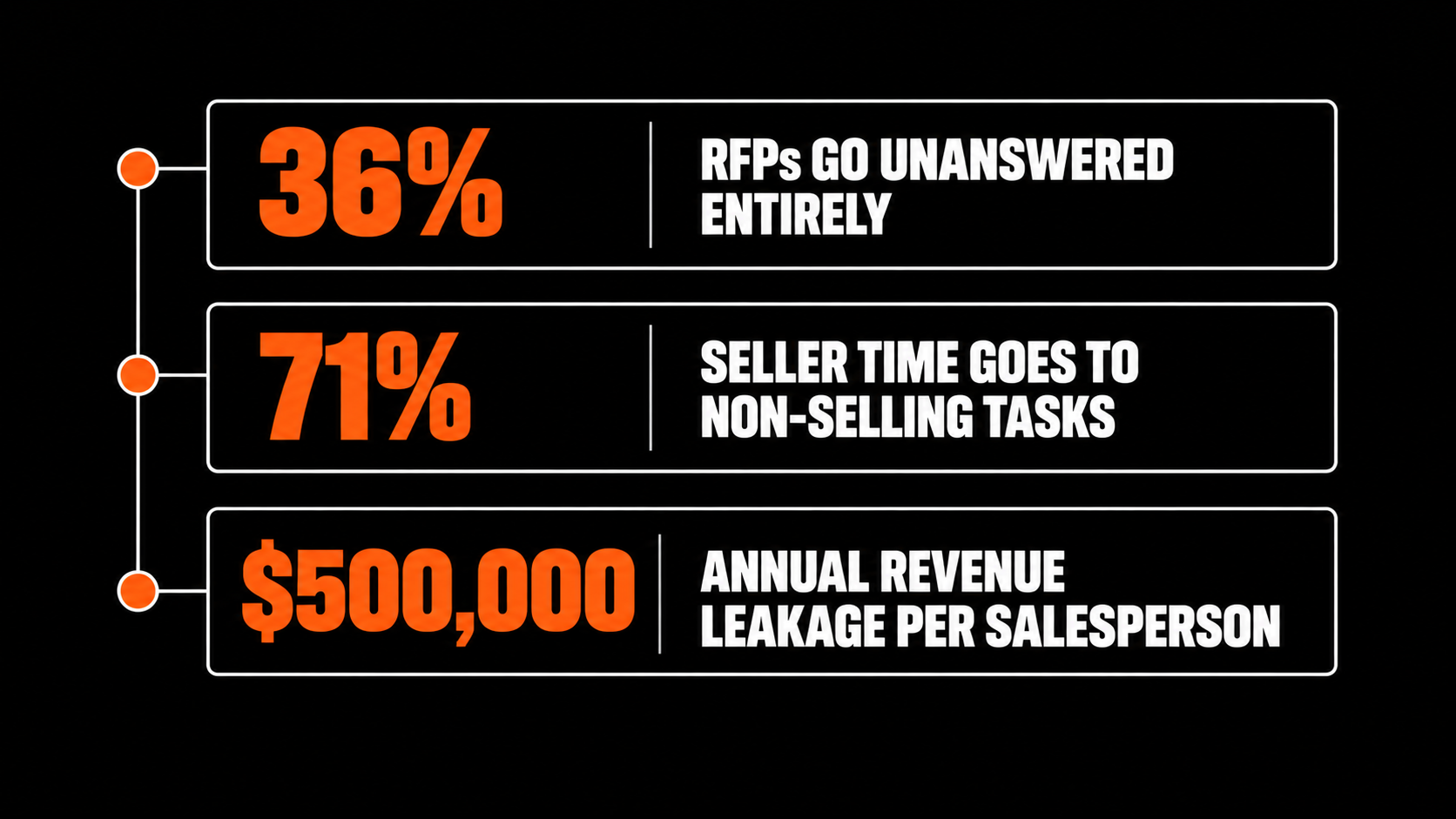
It's tempting to treat inconsistent RFP data as an operations nuisance, something a corporate analyst cleans up once a month before an ownership call. The numbers say otherwise.
Across group sales teams, roughly 36% of RFPs go unanswered entirely, not because the opportunity wasn't worth pursuing, but because it got lost in an inbox, buried under a manual intake process, or never routed to the right seller in a multi-property environment. Of the RFPs that do get worked, roughly 61% of won deals go to one of the first three properties or vendors to respond. Standardized, automated intake is what makes early response possible at scale. A seller can't respond quickly to an RFP that first has to be manually transcribed into a CRM field by field.
The labor cost compounds the revenue cost. Industry estimates put the average seller's time spent on non-selling tasks, including manual data entry, formatting, and chasing down missing RFP details, at around 71%. That leaves less than a third of a seller's week for the actual selling that standardized data is supposed to free up. At the portfolio level, this shows up as an estimated $500,000 in annual revenue leakage per salesperson, driven by slow response times, missed follow-ups, and inconsistent qualification rather than a lack of demand. The demand exists. The execution layer between the inquiry and the proposal is where it leaks.
How AI RFP Automation Actually Standardizes Intake
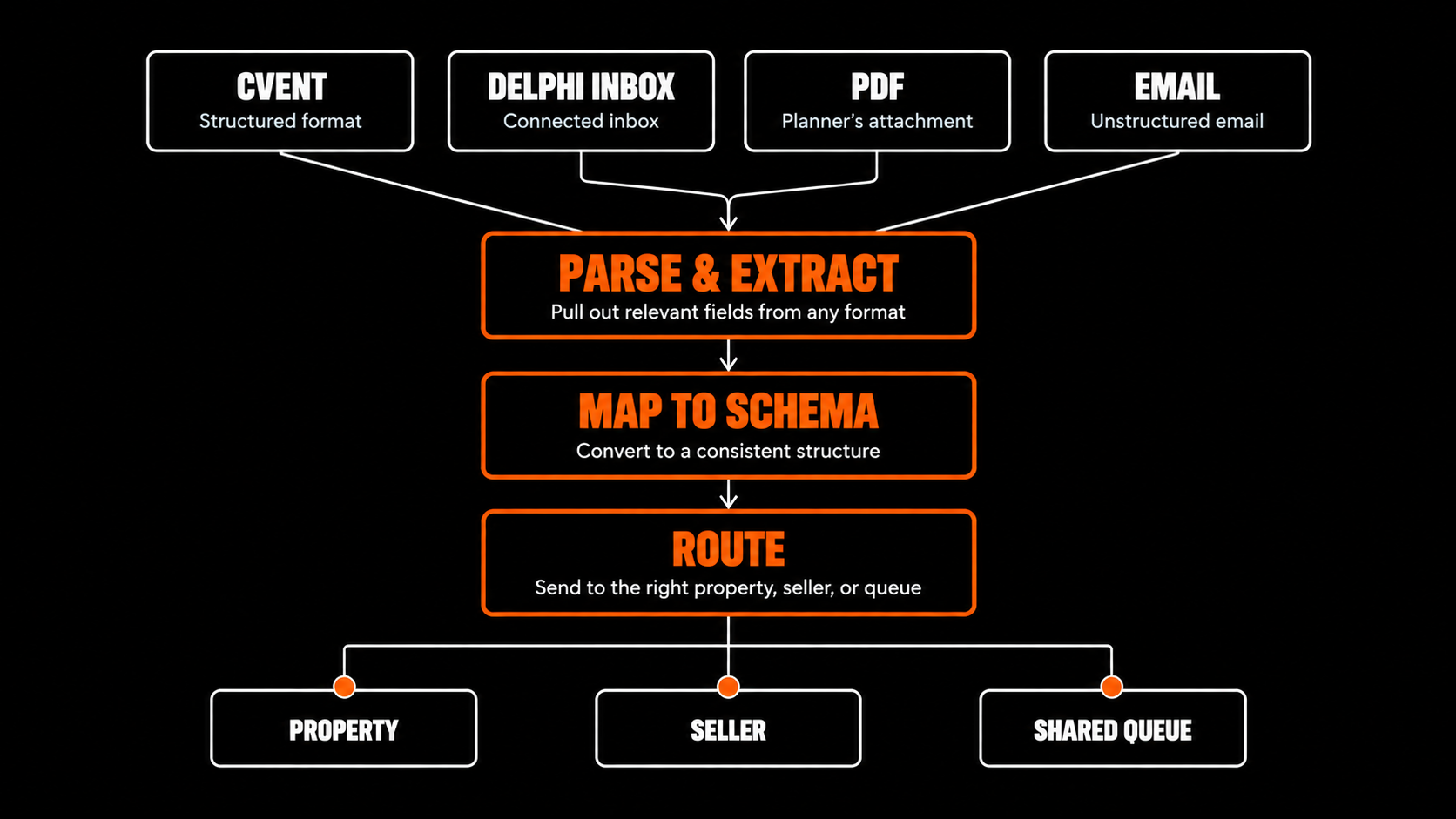
AI RFP automation tools take on the standardization job by working at the point of intake, before an inquiry ever reaches a seller's desk. Regardless of whether an RFP arrives through Cvent's structured format, a Delphi-connected inbox, a planner's PDF attachment, or a direct email with no structure at all, the automation layer parses the document, extracts the relevant fields, and maps them into a consistent schema. Room block by night gets normalized into the same format whether the source document listed it as a table, a paragraph, or a range. Budget language gets extracted even when a planner writes "flexible depending on concessions" instead of a number. Meeting space requirements get tagged consistently whether the planner specified square footage, attendee count, or a named room type from a previous stay.
This is meaningfully different from what a sales and catering platform like Delphi or a sourcing platform like Cvent already does. Those systems are systems of record. They store the data once it exists in the right format. AI RFP automation operates as a system of execution sitting on top of them, doing the work of getting inconsistent inputs into that right format in the first place, then routing the standardized record to the correct property, seller, or shared queue based on portfolio rules rather than whoever happens to be monitoring an inbox that day.
The practical effect for a 20-to-80-property group is that a regional VP of sales can pull a single report and see every open RFP across the portfolio in the same fields, at the same stage definitions, regardless of which property or which channel the inquiry originated from. That is what makes portfolio-wide benchmarking, pipeline forecasting, and RevPAM (Revenue Per Available Square Metre) tracking possible in the first place. None of those measurements mean anything if the underlying inquiry data isn't standardized before it gets aggregated.
The Speed Effect of Standardized Data
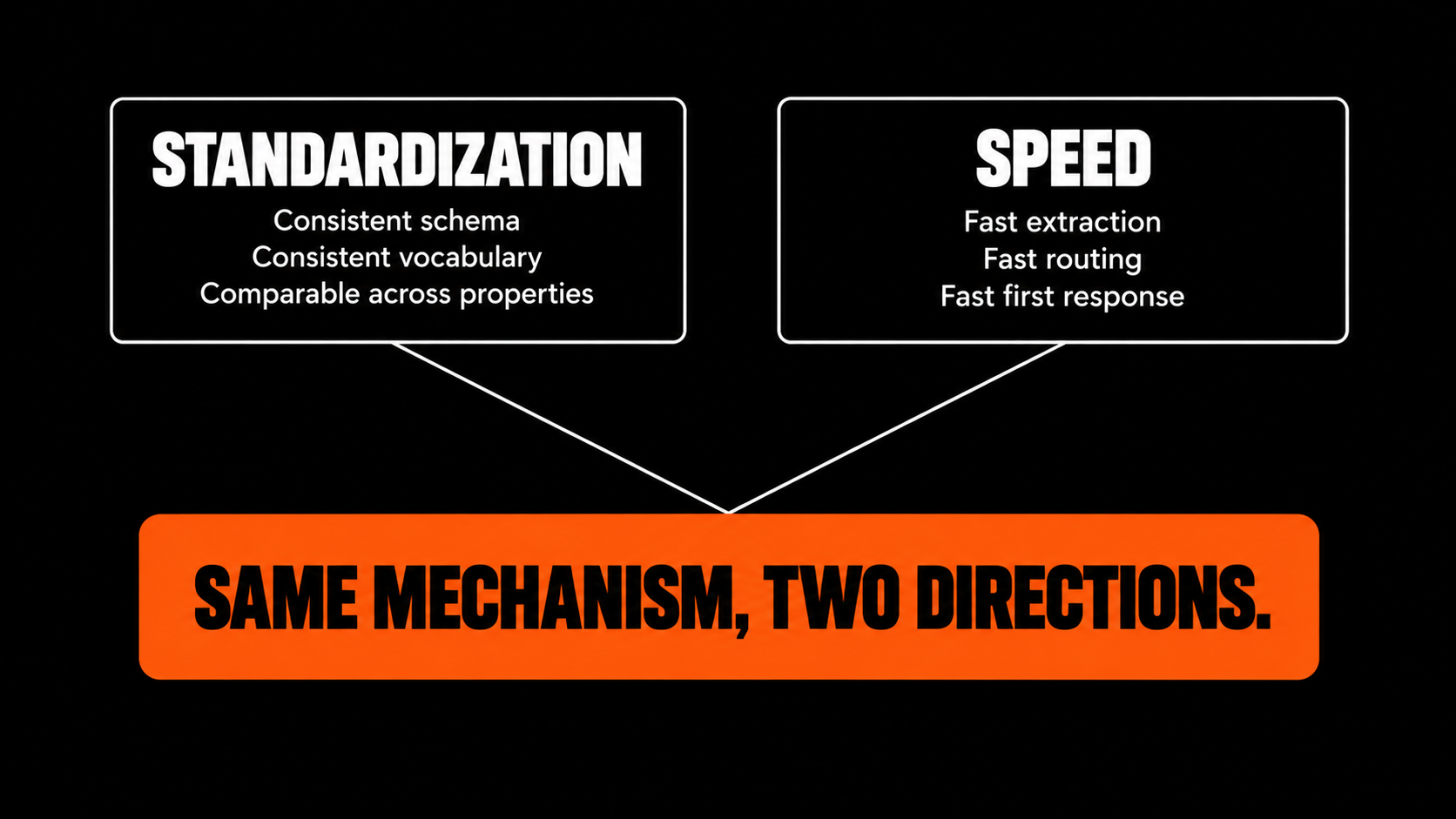
Standardization and speed are the same problem approached from two directions. A hotel group that manually processes an RFP, meaning a person reads the inbound document, decides which fields matter, types them into a CRM, and formats a proposal from scratch, typically spends around 37 minutes per RFP on that intake and initial-response work. With AI RFP automation handling extraction, standardization, and first-draft proposal generation, that number drops to roughly 4 minutes. The gap isn't really about faster typing. It's that a machine doesn't need a training document to consistently apply the same field definitions across a thousand inquiries a month, and it doesn't get slower on the RFPs that arrive unstructured.
That speed has a measurable payoff. Hotels that respond within four hours of receiving an RFP see a win-rate advantage of roughly 20 to 30 percentage points over slower responders. Given that most of the value in group business goes to whichever property answers first with a complete, accurate proposal, the standardization work isn't a back-office nicety. It's the mechanism that makes fast, accurate response possible across dozens of properties at once, rather than only at the one or two properties with the most disciplined sales manager.
What to Look for When Evaluating AI RFP Automation
Not every platform marketed as "AI for hotel RFPs" is built to solve the standardization problem at the portfolio level. A few criteria separate tools that genuinely standardize group inquiry data from tools that only speed up a single property's workflow:
- Source-agnostic intake. The tool should extract and normalize data from Cvent, Delphi exports, direct email, and PDF attachments equally well, not just from one sourcing platform's structured feed.
- A consistent schema across properties. Room block, meeting space, budget, and stage definitions should map to the same fields regardless of which property received the inquiry.
- No forced system replacement. A genuine execution layer should sit on top of existing Delphi and Cvent accounts rather than requiring a hotel group to rip out and replace systems of record it has already invested in, and it should not require a lengthy IT implementation to get started.
- Portfolio-level reporting, not per-property exports. Ownership and regional leadership need one dashboard showing standardized data across every managed property, not a monthly manual roll-up.
- Data ownership and exportability. Standardized data is only useful if the hotel group can pull it out, share it with ownership, or move it to another system without a fight.
- Measurable outcomes, not just feature claims. Look for platforms willing to be measured on admin hours saved, follow-up time reduced, RFP volume worked, and revenue captured, ideally over a defined pilot period rather than a sales pitch alone.
A Practical Path to Standardization
For a hotel group heading into budget season, the lowest-friction way to test whether AI RFP automation actually solves the standardization problem is a short, bounded pilot. A six-week window is typically enough to see the pattern: whether inbound RFPs from every property and every channel start resolving into the same fields, whether response time drops, and whether a regional leader can finally pull one report instead of five.
The four outcomes worth measuring during a pilot are straightforward: admin hours saved per seller, time from inquiry to first response, total RFP volume actually worked instead of missed, and revenue tied back to standardized, fast-responded inquiries.
This is the logic behind Hippo Rev's current 6-Week Free Pilot, running for a limited window ahead of 2027 budget season.
Portfolios that get this right heading into 2027 budget planning will be the ones that can show ownership a single, standardized view of group pipeline health across every property, not five spreadsheets that a corporate analyst reconciled by hand the night before the board meeting.
If you want to see what that looks like on your own data, you can start the free 6-week pilot over here.
Frequently Asked Questions
What does "standardizing group inquiry data" mean for a hotel portfolio?
It means every RFP, regardless of which property, channel, or format it arrives in, resolves into the same set of fields (room block, meeting space, budget, decision timeline, lead source, and pipeline stage) using the same terminology across every property in the portfolio.
Does AI RFP automation replace Delphi or Cvent?
No. Delphi and Cvent remain systems of record for sales and catering data and RFP sourcing. AI RFP automation works as a layer on top of those systems, standardizing and routing inbound inquiries before they reach a seller, without requiring a hotel group to replace existing platforms.
Why do multi-property hotel groups struggle with data standardization in the first place?
Individual properties often adopt their own naming conventions, sales stages, and intake habits, especially in portfolios that grew through acquisition. Delphi's data model in particular is built around a single property, so multi-property reporting typically depends on manual consolidation by a corporate analyst rather than a native portfolio view.
How much faster is AI-assisted RFP processing compared to manual processing?
Manual RFP intake and initial response typically takes around 37 minutes per inquiry. With AI-assisted extraction, standardization, and first-draft proposal generation, that drops to roughly 4 minutes.
What happens to RFPs that never get a response?
Roughly 36% of RFPs go unanswered across group sales teams, usually because of manual intake bottlenecks or unclear routing across properties rather than a lack of genuine demand. Standardized, automated intake is what allows a hotel group to work through inbound volume instead of losing a third of it to process failure.
Is a faster response actually worth more revenue, or just more convenience?
Hotels that respond to an RFP within four hours see a win-rate advantage of roughly 20 to 30 percentage points over slower responders, and about 61% of won group deals go to one of the first three properties or vendors to respond. Standardized intake is what makes that speed achievable across an entire portfolio rather than only at the best-run individual property.
.png)
Hotel RFP Automation: Why Teams Are Leaving Spreadsheets
Hotel RFP automation is replacing spreadsheets on both sides of the hotel sourcing process. The article explains how corporate travel buyers use automation to standardize sourcing and monitor negotiated rates, while hotel sales teams use it to centralize inquiries, reduce manual proposal work, and respond faster.
Hotel RFP Automation: Why Buyers and Sellers Are Both Moving Off Spreadsheets
A hotel RFP looks like a single document, but it triggers two very different workflows depending on which side of the desk you sit on. For a corporate travel manager, it's the start of an annual sourcing cycle that sets negotiated rates for the whole company. For a hotel sales team, it's one of hundreds of inbound requests competing for attention in the same week. Both groups have relied on spreadsheets and email threads to manage this process for decades, and both are now finding that approach breaks down as programs get larger and more complex.
That shared breaking point is why RFP automation has become a genuine software category rather than a niche tool. Understanding how it works on each side of the transaction, and where the two sides actually intersect, explains why the shift away from spreadsheets is happening now rather than five years ago.
What Is a Hotel RFP, and Why Are There Actually Two Kinds?
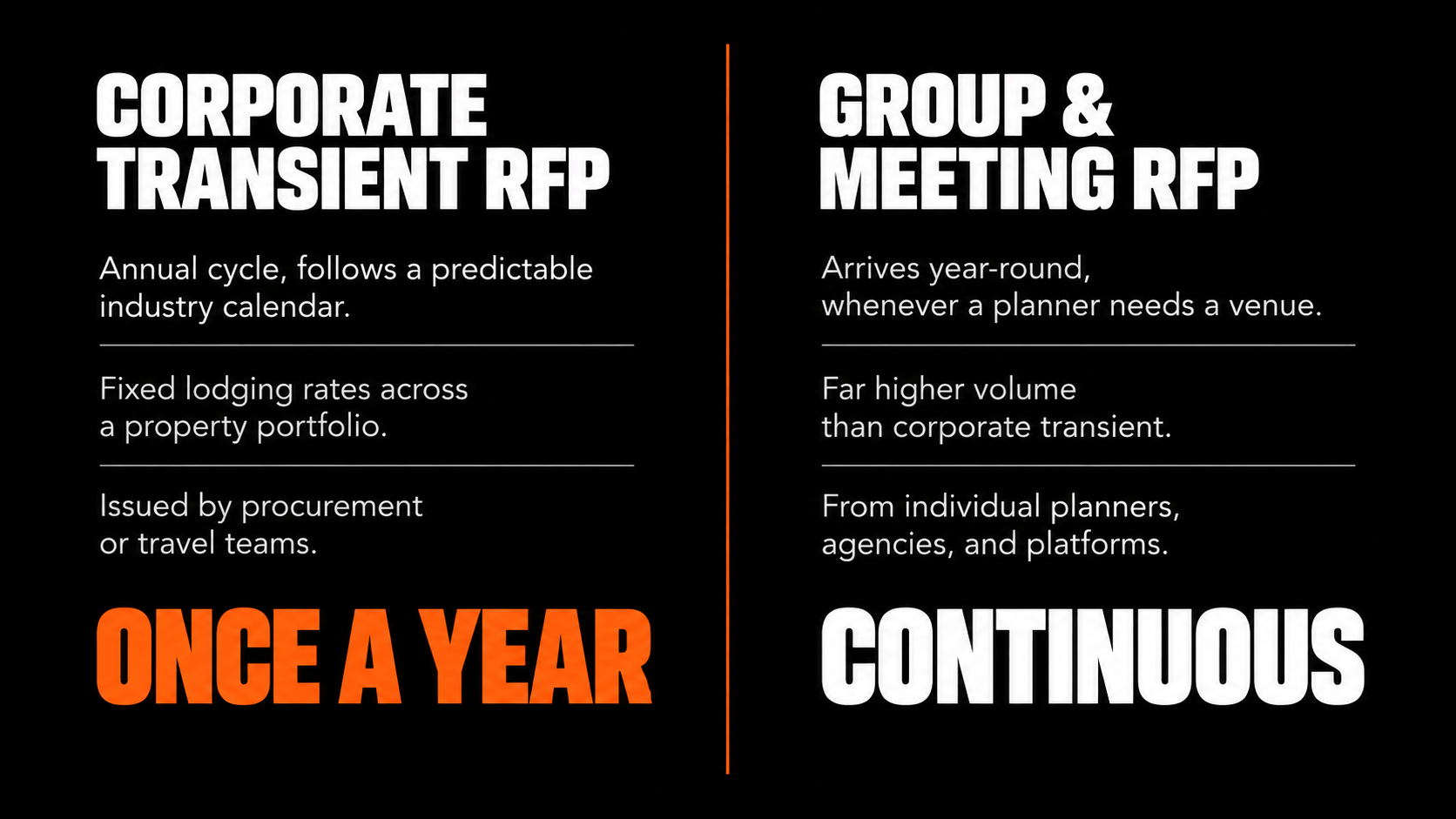
A hotel RFP (Request for Proposal) is a formal document a buyer sends to one or more hotels asking for pricing, availability, and terms for a stay, meeting, or group event. The hotel responds with a proposal, and the buyer selects, negotiates, and contracts based on the responses received.
In practice, this covers two distinct processes that often get discussed as if they were one.
The first is the annual corporate transient RFP, run by a company's travel or procurement team to negotiate fixed lodging rates for the coming year across a portfolio of properties their employees stay in regularly. This follows a predictable industry calendar: buyers typically issue RFPs between June and August, hotels respond in September and October, and negotiated rates load into global distribution systems for a January 1 effective date, a cadence supported by the GBTA Hotel RFP Workgroup.
The second is the group and meeting RFP, sent whenever a planner needs a venue for a conference, event, or block of rooms. These arrive year-round, in far higher volume, from individual planners, meeting agencies, and platforms rather than a single procurement department on a fixed schedule.
Both processes ultimately land on hotel property or sales teams, which is why automation is being adopted on both the buyer side that issues these RFPs and the seller side that has to respond to them, often at the same time within the same sales office.
The Buyer Side: Why Corporate Travel Procurement Is Automating Hotel Sourcing
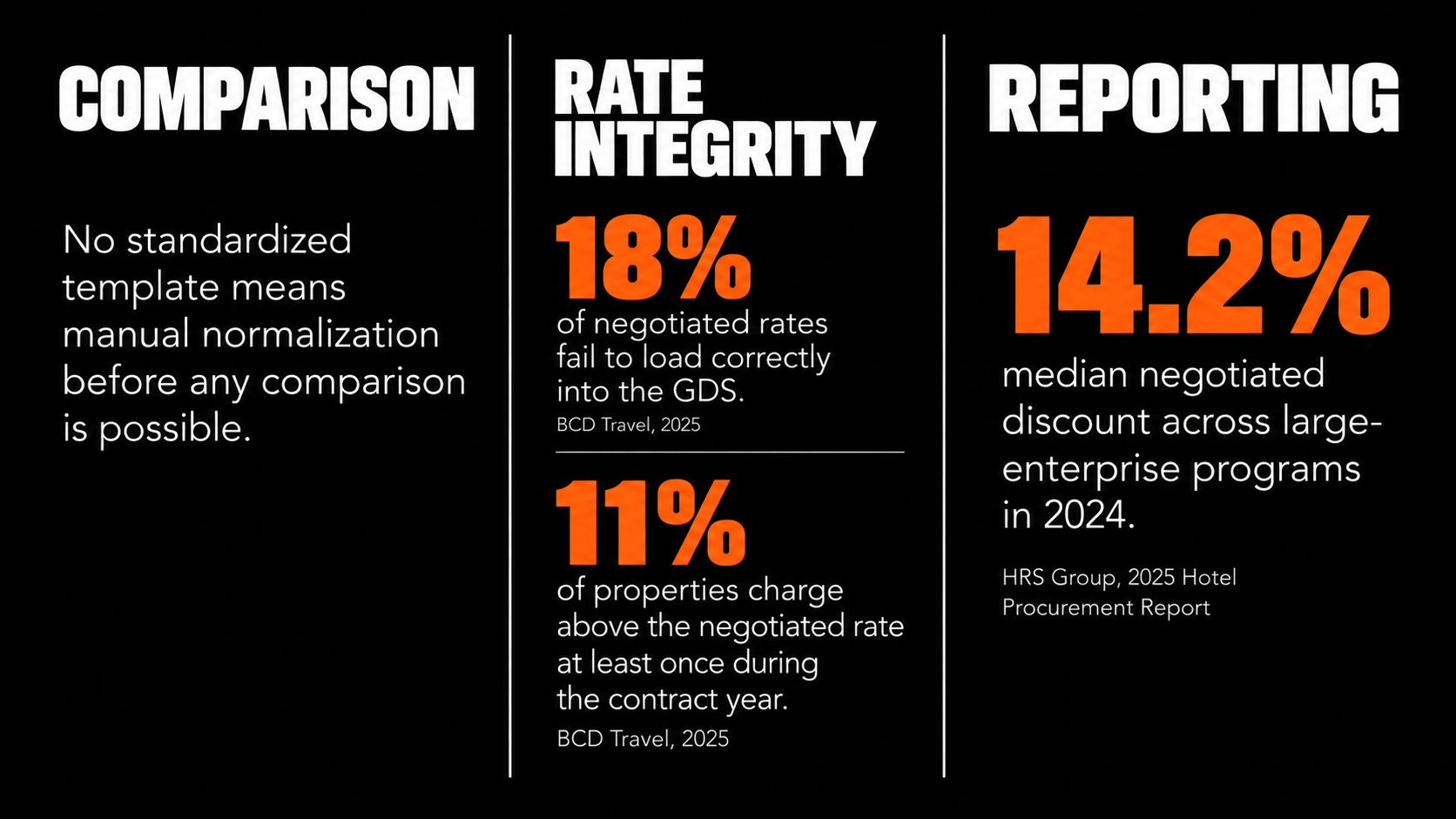
Corporate lodging is the largest single line item in most business travel budgets. According to GBTA's Business Travel Index, business travelers spend roughly $461 billion annually on accommodation, and a large share of that spend runs through negotiated RFP programs. Cvent's sourcing platform alone processed about $16.5 billion in corporate hotel sourcing volume in 2024, which gives a sense of how much money moves through this single annual exercise.
Running that process on spreadsheets creates three specific problems that scale badly as a program grows.
Comparing proposals is genuinely hard when every hotel responds differently. Without a standardized template, one hotel's proposal lists an all-inclusive nightly rate, another separates out resort fees, and a third quotes seasonal bands with different blackout dates. A travel manager sourcing dozens or hundreds of properties has to manually normalize every one of these before an apples-to-apples comparison is even possible. Research from GBTA and Cvent, based on a survey of corporate travel managers and hotel professionals across the U.S., Canada, and Europe, found that structured RFPs remain the preferred sourcing method for managed hotel and meetings programs, precisely because structure is what makes comparison possible at all.
Rate integrity breaks down after the RFP closes. Negotiating a rate is only half the job. That rate then has to load correctly into the global distribution system, hold for the full contract year, and be enforced at the front desk. A 2025 industry report from BCD Travel found that 18 percent of negotiated rates fail to load correctly into the GDS at the start of a contract, and 11 percent of properties charge above the negotiated rate at least once during the contract year. Spreadsheets have no way to catch either failure; someone has to notice the discrepancy on an expense report months later, if anyone notices at all.
Reporting to finance and leadership takes real effort to assemble. Per HRS Group's 2025 Hotel Procurement Report, the median negotiated discount across large-enterprise programs was 14.2 percent in 2024, which is a meaningful number for a CFO to see, but pulling it together from scattered proposal PDFs and email chains is its own project every renewal cycle.
Automated sourcing platforms address these by standardizing intake into comparable formats, tracking negotiated terms in a structured record rather than a document trail, and generating reports directly from that record instead of reconstructing them after the fact. This is also why fixed, pre-negotiated rates remain dominant in corporate programs despite years of discussion about dynamic pricing: the same GBTA-Cvent research confirmed that roughly four out of five travel managers always or regularly negotiate fixed rates, and fixed rates are much easier to audit and forecast against when the underlying data is organized.
The Seller Side: Why Hotel Sales Teams Are Automating RFP Response
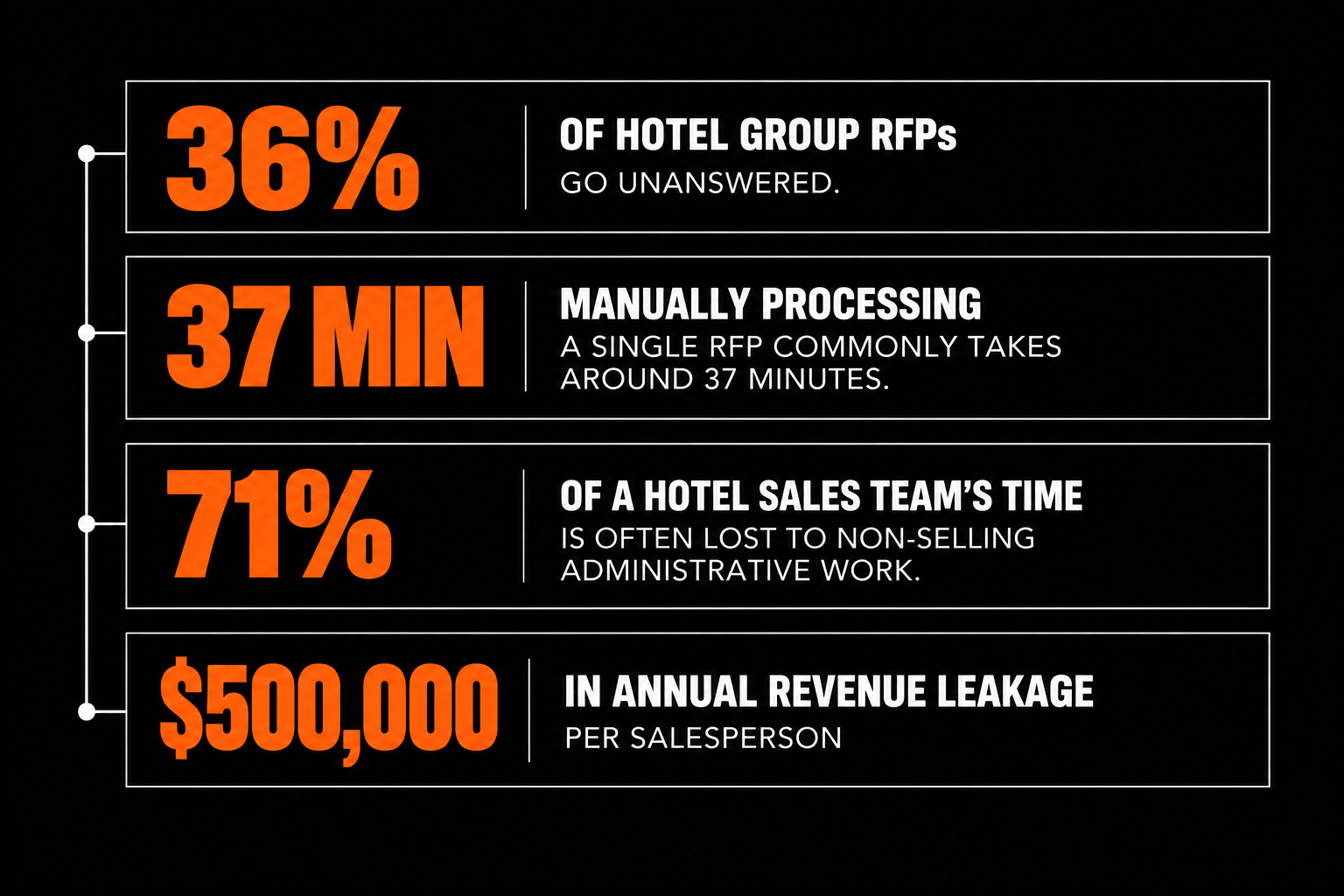
On the hotel side of the same relationship, the pressure point isn't sourcing complexity, it's volume and speed. A hotel sales team doesn't run one RFP cycle a year; it processes a continuous stream of group and meeting inquiries arriving from Cvent, email, web forms, and phone calls, often into the same shared inbox.
Industry analysis of RFP response patterns points to a persistent gap between how much business arrives and how much actually gets a reply. Roughly 36 percent of hotel group RFPs go unanswered, not because the business is unwanted but because it gets lost in the volume of manual intake and follow-up. That gap matters because speed compounds: 61 percent of won deals go to whichever hotel is among the first three to respond, and research from Cvent and industry operators consistently shows that hotels responding within four hours win at materially higher rates than those responding in 24 to 48 hours, with the advantage running 20 to 30 points in some analyses.
The administrative side of the job is a large part of why response times slip. Manually processing a single RFP, pulling availability, checking rates, drafting a proposal, and routing it for approval, commonly takes around 37 minutes per inquiry when done by hand across disconnected systems. Multiplied across a full pipeline, that adds up to a meaningful share of a salesperson's week spent on data entry rather than selling, and estimates of time lost to non-selling administrative work run as high as 71 percent of a hotel sales team's total hours. On average, companies source roughly a third of their sales revenue through deals that involve an RFP, which means a slow, manual process isn't a minor inefficiency; it's sitting directly on top of a major revenue channel. The cumulative effect on an individual salesperson's book of business is often estimated at around $500,000 in annual revenue leakage once missed and delayed RFPs are added up over a year. A survey of hoteliers found that 90 percent believe the group booking process itself is fundamentally broken, and most attributed the problem to the clunky, manual workflow rather than pricing.
Automated RFP response tools address the mechanical bottlenecks directly: pulling multi-channel RFPs into one queue, auto-populating proposals from existing rate and availability data, and flagging aging inquiries before they go cold. That doesn't replace the judgment a sales manager brings to a negotiation, but it removes the copy-and-paste work that currently stands between an inquiry landing in an inbox and a proposal reaching the planner.
Where the Two Sides Actually Meet
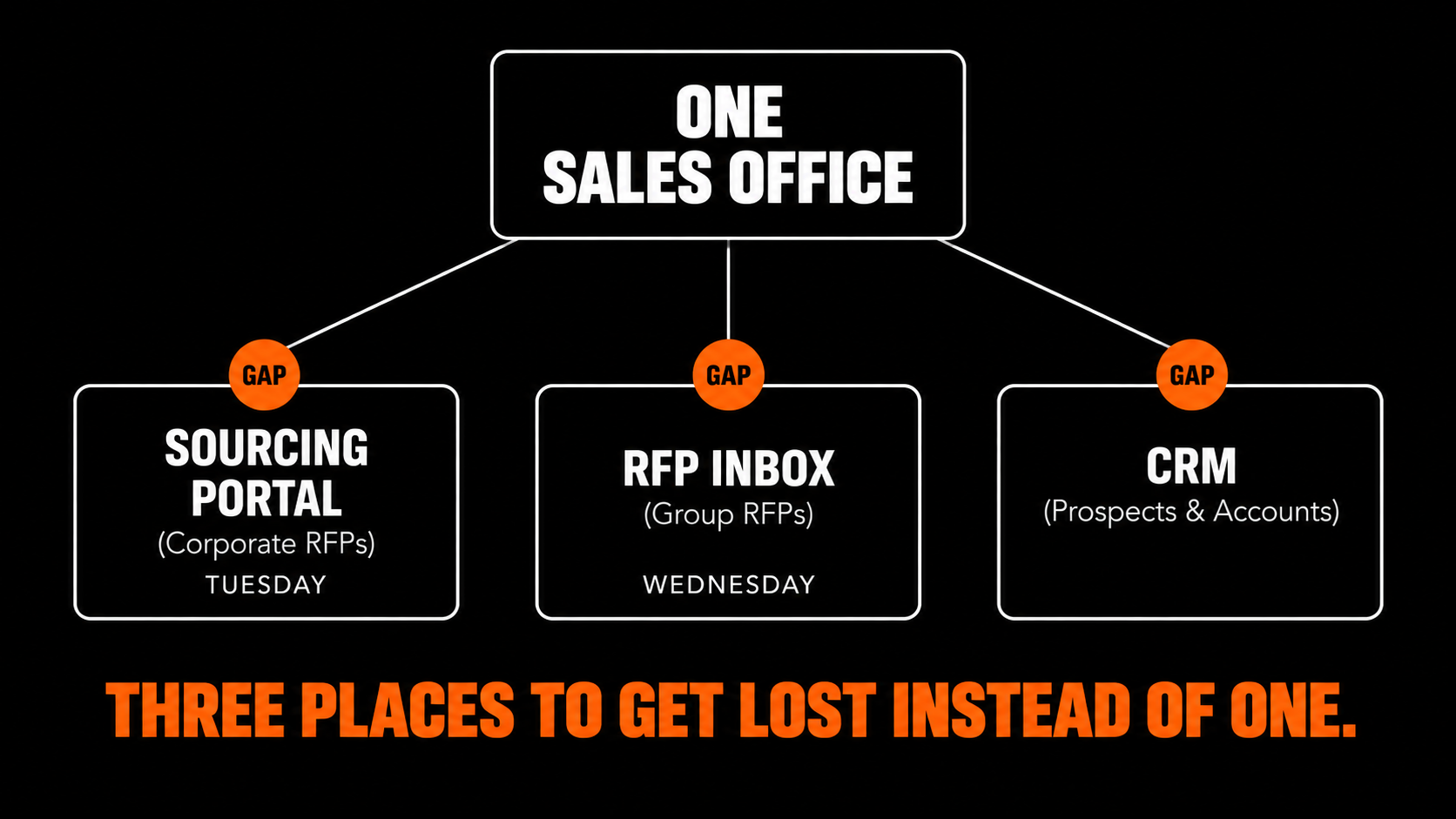
The buyer-side and seller-side processes look separate on paper, but they converge inside the same hotel sales office. The person fielding an annual corporate RFP from a Fortune 500 procurement team on Tuesday may be fielding a 200-room conference RFP from a meeting planner on Wednesday, often using entirely different tools for each. That fragmentation is part of why response times and rate accuracy both suffer: a sales team juggling a corporate sourcing portal, a group RFP inbox, and a separate CRM has three places for a request to get lost instead of one.
This is also where automation on each side reinforces the other. A hotel with clean, structured availability and rate data (built to satisfy corporate procurement's need for accurate, comparable proposals) has the same underlying data infrastructure needed to respond quickly and accurately to a group RFP. Conversely, a hotel that has automated its group RFP response process, so pricing and availability are already centralized and current, is better positioned to respond credibly to a large corporate RFP without a scramble. The investment a hotel makes in organizing its RFP data for one side of the business tends to pay off on the other.
What to Look for in an RFP Automation Platform
Whether the goal is sourcing hotels or responding to inquiries, the core capabilities that matter are largely the same:
- Centralized intake. One queue for RFPs arriving from multiple channels, rather than a mix of inboxes and portals.
- Standardized comparison or proposal formats. So responses (or offers) can be evaluated or generated consistently instead of being reformatted by hand.
- A structured negotiation record. A full history of terms offered, countered, and agreed to, so nothing depends on someone's memory of an email thread from three months ago.
- Built-in reporting. Metrics on response time, win rate, participation, or compliance available on demand instead of assembled manually before a leadership review.
- Room to scale. A workflow that holds up whether a program covers ten properties or a thousand, or whether a hotel handles ten RFPs a month or several hundred.
These aren't features specific to one vendor; they're the baseline a spreadsheet-based process simply cannot deliver once volume passes a certain point, which is why both buyers and sellers in this market are converging on similar automation logic even though they're solving different problems.
The Takeaway
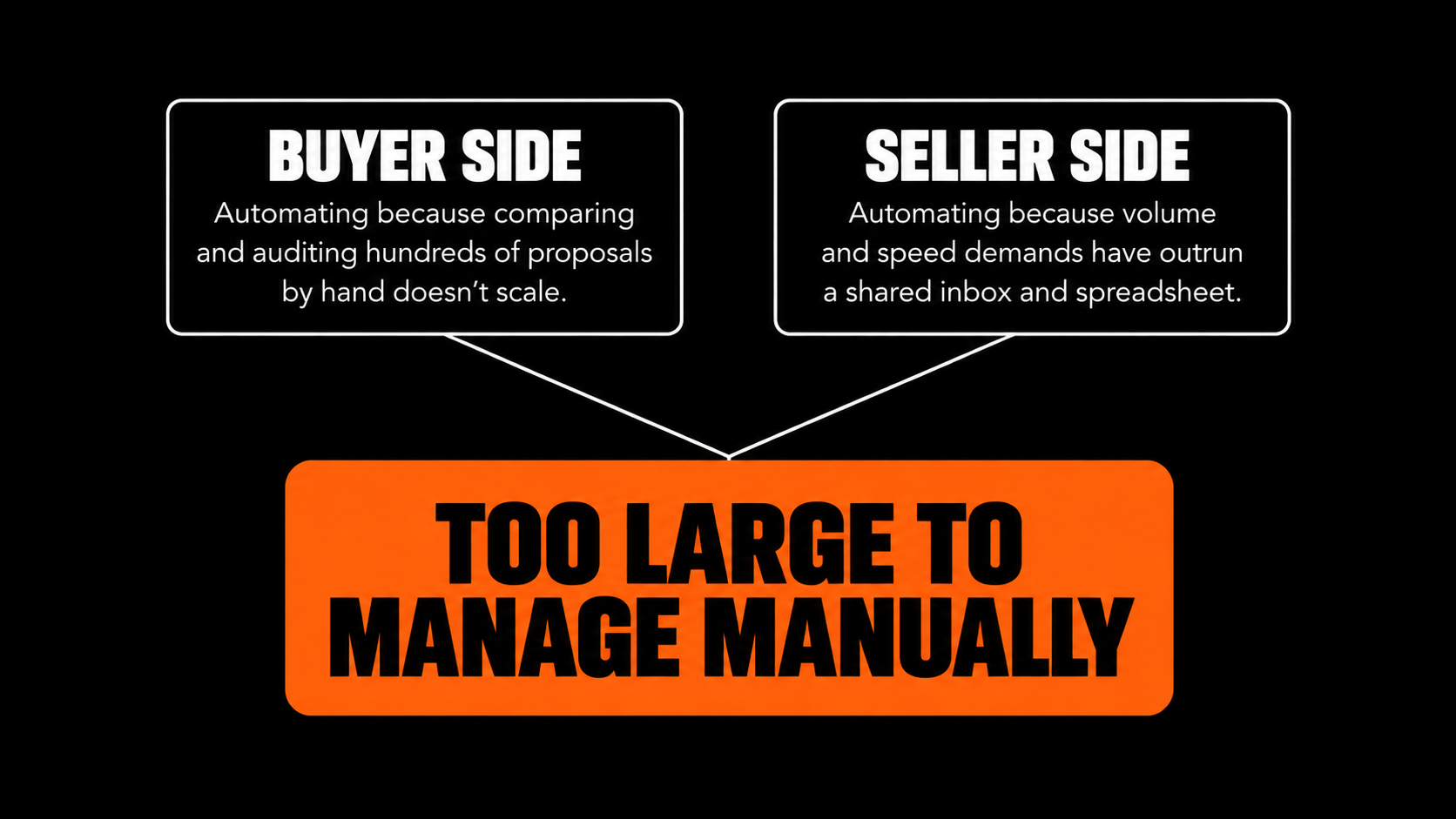
Hotel RFP automation isn't a single trend; it's two related shifts happening on opposite sides of the same transaction. Corporate travel procurement teams are automating because comparing hundreds of proposals and auditing negotiated rates by hand doesn't scale with modern program size. Hotel sales teams are automating because the volume and speed demands of group and meeting RFPs have outrun what a shared inbox and a spreadsheet can reasonably handle. Both are responding to the same underlying reality: RFP-driven revenue is too large a share of the business to keep managing manually.
If slow or missed RFP responses are costing your hotel sales team booked business, Hippo Rev is built specifically for that side of the equation. It centralizes RFP and lead intake from channels like Cvent, email, and web forms into a single system, and helps sales teams cut the time spent on manual proposal work so more inquiries get a fast, accurate response. You can see how it works by getting a free Hippo Rev demo here.
Frequently Asked Questions
What's the difference between a corporate hotel RFP and a group hotel RFP?
A corporate RFP is issued once a year by a company's travel or procurement team to negotiate fixed lodging rates across a portfolio of hotels for the coming year. A group RFP is issued whenever a planner needs a venue for a specific meeting or event, and these arrive continuously throughout the year rather than on a fixed annual schedule.
Why do so many hotel RFPs go unanswered?
It's rarely a deliberate decision to decline the business. Most unanswered RFPs get lost in the volume of manual intake, since requests arrive from multiple disconnected channels and sales teams without a centralized queue can't reliably track and prioritize every one.
How much does response speed actually affect win rate?
Meaningfully. Research from Cvent and industry operators consistently shows hotels responding within four hours win at materially higher rates than those responding in 24 to 48 hours, and planners evaluating several properties at once tend to anchor their comparison around whoever responds first.
Do smaller hotel programs or independent hotels need RFP automation?
The need scales with volume rather than company size. A property or program handling a small, manageable number of RFPs a month may do fine with a well-organized spreadsheet. Once volume grows to the point where requests are being missed or reporting takes real effort to assemble, automation starts to pay for itself.
Does automating the RFP process remove the negotiation and relationship-building parts of the job?
No. Automation is best suited to the repetitive, administrative parts of the process, intake, data entry, proposal drafting, and reporting. The judgment involved in negotiating terms and building supplier or planner relationships still depends on experienced people; automation is meant to free up more of their time for that work, not replace it.
.png)
Hotel Sales Outsourcing: Benefits, Risks, and Limitations
Hotel sales outsourcing can provide immediate sales coverage, continuity, cost predictability, and access to experienced professionals when in-house staffing is difficult. The article also explains its limits, particularly that outsourcing alone does not fix fragmented RFP intake, slow response processes, or inefficient sales infrastructure.
Hotel Sales Outsourcing: What It Actually Solves (and What It Doesn't)
A hotel sales team has one job: turn inquiries into signed business before a competitor does. When that seat sits empty, which happens often in an industry with some of the highest staff turnover in the U.S. economy, group and corporate revenue is usually the first thing that slips. That's the problem hotel sales outsourcing is built to solve, and it's a big part of why the model has moved from a niche workaround to a mainstream staffing strategy heading into the 2027 group sales cycle.
This article explains what hotel sales outsourcing actually means, why more owners and general managers are evaluating it now, what it costs to leave a sales seat unfilled, and where the model has real limits that no outsourcing contract can fix on its own.
What Is Hotel Sales Outsourcing?
Hotel sales outsourcing is the practice of hiring an external company or independent sales professionals to handle some or all of a hotel's group, corporate, and event sales functions on an ongoing contract basis, instead of staffing those functions with full-time, in-house employees. The outsourced team typically works as an extension of the property, using the hotel's own systems, rates, and brand voice, rather than operating as a separate agency layer the guest or planner would notice.
It's a distinct category from two things it's sometimes confused with. It is not the same as outsourcing revenue management, which focuses on pricing and inventory rather than active selling. And it is not the same as hiring a marketing agency, which drives awareness and demand rather than closing individual accounts. Hotel sales outsourcing specifically covers the sales cycle: prospecting, RFP response, proposal negotiation, site visits, and account management for corporate, group, and MICE (meetings, incentives, conferences, and events) business.
Why More Hotels Are Considering It Now
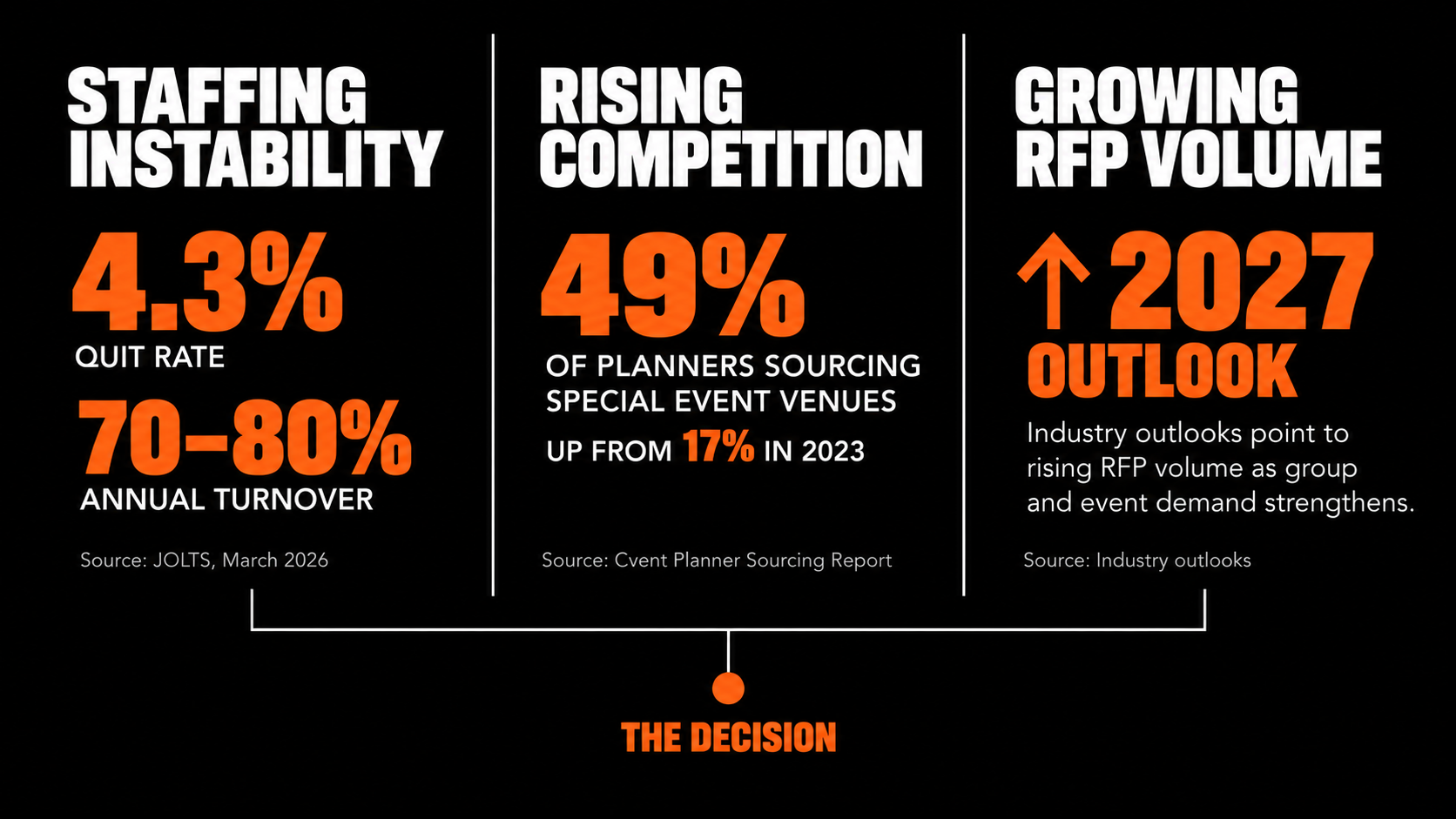
Three forces are pushing the decision at the same time: staffing instability, rising competition for group business, and growing RFP volume.
The Real Cost of an Empty Sales Seat
Hospitality has the highest turnover of any major U.S. industry. The Bureau of Labor Statistics' JOLTS data put the accommodation and food services quit rate at 4.3% in March 2026, nearly double the private-sector average, and annual turnover in the sector regularly runs between 70% and 80%. Sales and management roles are more stable than front-line positions, but they aren't immune, and a vacancy at the Director of Sales level carries a different cost profile than a vacancy at the front desk.
A separate workforce research from Gallup estimates replacement cost at roughly 40% of annual salary for front-line roles, rising to as much as 200% of salary for managers and department leaders, a range that reflects how much of a sales director's value is tied up in relationships and market knowledge that a new hire has to rebuild from zero. When a hotel loses its only sales person and takes two or three months to backfill the role, that gap doesn't just cost the salary; it costs every group inquiry that arrived and went unanswered during the vacancy.
Rising Competition for Group and Event Business
Hotels aren't just competing with other hotels anymore. According to Cvent's Planner Sourcing Report, 49% of meeting and event planners said they were sourcing special event venues such as unique spaces and coworking venues, up from 17% in 2023. That shift means hotel sales teams have to work harder and respond faster to keep pace with a wider, more agile set of competitors for the same piece of group business.
At the same time, industry outlooks heading into 2027 point to rising RFP volume as group and event demand strengthens. More inquiries sound like good news, and they are, but each one still has to be reviewed, qualified, priced, and answered, which puts direct pressure on whatever team (in-house or outsourced) is doing that work.
How Hotel Sales Outsourcing Works
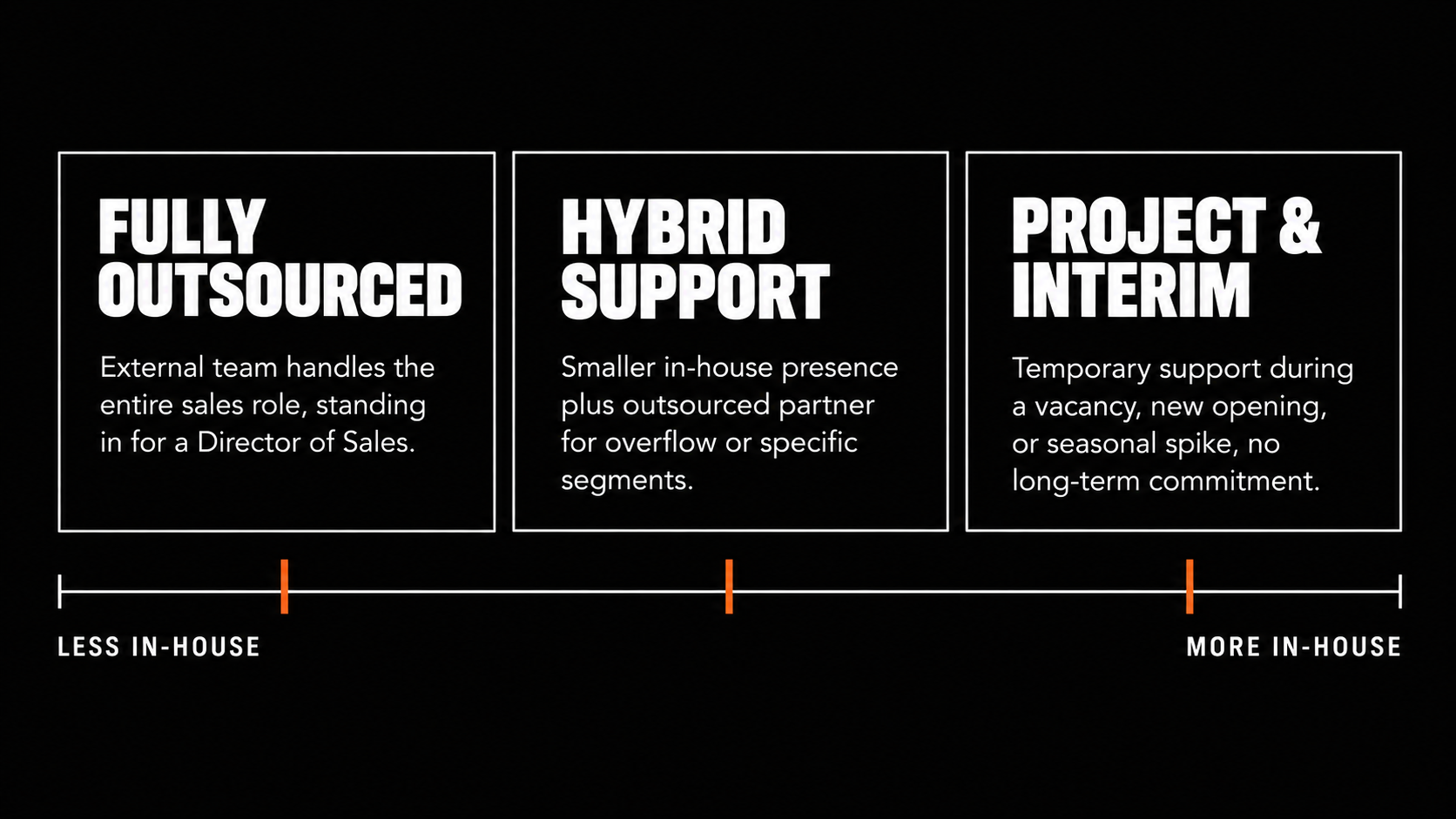
Outsourced hotel sales arrangements generally fall into one of three models:
- Fully outsourced sales function. An external team handles the entire sales role for the property, including prospecting, RFP response, negotiation, and account management, effectively standing in for a Director of Sales.
- Hybrid or augmented sales support. The hotel keeps a smaller in-house presence, often a single sales or catering coordinator, and brings in an outsourced partner to cover overflow, specific market segments such as corporate or MICE, or gaps during a transition.
- Project or interim coverage. A hotel brings in outsourced sales support temporarily, most often during a Director of Sales vacancy, a new property opening, or a seasonal demand spike, without committing to a long-term contract.
Most outsourced partners work inside the hotel's existing property management system, sales and catering platform, and CRM, rather than asking the property to adopt new tools, which is part of what makes the arrangement feel closer to an in-house extension than a third-party vendor relationship.
Five Benefits Hotels Typically Cite
Cost predictability. A full-time sales hire carries more than base salary: benefits, commission structures, training time, and the turnover costs outlined above. An outsourced arrangement is usually structured as a predictable monthly or contract fee, which makes sales cost easier to budget and scale.
Access to established relationships and expertise. An outsourced sales professional typically arrives with existing corporate, travel agency, and MICE network relationships rather than needing months to build them from scratch, which shortens the time to first booked business.
Scalability with demand. Group and corporate demand rarely moves in a straight line. City hotels see midweek strength and weekend softness; resorts see the reverse. Outsourced arrangements can flex sales coverage up during a need period and back down in the off-season in a way that a single full-time hire cannot.
Continuity through staffing gaps. Because the outsourced team isn't tied to one individual's employment status, a hotel avoids the "empty seat" scenario entirely: coverage continues even if a specific salesperson on the outsourced team changes.
More GM and staff time for guest-facing work. When sales prospecting, RFP response, and account management sit with a dedicated outsourced partner, general managers and operations staff spend less time covering sales gaps and more time on the guest experience that drives repeat business and reviews.
What Outsourcing Doesn't Fix
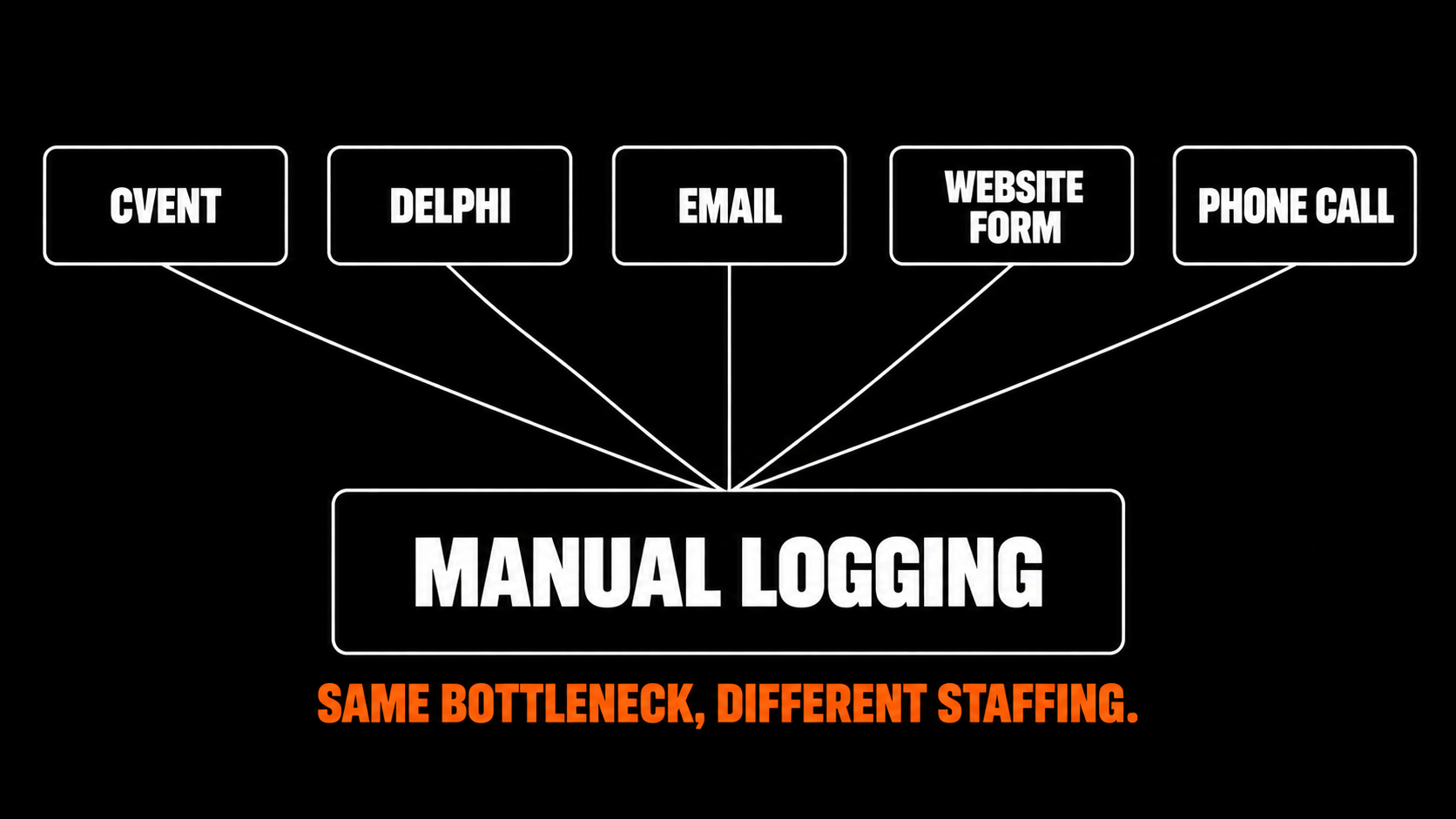
Outsourcing solves a staffing and continuity problem. It does not automatically solve a speed or infrastructure problem, and it's worth being clear-eyed about that distinction before signing a contract.
An outsourced sales team is still bound by whatever systems and processes the hotel has in place for receiving, tracking, and responding to inquiries. If RFPs arrive through five different channels (Cvent, Delphi, email, a website form, a phone call) and get logged manually, an outsourced team will inherit that same fragmented intake process, just with different people doing the manual work. Outsourcing changes who answers the RFP; it doesn't necessarily change how fast the RFP gets answered, unless the underlying process improves too.
This matters because response speed is one of the more measurable drivers of group sales win rates. Planners routinely send the same RFP to multiple properties at once, and the businesses that respond fastest and most completely tend to win a disproportionate share of that business, regardless of whether the response came from an in-house or outsourced sales team. A hotel that outsources sales but keeps a slow, manual RFP intake process has traded one bottleneck for another.
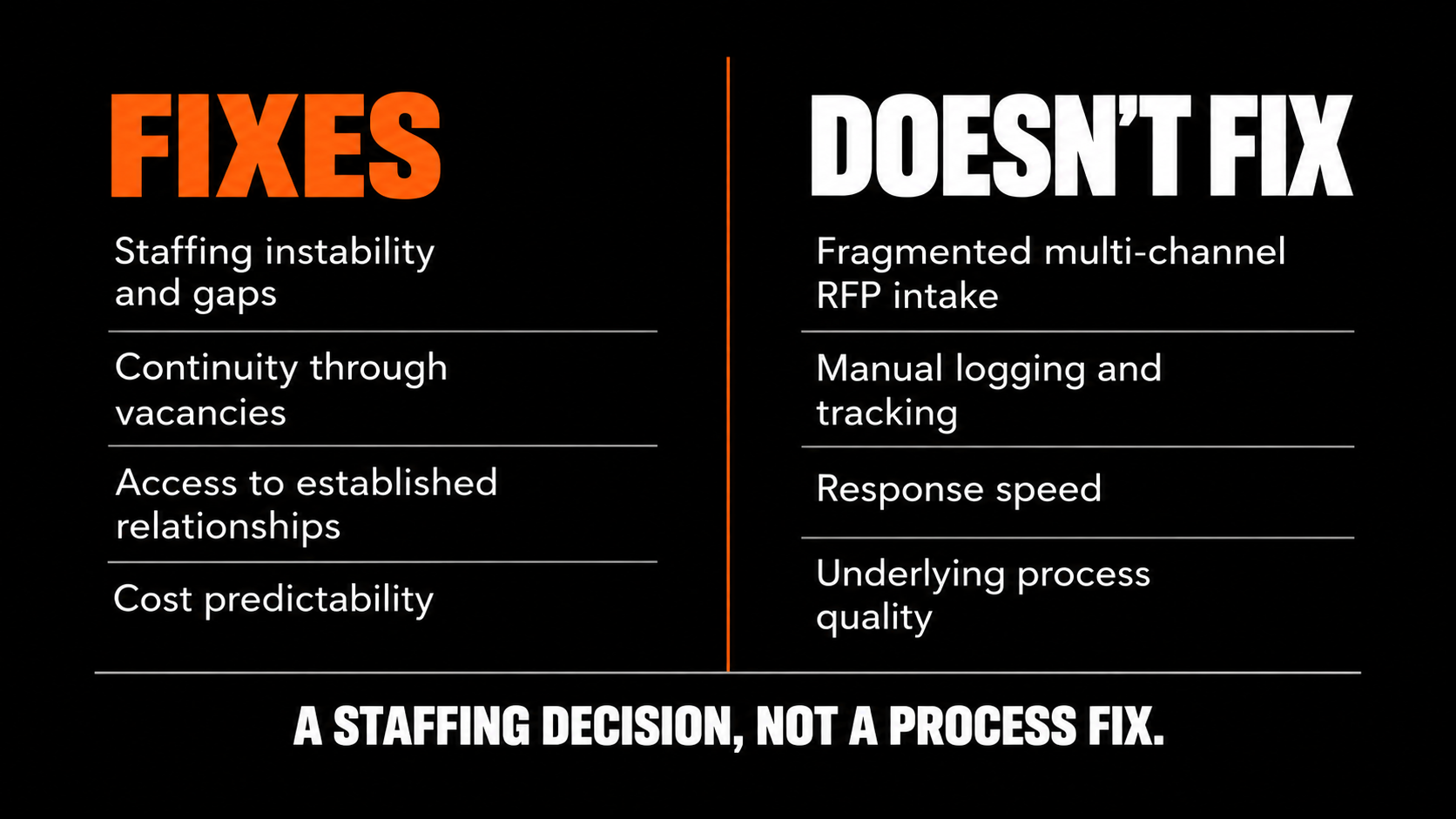
Hotel Sales Outsourcing vs. Building an In-House Team
The right answer depends on property size, market complexity, and growth stage, not on which option is universally "better."
An in-house team tends to make more sense when a hotel has enough group and corporate volume to justify a full-time role or team, when brand standards or ownership require dedicated on-property presence, or when the property is part of a portfolio with centralized sales support already in place.
Outsourcing tends to make more sense for smaller or independent properties where a single-person sales department creates a single point of failure, for hotels opening new properties that need immediate sales coverage before a full-time hire can be recruited and trained, and for properties bridging a Director of Sales vacancy without letting group pipeline go cold.
Some hotels land on a middle path: an in-house sales or catering coordinator handling relationship management and site visits, paired with outsourced support for prospecting or overflow RFP volume during peak season.
What to Look For in an Outsourced Sales Partner
Not all outsourced sales arrangements are structured the same way, and the details matter more than the pitch. Before signing, hotels should get clear answers on:
- How the partner reports performance (booked room nights, conversion rate, response time) rather than just activity metrics like calls made
- Whether the partner works inside the hotel's existing CRM and sales and catering platform, or requires a separate system
- How brand voice, negotiated rate integrity, and contract terms are protected when someone outside the property is representing it
- What happens to relationships and account history if the contract ends
- Whether pricing is a flat fee, commission-based, or a hybrid, and how that aligns incentives with the hotel's actual revenue goals
The Common Thread: Speed Still Decides Who Wins
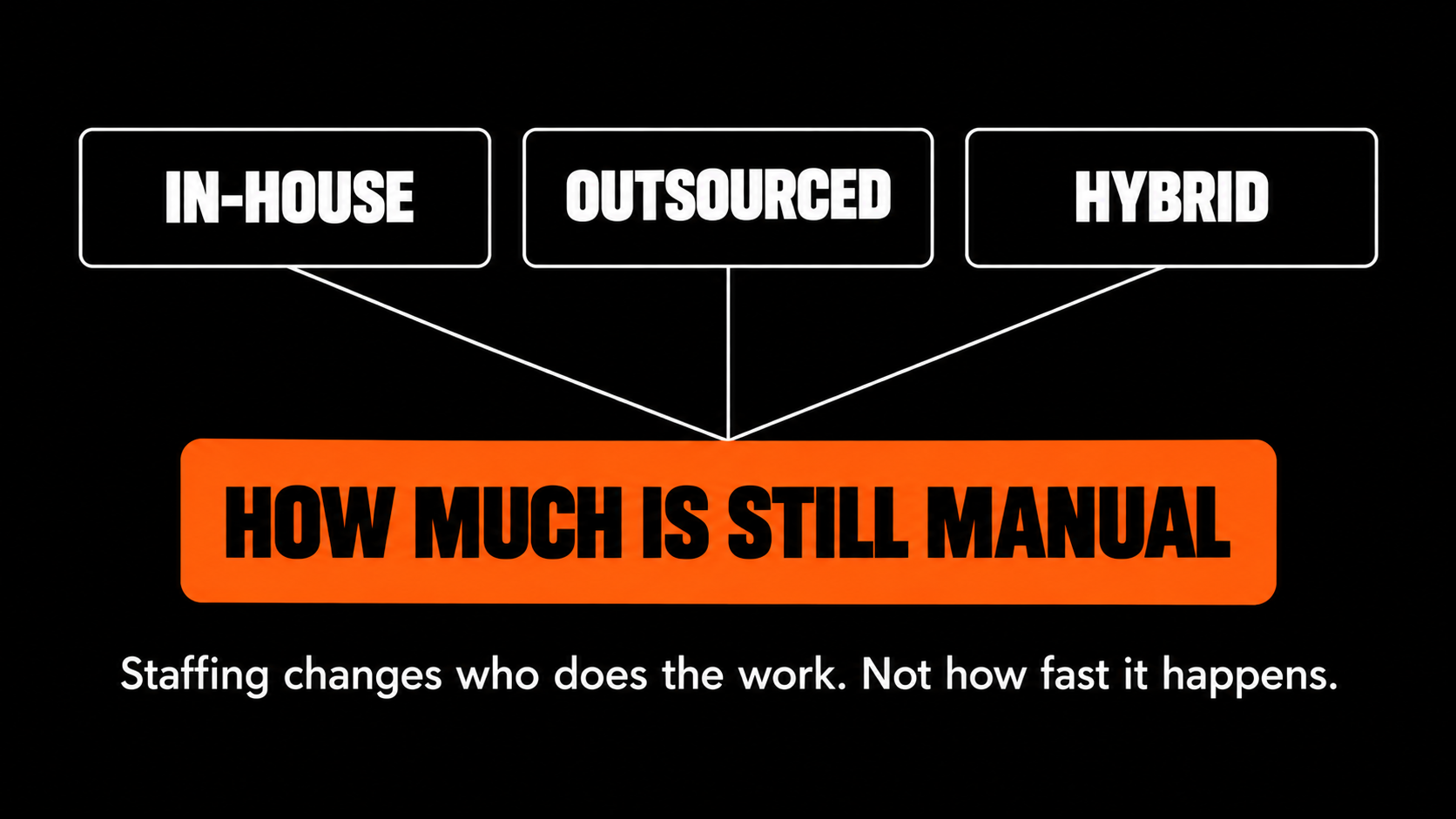
Whether a hotel staffs its sales function in-house, outsources it entirely, or lands somewhere in between, the underlying challenge is the same: a growing share of group and event business goes to whichever property responds first with a complete, accurate offer. Staffing model changes who is doing that work. It doesn't change how much of that work is still manual, or how long it takes to move an inquiry from inbox to signed proposal.
This is where a growing number of hotel sales teams, in-house and outsourced alike, are pairing their staffing decision with tools purpose-built to speed up the mechanics of RFP intake, qualification, and follow-up. Hippo Rev is built for exactly that layer of the process: a system of execution that sits alongside a hotel's existing CRM and sales and catering platforms to help group sales teams triage incoming RFPs, follow up faster, and get pricing out the door before the window closes. It's designed to complement whatever staffing model a hotel already has in place, not replace it. If your team, in-house or outsourced, is losing group business to slower response times rather than a lack of relationships, that's worth diagnosing on its own. You can get a clear read on where your RFP process is actually leaking time and revenue with a free Capture Audit; it takes about 20 minutes, uses your own numbers, and there's no sales deck involved.
Frequently Asked Questions
Does hotel sales outsourcing work for independent and boutique hotels, or only larger properties?
It works for both, but the case is strongest for independent and smaller select-service properties, where a single Director of Sales role often means the entire group sales function depends on one person's availability and tenure.
How much does hotel sales outsourcing typically cost compared to a full-time hire?
Pricing structures vary by provider and can be flat-fee, commission-based, or a hybrid of the two. The comparison that matters isn't base salary versus contract fee alone; it should include the recruiting, training, and turnover costs a full-time hire carries, which industry benchmarks put well into the thousands of dollars per departure.
Can an outsourced sales team still handle brand-specific systems like Cvent or Delphi?
Most established outsourced partners work directly inside a hotel's existing platforms rather than requiring new ones, since operating within the hotel's own PMS, CRM, and sales and catering tools is part of what makes the arrangement function as an extension of the property rather than a separate vendor.
What's the biggest risk of outsourcing hotel sales?
The most common risk is treating outsourcing as a complete fix for a slow or fragmented RFP response process. Outsourcing changes staffing; it doesn't automatically fix how inquiries are tracked, prioritized, and answered, so hotels should evaluate a partner's actual response-time performance, not just their client roster.
Hotel RFP Response Time: How Fast Should Hotels Reply?
How quickly should hotels respond to group RFPs? The answer depends on urgency, complexity, lead time, and internal coordination. This guide explains why immediate acknowledgment and full proposal turnaround should follow different timelines.
How Fast Should Hotels Respond to Group RFPs? A Smarter Framework for Speed, Strategy, and Higher Win Rates
Hotel group sales teams are under growing pressure to respond to RFPs faster than ever. Some sourcing platforms reward quick responses, Director of Sales scorecards track turnaround times, and planners increasingly expect acknowledgment almost immediately.
But should every hotel group RFP really be answered within two hours—or even 24 hours?
Not necessarily.
A last-minute group arriving next week and a citywide event planned five or six years in advance are fundamentally different sales opportunities. They involve different levels of risk, analysis, internal coordination, and decision-making. Yet many hotel sales teams are expected to handle both according to the same response-time standard.
That approach can create the opposite of the intended result: rushed proposals, missed details, inaccurate pricing, unnecessary declines, and qualified RFPs that never receive a response at all.
The better strategy is not choosing between RFP response speed and proposal quality. It is creating a hotel RFP response process that moves quickly where speed matters and gives sales teams enough time for thoughtful analysis when complexity demands it.
Why Hotel RFP Response Time Matters
RFP response time typically refers to the period between receiving a group request for proposal and sending a substantive response containing availability, rates, terms, concessions, meeting-space information, and other requested details.
In practice, however, there are really two response times:
- Acknowledgment time: How quickly the hotel confirms that the RFP was received and is being reviewed.
- Proposal turnaround time: How quickly the hotel delivers a complete and strategically sound proposal.
Those two activities should not always operate on the same clock.
Acknowledging an RFP is primarily administrative. A hotel can confirm receipt quickly, demonstrate responsiveness, and tell the planner when to expect a complete proposal.
Building a strong proposal is different.
Depending on the program, a hotel sales manager may need to evaluate room-block requirements, meeting-space availability, food and beverage commitments, attrition terms, historical patterns, displacement risk, future compression, concessions, renovations, and long-term rate strategy.
Complex opportunities can also require coordination with revenue management, catering, operations, finance, the general manager, ownership, or a destination organization.
Trying to compress all of that into an arbitrary two-hour deadline can produce a fast response without producing a good response.
Faster Hotel RFP Responses Can Win More Business—but Speed Is Only Part of the Equation
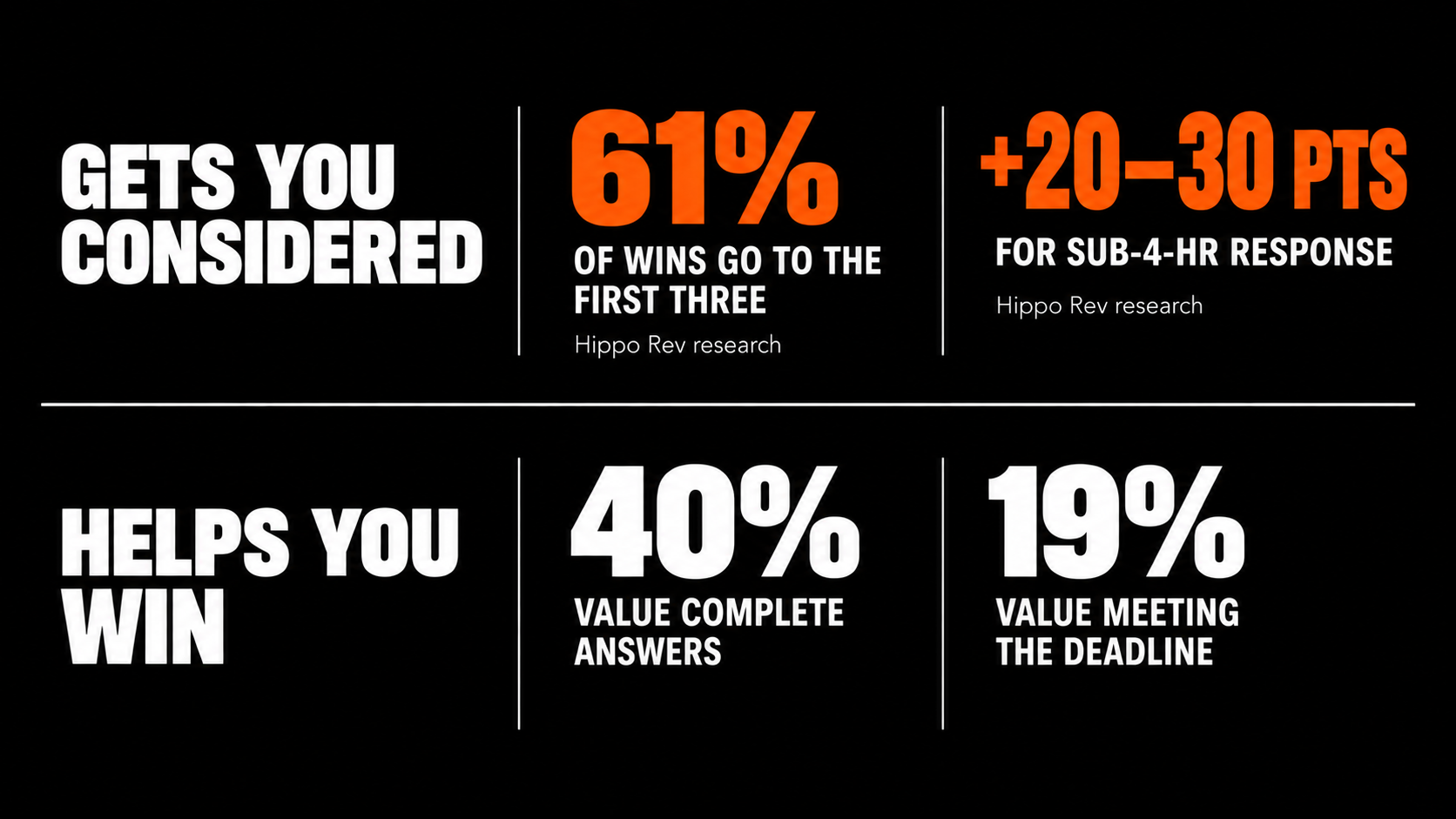
There is a legitimate reason hotels prioritize response speed.
Roughly 61% of won RFPs go to one of the first three hotels to respond, while hotels responding within four hours have been associated with win-rate advantages of approximately 20 to 30 percentage points compared with slower responders.
First-mover advantage matters.
An early proposal can shape the planner's expectations and become the benchmark against which later hotel proposals are compared.
But planners also care deeply about what is actually inside the proposal.
Industrywide planner research has found that 40% of planners said hotels could improve their chances of winning by answering every question contained in the RFP, while 19% pointed to meeting the stated deadline. Accurate pricing was also identified as an important factor.
The lesson is straightforward:
Speed gets a hotel considered. Accuracy, completeness, fit, pricing, and personalization help win the business.
Responding first with an incomplete proposal is not automatically better than responding later with a stronger one.
Why a Universal Two-Hour or 24-Hour RFP Rule Does Not Work
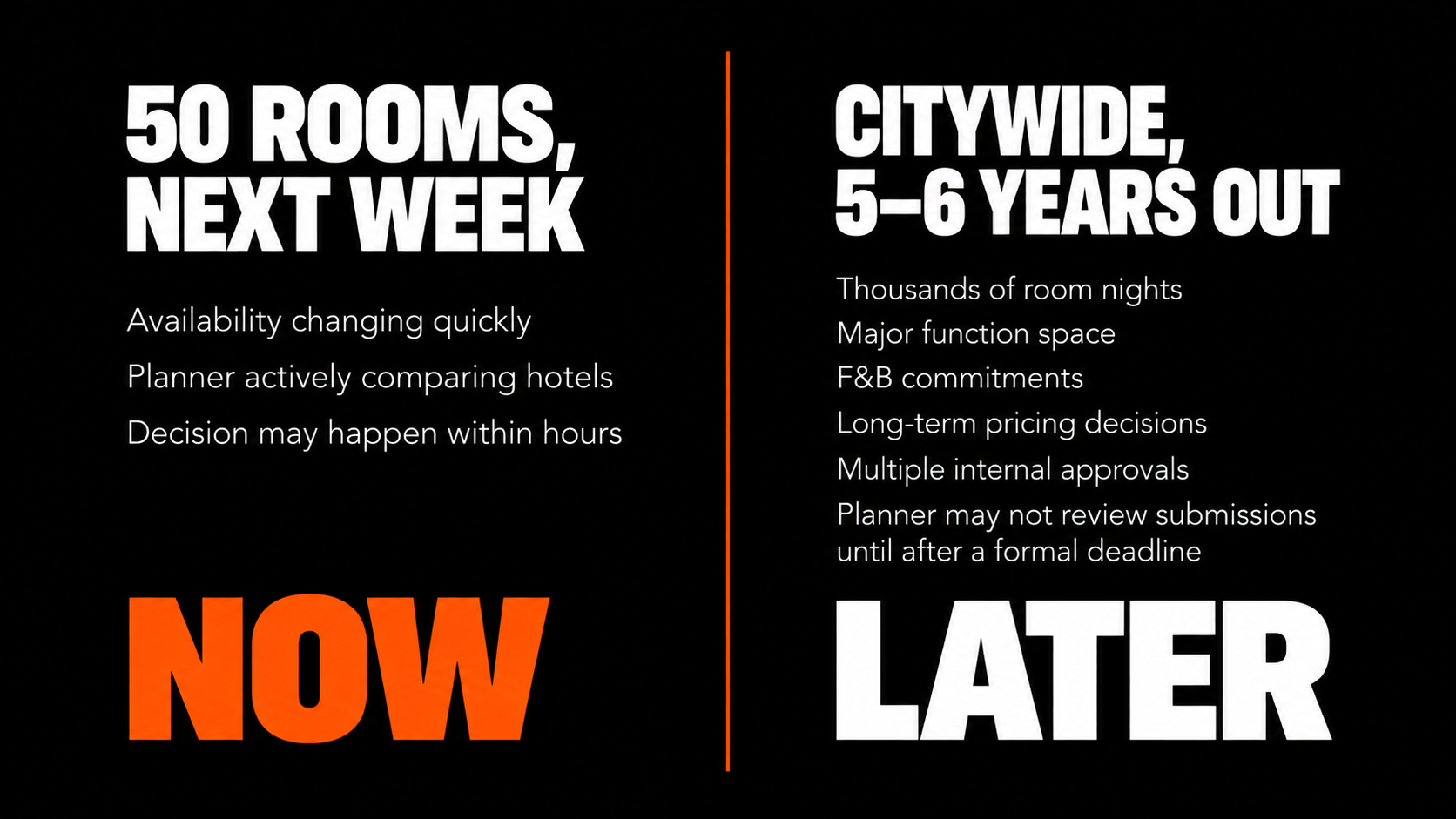
Not all hotel RFPs require the same amount of work.
Consider two examples.
A planner needs 50 rooms and a meeting room next week. Availability is changing quickly, the planner is actively comparing hotels, and the booking decision may happen within hours.
Speed is crucial.
Now consider a future citywide requiring thousands of room nights, major function space, food and beverage commitments, long-term pricing decisions, and multiple internal approvals.
The planner may have provided a formal response window and may not review submissions until after the deadline.
Treating both opportunities as if they require an identical turnaround time ignores the actual nature of the decision.
Forcing every RFP into the same response window can push hotel sales managers toward a transactional process:
receive, price, submit, move on.
That is exactly the wrong mindset for complex group business, where creativity, strategic pricing, flexibility, and thoughtful problem-solving can differentiate one property from another.
A Better Hotel RFP Response-Time Framework
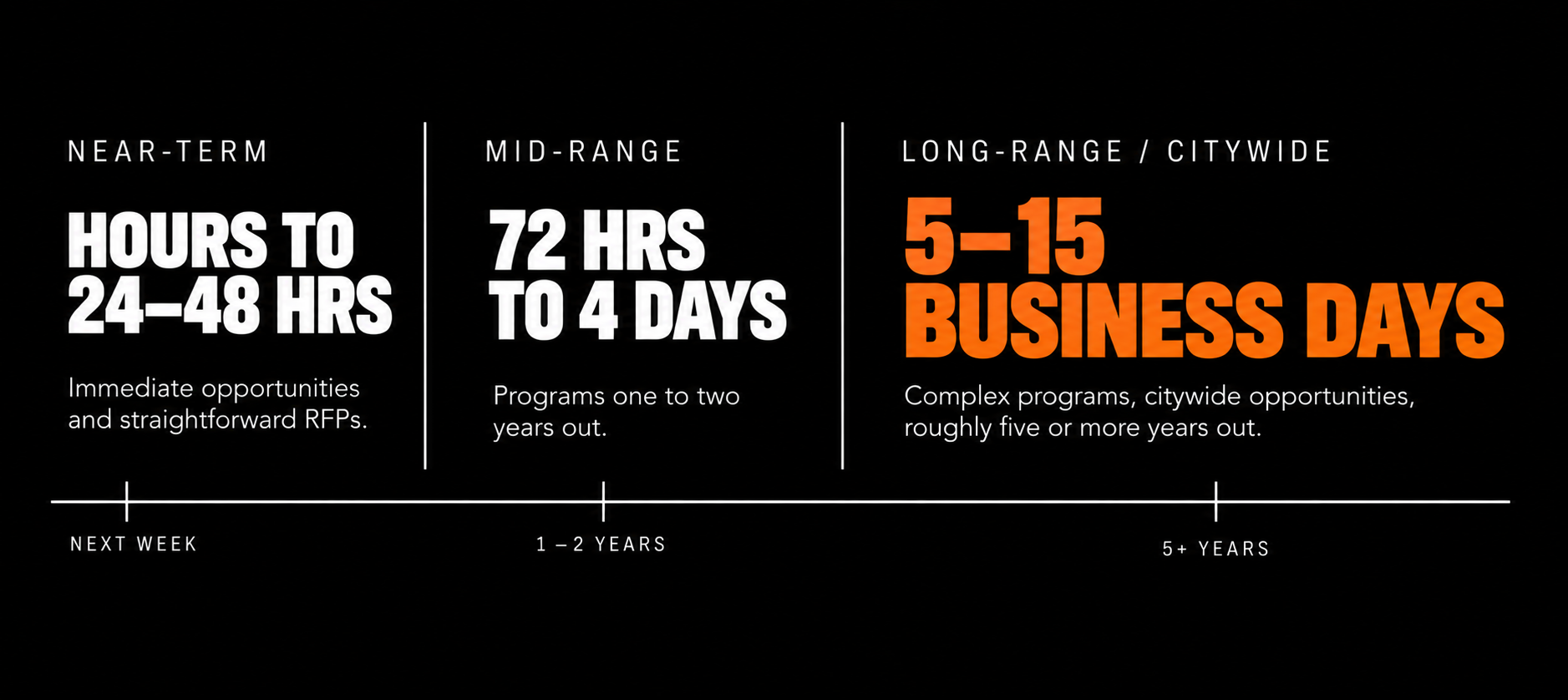
A more effective approach is to scale response expectations according to the event horizon, complexity, room-block size, meeting-space requirements, flexibility, and level of internal coordination required.
Near-Term and Straightforward Group RFPs: Respond Quickly
For urgent inquiries, short-lead bookings, and relatively straightforward programs, speed should remain a priority.
If the group is arriving soon or availability is actively changing, the planner may be making a decision while responses arrive.
These opportunities can justify responses within hours.
For straightforward programs one to two years out, a 24- to 48-hour response window can often be reasonable when dates, historical data, availability, and requirements are clear.
These are the opportunities where fast response time and planner experience can align without sacrificing strategic accuracy.
Mid-Range Group Programs: Allow Time for Analysis
As an event moves further into the future, certainty decreases.
Future city compression may not yet be clear. Event calendars may still be developing. Renovations, infrastructure changes, market conditions, and pricing strategies can evolve.
For programs several years out, approximately 72 hours to four days can provide hotel sales and revenue teams more time to produce a defensible response rather than relying on assumptions.
Long-Range, Complex, and Citywide RFPs: Strategy Requires More Time
Large citywides and long-range programs can involve significant financial and operational commitments.
These opportunities may require displacement analysis, revenue-management modeling, ownership or GM approval, meeting-space strategy, coordination with the local convention and visitors bureau, and assumptions about market conditions years in advance.
For programs roughly five or more years into the future, particularly citywide or highly complex events, five to fifteen business days may be a more realistic response period.
The precise number of days will vary.
The important principle is that the required turnaround should reflect the complexity and horizon of the decision rather than an arbitrary universal deadline.
Why Immediate Acknowledgment Can Matter More Than an Immediate Proposal
One of the most useful improvements hotel sales teams can make is separating acknowledgment from completion.
Planners do not always need a full proposal immediately.
Often, they need confirmation that someone has seen their request, intends to respond, and can provide a clear timeline.
A prompt acknowledgment tells the planner:
- The RFP was received.
- The hotel is actively reviewing the opportunity.
- The request has not disappeared into an inbox.
- A complete proposal will arrive by a specific date.
That visibility can maintain trust even when the proposal itself requires several days of work.
For complex RFPs, a fast acknowledgment combined with a realistic delivery commitment can create a better planner experience than a rushed proposal sent immediately and corrected repeatedly afterward.
What Happens When Hotel RFP Deadlines Are Too Aggressive?
Unrealistic turnaround expectations can create several predictable problems.
Hotels Decline Business They Could Potentially Accommodate
Under intense time pressure, sales managers may review an opportunity too quickly and determine that the hotel cannot accommodate it.
A more detailed analysis might reveal workable alternatives, such as date flexibility, different meeting-room configurations, catering solutions, or off-site function space.
A rushed “no” can eliminate business that better analysis might have converted into a “yes.”
Pricing Becomes Less Strategic
A hotel group proposal should consider more than availability.
Revenue management may need to analyze displacement, demand, compression, historical performance, and future market conditions.
When there is not enough time for that analysis, pricing may become overly conservative, generic, or disconnected from the true value of the opportunity.
Proposals Become Generic
If every RFP is treated as a race, customized selling becomes difficult.
Sales managers are encouraged to answer questions, complete required fields, and submit as quickly as possible rather than examining the planner's priorities and presenting creative solutions.
The result is a proposal that technically responds to the RFP but does little to differentiate the hotel.
Some RFPs Never Get Answered
Roughly 36% of inbound hotel group RFPs go unanswered entirely.
This is not always because sales teams lack interest.
Hotel sellers are also spending significant amounts of time on administrative tasks, manual data entry, follow-up, proposal formatting, status updates, and internal coordination.
Approximately 71% of seller time can be consumed by non-selling activities, contributing to significant revenue leakage.
When every inquiry is expected to move through the same urgent workflow, high-value opportunities can become buried alongside routine requests.
One especially vulnerable period is outside normal working hours, when after-hours hotel RFPs and leads can remain untouched while planners continue evaluating other properties.
The Real Hotel RFP Problem Is Often Administrative Work
Hotel sales managers generally know how to evaluate group business.
The bigger constraint is often how much administrative work stands between receiving an RFP and making a strategic decision.
A seller may need to:
- Capture information from an inbound request.
- Enter details into internal systems.
- Check inventory.
- Find historical information.
- Coordinate with revenue management.
- Request internal approvals.
- Compile meeting-space information.
- Format the proposal.
- Track deadlines.
- Follow up with the planner.
The more time sales professionals spend gathering and transferring information, the less time they can spend selling.
That is why improving hotel RFP response time should focus heavily on eliminating unnecessary administrative work rather than simply telling salespeople to work faster.
How Automation Can Improve Hotel RFP Response Times Without Sacrificing Quality
Automation has an important role in modern hotel group sales, but the goal should not be generating the fastest possible generic proposal.
The biggest opportunity is automating the repetitive work surrounding the strategic sales process.
An effective hotel RFP system can help:
- Capture inbound RFPs regardless of source.
- Prevent opportunities from sitting unnoticed in individual inboxes.
- Identify deadlines and event dates automatically.
- Route opportunities according to urgency and fit.
- Compile relevant account and inventory information.
- Reduce repetitive data entry.
- Track outstanding responses.
- Support follow-up.
- Give sales managers more time for pricing, strategy, and personalization.
Hotels have reduced manual RFP processing from roughly 37 minutes to about four minutes per request by automating administrative steps.
That difference matters because the objective is not simply sending proposals faster.
It is giving sales managers enough capacity to respond quickly and thoughtfully.
The Risk of Automating the Entire Hotel Proposal
AI and automation can generate proposal content rapidly once inventory and account information are available.
But automating the entire sales response creates another risk.
If every competing hotel relies on similar automated proposal templates, planners may receive several responses that sound almost identical.
When differentiation disappears, price becomes one of the few obvious comparison points.
That risks turning hotel group sales into a rate competition rather than a conversation about value, fit, creativity, service, and partnership.
Automation works best when it removes mechanical work while preserving human judgment.
A system can help gather the information.
The salesperson should still understand the program.
What an Effective Hotel Group RFP Process Should Look Like
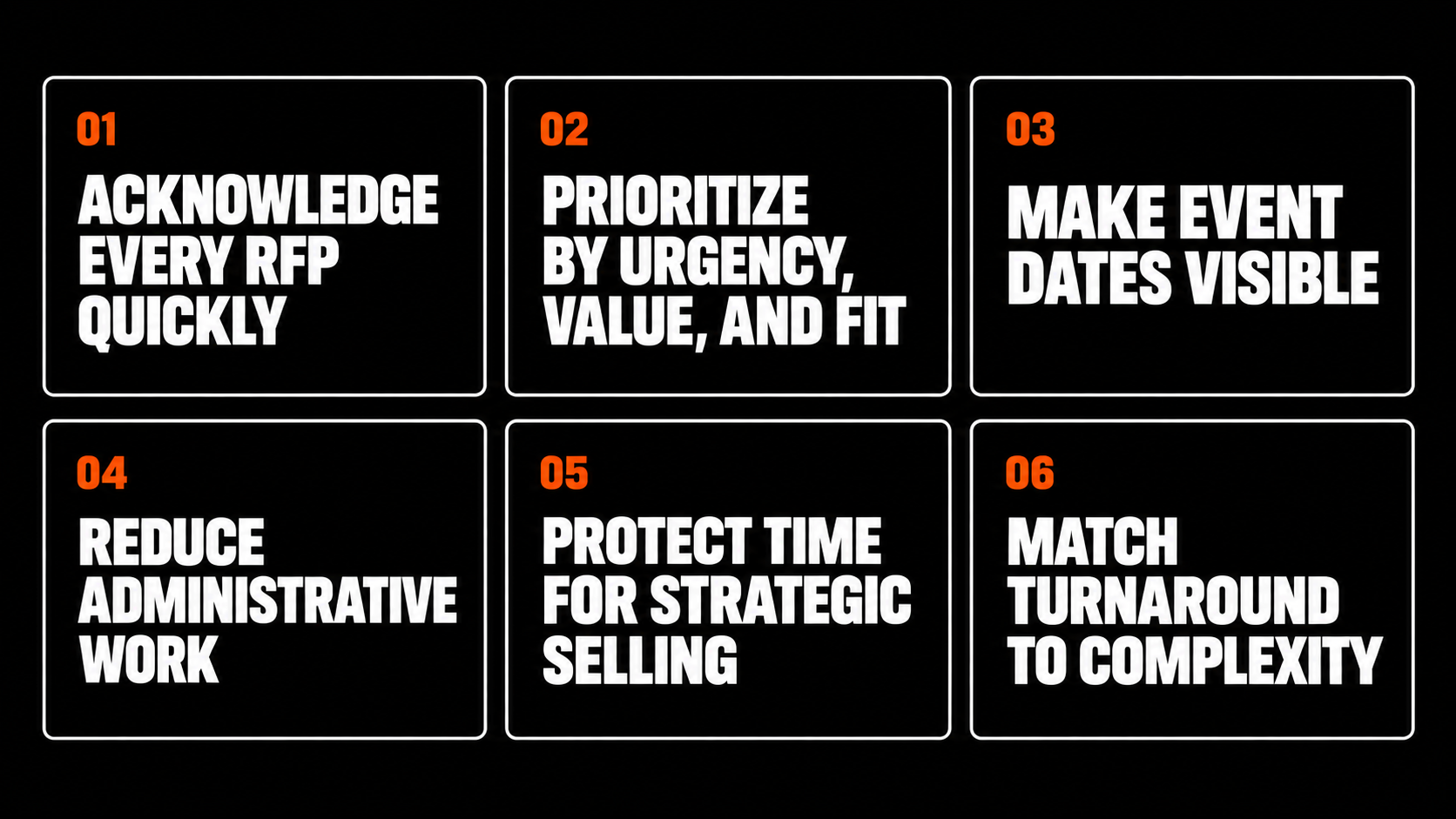
A strong RFP process should help hotel teams respond differently to different opportunities rather than forcing every request through one workflow.
An effective process should:
Acknowledge every RFP quickly.
The planner should know the request was received and understand when a full response will arrive.
Prioritize based on urgency, value, and fit.
A short-lead opportunity requiring immediate action should not compete for attention on exactly the same basis as a long-range citywide.
Make event dates and deadlines visible.
Sales teams should immediately understand whether the program is arriving next week, next year, or several years from now.
Reduce administrative work.
Technology should handle repetitive data capture, routing, tracking, and information gathering wherever possible.
Protect time for strategic selling.
Sales managers should spend their time analyzing displacement, positioning rates, developing creative solutions, and building relationships.
Match proposal turnaround to complexity.
The amount of time allocated to a response should reflect the actual work needed to produce a reliable proposal.
What Event Planners Can Do to Get Better Hotel Proposals
Hotels are not the only side responsible for creating an efficient RFP process.
Planners influence proposal quality through the way they source business.
Sending requests to a smaller group of well-matched hotels, providing realistic budget parameters, outlining priorities clearly, and setting response deadlines that reflect program complexity can produce better outcomes.
A realistic timeline gives hotels more opportunity to build strategic pricing and concessions.
When a deadline genuinely cannot be met, hotels should communicate immediately and offer a reasonable alternative timeline rather than remaining silent.
The most productive RFP process is based on mutual visibility rather than one-sided urgency.
Speed vs. Quality Is the Wrong Hotel RFP Debate
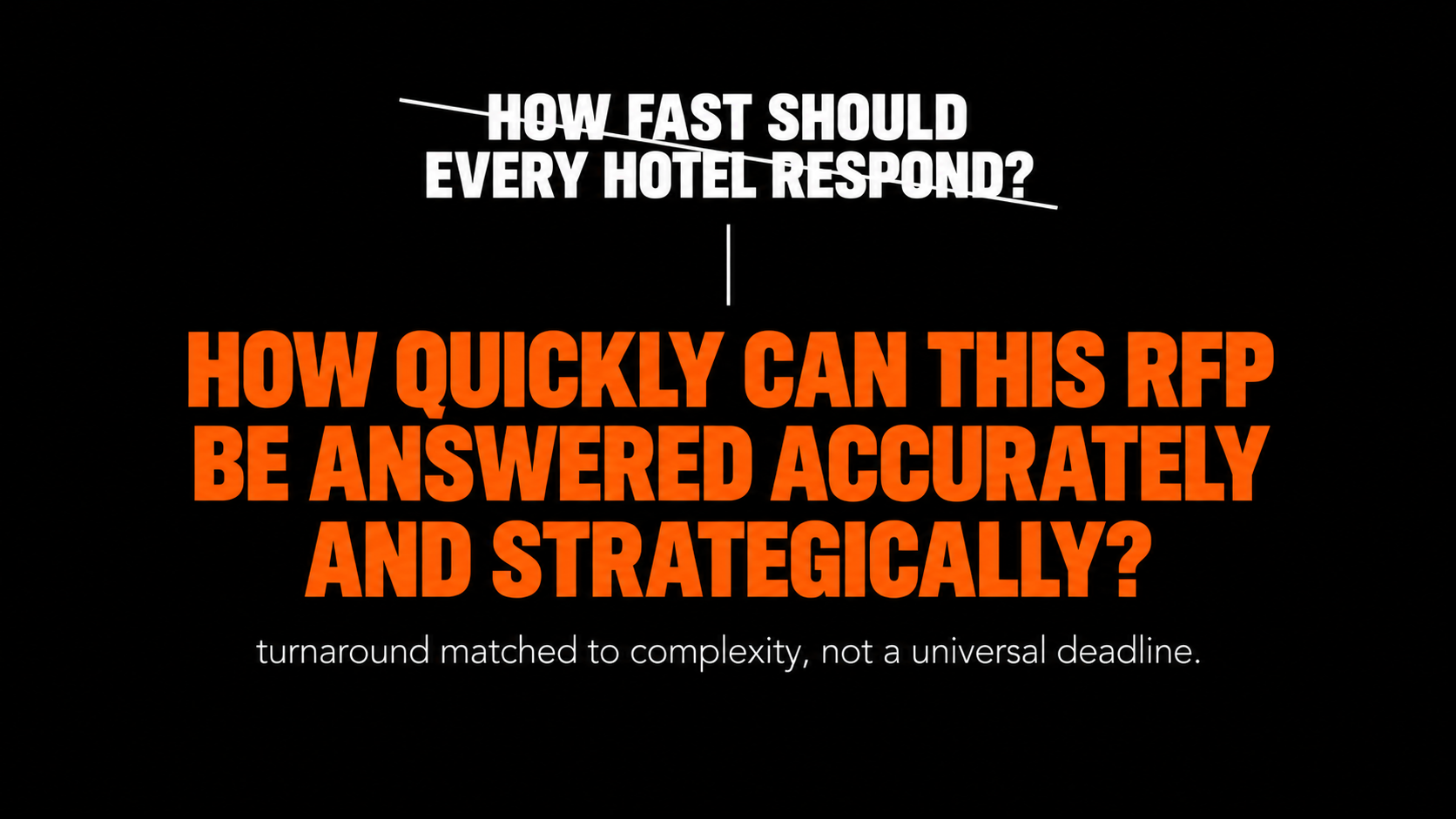
Hotel sales teams should not have to choose between answering quickly and answering well.
The real challenge is eliminating the administrative burden that makes those goals feel incompatible.
For a short-lead booking, being one of the first qualified hotels to respond can create a meaningful competitive advantage.
For a complex future citywide, the winning proposal may depend far more on accuracy, strategic pricing, capacity analysis, creative solutions, and internal alignment.
The right question is therefore not:
“How fast should every hotel respond to an RFP?”
The better question is:
“How quickly can this particular RFP be answered accurately and strategically?”
That distinction allows hotels to prioritize speed where speed genuinely influences the buying decision while protecting the analysis required for larger, longer-range opportunities.
The Bottom Line
There is no universal hotel RFP response time that works for every piece of group business.
Fast acknowledgment should be standard.
Full proposal turnaround should depend on lead time, complexity, room-block size, meeting-space requirements, internal approvals, and the planner's stated deadline.
Straightforward and near-term opportunities may justify responses within hours or 24 to 48 hours. Mid-range programs may require several days. Large citywide and long-range RFPs can reasonably require five to fifteen business days when strategic analysis and multiple stakeholders are involved.
Hotels improve their chances of winning when they stop treating response speed as an isolated KPI and start managing it as part of a broader group-sales strategy.
The goal is not to send the fastest proposal.
The goal is to send the fastest accurate, complete, competitive, and strategically sound proposal possible.
For hotel sales teams struggling with response times because manual RFP intake, tracking, follow-up, and data gathering are consuming selling hours, Hippo Rev is designed to reduce that administrative burden. By helping manage the repetitive work around RFP capture and follow-up, sales managers can spend more time on displacement analysis, rate strategy, internal coordination, personalization, and the decisions that actually influence whether a group books.
Book a free Capture Audit here.
Frequently Asked Questions
How quickly should hotels respond to group RFPs?
The appropriate hotel RFP response time depends on the program. Urgent or short-lead bookings may justify responses within hours, while straightforward future programs may reasonably receive responses within 24 to 48 hours. More complex or long-range programs can require several business days.
Should hotels respond to every RFP within 24 hours?
No single deadline is appropriate for every RFP. A 24-hour turnaround may work for a straightforward opportunity, but a complex citywide or long-range event may require significant revenue-management analysis, internal coordination, and executive approval before a reliable proposal can be submitted.
Does responding faster increase hotel RFP win rates?
Faster response can provide a competitive advantage. Industry data cited indicates that approximately 61% of won RFPs go to one of the first three responding hotels, while very fast responses have been associated with higher win rates. However, proposal completeness, pricing accuracy, personalization, and strategic fit also influence the planner's decision.
What should hotels do when they cannot meet an RFP deadline?
Hotels should acknowledge the request quickly, explain that additional analysis or approvals are required, and provide a realistic alternative delivery date. Clear communication is generally more useful than sending a rushed proposal or failing to respond.
Why do hotel group RFPs go unanswered?
High RFP volume, fragmented intake channels, manual data entry, internal coordination, follow-up responsibilities, and other administrative work can overwhelm hotel sales teams. Improving intake, routing, tracking, and automation can reduce the likelihood that qualified opportunities are missed.
How can hotels respond faster without sacrificing proposal quality?
Hotels can automate administrative tasks such as RFP intake, routing, data gathering, deadline tracking, and follow-up. Removing repetitive work allows sales managers to dedicate more time to pricing strategy, displacement analysis, customization, and relationship-building.
Is AI useful for hotel RFP responses?
AI can be useful for organizing information, automating repetitive tasks, and accelerating proposal preparation. However, the strongest approach preserves human judgment for strategic pricing, capacity decisions, creativity, personalization, and complex negotiations.
.jpg)
Hotel RFP Automation: How AI Helps Sales Teams Win Faster
AI is helping hotel group sales teams reduce RFP turnaround by automating manual intake, data gathering, proposal drafting, routing, and follow-up. The article explains why response speed affects win rates, where traditional RFP workflows lose time, and how hotels can use AI while preserving data quality, security, and human approval.
How AI Is Cutting Hotel RFP Response Times From Days to Hours
Hotel group sales teams lose deals for a reason that has nothing to do with rate or property quality: they simply answer too slowly. Meeting and event planners routinely send the same RFP to multiple venues at once, and the property that responds first often wins before the others have finished their pricing review. For hospitality sales teams still working through Requests for Proposals (RFPs) by hand, that speed gap is now one of the biggest controllable factors in win rate.
This article looks at what's actually driving the industry's shift from multi-day RFP turnaround to same-day and near-real-time response, what the current data says about the payoff, and what a hotel group should look for if it's evaluating AI to close that gap.
Why RFP Response Time Decides Who Wins the Deal
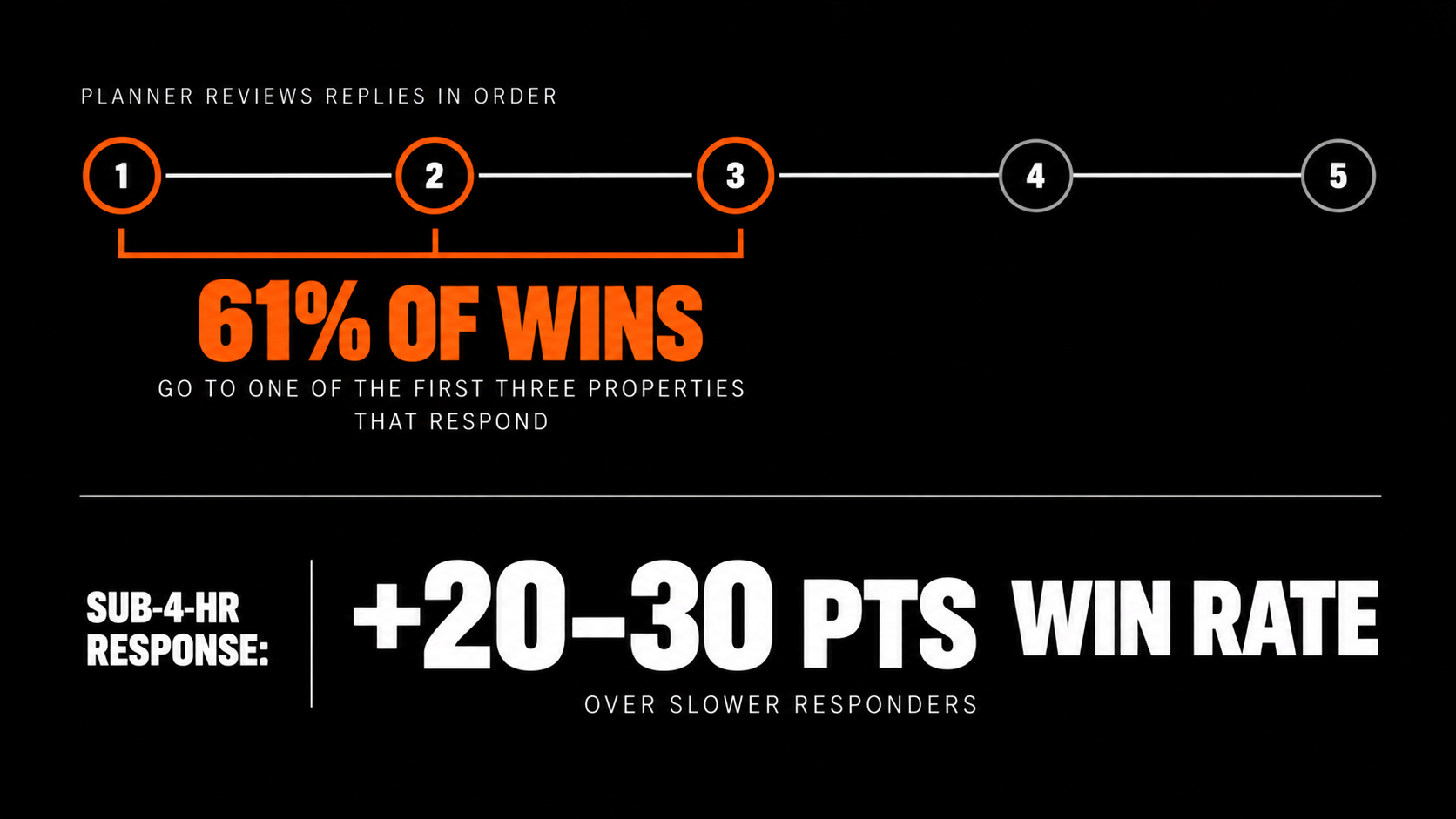
Response speed is not a minor operational metric in group sales. It's one of the clearest predictors of who wins the business. Roughly 61% of won hotel RFPs go to one of the first three properties that respond, and a sub-4-hour response time correlates with a 20 to 30 percentage point win-rate advantage over slower responders. In a category where the average hospitality RFP win rate already sits at just 5% to 7% (compared with roughly 44 to 45% across industries broadly), that gap is the difference between a sales team that competes and one that's perpetually catching up.
The math behind this is straightforward. A meeting planner sourcing a group event typically sends the RFP to several venues in parallel, then works down the list of replies as they arrive. Properties that respond within hours stay in the conversation while the planner is still actively comparing options. Properties that take a day or two often arrive after a shortlist has already formed, meaning the proposal gets a fraction of the attention it would have received earlier, if it gets read at all.
Recent industry benchmarking backs this up. According to Loopio's 2026 RFP trends analysis, the average win rate across industries climbed to 45% in 2025, up from 43% the prior year, with the improvement concentrated among teams that tightened their response process rather than teams that simply wrote more proposals. Speed and process discipline, not proposal volume alone, are what move the win rate.
What Actually Slows Down a Hotel RFP Response
Before looking at AI's role, it's worth being specific about where the time actually goes, because "slow RFP response" usually isn't one problem. It's several smaller ones stacked together:
- RFPs get missed entirely. An estimated 36% of RFPs sent to hotels go unanswered, not because the property couldn't win the business, but because the request landed in an inbox, a portal, or a shared folder that nobody checked in time.
- Manual intake and triage eats the clock. Processing a single RFP by hand, pulling it from email or a sourcing platform, checking dates against group inventory, routing it to the right salesperson, takes about 37 minutes on average when done manually.
- Sellers spend most of their time on work that isn't selling. Industry data puts the share of a seller's week spent on non-selling tasks, data entry, searching for past proposal language, chasing internal approvals, at roughly 71%.
Analysts estimate this combination of missed, delayed, or under-resourced RFP response costs a hotel salesperson roughly $500,000 in annual revenue leakage, primarily through business that goes to a faster-responding competitor.
None of this is really about writing quality. It's about how much of the "before the writing starts" process, finding the RFP, pulling the right rates and past answers, checking availability across systems, is manual. That's the part AI has started to compress.
From Days to Minutes: What AI Actually Changes
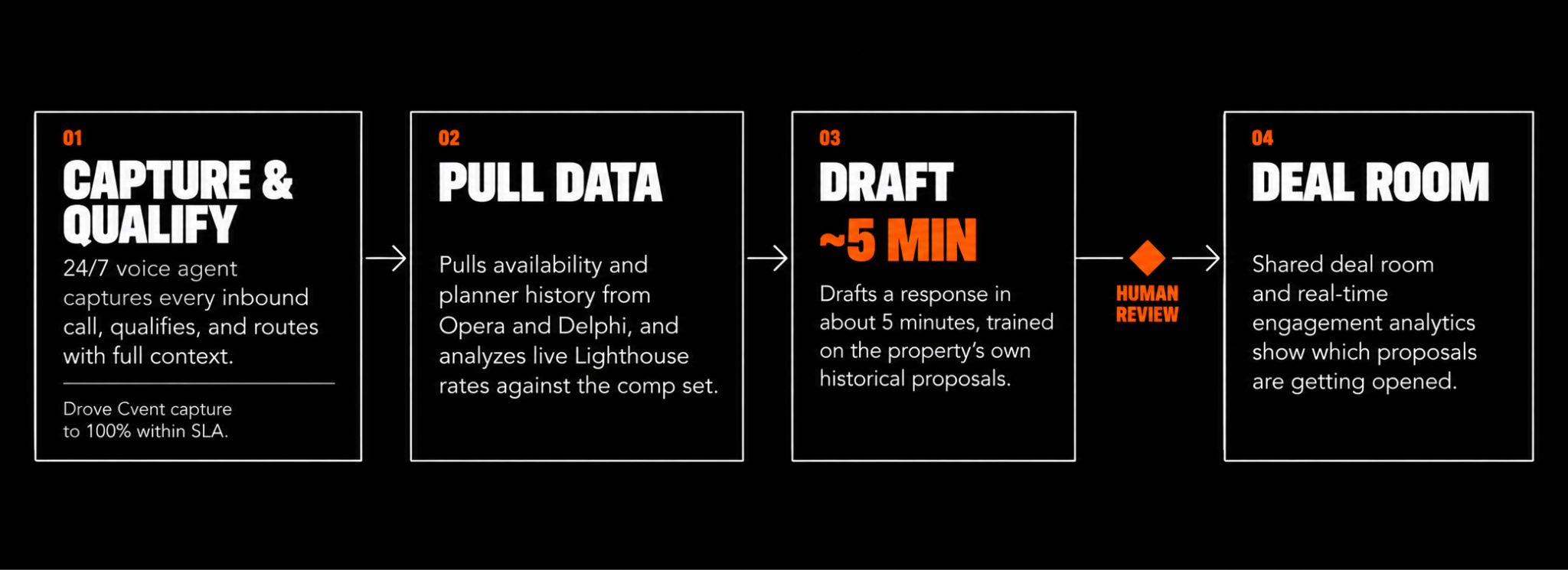
A useful illustration of how this plays out comes from Wyndham Indianapolis West, a 407-room property with roughly 37,000 sq ft of meeting space, which deployed Hippo Rev in 2026. The hotel's group sales demand came from Cvent, VisitIndy, Eventective, Wyndham Community, and direct email and phone, with 312 Cvent RFPs alone in the prior twelve months. Every one of them triggered the same manual sequence: check availability in Opera, pull current rates from Lighthouse, check planner history in Delphi, build the proposal in a Word template, review, send. That process took about 33 minutes per RFP, and with roughly 26 Cvent RFPs a month before counting other channels, a single rep was losing the better part of two days a week to admin. After-hours calls rolled to voicemail, and pricing varied rep to rep since it came down to whoever happened to be handling the request.
Hippo Rev went live as an overlay on the property's existing systems, no migration, no new tools to learn, in 10 days, and now runs across all three stages of the lifecycle. A 24/7 voice agent captures and qualifies every inbound call and routes it with full context, which brought Cvent capture to 100% within SLA. For proposals, the system pulls availability and planner history from Opera and Delphi, analyzes live Lighthouse rates against the comp set, and drafts a response in about 5 minutes, trained on the property's own historical proposals so it reads in the team's voice. A shared deal room and real-time engagement analytics show which proposals are actually getting opened.
Owner Rita Patel-Chevere put it plainly: "My team is finally doing what they should be doing. Not typing RFPs. Closing deals." The results: RFP turnaround cut 85%, from 33 minutes to 5, 100% Cvent capture, and a property sales target raised 10% on the strength of the new run rate.
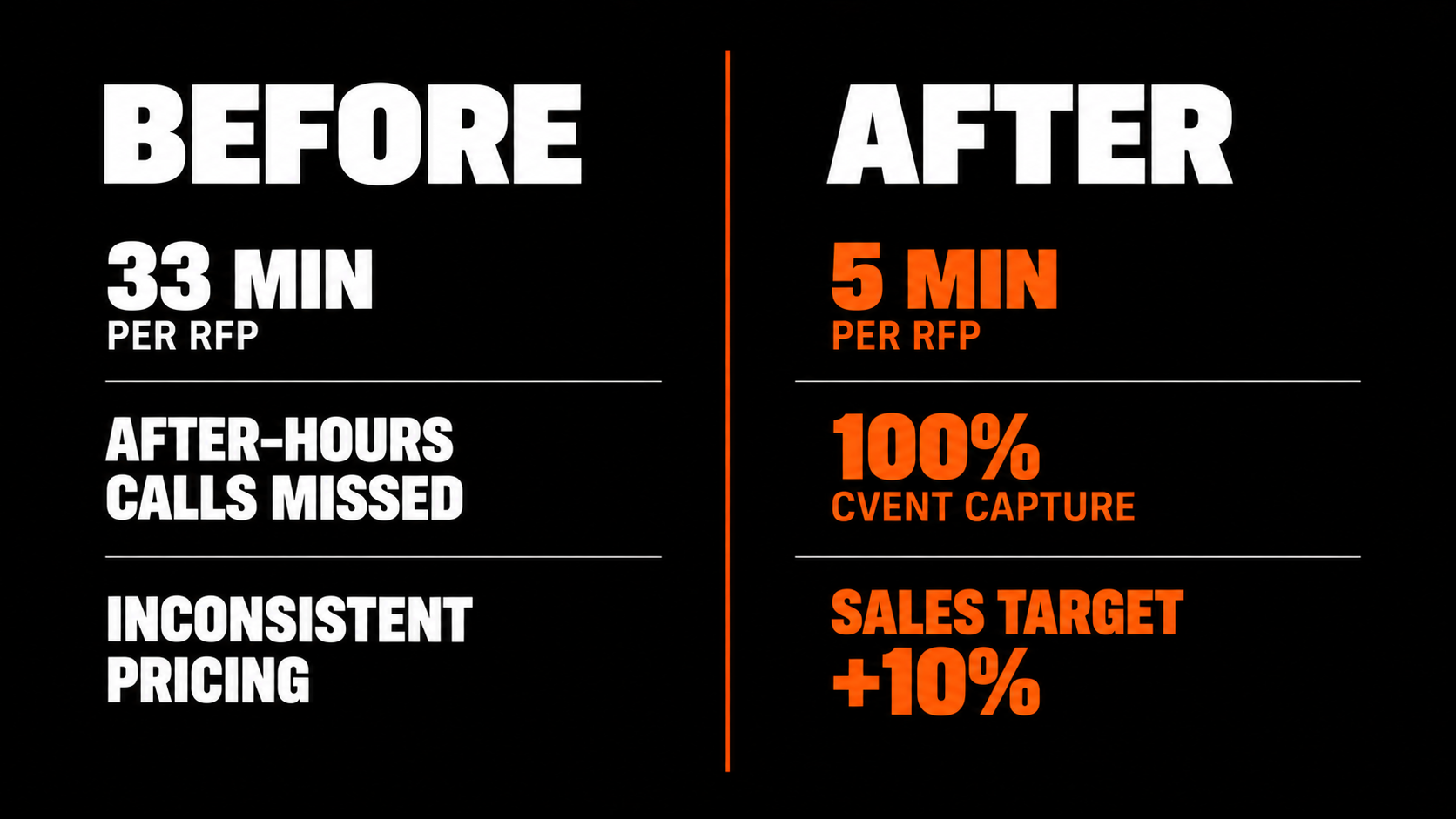
Why Speed Alone Isn't the Whole Story
It's worth being precise here: faster is not automatically better if it comes at the cost of accuracy. Wyndham's pricing recommendations are built directly from the property's own comp set and proposal history specifically to prevent the kind of plausible-sounding but incorrect output that's a well-documented risk with generative systems operating outside a controlled data set.
In all such cases of successful AI adoption, consistent property data is especially important, because hotel RFP data inconsistency can undermine automation when different systems, documents, or team members are working from conflicting information. Read more about it here.
What a Hotel Sales Team Should Look For in AI-Assisted RFP Tools
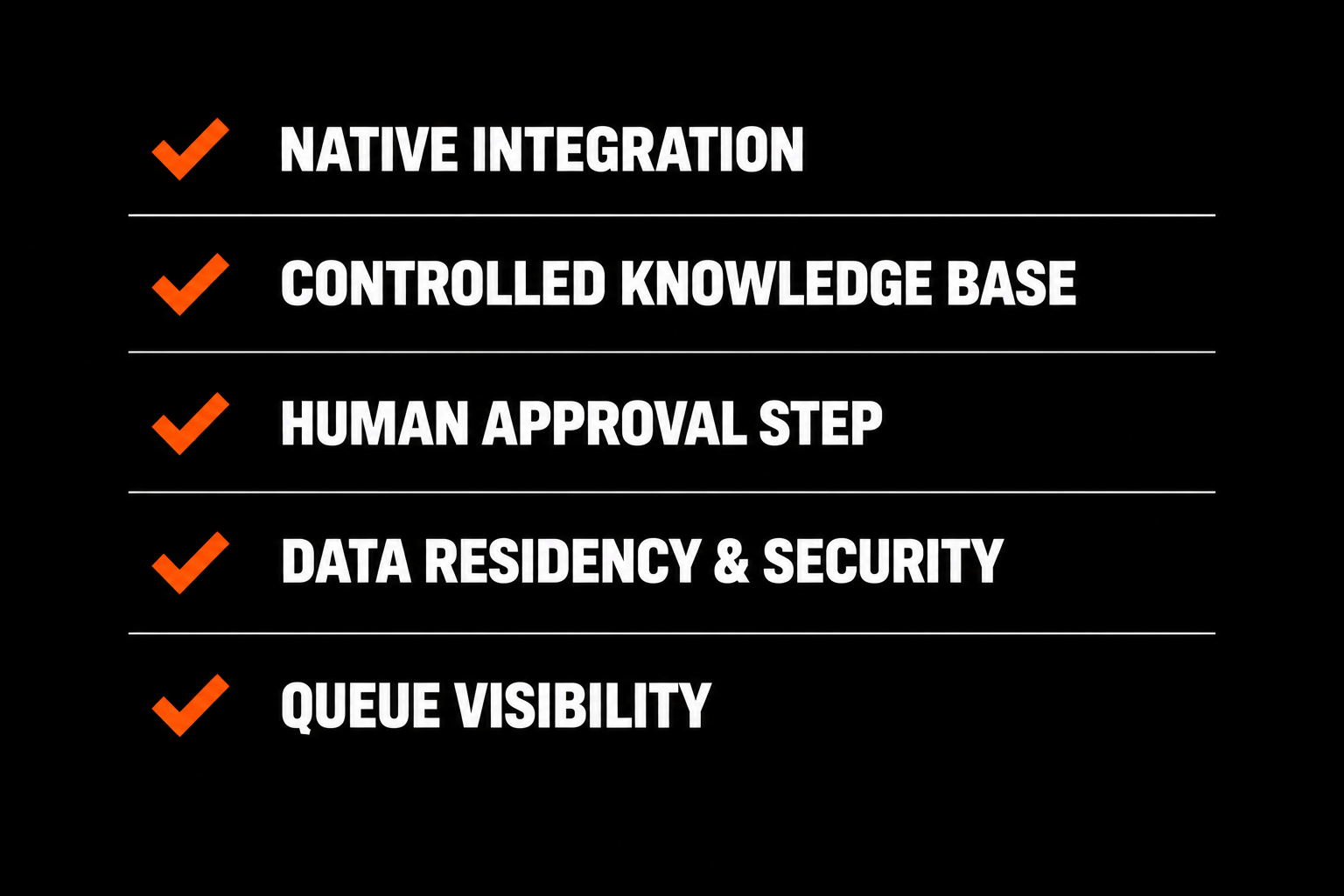
Given the operational and governance complexity involved, a few criteria separate tools that genuinely close the response-time gap from ones that add another disconnected system:
- Native integration with existing group sales infrastructure. A tool that requires manually re-keying data from Delphi, Cvent, or Opera into a separate system reintroduces the manual step it's supposed to remove.
- A controlled, brand-approved knowledge base. Answers should be drawn from a hotel's own past proposals, rate sheets, and property data, not generated from general web knowledge, to avoid the hallucination risk described above.
- A human approval step before anything reaches a planner. Speed shouldn't come at the cost of a final quality and accuracy check.
- Data residency and security controls appropriate to sensitive pricing and client information. RFP content includes competitive rate data and client details that shouldn't be processed by, or used to train, public AI models.
- Visibility into where RFPs stall. Teams benefit from knowing not just how fast they're responding on average, but which specific requests are sitting unanswered, so nothing falls through simply because no one was watching the queue.
The Bottom Line
The shift from multi-day RFP turnaround to same-day, and in many cases sub-hour, response is no longer an aspirational benchmark. It's what current AI-assisted proposal workflows are already delivering, provided the underlying data is well-governed and a human stays in the approval loop. For hotel group sales teams operating in a category where win rates already run far below the cross-industry average, and where the first three responders capture the large majority of won business, response speed is one of the few levers that's both fully within a sales team's control and directly tied to revenue outcomes.
The RFPs that get answered fastest and most accurately aren't necessarily coming from the largest sales teams. They're coming from teams whose intake, drafting, and follow-up no longer depend on someone manually checking an inbox, cross-referencing three different systems, and starting a proposal from a blank template.
That gap, between RFPs that get a fast, accurate answer and RFPs that quietly go unanswered or arrive too late to matter, is exactly what Hippo Rev is built to close for hotel group sales teams. It's designed to sit on top of the systems teams already use, catching and triaging incoming RFPs, pulling from a property's own approved content to draft a first response, and surfacing the requests at risk of going unanswered, all with a human still reviewing before anything is sent. If missed or slow RFP responses are costing your team business, you can see what that looks like against your own numbers with a free Capture Audit.
Frequently Asked Questions
How much faster can AI make hotel RFP response times?
Industry benchmarking shows average manual drafting time of roughly 25 hours per RFP, with AI-assisted teams cutting that to under 5 hours for standard requests. Hospitality-specific processing tasks that take about 37 minutes manually can drop to roughly 4 minutes when intake and drafting are automated.
Why does RFP response speed matter so much for hotels specifically?
Meeting planners typically send the same RFP to several venues at once and often work through responses in the order they arrive. About 61% of won deals go to one of the first three properties that respond, and hospitality's average win rate of 5-7% is already well below the roughly 44-45% average across other industries, making speed one of the few controllable factors that meaningfully moves the outcome.
Does faster AI-generated response mean lower quality?
Not when the AI draws only from a hotel's own approved content and a human reviews every proposal before it's sent. The risk of inaccurate or generic-sounding output comes from letting AI generate answers outside a controlled knowledge base, not from automation itself.
What's the biggest hidden cost of slow RFP handling?
Beyond lost individual deals, the combination of missed RFPs, manual triage time, and non-selling administrative work is estimated to cost a hotel salesperson roughly $500,000 in annual revenue leakage, mostly to competitors who simply responded first.
Is AI adoption for RFP response actually common yet, or still early?
It's moved past early-adopter territory. Generative AI use among proposal teams roughly doubled between 2023 and 2025, from about 34% to 68%, with nearly a third of adopters using it daily rather than occasionally.
.jpg)
Hotel Group Revenue Management: Why It Still Lags
Hotel group revenue management continues to rely heavily on manual pricing, fragmented RFP workflows, and static rate floors while transient pricing has become increasingly automated. The article explains how faster proposal turnaround, shared data, structured RFP intake, and market-responsive pricing can help hotels improve group sales win rates and reduce revenue leakage.
Why Hotel Group Revenue Management Still Lags Behind the Rest of the Business
Transient pricing at most hotels now runs on real-time demand signals, automated rate shopping, and forecasting models that adjust several times a day. Group business does not get the same treatment. Group rates are still set largely by hand, group RFPs still move through the same multi-department approval chain they did a decade ago, and the sales team fielding those RFPs is still buried in email.
That gap matters more now than it used to, because group demand has recovered and competition for it has intensified. Hotels are chasing the same event and meeting budgets with a process that was never built for speed.
This is the core problem in hotel group revenue management: the discipline that governs transient pricing has industrialized, while the discipline that governs group pricing and group sales response has not. The result shows up directly in win rates, in leaked revenue, and in how much of a sales team's day gets spent on administrative work instead of selling.
What Group Revenue Management Actually Covers
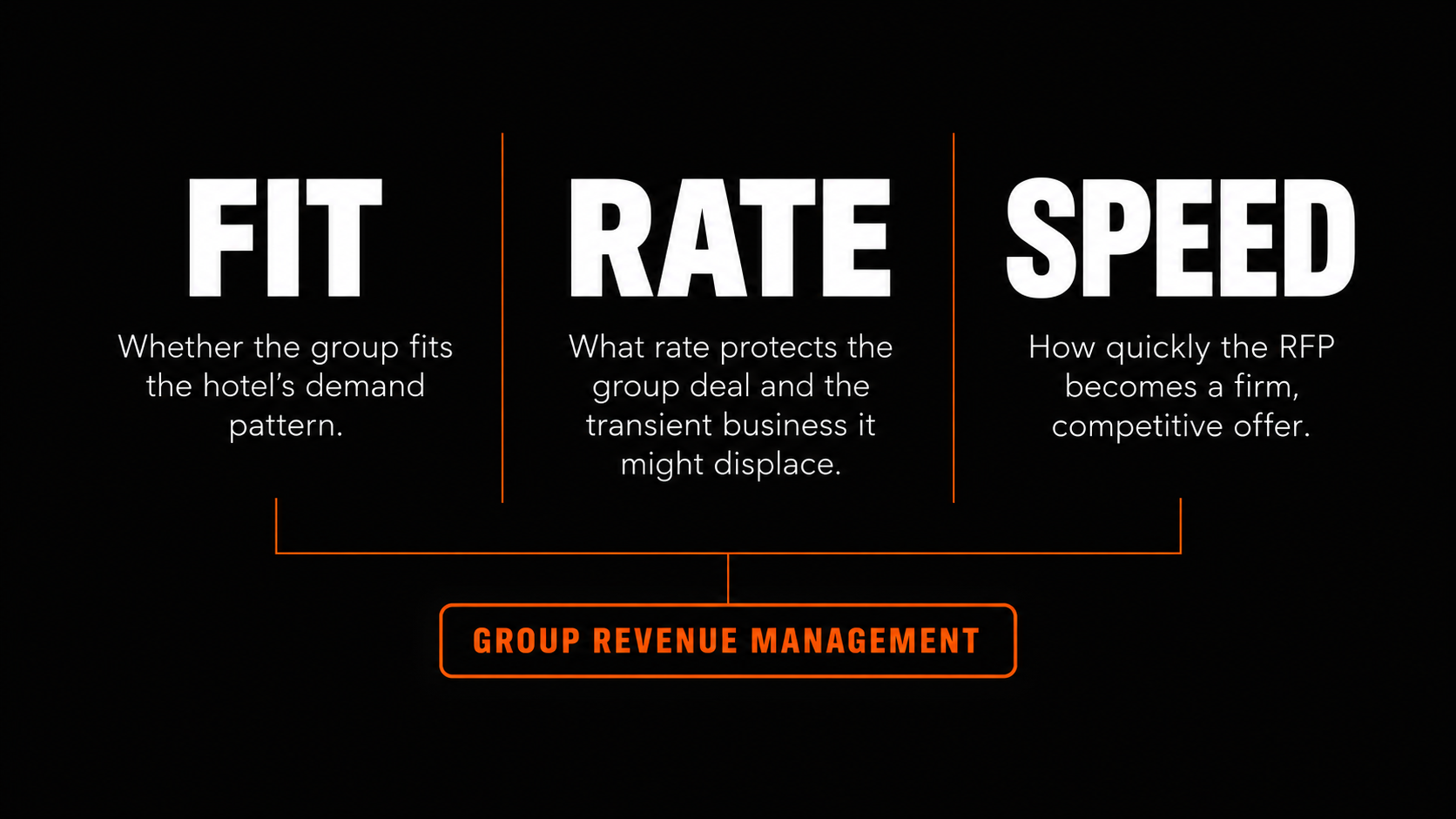
Group revenue management is the set of decisions a hotel makes about which group and meeting business to pursue, at what rate, and with how much room and function space displacement. It sits between sales, catering/events, and revenue management, and it typically involves three interlocking judgments: whether the group fits the hotel's demand pattern, what rate protects both the group deal and the transient business it might displace, and how quickly the hotel can turn a request for proposal (RFP) into a firm, competitive offer.
That last piece is where group revenue management most visibly breaks down. Transient pricing decisions happen inside a revenue management system in seconds. Group pricing decisions still typically require a human to check room availability, model transient displacement, price catering and food and beverage, and route the response through sales leadership — often across several email threads and spreadsheets.
Why Group RFPs Move Slower Than the Market Around Them
A group RFP response is a coordination problem before it is a pricing problem. Sales has to confirm the request is a fit. Revenue management has to model what the group would displace in transient revenue on the dates requested. Catering has to price meeting space, food and beverage, and any packages. Someone has to reconcile all of it into a single proposal before it goes back to the planner. Every one of those handoffs is a place where a request can sit in an inbox.
That coordination tax is showing up in industry research. Hotel News Resource's 2026 coverage of The State of Group, Event, and Corporate Sales found that 63.1% of hotels cite finding qualified leads as their top challenge in attracting group demand, while nearly 30% say quickly qualifying those leads is the part of the RFP process most in need of improvement. In other words, before a hotel even gets to pricing a group correctly, it is often struggling just to triage and move the request forward.
The volume problem compounds the coordination problem. Meeting planners today submit RFPs through hotel websites, third-party sourcing platforms, brand.com channels, and direct email — often to the same property simultaneously. Easy RFP, a sourcing-side resource for meeting planners, puts the average hotel RFP response rate at only 40–50%, and notes that hotels effectively triage incoming requests by fit, perceived probability of winning, and how much effort a clear response will take. Poorly formatted or ambiguous requests — a meaningful share of the volume most sales inboxes receive — get pushed to the bottom of the pile or dropped entirely.
Hippo Rev's own research into hotel group sales teams puts a number on how much of this volume goes unanswered altogether: roughly 36% of group RFPs never get a response. When a hotel is losing more than a third of its incoming opportunities before a rate is ever quoted, the problem isn't demand. It's throughput.
That problem becomes even more visible when you look at the four stages where hotel RFP revenue can leak from the sales process. Check out the full blog here.
The Real Cost of a Slow Response
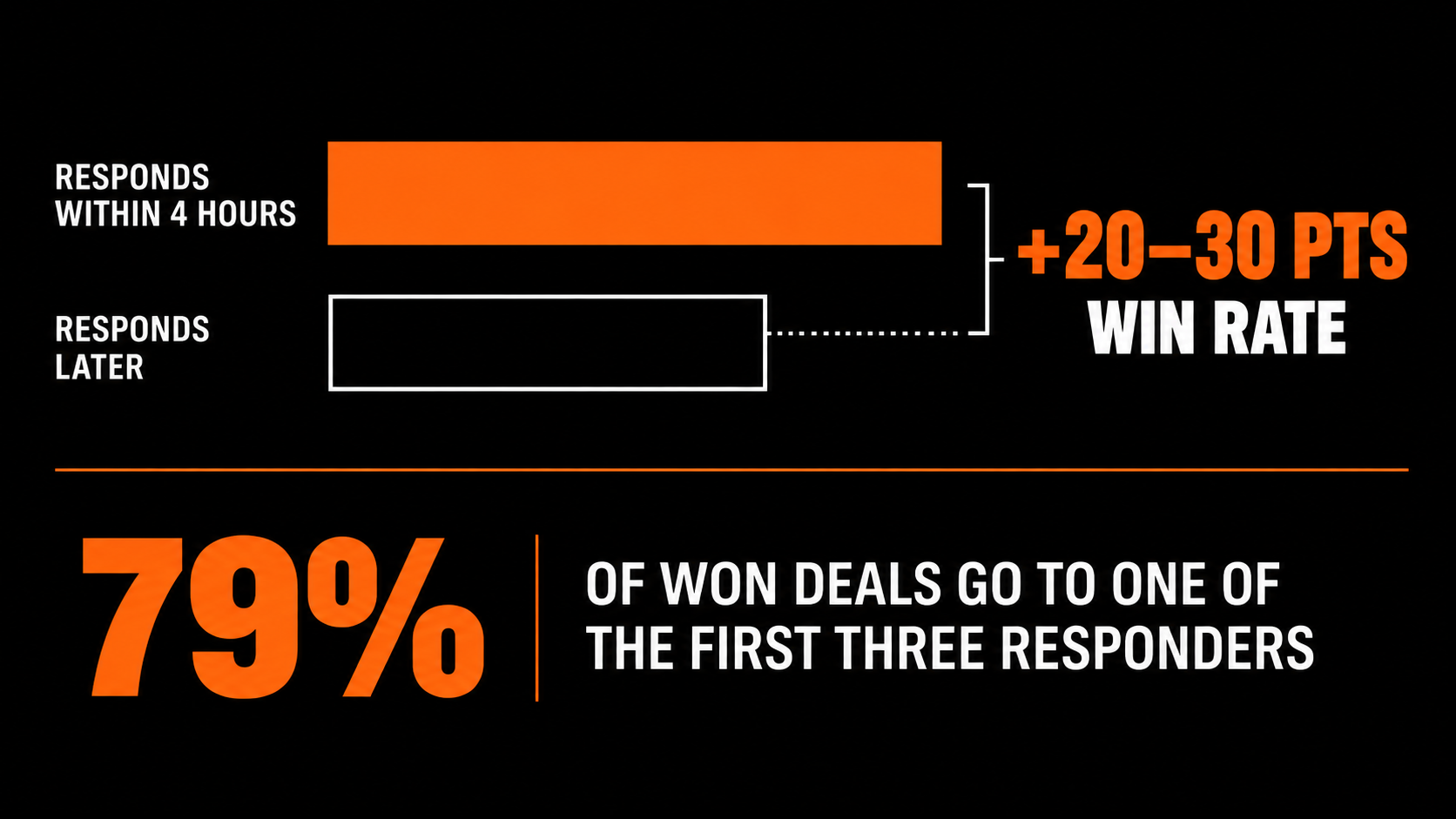
Speed is not a soft advantage in group sales — it is close to the whole game. Research on group sales response patterns has found that 75-79% of won group deals go to one of the first three hotels to respond, regardless of whether that hotel offered the lowest rate. Planners working multiple RFPs simultaneously tend to build their shortlist from whoever answers first and answers clearly, then negotiate from there. A hotel that responds fifth or sixth is often negotiating for a spot on a list that's already been narrowed.
The relationship between speed and win rate isn't marginal, either. Hotels that respond to a group RFP within four hours see a 20–30 percentage point win-rate advantage over slower responders. That is a large enough swing to change how a sales leader should think about staffing and process — a hotel that fixes response time is, in effect, fixing win rate without changing a single rate strategy.
The time cost behind that slow response is concrete, too. Manually processing a single group RFP — checking availability, modeling displacement, assembling a proposal — takes a hotel sales team roughly 37 minutes on average. Multiply that by dozens of weekly RFPs across property types, discounted concessions, and the peak-season crunch, and the disruption caused when people change roles or leave the team, and the arithmetic gets brutal: Hippo Rev estimates the resulting inefficiency costs a hotel salesperson approximately $500,000 in annual revenue leakage, largely from RFPs that arrive too slowly, get deprioritized, or never get a response at all.
That leakage is consistent with what broader proposal-management research shows about how sales teams spend their time. Loopio's 2026 RFP benchmarking work, compiled from proposal teams across industries, put average response time at 25 hours and found that AI-assisted response generation has roughly doubled in adoption over the past two years — evidence that speed has become a competitive lever organizations are actively trying to pull, not an incidental byproduct of a well-run team.
Sellers spend an estimated 71% of their time on non-selling tasks — chasing paperwork, re-keying the same information across systems, and manually assembling proposals — rather than on the qualifying, negotiating, and relationship work that actually wins group business.
Group Pricing Still Runs on a Static Number
The pricing side of group revenue management has its own version of the same problem. Most hotels set a minimum acceptable rate (MAR) for group business — a floor below which a rate should not be quoted — and then leave that number largely static across a booking window, adjusting it only occasionally as market conditions shift. That approach made sense when group rates were negotiated slowly and infrequently. It makes less sense now, when the transient side of the same hotel is repricing multiple times a day.
Current revenue management guidance treats this gap explicitly. Recent hotel revenue strategy analysis recommends defining rate floors tied directly to cost-per-occupied-room and reviewing pricing recommendations at least daily, on the logic that "rate decisions made on yesterday's data are already behind the market."
That standard is now routine on the transient side — PwC's 2026 outlook projects U.S. hotel RevPAR growth of 2.9% year over year, with demand growth of 3.2% outpacing supply growth of 2.3%, a gap that dynamic, frequently-updated pricing is built to capture.
A group MAR that gets set once at the start of a booking period and revisited only occasionally can't respond to that same movement, which means hotels are either underpricing group business relative to what the market would bear, or holding a rate so rigidly that they lose winnable deals to a competitor with more pricing flexibility.
The deeper issue is that group pricing and group response speed are not actually separate problems — they're the same problem viewed from two angles. A hotel that can't quickly model transient displacement also can't quickly and confidently defend a group rate in negotiation. A hotel that takes 37 minutes to assemble one proposal doesn't have the bandwidth to revisit its MAR daily. Fixing the coordination bottleneck is largely what makes more responsive, more accurate group pricing possible in the first place.
What an Effective Group Revenue Management Process Looks Like
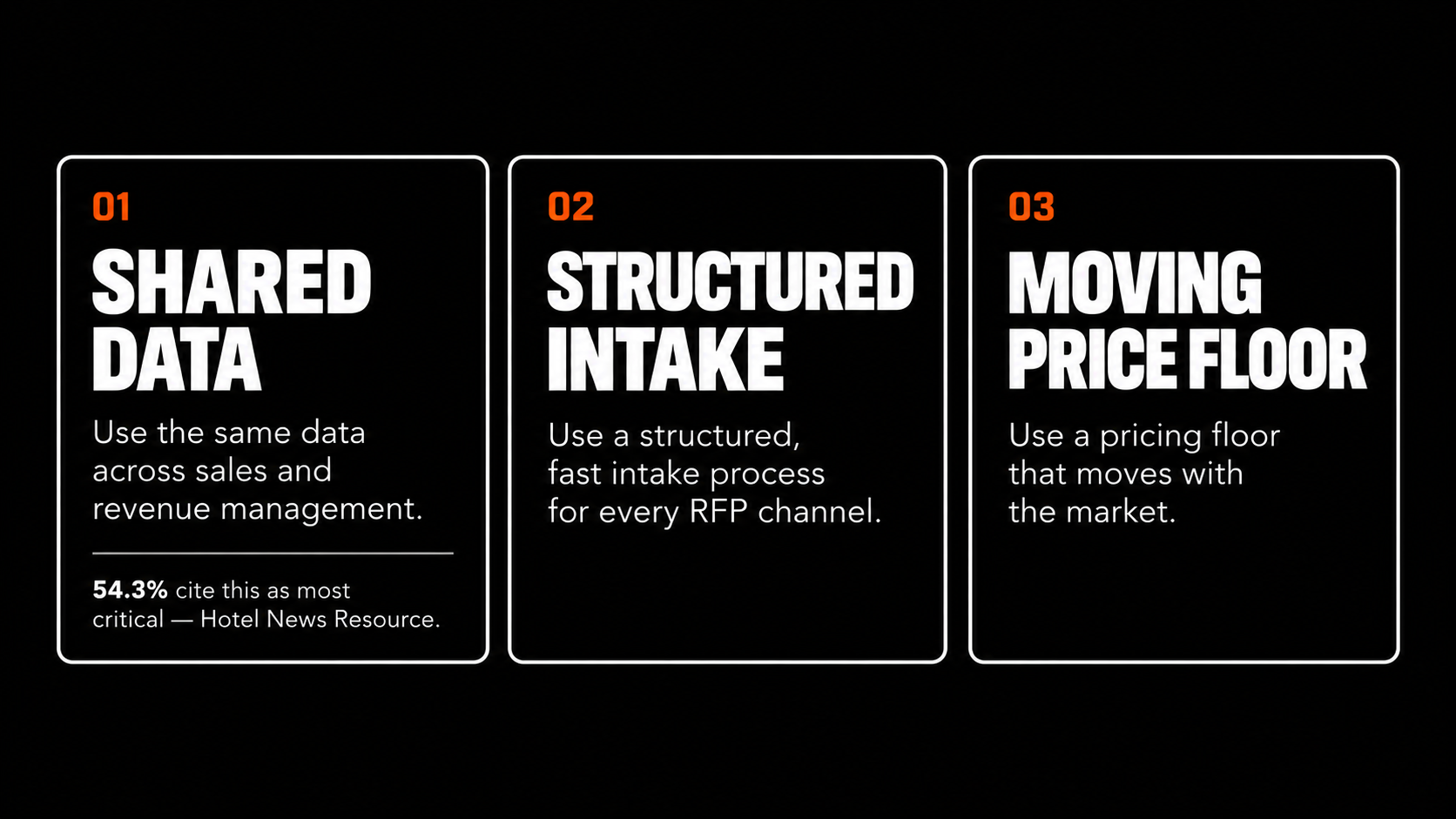
Hotels that manage group business well tend to share three characteristics, based on both current industry research and the operational logic of the problem itself:
- Shared data between sales and revenue management. Hotel News Resource's 2026 research found that 54.3% of hotels say sharing data and account intelligence is the single most critical factor for revenue management and sales working effectively together.
When both functions are working from the same view of demand, displacement, and account history, pricing decisions and proposal turnaround both get faster. - A structured, fast intake process for every RFP channel. Because RFPs arrive through multiple channels at once — direct email, hotel website forms, sourcing platforms — hotels that respond consistently tend to route every request through one intake process rather than triaging by channel or by whoever happens to see it first.
- A pricing floor that moves with the market. Rather than a MAR set once and left alone, stronger group pricing processes revisit the floor regularly, using the same demand signals that already drive transient pricing.
None of these are exotic requirements. They're closer to operational discipline than new technology in the abstract — but they are genuinely difficult to sustain by hand once RFP volume passes a certain point, which is exactly where most group sales teams already are.
Group RFPs vs. Transient Bookings: Why the Comparison Matters
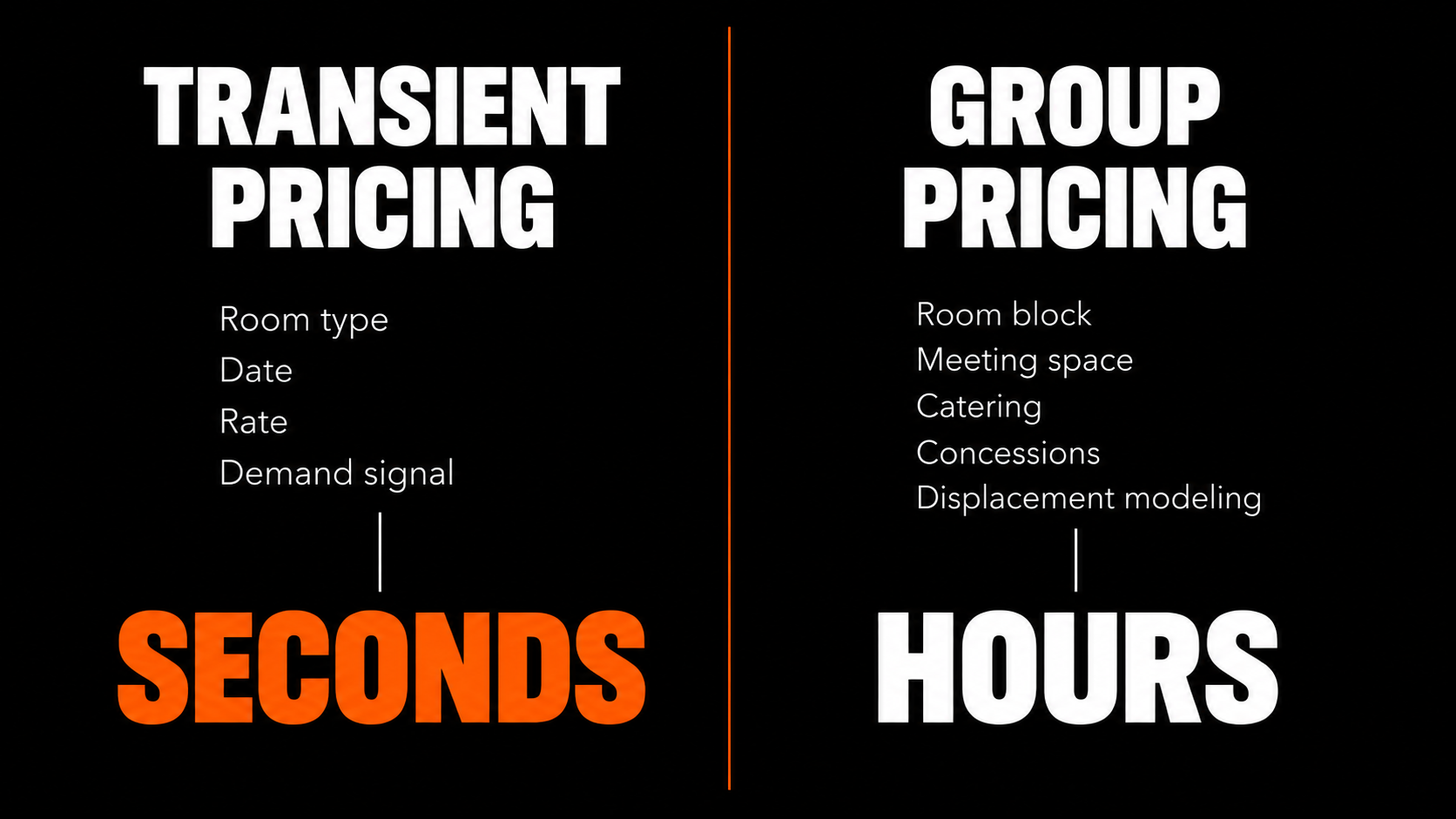
It's worth being precise about why transient pricing outpaced group pricing in the first place, because it explains what actually needs to change. Transient revenue management became automated because the decision structure is simple and repeatable: one room type, one date, one rate, adjusted against demand signals a system can ingest continuously. Group revenue management involves a proposal, not a rate — room block, meeting space, catering, concessions, and displacement modeling all bundled into one document that has to go back to a planner who is comparing it against several other hotels' proposals on the same timeline.
That complexity is real, but it isn't a reason group RM has to stay manual — it's a reason the coordination and data-assembly work around it is worth automating, even if the final judgment call on a group deal still belongs to a person. The hotels narrowing the gap between group and transient sophistication aren't necessarily negotiating differently. They're removing the 37 minutes of manual assembly work between "RFP received" and "proposal sent," so that the humans on the sales and revenue management side spend their time on judgment calls instead of data entry.
Check out our detailed blog on how the traditional hotel group sales proposal process is increasingly showing its limitations.
The Bottom Line
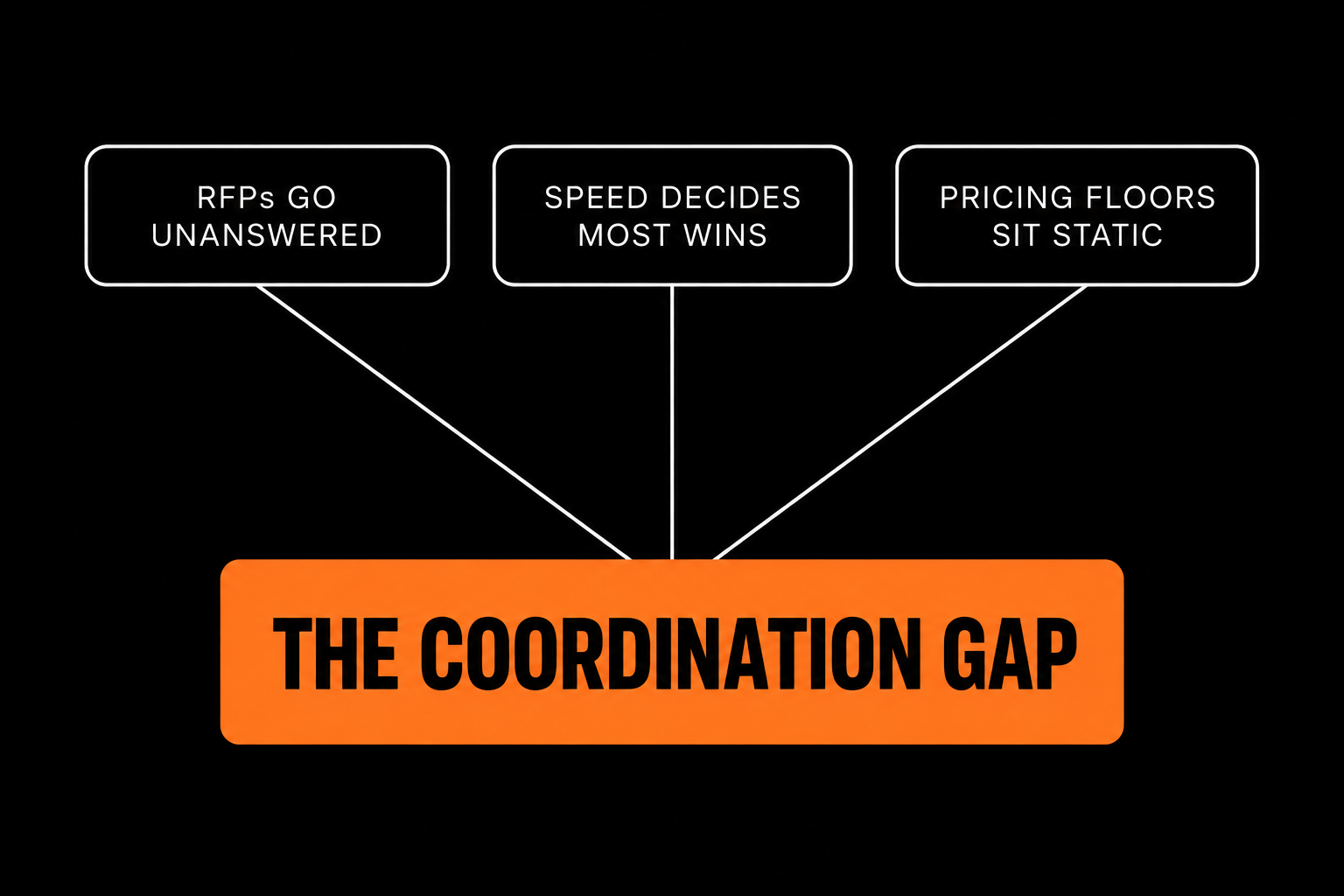
Group business hasn't gotten less important — meeting and event budgets have recovered, and the hotels winning that business are increasingly the ones that show up first with a clear, well-priced proposal rather than the ones with the lowest rate. But the process most hotels use to get from RFP to proposal hasn't changed nearly as much as the market around it. Roughly a third of group RFPs go unanswered, the majority of won deals go to whichever hotel responds fastest, and group pricing floors often sit untouched while transient rates move daily. Those aren't three separate problems. They're symptoms of the same coordination gap, and closing it is now one of the more direct ways a hotel group sales team can improve its win rate without changing anything about the property itself.
If slow RFP turnaround and a rigid group pricing floor sound like your team's current bottleneck, that's exactly the gap Hippo Rev is built to close. It's designed to move a group RFP from intake to a priced, ready-to-send proposal in minutes instead of the better part of an hour, so sales teams can respond inside that first-mover window instead of losing deals to whoever answered first. You can see how it works against your own numbers with a free, 20-minute Capture Audit — no deck, just your team's current RFP and response data — by booking one here.
Frequently Asked Questions
What is the difference between group revenue management and transient revenue management?
Transient revenue management prices individual room nights against real-time demand signals, usually inside an automated system. Group revenue management prices a bundled proposal — room block, meeting space, and catering — against a request for proposal, and historically has relied on manual coordination between sales, catering, and revenue management rather than an automated pricing engine.
Why do hotels lose group business even when they quote a competitive rate?
Because speed, not just price, determines a large share of group wins. Data on group sales response patterns shows the majority of won deals go to one of the first three hotels to respond to an RFP, and hotels that respond within four hours see a significantly higher win rate than slower responders — meaning a competitive rate delivered late can still lose to a merely adequate rate delivered fast.
What is a minimum acceptable rate (MAR) in group sales?
A minimum acceptable rate is the floor a hotel sets for group business, below which a sales team should not quote a rate without additional approval. Many hotels set this rate once for a booking period and adjust it infrequently, which can leave group pricing out of step with the demand conditions that are simultaneously moving transient rates.
How much revenue do hotels typically lose to slow or missed group RFP responses?
Estimates vary by property and market, but Hippo Rev's analysis of hotel group sales performance puts the figure at roughly $500,000 in annual revenue leakage per salesperson, driven primarily by RFPs that are answered too slowly or not answered at all.
Can group pricing be automated the way transient pricing is?
The final decision on a group deal typically still involves human judgment about relationship value, event fit, and negotiation. What can be automated is the data assembly around that decision — availability checks, displacement modeling, and proposal generation — which is usually the slowest part of the process and the biggest driver of missed or delayed responses.
.png)
Hotel Sales Ecosystem: How to Win More Direct Business
The highest-performing hotels don't wait for bookings to arrive. Learn how a proactive sales ecosystem combines AI, CRM, segmentation, and faster execution to capture demand earlier, improve conversions, and create sustainable revenue growth.
Beyond the "Book Now" Button: Building a Living Sales Ecosystem
Hotels grow faster when they shift from passive bookings to a proactive sales ecosystem.
In the modern hospitality landscape, waiting for the phone to ring is a strategy for stagnation. Real revenue growth doesn't come from passive order-taking. It comes from building a proactive Sales Ecosystem.
Successful hotel sales operations stop viewing lead generation and conversion as separate lists of chores. Instead, they view them as a continuous loop of intelligence gathering, psychological segmentation, and relationship farming.
The Market Imperative: Why "Business as Usual" Is a Risk
A living sales ecosystem is no longer an advanced tactic. It is becoming the only viable path to defend guest acquisition, protect margins, and stay relevant as the landscape tilts rapidly toward platforms with deeper pockets and faster technology.
The OTA Power Shift Is Accelerating
OTAs are capturing early guest intent and edging out hotels at the top of the funnel.
Recent data makes one fact undeniable: OTAs are outspending and out-optimizing hotels at a scale not seen before. For independent lodging properties, OTAs now account for 61% of bookings, with the direct channel holding its ground but under growing pressure as AI-powered search and metasearch increasingly funnel travelers to OTA ecosystems.
The implication for hotels is stark. If you don't build your own proactive sales ecosystem that captures, nurtures, and personalizes early interest, OTAs will own your top-of-funnel indefinitely, and reclaiming that ground later becomes financially unrealistic.
The Direct Booking Paradox Deepens
Even with heavier investments in direct booking strategy, more than half of leisure travelers still begin their research on OTAs or meta-search sites. With OTAs now attracting a growing share of longer-stay guests as well (room nights share rising from 53% to 56%), hotels risk losing not just volume but their highest-value stays.
A living sales ecosystem gives you a mechanism to intercept and convert these high-intent travelers earlier, before they become commodities in OTA search results.
The Shrinking Window Isn't Just About Timing. It's About Volatility.
Volatile booking behavior demands always-on lead generation and rapid conversion.
Duetto and Cloudbeds' 2025 Hotel Market Pulse report shows average length of stay declined every month from January to July 2025 versus 2024, as travelers opt for shorter, more frequent trips amid economic uncertainty . Demand spikes are sharper, troughs are deeper, and lead time is increasingly unstable.
You can't respond to this volatility with periodic campaigns. The only feasible response is an always-on sales engine that identifies real-time demand pockets, generates leads continuously, and converts fast.
The Corporate Travel Equation Has Reset
Corporate travel hasn't just recovered; it has reorganized. GBTA's January 2026 poll shows cautious optimism:
59% of industry professionals are optimistic about 2026,
while 84% of buyers expect travel spending to increase or stay at 2025 levels (44% expect an increase, averaging 12% growth) .
However, balancing cost control with traveler satisfaction remains the top challenge for 59% of buyers, and 74% of U.S. buyers cite program cost control as a major concern .
Employees want to travel more, with increases in linked trips, blended trips, and longer-duration stays. But procurement priorities have shifted toward cost control, predictability, and traveler well-being.
This creates a dual requirement: your sales narrative must offer transparency and efficiency for the buyer while simultaneously promising personalization and experience for the traveler.
Reputation Is Now a Core Sales Function
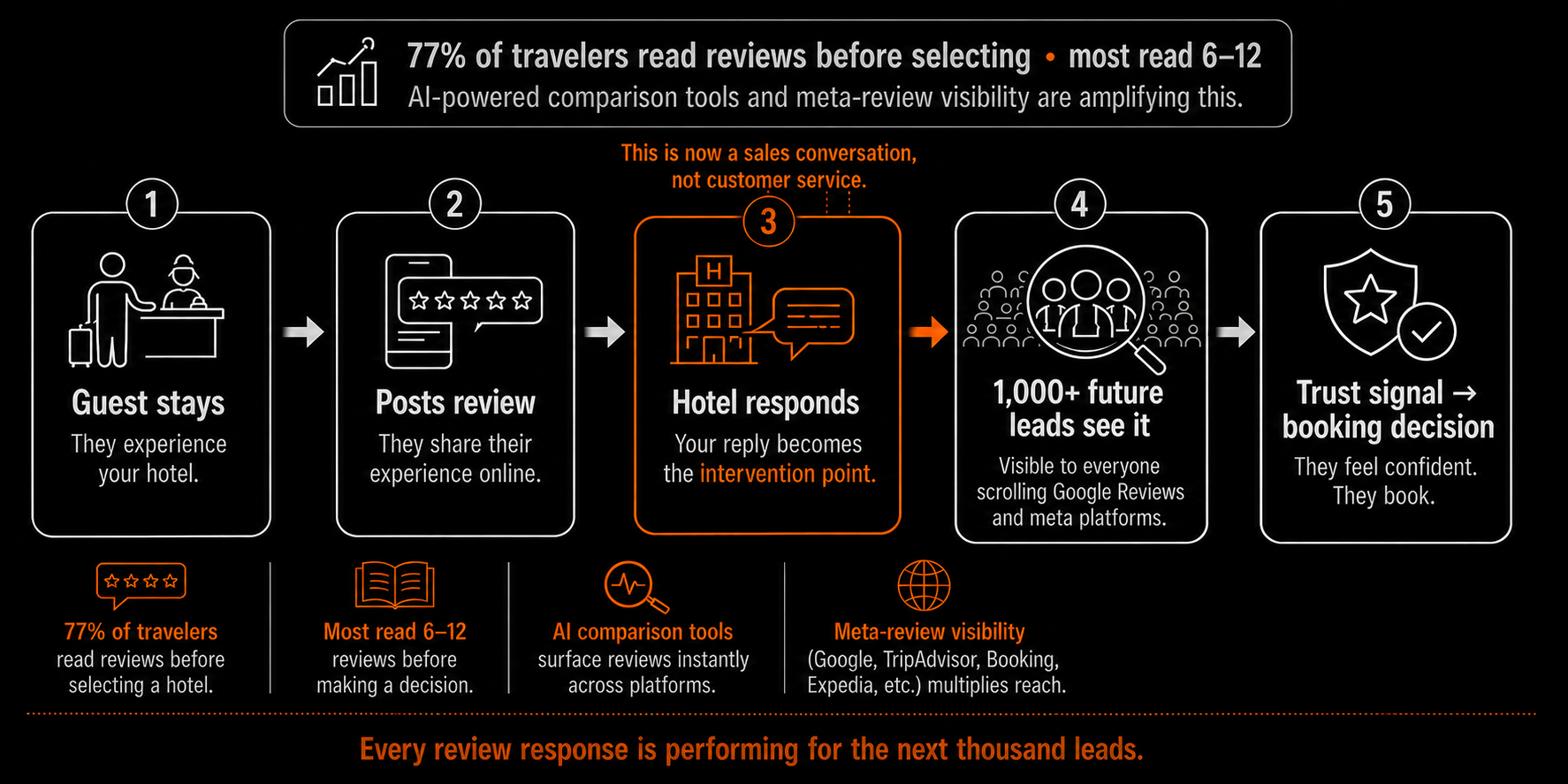
Travelers continue to treat reputation signals as a primary filter. Earlier TripAdvisor data showed 77% of travelers read reviews before selecting a hotel, and most read 6 to 12 reviews before booking. In 2026, with AI-powered comparison tools and meta-review visibility increasing across platforms, this influence has only intensified.
Every review response has become a public sales conversation. Consistent, strategic reputation management is now part of revenue generation, not a peripheral marketing task.
Technology Adoption Is No Longer Optional
HSMAI's 2025 Revenue Optimization trends highlight AI and machine learning as revolutionizing dynamic pricing and demand forecasting, while technology integration and data fragmentation remain top challenges for revenue leaders . GBTA's 2026 poll shows 65% of professionals prioritize AI-driven pricing optimization and 64% prioritize predictive analytics, with 46% citing "figuring out AI" as a top operational challenge .
Hotels that fail to build a modern, tech-enabled sales ecosystem will be outpaced by those who do. Across every segment, leisure, corporate, and group, the market is rewarding those who capture demand early and penalizing those who wait for it.
This ecosystem isn't simply a growth strategy. It's fast becoming the minimum requirement to maintain visibility, pricing power, and relevance in a market where guest acquisition is being rewritten in real time.
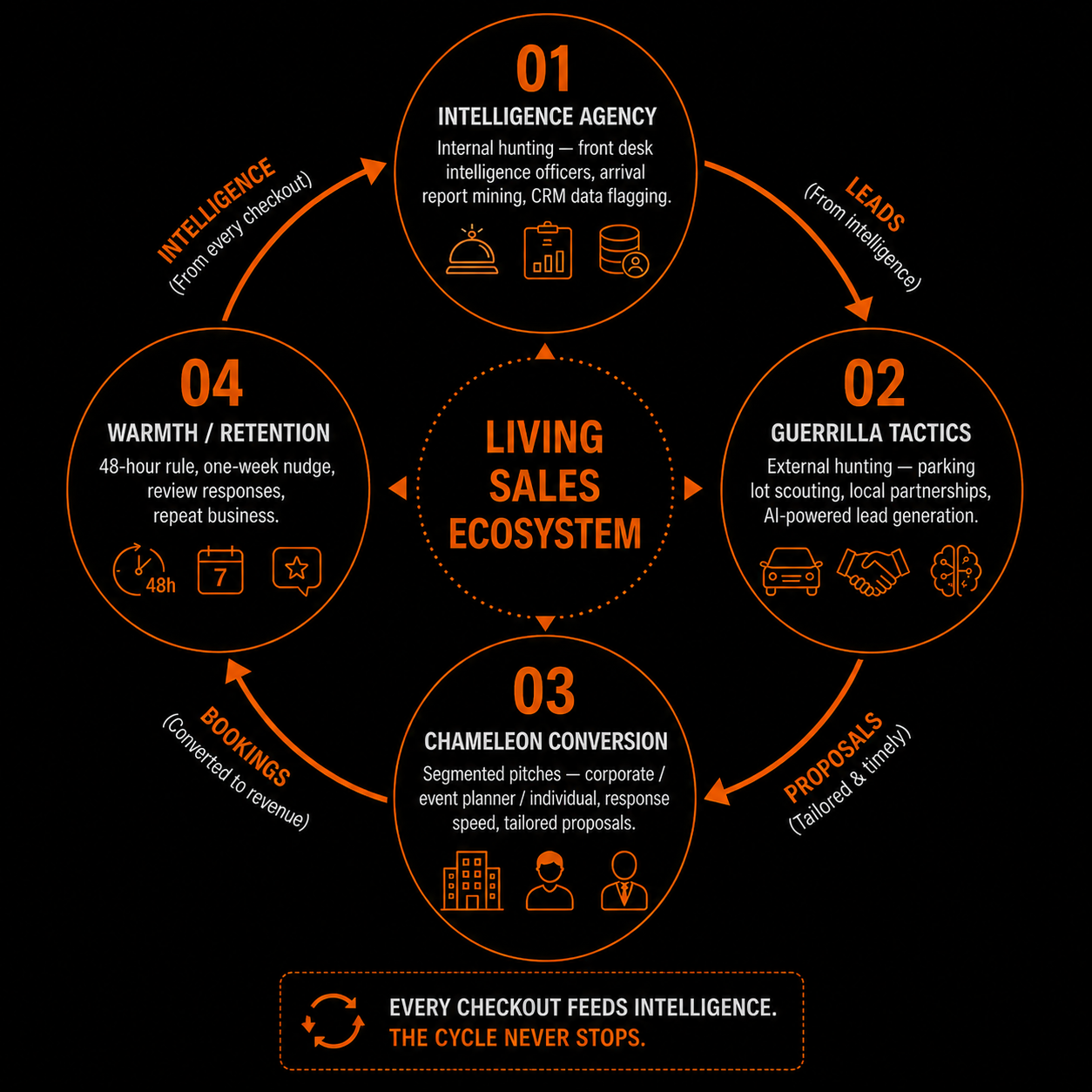
Phase 1: The Intelligence Agency (Internal Hunting)
Before you spend a dime on external advertising, look inside the building. The most undervalued asset in hotel sales is usually standing right in the lobby: the front desk.
Many sales directors view the front desk merely as operational staff. However, a strategic shift involves training these team members to act as intelligence officers. They shouldn't just hand out keys; they should be qualifying guests during check-in.
The Tactic: Train staff to ask targeted questions about the reason for travel. If a guest is booking multiple rooms or staying for an extended period, that is not just a booking. That is a potential corporate account.
The Data Mine: Similarly, your current ecosystem is hiding leads. By auditing arrival reports and guest profiles, you can spot work email addresses or patterns that indicate business travel. A CRM system shouldn't just be a database. It should be a tool to track these repeat guests and flag them for upsell opportunities.
Phase 2: Guerrilla Tactics (External Hunting)
Old-school field intelligence still uncovers leads technology can't.
While digital data is king, there is a surprising amount of value in old-school grit.
In an era of high-tech marketing, one of the most effective strategies is physical reconnaissance. Some hospitality experts suggest a tactic that requires zero software: parking lot scouting.
The Tactic: Drive through the parking lots of competitor hotels. Look for branded company vehicles. If a construction company or consulting firm has a fleet of cars parked at the hotel across the street, you have just identified a qualified corporate lead.
This boots-on-the-ground approach extends to local partnerships. Don't just ask for business; create ecosystems. Bundle your services with local venues or offer exclusive corporate rates to nearby businesses to create a steady stream of referrals.
AI-Powered Lead Generation
AI agents now transform hotel sales by automating lead qualification around the clock, analyzing inquiries for value potential and preferences to achieve higher conversion rates on group bookings.
Hotels integrating AI with PMS and CRM systems save 20 to 40 hours weekly on manual tasks while boosting conversions through real-time personalization and intent detection.
This fits seamlessly into Phases 1 and 2, enhancing internal data mining and external scouting with predictive tools that prioritize high-value corporate and event leads.
If you want a deeper breakdown of how AI will reshape hospitality in the coming years, you can explore our analysis here.
Phase 3: The Chameleon Approach (The Art of Conversion)
The best sales teams adapt their value proposition like a chameleon to each buyer.
Once you have the lead, the one-size-fits-all sales pitch must die. High conversion comes from segmentation. You must divide your leads into distinct buckets, corporate, event planners, and individuals, and become a chameleon, adapting your value proposition to their specific anxieties.
For the Corporate Client: They do not care about the view as much as they care about friction. Your pitch must emphasize efficiency: streamlined check-in and check-out, early arrival options, and free Wi-Fi.
For the Event Planner: They are selling a vision. You must help them see it. Using virtual or in-person tours is critical here, as it helps them visualize their specific wedding or conference in your space.
For the Individual: They want to feel special. This is where personalization wins. A generic email won't work, but a personalized offer based on their previous preferences will.
Remember, speed matters most in group and event segments. Industry data shows 61% of won deals go to one of the first three responders. Segmentation tells you what to say. Response speed decides whether you get to say it at all.
Hotels refining their corporate strategy will find more ideas in our piece on Maximizing MICE Leads in a Competitive Market.
Phase 4: The "Warmth" Strategy (Closing and Retention)
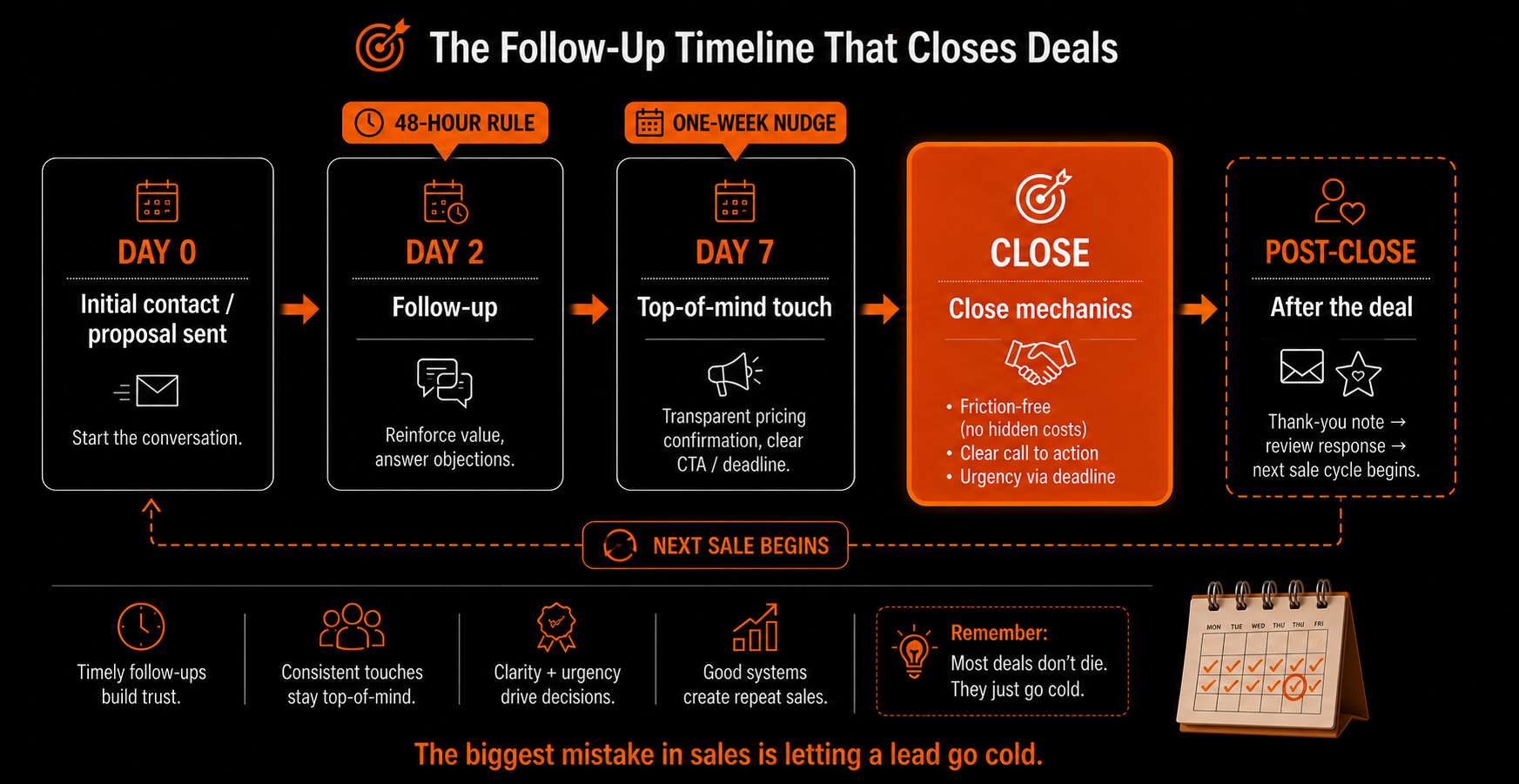
The biggest mistake in sales is letting a lead go cold. The data suggests a specific rhythm for nurturing:
The 48-Hour Rule: Send a follow-up 48 hours after the initial contact.
The One-Week Nudge: Touching base again a week later keeps the hotel top-of-mind.
However, the close must be friction-free. Be transparent about pricing immediately. Hidden costs kill trust, especially with B2B clients. Give them a clear call to action or a deadline for an offer to create urgency.
Revenue Management Trends Can Help
In 2025, integrating PMS and RMS enables real-time data sync for swift pricing adjustments amid rising costs and competitive pressures, with direct bookings prioritized to cut OTA commissions.
Personalized pricing models and AI-driven forecasting help hotels stabilize revenue, targeting the right customers with tailored offers to lift conversion rates beyond industry averages.
These tools amplify the ecosystem by turning segmented leads into profitable, repeat business through automated upselling and demand prediction.
The Cycle Continues
Every checkout is the starting point for your next revenue opportunity.
Finally, the sale doesn't end when the guest checks out. That is actually when the next sale begins.
Sending a simple thank-you note after a stay validates the guest's choice and opens the door for feedback. By responding to reviews, both positive and negative, you aren't just talking to that one guest. You are performing reputation management for the next thousand leads who are scrolling through Google Reviews looking for a reason to trust you.
The Bottom Line: Sales is not about waiting for demand; it is about capturing it. By combining the old-school tactics of competitor scouting with the modern precision of CRM data, you build a pipeline that is sustainable, diverse, and highly profitable.
How Hippo Rev Powers Your Living Sales Ecosystem
A sales ecosystem only compounds when every lead it generates actually gets worked.
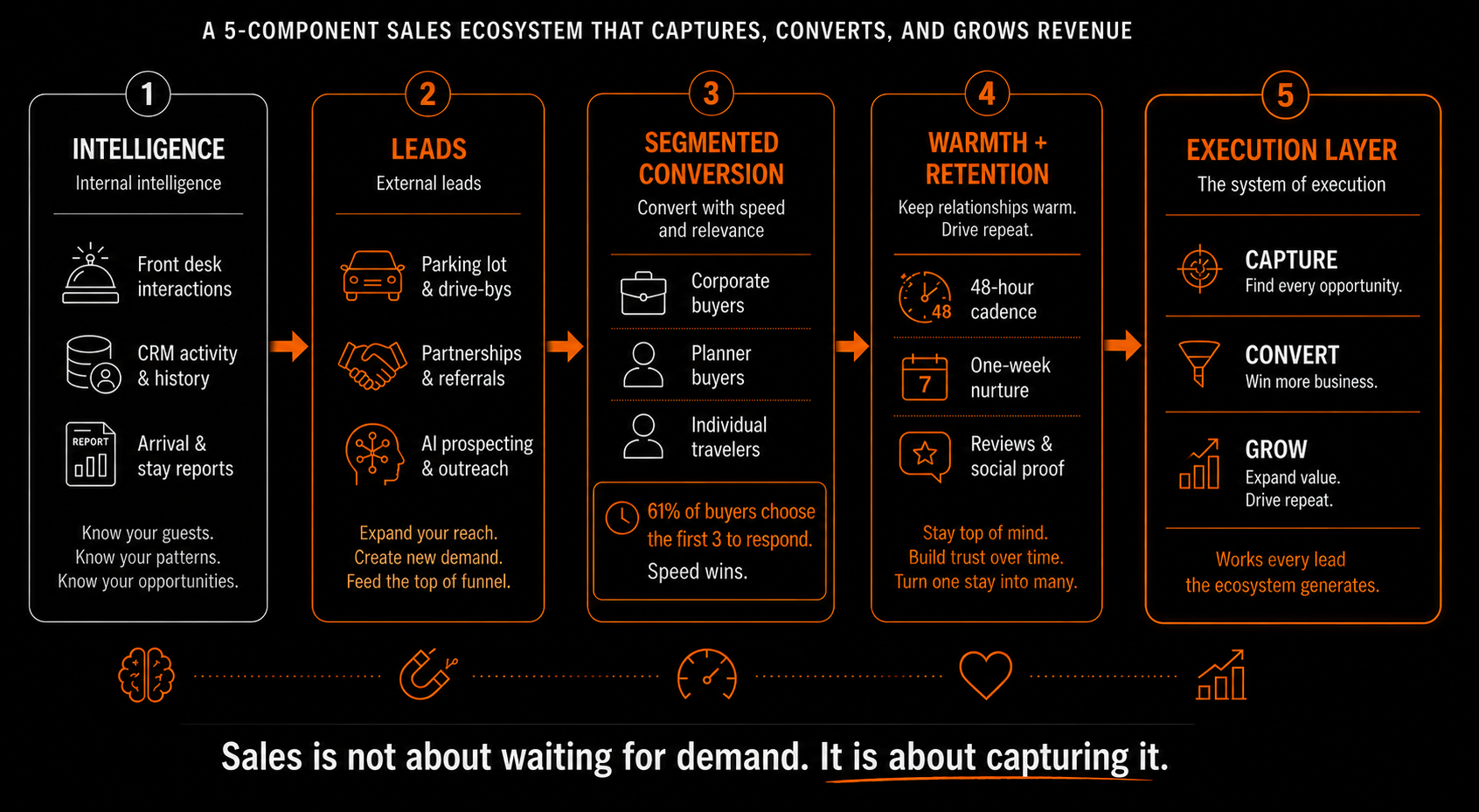
Here is the uncomfortable truth behind every strategy in this article: most hotels do not have a demand problem. They have an execution problem. Industry-wide, 36% of RFPs go unanswered, and the average salesperson leaks roughly $500K in revenue every year to slow responses, missed follow-ups, and leads that die in inboxes. Your ecosystem can generate all the intelligence in the world, but if your team can't act on it fast, the deal goes to whoever responds first.
Hippo Rev is a Revenue Capture Platform built for hotel group sales teams. It is not another system of record sitting next to your CRM, PMS, and RMS. It is a system of execution that moves every deal through three stages:
Capture: Every inquiry from every channel lands in one pipeline the moment it arrives, qualified and prioritized so nothing slips through. RFPs that used to take around 37 minutes to process get done in about 4.
Convert: Your team responds first with proposals tailored to the buyer in front of them, whether that's a corporate travel manager focused on efficiency or an event planner selling a vision. That matters when speed-to-lead decides win rates .
Grow: Follow-ups run on the rhythm this article describes, as per the 48-hour touch and the one-week nudge, so no lead goes cold and won business turns into repeat business.
If you want to see what your property is actually leaking, book a Capture Audit. 20 minutes, your numbers, no deck.
Frequently Asked Questions
How can a sales team prevent losing a deal at the final closing stage?
To prevent deals from falling through at the last minute, sales teams must be transparent about pricing and terms to eliminate surprises. Transparency builds trust, which is particularly vital for long-term corporate clients. Additionally, providing a clear call to action, such as a specific deadline or booking link, encourages the lead to stop hesitating and finalize the booking.
What is the most critical step to take after attending a trade show?
While manning a booth and networking are important, the most critical step is to follow up promptly after the event. You should reach out to new contacts with a personalized message to reinforce the connection and share tailored offers to keep the hotel top of mind.
What is the best way to leverage local businesses for lead generation?
Form partnerships by offering specific corporate rates to nearby corporations that book regularly. Additionally, hotels should bundle their services with local venues to create appealing event packages, which helps increase visibility within the local market.
.png)
AI Agents vs Automation: Why Humans Still Matter
AI agents are changing how work gets done, not by replacing people but by eliminating repetitive administrative tasks. Learn how agentic AI augments human expertise, improves productivity, and enables professionals to focus on higher-value work.
AI Isn't Trying to Steal Your Job
Most fears about AI come from misunderstanding how these systems actually behave.
There's no single way people start working with AI. Some try one prompt, then another, and one day it's simply clear they're using it for everything. Others start with a few small automations and keep them quiet until a "So are we really doing this?" conversation with their boss makes it official.
But over time, things change. The AI assistant that seemed perfect begins making imperfect suggestions and the occasional hallucination. And you start to wonder: am I working with a tool, or with something that sounds confident but can't be trusted?
Then there's the flip side, where it sounds smarter than you expected, and you catch yourself asking, "Is it coming for my job?"
For the past two years, conversations about AI have swung between excitement and existential dread. Every headline, every demo, every new model announcement seems to provoke the same anxious questions.
It's an understandable reaction. Historically, each major automation milestone, from factory robotics to Deep Blue to Siri to ChatGPT, has triggered the same worry.
Let's unpack why.
The Old Question: "Can AI Do My Job?"
Work is shifting from comparing humans and AI to expanding what humans can do with AI.
For decades, AI progress was evaluated on one dimension: how well can it imitate human performance?
- Could it solve problems?
- Could it answer questions?
- Could it write coherent sentences?
- Could it "think"?
That framing naturally put humans and AI into a comparison match neither side asked for.
But today's agentic systems aren't trying to imitate humans. They're trying to work with humans by handling the parts of work that require precision, persistence, and high-volume pattern processing, the work humans find tedious, slow, or simply exhausting.
The question is shifting from imitation to extension. Not "Can AI do what I do?" but "How much more could I do with AI?"
The Background Noise of Modern Work
Modern knowledge work is overloaded with tedious, low-value tasks that drain energy.
If you're a typical knowledge worker, your job slowly transformed into a scavenger hunt of inefficiencies.
You spend your day bouncing between:
- pulling data from six tools,
- rewriting the same paragraphs,
- filling forms that only exist because other forms exist,
- crafting updates that vanish into dashboard oblivion,
- replying to messages about messages about previous messages.
By 6pm, you feel like you worked hard, but you can't point to much meaningful work you actually produced.
How AI Agents Are Quietly Eliminating the Drudgery
Agents automate multi-step workflows across tools.
AI isn't here to take your job. AI is here to take the parts of your job that take you away from your actual job.
And to understand why that matters, we need to look at what modern AI agents actually do. Not the hype, but the mechanics.
Traditional AI answered questions. Traditional automation, like simple macros or email rules, can handle a single, repetitive step. An AI agent, as defined in the Introduction to Agents whitepaper, is fundamentally different. It is a goal-oriented system capable of planning, reasoning, and executing multi-step workflows across different tools and interfaces.
Here's what that looks like in practice.
1. Agents eliminate tool-hopping
Most professionals spend a shocking amount of time switching between systems: CRM to inbox to spreadsheets to PMS to dashboards to two browser tabs you forgot you opened.
AI agents remove this by calling these systems directly. According to Google's agent architecture, an agent can use APIs, databases, search tools, and UI actions as part of its workflow, pulling information without you ever touching five different tabs.
2. Agents draft the "first 80%" of everything
In many jobs, the first version of a task, whether a draft, summary, proposal, follow-up, checklist, or data extraction, is the most time-consuming part.
AI agents handle this upfront work by ingesting documents, synthesizing context, and producing structured, ready-to-edit outputs.
3. Agents remove the burden of remembering everything
Humans are terrible at short-term memory. Agents are built for it.
Through state, context windows, and long-term retrieval (RAG), they maintain continuity across tasks:
- what happened earlier in the workflow
- what tools were used
- which data was retrieved
- which failures or conflicts occurred
You're freed from the cognitive overhead of tracking dozens of tiny details that don't require expertise, just persistence.
4. Agents handle the "micro-decisions" humans resent
Every complex task contains dozens of tiny decisions:
- Which field is missing?
- Which source of truth should I use?
- How should this be formatted?
- Should I escalate or proceed?
- Is this similar to something I solved last week?
AI agents use planning, tool reasoning, and context engineering to make these decisions efficiently. They escalate only when logic, policy, or confidence thresholds tell them to.
What disappears for humans: second-guessing, scanning for errors, repetitive classification, mechanical sorting and formatting.
What remains for humans: the decisions that actually need human judgment.
The Great Flip: From Replacement to Reinforcement
Let's be honest: early AI was often a zero-sum game. Factory robots replaced assembly line workers. Chatbots replaced basic customer service reps. The narrative was clear: humans versus machines.
But look at what's happening now:
AlphaFold 3 (2024) isn't replacing biologists. It's giving them the ability to predict complex molecular interactions, accelerating drug discovery from years to days.
Beethoven X (2021) didn't replace composers. AI collaborated with musicologists to complete Beethoven's unfinished 10th symphony.
Sony's Flow Machines doesn't replace musicians. It helps artists explore new creative directions, like the AI-assisted pop track "Daddy's Car" (2016).
The paradigm has flipped. We're no longer building our replacements. We're building our reinforcements.
The Co-Creation Contract: The Centaur Model
AI breakthroughs are giving professionals new capabilities instead of taking their roles.
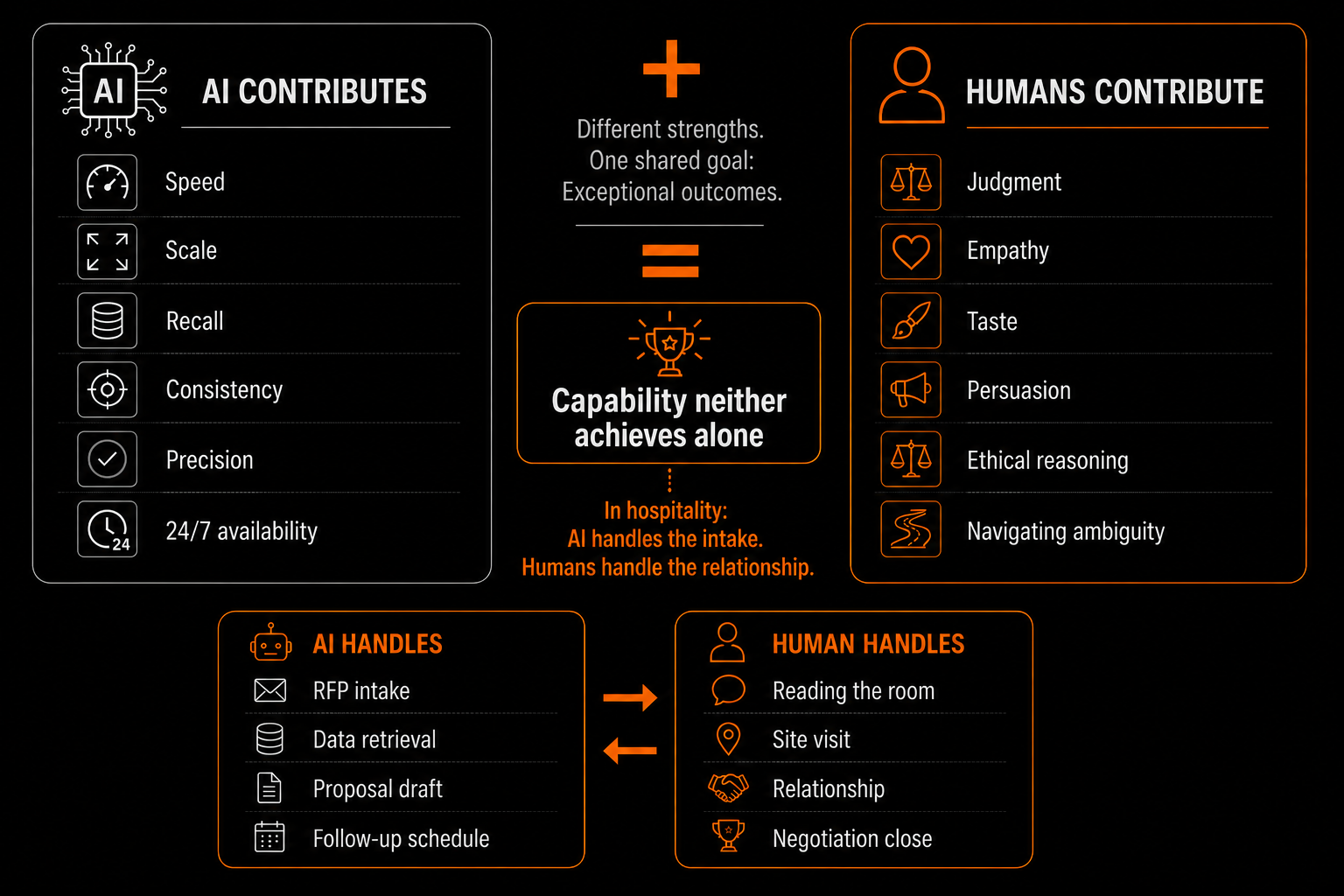
The most powerful framework emerging is what some call the Centaur Principle: half human, half AI, working as one integrated system.
AI excels at: speed, scale, recall, consistency, precision, 24/7 availability.
Humans excel at: judgment, empathy, taste, persuasion, ethical reasoning, navigating ambiguity.
Put together, you get a combined capability that neither side could achieve alone.
Why This Shift Matters (A Lot) in Hospitality
AI agents are becoming the operational backbone that restores time for human service.
If any industry needs this transformation, it's hospitality.
Right now:
- 65% of U.S. hotels report staffing shortages (Feb 2025).
- Sales teams spend only 28 to 30% of their time actually selling.
- Planners expect RFP responses in under four days.
- Cvent sourced $16.5B in group business in 2024 alone.
That's a high-intensity, high-volume workload on teams already stretched thin.
Agentic AI fits naturally into this gap. Not as a replacement for staff, but as administrative reinforcement, giving sales professionals time back for the human parts of the job.
Examples already emerging in hospitality:
- RFP handling: agents that ingest, analyze, summarize, draft, route, and follow up
- Lead qualification: agents that de-duplicate inquiries, qualify them, and auto-request missing information
- Pricing support: agents that evaluate comp sets, blackout dates, and pace, then suggest ranges
- BEO preparation: agents that pull PMS, CRM, and event data and flag conflicts
- Prospect research: agents that summarize verified data before a sales conversation
No one went into hospitality because they dreamed of formatting spreadsheets. Agents help staff return to the relationship-driven core of the industry.
To explore how this looks in practice, read our full breakdown here.
The Accuracy Trap: What Humans Misunderstand About AI
A common objection is: "AI isn't perfect."
True. But also: neither are humans.
More importantly, the goal isn't perfection. It's acceleration.
Consider this comparison. An AI agent may complete a task at around 70% accuracy in minutes. A human may push it to 85% accuracy, but only after spending several hours. In many workflows, that extra 15% offers diminishing returns, while the lost time harms productivity, responsiveness, and customer experience.
Agents don't eliminate human review; they eliminate human overuse. Humans step in where nuance matters. AI handles the grunt work that prevents humans from getting to nuance in the first place.
The Path Forward: Practical Adoption
The future belongs to teams that leverage AI as a partner, not a threat.
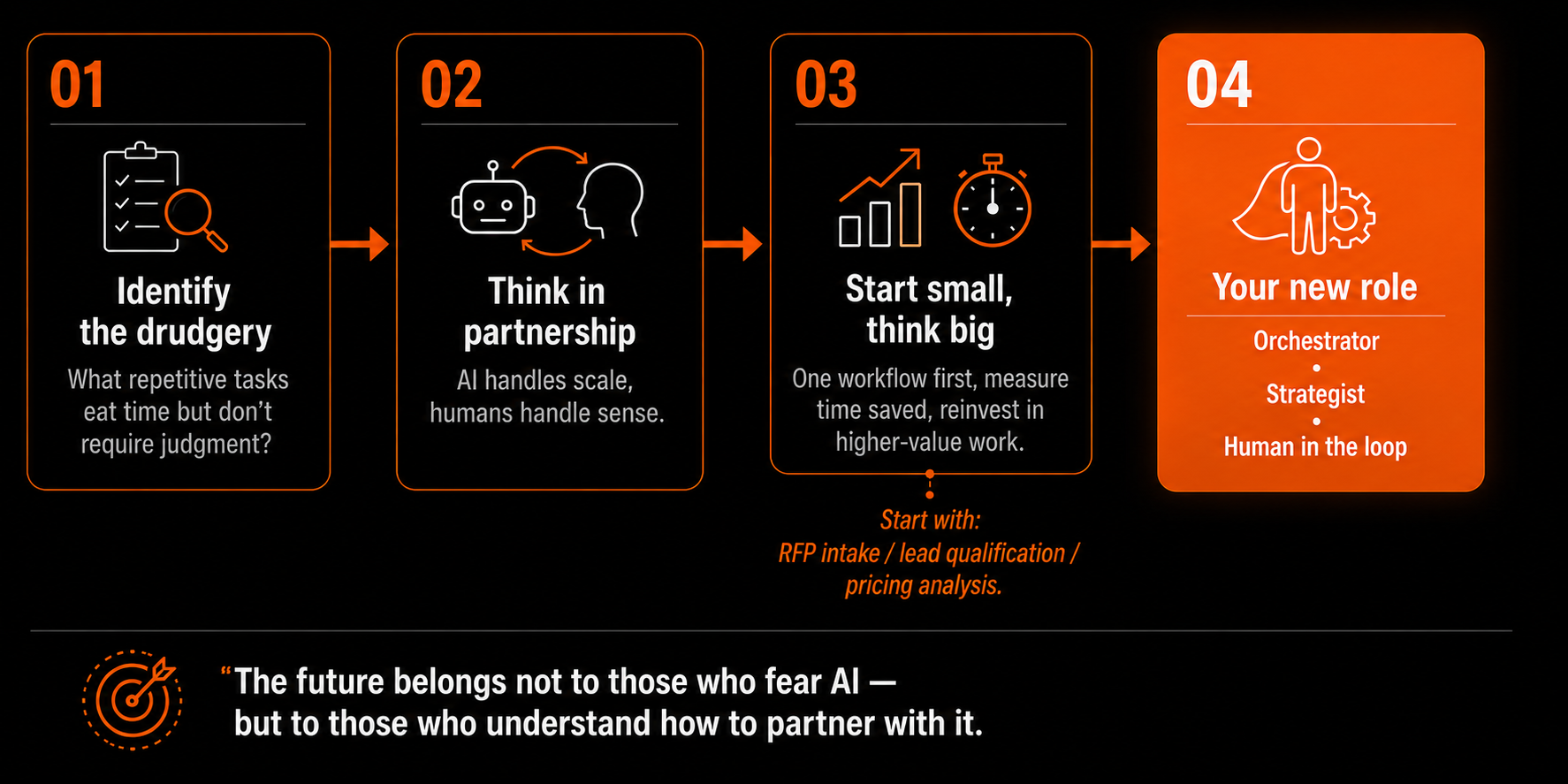
So how do you move from anxiety to augmentation? Start with the framework, not the fear.
Identify the drudgery: What repetitive tasks eat up your team's time but don't require human judgment? Start there.
Think in terms of partnership, not replacement: Look for opportunities where AI handles the scale while humans handle the sense.
Start small, think big: Begin with one workflow, whether that's RFP intake, lead qualification, or pricing analysis. Measure the time saved, then reinvest that time in higher-value work.
Embrace the new role: Your job isn't disappearing. It's evolving. You're becoming an orchestrator, a strategist, a human in the loop where it matters most.
The Bottom Line
We've spent decades asking the wrong question. The issue was never whether AI would replace us. It was whether we'd learn to work alongside it in ways that amplify our humanity rather than diminish it.
The evidence is now clear: when designed thoughtfully, AI doesn't make us obsolete. It makes us better. It handles the tedious so we can focus on the meaningful. It analyzes the data so we can make the decisions. It manages the routine so we can build the relationships.
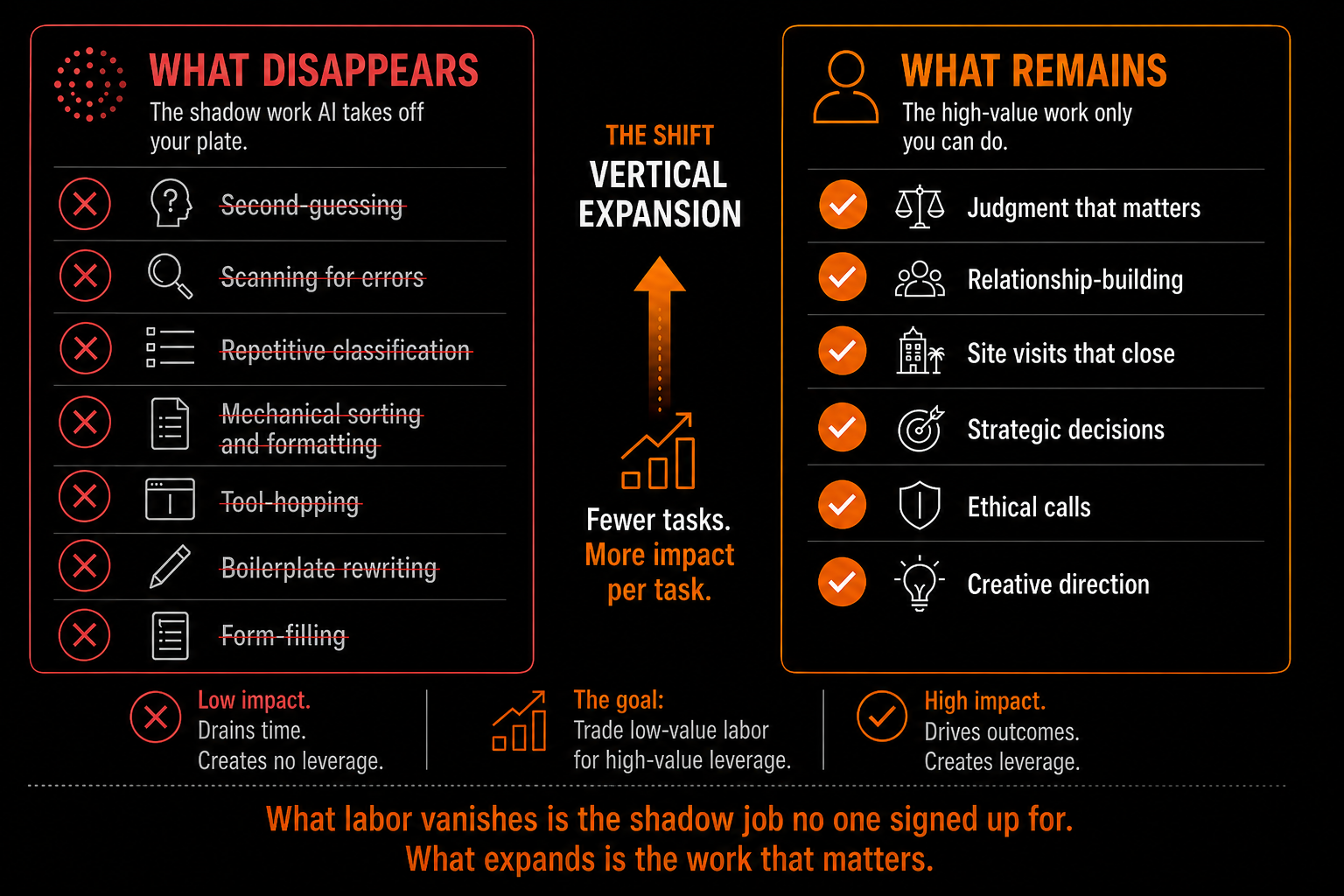
This is the thinking behind how we built Hippo Rev for hotel group sales teams: a system of execution that handles the capture, qualification, and follow-up work so sellers can spend their day selling. If you want to see what that looks like against your own numbers, book a Capture Audit. 20 minutes, your numbers, no deck.
The future belongs not to those who fear AI, but to those who understand how to partner with it.
Frequently Asked Questions
What specific types of work are AI agents best suited to take over, and why those tasks first?
AI agents are most effective at tasks that are high-volume, rule-based, context-dependent, and multi-step, such as data entry, information retrieval, formatting, error-checking, and workflow routing. These tasks require consistency and patience, two things humans are famously terrible at when performed repetitively. Agents excel here because they can plan steps, call tools and APIs, observe the results, and iterate without fatigue, distraction, or cognitive overload. This frees humans to focus on ambiguous, relational, or strategic work that agents cannot reliably handle.
If improving hotel RFP response speed is your priority, you might find this resource on converting hotel sales leads especially useful.
How do AI agents avoid becoming "hallucination machines" when given operational responsibility?
Hallucinations decrease significantly when the agentic system is grounded in verifiable data sources such as RAG pipelines, enterprise databases, APIs, and controlled tool outputs. Instead of guessing, agents look things up. The orchestration layer also enforces planning steps, memory usage, and validation logic. When uncertainty persists, well-designed agents escalate to humans with a concise summary of what's missing, preventing errors from reaching production.
If agents handle so much administrative work, how do human roles evolve rather than shrink?
Human roles shift toward the parts of work that were always the real value: relationship-building, negotiation, judgment-based decisions, ethical calls, context-sensitive creativity, and cross-functional collaboration. The labor that vanishes is the shadow job no one signed up for, the hours spent reconciling data, rewriting boilerplate, cleaning spreadsheets, crafting repetitive emails, or switching between systems. As drudgery compresses, human contribution expands vertically: fewer tasks, more impact.
What prevents AI agents from overstepping human boundaries or making harmful decisions?
Modern agentic systems use multiple layers of safety:
- Deterministic guardrails (policies, access controls, tool limits)
- AI-powered guard models that screen intent, outputs, and risk
- Confidence thresholds and uncertainty detection
- Human-in-the-loop escalation at key decision points
- Role, identity, and permission constraints via agent identity frameworks
These constraints ensure agents cannot unilaterally execute high-impact actions without approval.
Why is hospitality such a strong early fit for AI agents compared to other industries?
Hospitality has three unique characteristics:
- High task volume: RFPs, emails, BEOs, lead qualification, follow-ups.
- High stakes and high speed: planners expect responses in days; competition is fierce.
- Chronic staffing shortages: 65% of U.S. hotels report ongoing shortages.
Agents thrive in environments where administrative load is heavy and consistency matters, but human warmth and relationships are still central. Hospitality fits this profile perfectly and stands to benefit disproportionately.
.png)
Build vs Buy AI for Hotels: Which Is Right for You?
Building AI isn't simply a software decision. It is an operational commitment involving data quality, governance, maintenance, and long-term investment. This article helps hotel leaders evaluate whether building or buying AI delivers the greatest business value for hospitality leaders.
Build vs Buy AI for Hotels: Answer These Three Questions Before You Spend a Dollar
Are you thinking about building AI for your hotel? Answer these three questions first.
One. Do you have clean, trusted data flowing across every major system, from your PMS to your CRM to your sales inbox?
Two. Do you have one team that owns and governs that data?
Three. Can you afford to maintain AI for the next three years, not just build it?
If you answered "no" to even one of these, do not build it. Choose to buy instead. Here is the full case, backed by numbers.
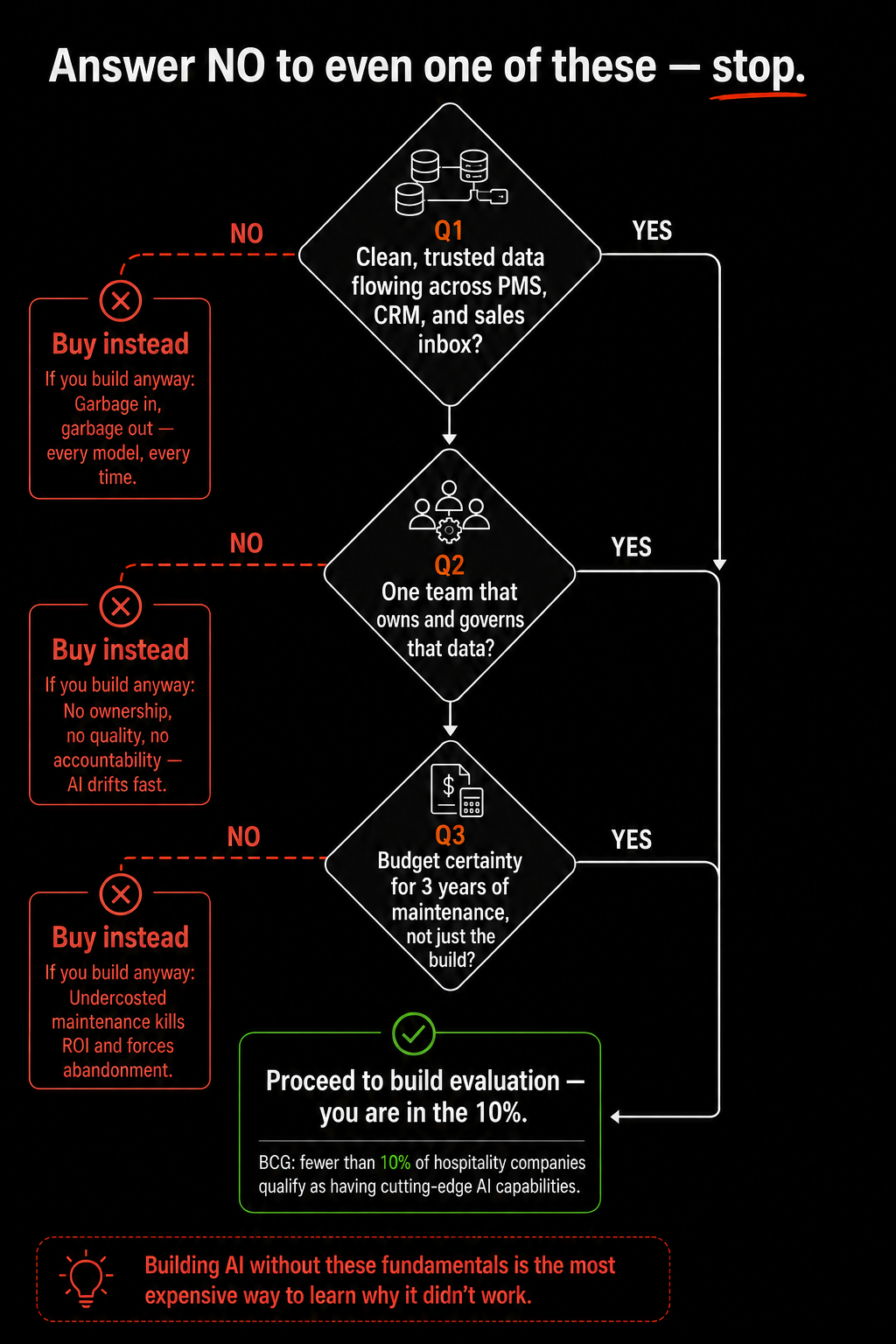
Most Hotels Do Not Fail Because AI Is Bad
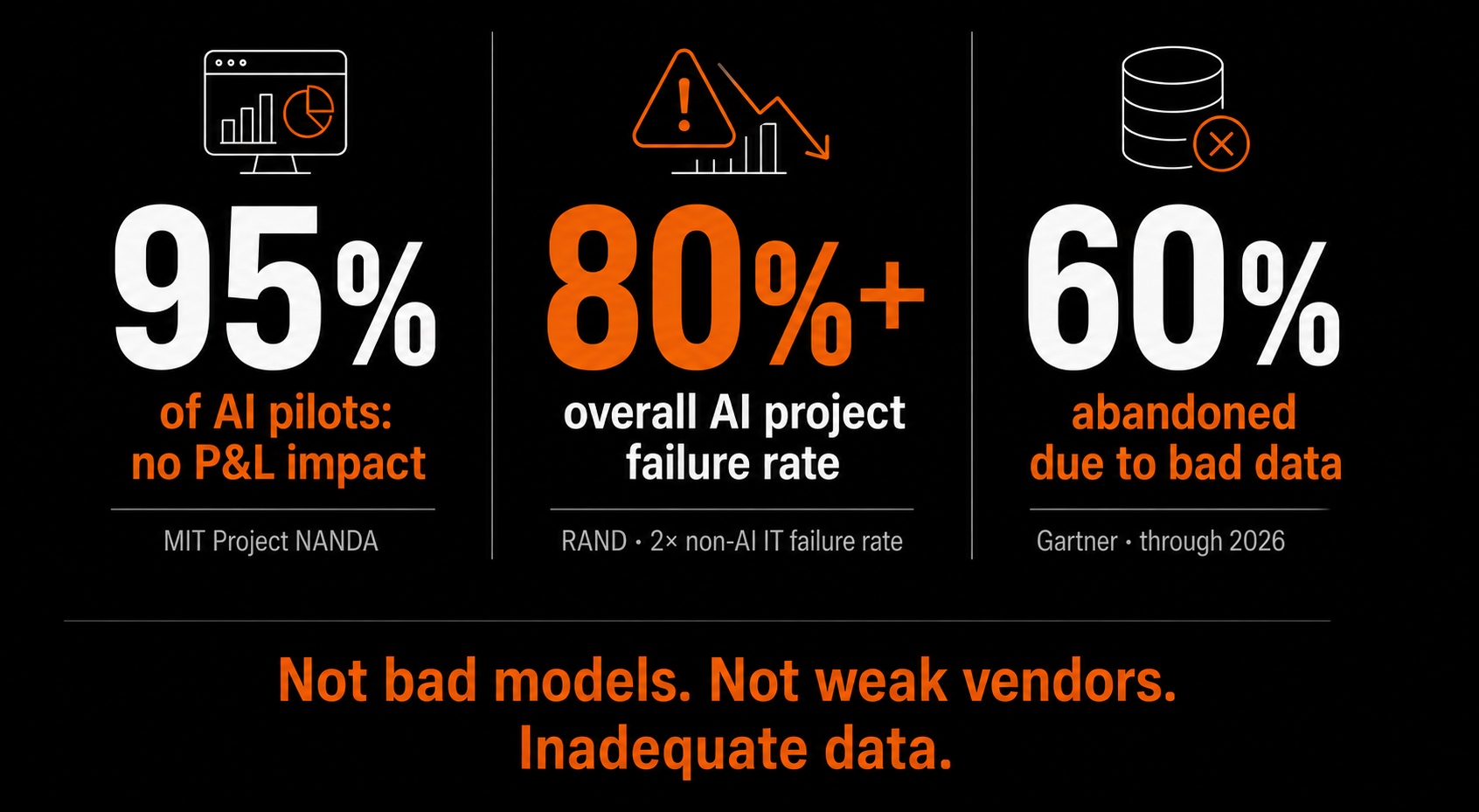
The failure data on enterprise AI is brutal. MIT's Project NANDA studied hundreds of enterprise AI deployments and found that 95 percent of generative AI pilots delivered no measurable impact on the profit and loss statement, despite companies pouring an estimated 30 to 40 billion dollars into these initiatives. RAND puts the overall AI project failure rate above 80 percent, roughly twice the failure rate of IT projects that do not involve AI. Gartner expects 30 percent of generative AI projects to be abandoned after proof of concept, and estimates that 60 percent of AI projects will be abandoned through 2026 due to inadequate AI-ready data.
Read that last line again. Not bad models. Not weak vendors. Inadequate data.
Hotels do not fail at AI because the technology is bad. They fail because they underestimate everything surrounding the technology. The data plumbing. The governance. The retraining. The three-year operating burden that starts the day the demo ends.
AI Is Not Classic Software. It Behaves Like a Living Organism
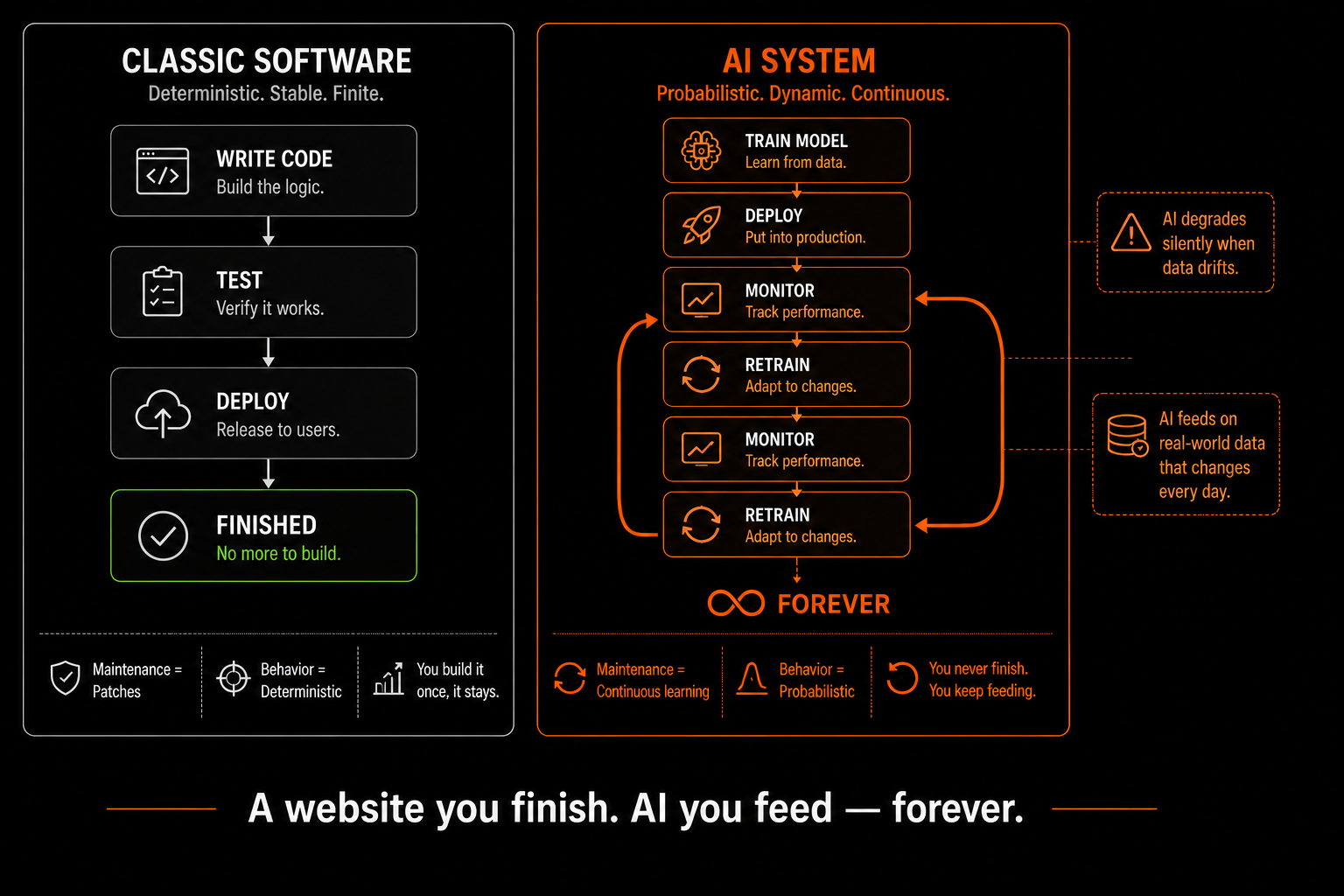
Some executives think AI is like traditional software. You write code, test it, deploy it, and you are done. AI does not work that way.
AI feeds on real-world data, and real-world data changes every single day. Guest behavior shifts. Group demand moves. Corporate travel patterns swing with the economy. A model trained on last year's booking pace starts making wrong calls the moment market conditions drift away from its training data.
If you do not continuously monitor, evaluate, and retrain the model, your brilliant internal project quietly degrades into a toxic technical liability. Nobody announces the moment it happens. You just start getting slightly worse pricing recommendations, slightly slower lead routing, slightly less accurate forecasts, until someone finally asks why the numbers stopped matching reality.
This is the core difference between building AI and building a website. A website you finish. AI you feed, forever.
The Maintenance Math Nobody Puts in the Business Case
Custom software maintenance in mature markets costs 10 to 20 percent of the initial build price every single year. Custom AI builds for hospitality typically range from 50,000 dollars for a focused single-function tool to 400,000 dollars or more for a platform that spans departments. Run the math on a 300,000 dollar build and you are committing 30,000 to 60,000 dollars annually just to keep it standing still, before you add a single improvement.
And that understates the real cost, because the biggest line item hides upstream of the model. Data preparation typically consumes 40 to 60 percent of a first-year AI budget. Cleaning duplicate guest records. Reconciling your PMS with your sales system. Building pipelines that survive a vendor API change. None of this shows up in the demo, and all of it shows up in the invoice.
Then there is the organizational cost. Traditional hotel IT teams are structured to ship projects, not to run ongoing operational pipelines. Shipping a project has an end date. Operating an AI system does not. If you build it anyway, ask yourself honestly: are you structured to run it long-term? Do you have the engineering resources? And what about the leadership headspace it will consume, headspace that could go into rate strategy, owner relations, and actual business development?
Read More: Causes of Data Inconsistency in Hotels.
The Evidence Favors Buying, and It Is Not Close
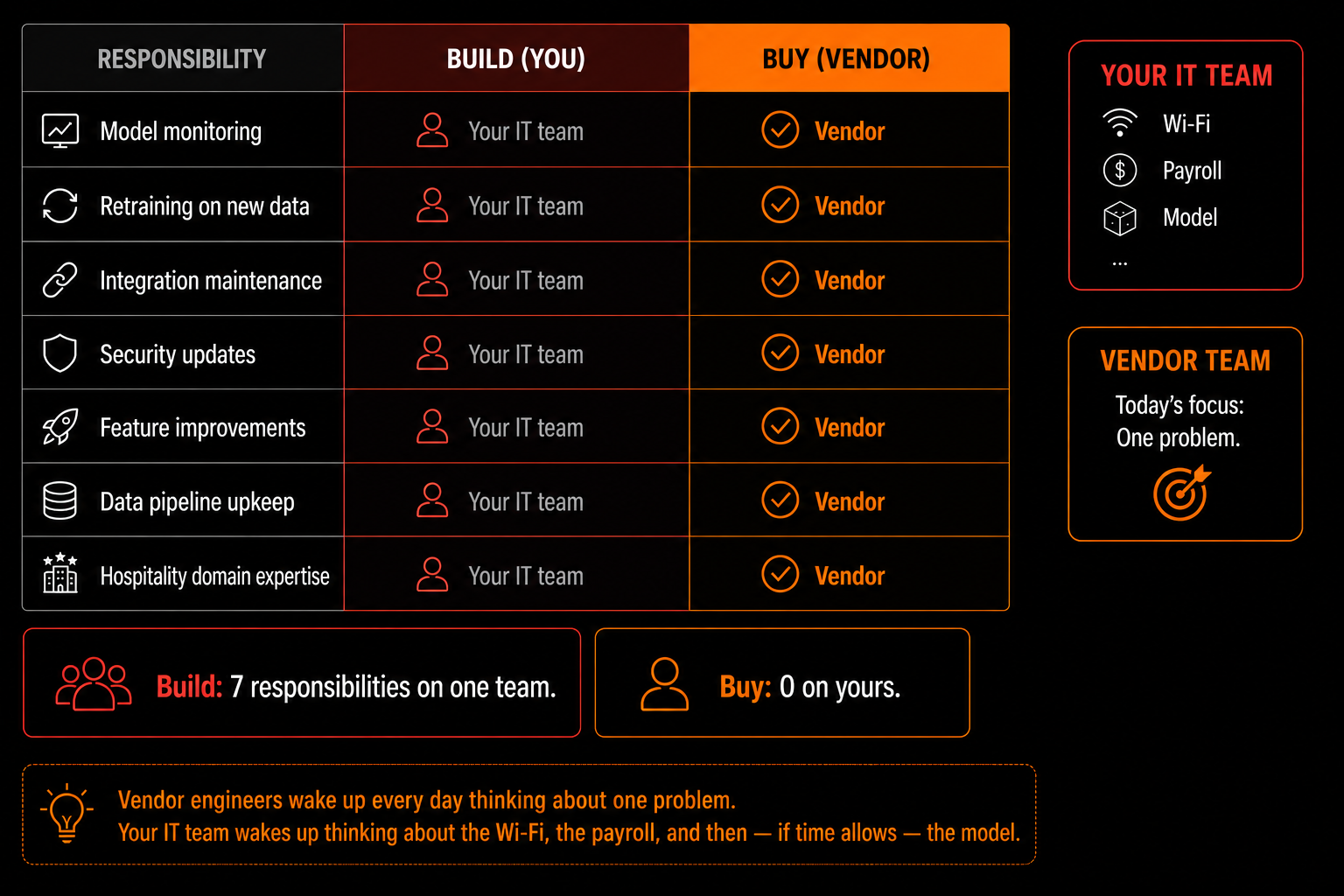
The most striking finding in the MIT research is a direct comparison between build and buy. Purchased AI solutions from specialized vendors succeeded about 67 percent of the time. Internal builds succeeded only about one third as often. The researchers noted that almost every enterprise they visited was trying to build its own tool, yet the data consistently showed that bought solutions delivered more reliable results.
Why would that be? Because a specialized vendor spreads the cost of monitoring, retraining, security, integration upkeep, and product improvement across hundreds of customers. You carry that entire burden alone. The vendor's engineers wake up every day thinking about one problem. Your IT team wakes up thinking about the Wi-Fi outage on the fourth floor, the payroll export, and then, if there is time left, the model.
For hotels, the buy case is even stronger than for most industries. BCG's analysis of AI adoption found that fewer than 10 percent of hospitality companies qualify as having cutting-edge AI capabilities that generate substantial value. Hospitality is not an AI-native industry, and pretending otherwise is how a 300,000 dollar build becomes a two-year distraction.
The hotels seeing real success over the next few years will not be the ones that built the smartest AI. They will be the ones that made the smartest business decisions about where their team's time and capital actually belong.
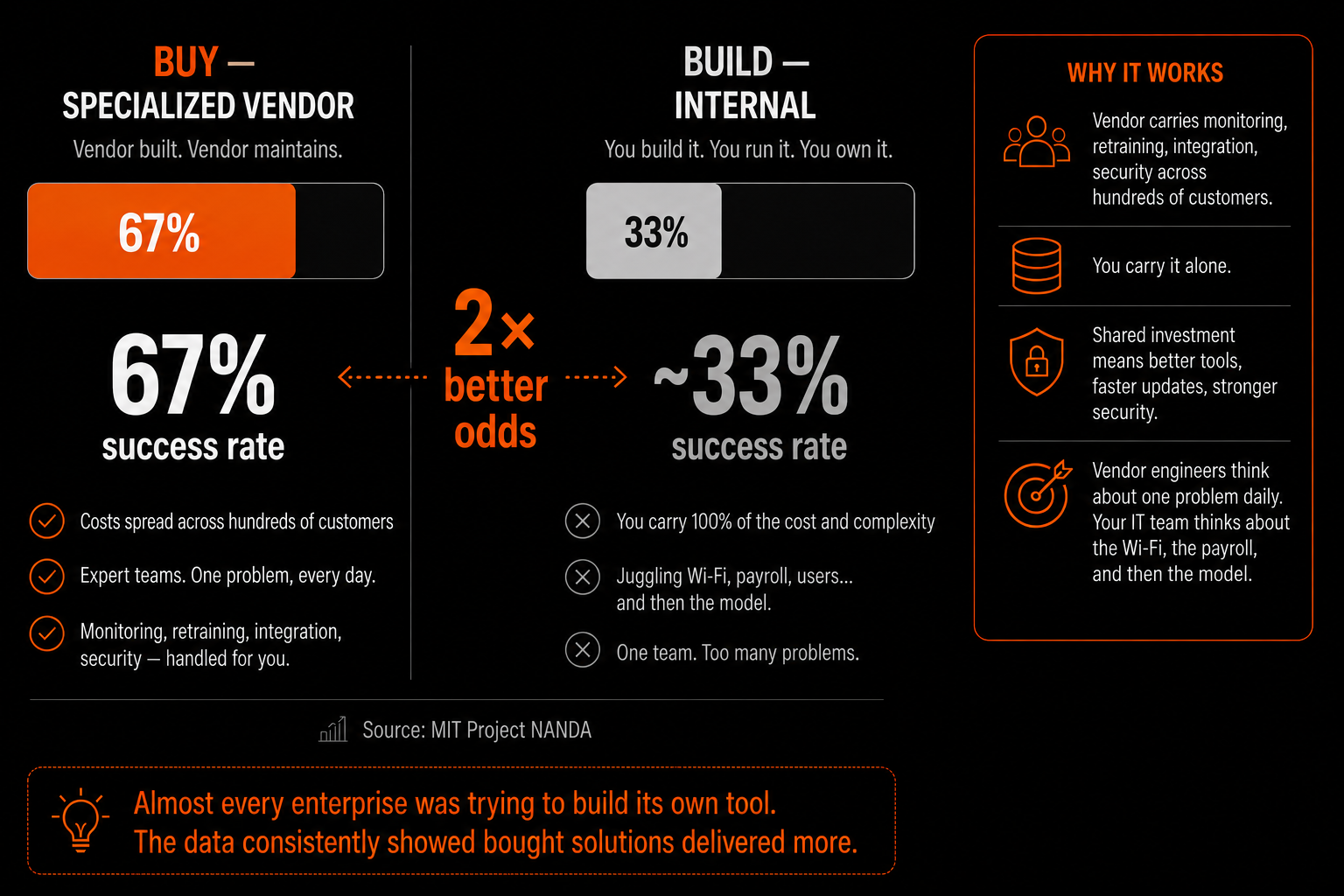
Where This Decision Bites Hardest: Group Sales
Here is where the build versus buy question stops being abstract. Group sales is the part of a hotel where execution speed directly converts to revenue, and where slow, fragmented systems already cost real money. Roughly 36 percent of hotel RFPs go unanswered industry-wide, and 61 percent of won deals go to one of the first three responders. That is not a demand problem. It is an execution problem, and it is exactly the kind of problem a purpose-built platform solves faster than an internal build ever could.
This is the problem Hippo Rev exists for. It is a Revenue Capture Platform built specifically for hotel group sales teams, handling the capture, conversion, and growth of group business without asking your IT team to become an AI operations shop. Teams using it have cut RFP processing from around 37 minutes to about 4 minutes per response. You get the AI outcome without the three-year maintenance commitment, because the monitoring, retraining, and integration upkeep are the vendor's job, not yours.
If you want to see what execution leakage is costing your specific property, book a Capture Audit. It takes 20 minutes, uses your numbers, and involves no deck.
Frequently Asked Questions
1. When does it make sense for a hotel to build AI in-house?
Only when all three conditions hold: clean, governed data across every major system, a dedicated team that owns that data, and budget certainty for at least three years of maintenance. In practice, this describes a handful of global chains, not the typical hotel group or management company.
2. How much does it cost to build custom AI for a hotel?
Custom hospitality AI builds generally range from 50,000 dollars for a single-function tool to 400,000 dollars or more for a multi-department platform, with data preparation consuming 40 to 60 percent of the first-year budget.
3. What is the ongoing cost after the build is finished?
Plan for 10 to 20 percent of the initial build cost every year in maintenance alone. That covers retraining, monitoring, integration fixes, and security updates, not new features.
4. Why do most AI projects fail?
Research from MIT, RAND, and Gartner points to the same causes: weak data foundations, poor integration into real workflows, unclear success metrics, and fading executive sponsorship. Model quality is rarely the reason.
5. Is buying AI really more successful than building it?
Yes. MIT's research found purchased solutions from specialized vendors succeeded about 67 percent of the time, while internal builds succeeded only about one third as often.
6. What does "AI-ready data" actually mean for a hotel?
It means your PMS, CRM, sales inbox, and booking channels feed consistent, deduplicated, trusted records into one governed source. If your sales team still reconciles group leads in spreadsheets, your data is not AI-ready.
7. Does buying AI mean losing control of our data?
No. Reputable vendors operate on your data under your governance, with contractual controls on usage and security. You retain ownership while offloading the operational burden.
8. Can our existing IT team maintain an AI system?
Usually not without restructuring. Hotel IT teams are built to ship projects with end dates. AI requires permanent operational pipelines: continuous monitoring, evaluation, and retraining. That is a different organizational muscle.
9. What happens if we build AI and then neglect it?
The model drifts. It keeps producing outputs, but they slowly diverge from reality as guest behavior and market conditions change. Degradation is silent, which makes it more dangerous than an outright failure.
10. How should a hotel start if it decides to buy?
Start with the highest-leakage workflow, not the flashiest one. For most properties with group business, that is the sales execution layer, where unanswered RFPs and slow response times are already costing measurable revenue. Audit that leakage first, then evaluate platforms against it.
Hotel Budget 2027: Start With Revenue and Profit Leaks
The 2027 hotel budget should begin with economic leakage, not last year’s spreadsheet. This article shows how hotels can examine demand capture, sales capacity, labor, distribution, space productivity and technology through a profit lens.
Hotel Budget 2027: Start With Revenue and Profit Leaks
Hotel budget season has a familiar pattern.
Last year’s spreadsheet gets opened. Revenue assumptions move up or down. Payroll gets challenged. Department heads defend familiar lines. Technology requests arrive with ROI slides attached. Eventually, the workbook becomes next year’s plan.
The problem is that 2027 does not look like a year in which simply adjusting last year’s assumptions will tell management where future profit will come from.
The research points to a more uncomfortable picture. Hotel demand is proving relatively resilient in several important markets, while operating costs remain stubborn. Travel pricing is moderating without becoming cheap. Group buyers are moving faster and behaving more selectively. Sales teams are still losing time to administration. And technology adoption is accelerating quickly enough that simply owning another system will not create much of an advantage.
Put those forces together and a different budget question emerges:
Where is the hotel already generating demand but failing to capture its full economic value?
That is the question worth taking into the budgeting room.
Because if 2027 is defined by reasonable demand and pressured margins, the best budget may not be the one with the most ambitious revenue forecast. It may be the one that identifies the operating constraints between demand and profit—and funds the removal of those constraints with evidence rather than optimism.
A stronger top line can still produce a disappointing year
The macro outlook contains an important contradiction.
STR and Tourism Economics have revised their U.S. expectations upward, with the research pointing to record room-night demand in the first half of 2026 and expectations for a stronger 2027 than earlier forecasts suggested. U.S. RevPAR growth is cited at 1.6% for 2027, while Asia Pacific is projected at 2.2%.
Globally, hotel ADR is expected to rise another 1.8% in 2027 after 3.7% growth in 2026.
That sounds constructive.
But it is not the same thing as saying hotel economics are becoming easier.
CBRE’s view in the supplied research is more cautious: soft top-line growth, sticky inflation and continued margin pressure. Gross operating profit per available room may rise, but expenses are expected to keep taking a meaningful share of the gain.
That distinction should shape the budget.
When demand is weak, management naturally focuses on stimulating demand. When demand is reasonably healthy but margins remain tight, the emphasis has to change. The question becomes how efficiently each piece of demand is acquired, processed, converted and served.
A hotel can budget 2% more revenue and still become economically weaker if acquiring that revenue requires more labor, more commissions, more administrative handling and more operating expense.
That is why 2027 budgets need to be read from the bottom up as well as the top down.
The revenue forecast tells you what you expect the market to give you.
The rest of the budget reveals how much of it you expect to keep.
The dangerous assumption is that demand is the bottleneck
Group business makes this especially clear.
The supplied research cites independent industry findings indicating that hotels responding to group RFPs within four hours report win rates 20 to 30 percentage points higher than properties responding later that day or the next. It also notes that booking windows have compressed sharply in some segments, in some cases toward 30 days.
Against that backdrop, speed stops being a service metric and starts becoming an economic variable.
The research also suggests that roughly 36% of RFPs go unanswered, while 61% of won deals go to one of the first three hotels that respond. Manual RFP processing is estimated at about 37 minutes per RFP versus roughly four minutes with automated processing.
Those figures should not automatically be treated as universal industry benchmarks. But they point to a problem hotel groups can—and should—measure for themselves.
Consider what an unanswered RFP looks like in a conventional sales report.
Often, it does not look like a lost deal at all.
There may be no formal decline, no recorded competitor win and no clean lost-business reason. The opportunity simply disappears before the hotel meaningfully enters the competition.
That is a dangerous kind of leakage because traditional reporting can make it almost invisible.
If management budgets primarily from converted business and documented losses, it may be building next year’s sales plan on an artificially small view of the addressable opportunity.
The real constraint may not be lead generation.
It may be the hotel’s capacity to work the leads it already receives.
That changes where the next dollar should go.
Stop confusing systems that remember with systems that act
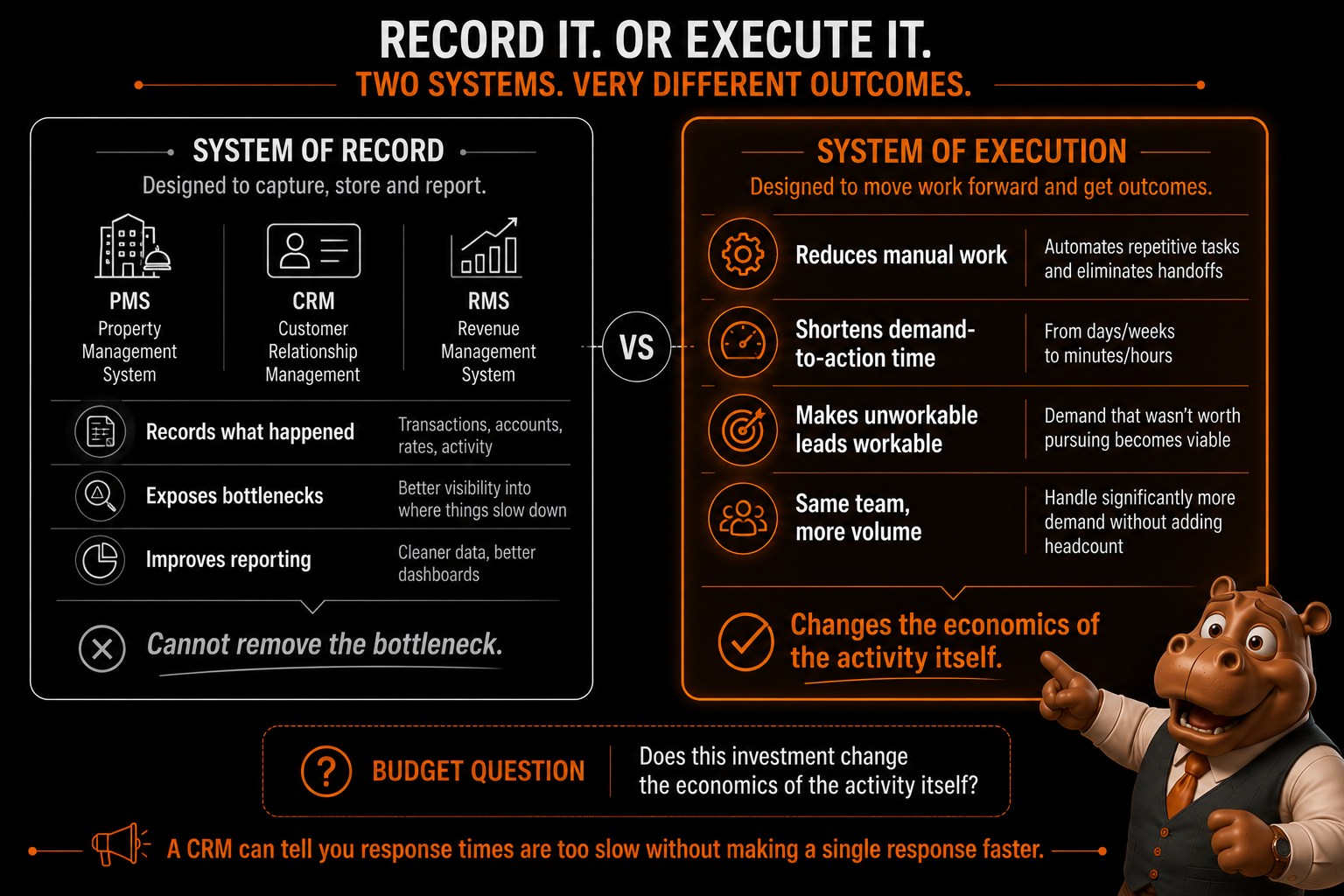
This is also where many technology discussions become muddled.
Most established hotel groups already have systems of record: PMS, CRM, revenue management platforms and other applications that record transactions, accounts, rates, activity and results.
Those systems matter enormously.
But a record of what happened yesterday does not necessarily solve an execution problem happening at 10:14 this morning.
An RFP arrives.
Someone needs to notice it. Qualify it. Gather information. Price it. Prepare a response. Send it. Follow up. Update the system. Coordinate internally. Repeat.
The supplied research describes the emerging distinction as one between a system of record and a system of execution.
That is a useful budgeting distinction because it helps clarify what management is actually buying.
A CRM may be perfectly capable of showing that response times are too slow without materially reducing the work required to respond faster. Better reporting can expose a bottleneck. It does not automatically remove it.
The same principle applies far beyond group sales.
Hotels should be asking which technology lines primarily document activity and which ones actually change the economics of the activity itself.
Does the investment reduce manual work?
Does it shorten the time between demand signal and commercial action?
Does it make a previously unworkable piece of demand economically worth pursuing?
Does it allow the same team to handle more volume without simply increasing payroll?
Those are stronger budget questions than, “Do we need another platform?”
AI enthusiasm makes proof more important, not less
Hospitality’s appetite for AI makes this distinction even more important.
In a 2026 survey of more than 400 hotel technology decision-makers, 85% expected to allocate at least 5% of their IT budgets to AI, while more than half expected AI allocations to exceed 10%. Separate industry tracking found that 82% of hotels were expanding their use of AI in 2026, up from 63% in 2024.
The obvious conclusion would be that AI investments are becoming easier to approve.
In one sense, yes. The category itself requires less explanation.
But that can make the individual investment harder to defend.
Once almost every department can produce an AI-related proposal, finance is no longer choosing between “AI” and “no AI.” It is choosing among several competing claims on the same limited pool of capital.
The winning proposal therefore needs more than a broad industry statistic.
It needs a baseline.
If a commercial team says automation will save time, finance should know how much time the current process consumes.
If faster responses are supposed to improve conversion, management should know its current response-time distribution and conversion rate.
If the tool is expected to capture neglected RFPs, the hotel should first count how many RFPs are currently receiving no meaningful response.
That is what makes the “proof before budget” principle so powerful.
In a margin-sensitive year, that is a much stronger basis for allocating capital.
The same logic should be applied to the entire P&L
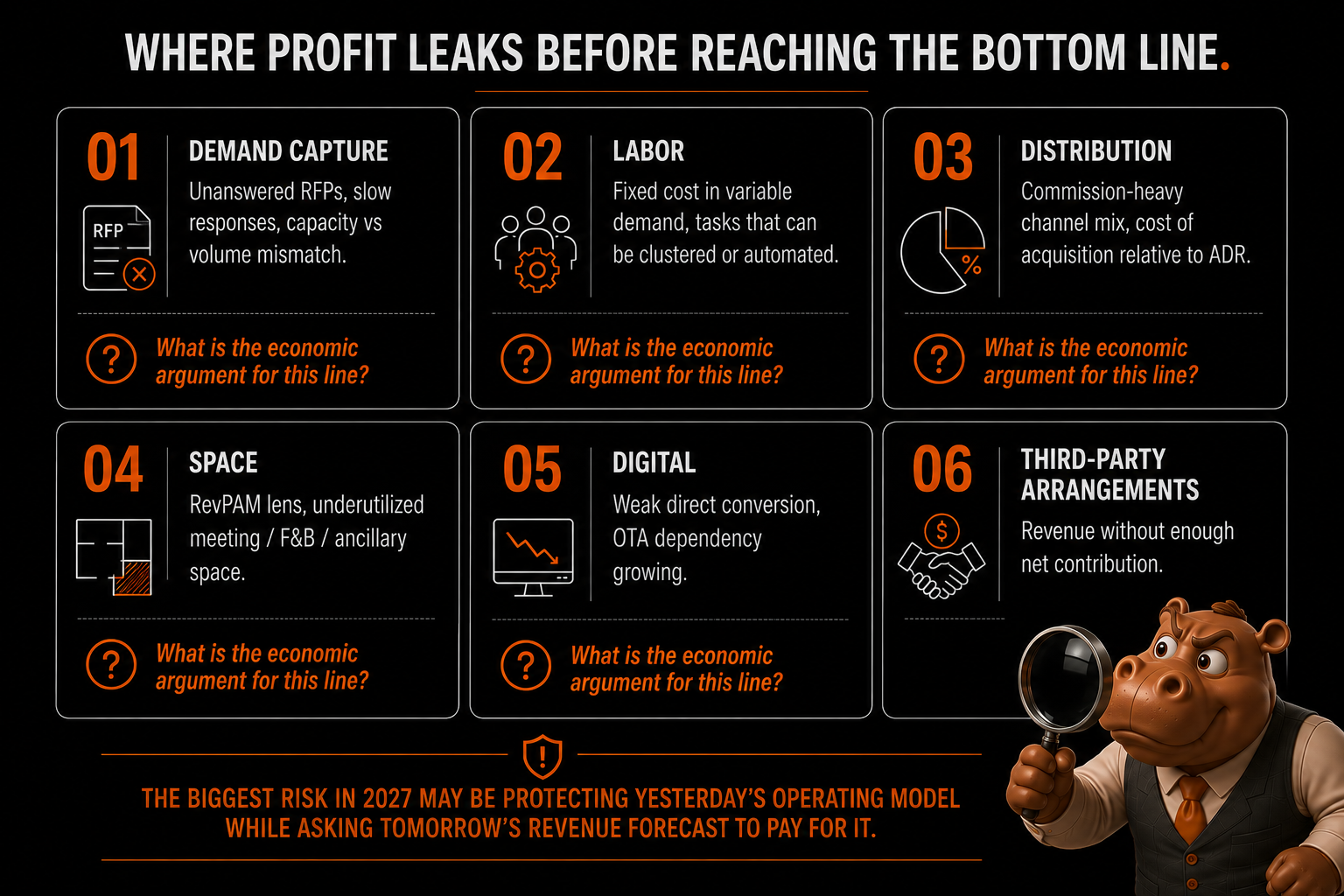
This proof-first mindset should not stop with sales technology.
Take payroll.
The research argues that hotels are exploring clustered leadership, hybrid roles, selective outsourcing and greater automation because labor remains the largest controllable expense.
A traditional budget might begin with departmental headcount and ask how much it can be reduced.
A more useful approach begins with work.
What work must be done?
Which tasks vary with occupancy?
Which require property-level presence?
Which can be clustered?
Which are repetitive enough to automate?
Which are genuinely revenue producing?
That produces a different organizational conversation than simply asking every department to cut 5%.
The same applies to physical space.
RevPAR remains essential, but the supplied research introduces RevPAM—Revenue Per Available Square Metre—as a broader way to think about the productivity of the asset.
A ballroom, rooftop, spa, restaurant or retail area consumes capital and often operating expense whether it is well monetized or not.
That creates a budgeting question that room-centric reporting can miss: are we protecting cost structures attached to spaces that are not producing enough economic value?
Third-party leases deserve the same treatment. A restaurant or salon may generate rent or revenue share while the hotel absorbs utilities and back-of-house support. Looking only at the revenue line can make an arrangement appear healthier than it is. The relevant view is closer to the net contribution.
Once again, the principle is consistent:
Budget the economics of the activity, not merely the historical department that owns the line.
Distribution deserves a profit lens too
The research’s emphasis on direct booking makes a related point.
A room booked through an OTA and a room booked through brand.com may contribute to the same occupancy number. They do not necessarily contribute the same economics.
In a year of margin pressure, that difference matters.
A budget that celebrates room revenue growth without examining the cost of acquiring that revenue risks optimizing the visible metric while allowing profit to deteriorate underneath it.
This is not an argument that every booking must be direct or that intermediaries have no role.
It is an argument for making distribution economics explicit.
If the budget assumes ADR growth, what does it assume about channel mix?
If direct conversion is a strategic priority, has the hotel actually funded the digital experience, personalization and commercial intelligence needed to support it?
If commissions rise alongside revenue, is management comfortable with that trade?
Every revenue assumption has an acquisition-cost assumption hiding behind it.
2027 is a good year to make those assumptions visible.
Buyer behavior belongs in the hotel budget too
Let’s look at corporate meeting economics from the buyer’s side.
For a 2027 domestic sales kickoff, the benchmark ranges from roughly $650 to $1,400 per attendee per day before airfare. Premium Tier-1 destinations contrast with more cost-efficient Tier-2 markets such as Indianapolis, Salt Lake City and San Antonio, where group ADRs can sit in the $110 to $185 range.
Hoteliers do not need to become corporate travel managers to understand the implication.
Their customers are budgeting too.
A corporate buyer looking at the total cost of room, F&B, meeting space, AV and transportation may make a very different destination decision from a buyer comparing ADR alone.
That means hotel sales budgets and demand calendars should reflect where buyers themselves are likely to feel pressure.
The same is true of timing.
The research highlights shoulder periods, major convention weeks and an unusually early Easter in 2027—March 28—as factors capable of compressing or redirecting demand. In Australia, fragmented school-holiday schedules could stretch family travel pressure from late March through late April.
These are not trivia for the strategy deck.
They belong in the assumptions behind monthly revenue plans, staffing grids, group need dates and pricing strategy.
An annual budget built as twelve equal portions of a market-growth forecast will miss exactly the kinds of calendar distortions that determine whether individual months outperform or disappoint.
Regional averages are becoming less useful as operating instructions
The geopolitical section of the research reinforces the same idea at a larger scale.
Global hotel ADR may rise modestly in 2027, but the recent research points towards sharply different regional trajectories: Asia Pacific leading growth, Europe nearly flat, the U.S. modestly positive and parts of the Middle East facing a much slower recovery following severe disruption described in the research.
Whether every regional projection ultimately lands exactly as forecast is less important to the budgeting lesson.
A global average is an input.
It is not an operating plan.
Properties exposed to different source markets, air routes, corporate accounts and event calendars can experience completely different years while the global average appears remarkably calm.
That is why simply adding the industry forecast to last year’s budget can create false precision.
The budget should reflect the demand drivers the hotel can actually observe.
What should survive the budget meeting?
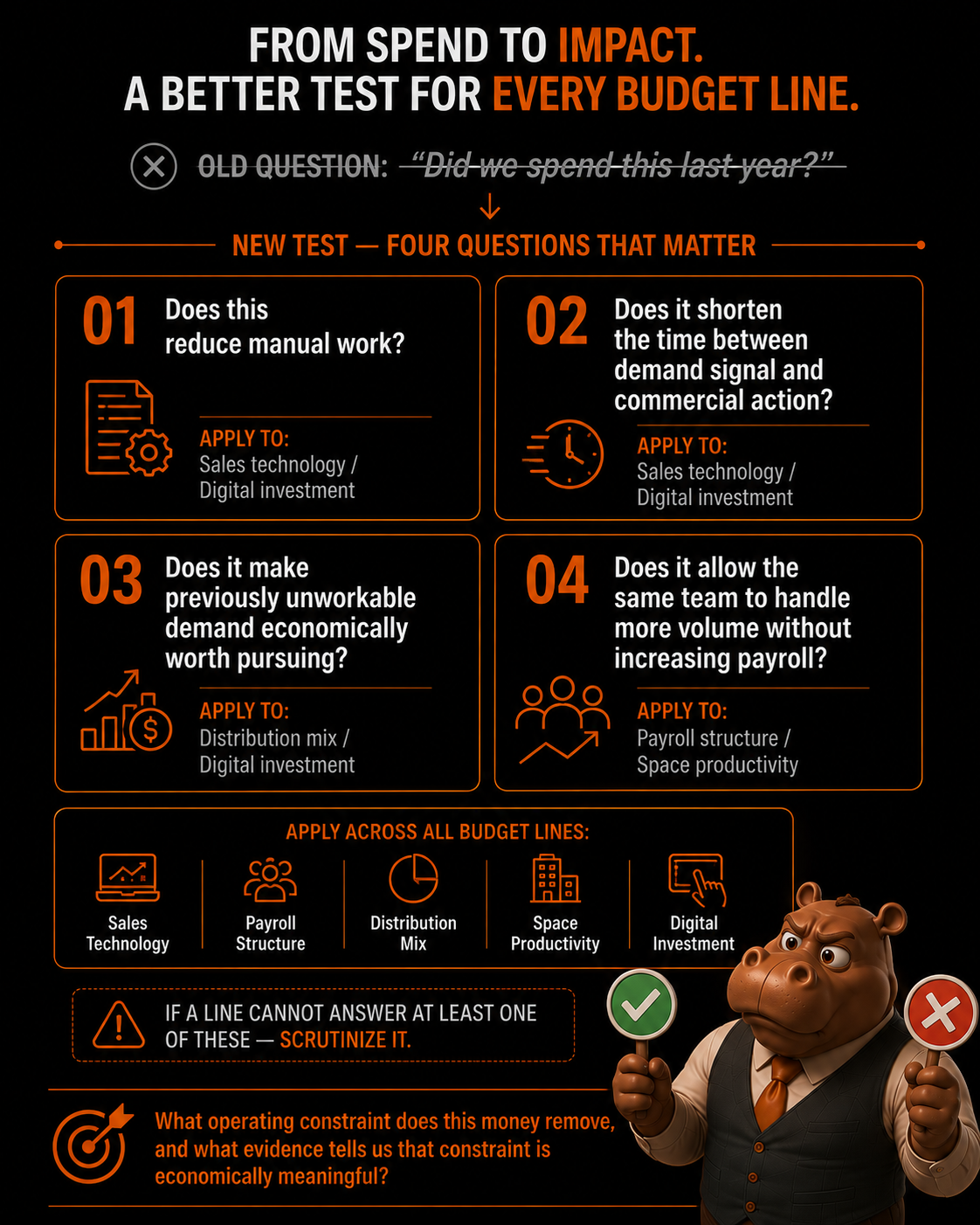
This leads to a useful test for almost every contested 2027 line item.
Not: “Did we spend this last year?”
Not even: “Is this strategically important?”
Ask instead:
What operating constraint does this money remove, and what evidence tells us that constraint is economically meaningful?
For sales technology, the constraint might be response capacity.
For payroll, it might be a staffing structure that keeps too much cost fixed when demand moves.
For distribution, it might be an expensive channel mix.
For underused space, it might be a room-centric view of asset productivity.
For digital investment, it might be weak direct conversion.
For a third-party lease, it might be an arrangement that produces revenue without enough net contribution.
And for some long-standing budget lines, the answer may simply be that no one has tested the assumption in years.
Those are the lines most deserving of scrutiny.
Because the biggest risk in 2027 may not be budgeting too cautiously.
It may be protecting yesterday’s operating model while asking tomorrow’s revenue forecast to pay for it.
Proof is more useful before the budget is locked
There is one practical problem with all of this: most teams are being asked to make these decisions before they have enough evidence.
That is especially true with newer sales technology. Finance wants to know what the return will be. Commercial leaders want to know whether the workflow will actually change. IT does not want to start a lengthy implementation for something the business has not yet proved. Everyone is asking reasonable questions, but the normal buying process often asks those questions in the wrong order.
The better sequence is to measure first and decide second.
That is the thinking behind Hippo Rev’s free six-week pilot for hotel groups. The first two weeks use the Delphi and Cvent reports the commercial team already produces, without requiring a new integration, migration or provisioning project. The following four weeks run against the live RFP workflow. At the end, the group gets a before-and-after view across four measures: administrative hours, time to first follow-up, RFPs worked and revenue associated with the workflow. There is no pilot fee and no performance target that has to be agreed in advance. The numbers either support the investment case or they do not.
That matters during budget season because it changes the nature of the conversation. Instead of asking ownership to approve a line based on an industry benchmark, a projected ROI or someone else’s case study, the commercial team can bring its own operating evidence into the room. The question becomes less, “Do we believe this could work?” and more, “Here is what changed in our portfolio. Is that worth funding?”
For groups still deciding what belongs in the 2027 plan, that may be the most useful role a pilot can play. Not as a shortcut to approval, and not as another technology demo, but as a way to replace one more assumption in the budget with something observed.
A budget is ultimately a theory of how profit will be made
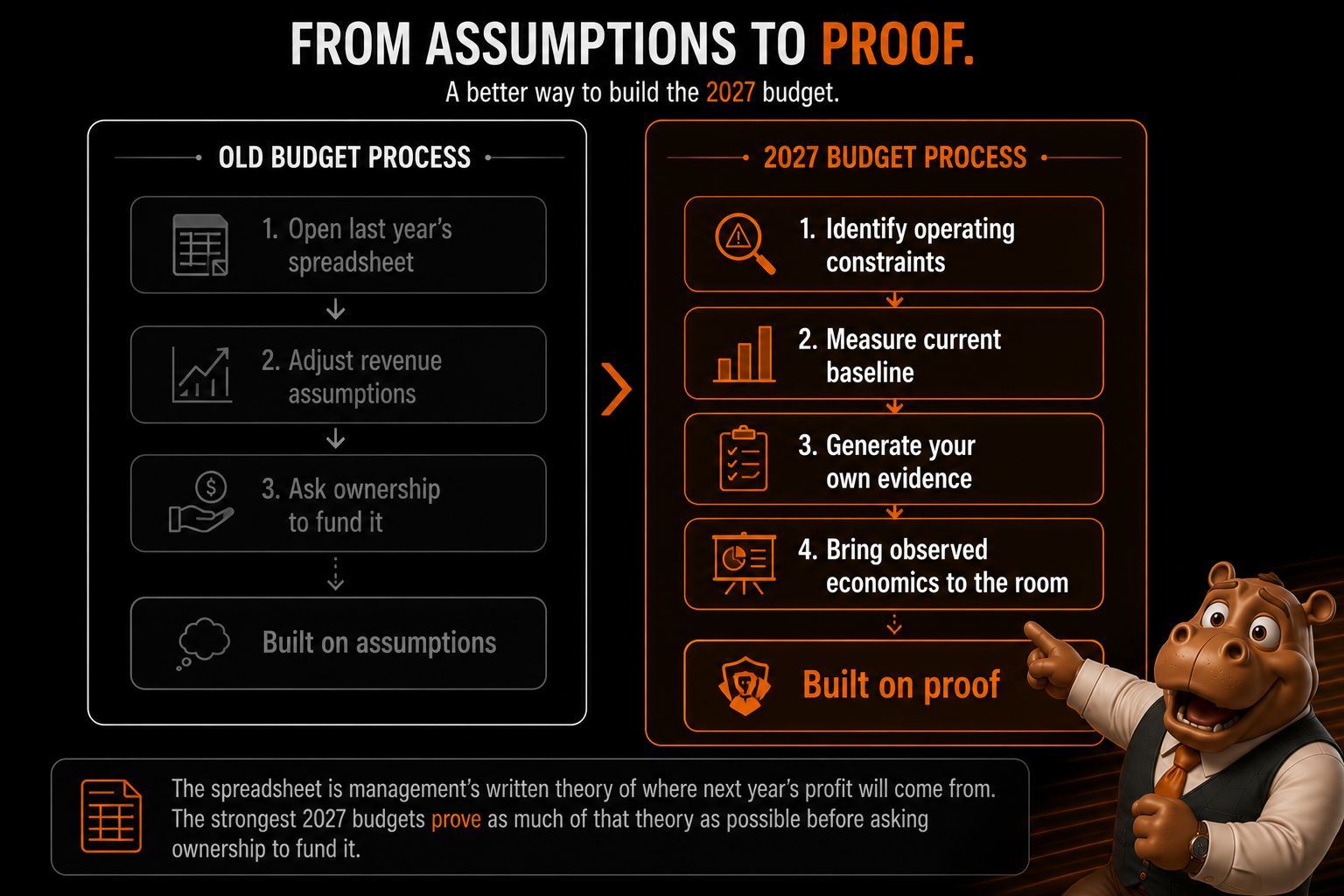
There is a temptation in every budgeting cycle to treat uncertainty as a reason to stay close to last year.
The research suggests the opposite.
Moderating price growth, resilient demand, uneven regional conditions, compressed booking windows, rising costs and rapid technology adoption make historical continuity a weaker assumption, not a safer one.
The most defensible 2027 budgets will therefore be built from a more granular understanding of the business: what demand is arriving, what prevents the hotel from capturing it, what it costs to process and serve, where money leaks before reaching the bottom line, and which investments can show measurable improvement.
That does not mean every pilot deserves a rollout, every role should be redesigned or every traditional expense should disappear.
It means every important line should have an economic argument behind it—and, wherever possible, evidence from the hotel’s own operation.
Because the spreadsheet is not merely a forecast of next year’s performance. It is management’s written theory of where next year’s profit will come from. The strongest 2027 budgets will be the ones that prove as much of that theory as possible before asking ownership to fund it.
Frequently Asked Questions
How should hotels approach budgeting differently for 2027?
Hotels should start by identifying where economic value is leaking rather than simply adjusting last year's budget lines. That means looking at where demand is generated but not fully captured, where labor is being consumed without creating proportional value, where distribution costs are eroding revenue, and where existing workflows limit commercial capacity. The 2027 budget should fund the removal of measurable constraints rather than assume that higher revenue alone will produce higher profit.
How should hotels evaluate AI investments during budget season?
Start with the current operating baseline. Measure how much time the existing process takes, where delays occur, how much demand goes unworked, and what outcomes the hotel currently achieves. Then test whether the AI investment materially changes those numbers. As AI proposals become more common across hotel departments, a specific investment should be justified by measurable improvements in a defined workflow rather than by the general argument that AI is strategically important.
How should hotels budget for distribution when revenue growth is expected to remain modest?
Hotels should evaluate the cost of acquiring revenue alongside the revenue itself. Two bookings with the same ADR can have different profit contributions depending on commissions, marketing costs, loyalty costs, and channel economics. A 2027 budget should therefore include assumptions about channel mix, direct conversion, acquisition costs, and the investment required to support profitable demand capture rather than focusing only on occupancy, ADR, and room revenue.
What evidence should a new technology investment have before it receives a 2027 budget line?
Ideally, the hotel should have evidence from its own operation rather than relying only on vendor benchmarks or projected ROI. A contained pilot can establish the current baseline, run the technology against a real workflow, and measure the change. For a group-sales workflow, that could include administrative hours, time to first follow-up, RFPs worked, and revenue associated with the process. The budget decision can then be based on observed economics rather than assumptions.
AI in Hospitality 2027: From Pilots to Operating Model
AI in hospitality is moving from experimentation to accountability and into the operating model. This article explains why 2027 puts hotel commercial and revenue teams at the center of AI strategy, how to redeploy capacity created by automation, and why testing workflows before budgeting can produce stronger investment decisions.
Hotel AI Strategy 2027: Why Commercial Teams Must Act
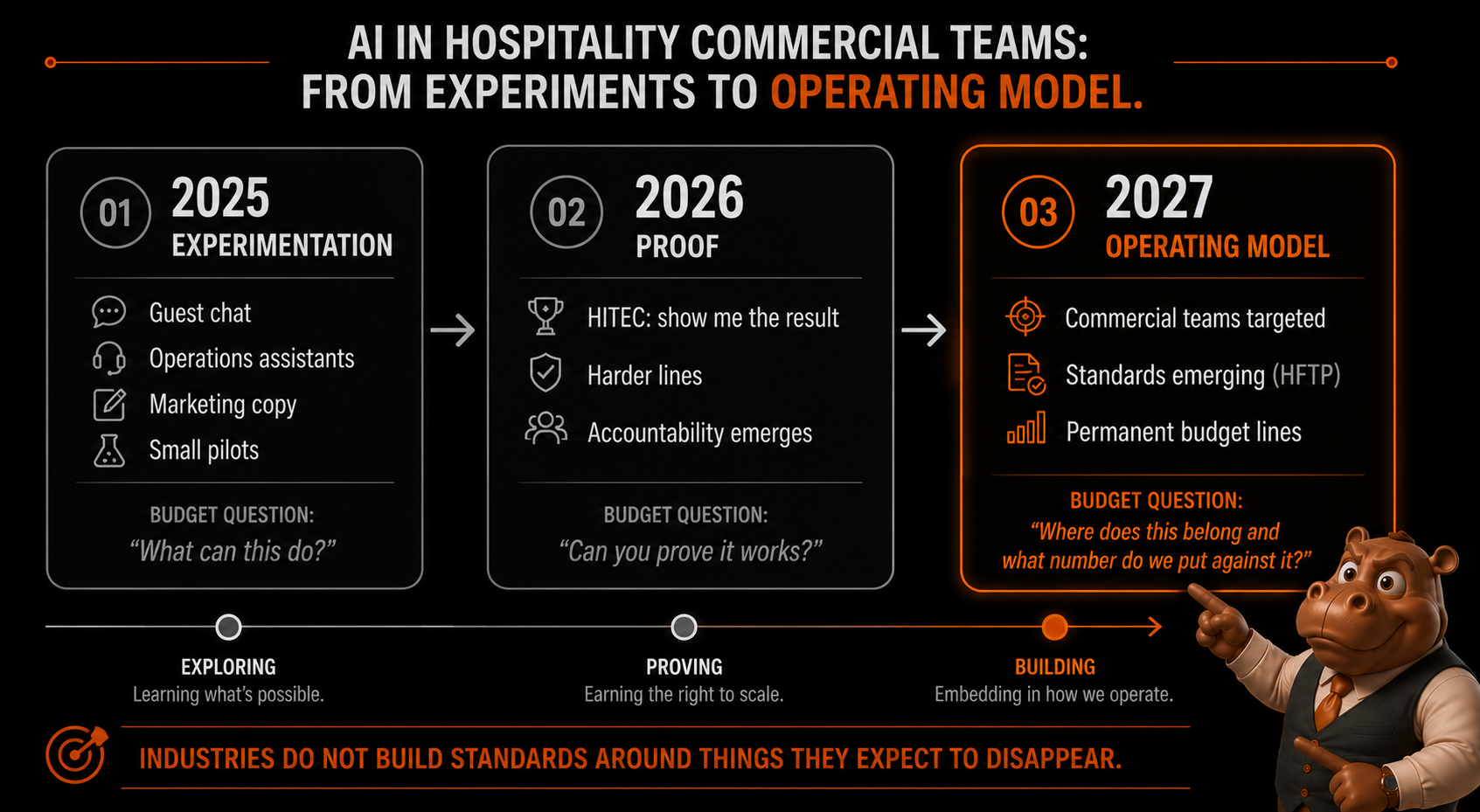
If you draw the last three years of AI in hospitality as a line, the direction is hard to miss.
2025 was the year of experimentation.
2026 became the year of proof.
2027 is shaping up to be the year AI becomes part of the operating model.
That progression matters because each stage asks a very different question.
In 2025, hotel leaders were asking, What can this technology do?
By 2026, the question had changed to, Can you prove it actually works?
And as teams build 2027 budgets, the question is becoming more practical still: Where does this belong in the business, what does it replace or improve, and what number do we put against it?
You could hear that change clearly at HITEC 2026. The conversation had moved well beyond AI novelty. The mood was closer to: show me the result. Oracle, on its own keynote stage, acknowledged that it does not yet have a clean way to prove AI’s value.
That admission is more important than it sounds.
It tells us the industry has crossed from excitement into accountability. And accountability is where technology stops being an interesting experiment and starts competing for permanent budget.
There is another shift happening underneath that one.
The first wave of hotel AI concentrated heavily on the guest experience and operations. The next wave is moving toward the commercial floor.
For sales and revenue leaders, that is where things get interesting.
From experiments to proof to infrastructure
In 2025, most hotel AI lived around the edges of the operation.
Guest chat. Operations assistants. Marketing copy. Small pilots that could be started without redesigning the business around them.
Some of those uses created real value. But the value was fragmented. AI was something teams tried. Few organizations were building the annual plan around it.
Then came 2026, and the tone changed.
At HITEC, operators began drawing much harder lines around what AI could and could not do.
The point was not that AI is limited. It was that the industry was starting to separate useful automation from magical thinking.
Bonafide brought an uncomfortable issue into view: hotels typically begin with roughly one-third of their facts misaligned across the sources AI assistants read from. Meanwhile, Frank Trampert of Revinate pointed out something that should make every hotel marketer pay attention: AI models may place less trust in polished marketing language and lean instead on what guests are actually saying in reviews.
Different problem. Same lesson.
AI becomes much less forgiving once it leaves the demo environment.
If the underlying information is inconsistent, AI exposes it. If the value cannot be measured, leadership questions it. If the workflow still relies on people to patch every gap manually, the promise looks considerably smaller in practice than it did on the slide.
That is why 2027 looks different again.
HFTP, the organization behind HITEC, is working on an industry standard for how hotel data should be structured so AI systems can represent properties accurately.
That is a significant signal.
Industries do not spend time creating standards around things they expect to disappear next year. Standards emerge when a technology begins moving from optional tool to shared infrastructure.
And once something becomes infrastructure, the budget conversation changes.
The question is no longer whether somebody in the hotel should experiment with AI.
It becomes: where does AI belong in the operating model, and what should it be accountable for?
Also Read: The Second Wave of AI in Hospitality
The spotlight is moving to sales, revenue and commercial teams
The first wave of hotel AI had an obvious home in operations and guest service.
The next wave has an equally obvious target: commercial work.
Why?
Because that is where some of the most expensive manual friction still sits.
Approximately 55% of hotel RFPs go unanswered, according to Groups360. And 72% of group business goes to whoever responds first, according to Amadeus.
Put those two figures next to each other and the problem becomes very concrete.
Hotels are receiving demand they have already paid to generate, only to lose part of it because the commercial team cannot process it quickly enough.
That is not primarily a lead-generation problem.
It is a throughput problem.
No amount of sophisticated guest-facing AI fixes a group-sales desk where qualified inbound business sits waiting while someone gathers information, checks systems, prepares pricing, formats a proposal and works through a queue of follow-ups.
The industry’s own strategists see the pressure moving toward commercial functions as well.
At HITEC, Floor Bleeker of In2 Consulting argued that AI will “change everything” and push hotel brands back toward competing on the actual guest experience. Natalie Kimball of Shiji expects the distribution battle to intensify and has even predicted the emergence of a higher OTA commission tier for AI-agent bookings.
The specific future may unfold differently from any one prediction.
But the direction is clear.
Distribution, pricing, demand capture, sales productivity and commercial execution are moving closer to the center of the AI conversation.
That means AI is no longer something the IT team evaluates on behalf of everyone else.
For commercial leaders, it has become a strategy question with direct revenue consequences.
The hotel seller was always a farmer. What happens when the field starts tending itself?
For decades, the group-sales job has looked remarkably similar to farming.
Demand arrives.
The seller tends it.
Gather the details. Check availability. Find the right pricing. Prepare the proposal. Format it. Send it. Follow up. Keep working the opportunity until it either closes or disappears.
A great deal of the job has never really been selling.
It has been processing the conditions required for selling to happen.
That distinction becomes much more important when AI enters the workflow.
If software can capture the inquiry, qualify it, pull together the relevant pricing inputs, prepare a proposal draft and keep basic follow-up moving, what exactly should the seller spend the day doing?
That question sounds threatening only if we assume the administrative portion of the job was the source of its value.
It wasn’t.
The more useful answer coming out of HITEC 2026 was narrower and more reassuring: AI takes on the mechanical layers—the sorting, drafting and routing—while people remain responsible for the things that always required a person.
Judgment.
Identity.
Accountability.
Keryn McNamara of Aimbridge took the idea further, predicting new jobs such as “agent supervisors”: people responsible for overseeing AI systems and holding their outputs accountable.
Adam Tuttle made the brand version of the same argument.
AI can scale a standard remarkably well.
But it cannot invent a standard worth scaling.
A person still has to decide what good looks like.
That is the real shift for hotel sales teams.
The farmer does not disappear.
The farmer becomes more of a hunter and a closer.
Time that once disappeared into chasing, formatting and routine preparation can move toward proactive prospecting, strategic account development, negotiation, larger group pursuits and the relationships that actually decide complex events.
The role moves closer to where its economic value was always supposed to be.
The redeployment math is where the strategy gets real
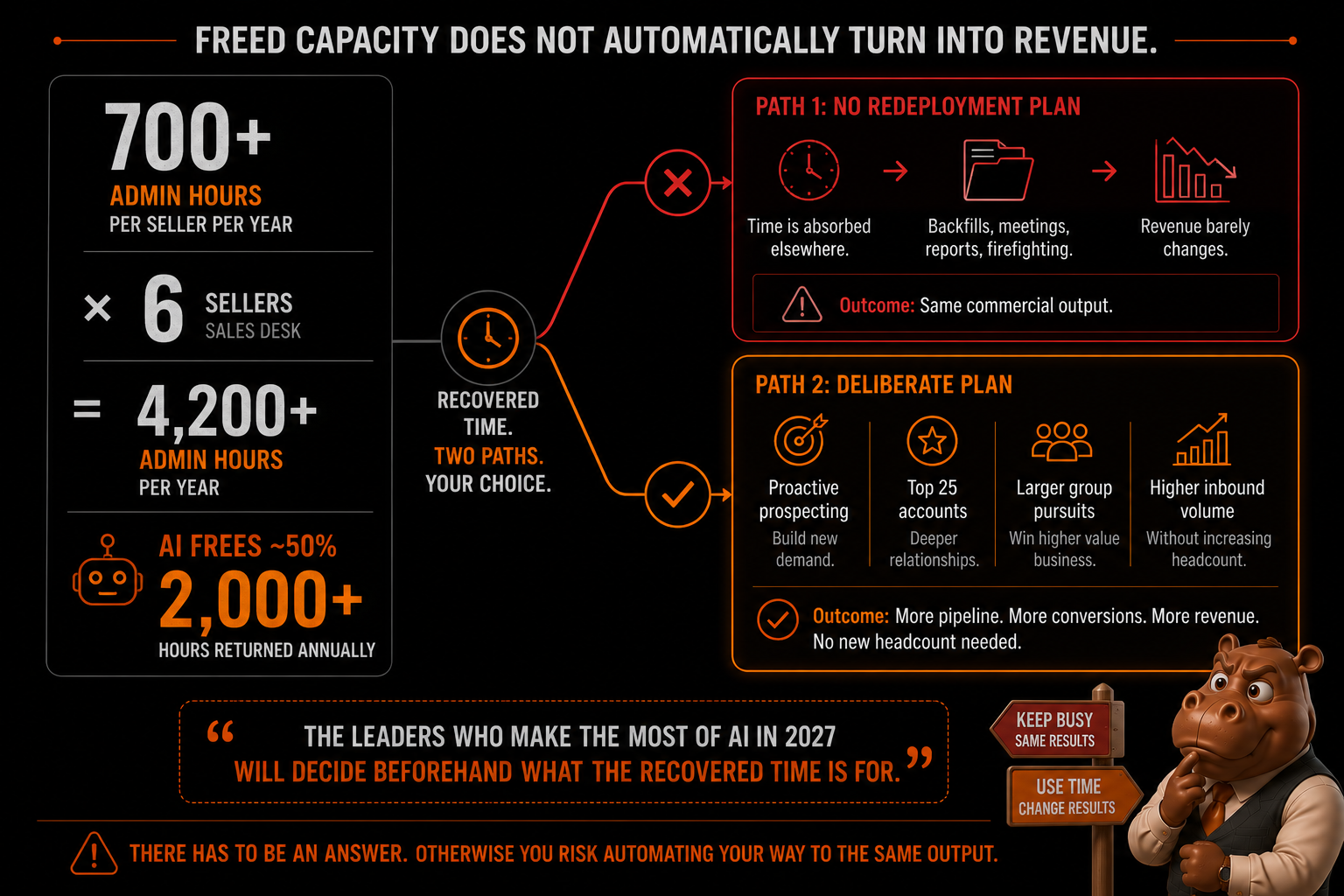
Most conversations about AI productivity stop at “hours saved.”
That is not enough.
Salesforce data puts the average seller at only 29% of the working week spent actually selling. Industry estimates place the administrative burden at more than 700 hours per seller per year.
If a strong AI-supported workflow gives back even half of those hours, the result is roughly 350 to 400 hours per seller, per year returned to the business.
On a six-person sales desk, that is well over 2,000 hours annually.
Now comes the part leaders should care about.
What happens to those hours?
Because freed capacity does not automatically turn into revenue.
Imagine clearing 2,000 hours of administrative work from a sales team and then changing nothing else about how the team operates. No new account strategy. No prospecting expectation. No reassignment of higher-value opportunities. No deliberate focus on larger group business.
You may have made the workflow much more efficient while barely changing the commercial result.
The time simply gets absorbed elsewhere.
That is why the leaders who make the most of AI in 2027 will not be the ones who merely remove administrative work.
They will decide beforehand what the recovered time is for.
Maybe it goes toward proactive prospecting.
Maybe toward the top 25 accounts that always deserved more attention but rarely received it.
Maybe it lets sellers pursue larger and more complex group opportunities that were previously too time-consuming.
Maybe it means a team can handle higher inbound volume without immediately adding another position.
The exact answer will differ by hotel and portfolio.
But there has to be an answer.
Otherwise you risk automating your way to the same output.
Why waiting until 2028 is not a neutral choice
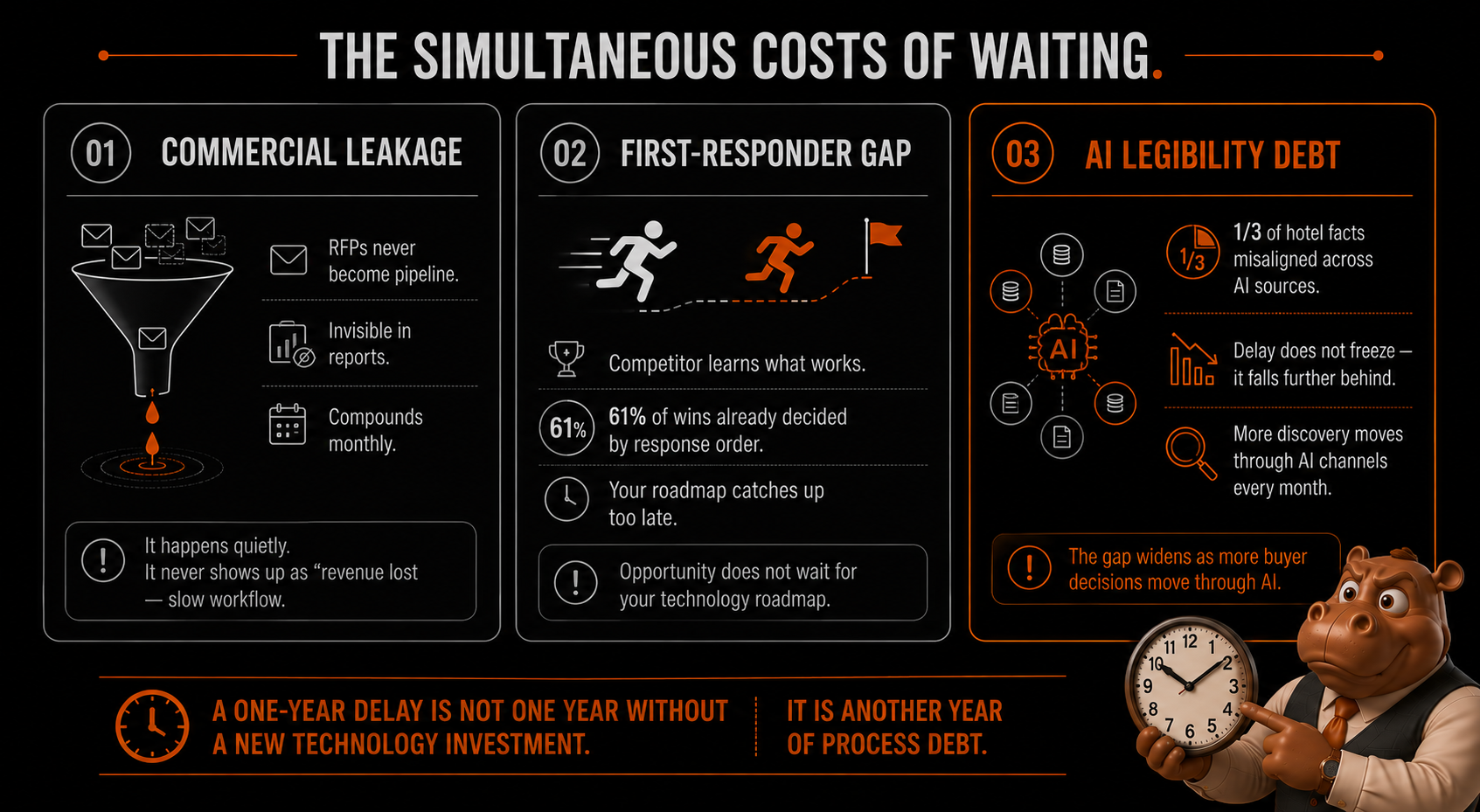
There is a reasonable instinct among hotel leaders to wait.
AI is moving quickly. Vendors are still sorting themselves out. Proof is uneven. Why not let the market mature for another year, learn from other operators and put the serious budget behind it in 2028?
Because waiting has a cost too.
Every month a group-sales desk remains heavily manual, some portion of inbound business still arrives faster than the team can work it.
Those RFPs do not necessarily appear later in a report marked “Revenue lost because our workflow was too slow.”
They simply never become meaningful pipeline.
That is what makes the leakage easy to underestimate.
At the same time, the first-responder advantage continues working in somebody’s favor. If your competitor reaches the buyer first, the opportunity does not wait politely for your technology roadmap to catch up.
There is a second form of delay too: AI legibility.
If roughly one-third of hotel facts can begin misaligned across the sources AI assistants use, postponing the work of cleaning, structuring and governing that information does not freeze the situation in place. It leaves the hotel less prepared as more discovery and decision-making moves through AI-assisted channels.
So a one-year delay is not simply one year without a new technology investment.
It can mean another year of commercial leakage, another year of process debt and another year in which competitors learn what works while your team waits for certainty.
By the time the evidence feels undeniable, the budgeting window may already have passed.
Then the same investment has to fight its way into a mid-year reforecast.
Anyone who has done that knows it is the harder conversation.
But you cannot budget confidently for a game you have never played
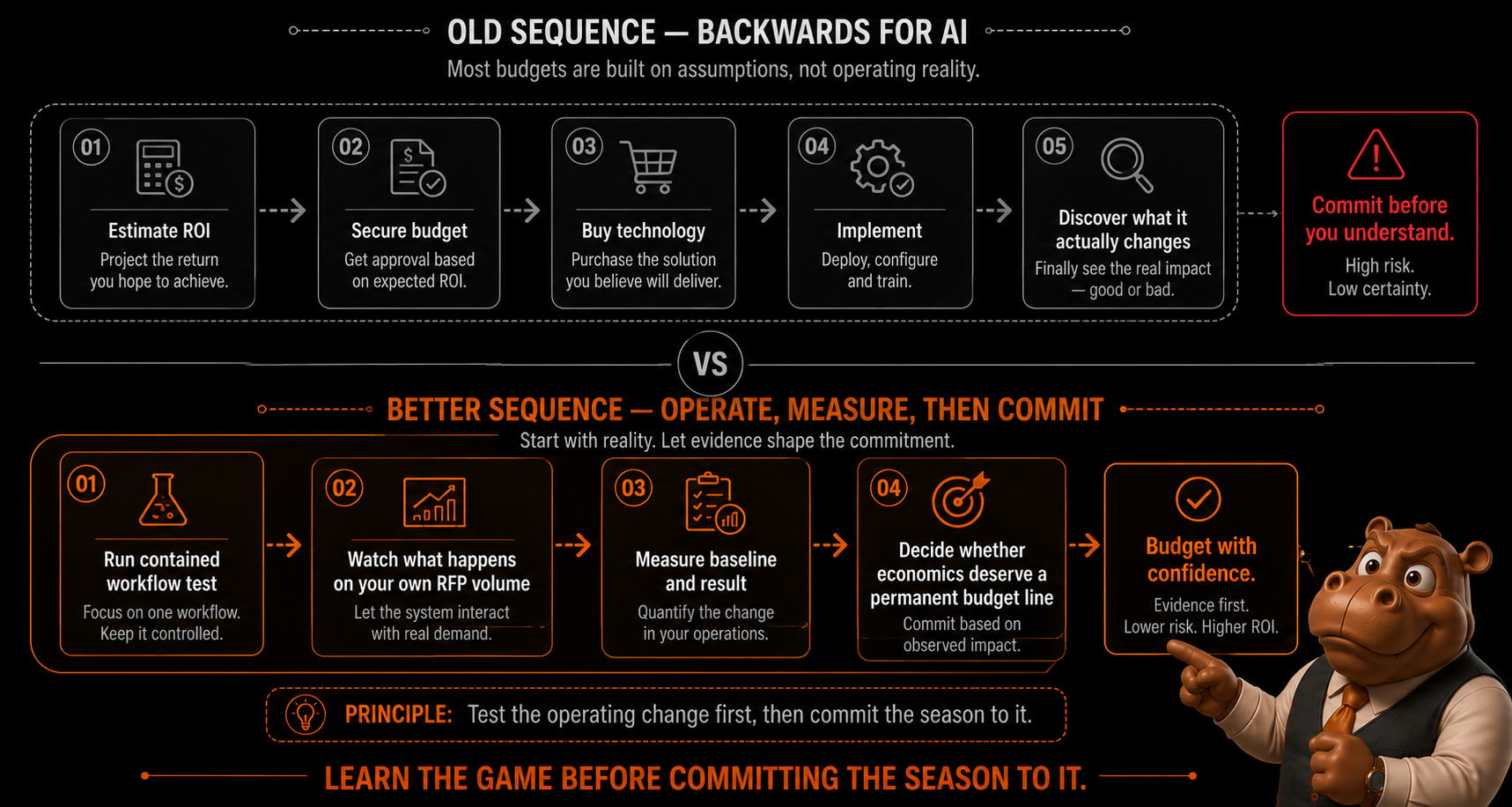
This is the legitimate objection.
Commercial leaders are being asked to budget for technology whose actual structural effect on their own team may still be unclear.
How many administrative hours will disappear?
How much faster will first follow-up become?
How many more RFPs will the existing team be able to work?
Where will the released selling time actually go?
What does any of that mean in revenue?
You cannot answer those questions credibly from somebody else’s case study.
And that is why the traditional software-buying sequence feels backwards for AI.
Normally, the process looks something like this:
Estimate the ROI.
Secure the budget.
Buy the technology.
Implement it.
Then discover what it actually changes.
For a workflow technology that can alter how people spend their time, a more sensible sequence is to test the operating change first.
Run a contained version of the workflow.
Watch what happens on your own RFP volume.
Measure the baseline and the result.
Then decide whether the economics deserve a permanent budget line.
That is the real purpose of a pilot.
Not to create a prettier demo.
To learn the game before committing the season to it.
What a six-week test actually needs to prove
That thinking is behind Hippo Rev’s free six-week pilot for hotel group sales.
Hippo Rev acts as an execution layer around the group-sales RFP workflow. It captures incoming RFPs, prepares priced proposal drafts using the systems and information the hotel already works with, and keeps follow-up moving, while the seller remains responsible for approving what goes out.
The pilot deliberately keeps the scope narrow.
The first two weeks are used to onboard using the hotel’s existing Delphi and Cvent reports, without a new IT integration and without pilot cost.
The next four weeks run live against one group-sales workflow at a single property or cluster.
The point is not to ask the team to believe a projected ROI.
It is to measure what happens.
At the end, the hotel receives its own before-and-after view across four practical measures:
Administrative hours per seller.
Time to first follow-up.
RFPs worked.
Revenue associated with the workflow.
Those results are then used to build a six-month projection from the hotel’s own operating data.
That distinction matters.
A vendor benchmark can tell you what might be possible.
Your own workflow tells you whether it is worth budgeting for.
And the pilot does not have to prove that AI is universally valuable. It only has to answer a much more useful question:
Does changing this particular workflow create enough commercial value in this particular hotel or portfolio to deserve a place in the 2027 plan?
If the answer is yes, the budget case becomes much easier to defend.
If the answer is no, that is useful information too.
Either way, leadership is no longer guessing.
Bottom line
2027 is the year AI begins moving from experiment to operating model for hotel commercial teams.
That does not mean the winners will be the hotel groups with the longest list of AI tools.
The advantage will go to the teams that understand exactly where AI removes friction, what the released capacity is worth, and—most importantly—what they intend to do with the time it gives back.
The farmer is becoming more of a hunter.
But that transition does not happen because a piece of software appears in the budget.
It happens when a commercial leader can say: Here is the work we no longer need sellers doing. Here is the capacity that gives us back. Here is where those hours will go. And here is what happened when we tested it on our own business.
That is a much stronger 2027 AI strategy than simply buying a tool.
And it is a much stronger budget conversation than waiting another year for somebody else to prove it first.
Frequently Asked Questions
What should hotel commercial teams actually budget for when planning AI adoption in 2027?
Hotels should budget around specific workflows and measurable outcomes rather than creating a generic “AI” line item. For group sales, that could mean identifying where AI can reduce administrative work, improve time to first follow-up, increase the number of RFPs the team can process, or improve revenue associated with the workflow.
How can a hotel decide which commercial workflows are ready for AI?
Start with workflows that combine high administrative effort, meaningful volume, and measurable commercial consequences. Group-sales RFP processing is one example because sellers repeatedly gather information, check systems, prepare proposals, and manage follow-up. A good AI candidate is a workflow where removing mechanical work gives people more time for judgment, prospecting, negotiation, account development, or closing.
Can AI improve hotel sales productivity without reducing headcount?
Yes. Productivity gains do not have to translate into fewer people. They can translate into greater capacity from the same team. If AI reduces time spent on RFP preparation, information gathering, and routine follow-up, sellers can potentially work more opportunities or spend more time on high-value selling activities.
Why is waiting another year to adopt AI not necessarily the low-risk option for hotels?
Waiting avoids an immediate technology decision, but it does not eliminate the cost of the current workflow. If RFPs continue to sit unworked, response times remain slow, or competitors learn to operate more efficiently, the hotel may continue losing opportunities that never appear clearly as lost revenue. Delaying also means postponing work around data quality, workflow design, and organizational learning that may become increasingly important as AI becomes more embedded in hospitality.
Why is hotel data quality becoming more important as AI adoption grows?
AI systems depend on the information available to them. If hotel facts are inconsistent across different sources, the output produced by AI-assisted systems can reflect those inconsistencies. As more discovery, representation, and workflow decisions involve AI, hotels need clearer and more structured information across their systems and external sources.
AI in Hotel Group Sales: Reshape the Sales Team
Hotel sales teams are spending too much time on administrative work and too little on selling. This article explains how AI can shift group-sales teams from manual processing toward execution, while keeping human judgment in the loop.
Hotel Sales Team Structure: From Admin to Execution
Ask a director of sales what their job is, and they will say winning group business. Then watch a normal Tuesday, and you will see something else: chasing missing RFP details, hunting for rates across systems, formatting proposals, re-keying data between the PMS and the CRM. Salesforce data puts the average seller at just 29% of the week actually selling. The rest, more than 700 hours a year per person, goes to work that does not close business.
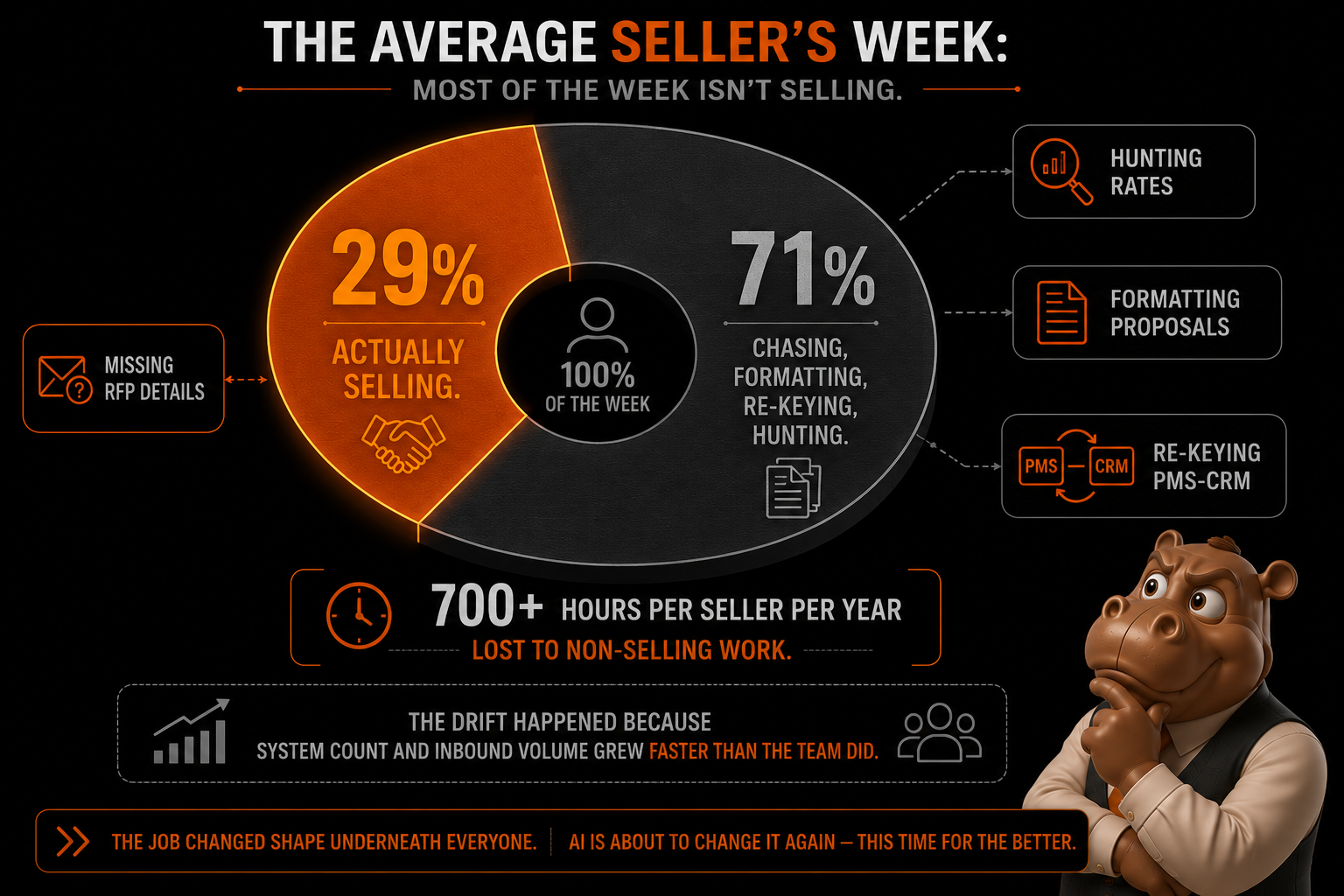
That drift did not happen because sellers got worse. It happened because the number of systems and the volume of inbound grew faster than the team did. The job changed shape underneath everyone. And now, with AI moving into hotel sales, it is about to change shape again, this time for the better.
The pressure the desk is already under
The instinct, when response times slip, is to hire. But the math does not support it. 65% of US hotels report staffing shortages, and hospitality turnover runs 70 to 80% a year, the highest of any US industry. Hiring is slow and expensive, and if the week is already going to admin, another hire mostly buys you more admin.
Meanwhile the buyer changed too. Most B2B buying decisions are now made by people who grew up with instant, self-service digital experiences and expect the same at work. They do not wait three days for a callback. If you are not first, you are usually not in the conversation.
Where the week actually goes
Revenue rarely leaks in one dramatic failure. It leaks across four quiet stages. At intake, RFPs arrive from many channels with no single inbox, and some die before a seller even sees them. At information-gathering, sellers hunt for rates, availability, and account history across disconnected systems. At proposal, they do repetitive manual data entry into templates. And at the systems layer, weak links between PMS, CRS, and CRM force re-keying and delay.
A delay at the first stage pushes back everything after it. Multiply that by 50 to 100 RFPs a month and you have a team that is busy all week and still losing deals it never had time to reach.
Also Read: Hotel Sales Productivity Crisis: Where a DOSM's Time Really Goes
The shift: machines take the mechanical, humans keep the human
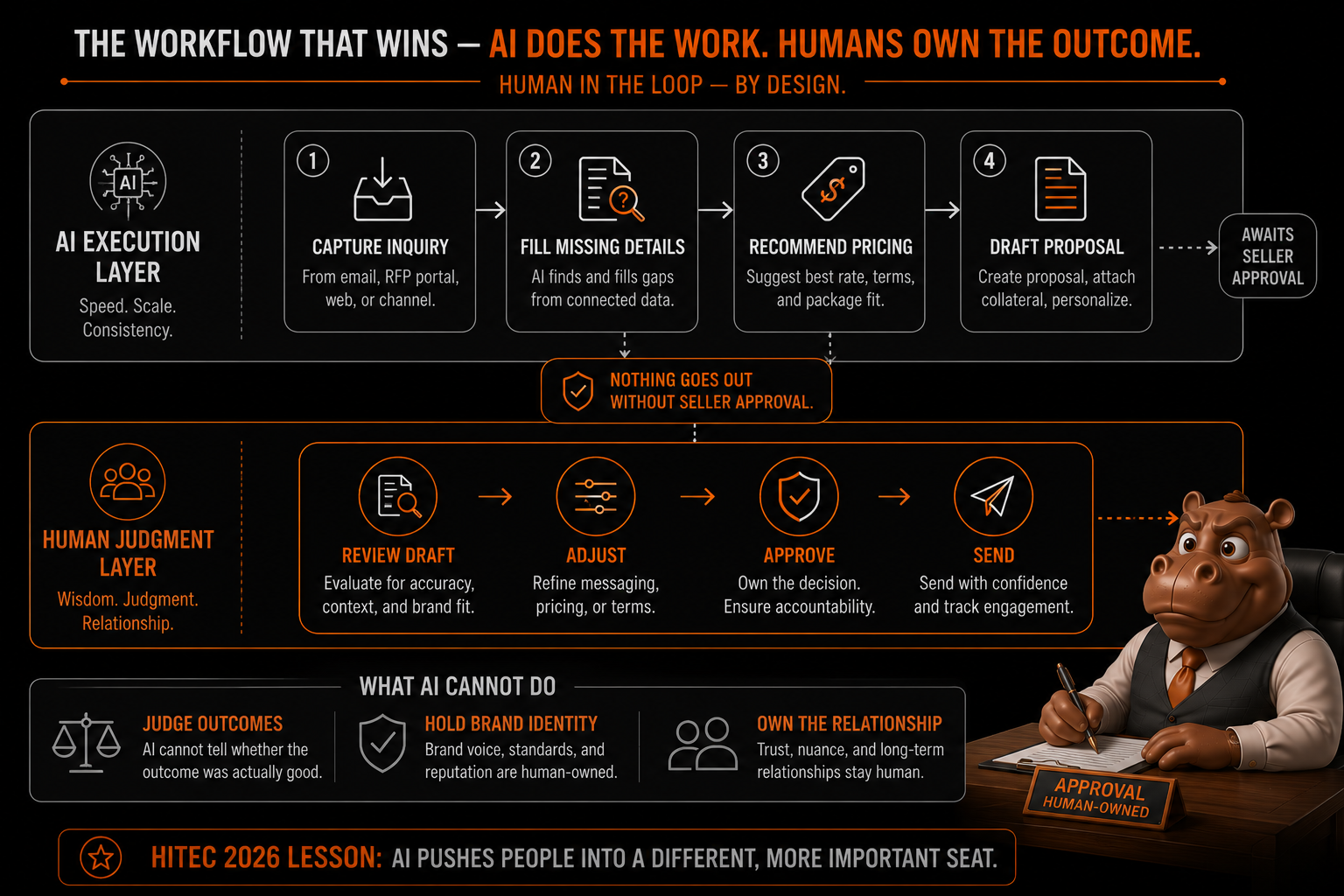
The clearest lesson from HITEC 2026 was not that AI replaces people. It was that AI pushes people into a different, more important seat. AI is genuinely good at taking messy, disconnected information and compiling it into something usable, sorting, drafting, routing. What it cannot do is judge whether the outcome was actually good, hold the brand's identity, or own the relationship.
So the modern group-sales workflow keeps a human in the loop by design: the AI captures the inquiry, fills in missing details, recommends pricing, and drafts the proposal, and a seller reviews and approves before anything goes out.
What the restructured desk looks like
Picture the same team, with the admin lifted off it. The AI acts as the execution layer that sits on top of the stack you already run, capturing every inquiry, converting it to a priced proposal in minutes, and keeping follow-up alive so no deal goes cold. Nobody learns a new tool, because it works inside Cvent, Delphi, the PMS, and the RMS the team already uses.
The seller's day re-points from paperwork to the parts of the job that were always human: reading the room, building the relationship, and closing. An eight-person team starts producing like twelve, not because anyone worked longer, but because the hours that were lost to admin came back.
Speed becomes the number the team is measured on
When execution is the game, response time stops being a soft metric and becomes the KPI. 72% of group business goes to whoever responds first, and hotels that reply within 24 hours are far more likely to win the bid. A modern desk tracks time-to-first-response the way it once tracked occupancy, because that is the number that now decides who is in the deal at all.
How to restructure without adding headcount
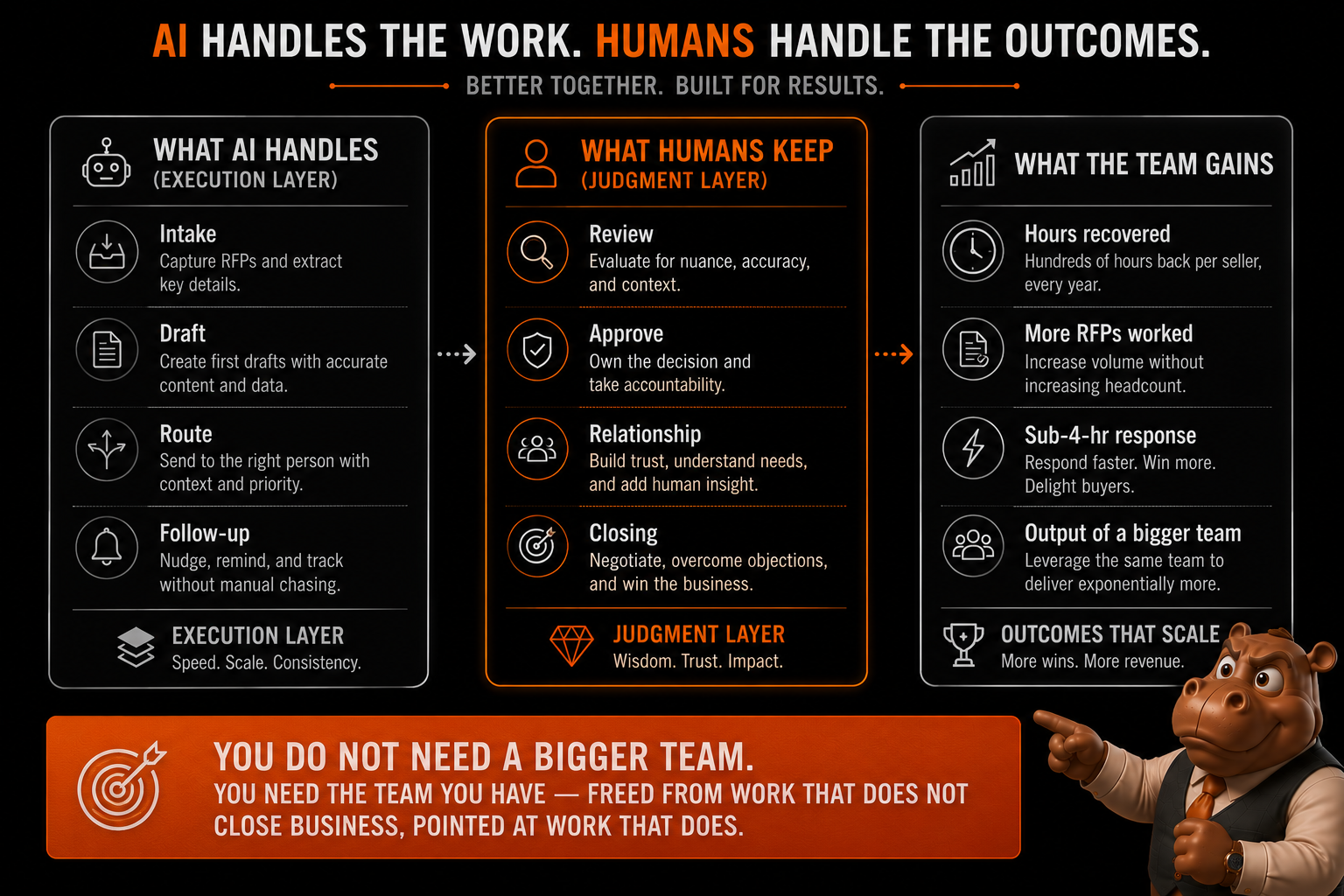
You do not need a bigger team. You need the team you have, freed from the work that does not close business, and pointed at the work that does. The honest first step is not a reorg, it is a measurement: see where the week actually goes today, and what it is costing you.
That is what a short, free pilot is for, and it is worth being clear about what it involves. Hippo Rev is the execution layer for hotel group sales: it captures every RFP, drafts the priced proposal in minutes from the data already in your systems, and keeps follow-up alive, with a seller reviewing every proposal before it goes out. The pilot runs a contained version of that for six weeks, free, on one workflow at one property or cluster, using only the Cvent and Delphi reports your team already pulls, so there is no IT project and nothing to buy.
At the end you get a before-and-after on your own data, admin hours per seller, time to first follow-up, RFPs worked, and revenue. That turns a restructuring debate into a decision you can make on real numbers: you can see, in black and white, how many hours came back and where to redeploy them.
Frequently Asked Questions
How should hotel sales teams change as AI takes over more administrative work?
Hotel sales teams should shift seller time away from repetitive execution and toward work that depends on human judgment. AI can handle tasks such as RFP intake, information gathering, proposal drafting, routing, and follow-up, while sellers focus on account strategy, relationship building, negotiation, and closing.
How can a hotel tell whether its sales team needs more people or simply less administrative work?
Start by measuring where seller time goes. If response times are slipping because sellers spend large portions of the week gathering information, updating systems, preparing proposals, or chasing routine follow-ups, adding another salesperson may simply add more capacity to the same inefficient process.
Which hotel group-sales tasks should be automated first?
The best candidates are repetitive, high-volume tasks that consume seller time but do not require much relationship judgment. These can include capturing RFPs from different channels, identifying missing information, pulling rates and availability, preparing first-draft proposals, updating systems, and triggering follow-ups. Hotels should generally automate the mechanical parts of the workflow first while keeping pricing judgment, negotiation, approval, and customer relationships under human control.
How can a hotel measure whether AI is actually making its sales team more productive?
Compare operational metrics before and after introducing AI into a defined workflow. Useful measures include administrative hours per seller, time to first follow-up, proposal turnaround time, RFPs worked per seller, opportunities that receive follow-up, win rate, and group revenue. Productivity should be demonstrated through measurable changes in the hotel's own workflow rather than generic claims about time savings.
What is the best way to test a new AI-powered hotel sales structure before reorganizing the team?
Test the workflow before changing the org chart. A contained pilot can focus on one property or cluster and one workflow, such as RFP intake through proposal and follow-up. Establish the current baseline first, then measure seller admin time, response speed, RFP throughput, and revenue during the test. The results show how much capacity AI actually creates and help leadership decide where recovered seller time should be redeployed.
AI Adoption in Hotel Sales: A Low-Risk Path
Hotel commercial teams are not stalling on AI because they doubt its potential. They are blocked by ROI uncertainty, IT concerns, workflow friction and weak proof. This article explains five common barriers to AI adoption in hotel sales and how a contained pilot can turn assumptions into measurable operating evidence.
Why Hotel Commercial Teams Stall on AI
At HITEC 2026, something quietly changed. For a couple of years, every hospitality tech event ran the same script: someone said "AI" on stage, the room nodded, and everyone went back to their booth. This year the debate about whether AI matters was simply over. The harder, more useful question took its place: which parts of this are real, and how do we actually adopt them without betting the year on a promise?
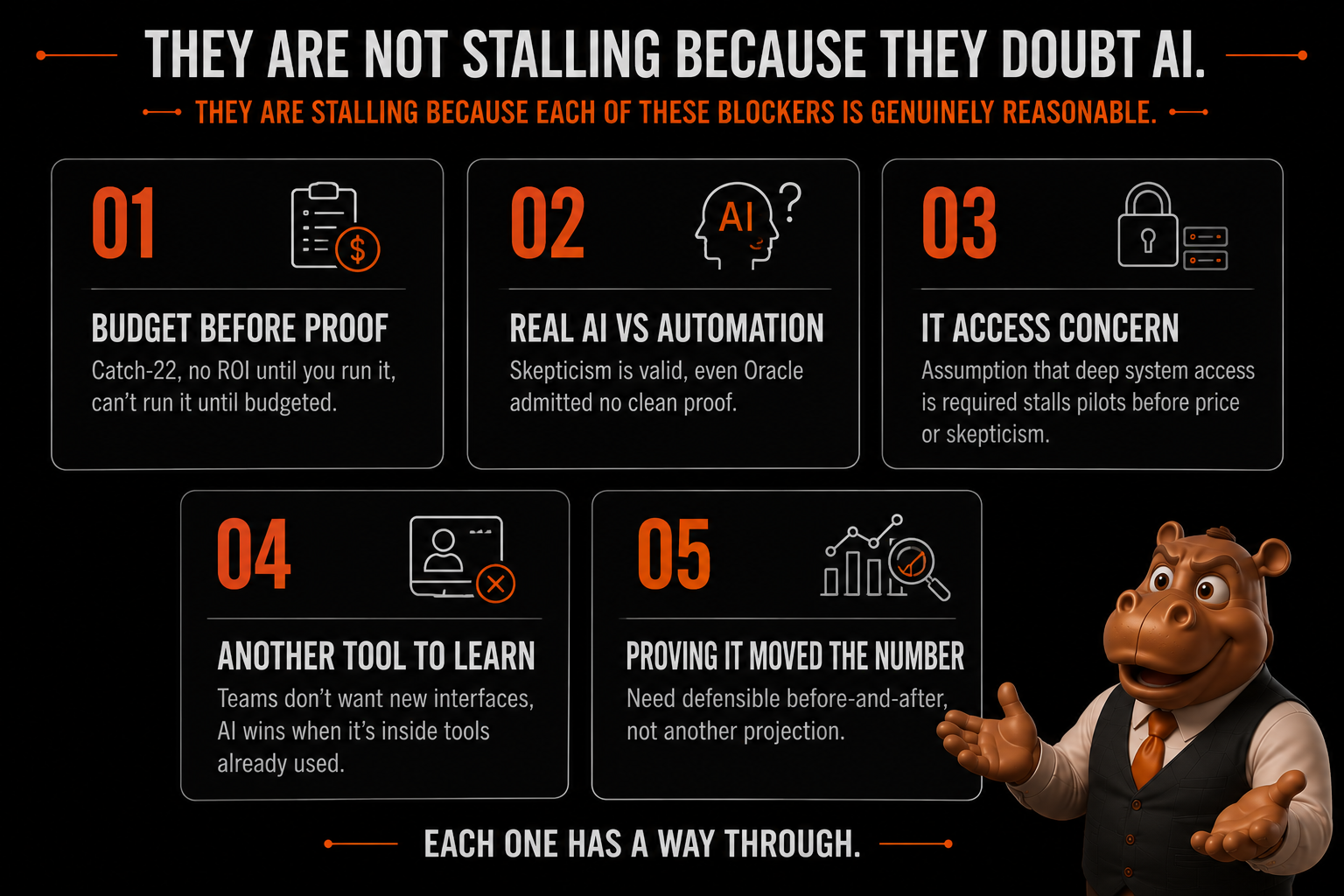
That is the question most commercial and revenue leaders are sitting with right now. And here is the honest part: they are not stalling because they doubt AI. They are stalling because bringing it in, especially during budget season, is genuinely difficult. There are five real blockers. Each one is reasonable. And each one has a way through.
Blocker 1: You have to budget for it before you can prove it
This is the catch-22 that stops more AI initiatives than any other. Leadership wants an ROI estimate before approving spend. But your team cannot produce a credible estimate until it has run the workflow on real RFPs, at your real volume, with your real win rates. You cannot know until you run it, and you cannot run it until it is budgeted.
So the initiative quietly drops out of the 2027 plan. A few months later the same team is asked to make the case through a mid-year reforecast, with less time, less evidence, and more resistance. The number that finally goes into the plan is the weakest kind of number: a guess made before anything was tested.
Blocker 2: "Is this real AI, or automation wearing a costume?"
Leaders are right to be skeptical, and the industry finally said so out loud. At HITEC 2026 even Oracle admitted it does not yet have a clean way to prove AI's value, because nobody has enough results to point to. A HotelKey executive put it plainly: payment automation is rule-based, and it should not be sold as AI just because it is automated.
A useful test is the difference between a calculator and a doctor. A calculator is fast because the problem is fully defined, one right answer, found instantly. A doctor is valuable precisely because the problem is not defined, symptoms are ambiguous, and judgment fills the gap. A lot of what gets sold as AI is a very fast calculator with a friendlier face. That is not nothing, speed has real value, but it is not judgment, and paying an AI premium for automation is how budgets get wasted. The fix is not more claims. It is proof on your own data.
Blocker 3: "AI needs our data, so IT has to clear it"
The assumption is that any AI tool needs deep access to internal systems, which means a security review and a quarter you do not have. That single assumption stalls more pilots than price or scepticism combined.
There is a second, newer data problem underneath it. HITEC surfaced that hotels typically start with about a third of their facts misaligned across the sources AI assistants pull from, and that AI models actually distrust polished marketing copy and lean on guest reviews instead. Being "AI-legible" is becoming its own advantage. Both problems point the same way: before you hand an AI system deep access, start with a version that needs no new access at all, running on the reports your team already exports.
Blocker 4: Nobody wants another tool to learn
The clearest lesson from HITEC 2026 was that AI is no longer a feature, it is becoming infrastructure, and it wins when it sits inside the tools hotels already use rather than living next to them as a separate app. Oracle built its assistant directly into OPERA Cloud. The startups that stood out read an inbox and worked across the PMS in the background, turning ten minutes of tab-switching into thirty seconds, without asking anyone to change their habits.
The practical move: if a vendor is pitching a brand-new interface your team has to be trained on, ask why it does not live inside the systems you already pay for. Sometimes there is a good answer. Often there is not.
Also read: 7 Reasons Teams Stay Manual
Blocker 5: Proving it actually moved the number
The bar the whole industry quietly agreed to at HITEC was simple and hard to dodge: show me the result. Commercial leaders do not need another projection. They need a defensible before-and-after they can take into a revenue meeting.
That means agreeing, up front, on the few things that matter and can be measured on your own data: admin hours per seller, time to first follow-up, RFPs worked per seller, and revenue. Measured, not modelled.
The low-risk way through: prove first, budget second
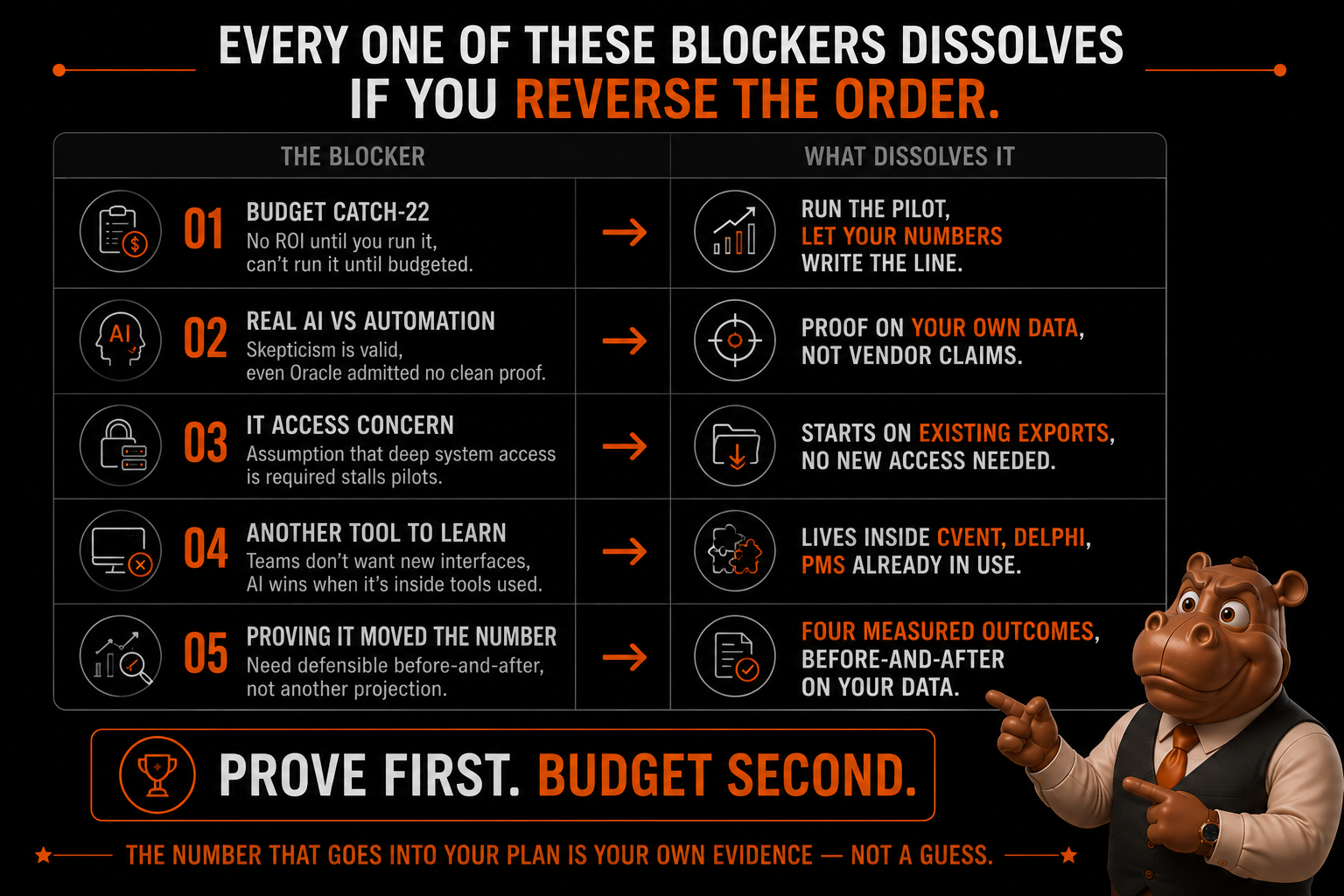
Every one of these blockers dissolves if you reverse the order. Instead of budgeting on faith and hoping the results follow, you run a small, free pilot first, and then let your own numbers write the budget line. But the words 'a pilot' mean nothing until you know exactly what it is, so here is the plain version.
Start with what Hippo Rev actually does. It is the execution layer for hotel group sales. It sits on top of the systems you already run, Cvent, Delphi, your PMS and RMS, and it runs the group-sales workflow for you. When an RFP comes in, it captures it, fills in the missing details, pulls the pricing, drafts a priced proposal in minutes, and keeps the follow-up going so no deal goes cold. A person on your team still reviews and sends every proposal, so the judgment stays human.
The pilot is a small, contained version of exactly that, run free for six weeks. The scope is fixed, not a custom build: one workflow (RFP to proposal), one property or cluster, and one named contact on each side. Weeks one and two are onboarding, using only the Delphi and Cvent reports your team already exports, which is why there is no new system access, no IT project, and no cost. Weeks three to six run live on your real RFPs.
What it targets is the exact place group revenue leaks, your RFP process. How it helps is simple: it lifts the repetitive admin off your sellers, the intake, the chasing, the pricing pull, the first draft, and it makes follow-up instant, so the same team can work more RFPs and answer them faster. What that helps with, in order, is response time, then RFP throughput, then win rate, and finally captured group revenue.
And the numbers you walk away with are your own, not a projection. At the end you get a clear before-and-after across four measures, admin hours per seller, time to first follow-up, RFPs worked per seller, and revenue, plus a simple six-month view built from them. Only after you have seen those numbers do you decide whether AI deserves a line in your 2027 budget.
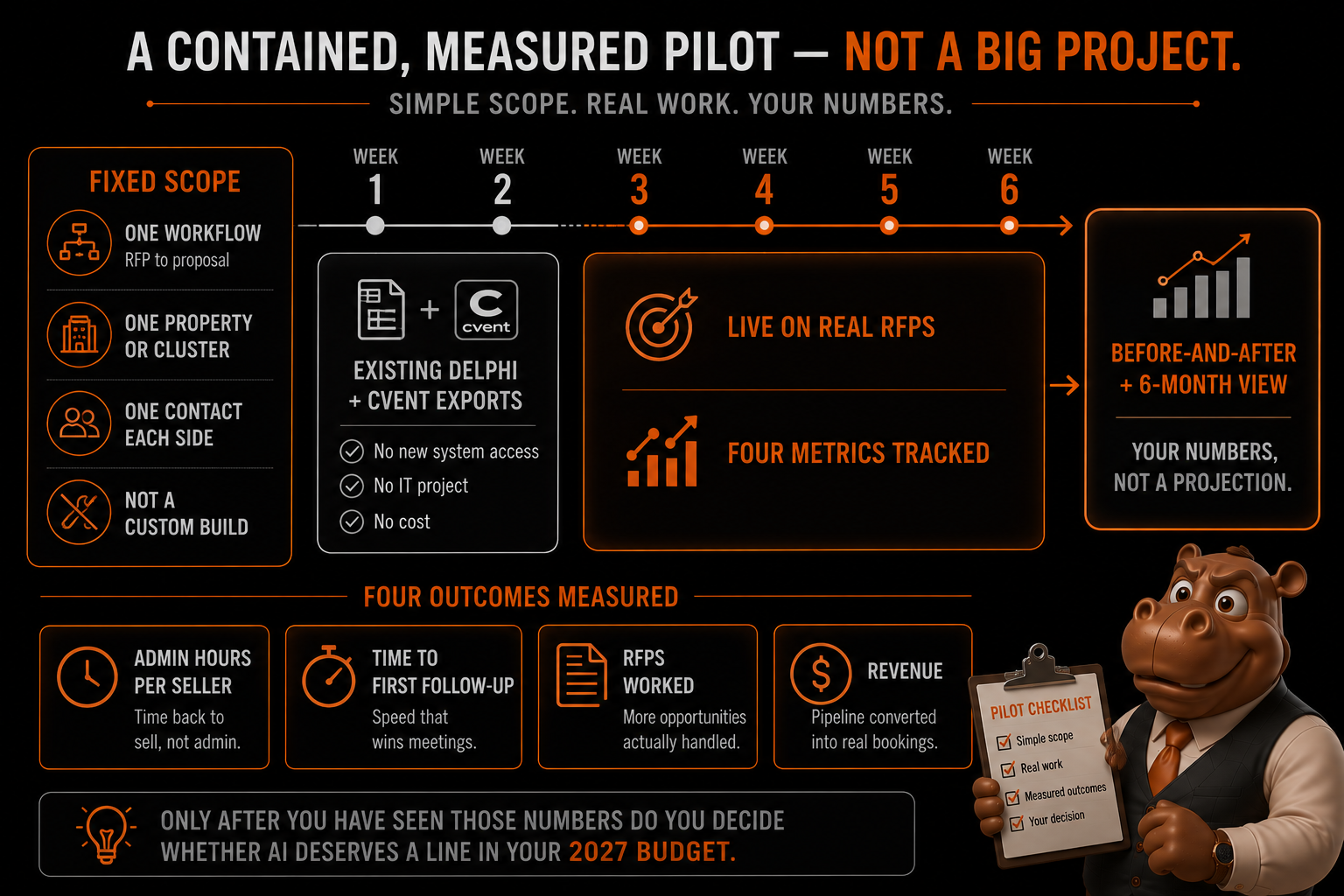
Five questions to ask any AI vendor before budgets lock
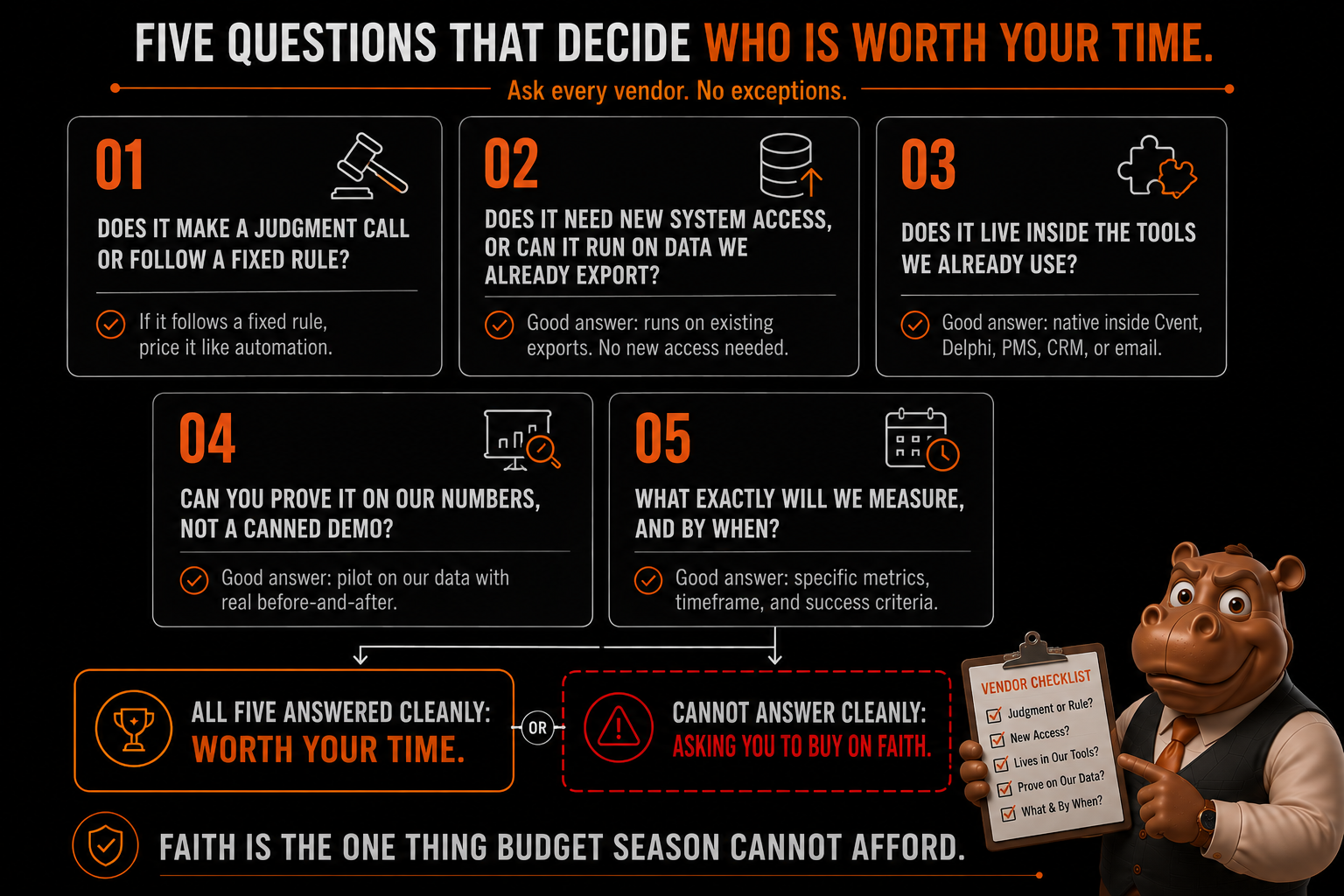
Adapt this from the posture the industry took at HITEC. First, does the system make a judgment call or follow a fixed rule? If it is a rule, price it like automation, not AI. Second, does it need new access to our systems, or can it run on data we already export? Third, does it live inside the tools we already use? Fourth, can you prove it on our numbers, not a canned demo? Fifth, what exactly will we measure, and by when? A vendor who can answer all five cleanly is worth your time. One who cannot is asking you to buy on faith, which is the one thing budget season cannot afford.
Frequently Asked Questions
How can a hotel prove the ROI of AI before putting it into the annual budget?
The strongest approach is to test the AI against a narrow, measurable workflow before committing budget. For hotel group sales, that could mean running a limited pilot on live RFPs and comparing results against the existing process.
What should a hotel actually measure during an AI pilot?
Measure outcomes that are close enough to the workflow for the AI to influence them directly. In group sales, useful measures include admin hours per seller, time to first follow-up, proposal turnaround time, RFPs worked per seller, and revenue generated from those opportunities. Broader metrics such as total hotel revenue may be too far downstream to tell you whether the AI itself worked.
How can hotel leaders tell the difference between AI and ordinary automation?
Ask whether the system is making decisions in situations where the inputs are incomplete or variable, or simply following predefined rules. A workflow that moves data from one field to another when a condition is met is automation. A system that interprets an RFP, identifies missing information, determines the next workflow step, or generates a proposal from changing inputs involves a greater degree of AI-driven reasoning. The distinction matters because hotels should not pay an AI premium for simple rules-based automation.
Can a hotel test AI without launching a full IT integration project?
Yes, the Hippo Rev pilot is deliberately designed around existing data flows. For example, a hotel can test an RFP workflow using reports its sales team already exports rather than immediately connecting the AI directly to core systems. This allows the commercial team to evaluate whether the workflow improves response time, seller capacity, and revenue outcomes before deciding whether deeper integration is justified.
Which hotel sales workflows are best suited for an AI pilot?
The best starting point is usually a workflow that is repetitive, high-volume, measurable, and still contains enough judgment that simple automation cannot solve the entire problem. Group RFP processing is one example because sellers repeatedly collect information, check pricing and availability, draft proposals, and follow up.
.png)
Hotel RFP Data: 8 Causes of Inconsistency
Inconsistent hotel RFP data usually begins with fragmented intake, manual re-entry, weak integrations, duplicate records, and unclear ownership. This article explains common causes, shows how poor data slows responses and costs revenue, and outlines practical steps for fixing the foundation.
What Causes Inconsistent Data in Hotel Group Sales RFP Software?
Inconsistent data in hotel group sales RFP software is caused by fragmented lead intake channels, manual re-entry between disconnected systems, unclear system-of-record ownership, weak integrations between the RFP tool and the PMS and CRM, duplicate accounts, stale content libraries, and the absence of anyone who actually owns data hygiene. The software rarely creates the inconsistency. It inherits it, then multiplies it at the speed of every proposal you send.
That is the short answer. The longer answer matters more, because every one of these causes is fixable, and each one you leave unfixed is quietly costing you group revenue. Industry analysis of RFP and proposal platforms is blunt about the stakes: delays in response, inconsistent pricing, and missed inquiries directly impact conversion rates and revenue. Here is where the inconsistency actually comes from.
Cause 1: Your Leads Arrive Through Five Different Doors

Group demand does not enter your hotel through one channel. It arrives through Cvent, brand portals, your website form, direct planner emails, phone calls, and referrals from sister properties. Each channel captures different fields in different formats. One RFP has a full room block breakdown. Another is three sentences in an email. When intake is fragmented, the data is inconsistent before a human ever touches it, and every downstream system inherits the mess.
Cause 2: Manual Re-Entry Between Systems That Do Not Talk

This is the single largest source of corruption. A seller copies details from a Cvent RFP into the sales and catering system, then re-keys rates from the revenue tool into the proposal, then updates the CRM after the fact, if there is time. Sellers already spend roughly 71 percent of their day on non-selling tasks, and re-keying is a big slice of it. Every manual hop is a chance for a transposed date, a wrong rate, or a room count that no longer matches the original request. Tired people typing under deadline pressure produce inconsistent data. That is not a character flaw. It is a process design flaw.
This is also where most of the day disappears in the first place, a pattern we quantified in our blog here.
Cause 3: Nobody Agreed on the System of Record
Ask three people at your property where the authoritative version of a group opportunity lives and you may get three answers: the sales and catering system, the CRM, or a spreadsheet someone maintains "just to be safe." When no single system is designated as the source of truth, every system holds a slightly different version of reality, and reconciliation becomes an argument instead of a process. Integration specialists consistently identify this as the root issue: the clearer it is which system controls which data, the fewer conflicts arise.
Cause 4: Weak or Broken Integrations
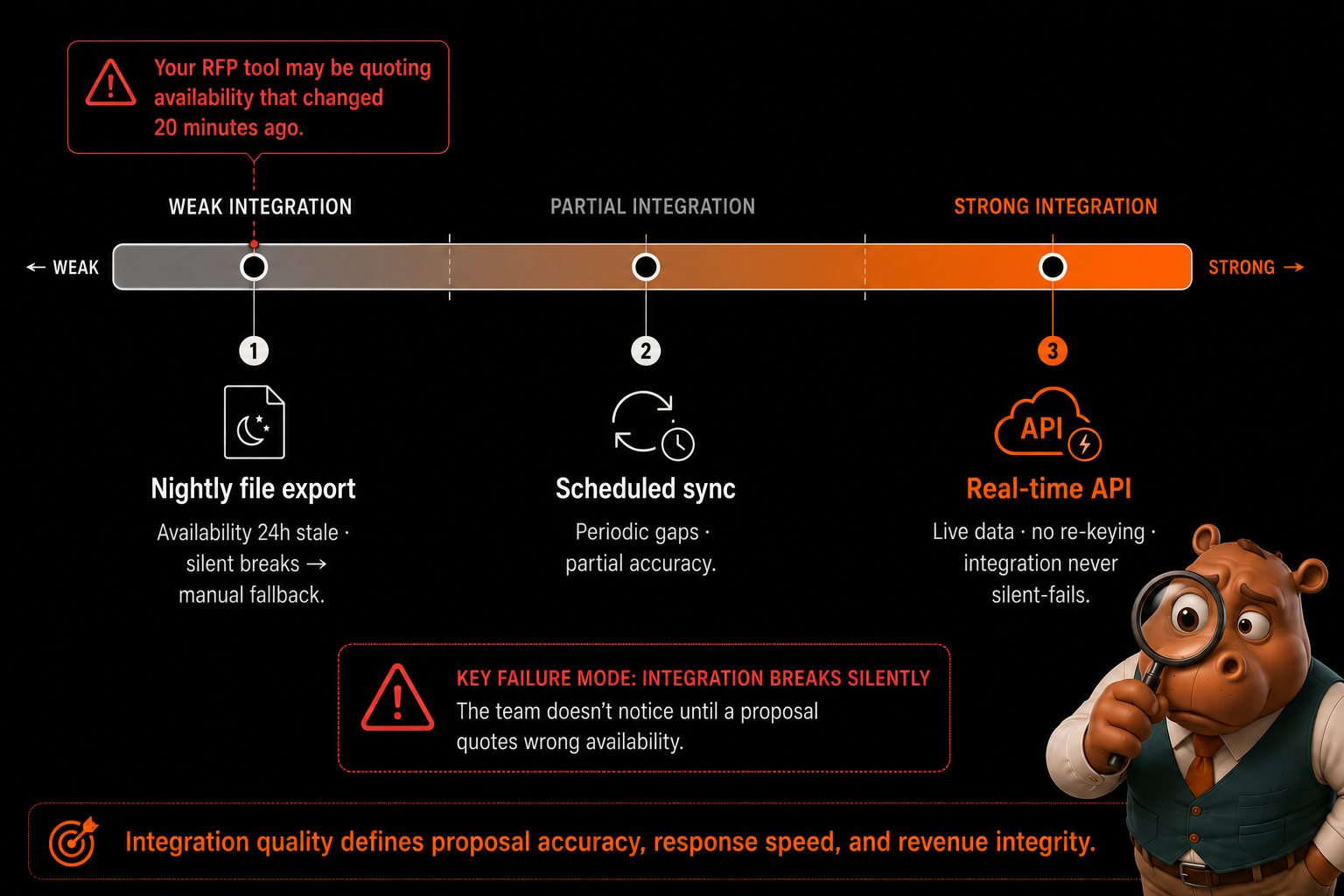
Even when systems are nominally connected, the connection quality varies wildly. Legacy platforms often sync through flat-file exports or scheduled polling rather than real-time event-driven updates, which means the RFP tool can be quoting availability that changed twenty minutes ago. When an integration silently breaks, teams fall back to manual entry, and the inconsistency compounds. A tool with a published API and an active integration ecosystem behaves very differently from one held together with nightly file transfers.
Cause 5: Duplicate Accounts and Ghost Records
The same corporate planner exists in your systems as three separate contacts: one created from a Cvent lead, one from an email inquiry last year, and one imported during a system migration. Each record holds partial history. Your response to their new RFP draws on whichever record the seller happens to open, so the proposal misses the negotiated terms from last year's program. Duplicates do not just clutter the database. They fragment relationship intelligence at the exact moment it should win you the deal.
Cause 6: Stale Content Libraries Inside the RFP Tool Itself
RFP software typically stores reusable content: meeting room capacities, F&B minimums, AV pricing, images, policies. That library is only as accurate as its last update. If your ballroom was reconfigured, your catering menus repriced, or your parking policy changed, and nobody updated the library, the software will confidently insert outdated facts into every proposal. This is inconsistency at industrial scale: one stale entry replicated across dozens of bids.
Cause 7: Portfolio Sprawl With No Common Standard

Multi-property groups face a structural version of the problem. Each property configures fields, stages, and naming conventions its own way, so portfolio-level reporting becomes painful or impossible. When property A logs a "definite" at contract signature and property B logs it at deposit, your pipeline report is comparing apples to invoices. Corporate teams end up requesting manual exports from each property and reconciling them by hand, which introduces yet another layer of manual error.
This is the exact fragmentation problem multi-property groups run into when they try to standardize RFP handling across a portfolio, something we cover in our blog here.
Cause 8: No Owner, No Hygiene
Ultimately, data stays consistent only when someone is accountable for keeping it that way. Most hotel sales operations have no designated data owner. Hygiene happens sporadically, usually right before an audit or a system migration, then decays again. Turnover accelerates the decay: each departing coordinator takes undocumented conventions with them, and each new hire invents their own.
What Inconsistent Data Actually Costs You
These causes are not cosmetic. Industry-wide, about 36 percent of hotel RFPs go unanswered, and 61 percent of won deals go to one of the first three responders. Inconsistent data attacks both numbers at once. Leads scattered across intake channels are the leads that go unanswered. Sellers who must verify every rate and capacity before sending are the sellers who respond fourth instead of first. Add it up across a year and the execution gap runs to roughly 500,000 dollars in annual revenue leakage per salesperson. Your RFP software did not cause that. Your data foundation did.
Fixing the Foundation, Then the Speed
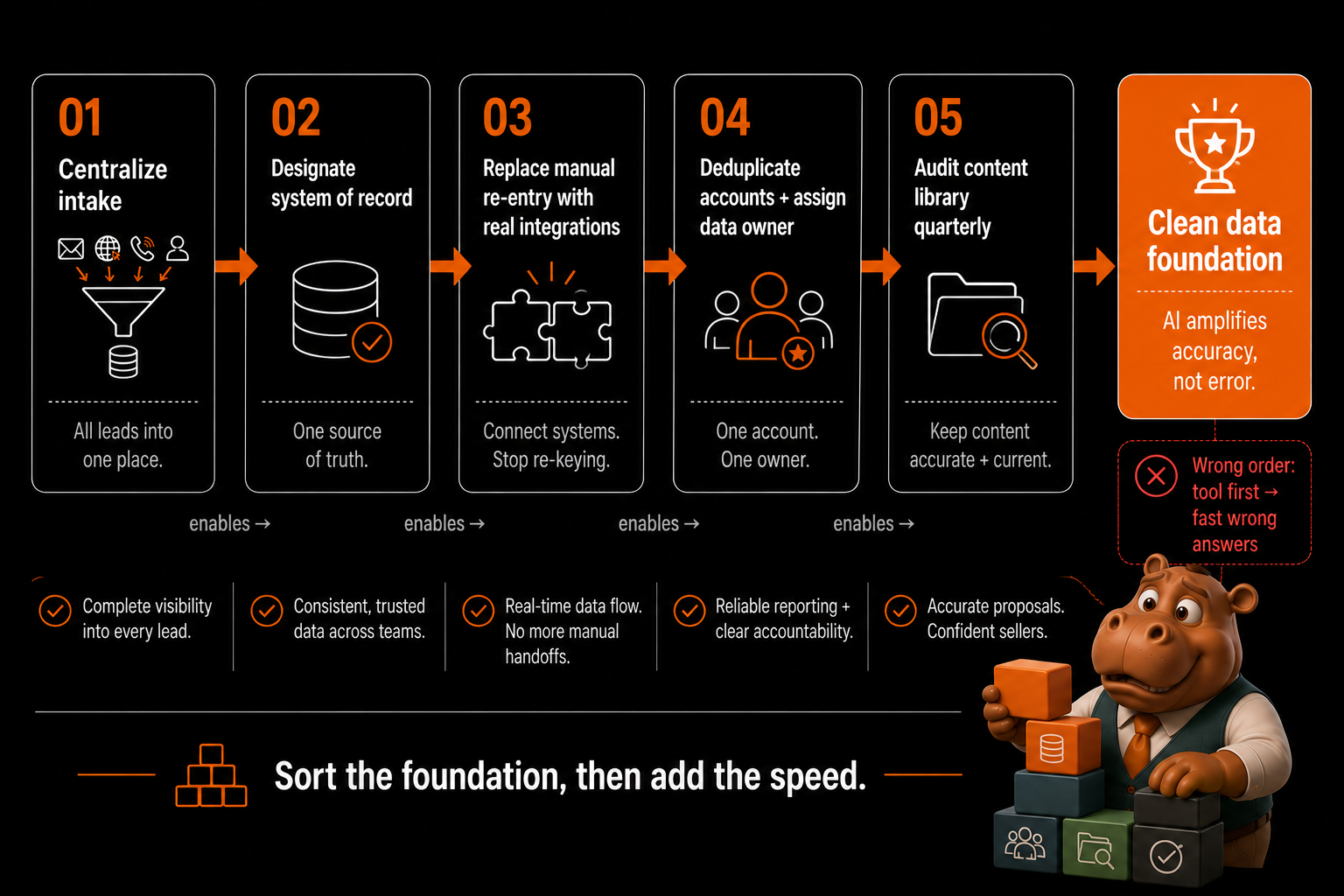
The fix follows the causes in order. Centralize intake so every lead lands in one place in one format. Designate a system of record and enforce it. Replace manual re-entry with real integrations. Deduplicate accounts and assign an owner for ongoing hygiene. Audit the content library quarterly.
This is also the honest place to mention how we think about it at Hippo Rev. The platform is built to capture every inbound group lead in one place and cut RFP processing from around 37 minutes to about 4 minutes, which removes the manual re-entry that causes most inconsistency in the first place. But we say this to every prospect: no platform, ours included, can fully compensate for data that is scattered or wrong at the source. Execution speed built on bad data just delivers wrong answers faster. Sort the foundation, then add the speed.
If you want to see where your current setup is leaking, book a Capture Audit. Twenty minutes, your numbers, no deck.
Frequently Asked Questions
1. What is the most common cause of inconsistent data in hotel RFP software?
Manual re-entry between disconnected systems. Every time a seller re-keys details from an RFP into a sales and catering system, CRM, or proposal, the data can drift. Fragmented intake channels are a close second.
2. Does the RFP software itself create data inconsistency?
Rarely. The software inherits inconsistency from fragmented intake, broken integrations, and stale content libraries, then replicates it across every proposal. The tool amplifies whatever foundation it sits on.
3. How do integration gaps cause inconsistent data?
Legacy integrations that rely on flat-file exports or scheduled polling sync data on a delay, so the RFP tool can quote rates or availability that have already changed. When integrations break silently, teams revert to manual entry, compounding the drift.
4. What is a system of record and why does it matter for group sales?
A system of record is the single designated source of truth for a data type, such as opportunities or account history. Without one, the CRM, sales and catering system, and spreadsheets each hold different versions of reality, and no report can be trusted.
5. How do duplicate planner accounts hurt RFP responses?
Duplicates fragment relationship history. A seller responding from one record misses negotiated terms, preferences, or past issues stored in another, producing proposals that contradict the client's actual history with your property.
6. Why does multi-property portfolio data get inconsistent?
Each property tends to configure fields, pipeline stages, and naming conventions differently. Portfolio reporting then requires manual reconciliation of mismatched exports, which introduces further errors and delays decisions.
7. How does inconsistent data affect RFP response speed?
Sellers must verify every rate, capacity, and term before sending, which slows responses. Since 61 percent of won deals go to one of the first three responders, that verification lag translates directly into lost business.
8. What does inconsistent group sales data cost a hotel?
Between unanswered leads and slow responses, execution failures cost roughly 500,000 dollars in annual revenue leakage per salesperson. Inconsistent data is a primary driver of both failure modes.
9. How often should the RFP content library be audited?
Quarterly at minimum, and immediately after any change to meeting space, catering pricing, policies, or renovations. One stale entry gets replicated into every proposal the software generates.
10. Should hotels fix their data before buying new RFP software?
Yes. Centralize intake, designate a system of record, and deduplicate accounts first. New software applied to a scattered data foundation produces the same inconsistencies at higher speed.
.png)
Hotel RFP Automation: 7 Reasons Teams Stay Manual
Hotels still rely on manual RFP processes because they feel familiar, controllable, and inexpensive. This article examines seven reasons those workflows persist—and reveals how unanswered leads, slow proposals, fragmented data, and unmeasured administrative work can quietly reduce group sales revenue.
Why Do Hotels Still Use Manual RFP Processes? 7 Real Reasons
Hotels still use manual RFP processes for reasons that have little to do with technology: the illusion of control that hands-on work creates, institutional habit, software costs that are visible while manual costs stay hidden, fear of losing the personal touch, brand-mandated system constraints, scar tissue from failed past implementations, and the simple fact that nobody is measuring what the manual process loses. None of these reasons are irrational. All of them are expensive.
The scale of the problem is well documented. In LinkedIn polls of hotel professionals, 90 percent pointed to the group and meetings booking process itself, not pricing, as the main barrier to winning business. Groups360 platform data shows 55 percent of hotel RFPs go completely unanswered. And yet, walk into most hotel sales offices today and you will still find RFPs scattered across inboxes, rates approved over email, and proposals assembled by copy and paste. Here are the seven reasons why, and why each one deserves a second look.

Reason 1: Manual Feels Like Control
When your team builds every proposal by hand, tracks every lead in a spreadsheet, and manages every follow-up personally, it feels like nothing can slip through. Procurement analysts call this the illusion of control: teams believe they can see everything because they touch everything. In practice, manual control is fragmented control. Information gets trapped in individual inboxes, different people work from different file versions, and the pipeline's accuracy depends on who updated the spreadsheet last. The feeling of control and the fact of visibility are two different things, and manual processes deliver the first while quietly destroying the second.
That gap between feeling in control and actually seeing the pipeline is the same one we mapped out in our blog here.
Reason 2: The Process Has Always Worked, Sort Of
Group sales predates every tool now trying to modernize it. Many directors of sales learned the craft on paper traces and phone follow-ups, won real business that way, and built careers on it. The process they inherited became the process they teach. This is not stubbornness. It is institutional memory doing what institutional memory does: preserving what worked. The problem is that "worked" was measured against yesterday's expectations. Today, over 60 percent of planners want RFP responses in four days or fewer, while 22 percent report waiting more than eight days. The manual process did not get worse. The benchmark it competes against did.
Reason 3: Software Costs Are Visible, Manual Costs Are Not
A software subscription arrives as an invoice the owner sees every month. The cost of the manual process arrives as nothing at all: no line item, no report, no alert. An unanswered RFP does not appear on a P&L. A proposal sent on day four instead of day one does not generate an expense entry. So the comparison always looks lopsided: a concrete new cost versus an apparently free status quo. The status quo is not free. Sellers spend roughly 71 percent of their day on non-selling tasks, and execution leakage runs to about 500,000 dollars annually per salesperson. The manual process is often the most expensive item in the sales budget. It is just the only one that never gets budgeted.
Reason 4: Fear of Losing the Personal Touch
Group sales is a relationship business, and many sales leaders worry that automation will make their responses feel robotic to planners who value a human connection. The concern is legitimate but aims at the wrong target. What automation removes is not the relationship. It is the copying, pasting, chasing, and reformatting that currently consumes the seller's day, the exact administrative weight that prevents relationship work. There is an irony hiding in the current state: while the planner imagines the hotel is crafting a tailored proposal, the sales rep is usually fighting formatting errors in a spreadsheet. The personal touch is not in the paste function. It is in the conversation the seller finally has time for.
Reason 5: Brand and Franchise Constraints
Branded and franchised hotels often operate inside a mandated technology stack. Leads arrive through brand channels, the sales and catering system is prescribed, and adding tools requires approvals that can take quarters. Sales leaders in these environments frequently conclude that since they cannot replace the mandated core, there is no point improving anything around it. That conclusion overshoots. The mandated stack usually governs where data must ultimately live, not how fast the team works before it gets there. The constraint is real. The paralysis it produces is optional.
Reason 6: Scar Tissue From Past Implementations
Many hotel sales teams have lived through a system rollout that overpromised and underdelivered: months of migration, mandatory training, and a tool the team quietly abandoned within a year. Once burned, leaders treat every new platform pitch as the same movie. This skepticism is healthy in moderation, and it should shape how hotels buy, favoring tools that fit existing workflows over tools that demand new ones. But using one failed rollout as permanent proof that all automation fails is a prediction, not a fact, and it hardens into a policy of doing nothing while competitors move.
Reason 7: Nobody Is Measuring What Manual Loses
This is the reason that keeps all the others alive. Most hotels do not track how many RFPs arrive each month, how many receive responses, how fast, or what converts. Without those numbers, the manual process has no visible failure. Meanwhile, the failures compound quietly: hotels using manual lead tracking see 35 to 40 percent longer sales cycles than those on purpose-built software, and 61 percent of won deals go to one of the first three responders. When the administrative weight of responding gets heavy enough, sellers begin filtering their own pipelines, silently dropping leads that look too small or too difficult. Unmeasured, that filtering looks like a quiet month. Measured, it looks like what it is: revenue leaving the building.
This is exactly the blind spot a DOSM's Tuesday reveals once you actually track it. Read more about it here.
The Reasons Are Understandable. The Math No Longer Is

Every reason above made sense in the environment where it formed. But the environment has moved. Planners expect responses in days, 71 percent of hoteliers themselves believe automated offers and instant booking will dominate meetings and events sales within five years, and 74 percent fear that OTAs and global tech platforms are coming for the group space. The question is no longer whether the manual process can be defended. It is whether it can compete.
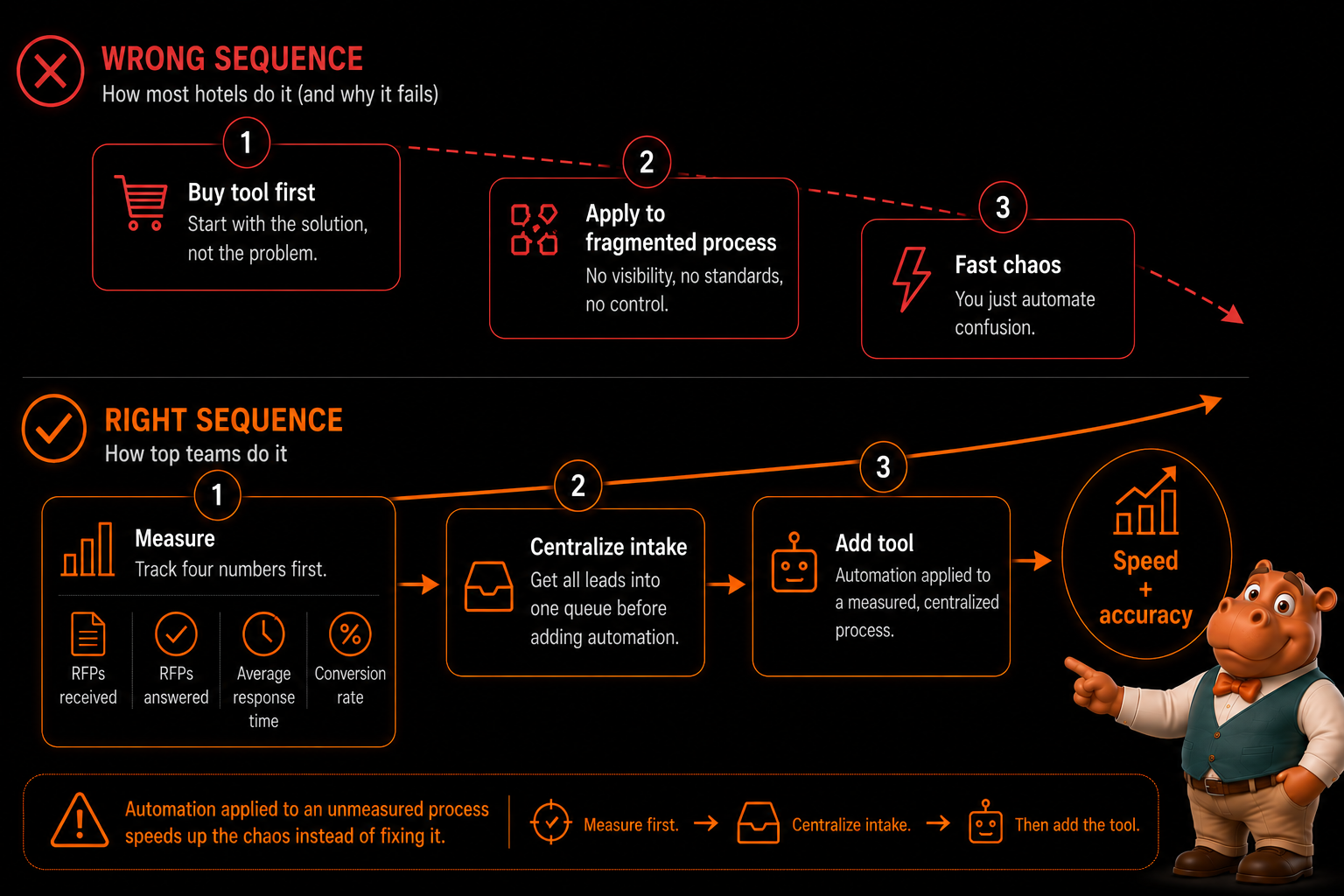
This is the gap Hippo Rev was built for. It captures every inbound group lead in one place and cuts RFP processing from roughly 37 minutes to about 4 minutes, removing the administrative weight that makes teams filter their own pipelines. And it works with the reasons above rather than against them: no rip-and-replace of a mandated stack, and the seller stays in the relationship while the platform handles the paste work. If you suspect your manual process is costing more than any subscription would, a Capture Audit will show you the number. Twenty minutes, your data, no deck.
Frequently Asked Questions
1. What is the most common reason hotels stick with manual RFP processes?
The invisibility of the cost. Software has a monthly invoice, while unanswered RFPs and slow responses never appear on a P&L, so the manual process always looks free even when it is the most expensive item in the sales operation.
2. Is the manual RFP process really that slow?
Yes. Assembling a proposal manually across disconnected systems commonly takes days, while over 60 percent of planners now expect responses within four days and 61 percent of won deals go to one of the first three responders.
3. Does automating RFP responses make proposals feel impersonal?
No. Automation removes the copying, formatting, and chasing, not the relationship. Sellers gain back the time currently lost to administration, which is where the personal touch actually lives.
4. How many hotel RFPs go unanswered?
Groups360 platform data puts it at 55 percent, and broader industry estimates run at 36 percent or higher. Either figure represents substantial group revenue abandoned before any competitor even wins it.
5. Why do sales teams trust spreadsheets more than software?
Spreadsheets feel controllable because the team touches every cell. In practice they fragment data across versions and inboxes, hiding risk rather than exposing it.
6. Can branded or franchised hotels automate if their tech stack is mandated?
Usually yes. Brand mandates typically govern the system of record, not the speed of work upstream of it. Tools that layer onto the existing stack avoid the approval battles a replacement would trigger.
7. What does a manual RFP process cost a hotel annually?
With sellers spending about 71 percent of their day on non-selling tasks, execution leakage runs to roughly 500,000 dollars per salesperson per year across missed, slow, and abandoned opportunities.
8. Why did our last sales technology rollout fail, and will a new one fail too?
Most failed rollouts demanded that teams change their workflow to fit the tool. Implementations succeed when the tool fits the existing workflow, so evaluate new platforms on adoption effort, not feature count.
9. How do I know if my hotel's manual process is losing deals?
Start measuring four numbers monthly: RFPs received, RFPs answered, average response time, and conversion rate. If you cannot produce those numbers today, that absence is itself the answer.
10. What should a hotel fix first: the process or the tool?
Measure first, then centralize intake, then add the tool. Automation applied to an unmeasured, fragmented process speeds up the chaos instead of fixing it.
.png)
Hotel AI-Legibility: How to Increase AI-Driven Bookings
AI assistants are becoming the new front door for hotel discovery. Learn why structured, accurate, and consistent hotel data is now essential for AI recommendations, higher visibility, and increased direct bookings, plus practical steps to make your property AI-legible.
The Best Hotel in Your Market Won't Win Anymore. The Best Described One Will.
You can run a better hotel than your competitor and still lose bookings to them. Not on price. Not on service. On data.
Here is the shift most hoteliers have not caught up with yet. When travelers ask AI assistants where to stay, the AI describes each hotel based on the information it can find. If your competitor's data is clean, consistent, and structured, the AI describes them accurately. If your data is scattered across outdated listings, conflicting profiles, and a website last touched in 2022, the AI describes you wrong. Or barely describes you at all.
The hotel that wins in your market is no longer going to be the best hotel. It is going to be the best described one.
The New Front Door Is a Chat Window

The numbers behind this shift are no longer speculative. Roughly 40 percent of global travelers have already used AI tools to plan a trip, and among Millennial and Gen Z travelers that figure runs as high as 60 percent. After ChatGPT began including more outbound links in its responses, AI referral traffic to hotel websites grew more than 50 percent in a matter of weeks, and Semrush data showed ChatGPT referrals to websites jumping 300 percent over just a few months.
The quality of that traffic matters as much as the volume. A traveler who clicks through from an AI recommendation has already asked a specific question and received a specific answer. They are not browsing. They are close to deciding. Expedia has reported that traffic arriving from ChatGPT converts to bookings at higher rates than traditional channels.
And the booking layer is collapsing into the chat itself. Booking.com and Expedia were among the first partners in OpenAI's app integrations, meaning travelers can now move from question to live rates to reservation without ever opening a browser tab. The discovery channel is becoming the distribution channel.
Group buyers are showing up with AI-shortlisted options before your sales team even knows a request exists, something we broke down in our blog here.
How AI Actually Describes Your Hotel
Here is the uncomfortable mechanical truth. An AI assistant does not know your hotel. It knows your data footprint. It assembles a picture of your property from three layers: what it learned in training, what it retrieves from live web search, and, increasingly, what it can pull from connected systems and structured databases.

Every layer depends on the same raw material: your website copy, your Google Business Profile, your OTA listings, your review responses, your meeting space specs, your policies. If those sources agree with each other and stay current, the AI can recommend you with confidence. If your website says one thing, your listings say another, and your event space capacities live in a PDF from 2019, the AI either describes you inaccurately or skips you entirely in favor of a competitor it can describe with certainty.
Consistency is the trust signal. AI systems weight it heavily when deciding whether they can confidently recommend a property. Inconsistency does not just weaken your description. It disqualifies you from the answer.
HITEC 2026 Made This Official
If you were waiting for a signal that this is now industry infrastructure rather than a marketing trend, HITEC 2026 delivered it. At the conference in San Antonio, HFTP announced its AI Collective Roadmap, and one of the group's first initiatives is a standard for how hospitality businesses structure and present their data. The standard defines how a property organizes its information so AI systems can discover its offerings, interpret its operational data in context, and represent its services to customers accurately.
Read that carefully. The industry's own standards body, the organization behind USALI, is now writing rules for machine readability. That happens when a problem stops being optional. The 30-plus experts and ten-plus association liaisons in the Collective are effectively telling every hotel: AI systems are describing you whether you participate or not, so give them something accurate to work with.
Also read our blog on what HITEC 2026 revealed about AI in hospitality.
AI-Legibility Is a New Skill, and It Is Separate From Hospitality

Being AI-legible is an emerging discipline, and it is completely separate from being good at hospitality. You can deliver flawless service, hold a 4.8 review score, rank on the first page of Google, and still be invisible or misrepresented in the channel where a growing share of travelers now start. Traditional SEO optimizes for keyword rankings. AI-legibility optimizes for inclusion in synthesized answers, and the two run on different signals.
Right now, almost nobody is doing this well. That is the opportunity. In most markets, no property has claimed the position of being the hotel AI systems can describe completely and confidently. The first one to do it inherits a disproportionate share of AI-driven discovery, because assistants tend to recommend what they can verify.
The fixes are not exotic either. Reconcile your listings so every source tells the same story. Move critical facts like meeting capacities, policies, and amenities out of PDFs and into structured, crawlable pages. Keep reviews answered and descriptions current. None of this requires a new hire. It requires ownership.
The starting point costs nothing. Open an AI assistant and ask the questions your guests would ask. Best hotels near the convention center. Properties with meeting space for 200. Your hotel by name. Read what comes back. If the answer is inaccurate, generic, or missing, that is your gap, and your competitor's opening.
This Applies to Your Group Business Too, and It Starts Before Any Tool
The same logic that governs leisure discovery governs group sales. A planner's AI assistant summarizing options for a 150-room corporate program can only work with the meeting space data, capacities, and terms it can find and trust. Scattered data loses that comparison before your sales team ever sees the lead.
We will be direct about this, because it applies to us too. Hippo Rev is built to capture and convert group demand at speed, but even we cannot fully help you if the data you feed the system is scattered or inaccurate to begin with. No platform can. AI tools amplify whatever data foundation they sit on. Clean data gets amplified into speed and accuracy. Messy data gets amplified into confident, fast mistakes.
So get your data sorted before you spend on any AI tool at all. And, if you want to see how much group revenue your current data inaccuracy execution is leaking, book a Capture Audit. It takes 20 minutes, runs on your numbers, and involves no deck.
Frequently Asked Questions
1. What does it mean for a hotel to be AI-legible?
AI-legibility means your property's information is structured, consistent, and current enough for AI systems to discover your offerings, interpret them correctly, and describe them accurately to travelers. It is a data discipline, not a marketing tactic.
2. What exactly did HFTP announce at HITEC 2026?
HFTP unveiled its AI Collective Roadmap, which includes an industry standard for how hospitality businesses structure and present data so AI systems can read it correctly, alongside an AI certificate program launching in Fall 2026 and a centralized industry AI portal.
3. How many travelers actually use AI to plan trips?
Around 40 percent of global travelers have used AI tools for trip planning, rising to roughly 60 percent among Millennials and Gen Z. Adoption is climbing year over year as assistants add live booking capabilities.
4. Do travelers book directly through AI assistants?
Mostly not yet. Research shows 53 percent of travelers are comfortable letting AI suggest hotels, while 66 percent would not yet trust it to book on their behalf. AI currently dominates discovery, then hands travelers to your website or an OTA to complete the booking.
5. Where do AI assistants get their information about my hotel?
From three layers: their training data, live web retrieval, and connected structured systems. Practically, that means your website, Google Business Profile, OTA listings, review platforms, and any structured data you publish.
6. Is AI-legibility the same as SEO?
No. SEO targets keyword rankings on search results pages. AI-legibility targets inclusion in synthesized answers. A hotel can rank well on Google and still be invisible to ChatGPT, Gemini, or Perplexity because the two channels reward different signals.
7. What is the fastest way to check my hotel's AI visibility?
Ask AI assistants the questions your guests would ask, including your property by name, and audit what comes back. Repeat quarterly. It costs nothing and exposes your gaps immediately.
8. What are the most common causes of poor AI visibility?
Conflicting information across listings, outdated website content, unstructured data trapped in PDFs, inconsistent property descriptions, and stale or unanswered reviews. Inconsistency is the biggest disqualifier because AI systems avoid recommending what they cannot verify.
9. Does this affect group and meetings business or just leisure?
Both. Planners and their AI tools evaluate meeting space, capacities, and terms the same way leisure travelers evaluate rooms. If your group sales data is scattered, you lose comparisons before a human ever reviews your property.
10. Should I fix my data before buying AI tools?
Yes, and in that order. Every AI tool amplifies the data underneath it. Clean, governed data turns AI investment into speed and accuracy. Scattered data turns the same investment into fast, confident errors.
.png)
How to Rank on Cvent's Top Meeting Hotels List in 2026
Cvent's Top Meeting Hotels lists are not editorial picks. They are built entirely on planner sourcing data: RFP volume, response rates, room nights, and conversion. This guide unpacks the methodology and the six practices top-ranked properties use to engineer their visibility.
Cracking the Code: How Hotels Earn a Spot on Cvent's Top Meeting Lists
Behind every top-ranked meeting hotel lies a formula built on speed, strategy, and flawless execution.
Every year, the hospitality industry eagerly awaits the release of Cvent's Top Meeting Destinations and Top Meeting Hotels lists. For planners, these rankings serve as a trusted directory of properties that deliver exceptional experiences. For hoteliers, securing a spot is a badge of honor that signals market dominance.
But how exactly does a hotel land on this prestigious list?
Contrary to common belief, these rankings are not based on editorial opinion, pay-to-play schemes, or marketing awards. They are strictly data-driven, built on the raw sourcing behaviors of thousands of planners and billions of dollars in RFP value flowing through the Cvent Supplier Network.
If you want to understand what top-tier hotels do to engineer their visibility and performance, you have to look at the math behind the magic. Here is what the world's top meeting hotels do to win.
1. They Master the Metrics
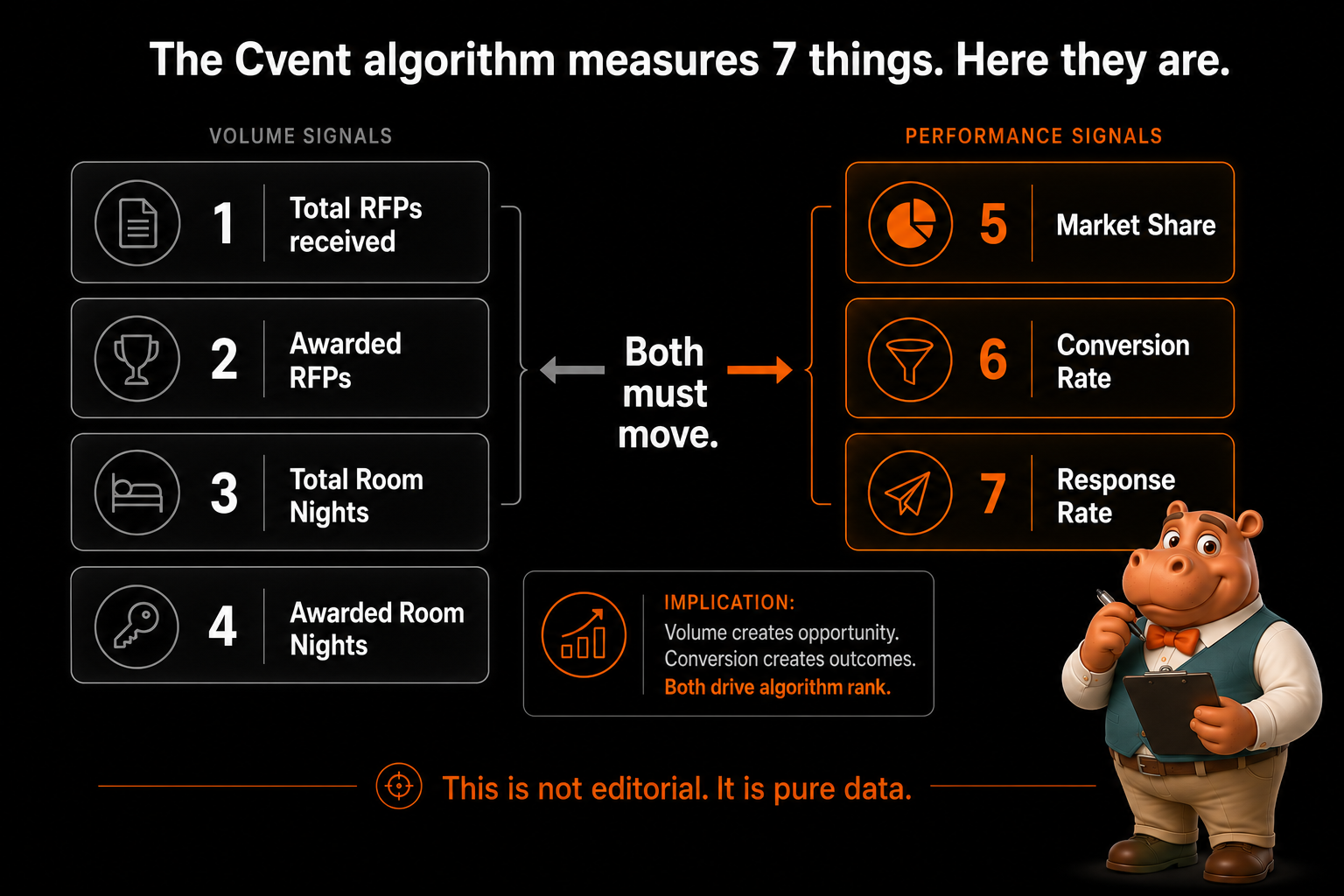
Winning begins with mastering the numbers that drive visibility and market share.
To feature in the rankings, a hotel must excel across specific quantitative criteria. Cvent analyzes sourcing activity from the entire calendar year, evaluating properties on Total Requests for Proposals (RFPs), Awarded RFPs, Total Room Nights, Awarded Room Nights, Market Share, Conversion Rate, and Response Rate.
Top-performing hotels understand that this is a volume and conversion game. They don't just wait for leads; they actively drive demand in its purest form. By consistently showing up, receiving a high volume of RFPs, and converting that interest into confirmed business, they climb the statistical ladder.
2. They Prioritize Speed and Responsiveness
Early responders capture the largest share of group business on Cvent.
In the race for group business, speed is a decisive factor. The methodology reveals that planners award a disproportionate amount of business to early responders.
Take the Ritz-Carlton Laguna Niguel, a success story in leveraging Cvent's tools. Their team operates with a clear strategy: if they see a Cvent lead, their priority is to open it immediately. In an industry where 80% of planners expect a response in four days or less, top performers aim much higher. The Ritz-Carlton sales team, for example, answers 24% of their RFPs in under four hours to maintain high service standards.
Hotels that rank high recognize that a swift, accurate response can outrun a larger competitor that is slow to reply.
Also read: Why the first responder advantage has become one of the biggest competitive edges in hotel sales.
3. They Move Beyond "Rates, Dates, and Space"
Creativity and customization turn a simple RFP into a lasting relationship.
The era of generic responses is over. Winners in 2026 understand that personalization is no longer optional. It is expected.
Top hotels customize their proposals to match the specific vision of the planner. Instead of sending templates, they use AI-powered tools to tailor responses efficiently. They treat every RFP as the start of a relationship, often picking up the phone to walk planners through the process or offer alternate dates.
As Andrea Greene, a senior sales manager at a top-performing property, notes, "You can't be generic anymore... You are doing creative selling with the destination, not just the hotel." This approach builds Return on Relationships (ROR), ensuring that planners trust the venue enough to return repeatedly.
4. They Leverage Business Intelligence
High-performing hotels refine strategy using real-time competitive insights.
You cannot improve what you do not measure. Hotels that feature on the Top Meeting Hotels lists rely heavily on data to refine their strategies.
Leading properties use tools like Cvent's CSN Business Intelligence to audit their performance against competitors. They review report cards to see where they rank in their competitive set regarding response rates and market share, allowing them to pivot their sales strategies instantly.
For example, the Grand Hyatt Nashville, consistently ranked in the top tier, credits business intelligence solutions with allowing them to improve internal sales strategies throughout the year.
Also read: The hidden costs of relying only on Cvent.
5. They Collaborate and Streamline
Efficiency is a hallmark of top-ranked hotels. The 2026 rankings highlight properties that make the booking process simple, capitalizing on the trend where 84% of planners are more likely to select a venue for simple meetings if it can be booked online.
Furthermore, top hotels use collaborative technology, such as diagramming tools, to share event space layouts with planners visually. This transparency helps planners visualize their event, whether it's a ballroom setup or an accessible room layout, building confidence in the venue's capabilities before a contract is even signed.
6. They Align with Their Destination
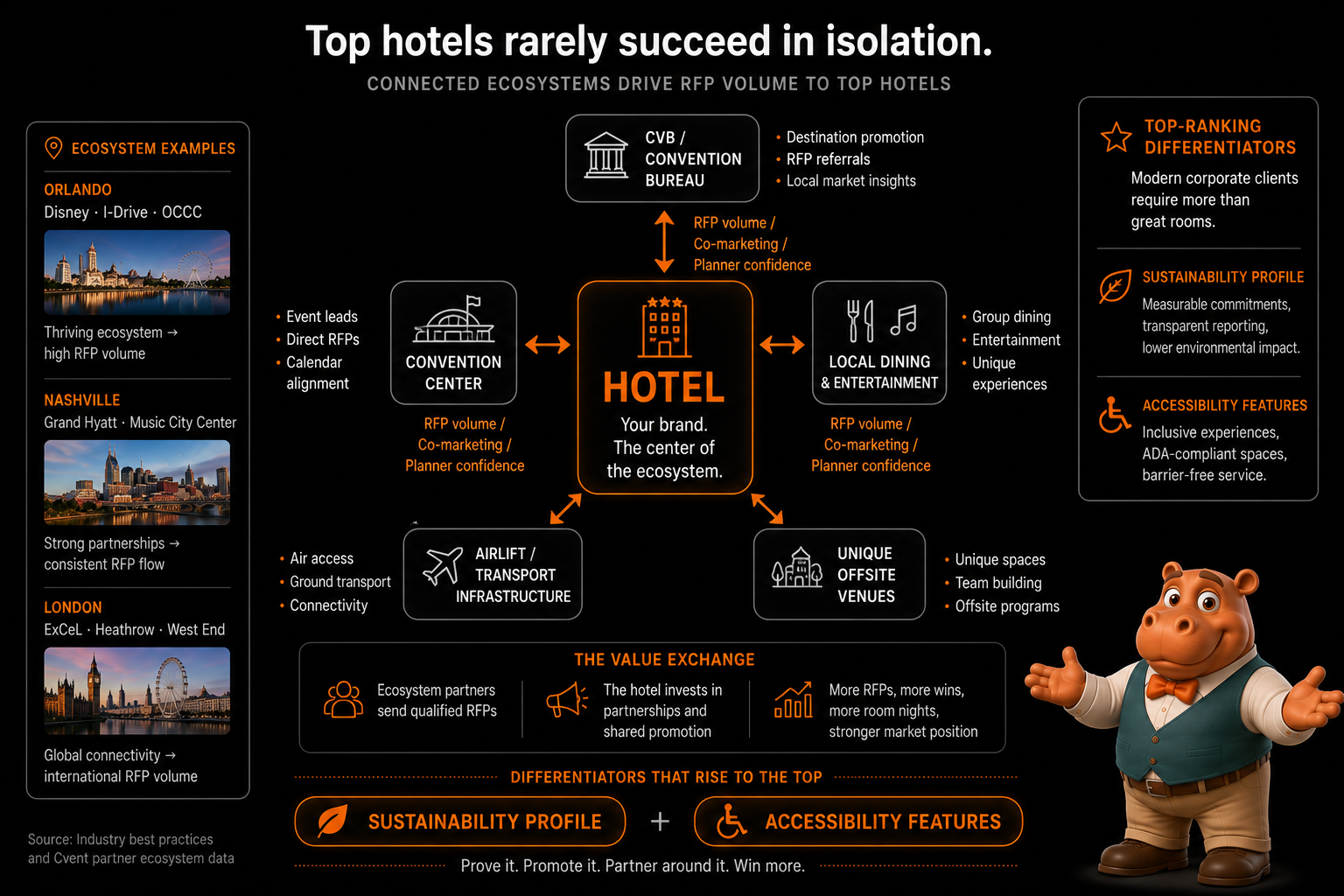
Top hotels amplify their ranking by leveraging the strength of their city ecosystem.
Finally, top hotels rarely succeed in isolation; they thrive as part of a successful destination ecosystem. Cities like Orlando, Nashville, and London dominate the Top Meeting Destinations lists because their hotels, convention bureaus, and venues work in tandem.
Successful hotels leverage their destination's strengths, selling the airlift, the local dining scene (like Orlando's Restaurant Row), and unique offsite venues, to create a cohesive package for the planner. They polish their profiles to highlight sustainability and accessibility, knowing these are key differentiators for modern corporate clients.
Earning a spot on Cvent's top lists isn't about luck. It is the result of a deliberate, data-backed strategy. It requires a hotel to operate like a high-performance engine: fueled by rapid response times, tuned with personalized service, and navigated by precise market data. When these elements fire in sync, a hotel doesn't just look good on paper. It becomes a partner that planners trust with their most critical business.
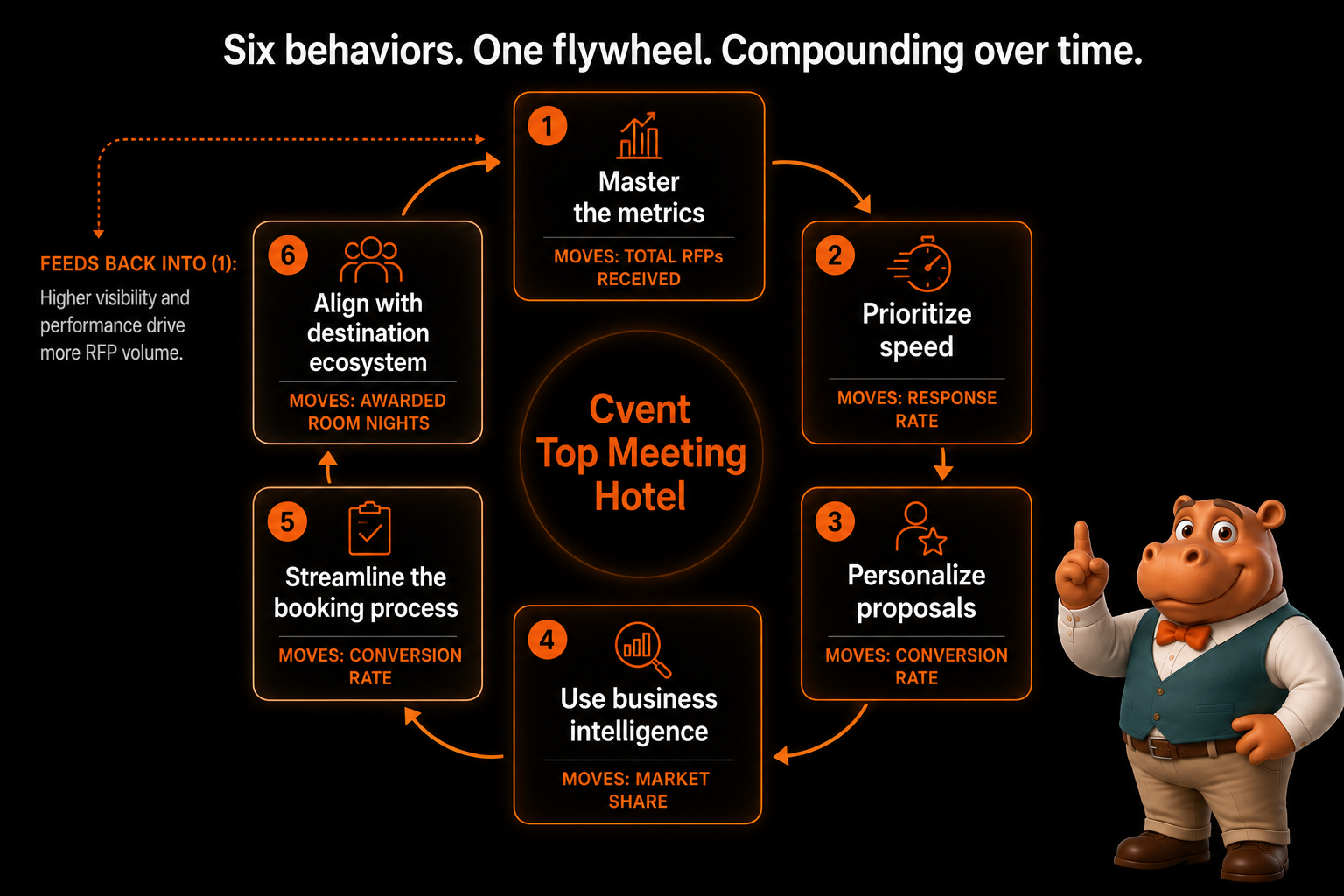
How Hippo Rev Accelerates Your Path to Becoming a Top Meeting Hotel
The Cvent algorithm rewards execution. Hippo Rev is built to deliver it.
If the Cvent Top Meeting Hotels lists are built on measurable planner behavior, then hotels aiming for those rankings need to strengthen exactly those signals: volume, speed, personalization, and conversion.
Here is the problem. Executing all of these simultaneously with a human team alone is nearly impossible. Industry-wide, 36% of RFPs go unanswered, and 71% of a seller's day goes to non-selling tasks. The metrics Cvent measures are precisely where most sales teams leak revenue.
Hippo Rev is a Revenue Capture Platform built for hotel group sales teams. It works as a system of execution alongside your systems of record, your CRM, PMS, and Cvent itself, and strengthens every ranking signal through three stages:
Capture: Win the first-responder race. Every RFP from Cvent, email, web forms, and calls lands in one pipeline the moment it arrives, with key details extracted and availability checked instantly. RFP processing drops from around 37 minutes to about 4, which means your team responds while competitors are still opening the lead. When 62% of won deals go to one of the first three responders, that speed shows up directly in your Response Rate and Awarded RFPs.
Convert: Personalize at scale. Generic templates lose. Hippo Rev helps your team build proposals tailored to each planner's specific event, and engagement analytics show you which sections a planner spent time on, so follow-up conversations start where their interest actually is. That is how personalization becomes a conversion metric instead of a talking point.
Grow: Keep every deal warm through to contract. Automated follow-ups run on a consistent rhythm so momentum never dies in an inbox, and clean handoffs to your PMS and CRM keep the booking process simple, the exact behavior 84% of planners reward. Won groups get nurtured into repeat business, which compounds your RFP volume year over year.
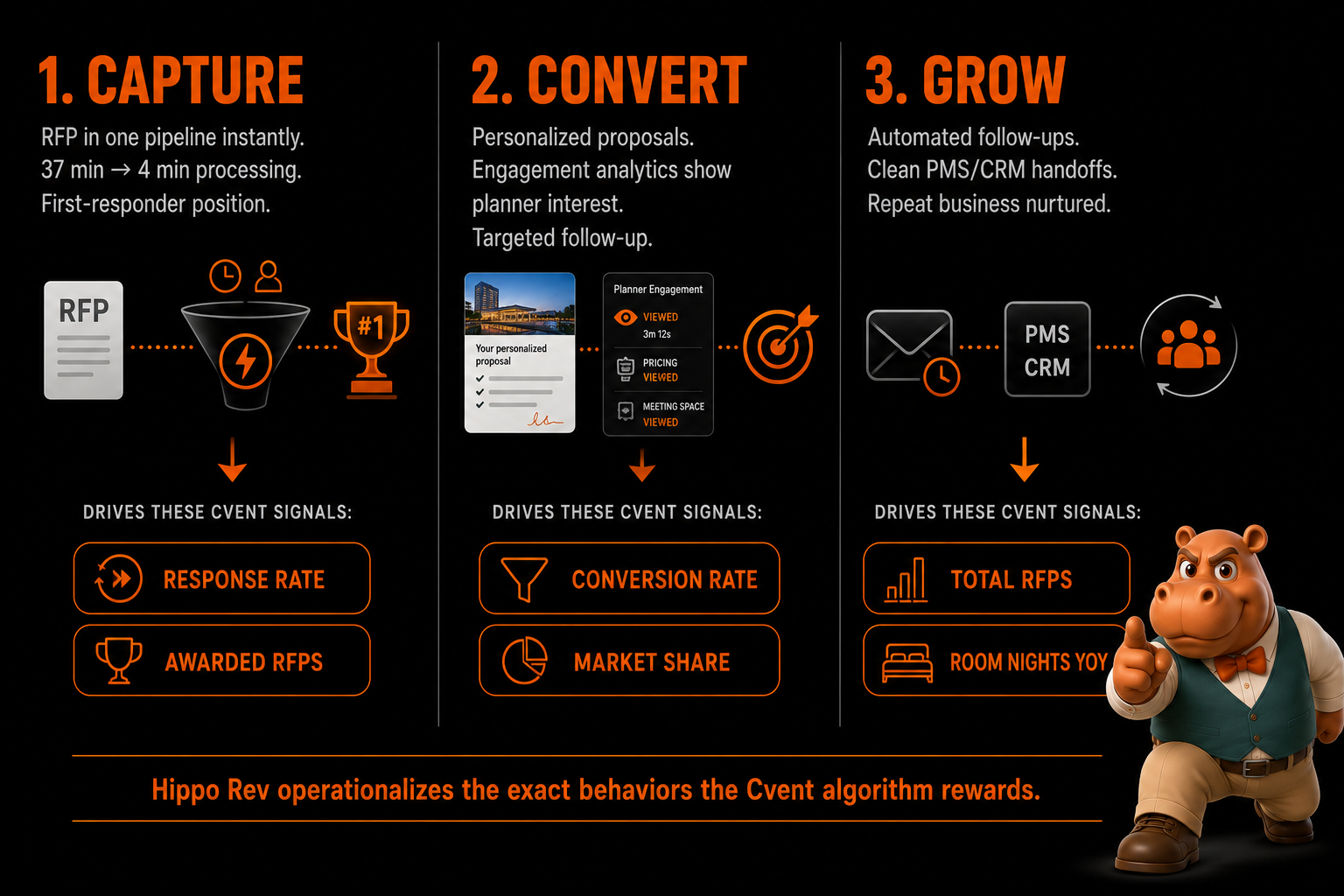
The math is straightforward. The average salesperson leaks roughly $500K in annual revenue to slow responses and dropped follow-ups. Hippo Rev operationalizes the very behaviors the Cvent algorithm rewards: respond faster, personalize better, convert consistently.
If you want to see where your property stands on these signals today, book a Capture Audit. 20 minutes, your numbers, no deck.
Frequently Asked Questions
How does the Cvent list account for emerging markets, or is it dominated solely by North American and European cities?
Cvent issues regional lists to ensure fair comparisons, and in 2025, it expanded to include a specific ranking for Latin America & Caribbean for the first time. This allows emerging powerhouses like Cancun and Riviera Maya (Mexico) to be recognized for their high volume of incentive travel and all-inclusive resort business. Meanwhile, in the Middle East, Dubai dominates due to its infrastructure of sky-high venues and high-capacity convention centers, while Singapore leads Asia Pacific due to its efficiency and infrastructure. This regional segmentation ensures that different markets are judged against their direct competitive sets.
Do "soft" factors like sustainability and accessibility actually impact the quantitative rankings, or are they just marketing buzzwords?
While the rankings are based on math (RFPs and bookings), sustainability and accessibility are now critical drivers of that math because they influence planner selection. Planners are increasingly mandated to choose inclusive and sustainable venues. Top destinations win business by highlighting accessibility features, such as using diagramming tools to ensure wheelchair-accessible layouts, and sustainability initiatives like net-zero goals.
Orlando has been the #1 meeting destination for years. Beyond just having many hotels, how does the destination's "ecosystem" contribute to this ranking?
Orlando's ranking is sustained by a cohesive ecosystem where the Convention Bureau (Visit Orlando), the massive Orange County Convention Center, and local hotels work in tandem. The destination leverages its unique assets, such as theme parks (Disney, Universal) and strong airlift, to create turnkey experiences for planners. Furthermore, the ecosystem creates a convention corridor where dining, entertainment (like I-Drive 360), and varied hotel price points are concentrated, simplifying logistics for planners. This alignment ensures that when a planner sources Orlando, they aren't just booking a room; they are booking a fully supported city-wide experience, which drives high RFP volume and conversion.
The sources mention that speed is a decisive factor. Is there a quantified benchmark for how fast a hotel needs to respond to an RFP to be considered a "top performer"?
Yes. Data indicates that 80% of planners expect a response in four days or less, but top performers aim for significantly faster turnaround times. The Ritz-Carlton Laguna Niguel, a featured success story in this aspect, notes that waiting even four to eight hours can result in lost opportunities. Their sales team answers 24% of RFPs in under four hours.
.png)
Hotel RFP Automation: An 8-Point Buyer's Checklist
Feature lists will not tell you which RFP automation platform actually wins business. This eight-point checklist covers intake, response speed, integrations, AI accuracy, lifecycle coverage, adoption, multi-property support, and reporting, with a specific vendor question for each so you can run a rigorous evaluation instead of a demo tour.
What to Look for in Hotel RFP Automation: An 8-Point Buyer's Checklist
When evaluating hotel RFP automation, look for eight things: centralized lead intake across every channel, measurable speed to first response, deep integrations with your PMS and CRM, accuracy safeguards on AI-generated content, coverage of the full deal lifecycle rather than just proposal creation, low adoption effort for your team, multi-property support if you run a portfolio, and reporting that proves the tool is actually winning you business. Feature lists will not tell you which platform delivers these. The questions below will.
The stakes justify the diligence. Industry-wide, roughly 36 percent of hotel RFPs go unanswered, 62 percent of won deals go to one of the first three responders, and over 60 percent of planners now expect a response within four days. RFP automation exists to close that gap. A tool that merely makes prettier proposals does not. Here is how to tell the difference.

1. Centralized Intake, Not Just Prettier Proposals
The first distinction in this category separates lightweight proposal builders from platforms that manage the full workflow. Hotel Tech Report's evaluation framework makes intake model a primary vector: does the system aggregate demand from every channel, or does it only format documents after a human has already gathered everything manually? Your group leads arrive through Cvent, brand portals, website forms, and direct planner emails. If the tool cannot capture all of them in one queue, your team is still doing the most error-prone work by hand, and the automation starts too late to matter.
Ask the vendor: show me how a lead from each of my intake channels lands in the system without anyone re-keying it.
2. Speed to First Response, Measured in Minutes
Since 61 percent of won deals go to an early responder, response speed is the single metric your automation must move. Do not accept "faster" as an answer. Demand a number. How long from RFP arrival to a complete, accurate, sendable proposal? Manual processes commonly take days once rate approvals and space checks are included. Strong automation compresses the processing itself to minutes. Anything that still requires your seller to assemble rates, availability, and content from three systems has automated the formatting, not the response.
Ask the vendor: time a real RFP from my inbox to a sendable proposal, live, during the demo.
Also Read: Why being the first responder consistently wins more hotel group business.
3. Integration Depth With Your PMS, CRM, and Revenue Tools
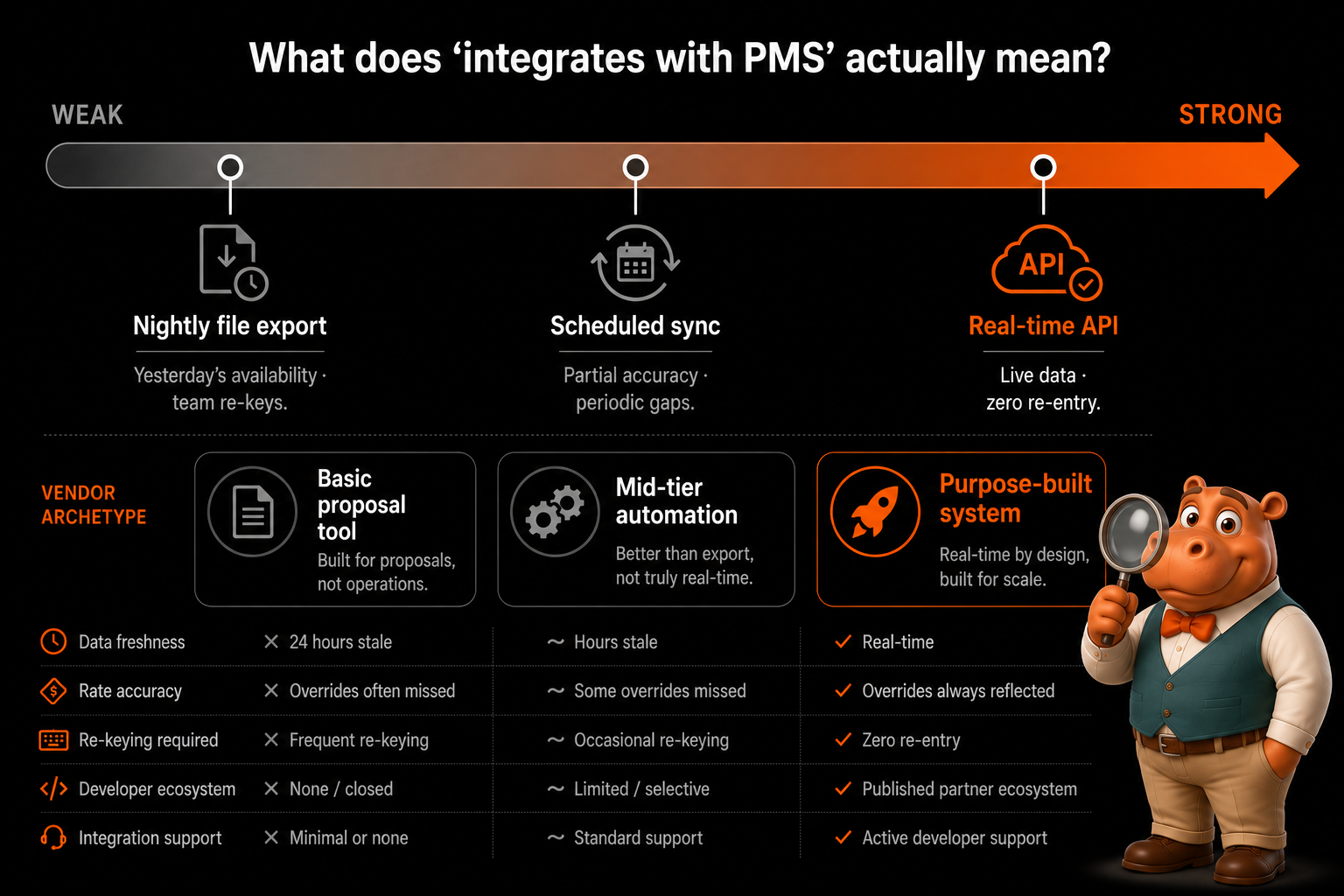
An RFP tool is only as accurate as the data feeding it. Integrations with the property management system ensure availability and rates are current; CRM integration brings account history and negotiated terms into every response. But integration quality varies enormously. Platforms with published APIs and active partner ecosystems connect reliably; platforms that sync through nightly file exports quote yesterday's availability. If your team ends up re-keying data because the integration keeps breaking, the tool is creating work instead of removing it.
Ask the vendor: which of my exact systems do you integrate with, is the sync real-time or scheduled, and can I speak to a customer running the same stack?
4. Accuracy Safeguards on AI-Generated Content
Most modern RFP tools now generate response content with AI, which makes accuracy the number one evaluation factor. Buyer guides in this space are direct about it: responses must draw on sources you trust, with strong protections against incorrect output, and a slow accurate response beats a fast hallucination. A proposal that confidently quotes the wrong ballroom capacity or an expired rate does more damage than a late one. Also confirm the data handling: your customer and rate data should never be used to train the vendor's models, and SOC 2 compliance is table stakes, not a differentiator.
Ask the vendor: where does each fact in a generated proposal come from, what happens when the system is not sure, and what is your policy on training models with my data?
5. Coverage of the Full Deal Lifecycle
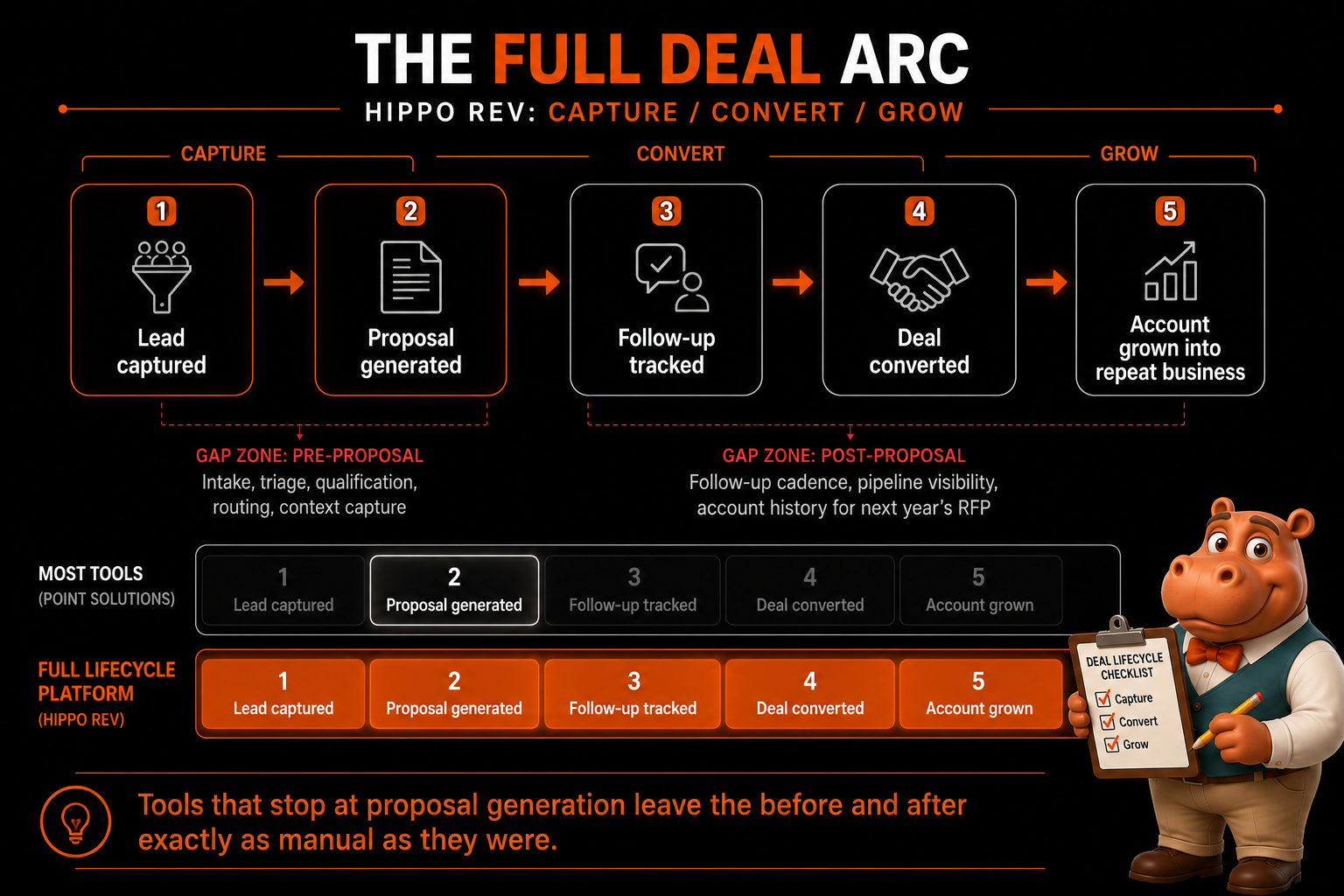
An RFP response is one moment in a longer arc: the lead must be captured, the deal converted, and the account grown into repeat business. Evaluate whether the platform covers that arc or just the middle of it. Does it track follow-ups and reminders so proposals do not die in silence? Does it maintain pipeline visibility so sales leadership sees pace and conversion in real time? Does it preserve account history so next year's RFP from the same planner starts from relationship intelligence instead of a blank page? Tools that stop at proposal generation leave the before and after exactly as manual as they were.
Ask the vendor: walk me through what happens after the proposal is sent.
6. Adoption Effort Your Team Will Actually Survive
The most common failure mode in hotel sales technology is not bad software. It is good software the team stops using. Platforms that demand a new workflow, months of migration, and mandatory retraining get quietly abandoned within a year. Evaluate the adoption path as rigorously as the features: does it layer onto your existing systems or replace them? Can a coordinator learn it in a day? Does it work on multiple devices, since your sellers respond from site tours and airports, not just desks?
Ask the vendor: what does week one look like for my team, and what is your customer adoption rate at the six-month mark?
Also Read: What successful AI onboarding looks like for hotel commercial teams.
7. Multi-Property Support If You Run a Portfolio

For management companies and groups, single-property tools break at scale. You need shared account records so a planner sourcing three of your markets is recognized as one relationship, consistent pipeline stages so portfolio reporting compares like with like, and lead routing so an RFP touching multiple properties reaches every relevant seller at once instead of surfacing in a hallway conversation four days later.
Ask the vendor: show me a portfolio pipeline view and how a multi-property RFP gets routed.
8. Reporting That Proves the Money
Finally, the tool must make its own case in numbers. At minimum: RFPs received, response rate, average response time, conversion rate, and revenue won, trended over time. These are the same numbers that expose what your manual process was losing, and they are how you will defend the subscription at budget season. A platform that cannot report its own impact is asking you to take ROI on faith.
Ask the vendor: show me the report I would put in front of ownership after ninety days.
How Hippo Rev Answers This Checklist
We built Hippo Rev against this exact list, so we will state our answers plainly. It captures every inbound group lead in one place, cuts RFP processing from roughly 37 minutes to about 4 minutes, grounds every generated response in your actual property data, covers the full Capture, Convert, Grow lifecycle, and layers onto your existing stack rather than replacing it. And consistent with what we tell every buyer: run the live test with us. If you want the baseline numbers first, a Capture Audit will surface them from your own pipeline in 20 minutes, with no deck involved.
Frequently Asked Questions
What is the most important feature in hotel RFP automation?
Centralized intake. If the platform cannot capture leads from every channel into one queue automatically, everything downstream still depends on manual re-entry, which is where speed and accuracy are lost.
How fast should automated RFP responses be?
Processing should take minutes, not days. Since 62 percent of won deals go to one of the first three responders, measure vendors on time from RFP arrival to sendable proposal.
Which integrations matter most for RFP automation?
PMS integration for live rates and availability, CRM integration for account history, and revenue management integration for pricing alignment. Prefer real-time API connections over scheduled file exports.
How do I evaluate the AI in an RFP automation tool?
Test accuracy, not fluency. Ask where each generated fact comes from, how the system behaves when uncertain, and confirm your data is never used to train the vendor's models.
Is proposal generation software the same as RFP automation?
No. Proposal builders format documents after a human gathers the inputs. True RFP automation covers intake, data assembly, response, follow-up, and pipeline tracking across the deal lifecycle.
What causes hotel RFP software implementations to fail?
Adoption, not features. Tools that force new workflows, long migrations, or heavy training get abandoned. Evaluate week-one experience and six-month adoption rates before buying.
Do small hotels with low RFP volume need automation?
It depends on volume and leakage. A property handling a few RFPs a month may manage manually, but once leads go unanswered or responses slip past two days, the lost revenue typically exceeds any subscription cost.
What should multi-property groups look for specifically?
Shared account records, consistent pipeline stages across properties, portfolio-level reporting, and automatic routing of multi-property RFPs to every relevant seller.
What reports should RFP automation provide?
RFPs received, response rate, average response time, conversion rate, and revenue won, trended monthly. These prove ROI and expose remaining leaks.
What should I do before buying RFP automation?
Baseline your current numbers: monthly RFP volume, response rate, and average response time. Clean and centralize your data. Automation amplifies the foundation it sits on, so measure and fix the foundation first.
.png)
Best AI Hotel RFP Tools for Multi-Property Teams (2026)
Multi-property group sales is not single-property sales multiplied. This guide compares seven AI hotel RFP tools, from Hippo Rev and Thynk to Delphi, Cvent, Tripleseat, Cendyn, and MeetingPackage, matching each to the portfolio bottleneck it actually solves so you can shortlist with confidence.
Best AI Hotel RFP Tools for Multi-Property Teams in 2026
The best AI hotel RFP tools for multi-property teams are the ones built around portfolio operations rather than single-property workflows: Hippo Rev for AI-driven revenue capture across group sales, Thynk for Salesforce-based commercial platforms, Amadeus Delphi with MeetingBroker for brand-standard portfolios, Cvent for enterprise demand and distribution, Tripleseat for event-led properties, Cendyn Proposals for fast branded proposal output, and MeetingPackage for instant booking of meetings and events. Which one is right for you depends on your stack, your volume, and how much of the deal lifecycle you want the tool to own.
First, a disclosure: we make one of the tools on this list. We have kept the descriptions factual and the fit criteria honest, because a tool that is wrong for your operation costs you more than any competitor's win costs us.
Why Multi-Property Changes the Requirements
Running group sales across a portfolio is not single-property sales multiplied. It breaks in specific ways. RFPs arrive at individual properties through separate inboxes, so a planner sourcing three of your markets is handled as three unrelated leads. Each property configures stages and fields its own way, so portfolio reporting means reconciling mismatched exports. Response speed varies wildly by property staffing, so from the buyer's side the whole portfolio looks disorganized even when most teams are fast. Hotels using manual lead tracking see sales cycles run 35 to 40 percent longer than teams on purpose-built software, and at portfolio scale that gap compounds across every property.
So the evaluation bar for multi-property teams is specific: centralized intake across all properties, shared account records, consistent pipeline stages, cross-property lead routing, and portfolio-level reporting. Here is how the leading tools measure against it.
1. Thynk: Best for Portfolios Standardizing on Salesforce

Thynk is a hospitality commercial platform built on Salesforce that unifies B2B sales, groups, meetings, and events. Its multi-property credentials are genuine: multi-property room blocks with a unified inventory view, proposals and BEOs generated across properties in multiple languages, and real-time metrics at both property and portfolio level. AI capabilities ride on Salesforce's Einstein and Agentforce layers, including RFP triage and proposal agents. The consideration is the flip side of the strength: you are adopting a Salesforce ecosystem, with the configuration depth and complexity that implies, and reviewers note the interface can be demanding for first-time users.
Best fit: hotel groups ready to standardize commercial operations on a Salesforce foundation and staff it accordingly.
2. Amadeus Delphi and MeetingBroker: Best for Brand-Standard Portfolios

The Amadeus sales and event management suite, anchored by Delphi with MeetingBroker for lead distribution and eProposal for responses, remains the incumbent choice across large branded portfolios. Its strength is exactly that incumbency: deep function-space management, brand familiarity, and support teams that know how to run the suite across 15-plus hotel deployments, a point reviewers on Hotel Tech Report specifically credit. The consideration is that it is a system of record first. Teams often add execution-speed tooling on top of it rather than getting response velocity from the suite itself.
Best fit: branded portfolios where Delphi is mandated or entrenched and the priority is standardized sales and catering operations.
3. Cvent: Best for Enterprise Demand and Distribution

Cvent sits on the demand side of the RFP equation: it is where a huge share of group RFPs originate, and its hotel-facing tools help portfolios manage that inbound flow, respond, and market venues across the network. For multi-property teams, being well-configured in Cvent is less a software choice than a channel necessity. Considerations are enterprise-grade pricing, typically custom and starting in five figures annually, and the fact that Cvent manages Cvent-sourced demand, not the direct emails, website forms, and referrals that arrive outside it.
Best fit: large portfolios with heavy corporate and association RFP volume flowing through the Cvent network.
4. Tripleseat: Best for Event-Led Properties and Venues

Tripleseat focuses on event sales and catering management, with an RFP auto-import feature that pulls specifications from major sources into branded proposals, plus integrations with Cvent and Opera. It is strongest where food and beverage and event execution drive the business: restaurants, venues, and hotels with significant banqueting. Considerations include a learning curve on advanced features and pricing that can feel premium for properties with lower event volume.
Best fit: multi-venue operators and event-heavy hotels where catering workflow depth matters more than rooms-led group blocks.
5. Cendyn Proposals: Best for Fast, Branded Proposal Output

Cendyn Proposals earns its recommendations among branded hotels for one focused job: preloaded boilerplate terms, amenities, and photos that let teams assemble polished proposals in minutes instead of hours. As a proposal layer it is quick to deploy and easy to adopt. The consideration is scope: it addresses the proposal document, not intake, routing, pipeline, or follow-up, so portfolio teams still need the surrounding workflow handled elsewhere.
Best fit: teams whose bottleneck is specifically proposal assembly and who already have intake and pipeline under control.
6. MeetingPackage: Best for Instant Booking of Meetings and Events
MeetingPackage combines a channel manager for meeting space with web proposals and pricing in one interface, and it leads the industry push toward instant booking for small meetings. With 90 percent of hoteliers saying the group booking process itself is broken and most expecting automated offers to dominate the segment within five years, its direction of travel is the market's direction. The consideration is segment fit: instant booking suits small, simple meetings, while complex group blocks still need a sales-led workflow.
Best fit: portfolios wanting to automate small meetings end to end and free sellers for complex business.
Also Read: Why the first 60 minutes determine whether hotels win or lose group business.
7. Hippo Rev: Best for AI-Driven Revenue Capture Across the Portfolio

Hippo Rev is a Revenue Capture Platform built specifically for hotel group sales teams. It centralizes inbound group leads from every channel into one queue, uses AI to cut RFP processing from roughly 37 minutes to about 4 minutes per response, and covers the full Capture, Convert, Grow lifecycle: intake, response, follow-up, and account growth. For multi-property teams, the design principle is that it layers onto your existing sales and catering stack rather than replacing it, which matters when properties run mandated brand systems. The honest caveat we give every buyer: the AI is only as accurate as the property data you feed it, so centralize and clean your data first.
Best fit: portfolios losing revenue to slow or missed RFP responses that want execution speed without a rip-and-replace project.
How to Choose
Match the tool to your actual bottleneck. If demand arrives and dies unanswered, you need capture and speed. If your system of record is mandated, choose something that layers on rather than replaces. If proposals are slow but intake is fine, a focused proposal tool may be enough. And whatever you shortlist, run one live test: time a real RFP from arrival to sendable proposal during the demo. If you want your baseline numbers before any demo, our Capture Audit produces them from your own pipeline in 20 minutes, no deck.
Frequently Asked Questions
What is the best AI RFP tool for a hotel management company?
It depends on the bottleneck. Hippo Rev leads for AI-driven capture and response speed across a portfolio, Thynk for groups standardizing on Salesforce, and Amadeus Delphi for brand-mandated environments.
What makes an RFP tool multi-property ready?
Centralized intake across all properties, shared account records, consistent pipeline stages, automatic routing of multi-property RFPs, and portfolio-level reporting without manual reconciliation.
Can these tools work alongside a mandated brand system like Delphi?
Several can. Execution-layer platforms are designed to sit on top of an entrenched system of record, adding intake and speed without replacing where data ultimately lives.
How much do multi-property RFP platforms cost?
Pricing is mostly custom. Enterprise suites typically start in the five figures annually, event platforms often run four figures monthly, and focused proposal tools cost less. Weigh any subscription against execution leakage, which runs to roughly 500,000 dollars per salesperson per year.
What does AI actually do in these tools?
Depending on the platform: parsing inbound RFPs, triaging and scoring leads, assembling responses from property data, recommending rates, and automating follow-ups. Verify that generated content is grounded in your actual data.
Also read: How layered AI makes hotel sales automation more reliable.
Should a multi-property team buy one tool for all properties or let each property choose?
One tool, centrally. Property-by-property choices recreate the fragmentation that causes slow responses and irreconcilable reporting in the first place.
How important is Cvent integration for these tools?
Very, if your demand flows through the Cvent network. A portfolio tool should ingest Cvent leads automatically alongside email, web, and brand-channel demand.
What is the biggest implementation risk?
Adoption. Tools that force new workflows across dozens of properties get abandoned unevenly, which is worse than no tool. Favor platforms your coordinators can learn in a day.
Do instant booking tools replace group sales teams?
No. They automate small, simple meetings so sellers can spend their time on complex, high-value group business.
What should we do before evaluating any of these tools?
Baseline your numbers: RFP volume, response rate, response time, and conversion by property. Then clean and centralize your data. Every tool on this list amplifies the foundation it sits on.
Your Hotel Sales Team Spends 70% of Its Time on Admin | Hippo Rev
Hotel sales managers are expensive, relationship-driven professionals spending most of their day on work that does not require a human. Here is the admin audit, task by task, and what can be automated today.
Why Your Hotel Sales Team Is Spending 70% of Their Time on Admin (And How to Get It Back)
Your Director of Sales earns a senior salary. She spends a large share of her day on data entry, copy-pasting proposal templates, and chasing Cvent confirmations. Ask yourself what that time is worth, and whether you are paying for a closer or a very expensive data-router.
Across onboarding sessions and demos, from a Hilton property in Los Angeles to independent boutiques, the ratio held up with uncomfortable consistency. The people you hired for relationships and negotiation spend most of the week on tasks that software should have handled years ago. This is the execution gap, and it is measurable.
Where do hotel salespeople actually spend their time?
Not on selling. Salesforce data shows reps spend only about 29% of their time actively selling, which means roughly 70% goes to admin: responding to RFPs, entering data, formatting proposals, and chasing confirmations. A single RFP response, from capture to price to propose to CRM update, commonly runs 45 to 60 minutes of manual work.
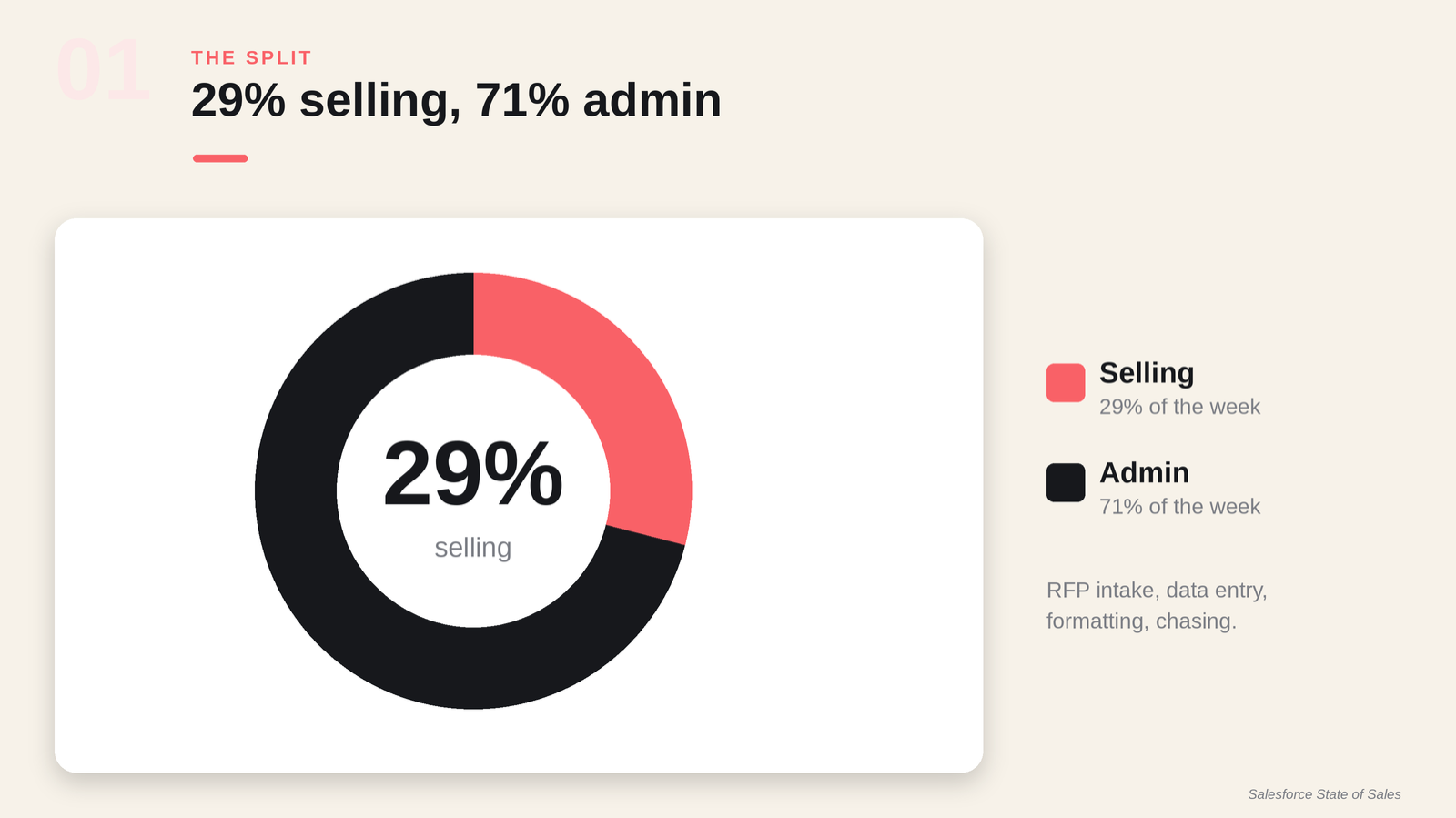
Break one RFP into its stages and the leak is obvious. Capture the lead. Find the missing details. Look up pricing. Build the proposal. Send it. Update the CRM. Schedule the follow-up. Each step is small. Multiply by 50 to 100 RFPs a month and the aggregate is most of a full-time role spent on work no customer ever sees.
Why is the problem getting worse, not better?
Because the systems do not talk to each other. Cvent, Opera, Delphi, Groups360, MeetingBroker, and the property CRM each hold a piece of the workflow, and none of them share it automatically. Every handoff between systems is a manual re-entry, which means more time lost and more room for version errors.
The compounding problem is integration, or the lack of it. A rep pulls a lead from Cvent, re-types it into the CRM, opens Opera or Delphi for pricing, drops that into a Word template, and emails it out, then logs the whole thing by hand. Without open API connections between the PMS, CRS, and CRM, every one of those transfers is human-powered, and every human transfer is a chance for a wrong rate or an outdated version to reach a planner.
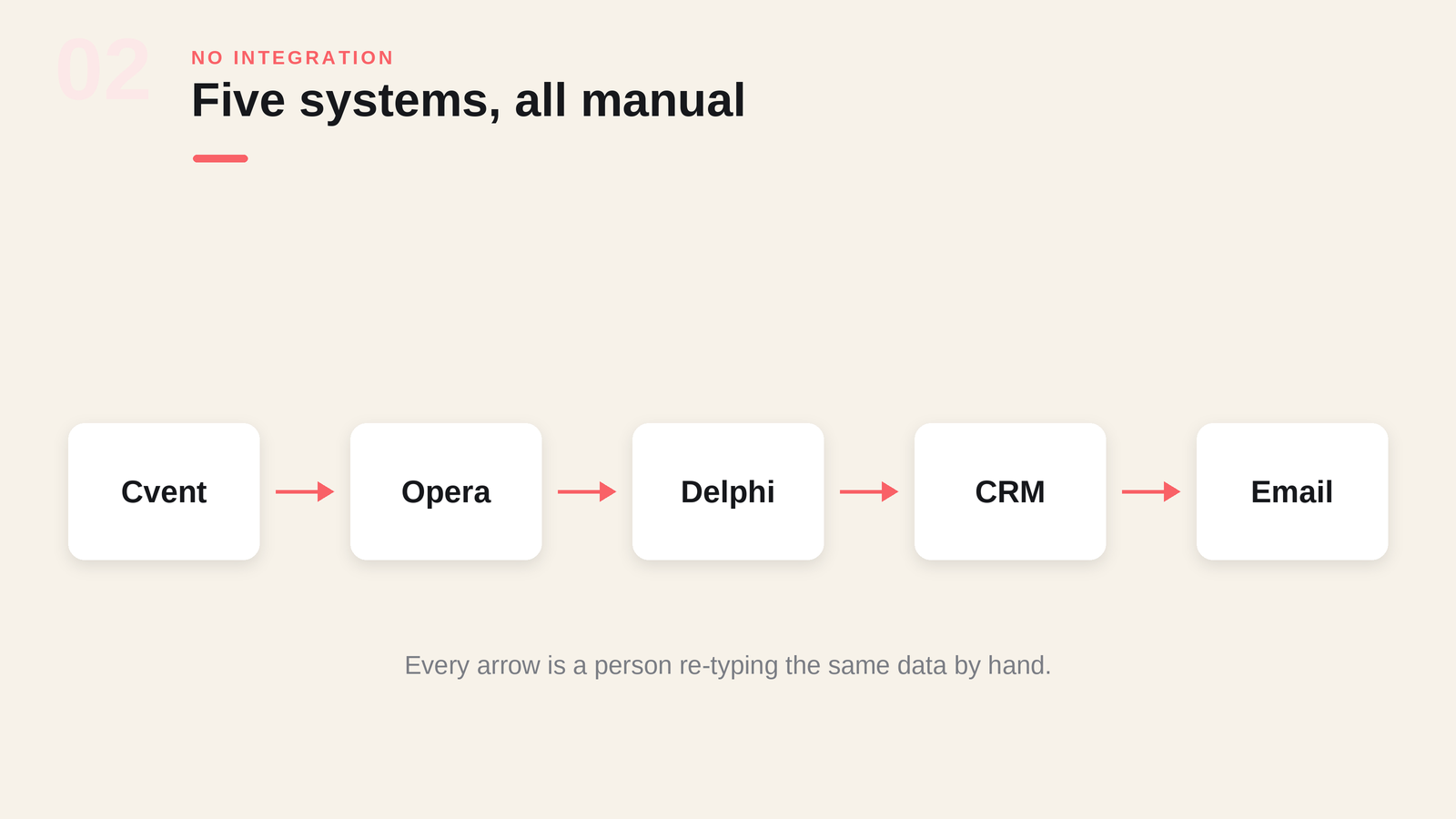
What does 70% admin mean for revenue?
It means your capacity is capped by paperwork, not by market demand. If automation lets one rep handle three times the RFP volume at the same quality, you are not just saving hours, you are unlocking closed group revenue that currently never gets worked because the team runs out of time before it runs out of leads.
Reframe the admin tax as an opportunity cost. Every hour spent formatting a proposal is an hour not spent on a fence-sitting group that a human conversation would have closed. When you free the 70%, you are not cutting cost, you are expanding the sellable surface area of a team you already employ. That is the argument for automation as a growth lever, not a savings line.

Which tasks can be automated today, and which still need a human?
Automate the mechanical work: lead capture, missing-detail collection, pricing lookup, proposal generation, CRM updates, and follow-up scheduling. Keep the human work human: the relationship, the negotiation, the site visit, and the final call. The line is simple, if a task is judgment-free and repetitive, it should not be on a salesperson's plate.
This split is the whole design philosophy behind Hippo Rev: the Capture, Convert, and Grow agents execute the workflow, and the humans do what only humans can. It is the same principle we lay out in why we built Hippo Rev.
What does this look like in the field?
Faster proposals and a team that sells more of the week. In practice, hotels using automation have cut proposal prep from the typical 30 to 60 minutes down to a few minutes, using tools that capture the lead, auto-complete the details, and generate a branded proposal on one click. The rep's day shifts from data entry back to selling.
The clearest field example is Wyndham Indianapolis West, where RFPs that took 33 minutes now go out in 5.
Implementation is less disruptive than the fear suggests. Connect Cvent, email, and the PMS, and the system starts working, often within the first 15 to 30 minutes. Nothing about the salesperson's craft changes. What changes is that the drudgery around it disappears.
As Hippo Mate puts it: "You close the deals. I'll do the paperwork. That was always the deal."
See the full admin automation walkthrough, from lead to signed proposal in under a few minutes. Book a quick revenue audit.
Frequently Asked Questions
How much time do hotel sales reps spend on admin?
Industry research puts active selling at roughly 29% of a rep's time, meaning about 70% goes to administrative work such as RFP processing, data entry, proposal formatting, and follow-up chasing.
What hotel sales tasks can be automated?
Lead capture, missing-detail collection, live pricing lookup, proposal generation, CRM updates, and follow-up scheduling can all be automated today. Relationship building, negotiation, site visits, and the final decision should stay with the salesperson.
Does automating admin work reduce sales headcount?
Typically it increases capacity rather than cutting headcount. By removing the admin ceiling, the same team can work far more RFPs, which turns freed hours into additional closed group revenue.
The After-Hours RFP Problem in Hotel Group Sales | Hippo Rev
A large share of group inquiries arrive after the sales office has gone home. The front desk is not built to sell groups at 11 PM, and by morning, someone else already replied.
The After-Hours RFP Problem: How Hotels Lose Leads While Everyone Sleeps
Your front desk agent answered the phone at 11 PM. A corporate planner wanted 80 rooms for a leadership offsite. The agent, doing exactly what the role asks, took a message. The planner booked another hotel across the street the next morning, before your sales team had even seen the note.
This scenario came up in demo after demo, and it is one of the most preventable losses in group sales. RFPs and phone inquiries do not respect the nine-to-five. They land in the evening, on weekends, and across time zones. The sales office is closed, the front desk is not equipped for a detailed group conversation, and the lead quietly expires overnight.
When do group leads actually arrive?
Far more often outside business hours than most teams assume. Evening and weekend submissions are common, and for global chains, a planner in one time zone routinely inquires while the sales office in another is dark. A meaningful share of phone-in group inquiries hit the property after the sales team has left for the day.
Modern buyers research when it suits them, not when your office is open. Harvard Business Review's audit of 2,241 companies found the average lead response time was 42 hours, and a large chunk of that delay is simply the clock running while nobody is at the desk. Every hour a high-intent lead waits, it cools, and the MIT and InsideSales research on the five-minute window shows how fast that decay sets in.
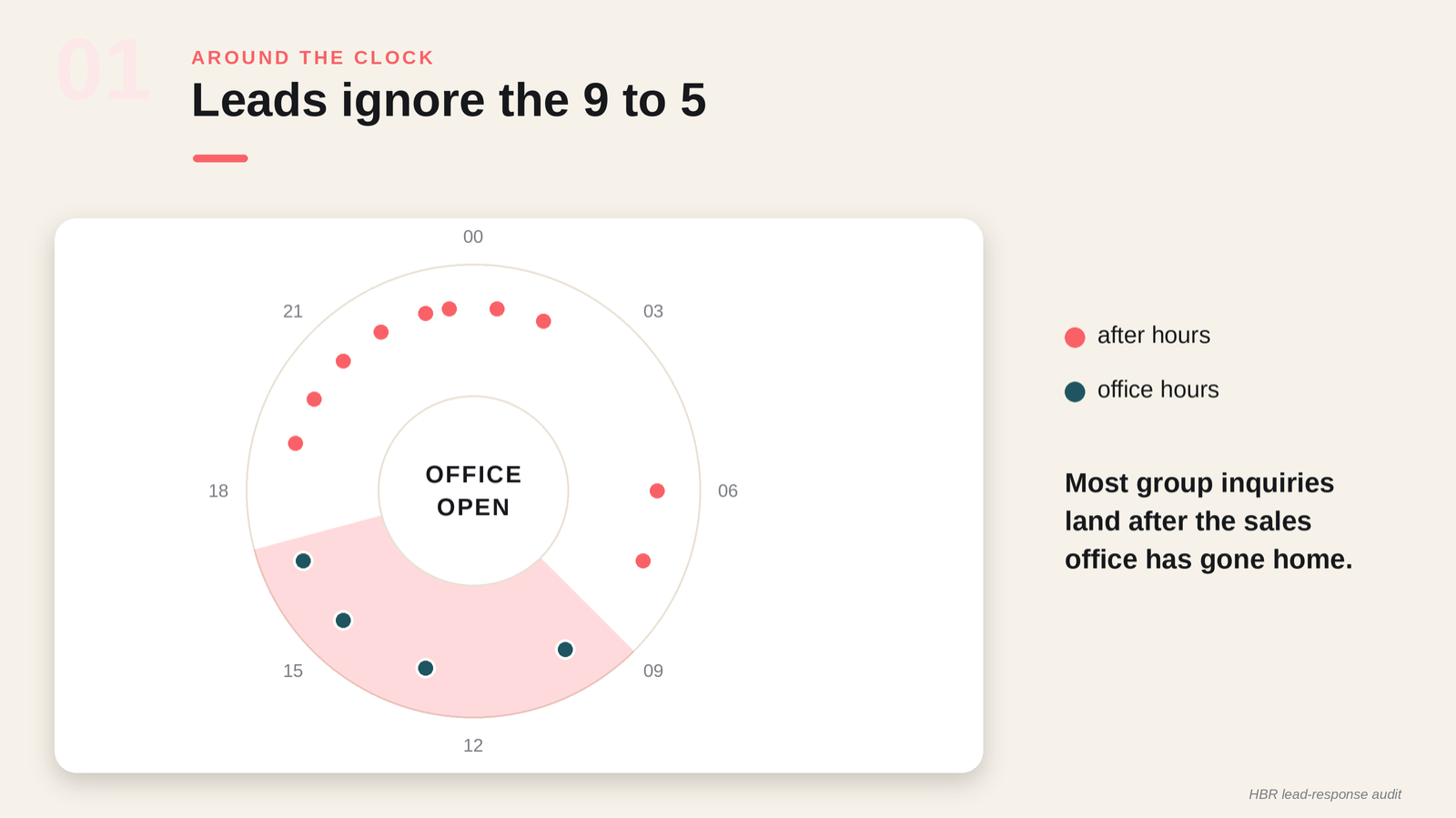
What happens at the front desk today?
A well-meaning handoff that loses the deal. The front desk is trained for arrivals, guest issues, and check-ins, not for qualifying an 80-room corporate offsite. The urgency does not get communicated to sales, the voicemail gets buried, and by the time a manager sees it, a competitor has already responded.
This is not a staffing failure. It is a job-design mismatch. Asking a front desk agent to capture a group sales lead at midnight is asking them to do a job they were never hired or equipped for. The information that does get taken is often incomplete, so even the leads that survive the night arrive the next morning missing the details a proposal needs.
What does a missed after-hours lead cost?
The same as any lost group deal, multiplied by how often it happens. If an average group booking is worth thousands of dollars and a real share of inquiries arrive after hours, the annual cost of the coverage gap runs well into six figures for a busy property. These are not declined deals. They are deals you never got to compete for.
Because 72% of first responders win the business, the after-hours gap is not a minor edge case. It is a structural handicap. Every night the office is closed, you concede the first-responder advantage to whichever competitor has a way to answer. We break down that advantage in the speed-to-lead piece.
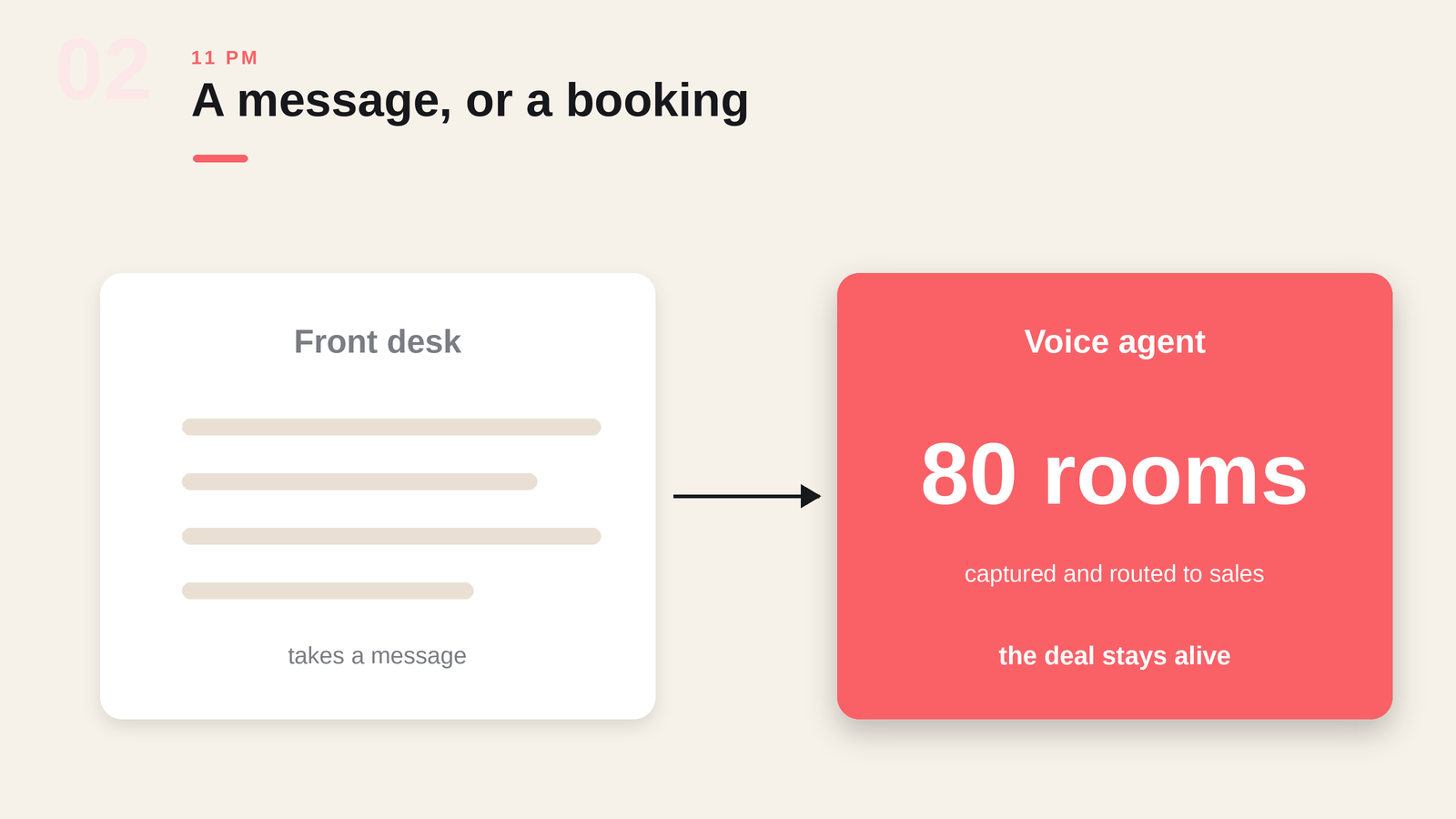
What does a voice AI agent do differently?
It answers the call like a trained group-sales intake specialist, at any hour. A voice AI agent has a real conversation, captures structured lead details, and immediately routes a complete summary to the sales team, so the planner gets an engaged response at 11 PM instead of a message pad. No hold music, no lost voicemail, available 24/7.
The difference is between capturing a lead and merely acknowledging one. A Front Desk Agent conducts the intake conversation, asks the qualifying questions a planner expects, and hands sales a structured, complete record the moment they log on. The lead is warm, detailed, and already in the system, not a sticky note.
What does it take to implement, and will it feel robotic?
Less than you think, and no. In most cases you forward your existing number, with no new hardware and setup measured in a day, not a quarter. Modern voice agents are conversational rather than scripted, handle the common group inquiry cleanly, and escalate genuine complexity to a human.
The common objections have straightforward answers. Will it sound robotic? Today's voice agents are natural and conversational. What about complex inquiries? The agent captures and routes them; it does not try to close every convention on its own. Does IT need to be involved? Usually only to forward a number. The goal is non-disruptive coverage that closes the gap, not a rip-and-replace project.
For example, Wyndham Indianapolis West went live in 10 days, sitting on top of the Opera, Lighthouse, and Delphi stack it already trusted.

Wish to hear a live after-hours call handled by Hippo Rev's voice agent ?
Book a live revenue audit with us.
Frequently Asked Questions
How many hotel group leads arrive after business hours?
A significant share of RFPs and the majority of phone-in group inquiries arrive in the evening, on weekends, or from other time zones. For chains operating across regions, after-hours inquiries are a daily occurrence rather than an exception.
Can a front desk handle group sales inquiries?
Front desk teams are trained for guest service, not group sales qualification. They can take a message, but they are not equipped to capture the event details, room-block needs, and urgency that a group lead requires, which is why after-hours leads so often go cold.
Does an AI voice agent replace the sales team?
No. It handles first-touch capture and structured intake when the office is closed, then routes a complete lead to the human team. The salesperson still owns the relationship, the negotiation, and the close.
The Hidden Cost of Cvent in Hotel Sales | Hippo Rev
Cvent delivers volume. But between listing fees, unqualified RFPs, and the hours spent processing leads that ghost, many hotels are quietly paying far more per booking than they think.
The Hidden Cost of Cvent: What No One Talks About in Hotel Sales
Your hotel paid tens of thousands of dollars for a Cvent listing last year. Now count the leads you actually closed from it. For a lot of properties, that division produces a number that stops the conversation cold: several thousand dollars per booking, before anyone counts staff time.
This is not a case against Cvent. It is the single largest sourcing marketplace in group business, and it belongs in most hotels' lead mix. It is a case for looking honestly at the return, because in demo after demo, sales leaders described the same quiet frustration. One select-service operator closed a handful of Cvent leads across an entire year before downgrading. A seven-property portfolio described chronic time lost to unqualified RFPs. Another leader cited a conversion rate on Cvent leads in the low single digits.
What does Cvent actually deliver, volume or quality?
Volume, reliably. Quality is where it gets expensive. Cvent generates a high number of RFPs, but planners routinely send the same RFP to four to eight properties at once, so each lead is commoditized on arrival. You are not receiving an opportunity, you are receiving a footrace, and most of the field will lose.
The Cvent Supplier Network reliably generates RFPs, but conversion is brutally concentrated at the top of the response curve. If you are not fast, the volume is just noise you paid for. That is the same first-responder dynamic we cover in the speed-to-lead breakdown.
It is also exactly the race Wyndham Indianapolis West was running across Cvent RFPs before it moved to a 5-minute response.
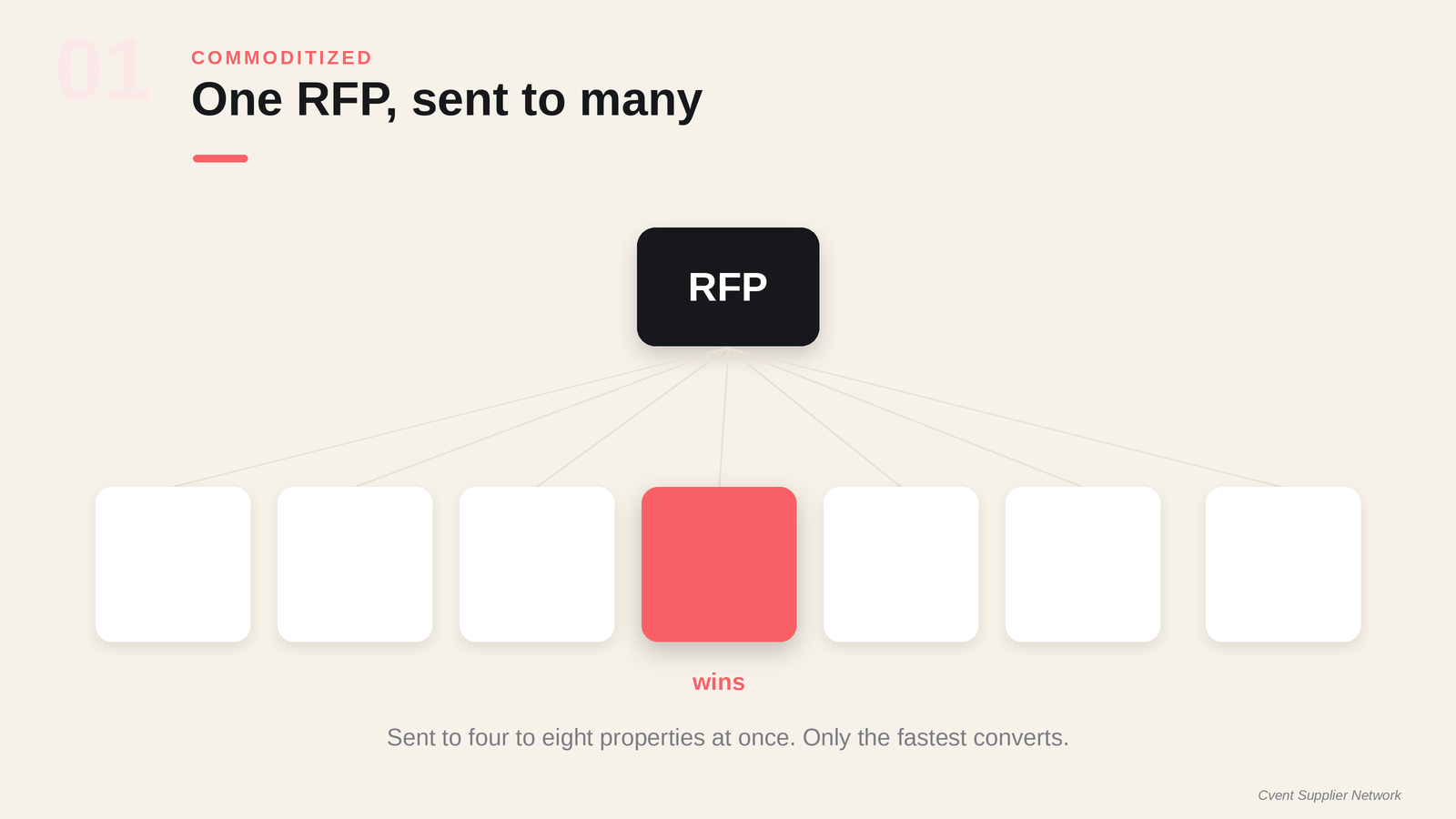
What is the hidden labor tax on every Cvent lead?
The listing fee is the visible cost. The hidden one is time. Every Cvent lead has to be pulled into the PMS, checked for missing details, priced, turned into a proposal, and then chased when the planner goes quiet. Multiply that by dozens of leads a month and the staff hours often outweigh the subscription itself.
Here is where the true cost lives, and it rarely shows up on any invoice:
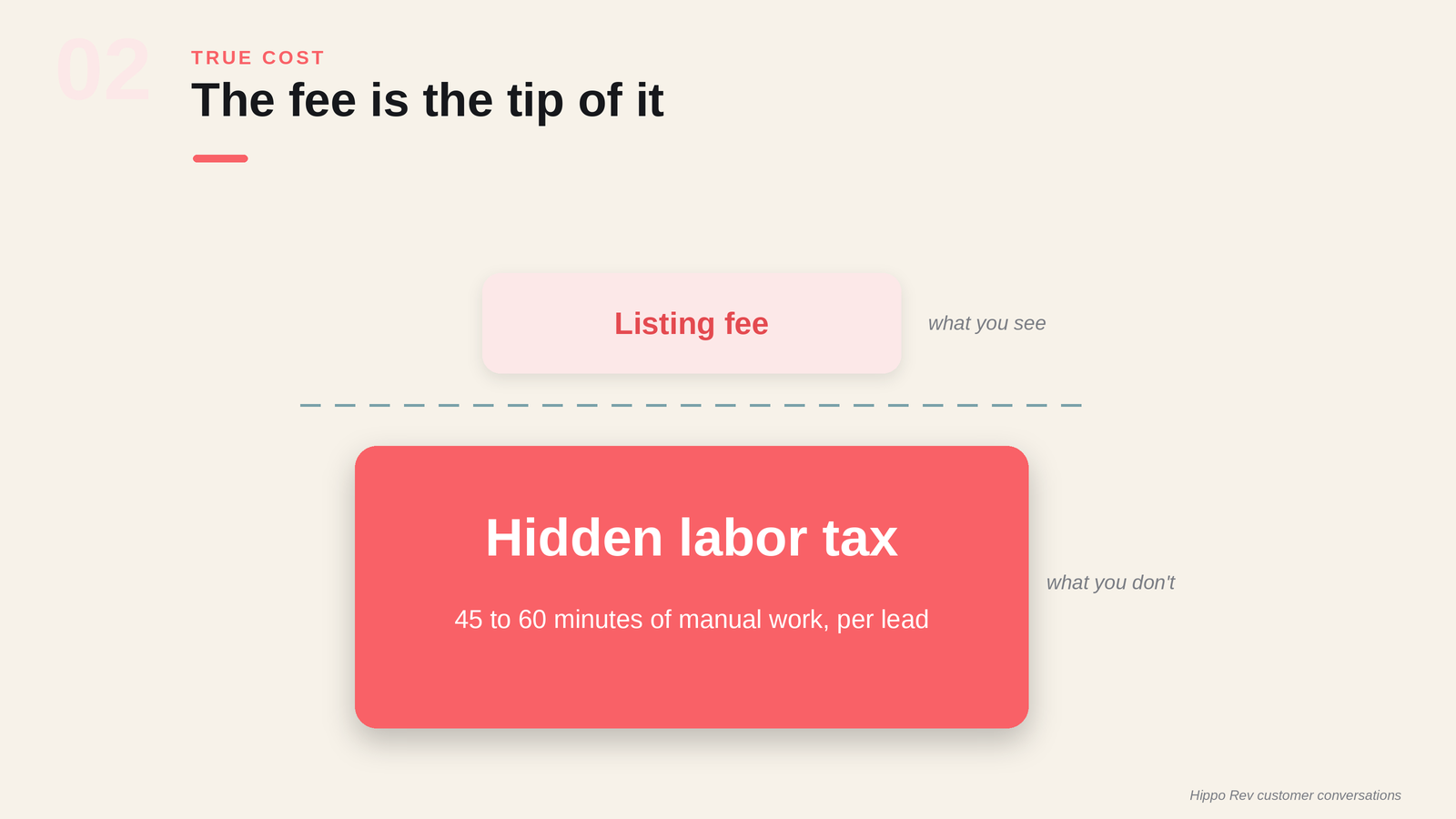
With reps already spending only about 29% of their time selling, the Cvent labor tax eats directly into the sliver of the week that actually produces revenue. The full accounting of that admin burden is in why hotel sales teams spend 70% of their time on admin.
What does a healthier, diversified lead mix look like?
One where Cvent is a channel, not the whole strategy. A resilient mix pairs Cvent with CVB and DMO portals, brand channels, direct corporate outreach, voice-captured phone inquiries, and repeat-planner relationships. When one channel's cost per booking spikes, the others keep the pipeline alive.
The properties that feel least trapped by Cvent are the ones that treat it as one input among several. They cultivate repeat planners, whose bookings cost almost nothing to source. They capture phone-in group inquiries that never touch a marketplace. And they invest in direct relationships that compound over time instead of resetting with every new RFP blast.
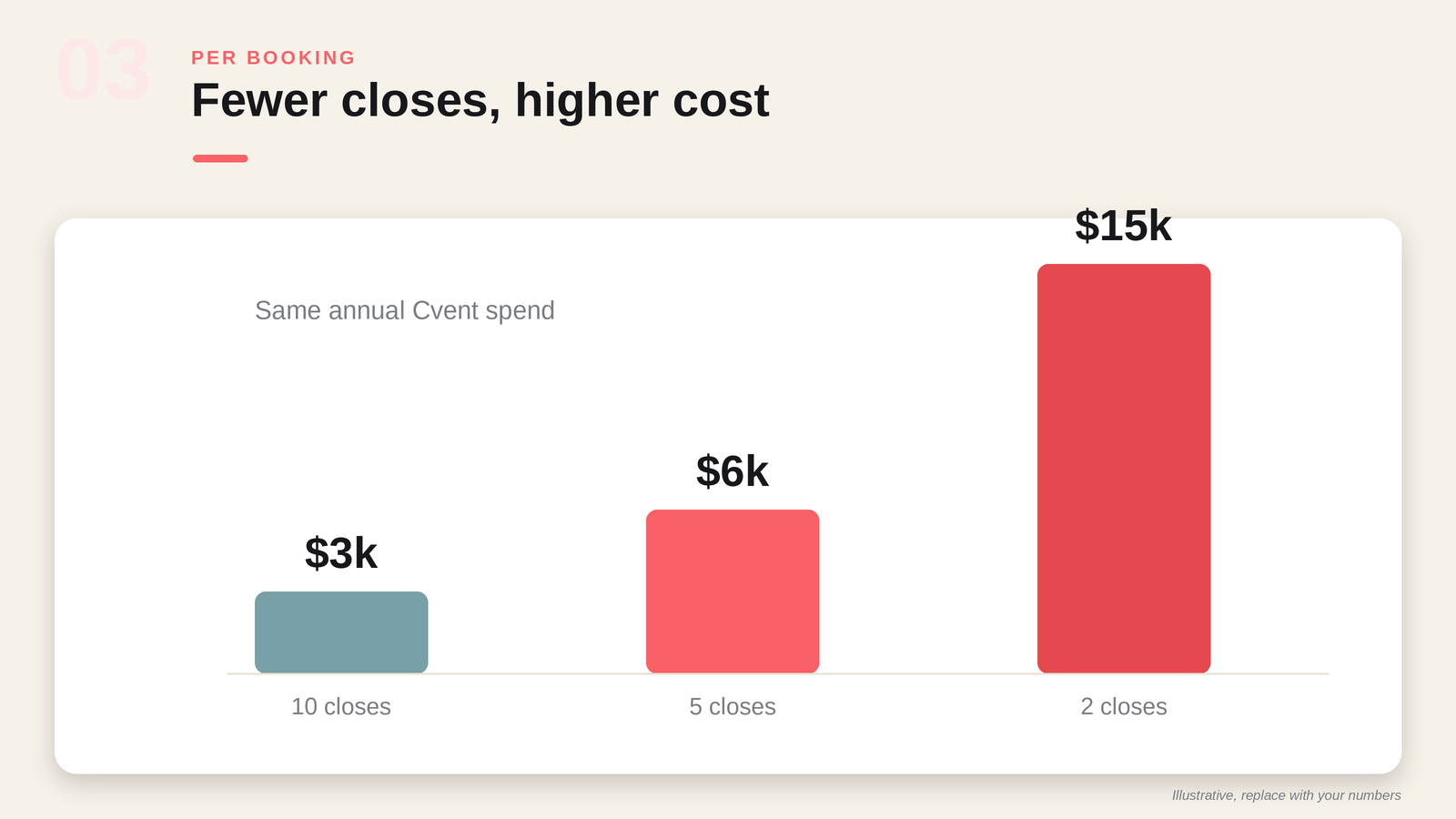
How do you keep Cvent in the mix without drowning in it?
Automate the volume so humans only touch the high-intent leads. Let AI capture every Cvent RFP, complete the missing details, and draft the proposal, then route only qualified, ready-to-advance opportunities to a salesperson. You keep the reach of the marketplace without paying the full labor tax on every lead.
This is exactly what the Capture layer of Hippo Rev is designed for. The Lead Catcher Agent pulls every Cvent inquiry into one place, the qualification step scores and prioritizes it, and the RFP Response Agent handles the mechanical proposal work. Your team stops processing Cvent and starts closing from it.
As Hippo Mate would ask: "Why pay for the volume if you only ever touch the noise?"
Calculate your true cost per Cvent close, and see exactly where the time goes.
Frequently Asked Questions
Is Cvent worth it for hotels?
Cvent is worth it when you can respond fast and process volume efficiently. The marketplace reliably generates RFPs, but returns collapse if leads sit in an inbox or take hours to answer. The real question is your cost per Cvent close, including staff time, not the listing fee alone.
How do I calculate my true cost per Cvent booking?
Take your annual Cvent spend, add the loaded staff hours spent processing Cvent leads, then divide by the number of bookings you actually closed from the channel. Most teams are surprised how much the staff-time line changes the number.
What are the best alternatives to Cvent for hotel group leads?
The strongest approach is a diversified mix rather than a single replacement: CVB and DMO portals, brand channels, direct corporate outreach, voice-captured phone inquiries, and repeat-planner relationships, with automation handling the marketplace volume underneath.
.png)
Why Hotels Lose Group Business in the First 60 Minutes | Hippo Rev
Group deals are rarely lost on price or product. They are lost on speed. Here is what the first hour actually costs a hotel sales team, and how the winning properties are closing the gap.
Why Hotels Are Losing Group Business in the First 60 Minutes
A meeting planner sends out four RFPs on a Tuesday morning. She books the first hotel that sends a complete, professional proposal. You were second, by 47 minutes. You never found out, because "second" in group sales looks exactly like silence.
In demo after demo with sales teams across the US, Canada, and Australia, from independent boutique properties to branded portfolios, the same story surfaced. The RFP arrives through Cvent or a brand portal. The sales manager is mid-shift on operations or stuck in a site visit. By the time a proposal goes out, the planner has already shortlisted someone else. The deal was decided in the first hour, and the hotel was not in the room.
How fast do you actually have to respond to an RFP?
Fast enough to be first, which in practice means minutes, not hours. Research shows most buyers sign with the company that responds first, and hotels that reply to an RFP within 24 hours are far more likely to win. In competitive group sales, the realistic target is a complete first response inside the first 60 minutes.
The benchmark study on this is the Lead Response Management Study from Dr. James Oldroyd at MIT and InsideSales.com, which analyzed more than 15,000 leads and 100,000 call attempts. Contacting a lead within five minutes rather than thirty makes you 21 times more likely to qualify that lead. After the first five minutes, the odds of meaningful contact drop roughly tenfold within the hour. The planner has not disappeared. She has just moved on to the next tab, the next vendor, and the rest of her day.
On the hospitality side, Amadeus reports that 72% of first responders win the business, and Thynk finds 79% of RFPs are won by one of the first three hotels to respond. The directional truth is the same everywhere you look: speed is the highest-leverage variable in the entire funnel, and it sits at the very top of it.
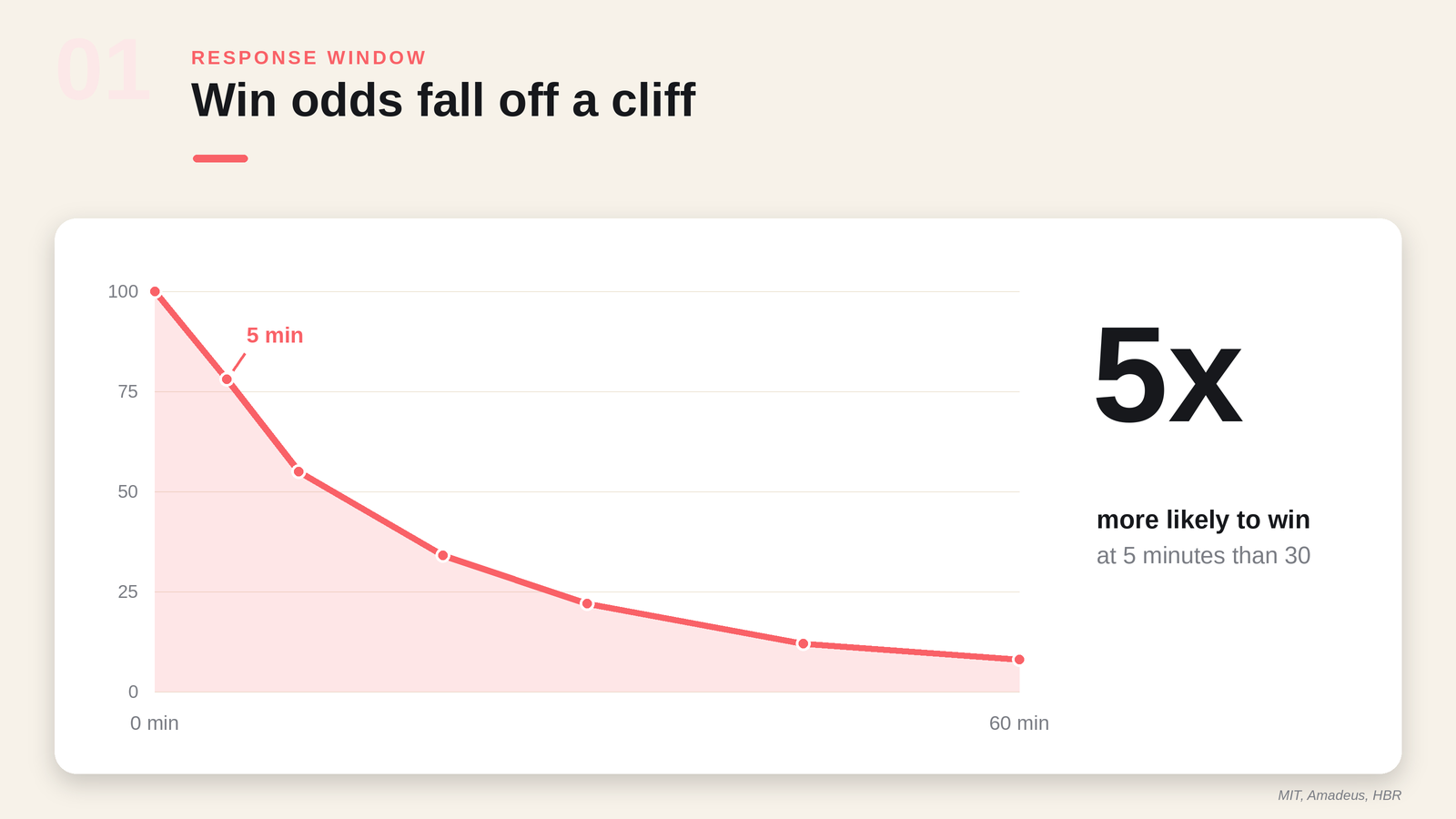
Why are hotel sales teams so slow to respond?
Because the response is not one task, it is a chain. A dual-role manager has to notice the RFP, gather missing details, look up live pricing across systems, build a proposal from a template, and update the CRM. Each handoff leaks time, and the person doing it is usually also running operations.
Slow responses are almost never a motivation problem. They are a structure problem. The typical sales manager wears two hats, sales and operations, and the RFP lands while they are covering the floor. Then the real delay begins:
- Noticing. RFPs arrive scattered across Cvent, email, phone, web forms, and CVB portals. Hours are lost simply spotting that a new one came in.
- Gathering. Event dates, attendee counts, room-block needs, and F&B details arrive incomplete, so the rep chases the planner before they can even start.
- Pricing. Live rates and availability live in Opera, Delphi, or a spreadsheet, and often need revenue-management sign-off.
- Building. The proposal is reformatted from scratch, one prospect at a time.
Meanwhile, Salesforce finds salespeople spend only about 29% of their time actually selling. The rest is the admin tax described above.
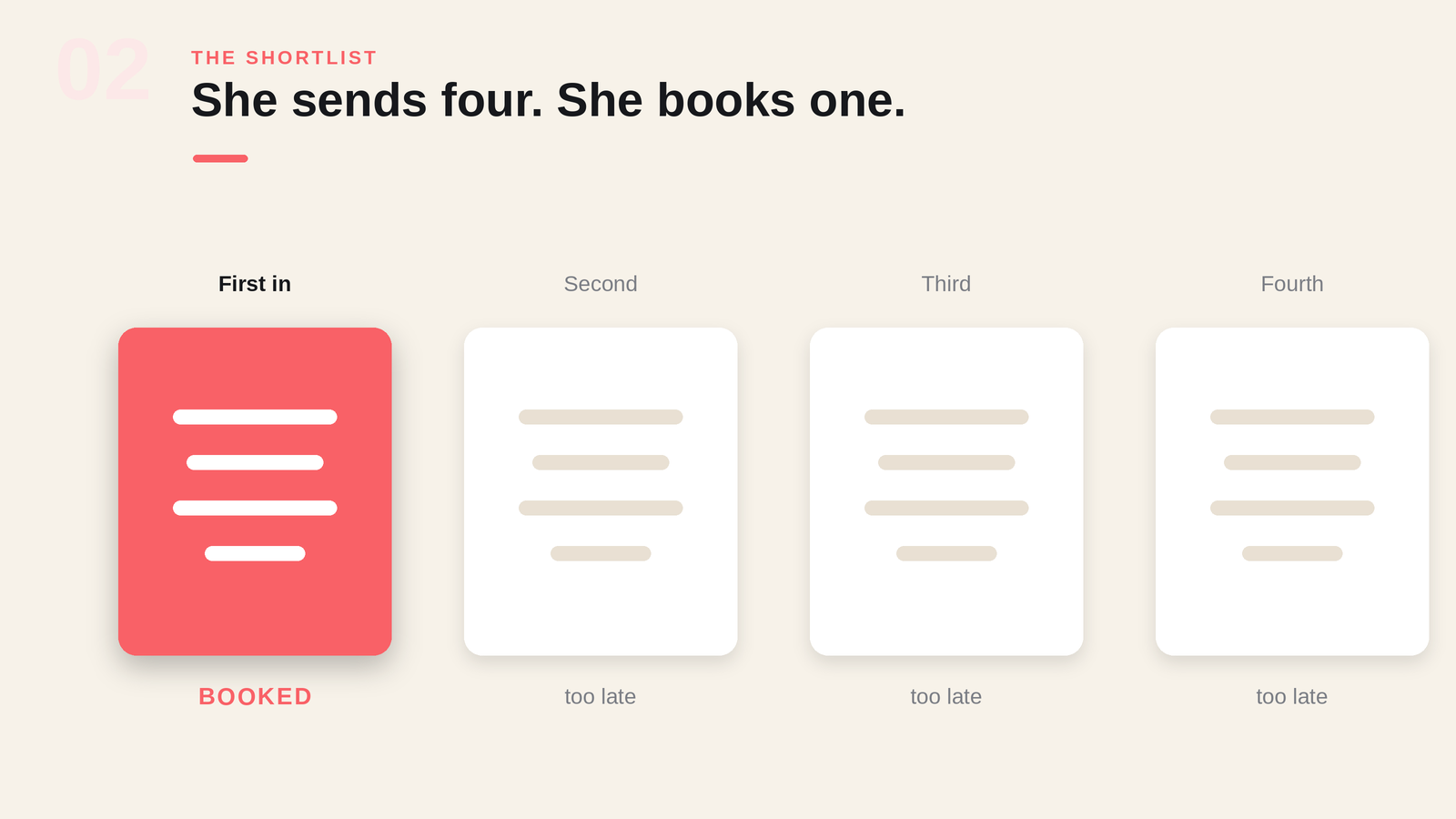
What does a slow first hour actually cost?
Enough to change your year. If you receive 100 RFPs a month at an $8,000 average deal value, and responding within 24 hours lifts your win rate by roughly 3.5 points, that is close to $19,600 in recoverable revenue every month, or more than $235,000 a year lost purely to slow replies.
Back-of-the-envelope math makes the leak visible. Harvard Business Review audited 2,241 US companies and found the average response time to a web lead was 42 hours, with 23% never responding at all. On the hotel side, Groups360 platform data has shown that a large share of hotel RFPs go completely unanswered. Every unanswered RFP is not a lost bid, it is a deal that never entered your pipeline, and if those leads cost marketing money to generate, it is wasted spend on top of lost revenue.
What do the hotels that win the first hour do differently?
They treat response time as a tracked KPI, not a vibe. The top performers use dedicated sales coverage, template-based proposals with pre-approved pricing, and a defined response SLA with alerts the moment an RFP lands. They remove the manual steps between RFP arrives and proposal sent.
The pattern is consistent. Winning teams stop treating the RFP response as an artisanal effort and start treating it as a repeatable operation. They map their four-stage response chain, find the bottleneck, and automate it. They know their first-three-responder rate the way they know their RevPAR. Our deep dive on speed-to-lead and the first-responder advantage breaks down the psychology of why the first complete proposal anchors the planner's entire evaluation.
You can also read how Wyndham Indianapolis West took its RFP response from 33 minutes to 5 and hit 100% Cvent capture within SLA.
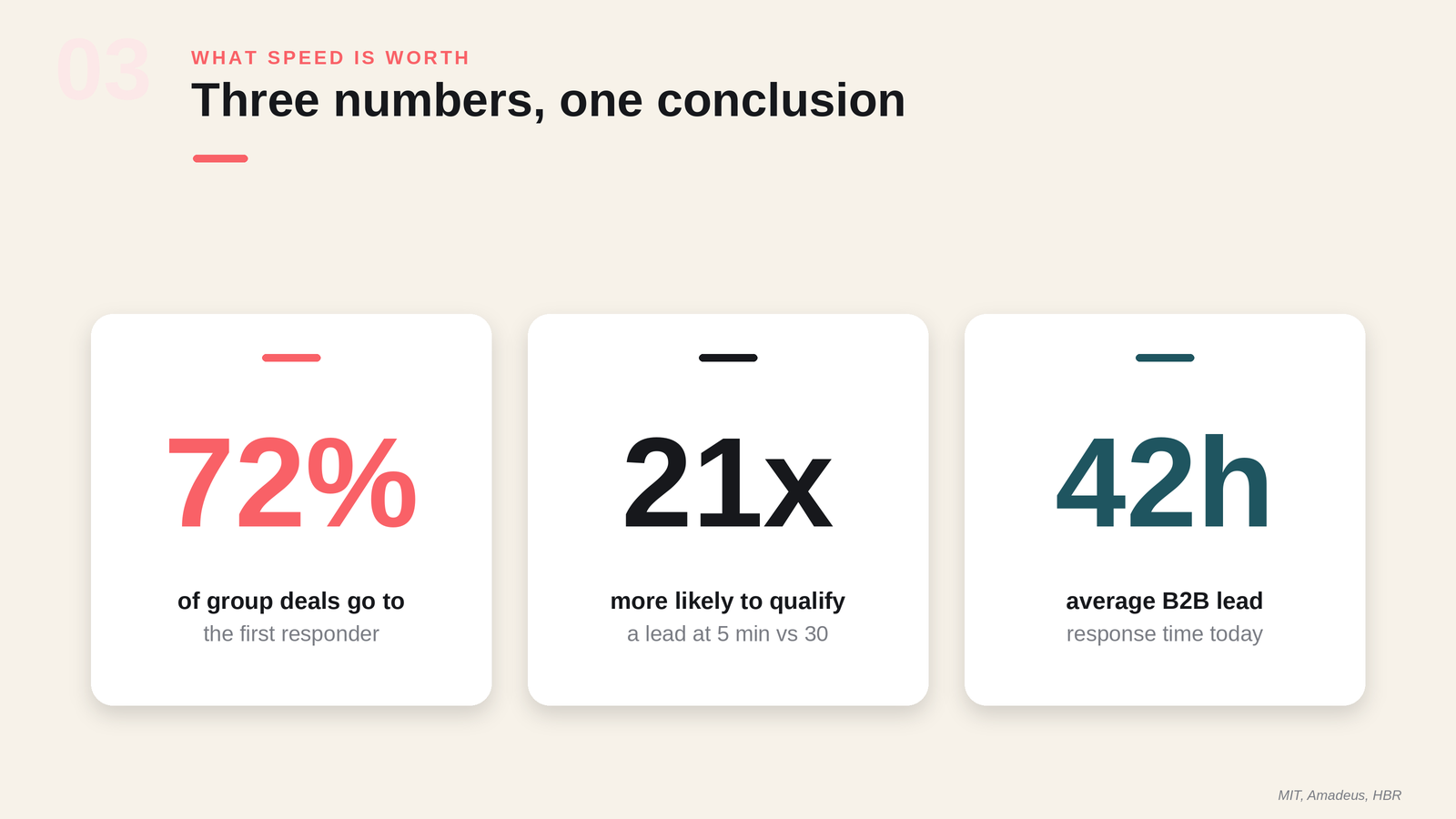
How does automation cut response time without replacing the salesperson?
It removes the mechanical work, not the human one. AI can capture the RFP the instant it arrives, fill in missing event details, pull live pricing, and draft a complete proposal in minutes, so the salesperson spends their time on relationship, negotiation, and the final call instead of data entry and formatting.
This is the core idea behind Hippo Rev. The Lead Catcher Agent captures every inquiry across channels, and the RFP Response Agent gathers missing details and generates a branded proposal with accurate pricing, often taking a 45-minute manual scramble down to under five. The judgment stays human. The drudgery disappears.
As Hippo Mate puts it: "Take your coffee. I've got the first hour."
You do not have to be the best hotel on the shortlist to win. You have to be the first complete, professional answer in the planner's inbox. Speed gets you in the room. Everything else you are already good at.
See how Hippo Rev handles the first response in under three minutes, even after hours.
Frequently Asked Questions
What is the 60-minute rule in hotel group sales?
It is the working benchmark that a complete first response to a group RFP should go out within the first hour of arrival. Research shows first responders win the majority of deals, so the practical goal is to be the first hotel with a professional proposal in the planner's inbox.
Does responding faster really beat responding better?
The two are not in conflict. Planners define a quality response as accurate, complete, and fast. A first proposal that answers their specific questions anchors the comparison, and later responses are judged against it. Speed and quality reinforce each other, as covered in the speed vs quality myth.
How can a small sales team respond to RFPs faster?
By removing manual steps rather than adding people. Automated intake, missing-detail collection, live pricing lookup, and template-based proposal generation let a lean team respond in minutes. That is the workflow Hippo Rev is built to run.
The Group Sales Proposal Is Broken | Hippo Rev
The standard hotel proposal is a static PDF with no interactivity and no tracking. Meanwhile planners compare four to six properties at once, and the most engaging proposal wins a disproportionate share.
The Group Sales Proposal Is Broken. Here Is What Winning Hotels Do Instead
You sent a 12-page PDF proposal on Tuesday. The planner opened it on Thursday, looked at page one for eight seconds, and booked your competitor. You never knew any of that happened, because a PDF tells you nothing after you hit send.
The PDF proposal is the default in hotel group sales, and it is quietly costing deals. In demos with directors of sales and event-sales managers, the same limitations came up again and again. The proposal is static, one-size-fits-all, invisible after it leaves the outbox, and easily lost in an email thread. Planners, comparing several properties simultaneously, reward the one that gives them the most useful, engaging experience, and a flat attachment rarely wins that comparison.
What is wrong with the standard PDF proposal?
It is a dead end. A PDF is static, so the planner cannot explore the space. It carries no engagement data, so you never know if it was opened, read, or shared. It is generic, so it treats a wedding and a corporate offsite the same. And it disappears into an inbox with no way to resurface at the right moment.
The core problem is that the PDF gives you nothing back. In every other part of the buying journey, the planner leaves signals. The proposal, the single most important document in the deal, is a black box the instant it is sent. You are flying blind at the exact moment you most need to know whether to follow up.
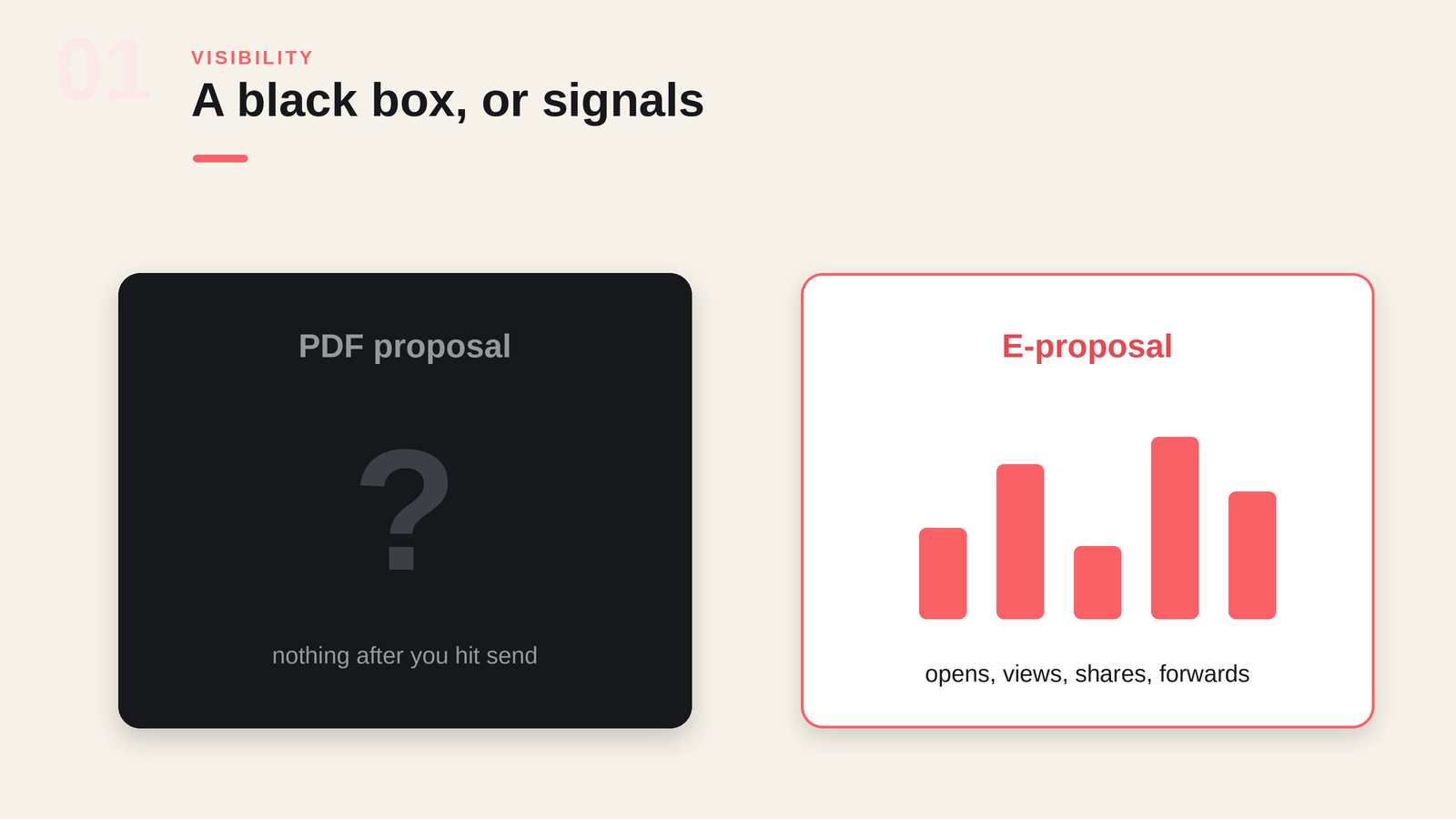
What do planners actually want to see in a proposal?
Proof you understand their event. Planners want capacity and flexibility, a genuine visual sense of the space, the technology and AV they will rely on, transparent pricing, and speed. Above all they want to feel the response was built for their specific event, not pulled from a folder of templates.
Planners are not asking for more pages. They are asking for relevance and clarity. A proposal that shows the actual room set for their headcount, answers their specific AV question, and arrives while their intent is high will beat a longer, prettier, generic document every time. This is the same insight behind the speed vs quality myth: to a planner, a fast, accurate, tailored response is the definition of quality.

What can an interactive e-proposal do that a PDF cannot?
It turns a document into an experience you can measure. An e-proposal embeds virtual tours and video, shows real-time availability, offers shareable links, and reports engagement analytics, so you can see when the planner opened it, what they viewed, and who they forwarded it to. That visibility tells your team exactly when and how to follow up.
The engagement gap is the unfair advantage. When you know a proposal was opened twice this morning and the video tour was watched to the end, your follow-up stops being a guess and becomes a timed, informed move. Stakeholder detection can tell you the moment a decision-maker, not just your original contact, opens the deal. This is the logic of the Engagement Agent and the wider Convert layer.
- Embedded virtual tours and video so the planner experiences the space, not just reads about it.
- Real-time availability instead of a rate that may be stale by Thursday.
- Engagement analytics that show opens, views, and shares.
- Shareable links that survive the email thread and reach the whole buying committee.
- Branded templates per event type for corporate, wedding, and SMERF business.
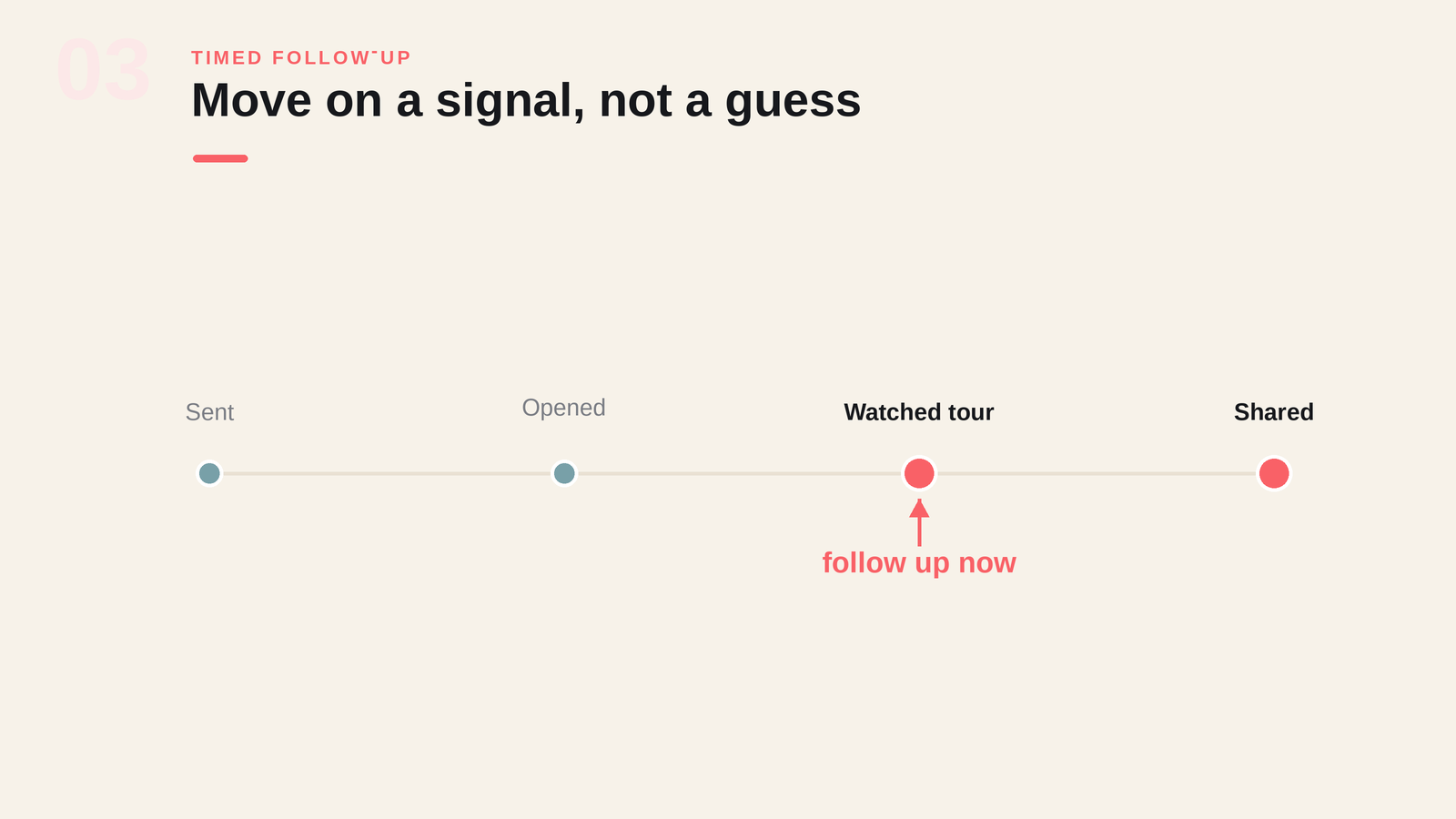
How do you personalize proposals at scale without more work?
By letting AI adapt the content to the lead. AI-generated proposal content can adjust to the event type, group size, and known preferences automatically, so every planner gets a tailored proposal without a salesperson rebuilding it by hand. Personalization stops being a time cost and becomes a default.
This is the resolution to the oldest tension in proposals: personalized documents win, but personalizing every document by hand is exactly the admin drain that eats 70% of the week. Automation breaks the trade-off. The RFP Response Agent generates a complete, event-specific proposal with accurate pricing and personalized video, at speed, so tailoring no longer competes with responding first.
What about brand compliance for chain hotels?
Standards and flexibility are not opposites. Multi-brand portfolios like Marriott, Hilton, and Fairmont can lock brand rules into the template layer, formatting, logos, approved language, while still allowing property-level customization of the space, pricing, and event detail. The brand stays consistent, and the property stays relevant.
For chains, the fear is that flexible proposals mean off-brand proposals. The opposite is true when the brand system lives in the template. Reps cannot break compliance because the guardrails are built in, and they do not want to, because the personalization they need happens inside those guardrails. Consistency and conversion stop fighting each other.
As Hippo Mate would say: "Send them something they can walk through, not something they have to squint at."
See a live Hippo Rev e-proposal, and how planners actually experience it.
Frequently Asked Questions
What is an e-proposal in hotel group sales?
An e-proposal is an interactive, web-based proposal that replaces the static PDF. It can include embedded virtual tours, video, real-time availability, and engagement tracking, and it gives the sales team data on how the planner interacts with it.
Do interactive proposals actually improve conversion?
They help in two ways. They give planners a more engaging, relevant experience that stands out in a multi-property comparison, and they give sales teams engagement signals that make follow-up timing far more precise, which lifts proposal-to-close rates.
For a real-world example of both effects, see how one Indianapolis hotel pairs 5-minute proposals with live engagement tracking.
Can chain hotels use interactive proposals without breaking brand standards?
Yes. Brand rules are enforced at the template level, so formatting, logos, and approved language stay locked while properties customize the space, pricing, and event-specific detail within those guardrails.
.png)
Hotel AI Lessons from HITEC 2026
HITEC 2026 brought more than 6,100 hospitality technology leaders together in San Antonio and shifted the conversation from AI excitement to AI accountability. This breakdown covers what actually surfaced across keynotes, startup pitches, and closed-door sessions, and what operators should do before buying the next tool.
What HITEC 2026 Actually Taught Us About AI in Hospitality
Introduction
Here's a number worth sitting with: 360 companies, 83,000 square feet of exhibit space, sold out. Not "mostly full." Sold out. More than 6,100 people showed up in San Antonio for HITEC 2026, and if you've been to a few of these shows over the years, you know that scale alone doesn't make a conference matter. What made this one matter was the conversation underneath the conversation.
For the last couple of years, hospitality tech events have followed a predictable script: someone says "AI" on stage, the room nods, everyone goes back to their booth and slaps "AI-powered" on a banner. HITEC 2026 broke that script. The question on everyone's mind wasn't will AI change hospitality. That debate is over. The real question — asked bluntly, on stage and at the bar — was: which parts of this AI wave are actually real, and which parts are just expensive automation wearing a costume?
That question showed up everywhere. In Oracle's own admission that they don't yet have a clean way to prove AI's value. In a HotelKey executive flatly saying that moving water bottles is not a job for AI. In a closed-door room of hotel CIOs who, for 90 minutes, talked without anyone trying to sell anything. This piece pulls together everything that surfaced across the week — the keynotes, the startup pitches, the booth conversations nobody planned to have — into the ideas that actually matter if you're building, buying, or operating in this space.
The Big Idea Running Through Everything
If you remember nothing else from this article, remember this: AI is no longer a feature. It's becoming infrastructure. And infrastructure gets judged differently than features do. A feature gets forgiven if it's a little rough around the edges — you're trying something new, fair enough. Infrastructure doesn't get that grace. If the plumbing breaks, nobody cares how innovative the pipes were.
That's the lens for everything that follows. Five things stood out as the real story of the week:
- AI is moving inside the tools hotels already use, not living next to them as a separate app.
- The industry is finally willing to ask, out loud, "is this actually AI, or just automation with better branding?"
- Your data — how clean, accurate, and well-structured it is — is quietly becoming your biggest competitive advantage or your biggest liability.
- Nobody agrees on who wins the next distribution war: independent hotels, big brands, or the OTAs. And that disagreement is itself important.
- Even with all this automation, the humans didn't get pushed out of the room. They got pushed into a different, more important seat.
Let's walk through each one, because each one comes with a story that makes it click.
AI Is Sneaking Into the Plumbing, Not Standing at the Front Door
Think about how you actually use technology at work. Do you love opening a new app for every single task? Of course not. You tolerate it when you have to, but the tools that actually become part of your routine are the ones that show up inside the software you already have open.
That's exactly the pattern HITEC 2026 made impossible to miss. Oracle didn't launch a separate "AI app" that hotel staff need to learn. They built the OPERA Cloud Assistant directly into OPERA Cloud — the system front desk, revenue, and operations teams are already living in all day. It helps assign rooms intelligently, writes rate descriptions, and lets staff ask plain-language questions about procedures instead of digging through a binder. The thinking here is simple and smart: hotel teams don't need more places to look. They need fewer, faster, and more consistent ones.
The startups on the E20X stage told the same story from a different angle. Altek AI, a team out of Oslo, built software that reads an incoming guest email, works across the PMS and booking systems in the background, and drafts a reply — turning what used to be ten minutes of tab-switching into about thirty seconds. Lobby does something similar for the messy 70% of reservations that involve group requests, contracts, and invoices bouncing around in email and PDFs — it sits quietly between the inbox and the PMS, doing the unglamorous work nobody wanted to automate because it seemed too tangled to touch.
Here's the rule worth remembering: the AI tools winning right now are the ones that disappear. Not literally — they're doing real work — but in the sense that nobody has to change their habits to benefit from them. If a vendor is pitching you on a brand-new interface you'll need to train your team on, ask yourself why it isn't living inside the system you already pay for. Sometimes there's a good answer. Often, there isn't.
"Wait — Is That Actually AI?"
This is the question that gave the week its edge, and it came from people you'd expect to be cheerleading for the technology, not interrogating it.
Fareed Ahmad from HotelKey put it about as plainly as anyone could. Payment automation, he said, is rule-based — if X happens, do Y — and it shouldn't be marketed as AI just because it's automated. But deciding whether a returning guest who had a bad experience last time deserves an upgrade this time? That's a judgment call based on messy, incomplete information. That's the real thing. He went further, splitting guest recognition the same way: the CRM and loyalty system decides what a guest should get, and the PMS just carries it out — because, as he put it, "AI isn't going to move the water bottles."
This wasn't a one-off comment. A separate panel — engineers and vendors talking through how AI handles maintenance and work orders — landed on almost identical language. The real AI, one of them said, is helping a stressed, possibly inexperienced front-line employee describe a broken thermostat without making them fill out a confusing form; the system just asks the right follow-up questions and routes the problem correctly. The hype is the idea that you can hand an AI agent the entire workflow and no longer need a facilities manager. Nobody on that panel believed that was close to happening, and they were the ones building the tools.
Even Oracle, mid-keynote, was refreshingly honest about this. They've built around 50 different agentic tools, with several already live in real hotels. But when asked about the payoff, their own team admitted: cloud computing had an obvious, sellable value story. AI doesn't — yet — because nobody has the results to point to that would show everyone else exactly how to capture that value.
Think of it like the difference between a calculator and a doctor. A calculator is fast and reliable because the problem is fully defined — there's one right answer, and the machine finds it instantly. A doctor is valuable precisely because the problem usually isn't fully defined — symptoms are ambiguous, histories are messy, and judgment fills the gap. A lot of what's being sold as "AI" in hospitality right now is really just a very fast calculator with a friendlier interface. That's not nothing. Speed has value. But it's not the same thing as judgment, and conflating the two is how budgets get wasted.
The practical move: before you sign anything, ask the vendor to walk you through one specific decision the system makes. If the answer is "it follows this rule," you're buying automation — which is fine, just price it like automation. If the answer involves weighing ambiguous, conflicting information the way a person would, you're buying something closer to real AI. Both are useful. Only one of them deserves the premium.
Your Data Is Either Your Best Asset or Your Biggest Liability — And Most Hotels Don't Know Which
Here's a thought experiment. Imagine a guest asks ChatGPT or Gemini whether your hotel has a rooftop pool, what time check-in is, and whether you allow pets. The AI doesn't call your front desk to ask. It pulls from whatever scattered, possibly outdated information about your property exists online — your website, a listing site, a review from three years ago, a directory that hasn't been updated since before the renovation. If that information is wrong, the AI doesn't know it's wrong. It just answers confidently. And the guest believes it, because why wouldn't they?
This is the quiet crisis nobody saw coming, and three completely separate parts of HITEC 2026 converged on it independently — which is exactly why it's worth paying attention to.
First, HFTP itself is building a formal industry standard for how hotels structure their data, specifically so AI systems can find, interpret, and represent a property's offerings accurately. That's not a small administrative project. That's an industry-level acknowledgment that this is now a foundational problem, not a nice-to-have.
Second, a startup called Bonafide pitched exactly this problem on the E20X stage, and the founder shared a number that should make every GM a little uncomfortable: hotels typically start with about a third of their facts misaligned across the sources AI assistants pull from. A third. Clean that up, and accuracy jumps past 80%. Think about what that means in practice — roughly one in three things a curious traveler's AI assistant tells them about your hotel right now is probably wrong, and you have no idea which third.
Third — and this is the part that connects everything — Frank Trampert from Revinate pointed out that AI models actually distrust a brand's own marketing copy. They lean on guest reviews instead, because reviews are real experiences shared by real people, not curated brand language. That's a fascinating inversion: the words you spent the most money polishing are the words the AI trusts the least. The messy, unfiltered guest review you've been quietly managing for reputation reasons is, to an AI system, the more credible source.
Put those three things together and you get a genuinely new competitive idea: being "AI-legible" is becoming its own competitive advantage, separate from being good at hospitality. You can run a wonderful hotel and still lose bookings to a mediocre one next door simply because the AI assistant a traveler is using describes your competitor more accurately and more favorably. That's a strange new kind of unfairness, and it's not going away.
The takeaway: before you spend another dollar on AI tools, spend a few hours auditing what AI systems currently say about your property. You might not like what you find. And start treating your guest reviews less like a reputation chore and more like the raw material AI systems use to decide whether you exist.
Nobody Agrees Who Wins the Next Distribution War — And That Disagreement Is the Real Story
If there was one moment at HITEC 2026 that felt like watching two smart people genuinely disagree about something that matters, it was this.
On the headliner stage, Floor Bleeker from In2 Consulting made a bold case: AI is going to "change everything," and it'll hurt the big brands the most. His logic — big hotel chains currently benefit from a distribution system built around their scale. If AI-powered discovery routes around that system, the advantage of being big partially evaporates, and brands get pushed back toward competing the old-fashioned way: by actually delivering a great guest experience, because that's the one thing AI can't fake for them. "They'll have to go inside the hotel again," he said, which is a great way of putting it — like the curtain gets pulled back and suddenly the actual product matters more than the marketing around it.
Other panelists weren't so sure things would move that fast. Lennert de Jong thought loyalty programs specifically would shift — AI making it easier to book within a loyalty relationship — but that most of hospitality would stay recognizably the same. Wyndham's Scott Strickland zoomed in on something concrete: right now, if you're chatting with an AI assistant about a trip, you have to leave that conversation and go to a brand's website to actually earn your loyalty points. That friction won't last. Once it disappears, bookings might happen entirely inside the AI conversation itself — which means brands need to be paying very close attention to which AI platforms guests are actually using, the same way they once had to pay attention to which search engines and travel sites mattered.
Then, separately, on the show floor — not on a stage, just in a booth conversation — Natalie Kimball from Shiji said something that should make every independent hotel owner sit up. Her view: the OTAs have already won this fight, the same way they won search years ago, because individual hotels simply can't outspend an OTA to stay visible in an AI-powered discovery layer. She thinks the window to prevent that outcome has already closed. Her specific prediction is worth writing down: she expects OTAs to introduce a new, higher commission tier specifically for AI-agent-driven bookings — maybe 20% instead of the current roughly 15% — the same way bundled vacation packages already cost hotels more than standalone bookings. That's not a vague worry. That's a number you can watch for.
But — and this matters — Kimball also offered the one genuinely hopeful idea in the whole debate, and it connects directly back to the data point above: she believes guest reviews, in large enough volume, become exactly the kind of content AI trusts and turns into something bookable. Which means independent hotels aren't necessarily locked out. They just need to win on a different battlefield than the one they're used to fighting on — not ad spend, but review volume and review quality.
Here's the honest summary: nobody at HITEC 2026 knows for certain who wins this. And that uncertainty is itself useful information. It means the smart move isn't to wait for clarity before acting — by the time there's clarity, the window will likely have closed. The defensive moves work regardless of which future arrives: clean data, strong reviews, and real investment in direct guest relationships that don't depend on winning a bidding war for visibility.
AI Didn't Push Humans Out of the Room — It Pushed Them Into a Different Seat
There's a version of the AI conversation that gets people anxious: machines taking over, judgment becoming obsolete, humans becoming spectators in their own industry. That version did not show up at HITEC 2026. What showed up instead was something more interesting and, frankly, more reassuring.
Richard Bradberry, talking through how AI handles maintenance work orders, said something simple but important: AI is genuinely good at taking a pile of messy, disconnected information and compiling it into something a person can actually understand. What it can't do is evaluate whether the outcome was actually good. Did the repair actually fix the problem? Was the vendor relationship worth keeping? That's still a human call, every time.
Adam Tuttle made the version of this point that should worry every brand operator paying attention: if you just ask an AI system to generate your service standards for you, you'll get the same generic standards as every other hotel that asked the same question. You won't lose efficiency — you'll lose identity. The thing that makes your property feel like your property, rather than a slightly different building with the same playbook as everyone else, has to come from a human who decided what that identity should be. AI can scale a standard brilliantly. It cannot invent one worth scaling.
Keryn McNamara from Aimbridge offered the most useful forward-looking idea on this front: she expects entirely new job titles to emerge, specifically "agent supervisors" — people whose job is to oversee what the AI agents are doing and hold them accountable. That's a genuinely different prediction than the tired "robots are taking our jobs" narrative. It's closer to what happened when factories got automated: you didn't end up with zero people on the floor, you ended up with fewer people doing repetitive tasks and more people watching, calibrating, and catching the mistakes the machines couldn't see themselves making.
AI recommends an action by checking it against the standards a hotel has already written down, and a human verifies the recommendation before anything happens. The real win isn't replacing the person. It's making the loop between recommendation and action so fast that the work actually gets done before the guest even notices there was a problem.
So the honest picture isn't "AI versus humans." It's AI handling the parts of the job that were always more mechanical than they felt — sorting, compiling, drafting, routing — while humans hold onto the parts that were always more human than they looked: judgment, identity, and accountability. That's not a smaller role for people. In a lot of ways, it's a more important one, because it's the part of the job that's harder to fake.
The Stuff That Wasn't About AI (And Mattered Just As Much)
It would be easy to walk away from HITEC 2026 thinking the entire show was an AI conference. It wasn't, and some of the most useful announcements of the week barely touched the topic.
Take tipping. It sounds almost too simple to be a real problem, but think about it: fewer guests carry cash than ever, and gratuity has always depended on cash being available. Housekeepers, valets, and spa staff have quietly been losing income not because their service got worse, but because the payment habits of travelers changed underneath them. Tipmo solved this with something refreshingly low-tech — an NFC tag a guest taps with their phone to tip instantly through Apple Pay or Google Pay, no app required. Sometimes the most important fix isn't artificial intelligence. It's just removing a piece of friction that's been quietly costing real people real money.
Group and event sales had a similar story. Hotel sales teams drown in inquiries — some serious, many not — and spend hours sorting through them while the genuinely good leads sit in the same queue as the dead ends. Canary's Agentic Sales Coordinator doesn't try to close the sale. It just gets the sorting right, so a human salesperson spends their limited time on the leads actually worth chasing. That's a smaller, less flashy promise than "AI sells your rooms for you" — and it's exactly why it's more believable.
And then there's the loyalty problem independent hotels have always quietly resented: a 35-room boutique property with a couple hundred annual repeat guests simply doesn't have enough transaction volume to make a points program feel meaningful to anyone. Cloudbeds and Journey's new partnership pools guest relationships across many independent properties at once, so those same loyal guests suddenly have redemption options across markets they might actually visit. It's a clever fix for a real structural disadvantage — though it comes with an honest risk worth asking about before signing up: if your brand voice gets buried inside someone else's shared loyalty interface, are your guests loyal to you, or just collecting points in a program that happens to include you?
What To Actually Do With All This
If you operate, build, or invest in this space, here's the practical version of everything above:
Check your own data before buying anything new. Search for your hotel the way a guest using AI would. If a third of what comes back is wrong — and statistically, it probably is — that's the first fire to put out, not the tenth.
Ask vendors the HotelKey question. Is this system making a judgment call with incomplete information, or following a fixed rule? There's nothing wrong with buying smart automation. Just don't pay an AI premium for it.
Literally call your own front desk during a busy shift. See what actually happens. The friction you notice as an insider is the friction your best guests are quietly absorbing every day.
Write your standards down before you hand anything to AI. AI will scale whatever standard you give it — including a vague or mediocre one. Garbage in, scaled garbage out.
Start treating reviews as discovery infrastructure, not just reputation management. AI systems trust them more than your marketing copy. That alone should change how seriously you take them.
Watch for the OTA agentic commission tier. It's a specific, testable prediction. If it shows up, it'll tell you a lot about how the distribution fight is actually going.
Think now about who "supervises" your AI tools. Someone needs to own the gap between what the system recommends and what actually happens. That role barely exists yet on most org charts. It will.
Don't sleep on the boring fixes. Cashless tipping, smarter lead sorting, pooled loyalty — none of it requires a leap of faith in unproven AI judgment, and all of it solves a real, specific, currently-costing-you-money problem.
The Bottom Line
The most useful thing that happened at HITEC 2026 wasn't a product launch. It was a shift in posture. The industry stopped asking whether AI matters — that question is settled — and started asking the much harder, much more useful question: which parts of this actually work, who benefits when they don't, and what do we lose if we move faster than our own standards can keep up with?
The hotels and companies that come out ahead from here won't be the ones with the longest list of AI tools bolted on. They'll be the ones who got their data right before chasing the next feature, who kept brand identity and guest judgment in human hands even as everything around them got faster, and who demanded proof instead of accepting promises.
Next year, the question worth asking every vendor on the floor won't be "what does your AI do?" It'll be simpler, and harder to dodge: "show me the result." That's the bar the whole industry quietly agreed to at HITEC 2026, whether everyone realizes it yet or not.
A Closing Thought on Execution
With Hippo Rev, A few threads from this week tie together more than they first appear to.
Hippo Rev's agents qualify, price, and draft, but every proposal still gets reviewed by a seller before it leaves — judgment stays human, the way Adam Tuttle insisted it should.
The "AI sits inside your existing tools" pattern is noted too: Hippo Rev reads and writes across the PMS, RMS, and Cvent stack hotels already run, rather than asking anyone to learn something new.
A lot of what Canary's sales coordinator tackled on stage — messy inbound, slow qualification, good leads buried under bad ones — is the same execution gap showing up across the industry's group sales desks generally. Hippo Rev solves this, crossing the gap between inbox, Cvent, PMS, and RMS before a seller even wakes up.
On distribution, the fix is less about winning a visibility war and more about not losing deals already in hand — Hippo Rev ensures capturing every inquiry across all possible-odd channels group business arrives through, instead of letting a third of RFPs die unanswered before a seller sees them.
And on follow-up, the same discipline follows — it gets handled structurally, with engagement tracked and follow-ups triggered automatically. None of it replaces the seller. It just clears the inbox they were drowning in, so the part of the job that was always human — reading the room, building the relationship, closing with empathy — gets the time it actually needs.
Key Takeaways from HSMAI 2026
HSMAI 2026 brought commercial leaders together across four regions with one recurring problem: hotels running on fractured forecasts, misaligned departments, and the wrong metrics. This breakdown covers what smart operators are actually doing differently on AI, loyalty, profit measurement, and group sales execution.
HSMAI's 2026 Event Insights
HSMAI’s 2026 event list has been interesting & insightful: San Antonio for the Americas flagship, Marina Bay Sands in Singapore for Asia Pacific, The Savoy in London for Europe's kickoff, plus a string of smaller forums and roundtables in Lisbon, Madrid, Paris, Amsterdam, and beyond. Different cities, different accents in the room, but sit through enough of these sessions across regions and you start noticing something: the same handful of ideas kept surfacing.
That's usually a sign something real is happening, not just a trend someone's trying to manufacture.
The official theme was "aligning people, technology, and data," which is the kind of phrase that goes in one ear and out the other at any conference. But sit through enough sessions and you realize the phrase was actually describing something specific: the walls between sales, marketing, and revenue management are coming down. Not because some consultant told everyone to knock them down, but because the data, the forecasts, and increasingly the AI tools all require it. The org chart is catching up to how the work already happens.
Here's what I took away from watching smart operators wrestle with that reality.
The Big Idea Underneath Everything Else
Picture a hotel where the sales team has one forecast for next month, the marketing team has a different one, revenue management has a third, and the general manager has a gut feeling that overrides all three when budget season comes around. Every department's forecast is reasonable on its own terms. None of them agree with each other.
This isn't a hypothetical. It's apparently how most hotels actually run.
Anders Johansson, who's been doing revenue management since the late 1980s, calls this the "seven futures problem," and his framing stuck with me: every commercial decision a hotel makes is a bet on future demand. Pricing is a bet. Staffing levels are a bet. Marketing spend is a bet. So when seven different people are placing seven different bets based on seven different guesses about the future, you don't get a coordinated strategy. You get seven small disagreements compounding into one big mess.
Johansson built a five-level scale to describe where hotels land on this. At the bottom, Level 0, there's no real forecast at all, just gut feel and last year's budget copy-pasted forward. At the top, Level 5, everyone in the building, sales, marketing, revenue, food and beverage, even housekeeping, is looking at the same real-time number. Most hotels, he says, sit somewhere uncomfortably in the middle: each department has built a genuinely solid forecast, but nobody's ever forced those forecasts to agree with each other.
That gap matters more than it sounds like it should. A forecast isn't just a planning document. It's the foundation everything else gets built on. Get it wrong, or get three different wrong versions of it, and the cracks show up everywhere downstream: in pricing that doesn't match demand, in staffing that doesn't match occupancy, in marketing campaigns that launch the week revenue management quietly drops rates.
This theme didn't stay in one session. In the opening keynote, Heidi Gempel talked about revenue leaders today being expected to "explain uncertainty with confidence," which is a brutal ask when you think about it. You're supposed to sound certain about things you're not certain about, because the patterns that used to be reliable, aren't anymore, and the new patterns haven't stabilized yet. Different speaker, same root problem: too many people trying to read a future that keeps refusing to hold still.
AI Isn't One Thing. Stop Treating It Like One.
Here's a distinction that should be obvious but apparently isn't: not all AI does the same job, and conflating them is costing hotels real money.
Tracy Dome broke it into three buckets, and once you hear it, you can't unhear it:
Generative AI is the stuff everyone already knows. It writes your emails, summarizes your meetings, makes you faster at tasks you were already doing.
Agentic AI actually takes action on your behalf. It doesn't just suggest, it executes. Most hotels are still in the experimenting phase here, which makes sense, because handing over the keys is scarier than getting suggestions.
Mathematical AI is the quiet one nobody's excited about, but it's been running revenue management systems for decades, well before anyone started calling things "AI" in marketing copy. It's not answering questions in plain English. It's solving an optimization problem: what's the right price, given this demand, this inventory, this moment.
Dome's line on this was the sharpest one of the conference: "revenue management is not a language problem, it's a mathematical optimization problem." Generative and agentic AI make you faster at your job. Mathematical AI actually makes the decision better. Those are not the same achievement, and right now, most of the industry's excitement is pointed at the first two while the third one, the one that actually moves pricing and revenue, gets treated like old news.
A different session, on the guest journey, made a related point from a totally different angle. The speaker's argument: the winning hotels won't be the ones that bolted on an AI chatbot somewhere. They'll be the ones where AI runs underneath the entire guest journey like plumbing, invisible, connected, doing its job from the moment someone starts dreaming about a trip through the moment they leave a review and even afterwards.
Think about it like the difference between adding a smart thermostat to your house versus rewiring the whole electrical system to be smart from the studs out. One is a gadget. The other changes what the house can do. Most hotels right now are buying gadgets.
Stop Counting Heads in Beds. Start Counting Profit.
This was the line that got repeated, almost verbatim, across at least three different sessions: stop measuring rooms, start measuring profit.
Here's the problem with occupancy as your scoreboard: it rewards filling rooms, period, without asking what it cost you to fill them or whether the people in them spent another dollar once they arrived. A hotel running 95% occupancy by giving rooms away at a loss isn't winning. It's just busy.
The speakers laid out a kind of ladder of metrics, each one a little more honest than the last. RevPAR (revenue per available room) ignores food, beverage, spa, everything except the room itself. TRevPAR pulls in those other revenue streams. Net RevPAR goes further and subtracts what it actually cost you to land that guest, the commissions, the acquisition spend. And profit per available room is the number that finally tells you the truth: not how busy you were, but how well you actually did.
Here's the kicker, illustrated with a comparison that made the room go quiet for a second: two hotels can post identical performance against their competitive set, the same RevGI, the same market share, and have wildly different profitability. One of them is simply better at getting guests to spend money once they're inside the building. Same scoreboard, completely different game.
Brian Hicks backed this up with numbers that put the shift in perspective. Back in 2011, ancillary revenue, everything outside the room rate, was under 1.7% of total hotel revenue. Today it's tracking toward 10-30%. Meanwhile ADR has basically gone sideways against inflation. So if you're only growing the line you've always grown, you're not really growing. The actual growth has moved to a different part of the building.
CoStar data shown elsewhere at the conference made this visual: RevPAR softening through 2025, food and beverage revenue climbing the whole time, with that gap expected to widen further once the FIFA World Cup and the 2028 LA Olympics start pulling in international demand.
So how do you actually capture that ancillary money? Two things, repeated by nearly everyone who touched the topic: total visibility (everyone, including housekeeping, looking at the same data) and genuine buy-in across departments, with the GM driving it. One speaker put it plainly: ancillary programs "die on the vine" the moment it becomes a commercial-team-only initiative and operations isn't pulled in.
The housekeeping example is the one I keep coming back to. Housekeepers spend more face-to-face time with guests than almost anyone in the building outside the front desk. A housekeeper who casually asks "do you have dinner plans tonight?" can outperform a marketing email, because it's a real human noticing a real person at exactly the right moment. That's not a tactic you can automate. It's a culture you have to build.
Loyalty Has a Math Problem, and It's Bigger Than People Think
The loyalty panel surfaced numbers that should worry anyone running a points program. Across loyalty programs broadly, hotels, airlines, retail, roughly half of all loyalty members are inactive. The average person belongs to about 18 different loyalty programs and meaningfully uses maybe half of them. All those unredeemed points sitting on the books? That's not a quirky footnote. It's a real liability quietly accumulating.
Against that backdrop, a genuinely interesting argument broke out on stage. One panelist made the case for emotional loyalty over transactional loyalty: "I don't think loyalty these days are all about transactional. I think emotional loyalty grows member retention and extends customer lifetime value." Another panelist pushed even further, raising a question that's been hovering over the industry for a while without anyone saying it out loud: when a hotel forces you to join its loyalty program just to unlock a price, is that actually loyalty, or is it just acquisition wearing a disguise? "Is it really loyalty in its traditional sense, or are we buying membership to a degree as well?"
That question lands because most of us have lived it. You've probably joined a "loyalty" program purely to see a lower number on a hotel website, with zero intention of ever staying again. That's not loyalty. That's a price unlock with extra paperwork.
The real insight buried under all this: the hard problem isn't getting people to sign up. It's getting them to actually engage after they do. Acquisition is the easy half. Activation is the half that actually compounds into something valuable over time, and it's the half most programs quietly neglect because sign-up numbers look better in a slide deck than engagement rates do.
Member discounts and emotional loyalty aren't opposites. You can run both. But they're different levers doing different jobs, and treating a spike in sign-ups as proof your loyalty program is "working" might just mean you're really good at handing out discounts, not that you've built any actual loyalty.
AI Is Quietly Becoming a Front Door, and Most Hotels Aren't on the Mat
Here's the part of the conference that surprised me most, because it's not the AI conversation everyone's already having.
Large language models read the internet differently than people do, and that difference is starting to affect who gets found and who doesn't. One panelist made a sharp observation: AI systems don't get overwhelmed by too many options the way human shoppers do. What actually confuses them is price-value coherence, basically, does your pricing make logical sense given what you're offering. If your room categories are named inconsistently across platforms, or your pricing looks arbitrary, that creates noise an AI system can't parse cleanly. Another panelist made the same point from a different angle: pricing inconsistency now directly affects your algorithmic visibility, not just your conversion rate.
And then there was the line that genuinely made people in the room sit up: "HTML is back." Apparently, large language models read plain HTML far more reliably than content buried behind JavaScript. Which is a strange kind of poetic justice, given how much of the last decade of web design has been a race toward flashier, more JavaScript-heavy sites. Turns out the thing that impresses a human visually might be invisible to the AI that's increasingly doing the recommending.
This connects to a story a different speaker told about his own family's vacation. He asked an AI assistant for the best luxury beach hotel for a family of four with connecting rooms. Checked Instagram. Checked Google. At every single stage, his own hotel, a real, good hotel, simply wasn't there. Invisible. And here's the number that should worry you: roughly 70% of travelers reportedly make their shortlist decision before they ever reach a booking site. If you're invisible at that stage, you're not losing a sale. You never had the chance to make one.
This is the new front door, and most hotels are still polishing the door they used to have.
The Skills Gap Nobody's Talking About
A quieter but important thread ran through the conference's talent and education sessions: the next generation of commercial leaders can't afford to be specialists in just one lane anymore.
One course facilitator described something I found genuinely telling. Sales leaders who took a revenue management course came away saying it gave them a better understanding of revenue management. Revenue managers who took the same course said it clarified the sales side for them.
Financial literacy came up again and again, not as in "go become a CFO," but as in being able to sit in a room and actually follow a conversation about cost, margin, and forecast accuracy without nodding along blindly. As one speaker put it, "there's a lot of money that goes into making money," and plenty of people who came up through sales or marketing have spent their whole careers focused on revenue without ever really learning the expense side of the business they're in.
This isn't a minor HR footnote. If the commercial functions themselves are converging, sales talking to revenue management talking to marketing talking to finance, but the people inside those functions were trained to stay in their lane, you've got an organization whose structure has evolved faster than its people have. That mismatch shows up as friction in every meeting where these departments are supposed to be working from the same playbook.
What Else Is Worth Watching
A few other signals from the conference floor worth flagging, even if they didn't get a full section above:
The Middle East just got a real lesson in demand shocks. Pre-conflict projections called for 13% growth in the region. Instead, demand dropped roughly 40% on average, with huge variance from property to property. One speaker's framing was honest in a way conference speak usually isn't: "this is not a slowdown. It's really a system shock." The instinctive response, discount harder, was specifically called out as the wrong move for markets that had spent years building a premium reputation. Worth remembering the next time demand falls off a cliff: discounting your way out can undo years of positioning in a matter of months.
China's outbound recovery isn't just slow, it's structurally different now. A speaker who's tracked Chinese outbound travel for over a decade made the point that most of the industry only thinks about Chinese travelers from the moment they land, completely missing the much bigger domestic tech and lifestyle ecosystem shaping their decisions before they ever book a flight. He flagged 2026 as a breakout year for Chinese consumer technology, including humanoid robotics, moving outbound alongside travelers. That's a signal worth tracking even if it feels distant right now.
Two enormous sporting events are coming, and the upside is bigger than room nights. The FIFA World Cup is expected to bring over 5 million international visitors to the US, and the 2028 LA Olympics are on the horizon after that. Both were specifically tied to ancillary and food-and-beverage revenue growth, not just occupancy. The opportunity isn't just selling more rooms. It's selling more of everything else, too.
So What Do You Actually Do With This?
Strip away the panel titles and slide decks, and here's what I'd actually act on if I were running a property right now:
Find out how many forecasts you're really running. If sales, marketing, and revenue management each have their own number that nobody's reconciled, you're stuck in the messy middle of that five-level scale, no matter how confident any individual forecast looks.
Sort your AI spending into the three buckets, generative, agentic, mathematical, and be honest about where the money's going. If it's all flowing toward the flashy, visible stuff while the mathematical engine that actually drives pricing decisions gets ignored, you're optimizing for demos, not results.
Swap your headline metric. If occupancy and ADR are still leading your board deck, you're reporting on a measure that's been quietly losing relevance for over a decade. Lead with TRevPAR or net RevPAR instead, and start tracking ancillary spend per guest.
Pull operations into the revenue conversation, literally. Give the whole property, including housekeeping, a simple shared number to rally around. Not a dashboard nobody opens. Something as dumb-simple as a thermometer everyone can glance at and understand.
Look at your pricing the way a machine would. Confusing room names, inconsistent pricing across channels, these aren't just annoying anymore. They're now an actual visibility problem in a world where AI systems are doing some of the recommending.
Split your loyalty metrics into two columns: acquisition and activation. Weight activation heavier. A surge in sign-ups driven by a gated discount isn't loyalty growth. It's just a price unlock wearing a costume.
Hire and train for range, not just depth. A little financial fluency for your sales and marketing people. A little commercial fluency for your revenue managers. The goal isn't to make everyone a generalist. It's to make sure nobody's stuck speaking a language the rest of the team can't follow.
Write your demand-shock playbook before you need it. The instinct to discount when things get scary is almost always the wrong first move. Decide that now, while you're calm, not later, while you're panicking.
The Thread That Ties It All Together
Pull back far enough, and everything at this conference was circling one idea: hospitality's commercial functions are being pulled together, whether by deliberate choice or by the simple gravity of shared data and shared AI tools, and the properties fighting that pull are the ones leaving money on the table.
The fractured forecast. The profit-over-occupancy shift. The loyalty programs mistaking sign-ups for devotion. The websites that are invisible to the AI assistants now doing some of the shopping for us. These aren't five separate problems. They're five symptoms of the same underlying shift: the math running underneath your revenue system, the story your loyalty program tells, the HTML structure of your website, the housekeeper who notices an empty dinner calendar, none of these are separate departments' problems anymore. They're all just inputs feeding the same number.
Worth keeping an eye on from here: whether hotels actually build that "one forecast, one truth" in practice, not just talk about it from a stage. Whether loyalty programs genuinely shift toward activation or keep leaning on the easy lever of discounting. And how fast AI-driven discovery, the assistants and agents increasingly doing the shortlisting for travelers, starts showing up in real distribution numbers instead of just conference conversation.
The next Commercial Strategy Conference lands in Orlando in June 2027. That's a reasonable deadline to check which of these ideas actually went somewhere, and which ones stayed exactly where they were this June: on a stage, getting nodded at.
Where This Is Already Playing Out
There's a real-world version of this convergence problem already playing out in group sales, where roughly a third of corporate RFPs reportedly go unanswered and most awards go to whoever responds first. Hotels already own the systems, the PMS, the RMS, the CRM, but nobody owns the motion between them, so deals stall in the same execution gap this conference kept describing. Tools like Hippo Rev exist precisely in that gap: not replacing the systems of record, but running the handoffs between them, so the forecast, the pricing, and the follow-up actually move as one coordinated effort instead of seven disconnected bets.
Group business is where the profit-over-occupancy argument gets tested hardest. A 240-room conference booking isn't just room revenue, it's catering, meeting space, and the ancillary spend that conference after conference pointed to as the real growth story.
But that upside only shows up if the proposal goes out fast, priced correctly, and gets followed through before the planner moves to the next hotel on their list. A platform like Hippo Rev, that pulls pricing straight from the RMS and keeps every proposal aligned with revenue strategy isn't just closing deals faster, it's protecting the total-revenue math this whole event was arguing for, one RFP at a time.
Can AI Increase Hotel RGI? The Revenue Math Every HMC Should See
Most arguments for sales technology are about efficiency. This one is about timing. There is a window open right now where the first management company to put AI on the sell side builds a measurable revenue advantage over its comp set, and that window is already closing.
The Window Math: Why the First HMC to Wire AI Into Sell-Side Wins
Quick answer
An illustrative 15-property hotel management company has roughly $5 to 9M in recoverable group revenue per year across inbound uplift, outbound prospecting, account re-engagement, and strategic relationships, capturable without new headcount. Because RGI is measured against a comp set, the first management company to wire AI into its sell side gains an estimated 2 to 3 point RGI advantage. That edge compresses once competitors adopt similar capability, which is why timing, not just technology, drives the decision.
Key takeaways
- Recoverable group revenue for a mid-market 15-property HMC is roughly $5 to 9M per year.
- It is demand the portfolio already has, not new demand it must create.
- First-mover sell-side AI can produce a 2 to 3 point RGI advantage over the comp set.
- The advantage is temporary; waiting forfeits the head start, not the eventual efficiency.
The number most portfolios never put on the table
Start with a portfolio you can picture: a 15-property hotel management company, mid-market and independent properties with active group business, the same DOSMs and the same headcount you have today.
Run the recoverable revenue, line by line, against published industry benchmarks.
Inbound uplift. Better win rate, sharper group ADR, and faster response on the demand you already receive. Conservatively, +$1 to 2M across the portfolio per year.
Outbound prospecting. Net-new corporate accounts and associations that nobody currently has time to chase. +$2 to 3M.
Account growth and re-engagement. Dormant clients with real lifetime value who simply never got a call. +$1 to 2M.
Strategic relationships. Deeper, expanded work with the third-party planners who already send you volume. +$1 to 2M.
Total recoverable group revenue, portfolio-wide: roughly $5 to 9M per year.
Without adding headcount. Without renegotiating brand standards. Without renovating a single property.
This is not new demand you have to go create. It is demand you already have and cannot currently capture, because the team is buried in the admin we walked through above.
That is the prize. The more important point is that it does not sit there waiting for you indefinitely.
Why this is a timing decision, not just a technology decision
Most sell-side technology decisions can wait, because the advantage they offer is permanent and equally available to everyone. This one is different, for three reasons, and all three are time-sensitive.
One: the buyers already got armed.
Cvent published its planner-facing handbook, “Mastering AI for Events,” back in 2024, and its own data shows roughly half of meeting planners now use AI to plan and execute events. The baseline expectation planners bring to every negotiation rises every month. The longer your sell side stays manual, the wider that capability gap grows.
Two: no one has armed the sell side yet.
There is no category leader who has published the sell-side equivalent of Cvent's playbook. No major incumbent has wired AI into the execution layer of group sales. The seat is empty. That will not be true for long, but it is true right now.
Three: comp sets will move, and then the advantage normalizes.
This is the part that makes it a window rather than an open door.
Whichever management company wires AI into the sell side first will respond faster, answer more RFPs, and price more consistently than its comp set, and that shows up in the rankings.
We estimate a 2 to 3 point RGI advantage for the first mover, built before the rest of the market figures out how.
Once the comp set catches up, response speed and answer rate become table stakes again, and the edge compresses back to zero.
First-mover advantage in a comp set is real precisely because it is temporary.
Where the RGI points actually come from
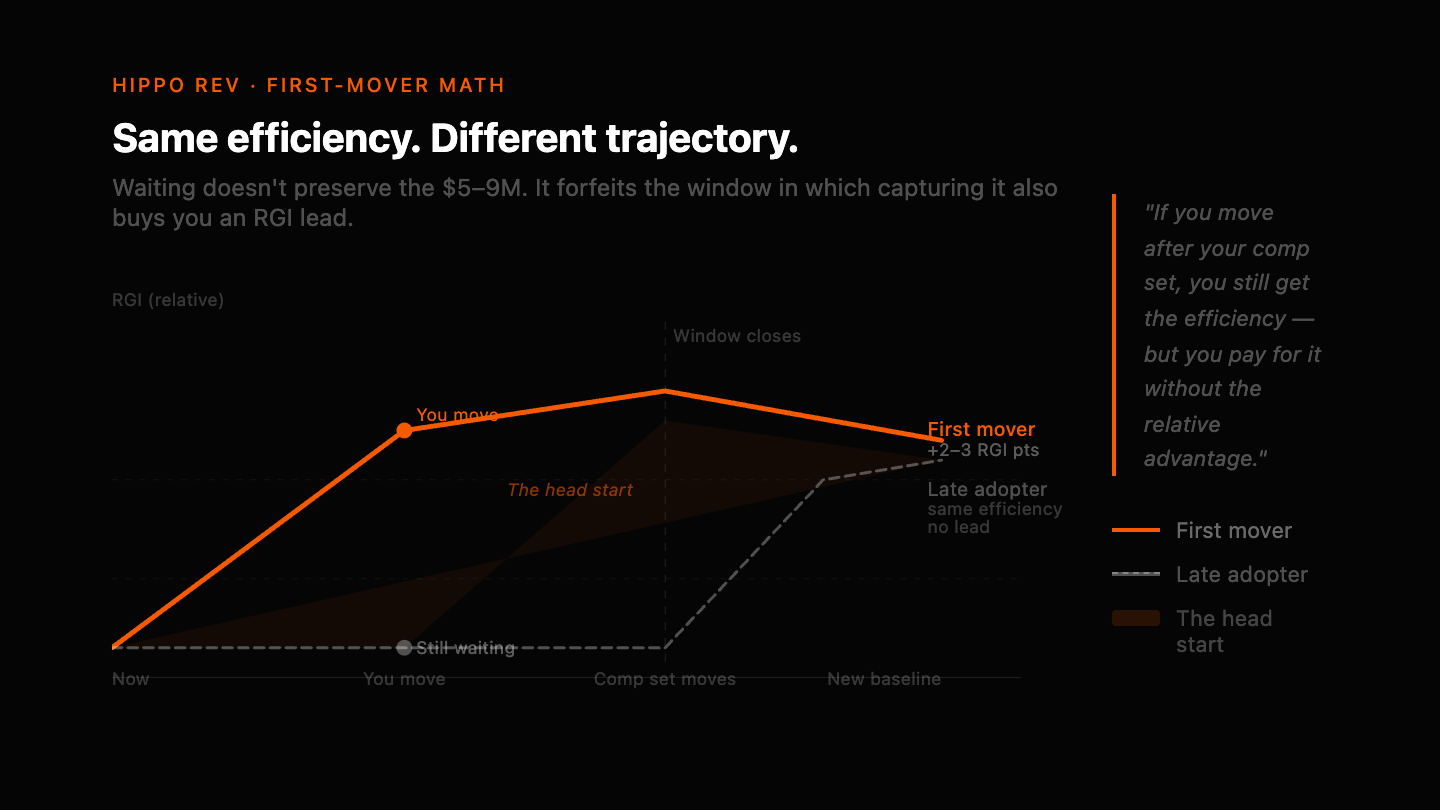
It is worth being concrete about why sell-side AI moves a ranking metric and not just an efficiency metric.
RGI is relative.
You do not win on absolute performance, you win on performance against your comp set.
So the question is not “are we good?” but “are we faster and more consistent than the hotels we are ranked against?”
Today, across the comp set, 55% of hotel RFPs go unanswered and the answered ones are usually won by one of the first responders. That is the ambient condition you are all operating in.
Now imagine one management company in that set quietly fixes its answer rate and its response time.
It starts capturing the 55% that were being ignored.
It starts being the first complete responder instead of the third.
It starts pricing every proposal with the same discipline because the system, not a tired seller at 6:30 PM, is building it.
Each of those is a relative gain against the comp set, and relative gains are exactly what RGI measures.
The comp set has not changed its behavior yet, so the gap is pure advantage.
That is the 2 to 3 points.
The advantage holds only until the others move.
Which is the entire argument for moving first.
“Too risky to change” is the objection that costs the most
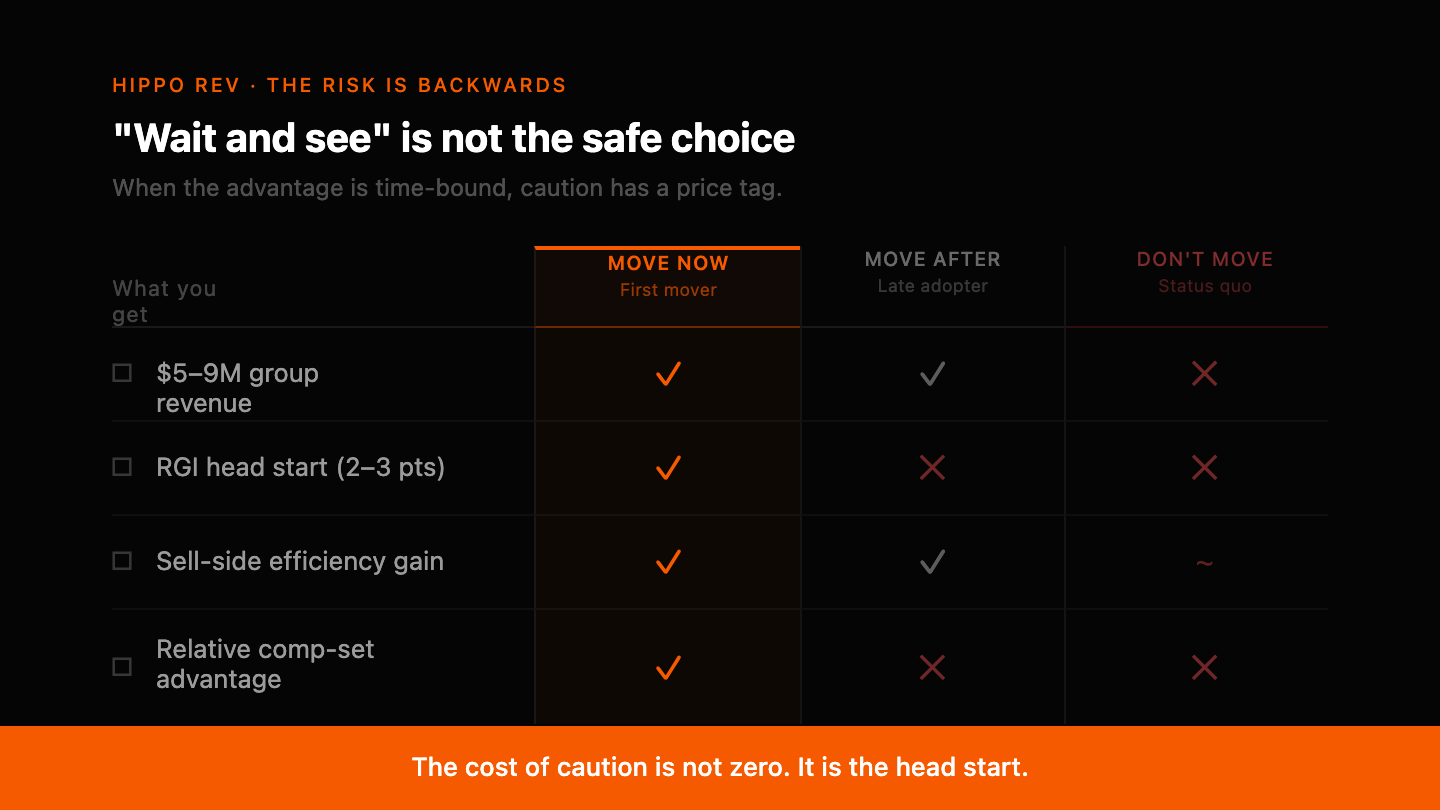
The reflex inside a portfolio is caution: changing systems across 15 properties sounds like risk, disruption, and IT pain.
It is the most reasonable-sounding objection in the room, and in this case it is the expensive one, for two reasons.
First, the risk framing is backwards.
A Revenue Capture Platform does not replace your PMS, your CRM, or your revenue management system.
It sits on top of the systems you already own and absorbs the execution work between them.
There is no rip-and-replace, no migration of records, no retraining your team onto a new system of record.
You overlay, you do not uproot.
You can start with one or two workflows on a few properties and expand on proof.
Second, “wait and see” is not actually the safe choice when the advantage is time-bound.
Waiting does not preserve the $5 to 9M, it forfeits the window in which capturing it also buys you an RGI lead.
If you move after your comp set, you still get the efficiency, but you pay for it without the relative advantage, because by then fast response and high answer rates are just the new normal.
The cost of caution is not zero.
It is the head start.
What moving first looks like in practice
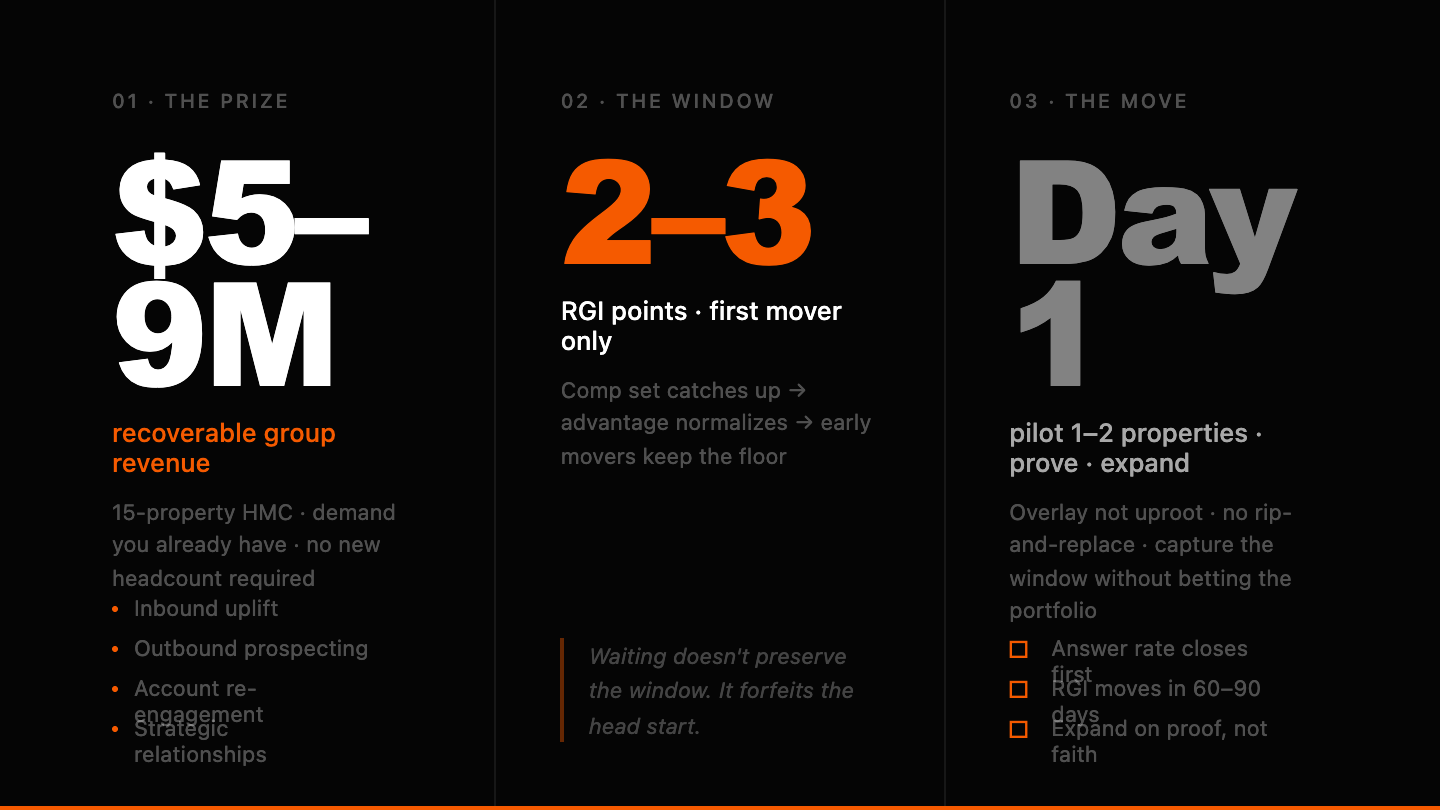
Moving first does not mean a portfolio-wide, big-bang rollout.
It means a structured pilot with the metrics that matter to a portfolio:
- Answer rate
- Response time
- Win rate
- ADR discipline
- SLA compliance
With role-based permissions, template governance, and an audit trail so execution is standardized rather than left to seller-by-seller variation.
The Lead Catcher Agent closes the answer-rate gap by ensuring no inquiry from any channel goes unseen.
The RFP Response Agent closes the speed and consistency gap by drafting from your real pricing.
The Engagement Agent recovers the dormant-account and relationship revenue that nobody currently has time to chase.
You prove it on a slice of the portfolio, you watch the comp-set metrics move, and you expand.
The whole point is that you can capture the window without betting the portfolio to do it.
Ready to see your portfolio's number?
The $5 to 9M figure is a model.
Your number is specific to your properties, your channels, and your current answer rate, and it is worth knowing before your comp set does.
Bring us your portfolio numbers and we will show you what is recoverable, or see the platform built for VPs of sales.
Frequently asked questions
Question: How much group revenue can a hotel management company actually recover?
Answer: For an illustrative 15-property mid-market HMC, the recoverable group revenue across inbound uplift, outbound prospecting, account re-engagement, and strategic relationships is roughly $5 to 9M per year, based on published industry benchmarks. The actual figure depends on a portfolio's current answer rate, response time, and channel mix.
Question: Why is wiring AI into the sell side a first-mover advantage?
Answer: RGI is a relative metric measured against a comp set. The first management company to improve its answer rate and response time gains ground against competitors who have not, producing an estimated 2 to 3 point RGI advantage. Once the comp set adopts similar capability, fast response becomes table stakes and the relative edge compresses.
Question: Does a Revenue Capture Platform require replacing our existing systems?
Answer: No. It sits on top of the PMS, CRM, and revenue management systems a portfolio already owns and handles the execution work between them. There is no rip-and-replace, and a portfolio can start with one or two workflows before expanding.
Question: What is the risk of waiting to adopt sell-side AI?
Answer: The recoverable revenue remains available later, but the window to capture it as a relative advantage over the comp set does not. Adopting after competitors means gaining the efficiency without the first-mover RGI lead, because faster response and higher answer rates will have become the market baseline.
Hotel Sales Productivity Crisis: Where a DOSM's Time Really Goes
She worked a full, exhausting day. She answered emails, built a proposal, prepped a site visit, and filled in a Cvent submission by hand. At 6:30 she finally logged off. And she did not move a single deal forward. This is not a performance problem. It is a workload problem, and it is the same at almost every property in your portfolio.
Your Best DOSM Didn't Sell a Single Thing on Tuesday. Here's Where the Hours Went.
Quick answer
A typical hotel director of sales spends most of the day on administrative work, intake, proposal building, portal entry, and waiting on approvals, rather than selling. Research indicates roughly 71% of a seller's day goes to admin, and about 70% of hotel sellers operate as order-takers rather than hunters. The result is days of effort with zero deals advanced. The cause is workload structure, not effort, and the fix is moving repetitive machine work off the seller's plate.
Key takeaways
- A full, productive-feeling day can still advance zero deals when it is consumed by admin.
- Around 71% of a seller's day goes to non-selling work, an industry-wide pattern.
- Prospecting, account growth, and relationship-building are the first activities to disappear.
- Returning those hours, not adding headcount, is what re-enables full-cycle selling.
Meet your best seller on a completely normal day
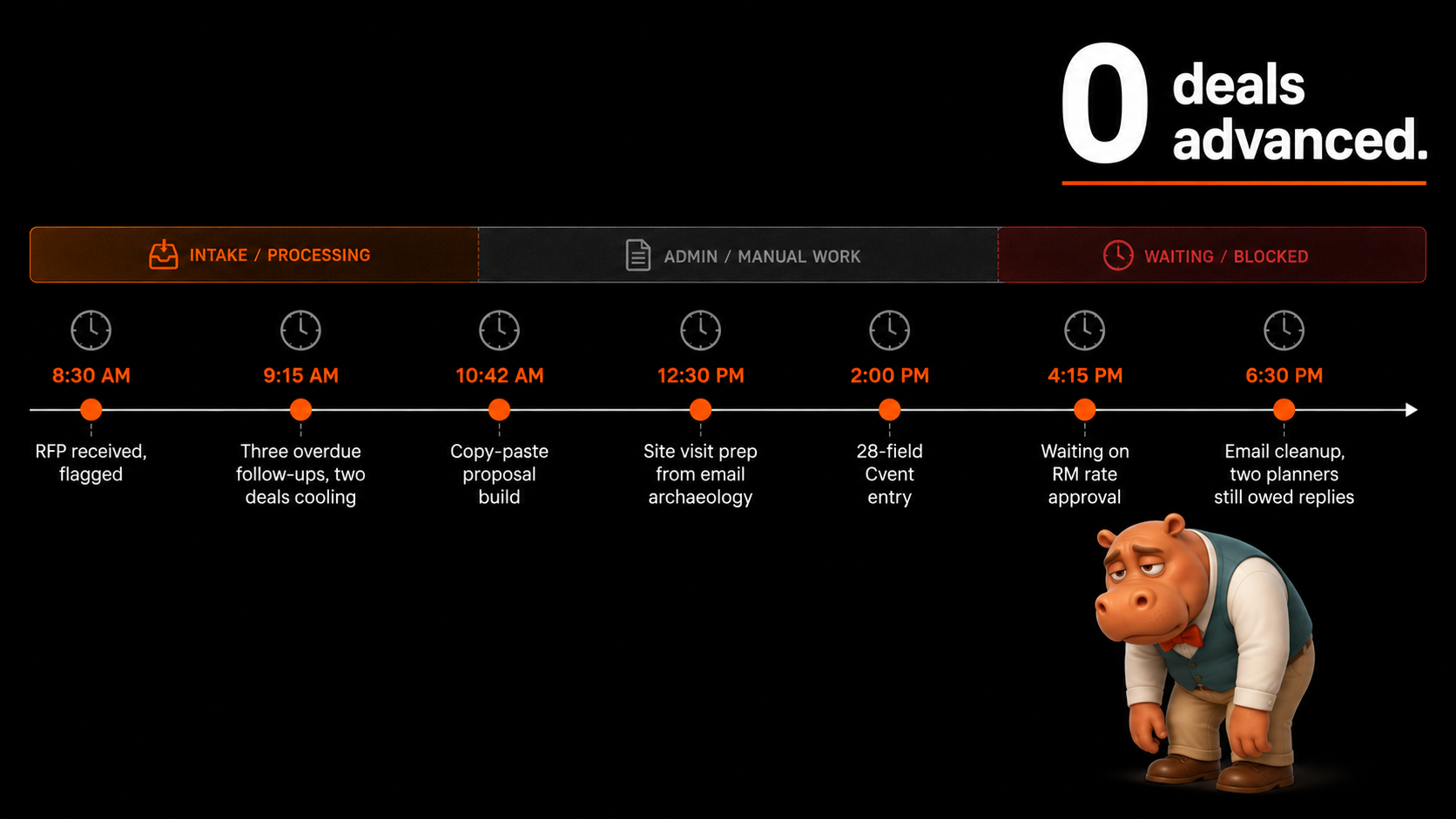
Let us follow your strongest director of sales and marketing through one ordinary Tuesday. Nothing goes wrong. There is no crisis. This is just what the job looks like now.
8:30 AM. The first RFP of the day lands. She skims it, sees it will take real work, and flags it for later. Later never quite arrives.
9:15 AM. Three follow-ups from last week are already overdue. She knows two of those deals are cooling while she watches.
10:42 AM. Proposal builder. She opens last week's template and starts copying and pasting, the group name, the dates, the room block, the F&B minimum, hoping she catches every field she needs to change.
12:30 PM. Site visit prep for a planner she met three months ago. She digs through email to reconstruct what they even discussed.
2:00 PM. A Cvent submission with twenty-eight fields to fill in by hand, because the portal does not talk to her other systems.
4:15 PM. She is waiting on Revenue Management to approve a rate before she can send anything. The request sits in someone else's inbox.
6:30 PM. Email cleanup. She still owes two planners a reply from yesterday. She closes the laptop.
Add it up. Eight hours of genuine, skilled effort. Zero deals advanced. No new account prospected. No dormant client re-engaged. No relationship deepened. She processed work. She did not sell.
The verdict, and why it is not about her
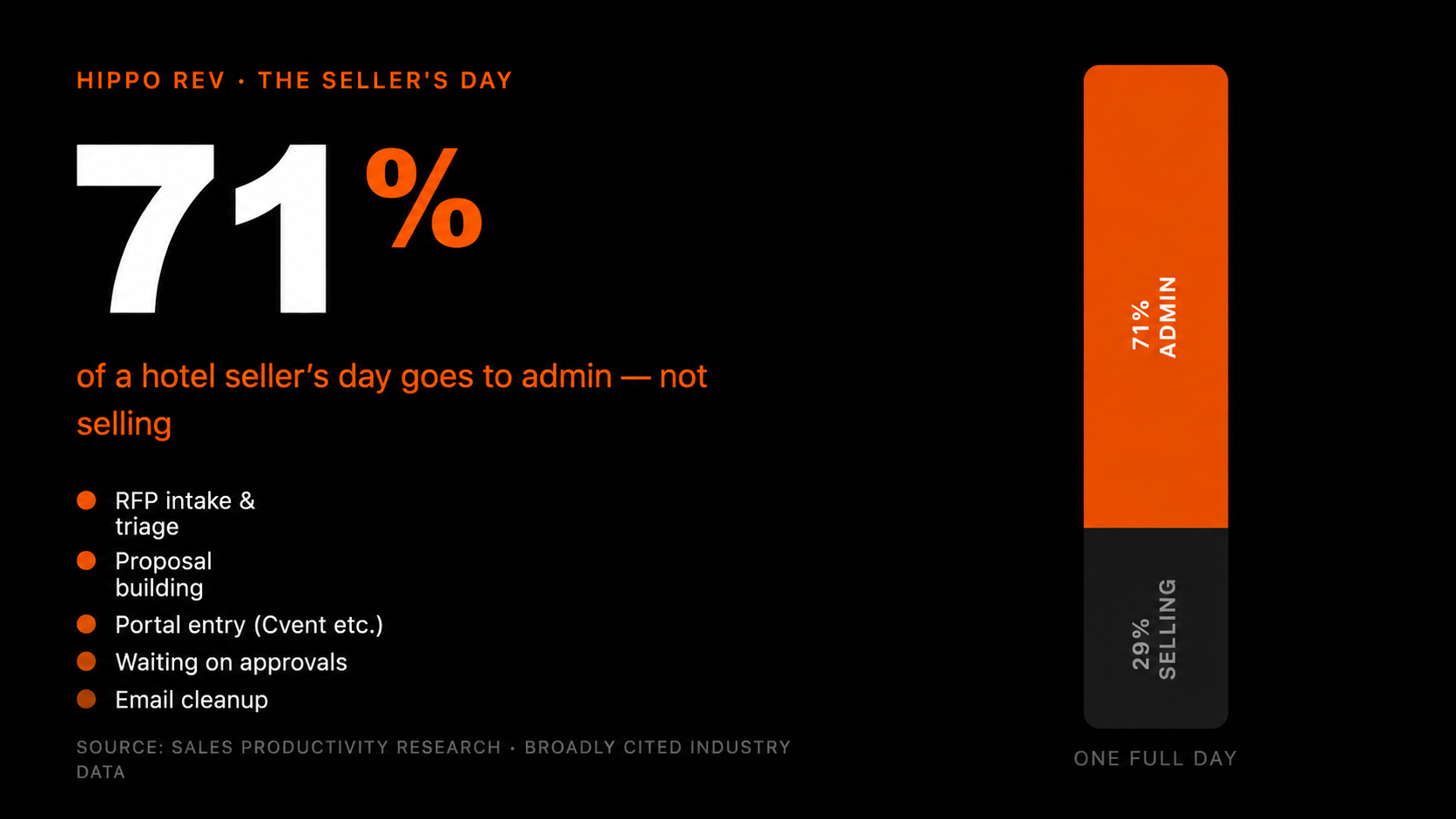
It would be easy, and wrong, to read that day as a productivity problem. She is not slow. She is not disorganized. She is doing exactly what the system around her rewards and demands.
The data says this is the norm, not the exception. Roughly 71% of a hotel seller's day goes to administrative work rather than selling, according to broadly cited sales-productivity research. And it is structural: when Kennedy Training Network and Knowland looked at how hotel sales teams actually operate, they found that about 70% of sellers function as farmers or order-takers, processing what arrives, rather than hunters who go create new business.
Read those two numbers together and Tuesday makes complete sense. If most of the day is consumed by admin, and the role has quietly been redefined around processing inbound, then a day with zero selling is not a failure. It is the predictable output of the workload. Your best person is losing deals for reasons that have nothing to do with effort or expertise.
How the job became this
The seller's day did not always look like this. It became this way through thirty years of math.
For three decades, the volume of inbound RFPs grew faster than the sales teams handling them. Cvent, HotelPlanner, Groups360, and the OTAs made it dramatically easier for planners to send inquiries to more properties at once. Inbound volume exploded. Headcount did not.
So sellers faced a quiet, daily choice: respond to the flood, or go hunt for new business. They chose respond, because that is what the comp set was doing and what the general manager was measuring. Over time, “respond to what comes in” stopped being one part of the job and became the entire job. Nobody decided the director of sales should stop selling. The arithmetic decided it for them.
The three things she was hired to do, and never gets to
When the day is fully consumed by intake and admin, three high-value activities disappear first, and they are exactly the three the role exists for.
Prospecting vanishes.
There is no cold outreach to new associations, no account-based motion at the property level, no hunting for net-new corporate business. The pipeline becomes whatever happened to show up in the inbox.
Account growth decays silently.
The client who booked in 2023 and did not come back in 2024 never gets a call to find out why. Dormant accounts sit untouched for twelve months or more, and their lifetime value quietly evaporates.
Relationships stay transactional.
The third-party planner who sends 40 RFPs a year is treated as a series of one-off requests. No quarterly business review, no pre-RFP positioning, no trust built in advance. And when that seller leaves, the relationship walks out with her, because it lived in her head, not in a system.
These are not nice-to-haves. Prospecting, growth, and relationships are where group revenue actually comes from. They are the first casualties of an admin-saturated day.
What giving the hours back actually changes
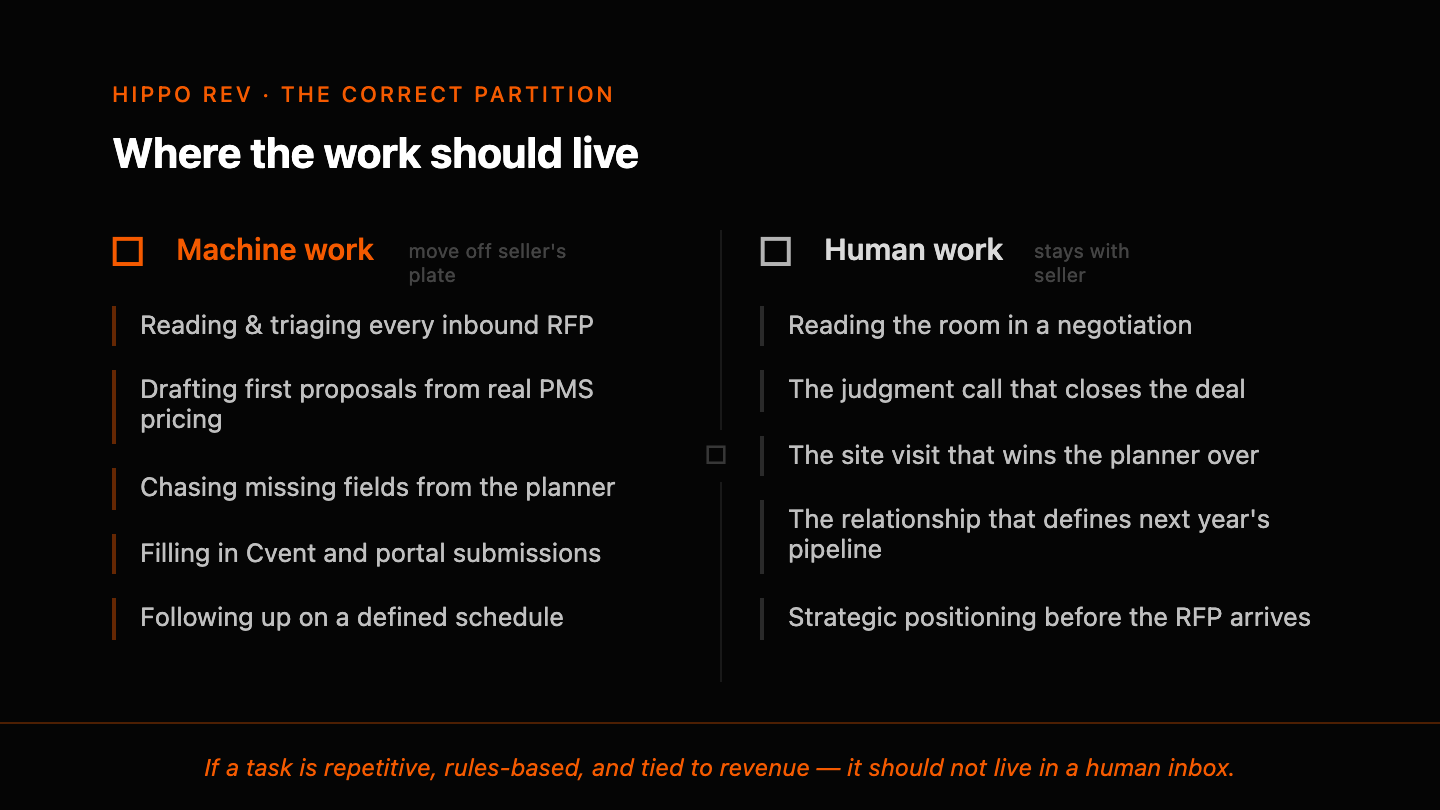
The reimagined version of this role is not a seller who works harder or faster. It is a seller whose day has a different shape, because the machine work has moved off her plate.
The principle is simple: if a task is repetitive, rules-based, and tied to revenue, it should not live in a human inbox.
Reading and triaging every inbound RFP, drafting the first proposal from real pricing, chasing missing fields from the planner, filling in the Cvent portal, following up on a schedule, that is machine work.
What stays human is the part that was always the actual job: reading the room, the judgment call in a negotiation, the site visit that closes, the relationship that brings the planner back next year.
Give her those hours back and the week reshapes itself. Inbound stops eating 70% of her time because AI absorbs it. Suddenly there is room to grow the dormant account, prospect the new association, and build the relationship that does not show up in this quarter's inbox but defines next year's pipeline.
The same person, the same headcount, finally doing the full-cycle job she was hired for.
This is what we built Hippo Rev to do
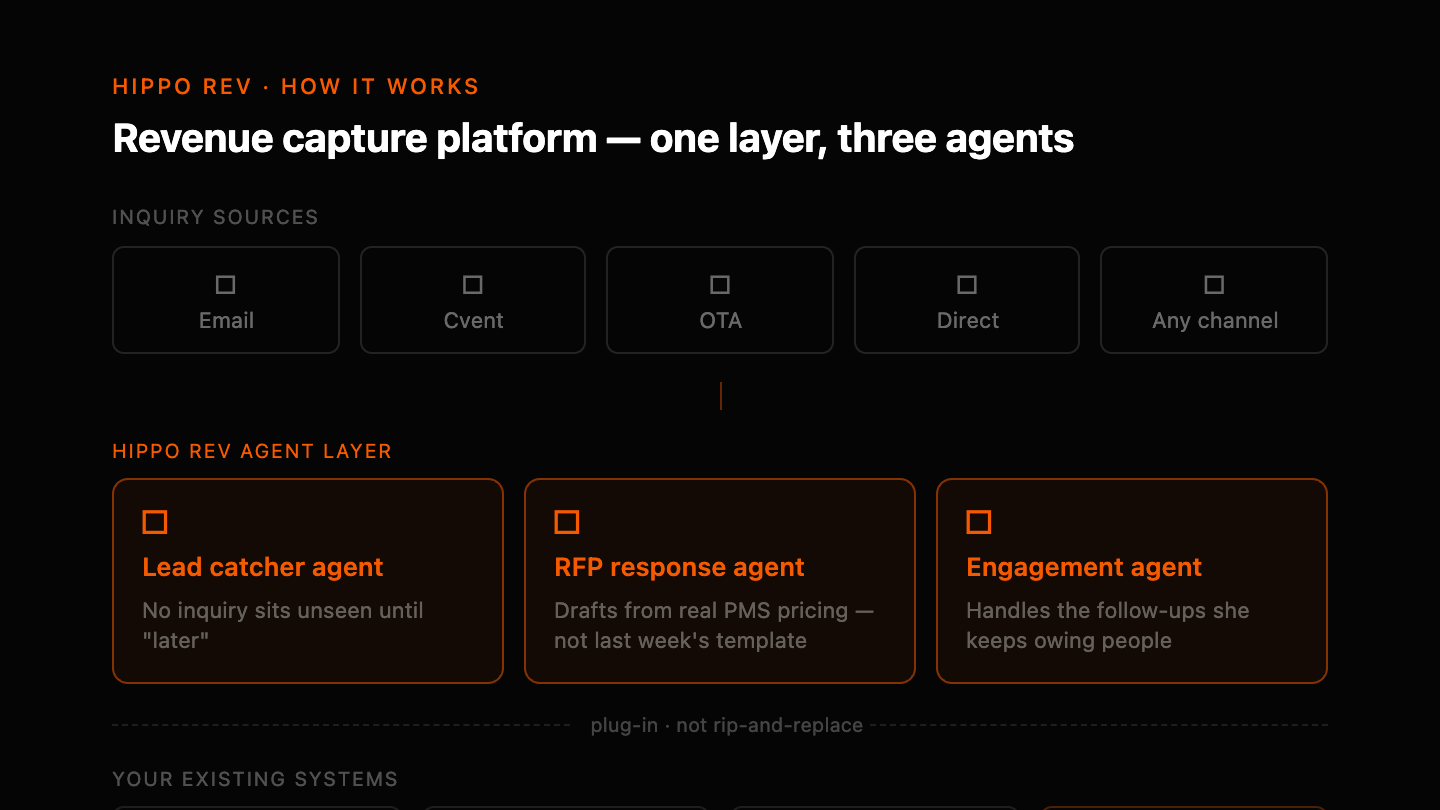
We did not build another tool for her to manage on top of the seven she already has.
We built a Revenue Capture Platform that does the sell-side machine work and hands the time back.
The Lead Catcher Agent makes sure no inquiry from any channel sits unseen until “later.”
The RFP Response Agent drafts the proposal from your real PMS pricing instead of last week's copy-pasted template.
The Engagement Agent handles the follow-up she keeps owing people.
It sits on top of the systems you already own, so it is not a rip-and-replace and it is not one more thing to learn.
The goal is not to replace your best seller. It is to stop wasting her on Tuesdays like this one.
Ready to give your team their Tuesdays back?
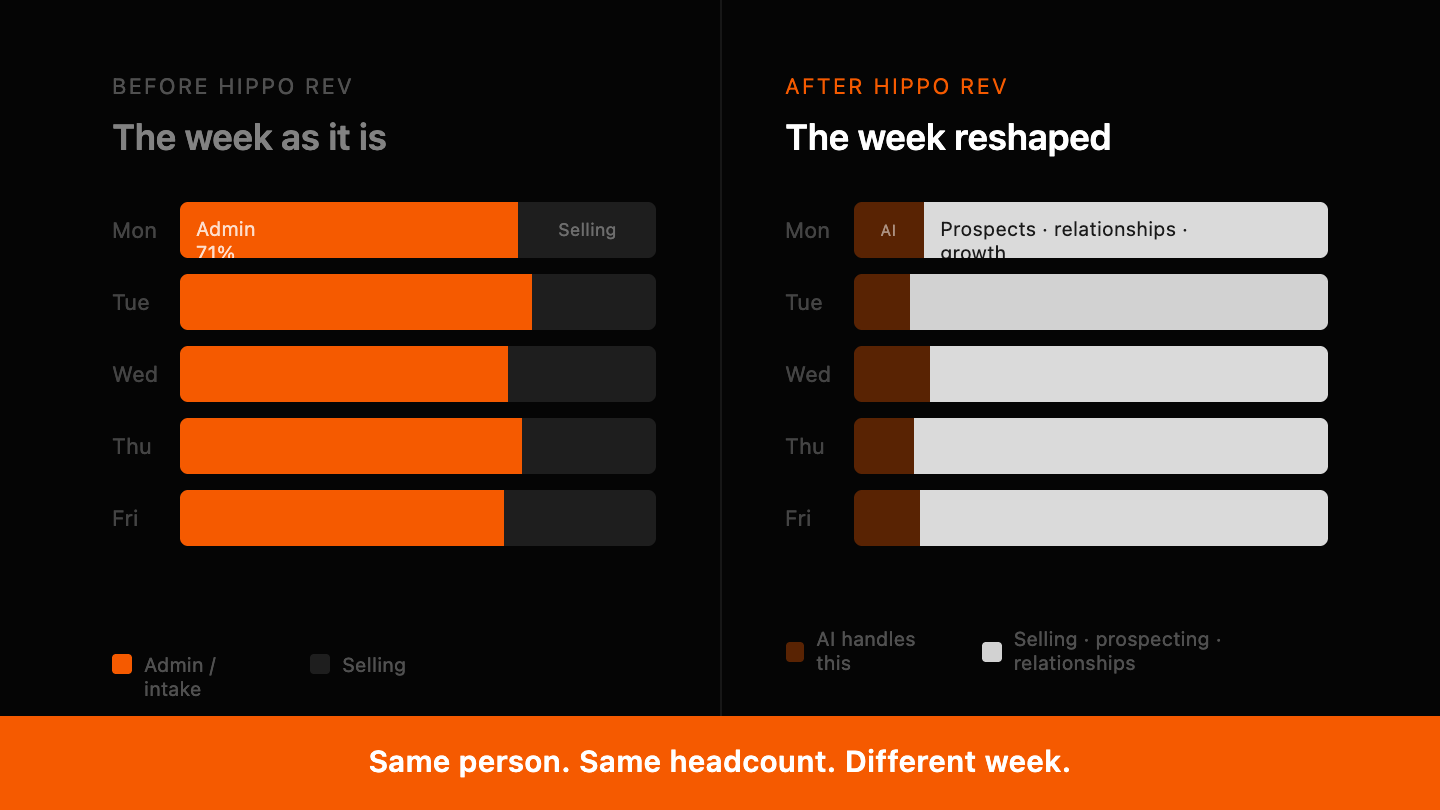
If this day looked familiar, it is because it is happening across your portfolio right now, quietly, in every seller's calendar.
See how Hippo Rev reshapes the week in a 15-minute demo, or explore the solution built for directors of sales.
Frequently asked questions
Question: Why do hotel sellers spend so little time actually selling?
Answer: Inbound RFP volume has grown faster than sales headcount for decades, so processing inquiries gradually became the entire job. Combined with administrative work like manual proposal building and portal submissions, this leaves most sellers with little or no time for prospecting, account growth, or relationship building.
Question: Does automating RFP work mean fewer sales jobs?
Answer: No. The goal is to move repetitive, rules-based tasks off the seller's plate so they can focus on the human work, negotiation, site visits, and relationships, that AI cannot do. The role becomes more strategic, not redundant.
Question: What is the difference between a farmer and a hunter in hotel sales?
Answer: A farmer or order-taker primarily processes inbound business that arrives on its own. A hunter actively prospects new accounts and grows existing ones. Research suggests about 70% of hotel sellers operate as farmers, largely because the workload leaves no room to hunt.
Question: How does Hippo Rev free up a seller's time?
Answer: Hippo Rev captures inquiries from every channel, drafts proposals from a hotel's real pricing data, chases missing details, and automates follow-up. By handling the machine work, it returns hours to the seller for the high-value activities that actually generate group revenue.

Why Hotel Sellers Can't Keep Up With AI-Powered Meeting Planners
Planners got a published, distributed handbook for using AI to source and pressure-test hotels. Sellers got AI features buried inside the same platforms, with no equivalent guide for the full sell-side workflow. One side was handed a method. The other was handed a login. That asymmetry, not demand, is what is quietly costing you group business.
Your Buyers Got an AI Upgrade. Your Sellers Got a Browser Tab.
Quick answer
Event planners now have AI tools and published guidance for sourcing and negotiating with hotels, while hotel sales teams have no equivalent, system-connected AI for the sell-side workflow. This buyer-seller AI capability gap, not a shortage of demand, is the root cause of slow RFP responses and lost group revenue. Closing it requires AI wired into a hotel's own systems (PMS, CRM, rate guidelines), not a general-purpose chatbot.
Key takeaways
- The buy side of every group deal is now AI-assisted; the sell side mostly is not.
- A general chatbot cannot close the gap because it has no access to a hotel's availability, pricing, or account history.
- Roughly 55% of hotel RFPs go unanswered and most won deals go to the first responders, both symptoms of the seller-side speed gap.
- The fix is a Revenue Capture Platform that connects AI to the systems a hotel already owns.
The day the negotiation stopped being even
For thirty years, the hotel seller and the meeting planner sat across a table that was, more or less, level. Both worked from email. Both worked from spreadsheets. Both worked at human speed. Whoever knew the market better, built the better relationship, and priced the block more sharply tended to win.
That table is no longer level.
Cvent publishes a planner-facing handbook, “Mastering AI for Events,” that walks event organizers through using AI across the planning lifecycle, including how they source, compare, and pressure-test the hotels bidding for their business. It is gated, distributed, and updated. The buy side has had a documented operating manual for getting more out of you since 2024, and planners are using it: Cvent's own data puts roughly half of meeting planners already using AI to plan and execute events.
The sell side has no equivalent of that kind. Hotels do get AI, but mostly as features buried inside the same sourcing platforms, not as a craft anyone teaches a director of sales to use across the whole workflow. There is no widely distributed, vendor-neutral guide showing your seller how to use AI to respond faster, price smarter, and hold the line in a negotiation. One side was handed a method. The other was handed a set of logins.
This is not a story about demand. It is a story about a capability gap that widens every month one side trains and the other does not.
What “armed” actually looks like on the buyer side
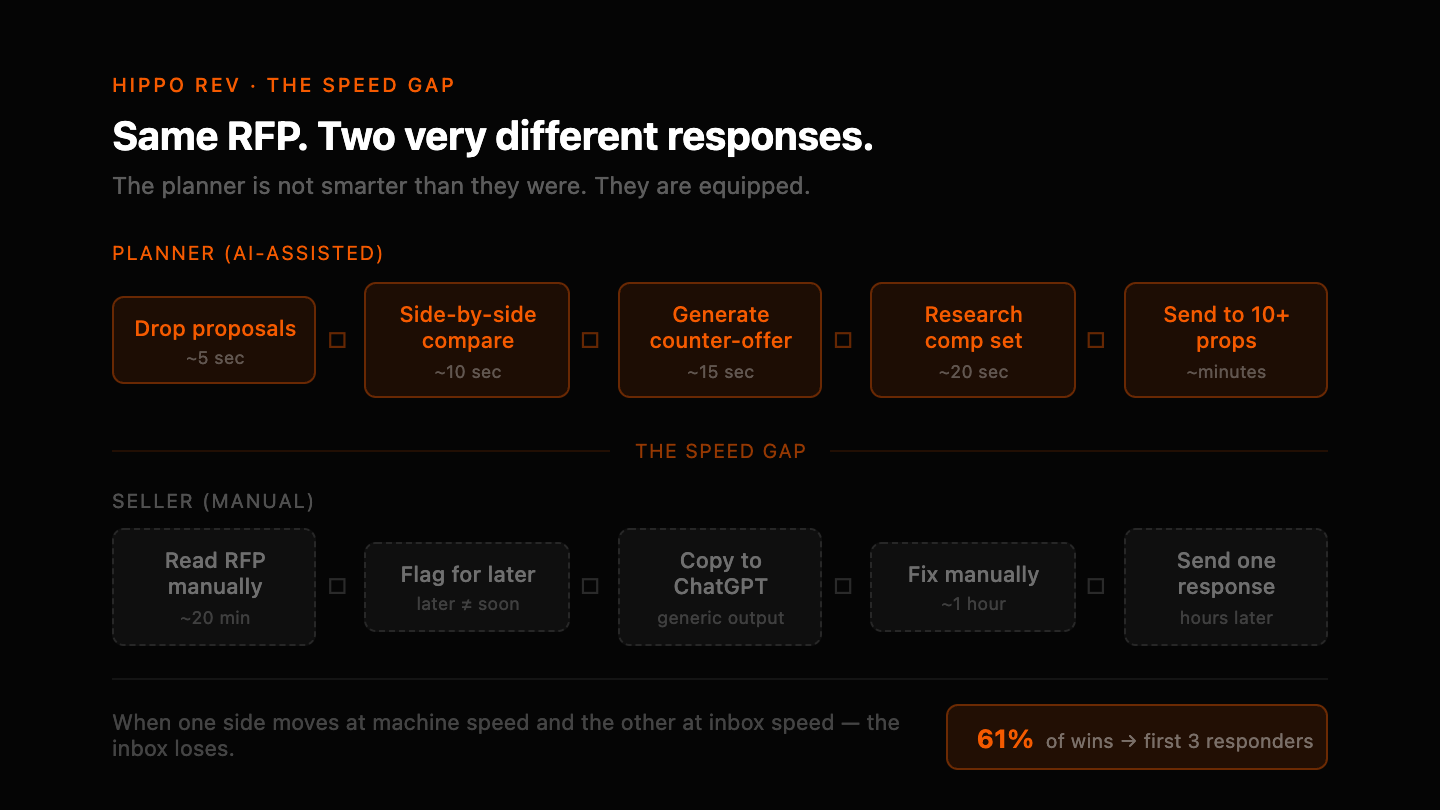
It helps to be specific about what the planner can now do that they could not do two years ago.
They can drop your proposal and three competing proposals into a model and get a side-by-side comparison of rates, concessions, and attrition clauses in seconds. They can generate counter-offer language calibrated to the exact gaps in your bid. They can research your property's recent reviews, your comp set's published rates, and your group's historical pricing before they ever reply to you. They can draft, in one pass, the kind of detailed, requirement-heavy RFP that used to take an afternoon, which means they can send more of them, to more properties, with less effort.
The planner is not smarter than they were. They are equipped. Every advantage compounds against a seller who is still reading the RFP for the first time on a phone between site visits.
What “still on a browser tab” actually looks like on the sell side
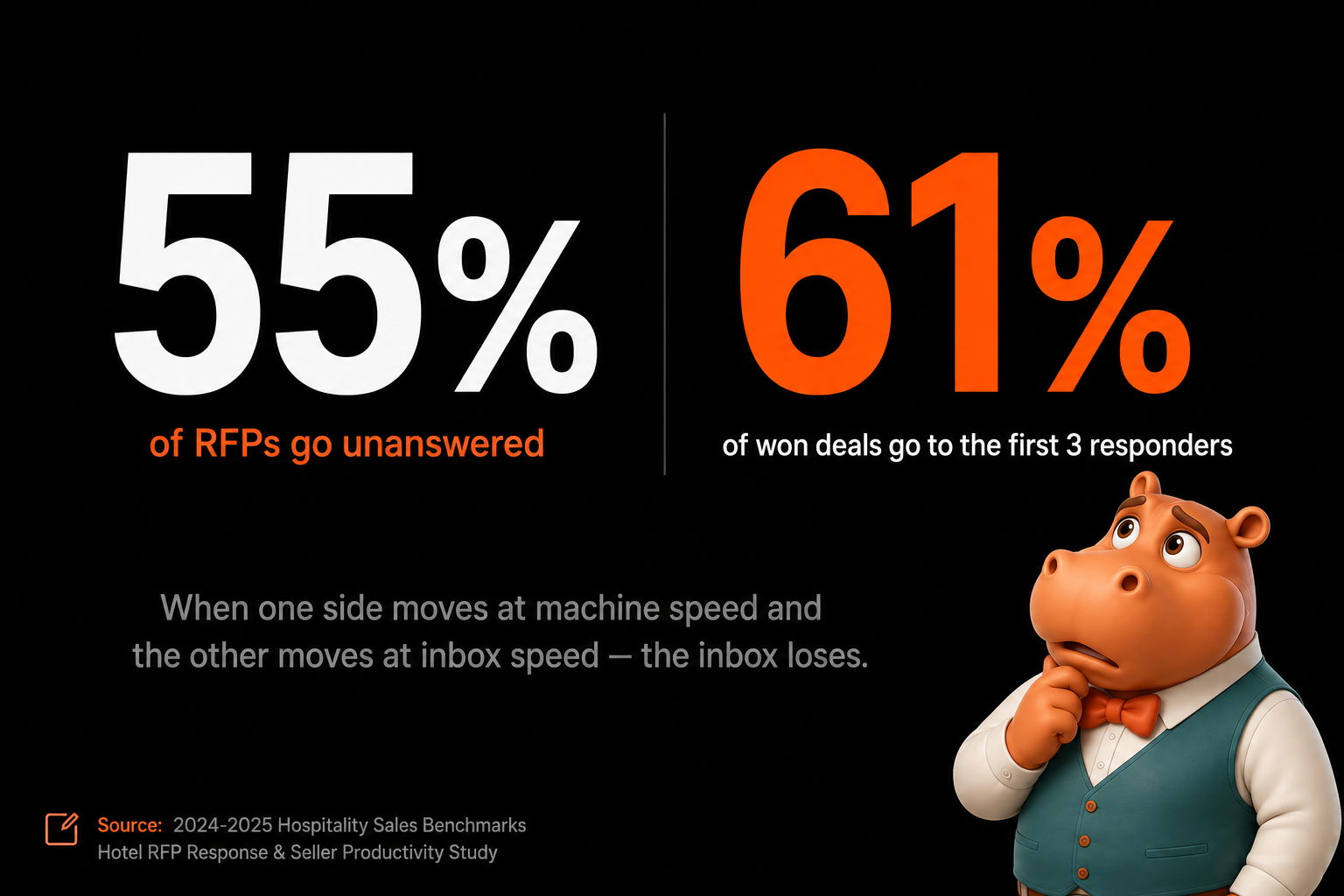
Now look at the other chair.
A qualified RFP lands at 4:15 on a Tuesday. Your best seller already owes two planners a reply from yesterday. She skims the new one, flags it for later, and gets pulled into a revenue meeting. When she finally opens it, she copies the requirements into ChatGPT, gets a generic draft that does not know your room types, your F&B minimums, or what Revenue Management will approve, and then spends an hour fixing it by hand anyway.
She is not behind because she is bad at her job. She is behind because roughly 71% of a hotel seller's day goes to administrative work rather than selling, and the one AI tool she has access to does not actually know anything about her hotel. A general model can write a polite paragraph. It cannot pull your pricing, check your availability, or remember that this planner sent you 40 RFPs last year.
The buyer's AI is purpose-built for getting a better deal. The seller's AI is a blank chat window. That is not a fair fight, and the results show up exactly where you would expect: 55% of hotel RFPs go unanswered entirely, and 61% of the ones that do get answered are awarded to one of the first three responders. When one side moves at machine speed and the other moves at inbox speed, the inbox loses.
Why a general chatbot will never close the gap
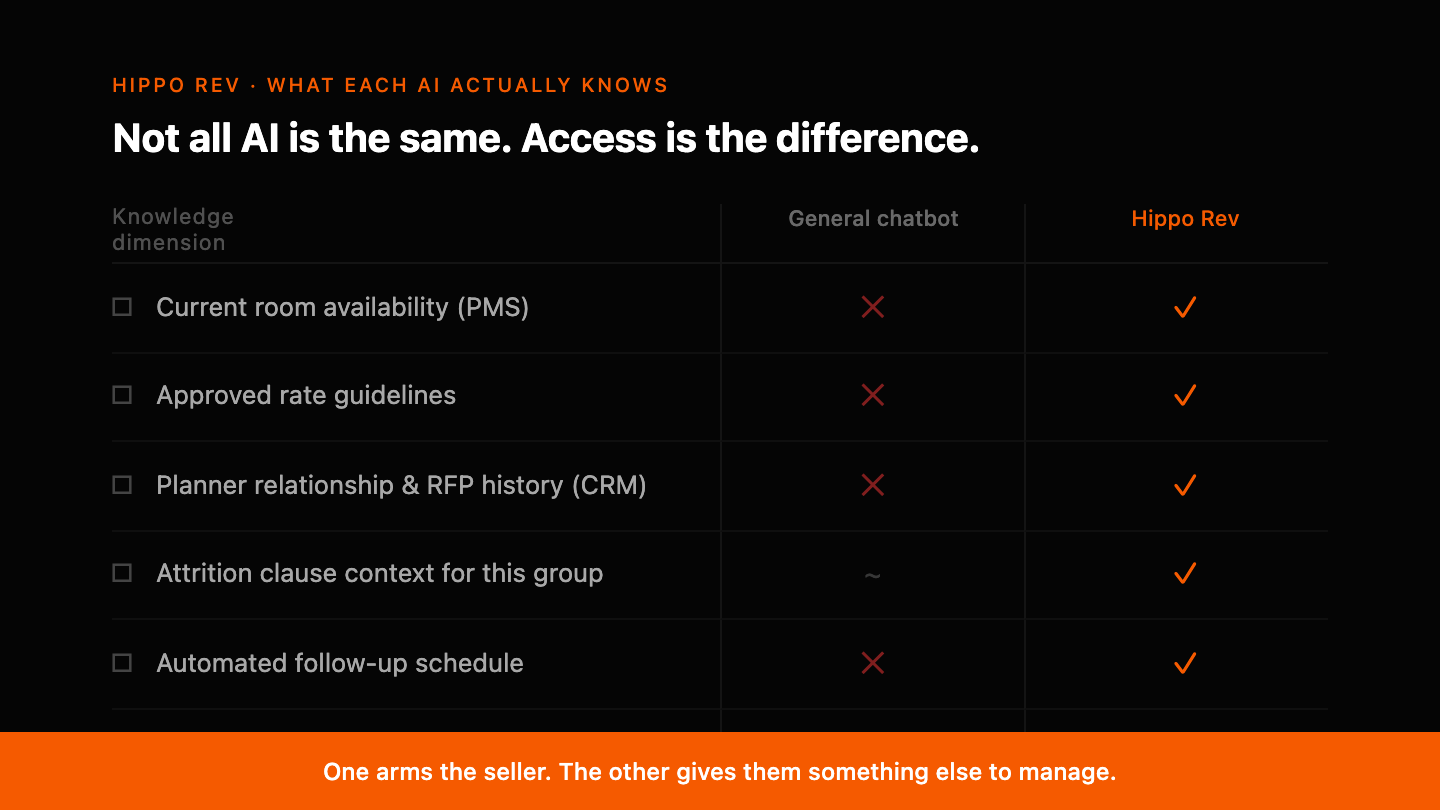
The instinct, once leaders see this, is to “give the team AI.” But handing a seller a consumer chatbot is not the same as arming them, for one structural reason: a general model has no access to the systems where your hotel's truth lives.
It cannot see your PMS, so it does not know what is available. It cannot see your rate guidelines, so it invents pricing you would never approve. It cannot see your CRM, so it treats a 40-RFP-a-year planner like a stranger. It produces something that reads like a proposal but is disconnected from every fact that makes a proposal real. The seller still has to do the actual work, which means the tool saved her a paragraph and cost her the time to check it.
Closing the capability gap requires the opposite of a generic chatbot. It requires AI that is wired into the systems you already own, so it works from your availability, your pricing logic, and your account history, not from a guess. This is the difference between layered, hotel-specific intelligence and a generic model dressed up for hospitality. One arms the seller. The other just gives them something else to manage.
Re-arming the sell side
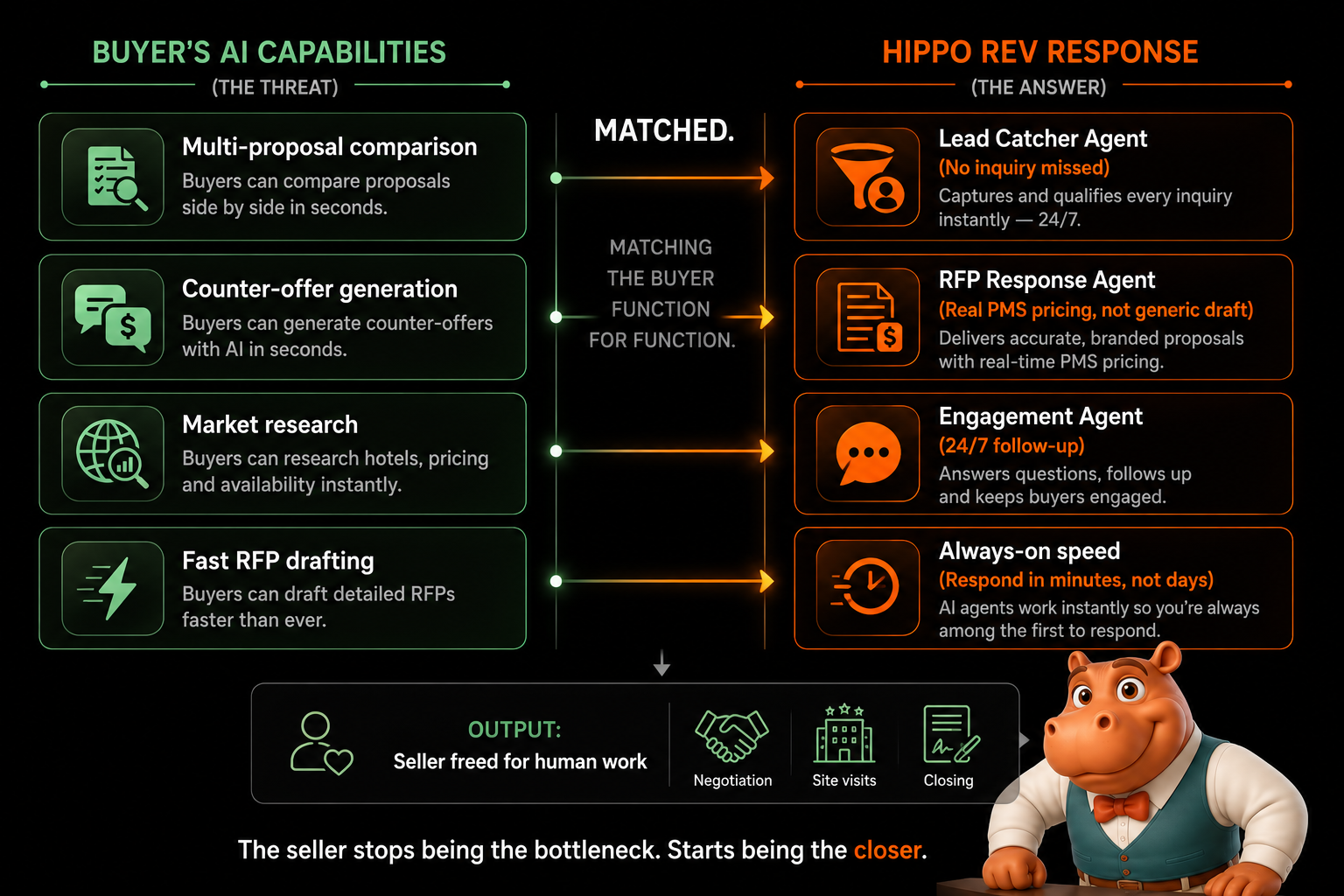
The fix is not to ask sellers to type faster into a chat window. It is to put a system of execution on the seller's side of the table, one that matches the buyer's AI capability by capturing every inquiry, drafting accurate proposals from your real data, chasing missing details, and following up around the clock.
That is the category we are building. Not a CRM that records what happened. Not a chatbot that talks to guests. A Revenue Capture Platform that does the sell-side machine work so your people can do the human work: reading the room, negotiating, and closing. The RFP Response Agent builds the proposal from your PMS pricing. The Lead Catcher Agent makes sure no inquiry from any channel sits unseen. The seller stops being the bottleneck and starts being the closer again.
The buyers got their handbook in 2024. The question for 2026 is whether your sellers get their equivalent before your comp set arms first.
Ready to re-arm your sell side?
The buyer-seller capability gap is not going to close on its own, and it will not close by working your team harder. It closes when your sellers get AI that knows your hotel as well as the planner's AI knows the market.
See what that looks like in a 15-minute demo of Hippo Rev, or download the Speed Wins Playbook for the framework behind a same-day response.
Frequently asked questions
Question: What is the Cvent AI playbook, and why does it matter to hotels?
Answer: “Mastering AI for Events” is a handbook Cvent published in 2024 to teach event planners how to use AI throughout the sourcing and planning process. It matters because it equips the buy side of every group negotiation with documented AI techniques, while no comparable, widely distributed guide exists for the sell side. The result is a growing capability gap between planners and the hotels bidding for their business.
Question: Can sellers just use ChatGPT to respond to RFPs?
Answer: They can, but a general-purpose model has no access to a hotel's PMS, rate guidelines, or CRM history. It can draft polite language, but it cannot produce accurate pricing or availability, which means the seller still does most of the work by hand. Purpose-built, system-connected AI closes the gap that a generic chatbot cannot.
Question: Is slow group revenue a demand problem or a capability problem?
Answer: For most hotels it is a capability problem. The inquiries are already arriving. The revenue is lost because the team cannot respond fast enough or often enough to capture demand it already has, especially now that buyers are using AI to move faster.
Question: What is a Revenue Capture Platform?
Answer: It is a system of execution that sits on top of the systems hotels already own and does the sell-side work of capturing inquiries, generating accurate proposals, and following up automatically. It is distinct from a CRM, which records data, and a revenue management system, which sets pricing.
The Second Wave of AI in Hospitality: From Tools to Thinking Partners
You trust AI at 6.6 out of 10 — but you actually rely on it at 4.7. That nearly two-point gap, measured across hotel chains worldwide, is one of the most brutally honest data points in the entire hospitality tech conversation.
THE SECOND AI WAVE IN HOSPITALITY
Why This One Feels Different — and Why That Matters
You bought the software. You sat through the demos. You nodded along to the ROI projections. You signed the contract and told your team this was the year you were going to get serious about AI.
And then, when the moment came to actually let it make a decision — about pricing, about a guest communication, about a rate you'd normally agonize over for twenty minutes — you overrode it. You went with your gut. You did it yourself.
You're not alone. And this pattern has a number attached to it.
The Gap Nobody Wants to Talk About
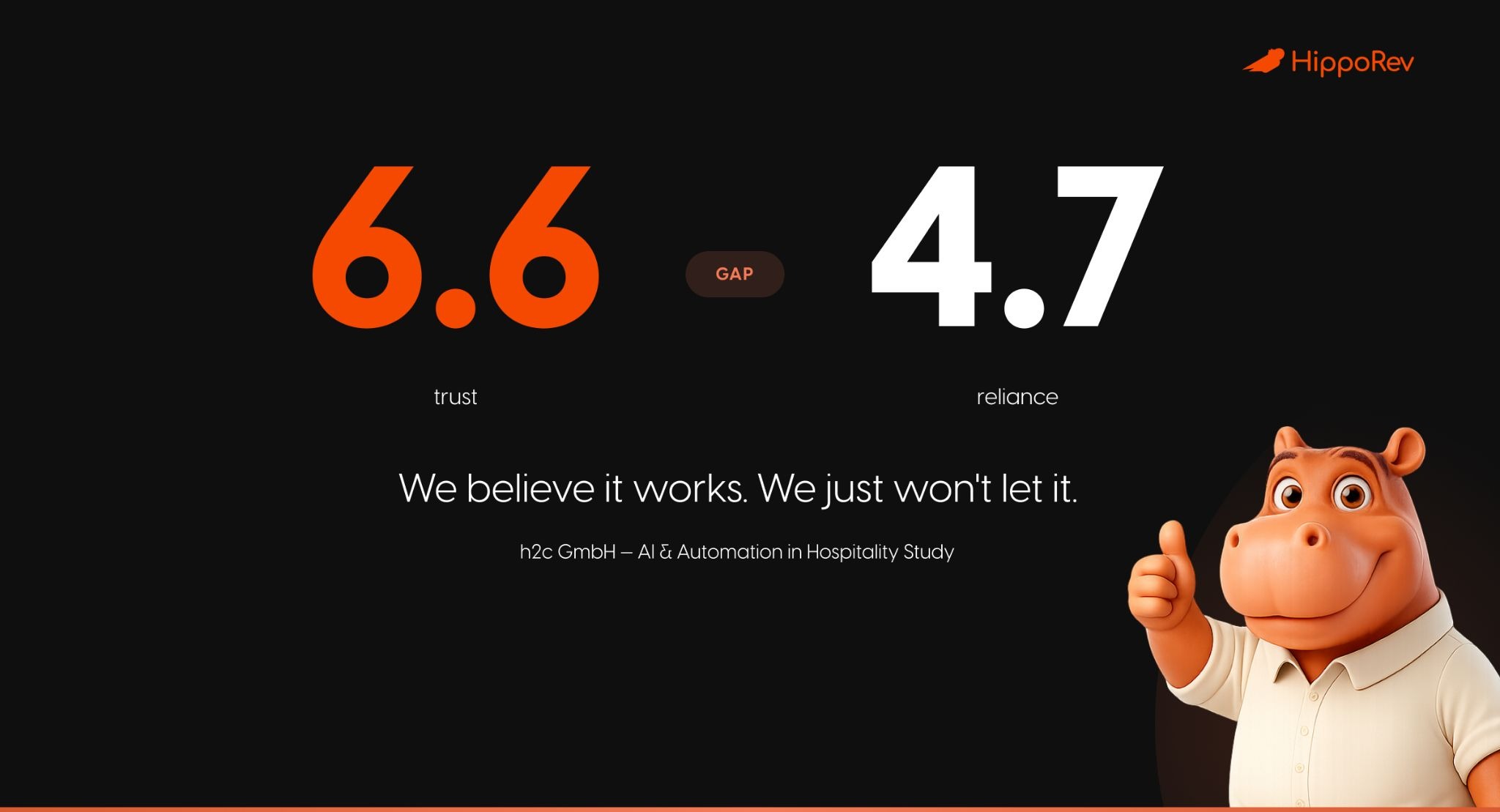
A landmark study by h2c GmbH asked hoteliers two deceptively simple questions: how much do you trust AI, and how much do you actually rely on it?
Trust: 6.6 out of 10. Reliance: 4.7 out of 10.
That gap — nearly two full points — is the most honest data point in the entire hospitality technology conversation. It says: we believe the technology works in theory. We're just not ready to let it work in practice.
78% of hotel chains are currently using AI. Up to 96% plan to maintain or increase their investment. But only 12.5% are confident they can scale it. Only 6 to 8% have a formal, company-wide AI strategy. And just 1% — one percent — have made AI genuinely central to their business model.
The industry has been running a very expensive experiment in looking like it's ready for the future.
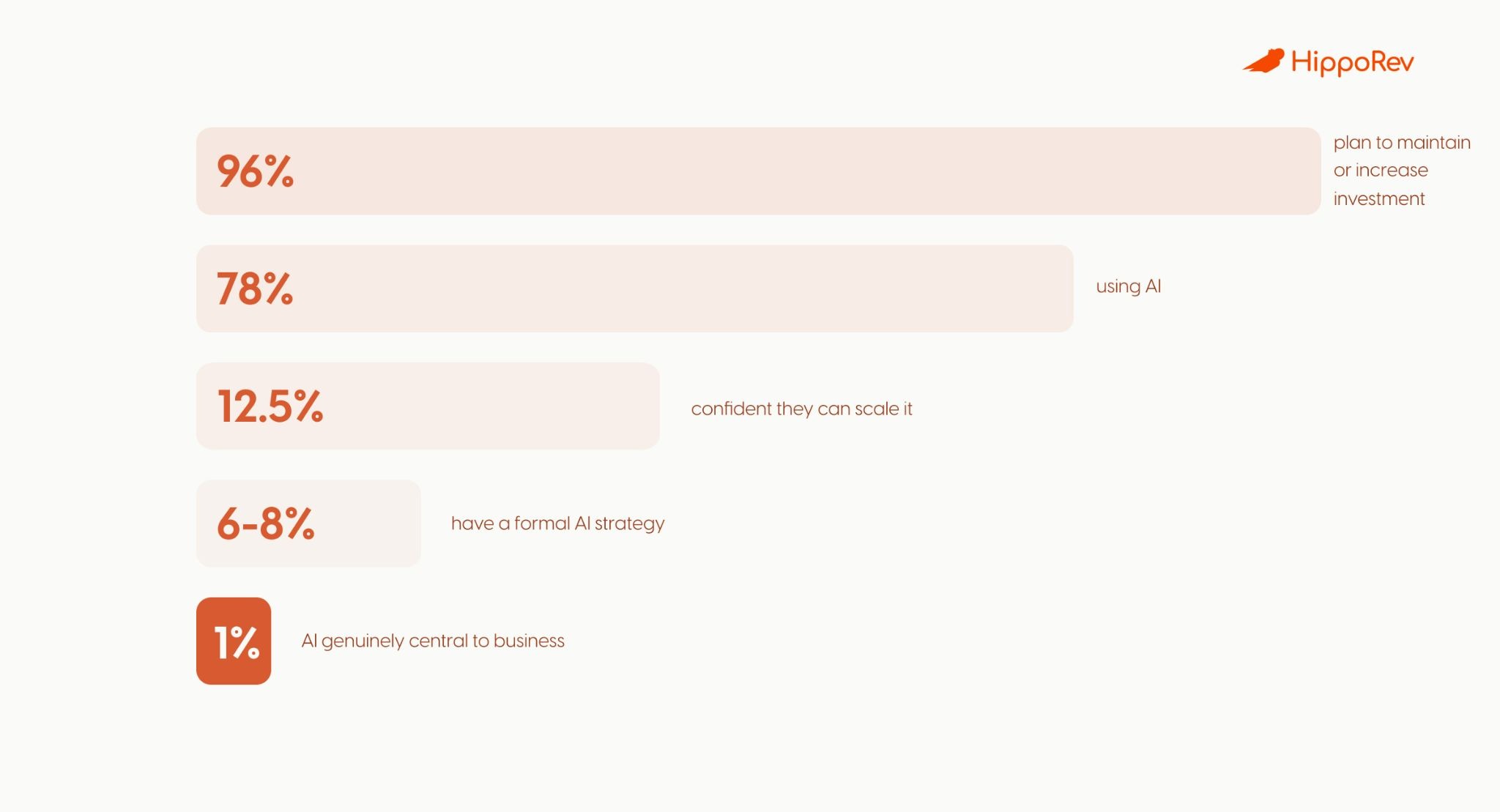
What the First Wave Actually Was
The first wave of hospitality AI was about proving the technology could do something impressive. Chatbots that could answer guest questions. Pricing engines that could monitor competitor rates. Revenue tools that could surface recommendations. Content generators that could draft a promotional email in seconds.
It was impressive. It was also, largely, siloed.
Each tool worked in isolation. Each one required a human to supervise it, validate its outputs, and decide whether to act on what it suggested. The AI generated the recommendation. The human made the call. The efficiency gains were real but narrow — islands of automation in an ocean of manual decision-making.
The result was a peculiar kind of technological limbo. Hotel operators had deployed AI broadly enough to count as adopters. They hadn't integrated it deeply enough to count as transformed. They'd built a dashboard full of insights and staffed a team to read it every morning.
That's not transformation. That's a more expensive version of what you were already doing.
The Second Wave Is Different — And You Can Feel It
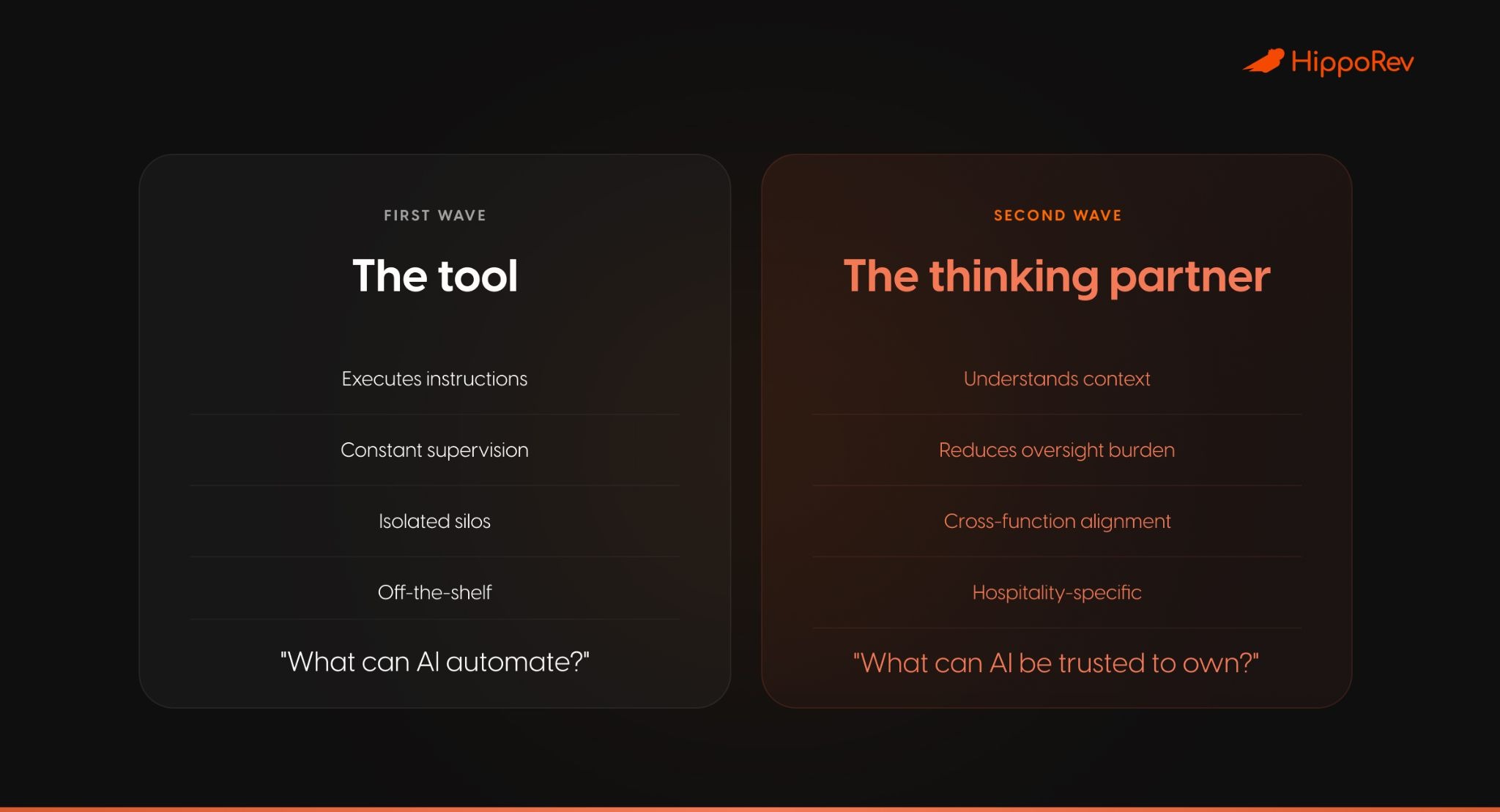
Something has shifted. The organizations that are pulling ahead aren't deploying more AI tools. They're deploying AI that thinks differently about its own role.
The first wave asked: what can AI automate?
The second wave asks: what can AI be trusted to own?
That's a different question entirely. It requires AI that understands context — not just instructions. That knows when the pricing logic says one thing but the business situation says another. That can execute a multi-step workflow across your PMS, your CRM, and your revenue management system without a human hand-holding it through each step. That can flag when something feels off instead of confidently doing the wrong thing at scale.
From Tool to Thinking Partner
Leading organisations are asking a new question when evaluating AI: Does this system behave like a tool — or like a thinking partner?
This architectural shift — from isolated tools to layered, context-aware systems — is what separates first-wave deployments from what's coming next. Read more on how layered intelligence works in hotel AI.
The Real Unlock Isn't Efficiency. It's Cognitive Load.
For the past five years, the hospitality AI conversation has been dominated by one framing: headcount reduction. AI as a way to do more with fewer people. AI as a cost-cutting mechanism dressed up in the language of innovation.
That framing is both wrong and counterproductive. Wrong, because the economics rarely work out the way the pitch decks suggest. Counterproductive, because it makes every department head a skeptic and every frontline employee a threat assessor.
The second wave is built on a more honest and more powerful idea: AI doesn't replace your people. It gives them their attention back.
66% of hotel chains report that AI is already enabling staff to step away from administrative tasks and refocus on guest-facing work. Not because the technology replaced the person. Because the technology absorbed the cognitive weight of the routine — the policy reconciliation, the first-pass pricing logic, the judgment calls that aren't really judgment calls, they're just decisions that take time.
"With AI, we're finally giving that time back." That quote came out of a September 2025 HSMAI roundtable. It's the most important sentence in the current hospitality AI conversation. Not because it's profound. Because it's finally honest about what the technology is actually for.
Your revenue manager shouldn't be spending three hours a day reconciling rate decisions that a well-governed AI system could handle in three minutes. Your front office team shouldn't be drafting the same guest communication for the fourteenth time this week. Your GM shouldn't be manually reviewing outputs from a system they don't trust enough to let run.
The cognitive load is the problem. AI that earns trust — that operates within defined guardrails, that flags anomalies instead of hiding them, that knows when not to act — is the solution. Not because it's smarter than your team. Because it's tireless in ways your team can't be, at the tasks your team shouldn't have to be.
Where the Value Is Actually Landing
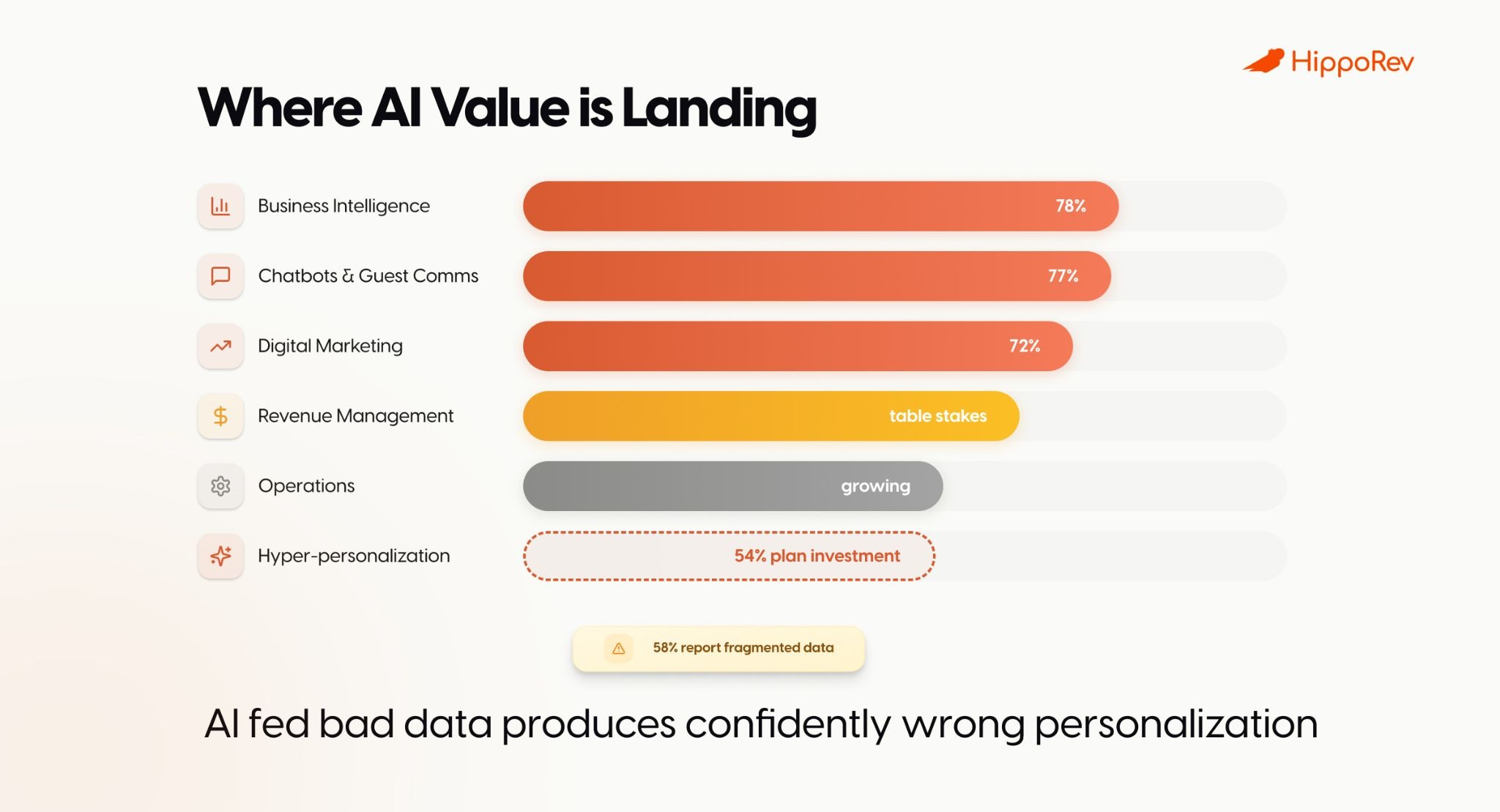
The industry has gotten clearer about where AI earns its keep. Business intelligence and analytics top the list — 78% of hoteliers cite it as their primary value driver. Guest communications and chatbots are close behind at 77%. Digital marketing, content, and SEO automation round out the established tier.
Revenue management is where things get interesting. Real-time dynamic pricing and continuous competitor monitoring are no longer differentiators. They're table stakes. The question has shifted from "can AI do this?" to "how tightly can we govern how AI does this?" — which is exactly the right question.
The next frontier is hyper-personalization: using guest data to drive genuinely relevant upsell offers and communications that don't feel like templates. 54% of brands plan significant investment there. But the honest caveat is structural: 58% of travel companies report fragmented or siloed customer data. And AI fed bad data doesn't produce good personalization. It produces confidently wrong personalization, which is worse than no personalization at all.
The industry knows where the value is. The work now is building the data infrastructure to actually access it.
The Part That Should Worry You
58% of hoteliers cite bias or errors in AI-generated decisions as a primary concern. That number deserves to be taken seriously.
Bad automation is not neutral. A pricing system that hallucinates a rate and ships it to OTAs before anyone catches it doesn't just cost you revenue on that night. It creates a compliance problem, a parity problem, and a trust problem with the team that was supposed to be supervising it. A guest-facing AI that responds confidently with incorrect information doesn't just fail to help. It actively damages a relationship you've spent years and real marketing budget building.
The first wave produced a lot of tools that were impressive in demos and unreliable in production. The second wave is being defined by organizations that refuse to accept that trade-off. They're demanding AI that enforces their brand logic, not just their efficiency targets. That operates inside their pricing rules, not just adjacent to them. That knows when to pause and escalate, not just when to execute.
This is what "governance maturity" actually means. Not a compliance checkbox. Not an AI ethics statement in the annual report. A system that has been built to operate correctly inside the specific complexity of how your hotel runs — and that you can trust enough to let it.
Wait and See Is Not a Strategy
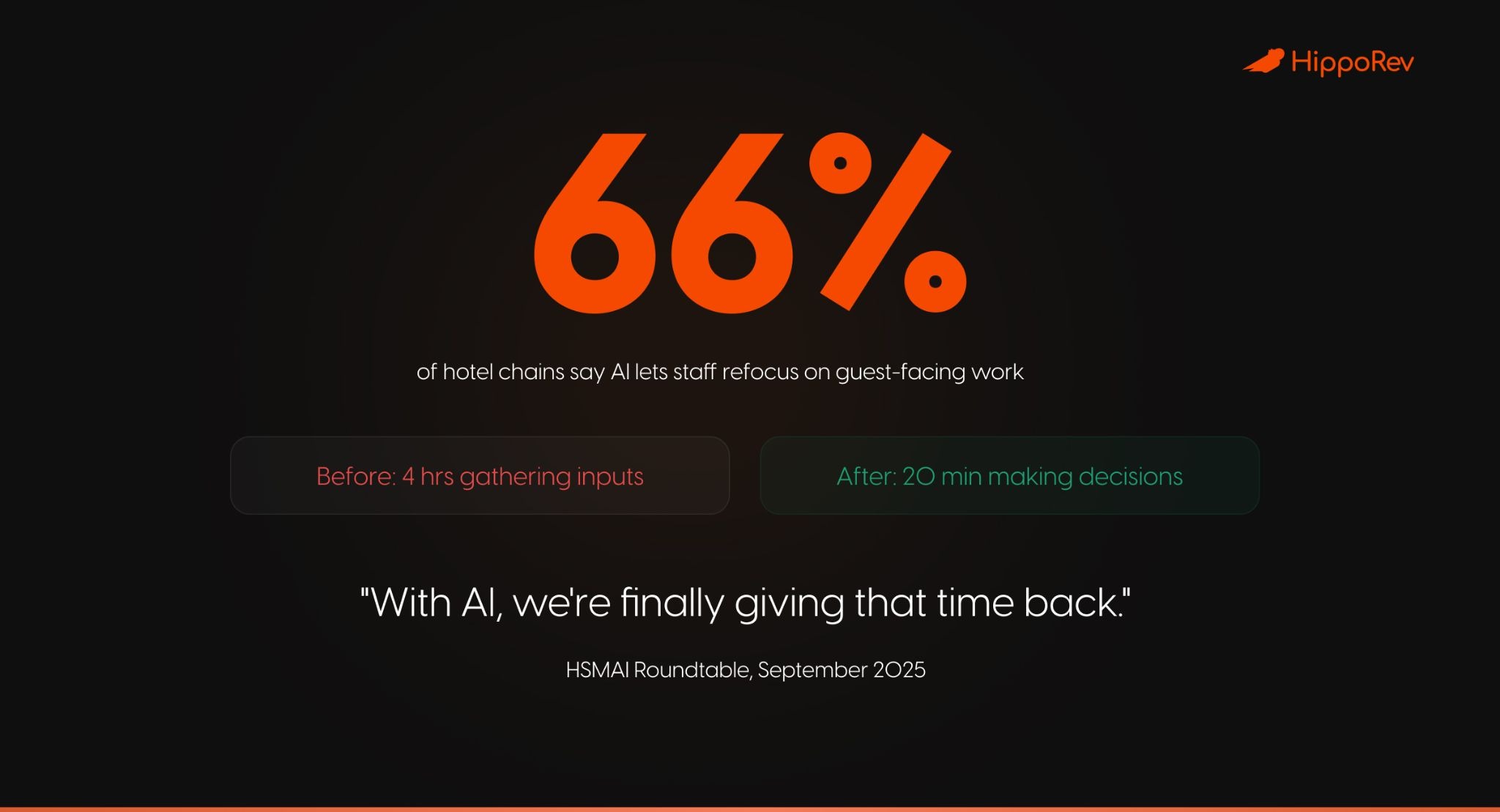
The HSMAI roundtable in September 2025 arrived at a blunt conclusion: wait and see is no longer a viable strategy.
That's not hype. It's an observation about competitive dynamics. The operators who figured out governed, integrated AI two years ago are not running the same operation you are. They've compounded that advantage month over month. Their teams have learned new patterns of work. Their systems have accumulated data that makes the AI smarter and more reliable over time. The gap between them and the field isn't closing — it's widening.
The good news is the second wave offers a more tractable entry point than the first. You don't need to build an agentic mesh from scratch. You need to pick one high-cost, high-repetition decision area — pricing reconciliation, guest communication triage, rate strategy analysis — and put AI to work on it with proper guardrails. Let it earn trust on something bounded before you hand it something broad.
The trust-reliance gap closes one solved problem at a time. It doesn't close from watching.
The entry point doesn't have to be complicated — but it does have to be set up correctly. Here's what good AI onboarding looks like for hotels.
What the Mature Version of This Looks Like
Picture an operation twelve months from now that closed the gap.
Your revenue manager arrives Monday morning and the week's rate strategy has already been assembled, checked against your brand pricing rules, flagged for anomalies, and staged for her review. She spends twenty minutes making actual decisions instead of four hours gathering the inputs to almost make them. She spends the rest of the morning talking to groups who are on the fence.
Your front office team isn't drafting. They're hosting. The routine communications went out correctly, on time, without anyone babysitting the send queue.
Your GM is looking at data that tells her where guest satisfaction is trending before it becomes a complaint. She's having a conversation about what to do about it, not a conversation about whether the data is right.
That's not science fiction. That's what 66% of hotel chains are already beginning to describe when AI absorbs the cognitive load correctly. The delta between where they are and where the rest of the industry is sitting on the 4.7 reliance score is not a technology gap. It's a decision gap.
The technology is ready. The governance frameworks exist. The case studies are real.
The only thing left to close is the distance between 6.6 and actually letting it work.
For hotel group sales specifically, closing the trust-reliance gap starts with the execution layer between your existing systems — the motion between inquiry arrival, proposal generation, and follow-up that currently runs on individual discipline and manual coordination.
Hippo Rev is built to run that workflow: a Revenue Capture Platform that reads from and writes to your PMS, RMS, and Cvent stack in real time, within defined boundaries, so your team reviews and acts rather than assembles and coordinates. [More on how the platform works here.]
Why This Moment Matters
Hospitality is an industry under structural pressure: compressed margins, increasing policy scrutiny, and finite talent bandwidth. In that environment, bad automation isn't neutral — it's actively harmful.
The second wave matters because it finally meets hospitality on its own terms. It doesn't promise to eliminate complexity. It promises to operate intelligently inside it — enforcing the right logic, flagging when not to act, and giving revenue and operational leaders systems they can actually trust.
This is not a technological revolution. It's a sign of maturity. And for leaders who've been waiting not for more hype, but for AI that genuinely respects how hotels work — that difference is everything.
Frequently Asked Questions
Question: As hotels leverage AI for "hyper-personalization," what are the core ethical tensions they face regarding guest privacy and algorithmic bias?
Answer: The drive toward hyper-personalization requires the continuous harvesting of extensive guest data, including behavioral patterns, real-time interactions, and even biometric inputs. The primary ethical tension lies between delivering bespoke service and crossing the line into intrusive surveillance. If data collection is opaque or lacks clear consent mechanisms, it deeply erodes guest trust.
Question: In back-of-house operations, how do AI-driven Decision Support Systems (DSS) improve areas like Food & Beverage (F&B) inventory and staff scheduling?
Answer: AI-driven Decision Support Systems (DSS) utilize advanced methods—such as time-series forecasting (ARIMA, LSTM) and deep learning—to optimize complex operations. For example, highly accurate short-term demand forecasting allows hotels to predict F&B inventory needs to prevent stockouts and food waste, and optimizes labor scheduling to reduce capacity losses and service degradation
Question: How is the rapid consumer adoption of Large Language Models (LLMs) and conversational AI changing how hotels must manage their digital presence and content strategy?
Answer: The discovery phase of the guest journey is moving from traditional search engines (googling) to "guided discovery" via AI-powered platforms, chatbots, and voice assistants. Consequently, traditional SEO tactics are no longer sufficient.
To maintain visibility, hotels must optimize for LLMs by transforming their website content to be highly conversational and hyper-relevant.
Question: How are mature hospitality organizations reframing the impact of AI on their workforce, moving away from the narrative of job replacement?
Answer: Mature organizations have recognized that the true power of AI in hospitality is to absorb cognitive load, not to replace human workers. By allowing AI to handle routine judgment calls, policy reconciliations, and repetitive administrative tasks, human teams regain "strategic attention".
.jpeg)
Speed vs Quality Myth: Why Automation Delivers Both
The belief that speed and quality trade off against each other in hotel sales was once a reasonable reality; today, it's only a comfortable excuse. Event planners don’t choose between speed and quality; they expect both.
The Speed vs Quality Myth
Bring up the topic of "speed-to-lead" in any hotel sales or B2B revenue meeting, and you will almost certainly encounter the exact same objection from your most veteran sales managers. It usually sounds something like this:
"We are a premium brand. We don't sell fast food; we sell bespoke, multi-thousand-dollar event experiences. I can either send a generic, sloppy automated email in five minutes, or I can take my time and craft a high-quality, customized proposal tomorrow. You have to pick one."
This is the Speed vs. Quality Myth.
It is the pervasive, deeply ingrained belief that moving fast inherently requires sacrificing attention to detail, personalization, and brand standards. It operates on the assumption that a high-quality response requires hours of manual human labor—checking inventory, consulting revenue management, formatting spreadsheets, and writing a customized cover letter.
For decades, this trade-off was a reality. But in today’s digitally transformed marketplace, this binary choice is not just a myth; it is an active threat to your pipeline.
The truth is that the modern B2B buyer does not separate speed from quality. To them, speed is quality. And more importantly, with the advent of intelligent sales automation and AI, the operational trade-off between the two has been completely eliminated.
Deconstructing the Myth: What Does "Quality" Actually Mean?
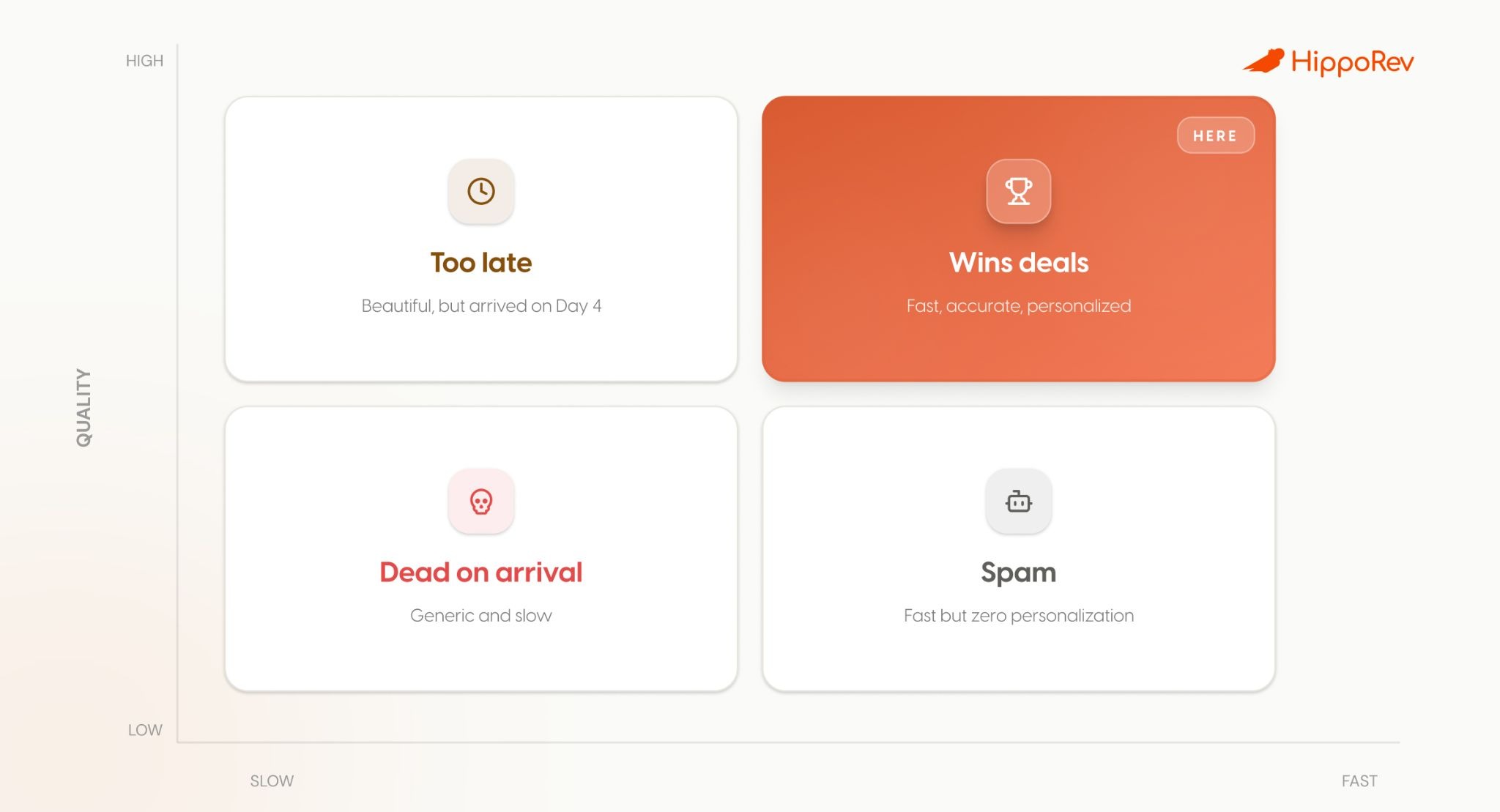
To understand why the Speed vs. Quality Myth is so damaging, we first have to redefine what a "quality" proposal actually means in the eyes of the person receiving it.
Hotel sales teams often define a high-quality proposal by its aesthetics: beautifully formatted PDFs, sweeping descriptions of the ballroom chandeliers, and perfectly manicured cover letters.
Event planners and B2B buyers define quality much differently. They are fundamentally driven by the expectation of a frictionless, instant, and transparent engagement experience. To a planner, a high-quality response is one that is accurate, answers their specific questions, provides transparent pricing, and arrives exactly when their buying intent is highest.
The data backs this up. The Cvent Planner Sourcing Report, which surveyed over 1,650 event professionals, identified the top sourcing frustrations for planners:
- 25% say "getting responses" is the most challenging stage of sourcing.
- 24% cite slow replies as a top frustration.
- 22% say proposals lack transparency.
- 21% say venues fail to answer custom questions.
Notice the intersection of these data points. Planners are equally frustrated by a lack of speed and a lack of substance.
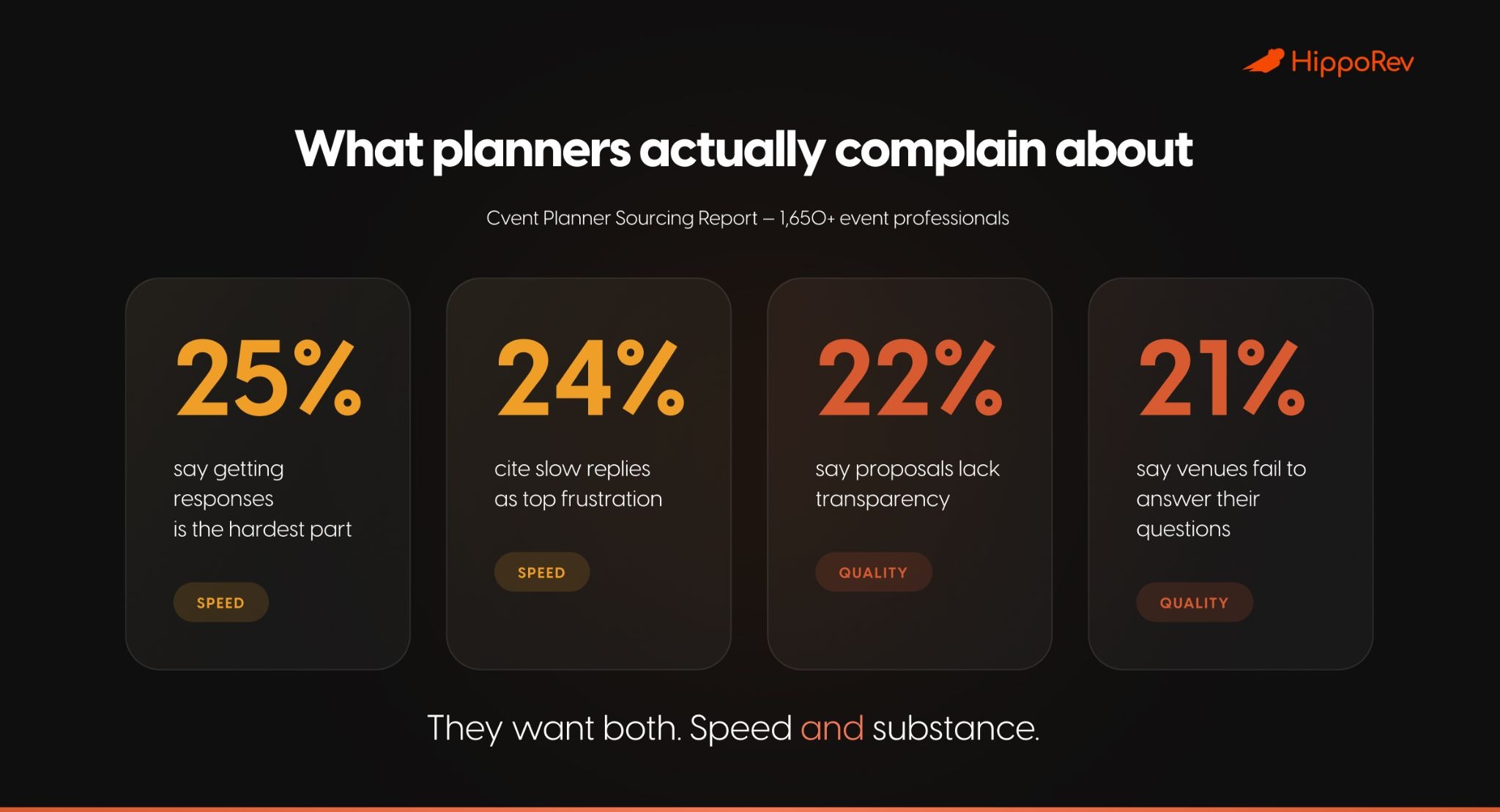
If you respond in five minutes but your proposal is a generic template that ignores the planner's specific questions about dietary restrictions or breakout room AV capabilities, that is a low-quality response. As the research notes, "Being first with a bad proposal doesn't help".
However, if you spend four days meticulously crafting the "perfect" proposal, you have also failed the quality test in the eyes of the buyer. Why? Because the prospect's buying interest has a limited shelf life. When they submit an RFP, they have an active impulse to buy, and every minute that passes degrades that impulse exponentially.
By the time your "perfect" proposal arrives 96 hours later, the planner has already established a psychological anchor with the first property that responded. They have likely already shortlisted their options, and your masterpiece is simply compared against the baseline established by your faster competitor. Research shows that 61% of RFPs are awarded to one of the first three responders. Furthermore, a staggering 78% of customers ultimately buy from the first company that responds to their inquiry.
Taking days to respond doesn't prove that you are a premium brand; it communicates to the buyer that you are inefficient, disorganized, and apathetic to their business.
Read More: Our Speed Wins Playbook breaks this down even further—showing you how to identify hidden delays, calculate lost revenue, and implement faster response workflows backed by real industry data.
But being first isn't enough as well if your content misses the mark. This is precisely why generic AI RFP responses fail to work, whereas truly effective proposals answer specific questions. Read more about it our layered intelligence blog.
The Automation Breakthrough: Engineering Speed AND Substance
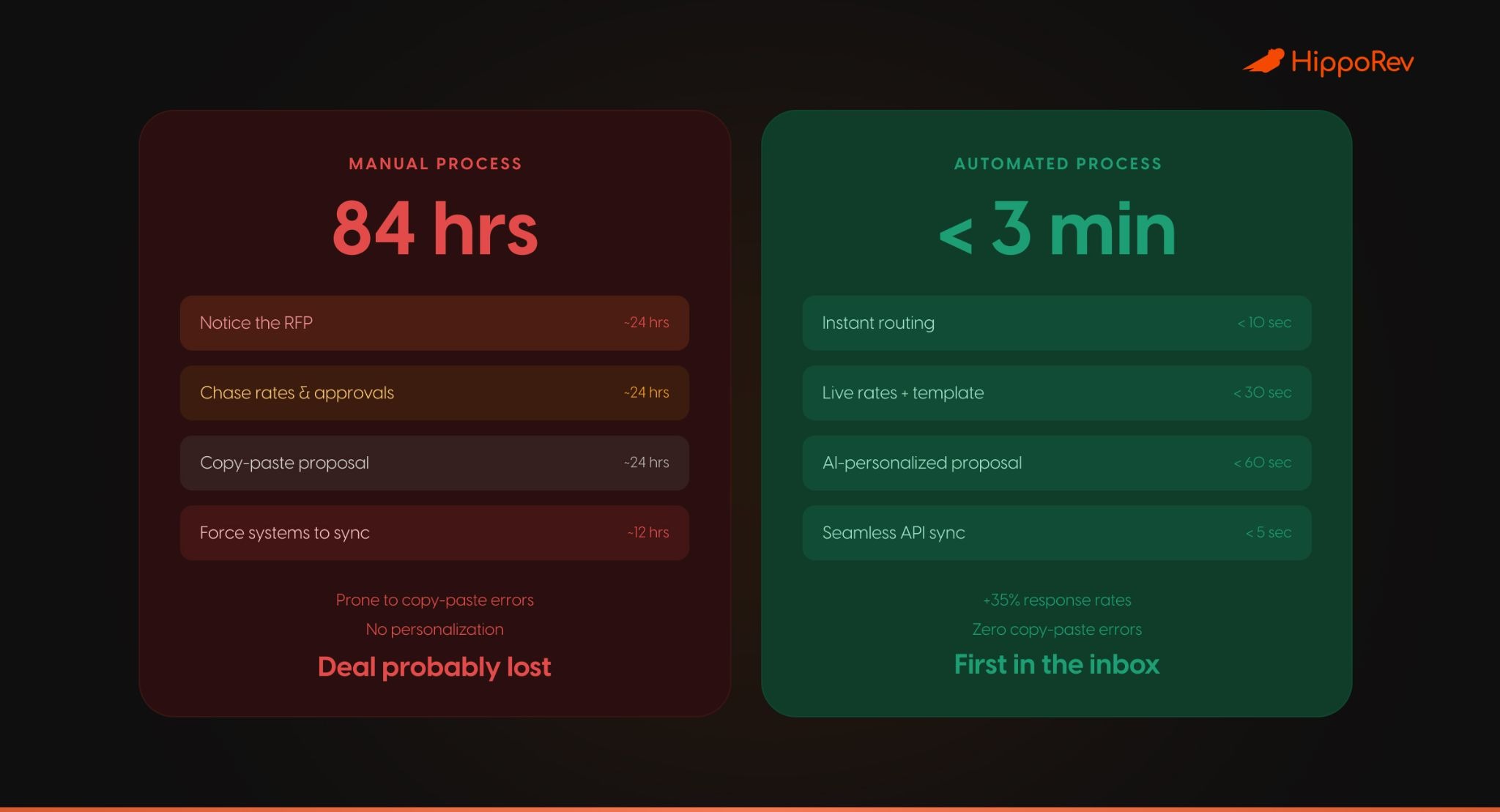
The reason sales teams feel they must choose between speed and quality is because their manual processes are fundamentally broken. Their current execution model is causing revenue to slip away at every stage.
When a typical RFP arrives, it triggers a chaotic, four-stage administrative scavenger hunt. A sales rep must manually notice the lead in a cluttered inbox, log into a disconnected Property Management System (PMS) to check availability, email Revenue Management for pricing approval, and then copy and paste all of this data into a fragmented Word document or Excel spreadsheet.
When humans do this manually, it takes days. When humans try to do this fast, they make catastrophic copy-paste errors—sending a proposal with the wrong group name or an incorrect room rate, instantly destroying the perception of quality.
This is where automation and Artificial Intelligence fundamentally change the equation. Technology removes the human variable from the speed of the first response while simultaneously increasing the accuracy and quality of the output.
When automation is correctly deployed, the process looks like this:
1. Instant Intake and Routing Instead of sitting in a shared inbox, the RFP is instantly ingested by the system. Automated lead routing assigns the lead to the correct sales manager based on territory, segment, or real-time availability in under 10 seconds.
2. Dynamic, High-Converting Templates The fear of "templates" is usually rooted in the memory of cold, robotic auto-responders. Modern automation uses dynamic, intelligent templates. Rather than starting from a blank page, the system utilizes pre-approved, brand-compliant frameworks.
The implementation of these intelligent templates actively drives engagement. In fact, utilizing customized, automated templates has been shown to yield +35% response rates from planners and prospects. Why? Because these templates are engineered for readability, transparency, and immediate value delivery, ensuring the buyer gets exactly the information they requested in a format that is easy to digest.
3. AI-Powered Personalization An AI agent does not just blast out a generic response; it reads the context of the inquiry. Within seconds, the AI can read the prospect's message, acknowledge their specific needs (e.g., "I see you require three breakout rooms with advanced AV"), query the hotel's integrated systems for live pricing and availability, and generate a contextual, highly personalized proposal.
By pulling verified data directly from the CRM and PMS through open API connections, automation eliminates the version errors and copy-paste mistakes that plague manual proposal creation. The math is flawless, the formatting is perfect, and the brand voice is rigidly maintained.
As Hippo Mate brilliantly asks: "Why choose between speed and quality when you can have both? Both directly determine whether you capture the deal revenue."
The Evidence: Automation Case Studies in Hospitality
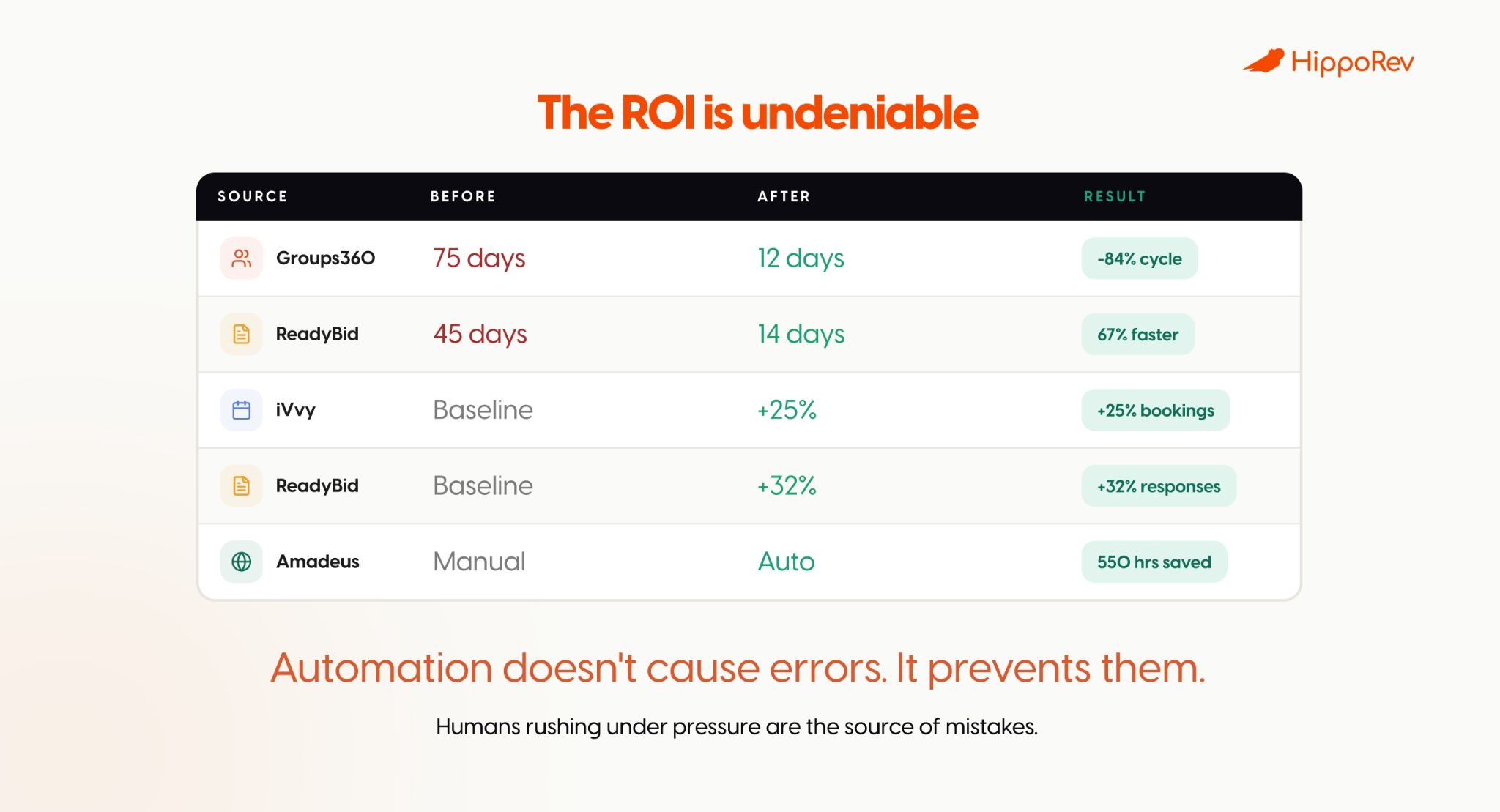
If you are still skeptical that software can accelerate your sales cycle without compromising your brand's standards, look at the verified ROI data from organizations that have already made the leap.
The implementation of sales automation and AI in the hospitality sector has yielded staggering, documented improvements across both velocity and operational quality:
- Shrinking the Sourcing Cycle: Data from Groups360's GroupSync platform reveals that implementing their automation solutions reduced the average sourcing cycle from a bloated 75 days down to just 12 days—an 84% reduction in friction.
- Faster Contract Finalization: According to 2024 data from ReadyBid, automation cut the contract finalization process from 45 days down to just 14 days, resulting in 67% faster sourcing cycle completion.
- Surging Win Rates: iVvy data demonstrates that automated proposal and booking engines resulted in 25% higher booking conversion rates. Similarly, ReadyBid reported a +32% increase in supplier response rates simply by automating the workflow.
- Massive Time Savings: Amadeus reports that deploying email and proposal automation can save a hotel sales team up to 550 hours per year.
The lesson is undeniable: Automation does not cause errors; it prevents them. Humans, rushing to meet a deadline while juggling fifty other tasks, are the source of sloppy mistakes. Algorithms operating with integrated data sources achieve a level of consistency and accuracy that manual labor simply cannot match.
The reason this trade-off between speed and quality feels real is because most sales workflows are fundamentally inefficient & structurally losing revenue. Read: What Happens in the 4 Days Before You Respond
Elevating the Human Element
There is a lingering fear among hotel sales professionals that embracing automation means replacing the "art" of sales with a machine. But this fundamentally misunderstands the purpose of AI in a commercial environment.
Currently, the average salesperson spends only 29% of their actual time selling. The remaining 71% of their week is consumed by administrative drudgery: hunting down rates, fighting with formatting in Microsoft Word, manually entering lead data into the CRM, and chasing internal approvals.
This administrative burden is exactly why 55% of hotel RFPs go completely unanswered, why a large share of revenue never gets captured at all. Sales reps filter their own pipelines, abandoning leads because the sheer weight of the manual response process is too heavy.
When you automate the initial response and proposal generation, you do not eliminate the salesperson; you liberate them.
Instead of acting as a human data-router—spending three days trying to force disconnected software platforms to talk to each other—your sales managers can instantly step into the role of strategic consultants.
Because the AI agent handled the initial 60 seconds of the interaction—delivering a flawless, branded proposal, answering basic qualification questions, and providing transparent pricing—the sales rep enters the conversation with a highly qualified, highly engaged buyer.
The human touch is no longer wasted on data entry. It is reserved for high-value activities: conducting an incredible property site tour, negotiating complex contract concessions, building genuine rapport with the event planner, and closing the deal.
As Brian Hicks, President and CEO of HSMAI, points out, "In sales, AI amplifies, rather than replaces, human talent. Predictive analytics, lead scoring, and proposal generation allow sales professionals to focus on consultative selling and relationship building".
Stop Making Excuses for Slow Revenue
The Speed vs. Quality Myth is a comfortable shield. It allows underperforming sales teams to justify their 42-hour response times by claiming they are protecting the brand's premium image.
But in a market where 80% of buyers expect a response in under four days, and where the vast majority of contracts are signed with the first property to reply, hiding behind the illusion of "bespoke quality" is a guaranteed recipe for losing market share.
Your competitors are adopting AI-first frameworks. They are consolidating their fragmented tech stacks, utilizing natural language processing to qualify leads instantly, and delivering transparent, highly customized proposals while your team is still waiting for a revenue manager to return an email.
You no longer have to choose between being the fastest or being the best. The technology exists today to be both.
It is time to audit your response protocols, tear down the administrative bottlenecks holding your team back, and deploy the automation required to answer every single RFP with flawless precision in a matter of minutes.
Many hotels are now using revenue capture platforms to generate proposals instantly while maintaining brand templates, accurate pricing, and contextual personalization. Hippo Rev is built around this principle, using automation to gather RFP data, apply property knowledge, and produce polished proposals within minutes rather than days.
Instead of sacrificing quality for speed, the technology removes the repetitive work that slows teams down in the first place & leads to lost revenue opportunity.
For sales leaders interested in seeing how faster execution helps you capture more revenue without compromising quality, booking a quick demo can provide a practical look at how these workflows operate.
Frequently Asked Questions
Is there really a trade-off between speed and quality in sales responses?
Historically, faster responses often meant sending generic messages. However, modern automation allows teams to deliver both speed and personalization simultaneously. AI systems can generate detailed responses using real-time data and templates.
What makes a high-quality hotel proposal?
A high-quality proposal answers the planner’s questions clearly, includes transparent pricing, and provides relevant details about event spaces and services. It should also be easy to review and tailored to the planner’s requirements. Speed alone isn’t enough without substance.
How does automation improve proposal accuracy?
Automation pulls data directly from integrated systems such as CRM and PMS platforms. This reduces copy-paste errors and ensures pricing, availability, and event details are consistent. Automated templates also maintain brand standards.
What technologies are used in modern hotel sales automation?
Common technologies include AI document analysis, workflow automation, CRM integration, and real-time data synchronization with property management systems. These tools streamline proposal creation and communication.
.jpeg)
The 4-Day Delay That Kills Hotel Sales
Four days of invisible RFP response chaos can quietly kill the deal. It's not laziness or lack of effort; it's a chain of compounding bottlenecks that most sales leaders have never mapped, measured, or even named.
What Happens in the 4 Days Before You Respond
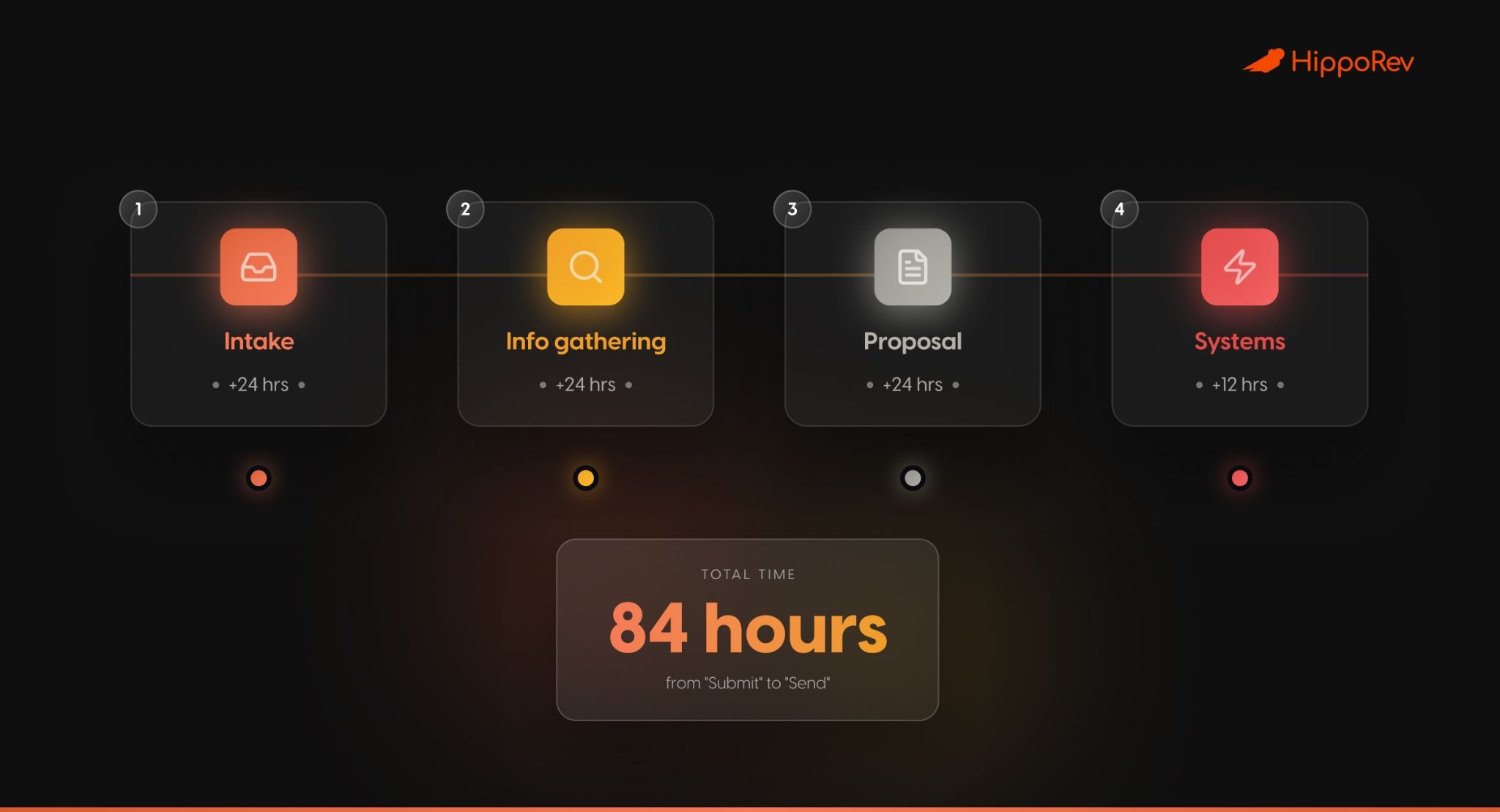
It is 9:00 AM on a Tuesday. A highly qualified event planner, managing a lucrative corporate summit with a 300-room block and a massive food and beverage budget, hits "Submit" on a Request for Proposal (RFP).
The digital inquiry flies through the ether and lands in your hotel’s system. For the event planner, their work is done, and the waiting game begins. In fact, research shows that 80% of planners expect an RFP response within four business days.
For your hotel, however, the clock has just started ticking on a chaotic, disjointed race against time.
If you ask the average hotel sales director how long it takes their team to respond to an RFP, they will likely tell you they are "pretty fast" and usually get back to prospects within a day or two. But the data tells a vastly different, more alarming story. A comprehensive Harvard Business Review audit analyzing 1.25 million sales leads across 2,241 U.S. companies revealed that the average B2B response time to a new inquiry is a staggering 42 hours. Even worse, the study found that 24% of companies took more than 24 hours to respond, and a shocking 23% never responded at all.
In the hospitality sector specifically, the numbers are actually worse. Platform data from Groups360 reveals that 55% of hotel RFPs go completely unanswered. They aren't declined; they are simply ignored.
How does this happen? How does a multi-thousand-dollar piece of business sit languishing in an inbox while sales teams genuinely believe they are working as fast as possible?
The answer lies in the anatomy of a slow response. Response time is not a single, isolated problem; it is a chain of compounding bottlenecks. Revenue loss happens through a chain of execution gaps that compound across the deal lifecycle. When we analyze the lifecycle of an inbound lead, we see what is known as the 4-Stage Leak Analysis. Time does not just disappear—it leaks at four distinct stages of the process.
To truly understand why you are losing deals to faster competitors, let’s break down exactly what happens inside the hotel sales office during those crucial four days before a response is finally sent.
Day 1: The Black Hole of Intake and Routing (Stage 1 Leak)
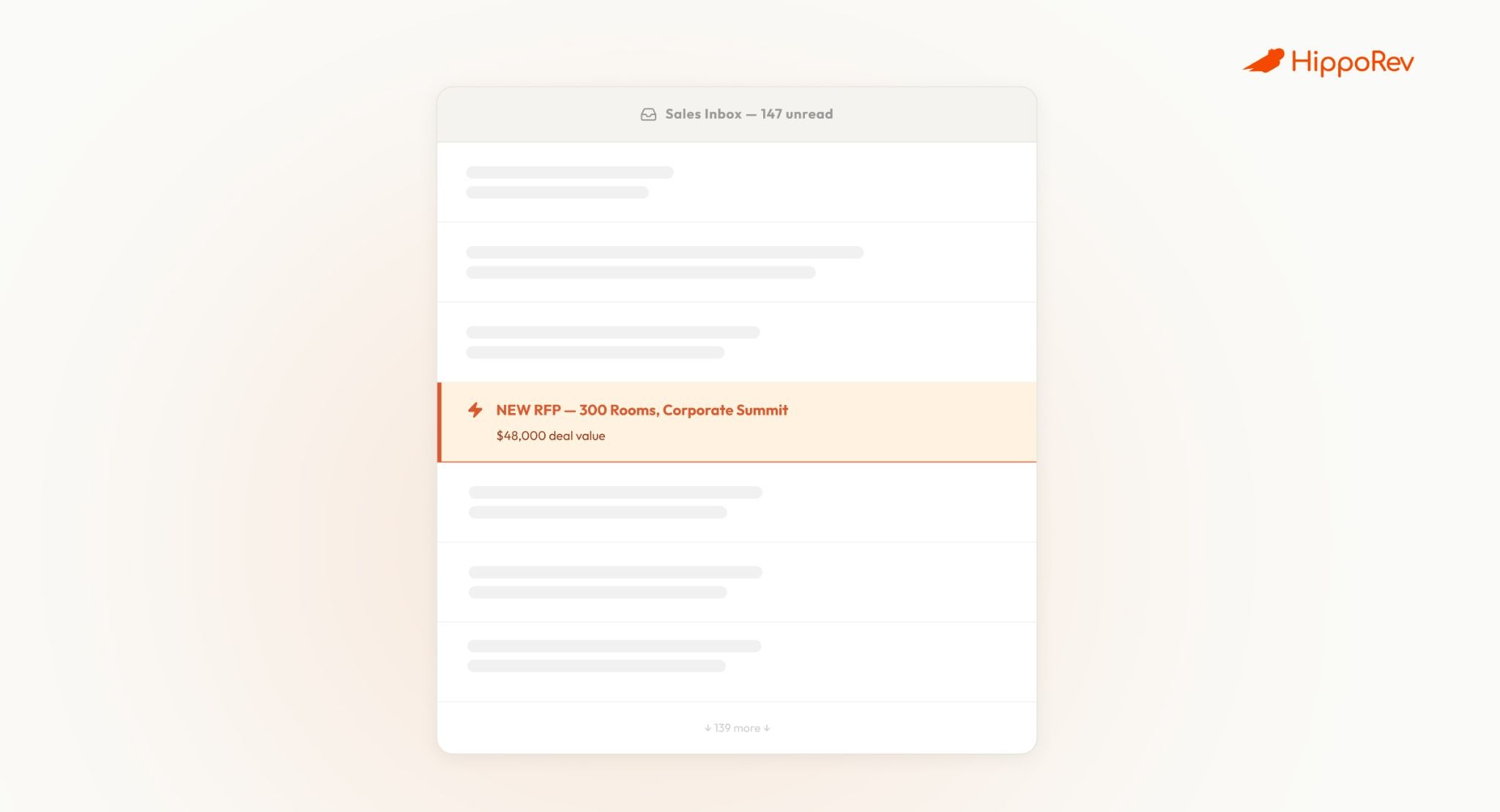
The Planner’s View: "I sent the RFP. The hotel is probably reviewing my event requirements right now." The Hotel's Reality: The RFP is buried in a shared inbox, and no one knows it exists.
The first major time leak happens at Stage 1: Lead Intake & Routing. In a modern hotel environment, RFPs do not neatly arrive in a single, organized queue. They arrive from multiple, fragmented sources: Cvent, direct emails, website forms, phone calls, and direct outreach.
On Day 1, your sales team is busy. The Director of Sales is in a two-hour revenue strategy meeting. Your top sales managers are conducting property site tours, putting out fires from a group currently in-house, or stuck in a lengthy Banquet Event Order (BEO) review.
Because the hotel relies on the manual monitoring of multiple inboxes and platforms, there is no automated routing system in place. This means that prioritization and assignment rely entirely on a human being having the free time to log in, read the inquiries, evaluate the size and scope of each lead, and manually forward it to the appropriate sales manager.
Often, sales and catering systems fail to capture the exact timestamp of when the RFP was received versus when the work actually began. As a result, hours—or even an entire business day—are lost simply noticing that the RFP has arrived. The prospect’s buying intent is currently at its absolute highest, but your team has not even opened the email.
By the end of Day 1, the lead has finally been spotted and assigned to a sales manager. But 24 hours have already burned off the clock.
Read: The 72% Rule and Why Being Second Means Losing
Day 2: The Scavenger Hunt for Information (Stage 2 Leak)
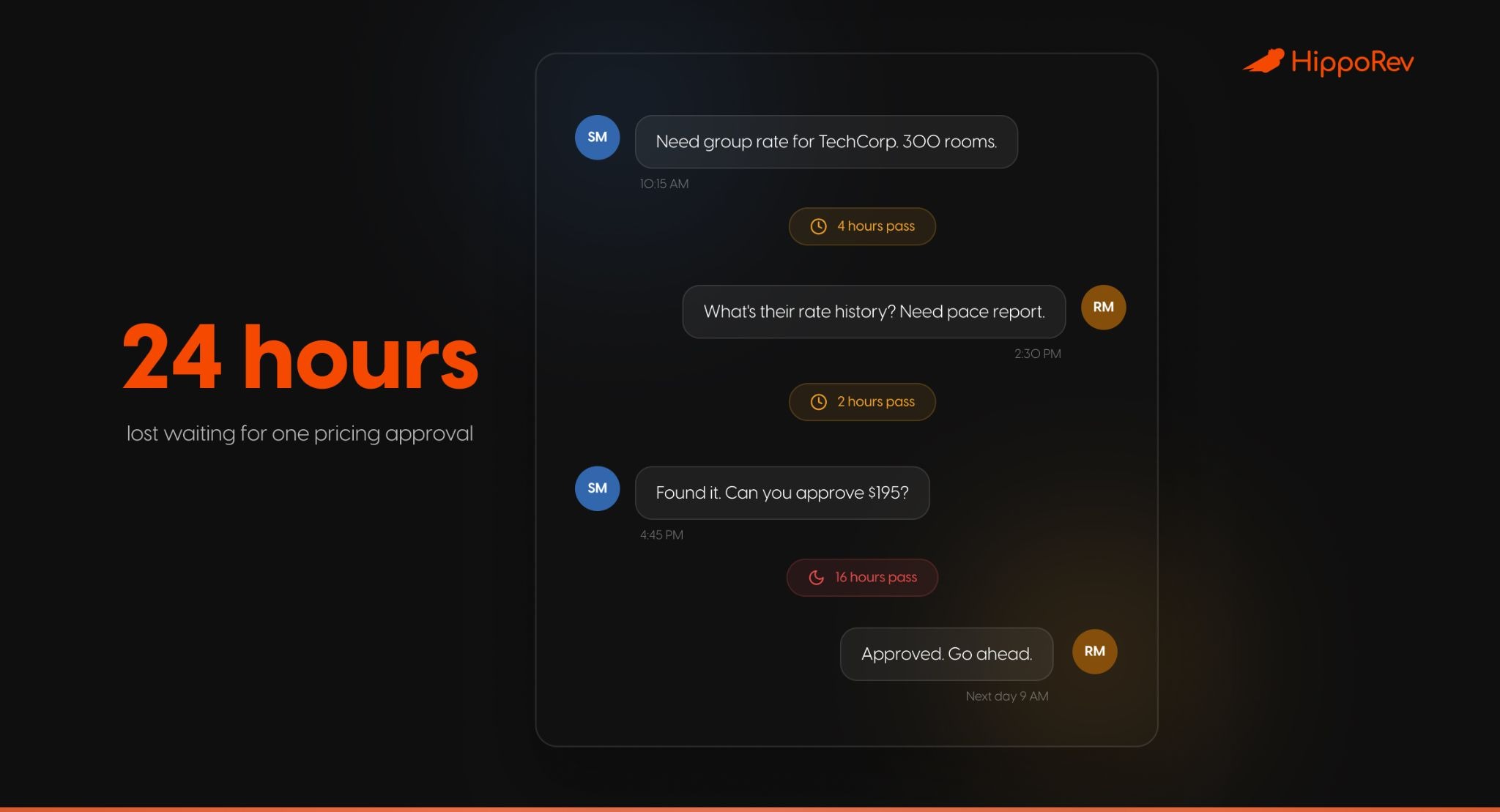
The Planner’s View: "The hotel is probably checking their availability and crunching numbers to get me the best possible rate." The Hotel's Reality: The sales rep is waiting for Revenue Management to reply to an email.
Now that the RFP is in the hands of the assigned sales manager, the real work begins. Or, more accurately, the waiting begins. Welcome to Stage 2: Information Gathering.
Before the sales manager can even begin to craft a compelling proposal, they need facts. They spend hours manually searching for rates and availability across disconnected systems. They need to manually research the prospect's account history to see if the group has stayed at the property or a sister property in the past.
Most importantly, they need pricing. Because dynamic pricing and group rate guidelines are often tightly controlled, the sales manager cannot simply quote a rate. They must draft an email to the Revenue Management team requesting approval for a specific rate block and concessions.
But Revenue Management is also busy. They are analyzing pace reports, adjusting transient rates, and sitting in their own meetings. The sales manager's pricing request sits in the Revenue Manager's inbox.
This represents massive hours lost waiting for information that, with the right technology, should be instant. The sales manager is essentially acting as a human router, chasing down internal details rather than selling the value of the property.
This is where revenue stalls—waiting on internal systems instead of moving toward conversion.
As Hippo Mate brilliantly puts it: "Why chase disjointed details for days when they can be gathered in minutes?".
By the end of Day 2, the Revenue Manager finally approves the group rate. But another 24 hours are gone. Meanwhile, data from Cvent shows that 61% of RFPs are ultimately awarded to one of the first three responders. At the 48-hour mark, it is highly likely that one of your competitors has already submitted a polished proposal and secured their place as the psychological anchor for this deal.
Day 3: The Copy-Paste Proposal Grind (Stage 3 Leak)
The Planner’s View: "The hotel must be customizing a beautiful, highly tailored proposal specifically for my group." The Hotel's Reality: The sales rep is fighting with formatting errors in a fragmented Excel spreadsheet.
On Day 3, the sales manager finally has all the raw ingredients required to respond: the dates are clear, the space is held, and the rates are approved. Now comes Stage 3: Proposal Creation.
In a hotel lacking sales automation, this stage is an agonizing exercise in administrative data entry. Time is heavily lost rebuilding what should be an automated process. The sales manager opens up a fragmented spreadsheet or an outdated Word document version of a proposal template.
They begin the repetitive data entry required to move information from the RFP into the hotel's property systems, and then from the systems into the proposal document. They manually customize the template for the prospect, copying and pasting the group name, the event dates, the room block matrix, and the F&B minimums.
Because this is a highly manual process, it is inherently prone to human error. A single copy-paste mistake from a previous proposal can result in sending the wrong group name or an incorrect rate—a mistake that instantly signals a lack of professionalism to the planner. The sales manager spends an extra hour meticulously proofreading the document to ensure the formatting hasn't broken and the math adds up.
A task that an AI-powered system could generate flawlessly in a matter of seconds has just eaten up half of the sales manager's afternoon.
Day 4: Fighting with the Systems (Stage 4 Leak)
The Planner’s View: "I really hope I hear back today. If not, I'm moving forward with the properties that already replied." The Hotel's Reality: The sales rep is trying to force three different software platforms to talk to each other.
It is now Day 4. The proposal is finally ready to send. But there is one final hurdle: Stage 4: System Integration Issues.
Because the hotel operates on disconnected Property Management Systems (PMS), Central Reservation Systems (CRS), and Customer Relationship Management (CRM) platforms, nothing syncs automatically. Manual data transfers between these systems cause version errors and severe administrative friction.
The lack of open API connections between platforms means the sales manager loses hours doing the administrative heavy lifting that technology was specifically designed to handle. They must manually log the activity in the CRM, manually update the status in the sales and catering system, and manually send the final PDF to the client via email or the Cvent portal.
Finally, 84 hours after the prospect hit "Submit", your sales manager hits "Send"—long after the revenue opportunity has shifted elsewhere.
The sales team breathes a sigh of relief. From their perspective, they successfully navigated a complex internal process and got a proposal out the door. They feel productive.
But out in the real world, the math tells a brutal story. According to data from Premiere Advisory Group and Cvent, hotels that respond within 24 hours are 70% more likely to win the bid. By waiting four days, your hotel has drastically slashed its own win probability. You have essentially done four days of administrative labor for the privilege of losing the deal.
The Compounding Effect of Administrative Delay
What becomes painfully obvious when looking at this day-by-day breakdown is the compounding effect of these time leaks.
Response time is not a single, massive delay; it is four distinct problems stacked on top of each other. A delay at Stage 1 (Intake) pushes back everything that follows. When a sales manager is balancing an active pipeline, conducting site tours, and managing 50 to 100 incoming RFPs per month, these small, seemingly insignificant delays multiply into a massive aggregate loss of time.
Fixing just one stage without addressing the others still leaves you slow. If you fix proposal generation but ignore lead routing, the lead still sits unseen for 24 hours. If you fix system integrations but your reps still have to wait a day for Revenue Management to approve pricing, you still lose the speed advantage.
[[Our Speed Wins Revenue Playbook is your guide to closing the gap between a 4-day delay and a same-day response. Built on verified research from top hospitality platforms and academic studies, this playbook provides the framework you need to overhaul your sales process & capture more reveue.]]
The Harsh Truth: Why 23% Never Respond At All
When you view the RFP process through the lens of this 4-Stage Leak Analysis, it suddenly becomes very clear why the Harvard Business Review found that 23% of B2B companies never respond to inquiries at all.
It also explains the staggering Groups360 data showing that 55% of hotel RFPs go completely unanswered.
When the administrative burden of responding to an RFP takes four days of chasing, copying, pasting, and navigating disconnected systems, sales reps naturally begin to filter their own pipelines. If a lead looks "too small" or "too difficult," or if the sales rep is simply having a busy week, the psychological weight of the 4-stage process causes them to abandon the lead entirely.
This represents a purely lost revenue opportunity. If your marketing and distribution teams are spending money to drive visibility and generate RFPs, letting 55% of them vanish into the ether is a catastrophic failure of ROI.
You Cannot Hire Your Way Out of a Structural Problem
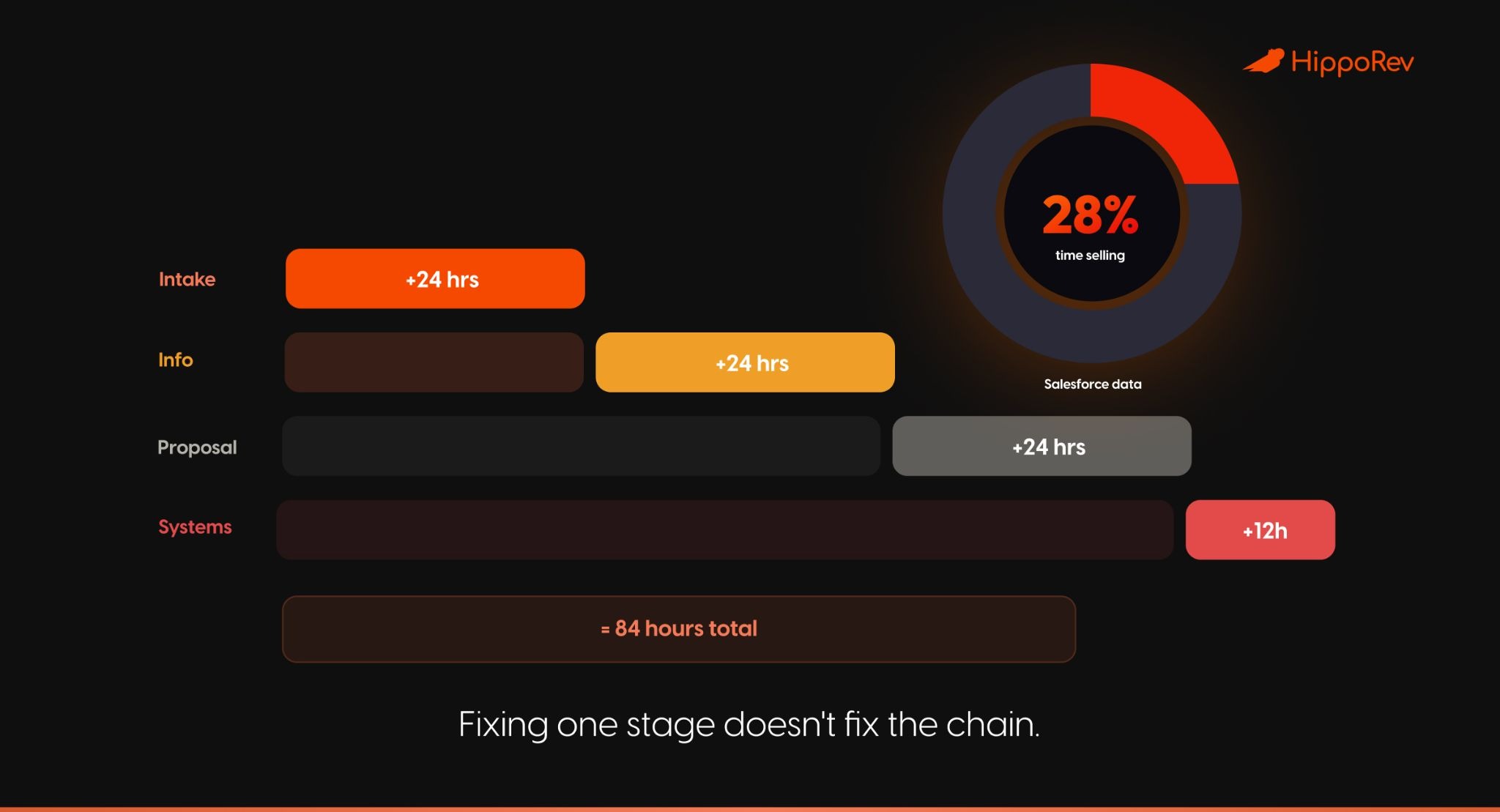
When hotel leadership finally realizes that their response times are costing them millions in group revenue, the knee-jerk reaction is often to demand that the team "work faster" or to request budget to hire more sales coordinators.
But the staffing reality check proves this is an unwinnable battle. Currently, 65% of U.S. hotels still report staffing shortages, according to the AHLA. Hotel employment remains nearly 10% below pre-pandemic levels. Furthermore, the hospitality industry suffers from the highest turnover of any U.S. industry, churning through staff at a rate of 70-80% annually.
Even if you could fully staff your office, human beings have physical limitations. Salesforce data shows that salespeople spend only 28% of their actual time selling. The other 71% is eaten up by the exact administrative leaks detailed in the 4-stage breakdown.
The math simply does not support adding more humans to solve a structural, technology-based process problem.
The Ultimate Cost of Days vs. Minutes
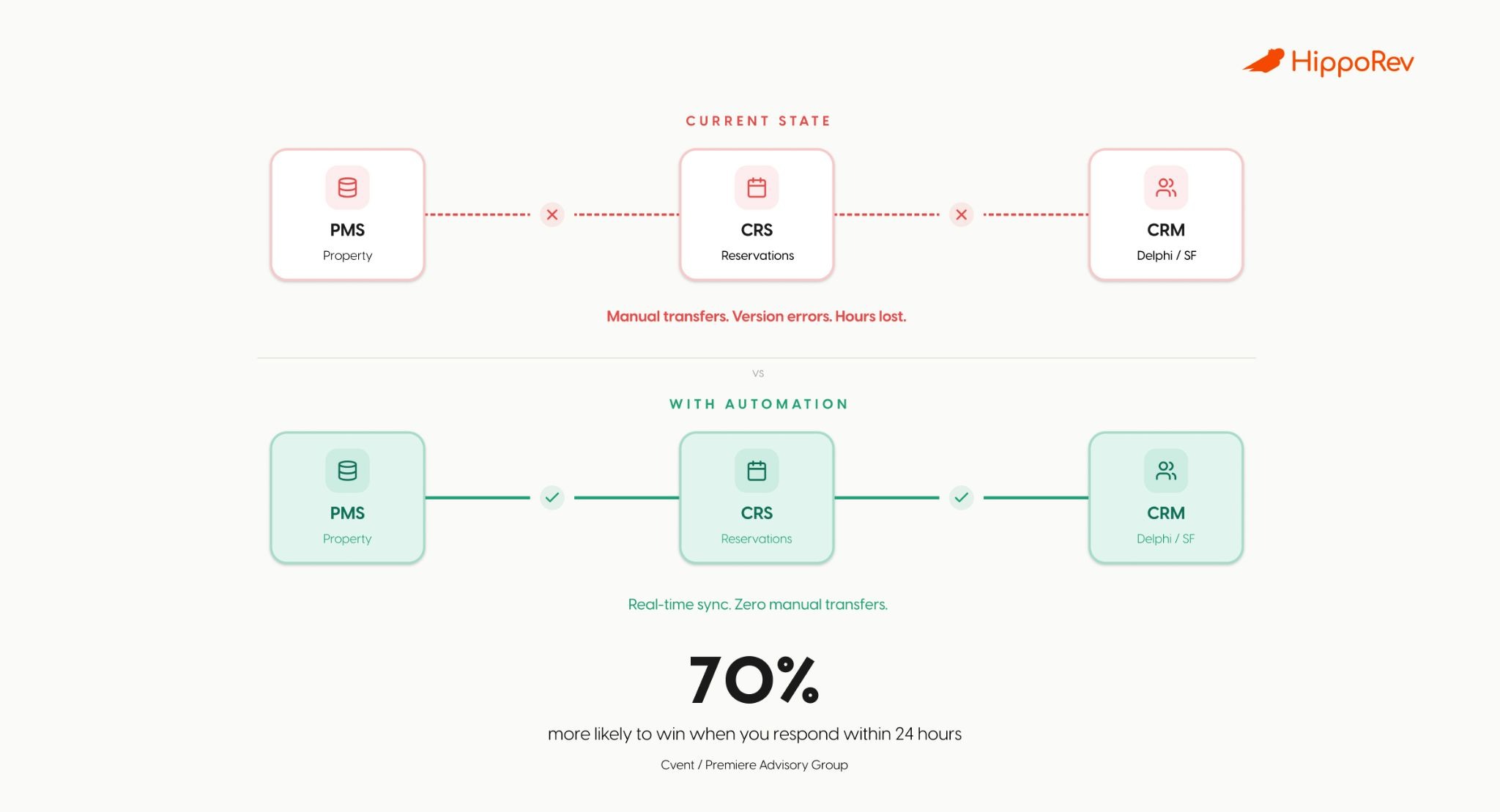
Event planners are professional buyers. They know that how a hotel handles the sales process is a direct preview of how they will handle the actual event.
When a response takes four days, it can unintentionally give event planners the impression that your team might be stretched too thin to fully prioritize their event. 24% of event professionals cite slow replies as a top frustration, and 37% of planners cite bad communication as the primary reason they choose another property.
Non-responsiveness and slow replies do not just cost you the current deal—they remove you from future consideration. Planners have long memories, and 93% of them are willing to pay more to book with hotels where they have established, reliable relationships.
If you trace your RFPs and find that they are languishing in the 4-day cycle of Intake, Information Gathering, Proposal Creation, and System Integration, you are bleeding pipeline & you are losing revenue before it even enters your pipeline.
Technology is the only scalable solution. With an AI-powered system, lead routing is instantaneous. Information gathering takes seconds. Proposal generation is automated. System integrations are seamless.
Ready to stop leaking pipeline?
When you break down the anatomy of a slow response, it becomes clear that the problem isn’t effort—it’s process.
Increasingly, hotels are addressing these structural bottlenecks with workflow automation that removes the manual friction between each stage. Hippo Rev is built around this exact idea:
It works as a revenue capture platform that runs deal execution across your systems—automatically capturing RFPs from multiple channels, gathering missing event details, generating proposal drafts, syncing information across systems, and moving deals forward without delay, so sales teams can focus on the client instead of the paperwork.
Instead of compressing four days of manual work into one stressful afternoon, automation restructures the workflow so the response can happen in minutes. If you’re exploring ways to fix the structural leaks in your sales process, seeing how these AI-driven workflows operate in a live demo can be surprisingly eye-opening.
Frequently Asked Questions
Question: How can hotels reduce their RFP response time?
Answer: Improving response time requires redesigning the workflow rather than simply asking sales teams to work faster. This includes automated lead routing, instant pricing access, and standardized proposal generation. AI-powered systems like Hippo Rev automate these steps so responses can be generated much faster.
Question: Why is responding within 24 hours important for hotel RFPs?
Answer: Studies show hotels that respond within 24 hours are significantly more likely to win the bid. Fast responses signal professionalism and responsiveness to planners. They also allow the property to establish the first psychological anchor.
Question: Can automation replace hotel sales managers?
Answer: Automation doesn’t replace the salesperson—it removes repetitive administrative work. This allows sales managers to spend more time building relationships with planners and negotiating deals. The human role becomes more strategic.
Question: What happens if hotels ignore process improvements in RFP response?
Answer: Slow response processes can lead to lost revenue, frustrated planners, and lower conversion rates. Over time, planners may stop including the property in RFP invitations altogether. Improving the response workflow helps protect long-term pipeline health.
.jpeg)
Revenue Leakage in Group Sales: Why Deals Are Lost Before You Respond
Research shows that most of the buyers sign with the first company that responds to their inquiry, not the cheapest or the best-equipped. Yet the average B2B response time sits at a staggering 42 hours, and 55% of hotel RFPs are never answered at all.
The 72% Rule and Why Being Second Means Losing
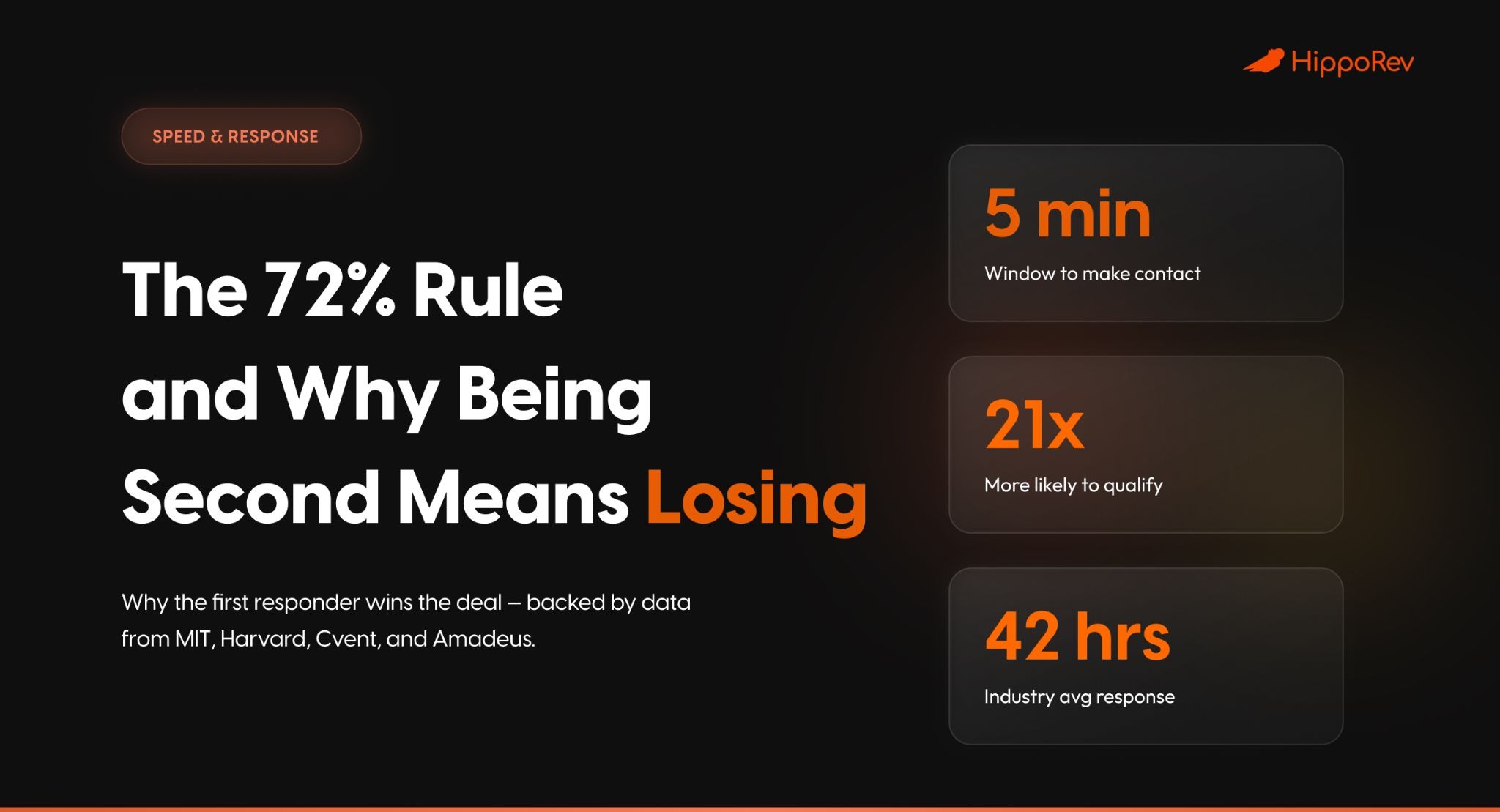
When was the last time your sales team tracked exactly how long it takes to respond to a new inbound lead or Request for Proposal (RFP)? If you are like the vast majority of hotel and B2B sales leaders, the honest answer is either "not recently" or "never". We meticulously track occupancy rates, average daily rates (ADR), RevPAR, and pipeline conversion metrics, yet response time—the very first interaction with a potential client—remains a massive blind spot.
Sales teams often operate under the assumption that they are "fast enough." They are busy, deals are closing, and the pipeline is moving. But in today’s hyper-competitive landscape, "fine" is the enemy of winning.
The reality is that you are no longer just competing on price or property. You are competing on how quickly you can capture and convert demand before it slips away. This is not sales folklore or motivational opinion; it is a proven reality backed by millions of data points and rigorous transaction data.
Welcome to the harsh truth of modern sales:
If you aren’t first to respond, that revenue is already moving to someone else.
The Rise of the Consumer-Trained Buyer
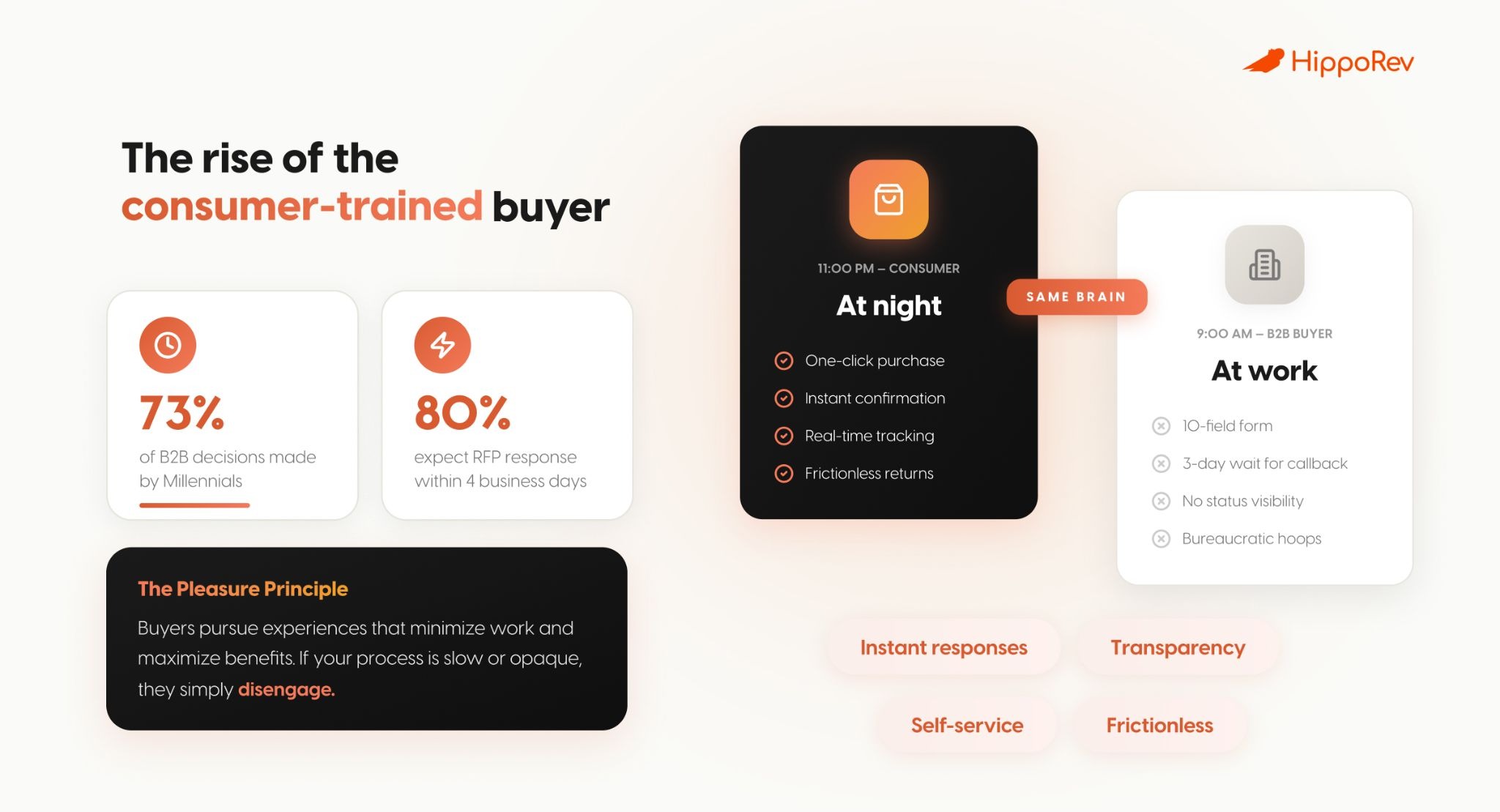
To understand why speed is so critical, we must first understand the psychology of the modern buyer. Today, 73% of all B2B buying decisions are made by Millennials. This demographic grew up in an era of frictionless, self-service digital experiences and expects the same level of ease and responsiveness in their professional lives that they enjoy as consumers.
Psychologically, buyers no longer separate their consumer selves from their professional selves. The same brain that appreciates a seamless, one-click transaction at night expects instant, frictionless engagement at work the next morning.
This is driven by the "pleasure principle," which states that people naturally pursue experiences that minimize work and maximize benefits. If your purchasing or booking process is slow, lacks transparency, or feels burdened by bureaucratic hoops, prospective buyers will simply lose interest and disengage. They do not want to fill out a 10-field demo request form and wait three days for a callback.
The Science of Speed: First Responder Research
When we look at the transaction data, the mathematics of lead response time are brutal and unforgiving.
The gold standard in speed-to-lead research is the Lead Response Management Study conducted by Dr. James Oldroyd at MIT and InsideSales.com. This peer-reviewed study analyzed over 15,000 unique leads and more than 100,000 call attempts across three years.
The researchers focused on a single, critical question: When should companies call web-generated leads for optimal contact and qualification ratios?
The findings completely shattered traditional sales timelines:
- The 5-Minute Window: Contacting a lead within the first 5 minutes versus 30 minutes makes you 100 times more likely to make successful contact.
- The 21x Multiplier: More importantly, reaching out within that 5-minute window makes you 21 times more likely to qualify the lead compared to waiting just 30 minutes.
- The Exponential Drop-Off: After the first 5 minutes, the odds of successful contact drop 10-fold within the first hour. By the time 30 minutes have passed, a prospect's interest has plummeted by more than 50%.
Why does this happen? The answer lies in the "contextual window". When a lead submits an inquiry, they are in a focused moment—actively researching, comparing options, and ready to engage. The moment they shift their attention to their inbox, their next meeting, or a new browser tab, you are no longer competing with other vendors; you are competing with the rest of their day.
The 72% Rule and The Psychological Anchor
In the hospitality and B2B sectors, the "first responder advantage" is absolute. Research from Lead Connect reveals that 78% of customers end up buying from the first company that responds to their inquiry. They do not necessarily buy from the cheapest vendor, nor the one with the best product—they buy from the one that answers first.
This aligns perfectly with what we see across industry-specific platforms. While the exact metrics vary, the directional truth remains constant. Consider the 72% Amadeus stat and the 79% Thynk stat, which further reinforce that the vast majority of event planners and travel buyers overwhelmingly award their business to the properties and platforms that reply with unmatched speed.
We see this heavily reflected in Cvent’s Supplier Network data, which shows that 61% of all RFPs are awarded to one of the first three responders. Furthermore, hotels that respond to an RFP within 24 hours are 70% more likely to win the bid.
When you respond first, you create a psychological anchor. By being quick, you demonstrate that your team is organized, eager, and professional. The planner begins their mental anchoring around your early response, and any later responses from competitors are compared against your baseline—often unfavorably.
The Cost of Being Average
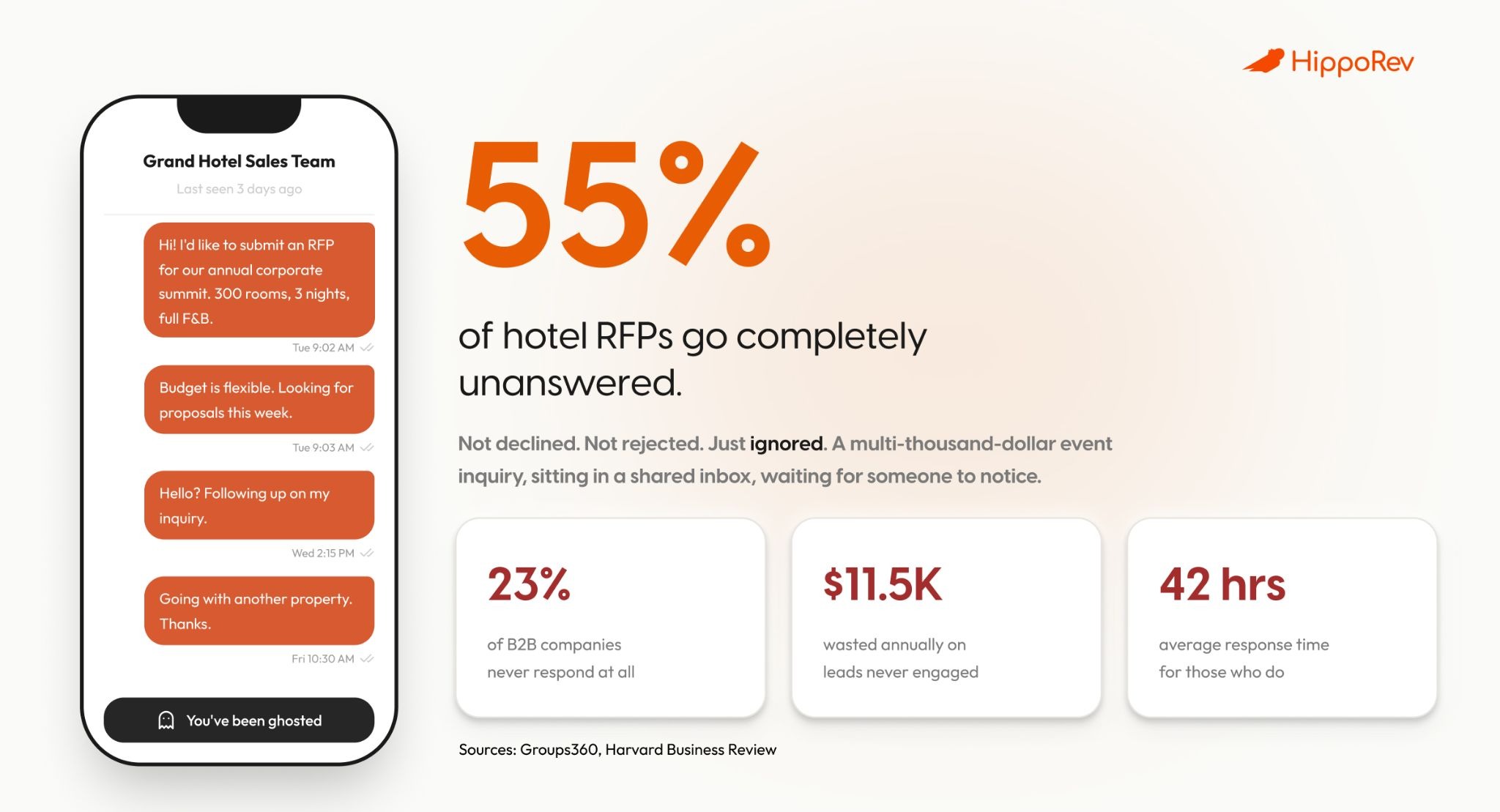
Despite this overwhelming evidence, the average B2B response time is shockingly slow. A comprehensive Harvard Business Review audit of 2,241 U.S. companies found that the average time to respond to a web-generated lead was 42 hours.
Even worse, the audit found that:
- Only 37% of companies responded within one hour.
- 24% took more than 24 hours to respond.
- 23% never responded at all.
In the hotel industry, the numbers are equally alarming. Groups360 platform data reveals that a staggering 55% of hotel RFPs go completely unanswered—they aren't declined or rejected; they are simply ignored. This represents direct revenue loss—deals that never even enter your pipeline.
If your marketing team is spending thousands of dollars generating leads through ads or platforms, every lead lost to a slow response is wasted ad spend. For example, if you generate leads at $8 each, losing 120 leads a month due to slow responses equates to nearly $11,520 wasted annually on leads you never properly engaged.
Where Your Response Time is Leaking
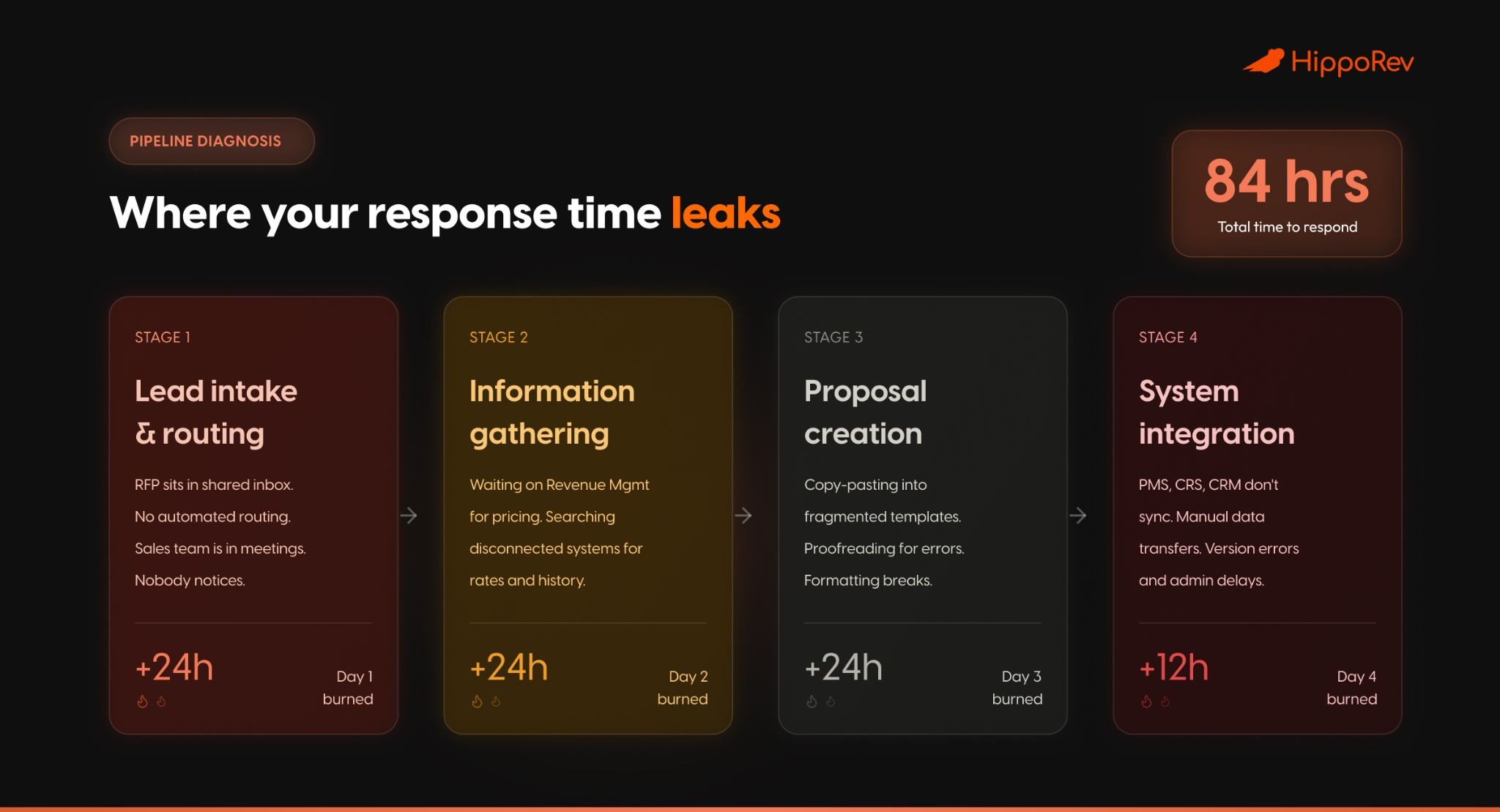
Most organizations know they aren't as fast as they should be, but they don't know why. The truth is, response time isn't a single problem; it is a chain of compounding bottlenecks.
Revenue loss doesn’t come from one failure—it happens across a chain of execution gaps that delay every deal.
When an inquiry or RFP arrives, time typically leaks at four distinct stages:
Stage 1: Lead Intake & Routing RFPs and leads pour in from multiple, disconnected sources—email, web forms, phone calls, and platforms like Cvent. Because teams manually monitor these inboxes without automated routing, hours or even days are lost simply noticing that the RFP arrived.
Stage 2: Information Gathering Once the lead is spotted, sales reps waste hours collecting missing details or searching for rates and availability across disconnected systems, researching account histories, and waiting for pricing approvals from revenue management.
Stage 3: Proposal Creation Next comes repetitive data entry. Sales managers manually customize proposal templates for each prospect, fighting with fragmented spreadsheets and outdated document versions.
Stage 4: System Integration Issues Finally, a lack of open API connections between the PMS, CRS, and CRM means manual data transfers cause version errors and severe administrative delays.
A delay at Stage 1 pushes back everything that follows. When your sales team handles 50 to 100 RFPs a month, these small delays multiply into massive aggregate time losses.
You Cannot Hire Your Way Out of This
Faced with slow response times, the traditional management reflex is to hire more people. But the math simply doesn't support adding more humans to solve a structural process problem.
Consider the current staffing reality: 65% of U.S. hotels still report staffing shortages, and hotel employment remains nearly 10% below pre-pandemic levels. Furthermore, the hospitality industry suffers from the highest turnover of any U.S. industry, sitting at 70-80% annually. Meanwhile, Salesforce data shows that salespeople spend only 29% of their actual time selling.
Human agents also have physical limitations. They have to sleep, eat, and attend meetings. Leads, however, do not stop at 5:00 PM. A European prospect might research your solution at 3:00 PM their time, which is early morning in the US. A C-suite executive might browse your offerings at 11:00 PM on a weekend. If you rely purely on human follow-up, you suffer from a massive "Experience Gap" where high-intent buyers go cold while waiting for your team to clock in.
Your current execution model has structural limitations that prevent you from capturing demand & revenue consistently.
For a behind-the-scenes look at why we built a technological solution to address this exact reality, read why HippoRev exists.
The AI Imperative: Seconds, Not Hours
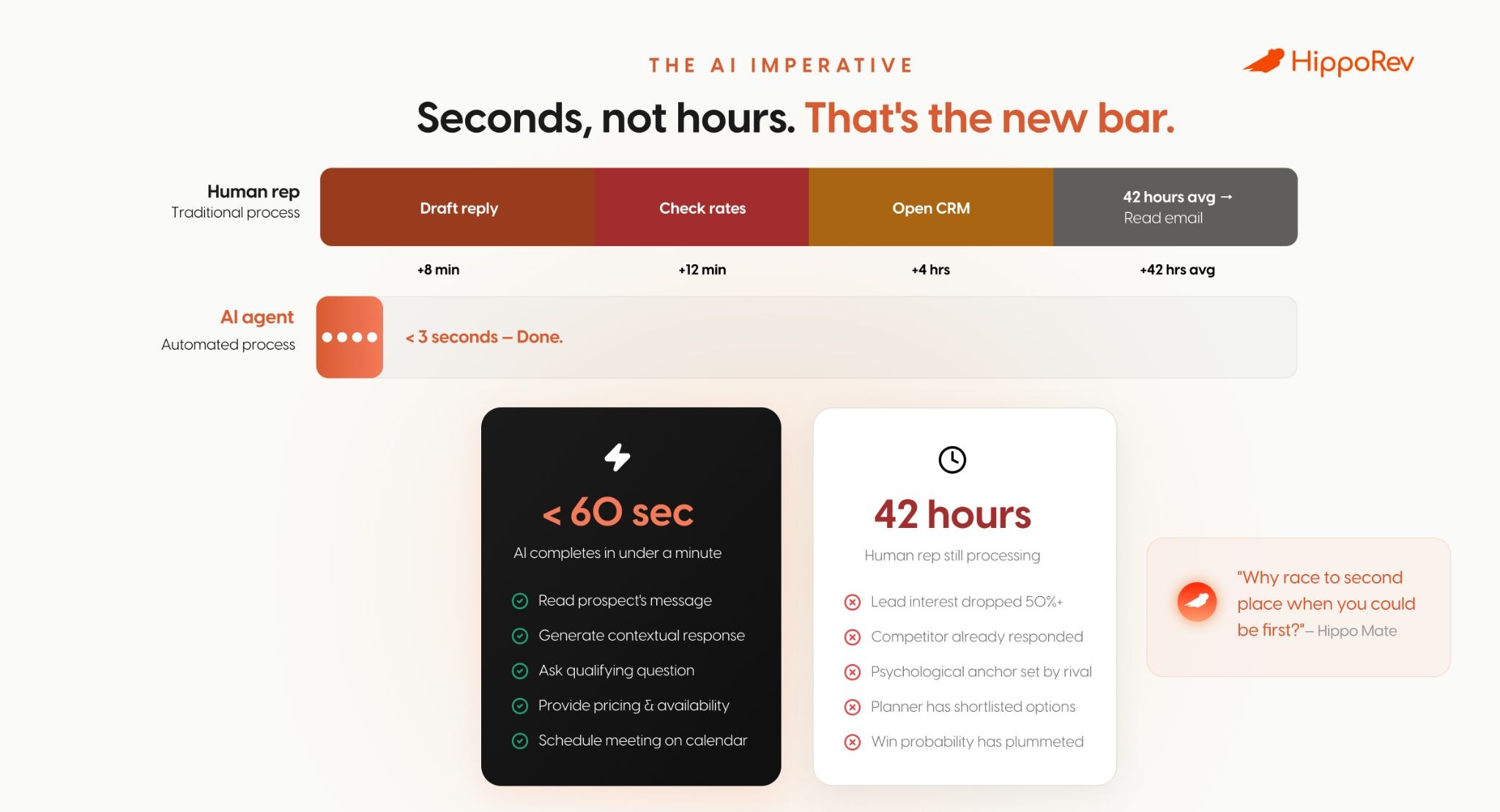
The gap between a 42-hour industry average response and a 5-minute elite response isn't closed by working harder; it is closed by working differently. Technology is the only scalable solution.
This is where Artificial Intelligence fundamentally alters the sales & revenue equation. A well-configured AI agent completely transforms response times & removes the delays that cause revenue loss:
- Constant Speed: An AI maintains a response time of less than 3 seconds, whether it is handling 5 messages or 500 simultaneously.
- Infinite Scalability: Unlike a human who gets saturated at high volumes, an AI maintains perfect quality and speed under any load.
- 24/7 Availability: AI agents operate 365 days a year without schedules, vacations, or sick leaves.
In the time it takes a human sales rep to simply read an email notification and open the CRM, an AI agent has already done the heavy lifting. Within the first 60 seconds, an AI agent can read the prospect's message, generate a contextual response, ask a qualifying question, provide pricing and availability details, and offer a concrete action—like scheduling a meeting directly on the sales rep's calendar.
By capturing the prospect exactly when their buying intent is highest, you eliminate the need for chasing cold leads.
As Hippo Mate wisely asks: "Why race to second place when you could be first? Why let revenue go to someone else when it could have been yours?"
You do not have to be the absolute best hotel or software on the market to win the deal. You just have to be in the conversation. Speed gets you in the room.
If you want to stop guessing and start measuring what speed is worth to your pipeline, it’s worth our full playbook. Download it here.
Calculate Your Cost of Being Slow
If you want to know exactly how much your slow response time is costing your business, look at the mathematics of the Speed Advantage.
Platform data shows that responding within 24 hours makes you 70% more likely to win. If your baseline win rate is 5%, a fast responder could achieve an 8.5% win rate.
Imagine you receive 100 RFPs a month, and 70% of them are responded to after the 24-hour mark. If your average deal value is $8,000, that 3.5 percentage point improvement in win rate equates to $19,600 in recoverable revenue every single month. That is over $235,000 a year that you are losing simply because you were too slow to reply.
You aren't losing deals because of price. You are losing them before you even get the chance to talk about price.
Self-Assessment: Is Your Pipeline Leaking?
The companies winning in today's market are not necessarily smarter or luckier—they are just faster. Your leads are already looking at competitor options, and the only question is whether you will be in that conversation or sitting on the sidelines because you took too long to call.
Where does your team stand? Take a moment to answer these critical audit questions honestly. Every "No" represents a massive revenue opportunity:
- [ ] Do you track average response time to RFPs as a primary KPI?
- [ ] Do you know how often your property is among the first 3 responders?
- [ ] Have you mapped out your four-stage response process and identified specific bottlenecks?
- [ ] Do you have automated alerts that trigger the exact second a new RFP arrives?
- [ ] Can your sales team access live rate and availability information instantly without waiting on revenue management?
- [ ] Are your PMS, CRS, and CRM systems fully integrated?
- [ ] Have you calculated the hard revenue impact of your current response time?
- [ ] Is response time improvement officially tied to your sales team's compensation or goals?
If you scored fewer than 5 "Yes" answers, you have a major opportunity to capture lost revenue. You cannot improve what you do not measure.
Stop losing revenue to faster competitors. It is time to map your bottlenecks, measure your baseline, and implement the automation needed to transform your sales cycle from weeks into minutes.
The Race to Now: From Lost Deals to Captured Revenue
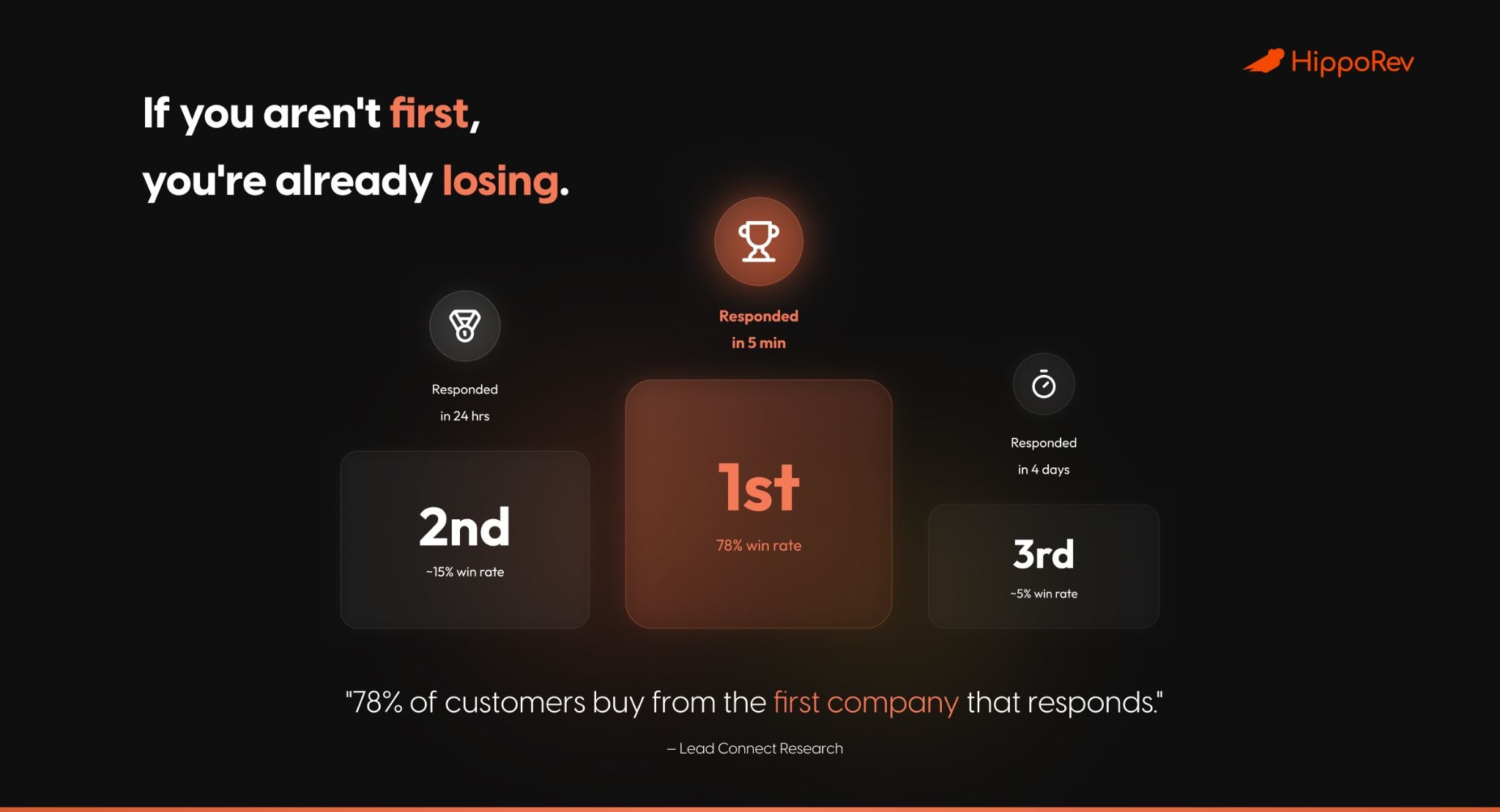
If the real battle in modern B2B sales is speed, then the real question becomes how to respond in minutes instead of hours. Many hotel teams are now experimenting with AI-driven workflows that capture inbound inquiries instantly, qualify them, and generate proposal drafts before a sales manager even opens their inbox.
Hippo Rev, for example, is built as a revenue capture platform designed specifically for hotel group sales teams to automate RFP intake, fill in missing event details, and generate proposals within minutes rather than days, ensuring every inquiry is captured and converted before it slips away. The goal isn’t replacing human salespeople—it’s eliminating the administrative delays that cost deals before the conversation even begins.
When speed is the first signal of professionalism, tools that shorten response time can make the difference between being first in the planner’s inbox or never entering the conversation at all. If you’re curious how fast-response workflows work in practice, it’s worth exploring a demo of how Hippo Rev handles inbound RFPs & and converts every high-intent opportunity without delay.
Frequently Asked Questions
Question: What is the 5-minute rule in B2B lead response?
Answer: The 5-minute rule refers to research showing that contacting a new inbound lead within five minutes dramatically increases the chances of successful engagement. Studies from MIT and InsideSales found companies are 21 times more likely to qualify a lead when they respond within this window. This is because buyers are still actively researching when they submit inquiries.
Question: Why does responding first to an RFP increase win rates?
Answer: Responding first creates a psychological anchor for the buyer. Event planners often evaluate later responses relative to the first proposal they receive. Being the first responder positions your property as organized, attentive, and easier to work with.
Question: What is speed-to-lead in hospitality sales?
Answer: Speed-to-lead refers to how quickly a hotel or vendor responds after receiving a new inquiry or RFP. Faster response times increase engagement and qualification rates. Many hotels now track response speed as a core sales KPI.
.png)
What’s New at Hippo Rev: April, 2026
For years, hotel group sales have been held together by spreadsheets & scattered PDFs. This fragmented approach leads to inconsistent, slow RFP responses, and lost revenue. Hippo Rev’s new Hotel Setup platform changes that by centralizing every detail of your property—from ceiling heights to AV specs—into a single, intelligent profile
What’s New at Hippo Rev:
AI Hotel Setup Platform.
The Hidden Chaos Behind Hotel Group Sales
Group sales is one of the most document-heavy, detail-sensitive businesses in hospitality — and for decades, it has been held together with spreadsheets, email threads, and the institutional memory of whoever has been on the team longest.
Ask a sales manager what the ceiling height is in their largest breakout room, and there's a decent chance they'll have to dig through a folder of PDFs, ping a colleague, or give a number they're not entirely sure about.
For years, hotel group sales teams have operated in a fragmented environment.
Critical property details live in:
- Spreadsheets shared across teams
- Outdated PDFs buried in inboxes
- Scattered documents across multiple systems
When a planner sends a Request for Proposal (RFP), teams scramble to assemble accurate responses—often under tight deadlines.
The result?
- Inconsistent quotes
- Missing details (like ADA compliance or AV specs)
- Slower response times
- Lost revenue opportunities
For planners, this is exhausting. For hotel teams, it's a competitive liability.
In an industry where speed and accuracy directly impact conversion rates, this fragmented approach is no longer sustainable.
That's exactly the problem Hotel Setup is built to solve.
What Is Hotel Setup—and Why It Matters
Hotel Setup is a structured onboarding platform designed to centralize every aspect of a hotel’s property data into a single, intelligent profile.
Instead of juggling multiple tools and documents, hotel teams complete a guided, 15-section onboarding process that captures:
- Operational details
- Physical property specs
- Policies and procedures
- Technical infrastructure
- Marketing and financial rules
Once completed, this profile becomes a living knowledge base—one that powers accurate, AI-assisted responses to planner inquiries.
Why This Matters for Modern Teams
For product leaders and technical decision-makers, Hotel Setup represents a shift from unstructured data chaos to structured intelligence.
It enables:
- Data consistency across teams
- Faster response cycles
- Scalable AI-driven workflows
- Reduced manual effort
In short, it transforms hotel data into a strategic asset, not just a static repository.
The Anatomy of a Complete Hotel Profile: 15 Key Sections
The power of Hotel Setup lies in its comprehensive, yet manageable, structure. The 15 sections are designed to cover the entire operational spectrum, ensuring no critical detail is ever missed.
- Property Profile: The basics, but made comprehensive—name, brand, type, address, total rooms, meeting space, and crucial data like peak seasons and local regulations.
- Branding: Centralize your visual identity—colors, fonts, logo—ensuring consistency across all generated documents
- Contacts & Users: Map your entire sales team, assigning roles and managing who handles group inquiries.
- Rooms Inventory: Go beyond room counts. Define room types, square footage, ADA room details, group pickup/release cadence, and shoulder night pricing.
- Meeting & Event Specs: The technical heart of your venue. Document ceiling heights, door dimensions, floor load, rigging points, and every possible seating configuration.
- AV & Internet: Specify AV vendor policies, Wi-Fi infrastructure details, streaming bandwidth SLAs, and dedicated power access.
- Catering & Culinary: Document kitchen capacity, menu frameworks, allergen and dietary protocols (Kosher/Halal), and outside vendor policies.
- Accessibility (ADA): Go beyond compliance. Detail accessible paths, assistive listening systems, and mobility rental options.
- Transportation & Logistics: Cover the operational logistics—motorcoach staging, ride-share zones, shuttle SLAs, and EV charging.
- Sustainability & Community: Highlight your green credentials with energy metrics, certifications (LEED, Green Key), and local sourcing partners.
- Marketing & Engagement: Define pre-arrival messaging, digital signage specs, and loyalty program rules for group bookings.
- Financials & Invoicing: Set deposit schedules, master vs. individual billing rules, and chargeback procedures.
- Documents & Artifacts: A secure repository for all collateral—floor plans, photos, technical diagrams—with shareable external links.
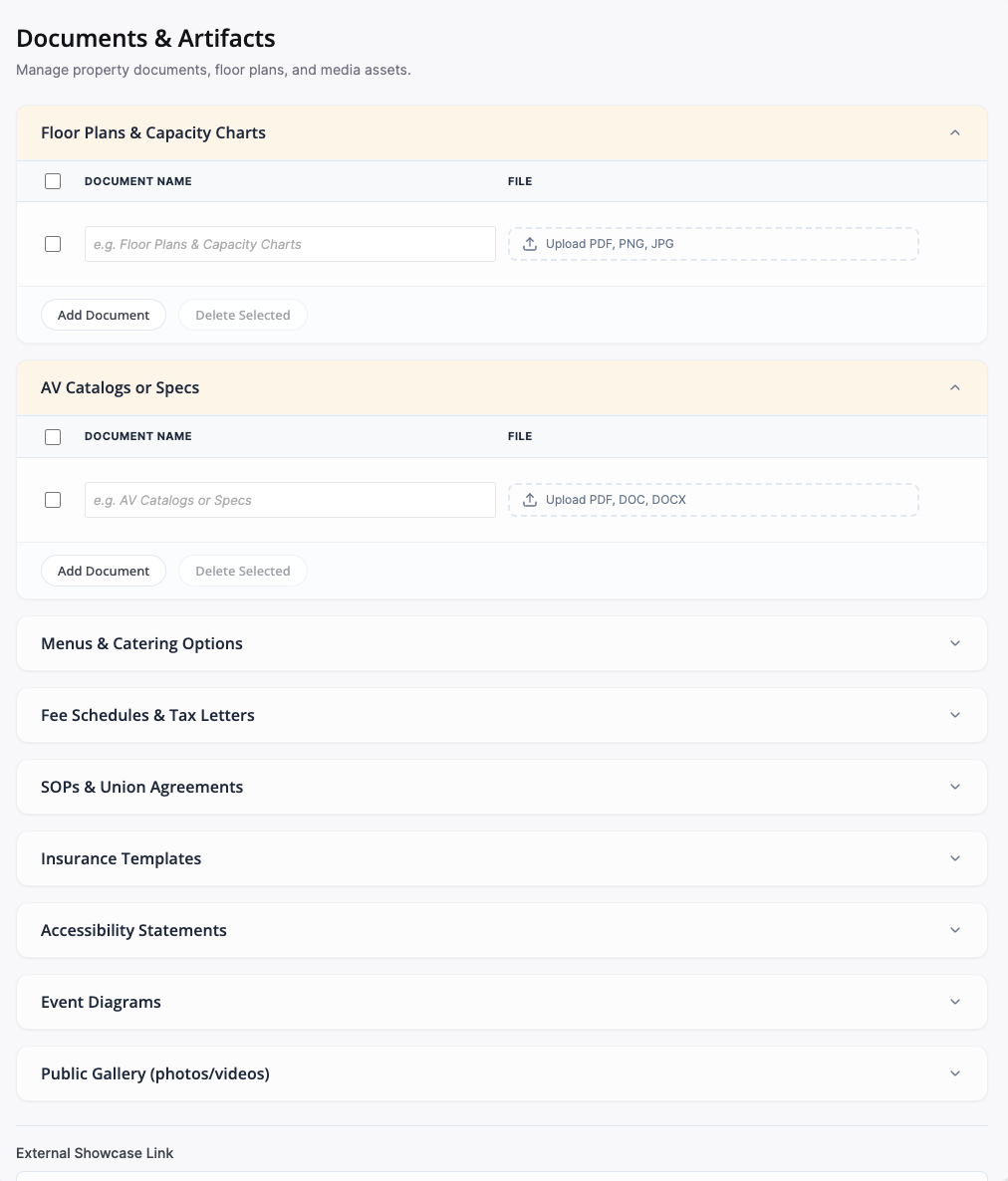
- Tech Stack & Integrations: Document your underlying systems (PMS, CRS, CRM) and integration capabilities like API/webhook availability.
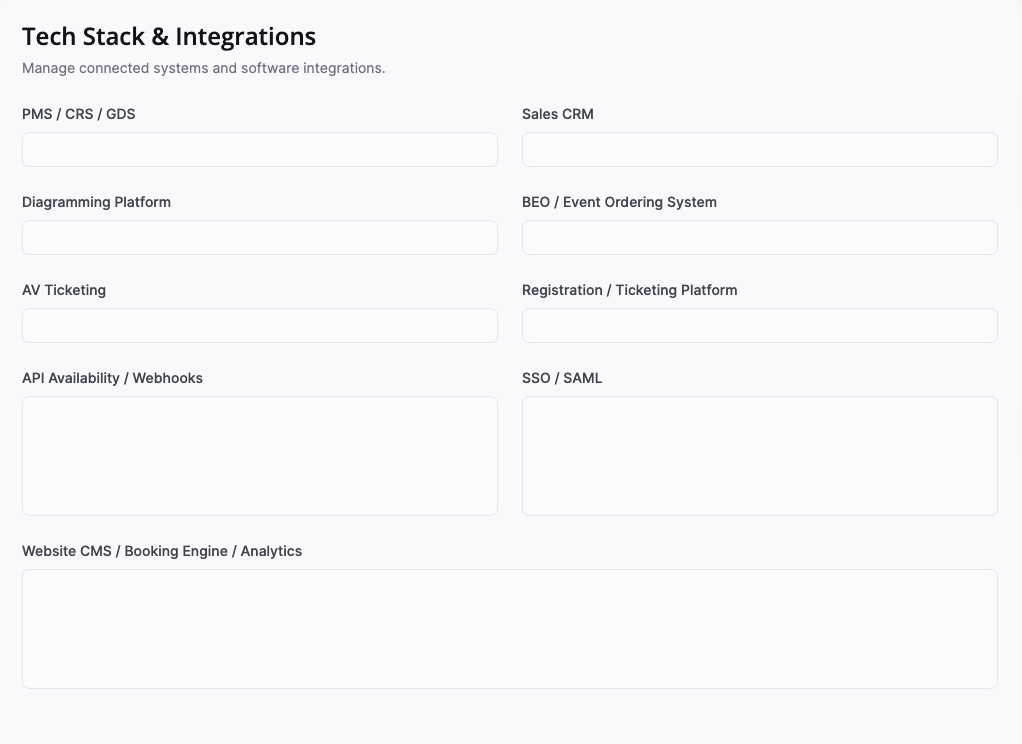
- Other Policy Documents: A catch-all for any supplementary PDFs or documents that don't fit neatly elsewhere.
This structured approach ensures that no detail is overlooked—and everything is instantly accessible.
Key Benefits of Hotel Setup
1. Centralized, Reliable Property Data
Hotel Setup eliminates the need for scattered documentation.
Instead of searching across systems, teams access a single source of truth that is:
- Complete
- Structured
- Always up-to-date
This reduces errors and ensures consistency across all communications.
2. Faster, AI-Assisted RFP Responses
With a fully populated profile, the platform enables AI to generate accurate responses to planner inquiries.
This means:
- No more manual data gathering
- No more guesswork
- Faster turnaround times
Teams can respond to more RFPs—without increasing workload.
3. Automated Document Generation
Once onboarding is complete, Hotel Setup automatically generates a ready-to-share policy document.
No formatting. No manual compilation.
This dramatically reduces time spent on:
- Proposal preparation
- Documentation assembly
- Standardization efforts
4. Reduced Manual Data Entry with AI Extraction
Uploading floor plans or spec sheets?
Hotel Setup uses AI to extract:
- Room dimensions
- Seating configurations
This minimizes manual input and accelerates onboarding—especially for large properties.
5. Data Integrity with Smart Save
The platform uses a Smart Save mechanism that:
- Detects exactly what changed
- Updates only those sections
Combined with atomic saving (all-or-nothing updates), this ensures:
- Data consistency
- Faster saves
- Reduced risk of corruption
6. Secure, Scalable File Management
All documents and assets are stored securely with:
- S3-backed infrastructure
- Signed download links
This ensures:
- Data security
- Controlled access
- Reliable storage
7. Multi-Property Scalability
For hotel management companies, Hotel Setup is multi-tenant ready.
Each property profile is fully isolated, enabling:
- Portfolio-level management
- Data separation across properties
- Scalable onboarding across locations
Real-World Use Cases
Use Case 1: Hotel Sales Teams Handling High RFP Volume
Sales teams often juggle dozens of RFPs simultaneously.
With Hotel Setup:
- Responses become faster and more accurate
- Teams reduce manual effort
- Conversion rates improve
Use Case 2: Event Coordinators Managing Complex Requirements
Event planners require detailed specs:
- Room dimensions
- AV capabilities
- Accessibility features
Hotel Setup ensures all this information is:
- Pre-structured
- Easily accessible
- Consistently presented
Use Case 3: Hotel Groups Managing Multiple Properties
For management companies overseeing multiple hotels, consistency is critical.
Hotel Setup enables:
- Standardized onboarding across properties
- Centralized oversight
- Scalable operations
Use Case 4: Revenue Managers Optimizing Group Business
Accurate data leads to better pricing and planning.
With structured inputs like:
- Seasonality
- Room inventory
- Billing rules
Revenue managers can make more informed decisions.
Technical Highlights Worth Knowing
Hotel Setup is built on strong technical principles that enable reliability and scalability. For product managers and technical decision-makers evaluating this tool, a few architectural details stand out:
Atomic Transactions ensure data integrity at the save level — a partial update cannot corrupt the profile state. This is foundational for any system being used as a source of truth.
AI Extraction from PDFs reduces onboarding friction for hotels with existing documentation. Rather than requiring manual re-entry of room specs, the system reads and parses structured data from uploaded floor plans and spec sheets.
Secure, Signed S3 Links for all uploaded files mean that access to sensitive documents is controlled and time-limited — not just stored and forgotten.
Multi-tenant Isolation at the profile level is essential for any SaaS platform serving hotel management companies. Full data separation between properties is non-negotiable for enterprise adoption.
Role-based Access through the Contacts & Users section allows hotels to control who manages which aspects of the profile, supporting proper operational structure for larger teams.
The Bigger Shift: From Static Data to Intelligent Systems
Hotel Setup represents a broader trend in SaaS:
Moving from static documentation → dynamic, AI-powered systems
Instead of:
- Static PDFs
- Manual workflows
You get:
- Structured data
- Intelligent automation
- Scalable operations
This shift is particularly important for industries like hospitality, where complexity and variability are high.
A Smarter Foundation for Hotel Group Sales
Hotel Setup is more than a feature; it's a strategic investment in your hotel's operational efficiency and revenue potential. By centralizing scattered information into a complete, structured profile, you empower your team to answer the questions planners ask before they even ask them.
It transforms the RFP process from a reactive scramble into a proactive, confident presentation of your property's full value. And it lays the groundwork for a future where AI assists at every stage of the group sales cycle, from initial inquiry to final billing.
For product leaders and decision-makers, it’s a clear example of how structured data + AI = operational leverage.
If your team is still relying on spreadsheets and scattered documents, it’s time to rethink your approach.
Adopt a structured, AI-powered system—and turn your property data into a competitive advantage.
Frequently Asked Questions
"We have hundreds of hotels with decades of legacy data in different formats. How does the platform handle the 'garbage in, garbage out' problem during migration? Does it validate our data or just store it?"
We prioritize structured intelligence over simple storage.
The "Smart Save" mechanism enforces data types and logical ranges. For example, if you try to input a ceiling height of "3 inches" or a room capacity of "bananas," the atomic transaction will fail and flag the error immediately.
"We have a complex hierarchy. Our corporate revenue manager needs visibility into all properties, but the catering manager at one hotel should only see their kitchen and culinary docs. How granular can your role-based access get?"
Very granular. The "Contacts & Users" section (Section 2) is mapped to specific read/write permissions across the other 14 sections.
You can configure access at the individual section level.
"We are building a custom dashboard for our sales leaders. How easy is it to pull the structured data from Hotel Setup into our own BI tools or reporting layers?"
Hotel Setup is built API-first. We treat the interface as a convenient way to input data, but the real value is the API as a way to output data to the rest of your ecosystem.
Agentic AI in Hospitality: Governance Matters
So here's a thing that's happening right now: AI is becoming less of a tool and more of a… colleague? Employee? A coworker who never takes lunch breaks? I don't know what to call it yet, but it's definitely not just software anymore.
When Your Hotel's AI Becomes a Coworker
So here's a thing that's happening right now: AI is becoming less of a tool and more of a… colleague? Employee? A coworker who never takes lunch breaks? I don't know what to call it yet, but it's definitely not just software anymore.
It's no longer software that waits for instructions. It's becoming something closer to a system with delegated authority — one that captures, decides, routes, and executes without waiting for a human to approve each step. That distinction matters more than most governance conversations acknowledge.
You didn’t notice it at first.
The AI started by answering simple guest questions.
Then it began modifying bookings.
Then it adjusted pricing based on demand spikes.
Then it started resolving complaints without asking anyone.
At some point, it stopped being a tool.
It became an operator.
And that’s why.. Success in 2026 and beyond lies not in the raw intelligence of the AI, but in its governance—specifically how we engineer trust, define boundaries, and design the "seams" where digital and human colleagues collaborate.
The shift
We are entering the era of Agentic AI in hospitality—systems with delegated decision authority. Not just insight. Action. Not just support. Execution.
An AI agent can now:
- Modify a reservation
- Rebalance inventory
- Route and respond to complaints
- Trigger compensation workflows
- Interact directly with guests
Without waiting for permission.
This terrifies some people. It should excite you.
Not because humans become less important, but because they finally get to stop doing work that was never worthy of them in the first place. Your front desk manager shouldn't be manually routing the 47th "what time is checkout?" message of the day. Your revenue analyst shouldn't be copy-pasting rate changes across six systems. Your guest services team shouldn't be updating spreadsheets about guest complaints when they could be actually solving them.
The panic around AI replacing hospitality workers misses the point entirely. The real shift is about speed and partition. AI handles the repetitive decision-making that bogs down your operations. Humans reclaim the work that actually matters—the strategic thinking, the emotional intelligence, the moments that turn a transaction into a relationship.
The 10% Problem That's Actually a 100% Problem
Here's what's wild: the AI support systems can now handle 80-90% of routine customer service stuff automatically. Eighty to ninety percent! That's insane!
But then there's that remaining 10%. The messy stuff. The angry guest. The weird edge case. The thing that requires actual human judgment. And apparently, this "human-AI handoff"—the moment when the robot realizes it's in over its digital head and needs to pass things to a human—has become this massive battleground for customer experience.
Because here's the thing: if a frustrated guest gets dropped during that handoff like a fumbled football, all those efficiency gains you got from automating 90% of tickets? Gone. Instantly negated. The guest doesn't care that you automated thousands of interactions successfully. They care that their problem fell through the crack between the robot and the human.
How Hospitality Roles Evolve When AI Becomes an Active Operator
Where does accountability go?
It doesn’t vanish.
It migrates.
From task execution
To agent orchestration.
Traditionally, accountability was centralized in human roles. As AI systems transition from "tools" to "organizational actors," they begin to assume roles within business processes—such as customer support triage or inventory rebalancing—that were previously filled by humans. This requires a shift in human roles from task execution to "Agent Orchestration" and "Business Engineering".
Humans are no longer just doing the work.
They’re defining the objectives.
Setting the constraints.
Engineering the guardrails.
It’s less “Do the thing.”
More “Design the thing that does the thing.”
Categorizing the New Digital Workforce
To understand this evolution, we can look to the TACO Framework (Taskers, Automators, Collaborators, Orchestrators):
- Taskers: AI agents that handle singular, repeatable goals, such as screening a guest profile for compliance risks.
- Automators: Agents that handle end-to-end workflows across multiple systems, like processing a booking modification across the PMS and CRM.
- Collaborators & Orchestrators: Complex multi-agent systems that coordinate supply chains or housekeeping schedules, dynamically adapting to real-time changes.
Outcome Ownership vs. Execution
Here’s the critical line:
AI may own execution.
Humans must own outcomes.
Because an agent doesn’t care if a VIP guest rage-posts on LinkedIn.
Your brand does.
Responsibility is assigned to the teams that define the agent's objectives (Objective Ownership) and oversight mechanisms. This ensures that even when an AI acts autonomously, it remains an instrument of organizational intent rather than a rogue operator.
Autonomy is not a vibe
An AI agent shouldn’t operate independently because it “seems smart.”
It should operate because it has earned bounded authority.
Autonomy is a spectrum. Not a switch.
An agent should only act when:
- Uncertainty is low
- The decision is reversible
- Policies are not violated
Drafting an email? Low risk.
Issuing a $2,000 refund to a VIP guest? Different category.
This is where most teams fail.
They give AI access without engineering context.
Context engineering > prompting
Real autonomous decision-making requires more than instructions.
Your agent needs more than a prompt. It needs the encoded organizational knowledge about your workflows, team structures, policies, and priorities. It needs to understand not just what to do, but what you would want it to do in edge cases.
It requires encoded organizational knowledge:
- Who owns which decisions
- Which guests trigger escalation
- What constitutes a “risk spike”
- What must always be human-approved
If a high-value guest submits a complex complaint, the system shouldn’t guess.
It should pause.
Or hand off.
Or escalate automatically.
The difference between a useful agent and a liability is knowing where that line sits. You don't want an AI that always asks permission. You also don't want one that confidently books a $50,000 suite for $50 because it misread a decimal point.
Artificial agency means delegated authority within strict constraints—not free will.
Trust Is Not Magic, It's Engineering
Here’s something hospitality leaders don’t say enough: trust isn’t magic. It’s not a feeling you manufacture. It’s an operational outcome.
Guests trust your brand because you deliver consistently. Staff trust your systems because they work predictably. Trust is built when the thing that happened is the thing that was supposed to happen, every time.
This is why teams reject tools that are technically brilliant but operationally flaky. An AI that occasionally hallucinates a room upgrade or misapplies a discount isn’t just making small mistakes. It’s breaking the fundamental contract of predictability. Staff can’t rely on it. Guests can’t rely on it. Eventually, no one uses it.
The fix isn’t smarter AI. It’s transparent AI.
When an AI agent prices a room at $400, it should be able to show its work—the occupancy data it used, the competitive rates it referenced, the demand forecast it factored in. This isn't about making the agent "explainable" for philosophical reasons. It's about giving your team the ability to audit decisions and validate that the agent is acting according to its encoded goals.
When something goes wrong—and it will—you need to trace it back to the specific agent that made the call and the specific human who deployed that agent with those permissions.
The handoff is the main event
The moment an AI realizes it's in over its head and needs human help—that's where your customer experience actually lives.
Context preservation is non-negotiable
A proper handoff carries:
- Full transcript
- Guest profile data
- Sentiment analysis
- The unresolved issue
- What actions were already attempted
The guest should never, ever have to repeat themselves.
No repetition. No reset.
Handoff like a relay baton, not a dropped call.
Automation vs Delegation
Automation executes scripts. Delegation transfers responsibility.
When an AI is delegated authority, it must know when it’s out of depth.
The most sophisticated systems use adaptive handoffs. The AI monitors the conversation in real-time. If customer frustration rises or the agent hits a competence cliff, the system imperceptibly slides the conversation to a human. No jarring "let me transfer you" moment. No starting over. Just seamless escalation that feels like continuity.
Like the human was there the whole time.
Because from the guest’s perspective, there is no AI-human distinction.
There is only:
“Did you solve my problem?”
The future belongs to operators who design the handoff as carefully as they design the automation.
Who owns the bad decision?
Here’s the question no one wants to ask: when an AI makes a bad decision, who owns it?
You can’t fire the AI. You can’t put it on a performance improvement plan. You can’t have a difficult conversation about expectations. It’s software. It has no feelings, no intent, no moral agency.
But the bad decision still happened. A room got oversold. A VIP got downgraded. A pricing error cost real money. Someone has to answer for it.
This is where mature organizations separate two things that less mature organizations collapse together: decision ownership and outcome ownership.
The AI holds decision ownership in the moment. It executed based on its parameters. But the humans who defined those parameters—the revenue manager who set the pricing rules, the IT director who approved the deployment, the executive who signed off on the autonomy level—they hold outcome ownership. They’re responsible for the consequences, whether financial, regulatory, or reputational.
This isn’t about blame. It’s about clarity. When everyone knows who’s accountable for what, you can fix problems instead of assigning fault. When it’s fuzzy, you get the worst of both worlds: no one feels responsible, but everyone feels blamed.
Mature systems assume failure
Reliable hospitality operational AI includes:
- Fail-safe switches
- Rollback protocols
- Threshold-based shutdown triggers
- Human override modes
Keeping the Human in Hospitality
Here's the thing everybody's worried about but nobody's saying directly: hospitality is defined by human connection. The warmth. The empathy. The moment when a staff member sees you're having a bad day and upgrades your room or sends up a bottle of wine or just takes an extra minute to chat.
AI can't do that.
AI shouldn't do that.
What AI should do is handle the drudgery. The logic. The routing. The availability checks. The classification of requests. All the mechanical stuff that takes time away from the actual human-to-human connection.
The goal is to let the human arrive at the interaction already prepared. The chatbot has already gathered the context, alerted the right department, pulled up the guest history. Now the human can focus entirely on the emotion and the empathy and the problem-solving.
Guests remember kindness, not software.
Certain decisions must remain human-led. The ones with high emotional stakes. The irreversible ones. The moments that matter. The governance frameworks need to enforce "human-in-the-loop" states for these situations, because AI is meant to enhance human service, not replace it.
The colleague framework
To make this work, you need to stop thinking of AI as a generic tool and start thinking of it as a digital colleague with specific boundaries.
You wouldn't hire a front desk agent without a job description. Don't deploy an AI agent without one either. Use an Agent Design Canvas—a document that defines the agent's mission, its constraints, its triggering conditions, and its risk thresholds.
What can this agent do? What is it explicitly prohibited from doing? Under what conditions does it act autonomously versus escalate to a human? What data can it access? What decisions can it make?
By defining these boundaries clearly, you transform AI from a risky experiment into a reliable daily operator. It becomes a colleague your team can trust to handle the routine so they can focus on what they do best.
The real AI opportunity isn’t in replacing people. It’s redesigning how humans and AI collaborate to create something better.
Hippo Rev is one example of what this looks like in practice for hotel group sales — a Revenue Capture Platform that runs the deal motion across existing systems, with defined boundaries on what executes autonomously and where human review is required. Inquiry capture, proposal generation, and follow-up coordination happen within a governed framework, so sellers focus on negotiation and relationships rather than coordination overhead. More detail on the platform is available [our layered intelligence blog].
Frequently Asked Questions
Question: How do we architect bounded autonomy so that an AI agent can execute 80–90% of operational decisions without silently drifting into unsafe authority over time?
Answer: Bounded autonomy has to be enforced at the architecture level — not the prompt level. The most reliable approach combines three things working together.
First, encode your decision thresholds — refund limits, escalation triggers, compliance flags — as deterministic rule engines that sit outside the LLM. The model proposes an action; a separate policy engine validates it before anything actually executes.
Second, build in confidence thresholding: if uncertainty is low and the action is reversible, let the agent execute; if uncertainty is high or the decision can't be undone, it escalates.
Third, run the model periodically in "shadow mode" against live traffic to catch drift before it causes real damage.
The damage usually doesn't happen all at once. It happens when business rules change but the agent's context doesn't, when edge cases weren't represented in your evaluation data, or when human overrides pile up but nobody's feeding them back into the system.
Bounded autonomy isn't something you set once and forget. It's maintained through continuous governance loops, not static constraints.
Question: What are the most common failure modes in Human–AI handoffs ?
Answer: Four patterns account for most damage: State Amnesia (transcript not passed forward, guest repeats themselves), Intent Fragmentation (AI misclassifies the issue before handing off), Sentiment Blindness (emotional intensity lost in translation), and Channel Reset (context breaks when moving across systems — chat to CRM to ticketing). A good handoff preserves all of it: transcript, guest profile, sentiment, unresolved issue, and actions already attempted.
Question: How should organizations distinguish between decision ownership and outcome ownership in autonomous hospitality systems?
Answer: Decision ownership belongs to whoever executes the AI agent, at runtime. Outcome ownership belongs to the humans who defined the parameters: the revenue manager who set pricing rules, the IT lead who scoped permissions, the executive who approved the autonomy level.
This isn't about blame — it's about clarity. When something goes wrong, you need to know exactly who designed the system that made the call. Codify this in deployment documentation, incident reviews, and liability pathways. Fuzzy accountability is how small mistakes become expensive ones.
Why Generic AI Fails Hotel Proposals — And How to Fix It
Most AI proposal tools don’t optimize for hotel sales. Discover how a layered intelligence architecture ensures accurate, policy-compliant proposals every time.
Why Most AI Proposal Tools
Get Hotel Sales Wrong
And What a Layered Intelligence Architecture Actually Changes
The 80% Rewrite Problem
Here is what hotel sales teams tell us after trying AI proposal tools:
"It sounds professional. But every rate is wrong."
"It made up concessions we have never offered."
"It ignored that this client has special terms."
"I spent 45 minutes fixing what it generated."
The pattern is consistent across hotel sales teams that have tried AI proposal tools. AI proposal These tools promise speed. They deliver rewrite headaches — and every minute spent rewriting is a minute your team isn't closing.
The proposals look good on the surface. The language flows. The structure seems right. But the details are wrong in ways that matter: pricing that does not match your actual rates, concessions that violate policy, generic descriptions that could apply to any hotel, and zero awareness of client history.
So teams end up rewriting 80% of the output. At that point, the "time savings" disappear.
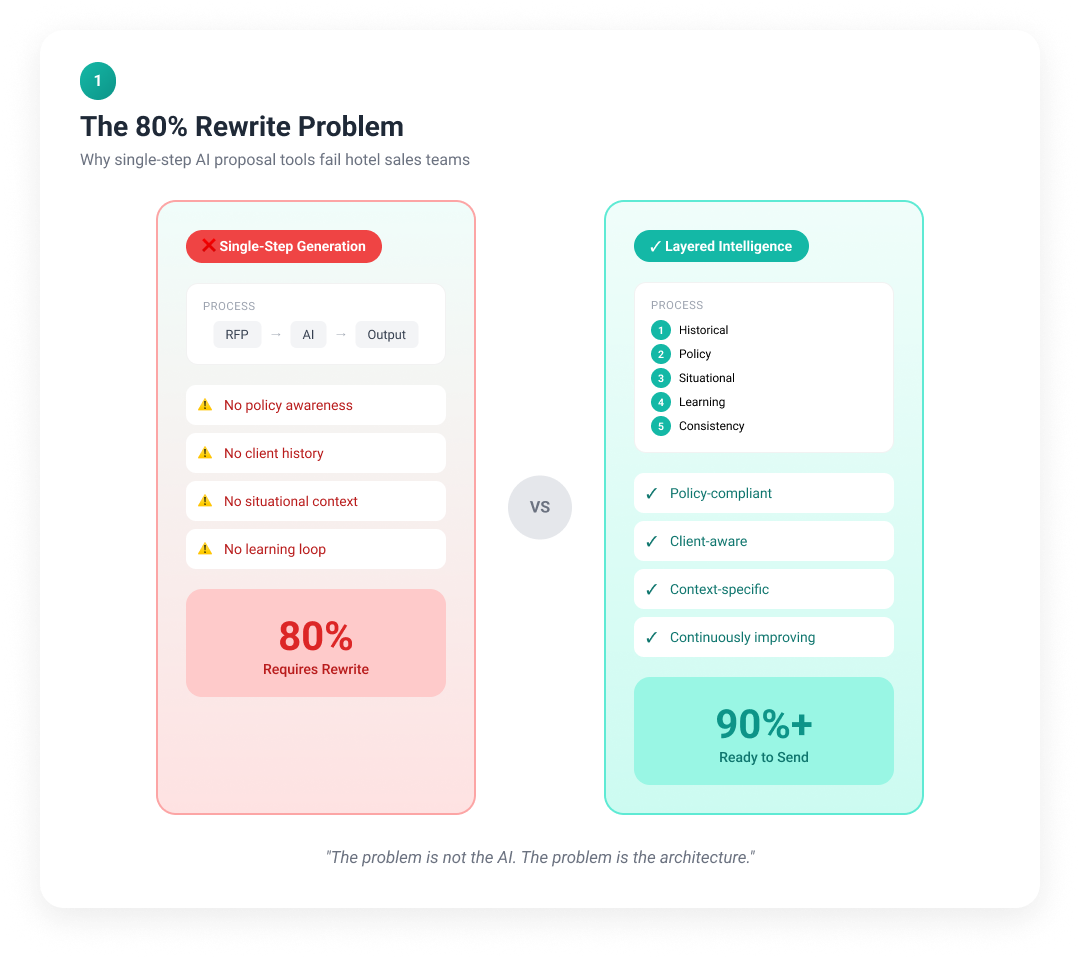
This is not a model quality problem. This is an architecture problem.
Most AI tools treat proposal generation as a single task: take an RFP, generate text. But hotel proposals are not a single task. They sit at the intersection of five different types of knowledge:
1. What has worked before for similar events
2. What your policies actually allow
3. What this specific situation demands
4. What your team has learned from past corrections
5. What needs to stay consistent across proposals
When AI treats these as one undifferentiated input, accuracy becomes random. Sometimes it gets things right. Sometimes it invents terms you never offered. Sometimes it ignores the discount cap you set last quarter.
That unpredictability is why you are still rewriting.
What Hotel Proposals Actually Require
Before building AI that generates accurate proposals, you have to understand what "accurate" means in hotel sales.
A proposal is not just words on a page. It is a business decision expressed as a document.
Pricing reflects your actual rates, seasonal adjustments, discount limits, and whether this client has negotiated special terms.
Concessions must stay within policy. You cannot offer what your brand prohibits. You cannot waive what revenue management has capped.
Language must sound like your property. A luxury resort reads differently than a convention hotel. Your proposals should sound like your proposals.
History matters. If this planner booked with you two years ago and loved certain menu items, that should inform how you present F&B.
Current context changes everything. High-demand dates look different than shoulder season. Strategic clients get different treatment than one-time inquiries.
Generic AI cannot hold all of this simultaneously. Language models generate plausible text based on patterns. They are not designed to enforce business rules or remember that ABC Corp gets 18% instead of 12%.
The Layered Intelligence Approach
The solution is not a smarter AI model. The solution is an architecture that separates different types of knowledge and applies them in the right order.
Think of it as five distinct layers, each handling a specific type of decision:

Layer 1: Historical Intelligence
What has your property done before in similar situations?
This is not just "past proposals" dumped into a system. It is structured knowledge: how you priced a 200-person corporate conference in March, what concessions closed the deal, what language resonated with that type of planner.
When a new RFP arrives, this layer retrieves the most relevant precedents. Proposals get grounded in what has actually worked, not what AI thinks might sound good.
The result: Consistency with past successful proposals for similar scenarios.
Layer 2: Policy Guardrails
What are the hard rules that cannot be broken?
During onboarding, hotel-specific policies get collected: pricing limits, cancellation terms, discount caps, blackout dates, brand requirements. These become constraints that every proposal must respect.
This layer acts as a filter. No matter what historical data suggests or what AI wants to generate, policy violations get caught before they reach your client.
The result: No policy violations. No manual corrections for compliance.
Layer 3: Situational Context
What is different about this specific situation?
Maybe this client has negotiated special terms. Maybe these dates have unusually high demand. Maybe your sales leadership wants aggressive pricing this quarter. Maybe the client budget is below your standard rate.
This layer handles exceptions, overrides, and current business realities. It applies strategic client rules, demand-based restrictions, and one-time approvals that should not leak into future proposals.
The result: Proposals feel intentionally crafted, not auto-generated.
Layer 4: Learning from Corrections
What has your team taught the system?
When sales edits a proposal before sending, that edit contains information. If you consistently change how breakfast is described, the system should learn. If you always adjust cancellation language for certain client types, that should become automatic.
This layer captures the gap between what AI generates and what humans actually send. Over time, it closes that gap.
The result: Accuracy increases with every proposal submitted.
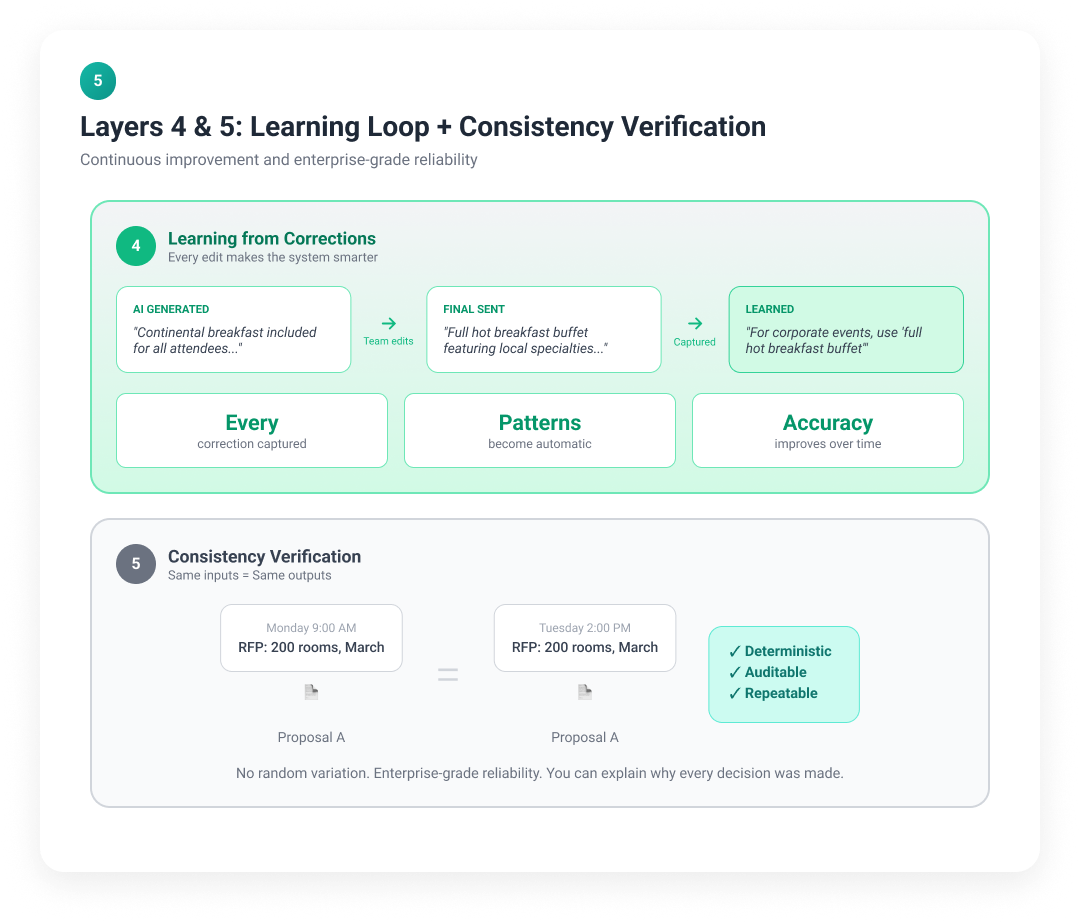
Layer 5: Consistency Verification
Is the output stable and auditable?
For the same RFP context, the same input data, the same questions, the system verifies whether the response remains consistent. Random variation is not acceptable for enterprise use.
This layer ensures deterministic, repeatable results. Same inputs today should produce the same outputs tomorrow.
The result: Enterprise-grade reliability you can trust.
How the Layers Work Together
Here is what layered intelligence looks like in practice.
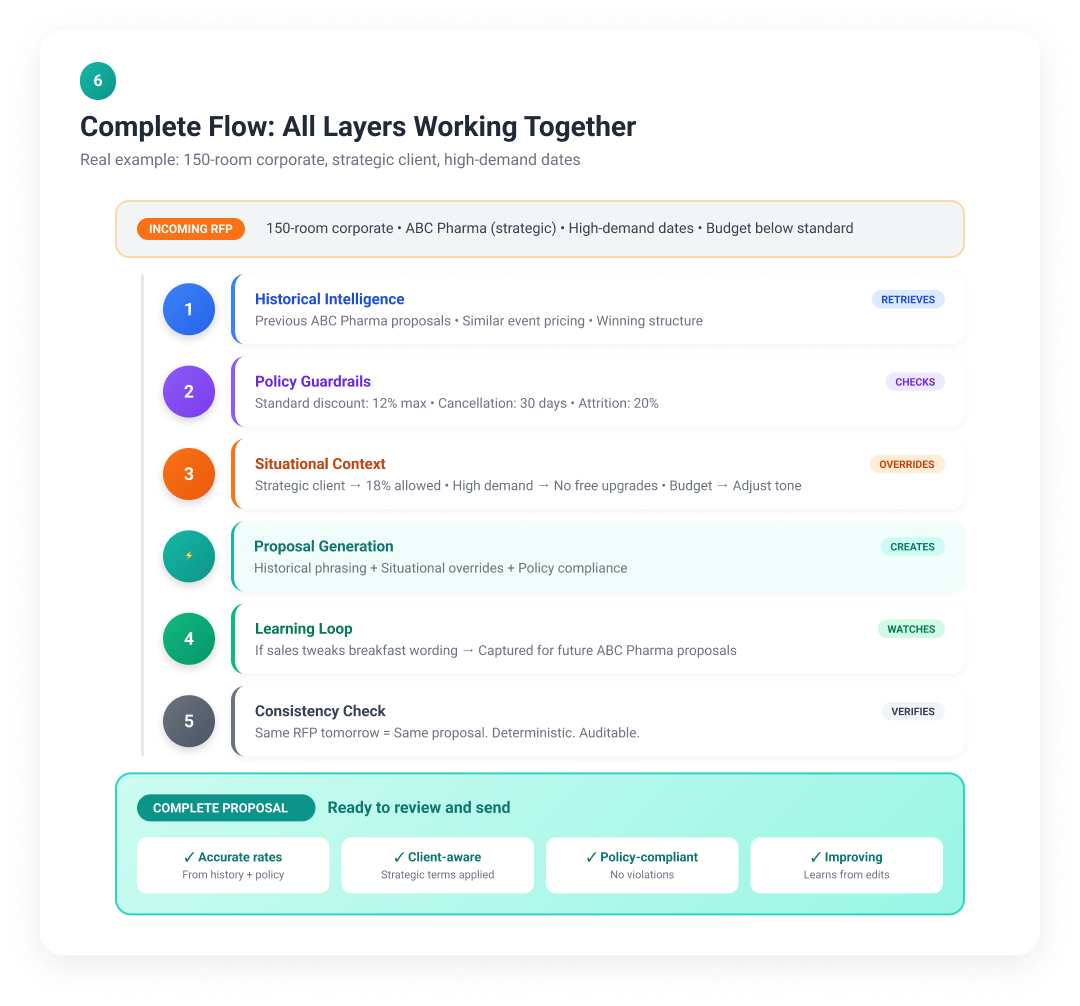
Incoming RFP:
150-room corporate conference
Strategic client (ABC Pharma, significant annual revenue)
Dates overlap with a citywide event
Client budget is below your standard rate
Without Layered Intelligence:
A generic AI retrieves some past proposals, notices you have offered discounts before, and generates a proposal with 15% off.
It does not know the citywide event means you should not discount. It does not know this client has special terms. It does not know your policy caps most discounts at 12%.
Result: Wrong in three different ways. Complete rewrite required.
With Layered Intelligence:
Policy layer checks: Standard discount cap is 12%. Cancellation requires 30 days notice.
Situational layer checks: ABC Pharma is a strategic account, allowed up to 18%. BUT these dates overlap high-demand period, so no free room upgrades. Budget is tight, so adjust pricing tone.
Historical layer retrieves: Previous ABC Pharma proposals, their preferred structure, the concessions that closed deals.
Generation happens: Using historical phrasing, applying situational overrides, staying within policy bounds.
Learning layer watches: If sales tweaks anything before sending, that edit is captured for future improvement.
Consistency layer verifies: Same RFP tomorrow produces the same proposal.
Result: A proposal that reflects your actual business rules, your relationship with this client, and your current revenue strategy. Ready to review, not ready to rewrite.
The Difference You Actually Feel
When proposal AI is architected correctly, the change is not subtle:
From "sometimes right, sometimes wildly off"
To "consistently accurate, occasionally needs minor tweaks"
The 80% rewrite drops to 10%. Your team goes from spending 45 minutes building proposals to spending 5 minutes reviewing them.
From "the AI does not know our property"
To "the AI sounds like someone who has worked here for years"
Because it has learned from your actual proposals, your actual policies, your actual corrections. It is not guessing. It is applying institutional knowledge.
From "I cannot trust it for important RFPs"
To "I trust it more for complex proposals because it remembers details I might miss"
Strategic clients, special terms, historical preferences. The system holds all of it so you do not have to.
From "every proposal feels like starting over"
To "every proposal builds on everything we have learned"
The learning loop means the system gets better with every proposal your team sends.
How Hippo Rev Approaches This
We built Hippo Rev's proposal generation on a multi-layered architecture because we saw what happens when you do not.
Every proposal Hippo Rev generates draws from:
- Your historical intelligence: how your property has actually responded to similar RFPs, what concessions closed past deals, what language resonated with similar planners
- Your policy guardrails: the rules that cannot be broken, enforced before output is generated, not after
- Your situational context: the current business realities — strategic client terms, high-demand date restrictions, revenue strategy overrides — that make this proposal different from the last one
- Your team's corrections: every edit your sellers make before sending is captured and fed back into future proposals, closing the gap between what AI generates and what your team actually sends
- Consistency verification: same RFP inputs produce the same proposal outputs, so your team can trust what they're reviewing
We call it the difference between AI that generates text and AI that institutionalizes your sales intelligence.
The result is proposals that are accurate enough to review and send. Not accurate enough to delete and start over.
The Bottom Line
The problem with most AI proposal tools is not the AI. It is the assumption that proposal generation is a simple task.
It is not.
It is a layered decision that requires historical context, policy enforcement, situational awareness, continuous learning, and consistent output.
When AI is architected for that complexity, proposals go from a rewrite headache to a review-and-send workflow.
That is what Hippo Rev was built to do.
When Proposal Accuracy Is Solved, the Bigger Problem Becomes Visible
But a proposal that's ready to send still has to get out the door fast enough to matter. And it still has to land in an environment where the planner can find everything they need, ask questions without emailing back and forth, and move toward a decision without chasing your team for follow-up.
Accurate proposals are necessary. They're not sufficient.
This is where the gap between a proposal tool and a Revenue Capture Platform becomes concrete.
A proposal tool solves one handoff — RFP in, document out. A Revenue Capture Platform runs across the full deal: the inquiry that arrived in Cvent at 11pm gets captured before anyone logs in the next morning. The missing attendee count gets requested from the planner automatically. The proposal gets built from live rates and sent for review. The planner opens the Active Deal Room, forwards it to their CFO, and your team sees the engagement signal in real time — before they've thought to check.
Hippo Rev is built as that platform. The layered proposal architecture is one component of a system that coordinates across Capture, Convert, and Grow — pulling from your PMS, RMS, and Cvent stack, running the workflow your sellers currently run by hand, and keeping humans in control of every decision that requires judgment.
The result isn't just faster proposals. It's a pipeline that doesn't leak & revenue that always gets captured.
See Layered Proposal Intelligence & Revenue Capture in Action
Book a Demo at Hippo Rev.ai
Hippo Rev | AI Built for Modern Hotel Sales Teams
So here's a thing that's happening right now: AI is becoming less of a tool and more of a… colleague? Employee? A coworker who never takes lunch breaks? I don't know what to call it yet, but it's definitely not just software anymore.
AI for Hotel Sales That Feels Like a Teammate, Not a Tool
Most group RFPs aren’t lost on pricing.
They’re lost on speed.
72% of the time, the first hotel to reply wins the deal.
But what if you’re too slow because you’re buried in admin work, not because you’re bad at your job?
This is the part of the revenue story that rarely gets talked about. That even great teams, with good intentions and hard working people, are losing business for reasons that have nothing to do with effort or expertise.
The Silent Crisis in Hotel Sales: Where Your Revenue Is Actually Leaking
Behind the grand lobbies and polished pitches, hotel sales teams are drowning in invisible work. Proposal emails, missing RFP details, call logs, data entry. These are friction points eating away at the very thing salespeople are meant to do: sell.
70% of hotel sales team time goes to non-revenue generating admin work. And as a result, 55% of group RFPs go unanswered.
This is the peak of inefficiency & a revenue black hole. One that’s felt across the industry, especially as 65% of hotels report being understaffed.
Modern hotel sales teams are judged on revenue outcomes, but equipped with tools that were designed to store information, not to move work forward. CRMs record activity. Portals collect requests. Email moves messages around. None of them actually take work off the salesperson’s plate.
So teams compensate the only way they can. By working longer hours. By multitasking. By triaging. By letting some requests wait or go unresponded.
We have spent years listening to hotel sales teams describe this moment. The moment where they know a deal matters, but the system around them makes it hard to act fast.
This is the pattern that repeats across properties, portfolios, and markets. Teams that are capable. Deals that are real. And a gap in execution — between the inquiry that arrived and the proposal that went out — that costs group revenue no one can see on a dashboard.
And that is where this product begins.
The Why Now: When Speed Became Survival
The world didn’t always work like this.
But post-pandemic, planners expect faster answers. Guests expect digital convenience. And hotels, operating with leaner teams than ever, are being asked to do more with less.
What used to be a 4-day proposal window is now a same-day race.
Whereas, on the other hand, AI has now matured to a point where multiple specialized agents can work together to execute complex, multi-step workflows. Each agent takes on a distinct responsibility—whether it’s capturing leads, completing missing details, generating proposals, or tracking engagement—collaborating seamlessly to complete the full sales task from inquiry to close.
The collision of these forces creates an opening for something genuinely new. Not incremental improvement. A fundamental reimagining of what revenue capture software should do.
What We Believe
We believe hotel sales teams shouldn’t lose deals because of slow software or scattered systems.
We believe RFPs should be responded to in minutes, not days.
We believe every inquiry deserves a response — not just the big ones.
We believe automation should feel like having a mate working alongside you—always on, proactively handling what needs to be done without waiting to be told, and not another tool that creates more work to manage.
We built Hippo Rev because the current tools weren’t built for this moment. They were built for a slower world. One where a four-day turnaround was fine. One where you had three people per RFP. One where follow-ups happened because someone remembered. One where losing revenue on the table was a norm.
That world is gone.
Introducing Hippo Rev: The Revenue Capture Platform for Hotel Group Sales
Hippo Rev isn’t a tool. It’s a teammate.
Our belief is simple and demanding.
Software should execute work, not just inform it.
If a task is repetitive, rules based, and directly tied to revenue, it should not live in a human inbox. It should live with an AI agent whose job is to do it, reliably, every time.
This is why we do not think of this product as automation in the traditional sense. Automation follows scripts. Agents take responsibility. And when multiple AI agents work together, each handling their part of the workflow, they complete the entire process end to end—from inquiry to the signed contract.
With Hippo Rev:
The platform operates across three stages that map directly to how a group deal actually moves.
Capture: Every inquiry — from Cvent, HotelPlanner, your website, your front desk line, email — lands in one unified dashboard. Nothing waits in a forgotten portal. Nothing slips because someone was in a meeting. Your team sees every opportunity, scored and ready for action.
Convert: Proposals are built from live pricing pulled from your PMS, comp set data from your RMS, and your property's own content library. Missing RFP details are identified and requested from planners automatically. Complete proposals are ready for seller review in under 30 minutes — not four hours.
Grow: Every open proposal is tracked in real time. Engagement signals — who opened it, which sections they viewed, when they forwarded it to a CFO — trigger the right follow-up at the right moment. Stalled deals get re-engaged. Past customers get proactive outreach. Pipeline grows because no deal goes cold without a trigger.
In this model, multiple AI agents handle the repetitive, time-consuming tasks—each one built for a specific job, working in sync to keep the process moving. What stays human is what matters most: the judgment, the relationships, the final call. What disappears is the drudgery that never should have been human work to begin with.
The future of hotel group sales isn’t about working harder.
It’s about removing the friction that’s slowing your best people down.
Group revenue doesn't leave loudly. It leaves quietly — in the proposals that took too long, the inquiries that sat unread, the follow-ups that never fired because someone got busy.
The execution gap is measurable. And it's closeable.
With Hippo Rev, speed becomes your strategy. And every inquiry becomes an opportunity for revenue.
We’ve built this for the realities of modern hotel group sales.
We’ve built this for teams who care about winning the right way.
By being present. By being fast. By being more human.
Ready to see what Revenue Capture looks like in practice?
Book a demo and experience the future of hotel group sales.
That's the world we're building. And we're just getting started.
Why HippoRev Exists | A Behind the Scenes Look at Hotel Sales Reality
We didn’t build another tool. We built an agent that executes. Take a behind the scenes look at how HippoRev was built to remove sales drudgery and return time, focus, and craft to hotel sales teams.
We Didn’t Set Out to Build Another Product. We Set Out to Fix a Feeling.
There’s a moment that keeps replaying in my head.
It’s early evening. The office is quieting down. A sales manager is finally packing up for the day when an RFP lands in the inbox. A good one. High value. Tight timeline.
They know the math.
Respond late, and the deal is probably gone. Respond now, and the evening disappears.
That tradeoff felt wrong. And the longer we spent around hotel sales teams, the more we realized it wasn’t an isolated moment. It was the job.
This is the story of how HippoRev came to be. Not as a product roadmap. But as a response to something that felt fundamentally broken.
The Pattern We Couldn’t Ignore
For years, we worked closely with sales teams across industries. We watched what helped them connect better. We built tools that made communication clearer, more personal, more human.
And yet, in conversation after conversation, the same frustration kept surfacing.
“I love selling. I hate everything around it.”
Hotel group sales teams were not short on effort, skill, or intent. They were drowning in process.
Inquiries arriving from everywhere. Details missing. Endless back and forth. Proposals that took hours to assemble. Follow ups that depended on memory, not signals.
The most striking part was this. None of it felt like real sales work.
It felt like people compensating for systems that were never designed for how hospitality actually works.
And somewhere in the middle of all this, a set of questions started to surface.
Why does every RFP, no matter how similar, have to be rebuilt from scratch?
Why does a sales manager need to manually call or email planners just to collect information that should have been obvious, structured, or already known?
Why does so much of a salesperson’s time go into chasing missing details instead of advancing real conversations?
None of these questions were about real effort or commitment.
The Wrong Fixes
At first, we tried to solve pieces of the problem.
Better visibility here. Faster creation there. Smarter reminders. More dashboards.
But every improvement felt like adding a layer on top of a shaky foundation.
Teams were already overloaded. Giving them another tool just gave them another place to check.
We realized something uncomfortable. We were optimizing the wrong thing.
The real issue was not insight. It was execution.
Hotels did not need to know what to do next. They needed the work to actually get done.
Asking the Hard Question
Late in the process, we asked ourselves a question that changed everything.
What if software did not just assist sales teams, but actually took responsibility for the work that slows them down?
Not suggesting. Not nudging. Not reminding.
Executing.
Capturing every inquiry. Qualifying intent early. Completing missing details. Building proposals. Tracking engagement. Triggering follow ups at the right moment.
And crucially, doing it in a way that still kept humans in control.
That question became the spine of HippoRev.
Why Hotels, Specifically
We chose to start with hotel group sales for a simple reason. The pain was visible, measurable, and urgent.
Group business is complex by nature. Multiple stakeholders. Detailed requirements. Tight timelines. High expectations.
And yet, most systems treated it like generic B2B sales.
They tried to solve individual problems—room blocks, event space constraints, planner preferences—in isolation. But group sales isn’t a series of disconnected tasks. It’s a tightly woven workflow where delay at any step breaks the whole.
Speed mattered more than most teams realized. Not speed for its own sake, but speed as a proxy for care, competence, and confidence.
When planners wait days for a response, they do not assume the hotel is busy. They assume it is disorganized.
Building Agents, Not Tools
Once we committed to the idea of execution-first software, everything changed.
We stopped asking what features to add.
We started asking what work should never require a human in the first place.
That led us to agents. Not chatbots. Not workflows. Purpose-built agents designed to own specific parts of the revenue process.
An agent that never misses an inquiry, no matter where it comes from.
An agent that sees what information is missing and goes and gets it.
An agent that understands pricing context and surfaces real options, not guesses.
An agent that watches how planners engage and knows when it is time to act.
Individually, each solves a familiar problem. Together, they remove entire categories of work from a salesperson’s day.
The Moments That Told Us We Were Close
There were many false starts along the way.
Agents that worked in isolation but failed together. Automations that were fast but brittle. Early demos that maybe impressed technically but didn’t change how teams felt emotionally.
The breakthrough moments were not technical. They were human.
A sales manager telling us they stopped checking six systems every morning.
A director realizing no RFP had slipped through in weeks.
Someone saying they reviewed a proposal after dinner instead of building it during dinner.
Those were the signals we cared about.
What Launching Actually Means to Us
Launching HippoRev is not about declaring victory. It is about opening the door.
It’s about moving from what needs to get done—capturing inquiries, qualifying leads, chasing details, building proposals, tracking engagement, triggering follow-ups—to when those things actually get done, automatically, instantly, and without slipping through the cracks.
We know this is a beginning. There is more to refine, more to learn, more to build.
But we believe deeply in the direction.
Software should remove drudgery, not add to it.
AI should execute work, not create more decisions.
Sales teams should spend their time building relationships, not fighting systems.
What Comes Next
We are starting with hotel group sales because the need is clear and the impact is immediate.
But the idea behind HippoRev goes beyond hospitality.
Everywhere we look, talented people are trapped doing work that software should have handled years ago.
Our goal is to change that, one workflow at a time, without losing the human side of selling.
If you are a hotel sales leader reading this, thank you for trusting us early. Your feedback shaped this more than you know.
If you are just discovering HippoRev, welcome. We are building this in the open, and we plan to keep listening.
This is not about replacing people.
It is about giving them their craft back.
And this is only the first step.
You can book time with us here:
How Hippo Rev Works: The Revenue Capture Platform That Closes the Execution Gap
See exactly how Hippo Rev's Revenue Capture Platform executes hotel group sales — from the moment an inquiry lands to a signed contract. A technical walkthrough of how the platform captures demand, builds complete proposals, and keeps every deal moving so your team stops losing group revenue to slow execution.
How Hippo Rev Works: A Complete Technical Deep Dive
Your hotel already has the demand. The RFPs are coming in. The inquiries are landing. The group business is there.
What's missing is execution.
Right now, around one in three corporate RFPs go unanswered. Sellers lose 780 hours per year to admin. Proposals that should take 20 minutes take four hours. Follow-ups depend on whoever remembers to send them. And leadership has no real visibility into which deals are moving and which are dying.
That's not a demand problem. It's an execution problem. And it costs the average hotel sales team $500K in annual revenue per salesperson.
Hippo Rev is built to close that gap. This is a technical walkthrough of exactly how the platform runs the deal motion across your existing systems — from first inquiry to signed contract — so your team stops losing revenue it already earned.
How the Platform Is Built: A System of Execution
Your existing tech stack — PMS, CRM, RMS, Cvent, Delphi, Outlook — is excellent at storing records. None of it was built to move a deal.
Hippo Rev is the execution layer that runs the motion between those systems. It reads from and writes to your stack in real time, automates the coordination work your sellers currently do by hand, and keeps humans in control of every decision that matters.
The platform operates across three stages that mirror how a group deal actually moves:
Capture → Convert → Grow
Within each stage, purpose-built agents handle specific tasks — qualifying leads, completing RFP details, pulling live pricing, tracking engagement, triggering follow-ups. Every agent shares context across the full deal history so nothing has to be re-entered and no signal is lost between steps.
The result: your team stops spending 70% of their week on coordination and starts spending it on calls, site visits, and closing.
Here's exactly how each stage works.
Stage 1: Capture Every Revenue Opportunity
Group inquiries rarely arrive in one clean place.
They come through Cvent, HotelPlanner, Groups360, CVB channels, email, website forms, front desk calls, partner portals, and sometimes even voicemail. When intake is scattered, even strong demand can disappear before a seller ever sees it.
Hippo Rev captures every inquiry across every channel and brings it into one unified view.
The platform:
- Pulls inquiries from portals, email, web forms, front desk calls, and other lead sources
- Deduplicates and timestamps every opportunity
- Captures key details such as dates, room block, event type, F&B signals, and planner context
- Qualifies leads against your ideal customer profile
- Routes each opportunity to the right seller automatically
- Uses Front Desk Agent, Website Chatbot, Source Aggregator, and Outreach workflows to make sure no demand is missed
The result is simple: nothing leaks.
Your team no longer has to search across inboxes, portals, and phone notes to understand what came in. Every inquiry is captured, qualified, and visible before the revenue opportunity goes cold.
Outcome: 100% inquiry capture. Zero missed opportunities. A cleaner pipeline from the first moment of demand.
Stage 2: Convert Faster With Complete, Revenue-Aligned Proposals
Capturing demand is only the first step.
The real execution gap appears when sellers need to turn an inquiry into a complete proposal. Pricing lives in the RMS. Availability lives in the PMS. Account context lives in the CRM. RFP details may sit inside Cvent, email, or a PDF. Meeting space information is often buried in decks, websites, or internal documents.
That is why proposals take hours when they should take minutes.
Hippo Rev connects the moving parts so your team can respond faster without sacrificing quality.
The platform:
- Identifies missing RFP details automatically
- Reaches out to planners when key information is incomplete
- Scores every lead based on fit, urgency, budget signals, event type, and account potential
- Pulls pricing and availability from your existing stack
- Uses market data, PMS/RMS rates, comp set pricing, and demand patterns to recommend pricing
- Drafts complete, brand-aligned proposals for seller review
- Keeps human approval in place before anything goes out
Instead of starting from a blank page, your seller starts from a complete draft.
The proposal can include accurate pricing, meeting space recommendations, relevant property content, approved templates, personalized video, virtual tours, and an interactive deal experience. Your team still reviews, adjusts, and applies judgment, but the repetitive admin work is already done.
Outcome: 12x faster RFP response, complete proposals in minutes, stronger pricing discipline, and every deal moving with seller judgment instead of seller admin time.
Stage 3: Grow Pipeline and Never Let Deals Go Cold
Most revenue leakage does not stop after the proposal is sent.
Deals stall because planners go quiet, sellers do not know which opportunities are hot, follow-ups happen too late, and old leads are rarely reactivated with discipline.
Hippo Rev turns follow-up into a system, not a memory test.
The platform:
- Gives every proposal an Active Deal Room
- Hosts proposal details, virtual tours, collaterals, gallery assets, and planner Q&A in one shared space
- Tracks opens, views, engagement, and planner activity in real time
- Shows sellers which deals are active, stalled, or showing buying intent
- Triggers follow-ups based on planner behavior
- Answers FAQs instantly, 24/7
- Sends personalized video follow-ups at scale
- Re-engages past customers and old leads to drive repeat revenue
Instead of guessing who to call next, sellers act on real engagement signals.
If a planner spends time reviewing pricing, revisits the room block, opens the virtual tour, or comes back to the proposal after days of silence, your team knows. Follow-up becomes timely, contextual, and tied to actual intent.
Outcome: better follow-through, fewer cold deals, stronger repeat revenue motion, and a fuller pipeline every month.
The Platform Outcome
Hippo Rev does not replace your hotel tech stack.
Your PMS, RMS, CRM, Cvent, email, and portals still own their records. Hippo Rev runs the workflow across them, so your sellers do not have to stitch every deal together by hand.
The platform helps hotel sales teams:
- Capture 100% of inbound group inquiries
- Respond 12x faster
- Reduce seller admin work by 70%
- Increase group deal win rates by 25%
- Improve follow-up timing and pipeline visibility
- Standardize proposal quality across properties
- Give sales leaders real-time visibility into response speed, SLA compliance, engagement, exceptions, adoption, and conversion
The bigger shift is not just speed. It is consistency.
What Consistent Execution Actually Changes
When the deal motion runs on a platform instead of on individual discipline, the results compound.
Every inquiry is captured, not just the ones that land in the right inbox. Every proposal reflects live pricing from your stack, not a seller's best guess. Every follow-up fires at the right moment, not when someone remembers. And your leadership team finally has a pipeline dashboard they can trust.
Your sellers stop spending Tuesday formatting proposals and start spending it selling.
That is the difference between having systems of record and having a system of execution.
Hippo Rev captures demand, converts it faster, and grows group revenue without adding headcount.
💼 Ready to Try It?
If you’re ready to:
- Cut proposal time by 90%
- Stop missing leads
- Automate your group sales workflow…
- & Finally capture revenue where it is leaking
→ [Book your free 30-day pilot here]
No credit card. No friction.
Just faster deals, better days, and zero RFP chaos.
Have Questions? Reach out directly.
Happy to walk you through any part of the flow.
Hippo Rev Is Live | Capture More Group Sales Revenue With AI Execution
Your team isn't underperforming — your systems were never built to move a deal fast enough to win it. Hippo Rev is the Revenue Capture Platform that closes the execution gap, from first inquiry to signed contract.
Introducing Hippo Rev
Hippo Rev: The Revenue Capture Platform for Hotel Group Sales
Your hotel already has the demand. The RFPs are arriving. The group inquiries are landing across Cvent, your email, your front desk line, and your website.
What's missing is the system to execute on them fast enough to win.
Around one in three corporate hotel RFPs go unanswered. 61% of deals are awarded to one of the first three responders. And the average hotel sales team spends 70% of their week on coordination tasks that don't close business — which means $500K in annual revenue leakage per salesperson, quietly accumulating every month the process stays manual.
This isn't a demand problem. It's an execution problem. And it's the problem Hippo Rev is built to close.
Hippo Rev runs the deal motion across the systems your team already uses — Opera, Delphi, IDeaS, Cvent, Outlook — reading and writing across your stack in real time, so every inquiry gets captured, every proposal gets built, and every follow-up fires at the right moment.
No rip-and-replace. No new systems to learn. Just consistent execution on every deal, regardless of volume or who is at the desk.
What’s launching
Hippo Rev is the Revenue Capture Platform for hotel group sales. It operates across three stages that mirror how a deal actually moves: Capture, Convert, and Grow.
Every inquiry lands in one unified dashboard — captured from every channel, scored against your ICP, and ready for action. Complete proposals are built from live pricing in your PMS, with missing RFP details gathered automatically before the draft is assembled. Every open proposal is tracked in real time, with follow-ups triggered by planner engagement signals, not by whoever remembers to send them.
Your sellers review, adjust where it matters, and send. The coordination work disappears. The selling time returns.
Why this matters right now
What’s happening in hotel group sales is not a lack of effort or intent.
It’s an execution gap that shows up at the worst possible moments.
RFPs are arriving fragmented across Cvent, email, phone calls, web forms, CVB referrals, and partner portals. Sales teams spend valuable time just pulling everything together. By the time an inquiry is fully tracked down, the moment has often passed.
And when this is happening matters more than it used to.
Planners are making decisions faster. Many book with the first few hotels that respond, often before pricing is finalized or site visits are scheduled. Speed has moved from a nice-to-have to a deciding factor.
Yet what sales teams are doing today still reflects an older reality.
Hours go into pulling rates, chasing missing information, formatting proposals, and remembering to follow up. Work that slows response precisely when speed matters most. It’s all the coordination work that should never require a seller's judgment or a seller's time.
The result is not just inefficiency.
It is revenue that quietly slips away.
Hippo Rev exists to close that gap.
Who Hippo Rev is for
Hippo Rev is built for hotel sales teams who feel busy but still lose deals they should have won.
If you're a VP of Sales, the gap shows up in your pipeline dashboard — deals that should be moving, properties that aren't responding fast enough, and no reliable visibility into which opportunities are stalled versus lost. Hippo Rev gives your team consistent execution across every property and the portfolio-level reporting to see where revenue is leaking before it's gone.
If you're a Director of Sales, the gap shows up in your Tuesday. Sixty inquiries across four channels, a team spending more time formatting proposals than talking to planners, and a week that ends with deals still waiting for responses. Hippo Rev returns 18 hours per seller per week to your team — not by adding headcount, but by removing the coordination work that never required a human.
If you're a Sales Manager, the gap shows up in proposals that take four hours and follow-ups that depend on memory. Hippo Rev builds complete proposals from live pricing in under 30 minutes and triggers follow-ups based on real engagement signals — so you call when planners are actually ready, not when you happen to remember.
Most importantly, it is built for hospitality. Not adapted from generic B2B software, but designed around how hotel group sales actually works.
What makes Hippo Rev different
Most hotel tech manages a piece of the deal. Your PMS holds availability. Your CRM tracks contacts. Your RMS holds rates. Cvent holds RFPs. None of them was built to coordinate the motion between all of those systems on every deal.
Hippo Rev runs that motion. It reads from and writes to your existing stack in real time — no rip-and-replace, no new systems for your team to log into. The platform coordinates across Capture, Convert, and Grow so that every deal moves consistently, regardless of volume or who is handling it.
Point solutions fix one handoff. Only a platform runs the whole deal.
The outcome isn't just speed. It's predictable execution — every proposal reflects live pricing, every follow-up fires on engagement signals, every opportunity gets captured before it expires. Revenue no longer depends on who is at the desk.
Proof it works
Early hotel partners using Hippo Rev are already seeing measurable results.
When the deal motion runs on a platform instead of individual discipline:
- Response time drops 12x — your hotel is consistently first on the shortlist
- Win rate climbs 25% — speed, proposal quality, and follow-through compound
- 100% of inquiries are captured — nothing leaks because someone was in a meeting
- Seller admin drops 70% — your team's week goes back to calls, site visits, and negotiations
- Pipeline coverage lifts — because new sellers ramp faster and attrition no longer costs you bookings
The metric that shows up most consistently: $300K+ in annual revenue increase per salesperson. Not from working harder. From stopping the leakage.
What happens next
Hippo Rev is now live.
We’re opening access in phases, working closely with early hotel partners to ensure every setup reflects their real workflows, integrations, and property needs.
If your team is tired of losing deals to speed, juggling fragmented systems, or spending more time on admin than selling, we’d love to show you what Hippo Rev looks like in action.
Book a short demo.
See your actual workflow.
Ask hard questions.
No pressure. Just a clear look at how group sales can work when execution is no longer the bottleneck.
"We believe every hotel deserves AI Agents that fit."
Most conversations take 15 minutes. No pressure. No obligations.

Follow us


.svg)