


AI & Sales Technology
Why Generic AI Fails Hotel Proposals — And How to Fix It
Most AI proposal tools don’t optimize for hotel sales. Discover how a layered intelligence architecture ensures accurate, policy-compliant proposals every time.



Why Most AI Proposal Tools
Get Hotel Sales Wrong
And What a Layered Intelligence Architecture Actually Changes
The 80% Rewrite Problem
Here is what hotel sales teams tell us after trying AI proposal tools:
"It sounds professional. But every rate is wrong."
"It made up concessions we have never offered."
"It ignored that this client has special terms."
"I spent 45 minutes fixing what it generated."
The pattern is consistent across hotel sales teams that have tried AI proposal tools. AI proposal These tools promise speed. They deliver rewrite headaches — and every minute spent rewriting is a minute your team isn't closing.
The proposals look good on the surface. The language flows. The structure seems right. But the details are wrong in ways that matter: pricing that does not match your actual rates, concessions that violate policy, generic descriptions that could apply to any hotel, and zero awareness of client history.
So teams end up rewriting 80% of the output. At that point, the "time savings" disappear.
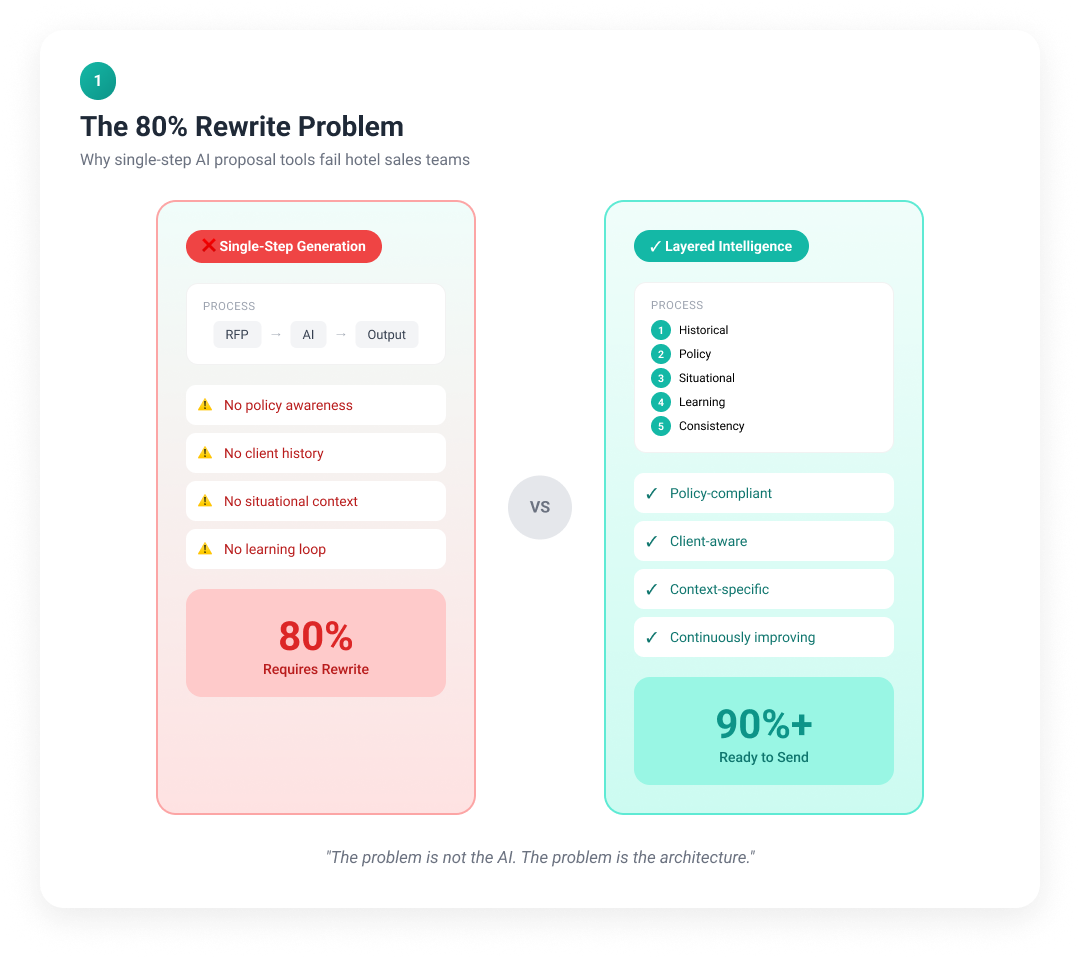
This is not a model quality problem. This is an architecture problem.
Most AI tools treat proposal generation as a single task: take an RFP, generate text. But hotel proposals are not a single task. They sit at the intersection of five different types of knowledge:
1. What has worked before for similar events
2. What your policies actually allow
3. What this specific situation demands
4. What your team has learned from past corrections
5. What needs to stay consistent across proposals
When AI treats these as one undifferentiated input, accuracy becomes random. Sometimes it gets things right. Sometimes it invents terms you never offered. Sometimes it ignores the discount cap you set last quarter.
That unpredictability is why you are still rewriting.
What Hotel Proposals Actually Require
Before building AI that generates accurate proposals, you have to understand what "accurate" means in hotel sales.
A proposal is not just words on a page. It is a business decision expressed as a document.
Pricing reflects your actual rates, seasonal adjustments, discount limits, and whether this client has negotiated special terms.
Concessions must stay within policy. You cannot offer what your brand prohibits. You cannot waive what revenue management has capped.
Language must sound like your property. A luxury resort reads differently than a convention hotel. Your proposals should sound like your proposals.
History matters. If this planner booked with you two years ago and loved certain menu items, that should inform how you present F&B.
Current context changes everything. High-demand dates look different than shoulder season. Strategic clients get different treatment than one-time inquiries.
Generic AI cannot hold all of this simultaneously. Language models generate plausible text based on patterns. They are not designed to enforce business rules or remember that ABC Corp gets 18% instead of 12%.
The Layered Intelligence Approach
The solution is not a smarter AI model. The solution is an architecture that separates different types of knowledge and applies them in the right order.
Think of it as five distinct layers, each handling a specific type of decision:

Layer 1: Historical Intelligence
What has your property done before in similar situations?
This is not just "past proposals" dumped into a system. It is structured knowledge: how you priced a 200-person corporate conference in March, what concessions closed the deal, what language resonated with that type of planner.
When a new RFP arrives, this layer retrieves the most relevant precedents. Proposals get grounded in what has actually worked, not what AI thinks might sound good.
The result: Consistency with past successful proposals for similar scenarios.
Layer 2: Policy Guardrails
What are the hard rules that cannot be broken?
During onboarding, hotel-specific policies get collected: pricing limits, cancellation terms, discount caps, blackout dates, brand requirements. These become constraints that every proposal must respect.
This layer acts as a filter. No matter what historical data suggests or what AI wants to generate, policy violations get caught before they reach your client.
The result: No policy violations. No manual corrections for compliance.
Layer 3: Situational Context
What is different about this specific situation?
Maybe this client has negotiated special terms. Maybe these dates have unusually high demand. Maybe your sales leadership wants aggressive pricing this quarter. Maybe the client budget is below your standard rate.
This layer handles exceptions, overrides, and current business realities. It applies strategic client rules, demand-based restrictions, and one-time approvals that should not leak into future proposals.
The result: Proposals feel intentionally crafted, not auto-generated.
Layer 4: Learning from Corrections
What has your team taught the system?
When sales edits a proposal before sending, that edit contains information. If you consistently change how breakfast is described, the system should learn. If you always adjust cancellation language for certain client types, that should become automatic.
This layer captures the gap between what AI generates and what humans actually send. Over time, it closes that gap.
The result: Accuracy increases with every proposal submitted.
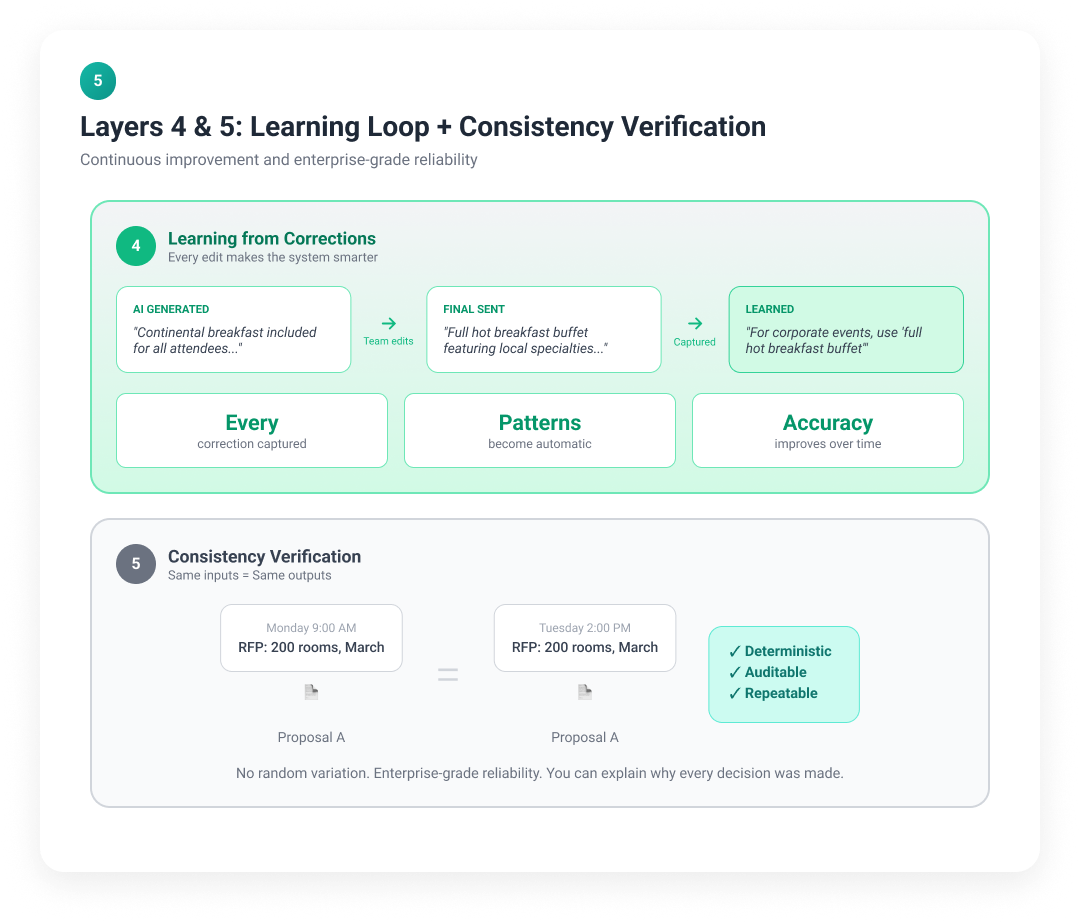
Layer 5: Consistency Verification
Is the output stable and auditable?
For the same RFP context, the same input data, the same questions, the system verifies whether the response remains consistent. Random variation is not acceptable for enterprise use.
This layer ensures deterministic, repeatable results. Same inputs today should produce the same outputs tomorrow.
The result: Enterprise-grade reliability you can trust.
How the Layers Work Together
Here is what layered intelligence looks like in practice.
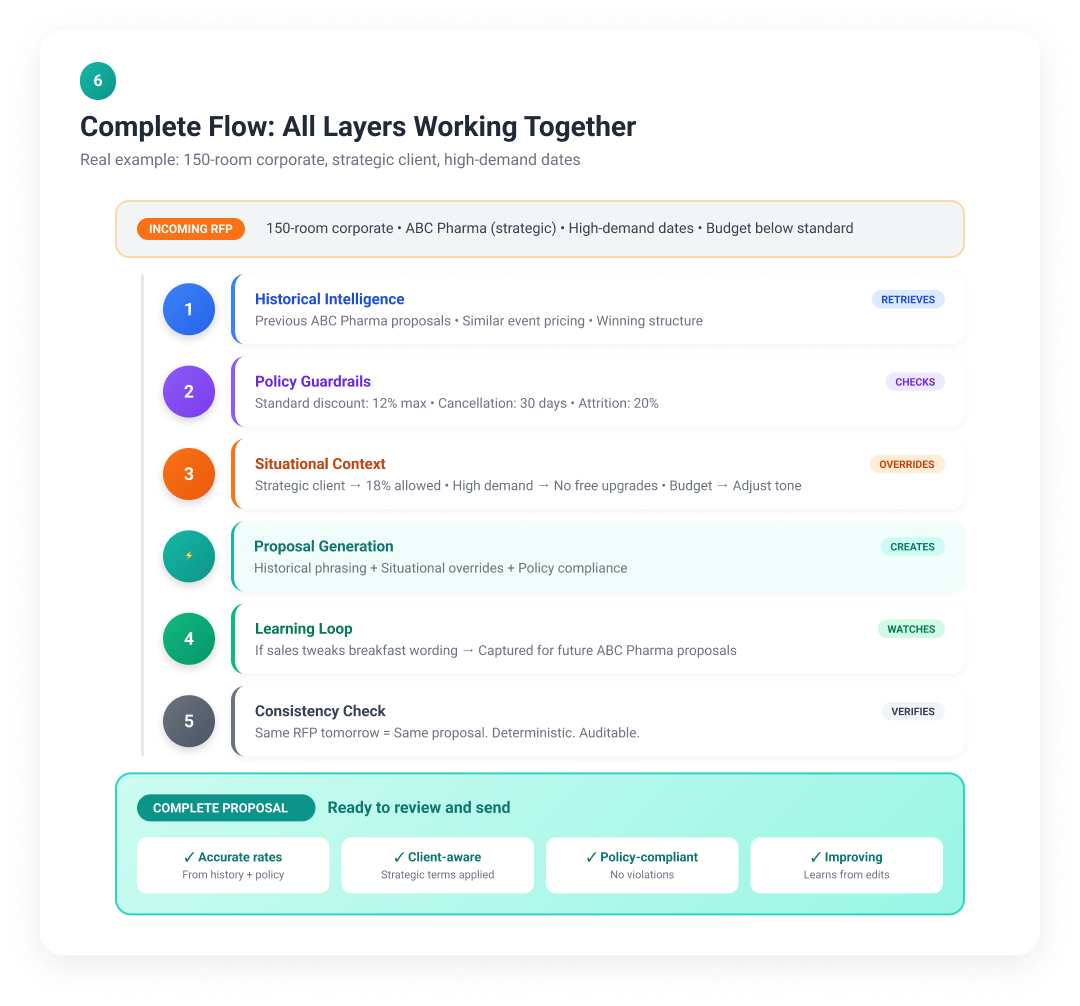
Incoming RFP:
150-room corporate conference
Strategic client (ABC Pharma, significant annual revenue)
Dates overlap with a citywide event
Client budget is below your standard rate
Without Layered Intelligence:
A generic AI retrieves some past proposals, notices you have offered discounts before, and generates a proposal with 15% off.
It does not know the citywide event means you should not discount. It does not know this client has special terms. It does not know your policy caps most discounts at 12%.
Result: Wrong in three different ways. Complete rewrite required.
With Layered Intelligence:
Policy layer checks: Standard discount cap is 12%. Cancellation requires 30 days notice.
Situational layer checks: ABC Pharma is a strategic account, allowed up to 18%. BUT these dates overlap high-demand period, so no free room upgrades. Budget is tight, so adjust pricing tone.
Historical layer retrieves: Previous ABC Pharma proposals, their preferred structure, the concessions that closed deals.
Generation happens: Using historical phrasing, applying situational overrides, staying within policy bounds.
Learning layer watches: If sales tweaks anything before sending, that edit is captured for future improvement.
Consistency layer verifies: Same RFP tomorrow produces the same proposal.
Result: A proposal that reflects your actual business rules, your relationship with this client, and your current revenue strategy. Ready to review, not ready to rewrite.
The Difference You Actually Feel
When proposal AI is architected correctly, the change is not subtle:
From "sometimes right, sometimes wildly off"
To "consistently accurate, occasionally needs minor tweaks"
The 80% rewrite drops to 10%. Your team goes from spending 45 minutes building proposals to spending 5 minutes reviewing them.
From "the AI does not know our property"
To "the AI sounds like someone who has worked here for years"
Because it has learned from your actual proposals, your actual policies, your actual corrections. It is not guessing. It is applying institutional knowledge.
From "I cannot trust it for important RFPs"
To "I trust it more for complex proposals because it remembers details I might miss"
Strategic clients, special terms, historical preferences. The system holds all of it so you do not have to.
From "every proposal feels like starting over"
To "every proposal builds on everything we have learned"
The learning loop means the system gets better with every proposal your team sends.
How Hippo Rev Approaches This
We built Hippo Rev's proposal generation on a multi-layered architecture because we saw what happens when you do not.
Every proposal Hippo Rev generates draws from:
- Your historical intelligence: how your property has actually responded to similar RFPs, what concessions closed past deals, what language resonated with similar planners
- Your policy guardrails: the rules that cannot be broken, enforced before output is generated, not after
- Your situational context: the current business realities — strategic client terms, high-demand date restrictions, revenue strategy overrides — that make this proposal different from the last one
- Your team's corrections: every edit your sellers make before sending is captured and fed back into future proposals, closing the gap between what AI generates and what your team actually sends
- Consistency verification: same RFP inputs produce the same proposal outputs, so your team can trust what they're reviewing
We call it the difference between AI that generates text and AI that institutionalizes your sales intelligence.
The result is proposals that are accurate enough to review and send. Not accurate enough to delete and start over.
The Bottom Line
The problem with most AI proposal tools is not the AI. It is the assumption that proposal generation is a simple task.
It is not.
It is a layered decision that requires historical context, policy enforcement, situational awareness, continuous learning, and consistent output.
When AI is architected for that complexity, proposals go from a rewrite headache to a review-and-send workflow.
That is what Hippo Rev was built to do.
When Proposal Accuracy Is Solved, the Bigger Problem Becomes Visible
But a proposal that's ready to send still has to get out the door fast enough to matter. And it still has to land in an environment where the planner can find everything they need, ask questions without emailing back and forth, and move toward a decision without chasing your team for follow-up.
Accurate proposals are necessary. They're not sufficient.
This is where the gap between a proposal tool and a Revenue Capture Platform becomes concrete.
A proposal tool solves one handoff — RFP in, document out. A Revenue Capture Platform runs across the full deal: the inquiry that arrived in Cvent at 11pm gets captured before anyone logs in the next morning. The missing attendee count gets requested from the planner automatically. The proposal gets built from live rates and sent for review. The planner opens the Active Deal Room, forwards it to their CFO, and your team sees the engagement signal in real time — before they've thought to check.
Hippo Rev is built as that platform. The layered proposal architecture is one component of a system that coordinates across Capture, Convert, and Grow — pulling from your PMS, RMS, and Cvent stack, running the workflow your sellers currently run by hand, and keeping humans in control of every decision that requires judgment.
The result isn't just faster proposals. It's a pipeline that doesn't leak & revenue that always gets captured.
See Layered Proposal Intelligence & Revenue Capture in Action
Book a Demo at Hippo Rev.ai
Share this post
Ready to close more group business?
See how HippoRev can transform your hotel sales workflow in 15 minutes.

Follow us


.svg)