From inquiry to close. Capture every MICE and SMERF RFP across channels. Auto-complete missing event details. Generate proposals with personalized videos 12x faster. Close group deals while competitors are still typing.


RFP Response Time
Win Rate on Group Business
Every Inquiry Answered
Manual Admin Work
The Scattered Hotel Sales Stack

AI Sales Agent for Hotels


AI Sales Agent for Hotels

HippoRev does the work. Your team closes the deals.
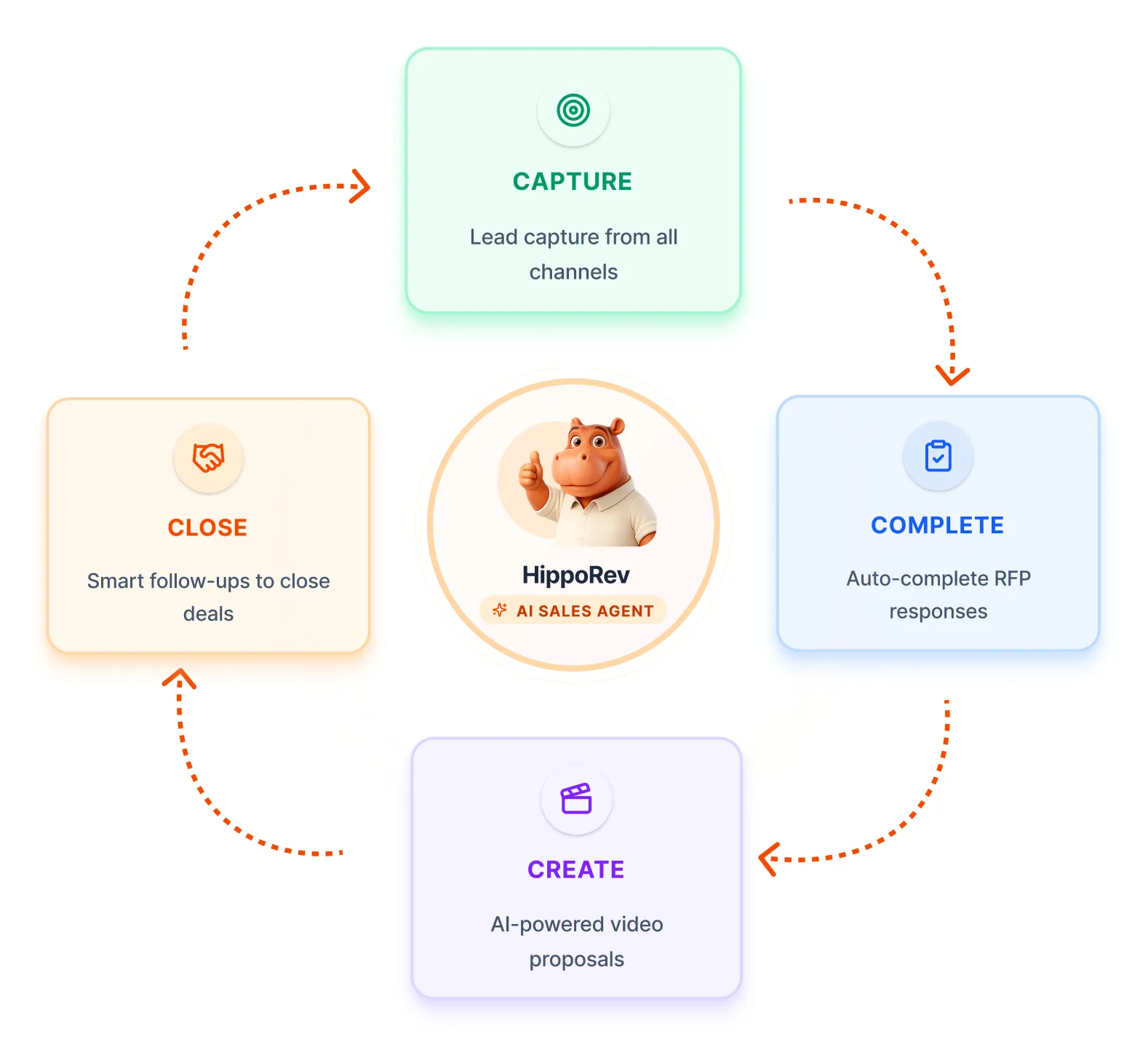
CAPTURE
COMPLETE
CREATE
CLOSE
STEP 1: CAPTURE
Lead Catcher Agent captures every MICE and SMERF inquiry. Front Desk Agent answers calls and collects details. Website Chatbot with Video engages visitors 24/7. Source Aggregator pulls from Cvent, email, and web forms. Qualification Agent scores and prioritizes the best opportunities. All flowing into one intelligent dashboard.
See how we capture inquiries →Why chase leads across 5 inboxes when they could all land in one?

STEP 2: COMPLETE
RFPs arrive incomplete. HippoRev identifies what is missing (event dates, attendee counts, room block needs, F&B requirements) and automatically reaches out to planners to gather the details. Lead scoring and business intelligence help you prioritize the best opportunities. You get proposal-ready RFPs without chasing information.
See Gap Detection in action →Why spend hours gathering details when I can do it in seconds?

STEP 3: CREATE
RFP Response Automation generates customized proposals with accurate pricing from your PMS and personalized video walkthroughs of your property. Review and approve in 5-10 minutes. Respond same-day while competitors take days.
See AI proposal generation →Why send PDFs that get ignored when you could send personalized proposals that wins?

STEP 4: CLOSE
Engagement Agent keeps every deal moving with AI-powered deal rooms, automated follow-up sequences, and real-time engagement tracking. Stakeholder detection alerts you the moment decision-makers open your proposal. Smart nudges re-engage stalled deals at the perfect time. Sales & Marketing Agent proactively re-engages past customers and drives new business through personalized video outreach — turning one-time bookings into repeat revenue. Close the deal, then close the next one.
See how we close and re-engage →Why let deals go cold — or past customers slip away — when I can keep them coming back?

Each agent is purpose-built for a different part of the hotel sales lifecycle. They share context and memory across every planner interaction.
Lead Catcher Agent
RFP Response Agent
Engagement Agent
Sales and Marketing Agent
AI Lead Capture & Qualification
Captures every MICE and SMERF inquiry across Cvent, email, phone, web forms, and partner portals. Qualifies leads instantly and routes hot opportunities to your team.
Front Desk Agent
Source Aggregator
Website Chatbot
Lead Qualification


AI Proposal Generation
Generates complete proposals with accurate pricing, virtual tours, and branded Active Deal Rooms. Auto-completes missing RFP details so you respond faster with better proposals.
Auto-Complete Details
Competitive Pricing
Virtual Tours
Active Deal Room


AI Deal Tracking & Follow-ups
Tracks who opened your proposal, watched videos, and viewed pricing. Automates personalized follow-ups based on engagement signals. Know exactly when to call.
Analytics & Insights
Follow-up Automation
FAQ Agent
Engagement Videos


AI Marketing & Outreach
Creates targeted video marketing campaigns, powers personalized video outreach at scale, and manages ongoing customer relationships. Fill your pipeline without the manual work.
Video Campaigns
Personalized Outreach
Customer Engagement


Director of Sales, Full-Service Hotel Group, Southeast US


Most AI proposal tools don’t optimize for hotel sales. Discover how a layered intelligence architecture ensures accurate, policy-compliant proposals every time.
Why Most AI Proposal Tools
Get Hotel Sales Wrong
And What a Layered Intelligence Architecture Actually Changes
Here is what hotel sales teams tell us after trying AI proposal tools:
"It sounds professional. But every rate is wrong."
"It made up concessions we have never offered."
"It ignored that this client has special terms."
"I spent 45 minutes fixing what it generated."
The pattern is consistent. AI proposal tools promise speed. They deliver rewrite headaches.
The proposals look good on the surface. The language flows. The structure seems right. But the details are wrong in ways that matter: pricing that does not match your actual rates, concessions that violate policy, generic descriptions that could apply to any hotel, and zero awareness of client history.
So teams end up rewriting 80% of the output. At that point, the "time savings" disappear.

This is not a model quality problem. This is an architecture problem.
Most AI tools treat proposal generation as a single task: take an RFP, generate text. But hotel proposals are not a single task. They sit at the intersection of five different types of knowledge:
1. What has worked before for similar events
2. What your policies actually allow
3. What this specific situation demands
4. What your team has learned from past corrections
5. What needs to stay consistent across proposals
When AI treats these as one undifferentiated input, accuracy becomes random. Sometimes it gets things right. Sometimes it invents terms you never offered. Sometimes it ignores the discount cap you set last quarter.
That unpredictability is why you are still rewriting.
Before building AI that generates accurate proposals, you have to understand what "accurate" means in hotel sales.
A proposal is not just words on a page. It is a business decision expressed as a document.
Pricing reflects your actual rates, seasonal adjustments, discount limits, and whether this client has negotiated special terms.
Concessions must stay within policy. You cannot offer what your brand prohibits. You cannot waive what revenue management has capped.
Language must sound like your property. A luxury resort reads differently than a convention hotel. Your proposals should sound like your proposals.
History matters. If this planner booked with you two years ago and loved certain menu items, that should inform how you present F&B.
Current context changes everything. High-demand dates look different than shoulder season. Strategic clients get different treatment than one-time inquiries.
Generic AI cannot hold all of this simultaneously. Language models generate plausible text based on patterns. They are not designed to enforce business rules or remember that ABC Corp gets 18% instead of 12%.
The solution is not a smarter AI model. The solution is an architecture that separates different types of knowledge and applies them in the right order.
Think of it as five distinct layers, each handling a specific type of decision:

What has your property done before in similar situations?
This is not just "past proposals" dumped into a system. It is structured knowledge: how you priced a 200-person corporate conference in March, what concessions closed the deal, what language resonated with that type of planner.
When a new RFP arrives, this layer retrieves the most relevant precedents. Proposals get grounded in what has actually worked, not what AI thinks might sound good.
The result: Consistency with past successful proposals for similar scenarios.
What are the hard rules that cannot be broken?
During onboarding, hotel-specific policies get collected: pricing limits, cancellation terms, discount caps, blackout dates, brand requirements. These become constraints that every proposal must respect.
This layer acts as a filter. No matter what historical data suggests or what AI wants to generate, policy violations get caught before they reach your client.
The result: No policy violations. No manual corrections for compliance.
What is different about this specific situation?
Maybe this client has negotiated special terms. Maybe these dates have unusually high demand. Maybe your sales leadership wants aggressive pricing this quarter. Maybe the client budget is below your standard rate.
This layer handles exceptions, overrides, and current business realities. It applies strategic client rules, demand-based restrictions, and one-time approvals that should not leak into future proposals.
The result: Proposals feel intentionally crafted, not auto-generated.
What has your team taught the system?
When sales edits a proposal before sending, that edit contains information. If you consistently change how breakfast is described, the system should learn. If you always adjust cancellation language for certain client types, that should become automatic.
This layer captures the gap between what AI generates and what humans actually send. Over time, it closes that gap.
The result: Accuracy increases with every proposal submitted.

Is the output stable and auditable?
For the same RFP context, the same input data, the same questions, the system verifies whether the response remains consistent. Random variation is not acceptable for enterprise use.
This layer ensures deterministic, repeatable results. Same inputs today should produce the same outputs tomorrow.
The result: Enterprise-grade reliability you can trust.
Here is what layered intelligence looks like in practice.

Incoming RFP:
150-room corporate conference
Strategic client (ABC Pharma, significant annual revenue)
Dates overlap with a citywide event
Client budget is below your standard rate
Without Layered Intelligence:
A generic AI retrieves some past proposals, notices you have offered discounts before, and generates a proposal with 15% off.
It does not know the citywide event means you should not discount. It does not know this client has special terms. It does not know your policy caps most discounts at 12%.
Result: Wrong in three different ways. Complete rewrite required.
Policy layer checks: Standard discount cap is 12%. Cancellation requires 30 days notice.
Situational layer checks: ABC Pharma is a strategic account, allowed up to 18%. BUT these dates overlap high-demand period, so no free room upgrades. Budget is tight, so adjust pricing tone.
Historical layer retrieves: Previous ABC Pharma proposals, their preferred structure, the concessions that closed deals.
Generation happens: Using historical phrasing, applying situational overrides, staying within policy bounds.
Learning layer watches: If sales tweaks anything before sending, that edit is captured for future improvement.
Consistency layer verifies: Same RFP tomorrow produces the same proposal.
Result: A proposal that reflects your actual business rules, your relationship with this client, and your current revenue strategy. Ready to review, not ready to rewrite.
When proposal AI is architected correctly, the change is not subtle:
From "sometimes right, sometimes wildly off"
To "consistently accurate, occasionally needs minor tweaks"
The 80% rewrite drops to 10%. Your team goes from spending 45 minutes building proposals to spending 5 minutes reviewing them.
From "the AI does not know our property"
To "the AI sounds like someone who has worked here for years"
Because it has learned from your actual proposals, your actual policies, your actual corrections. It is not guessing. It is applying institutional knowledge.
From "I cannot trust it for important RFPs"
To "I trust it more for complex proposals because it remembers details I might miss"
Strategic clients, special terms, historical preferences. The system holds all of it so you do not have to.
From "every proposal feels like starting over"
To "every proposal builds on everything we have learned"
The learning loop means the system gets better with every proposal your team sends.
We built HippoRev's proposal generation on a multi-layered architecture because we saw what happens when you do not.
Every proposal HippoRev generates draws from:
Your historical intelligence: How your property has actually responded to similar RFPs
Your policy guardrails: The rules that cannot be broken
Your situational context: The current business realities that should influence each specific proposal
Your team's corrections: The learning that makes every proposal better than the last
Consistency verification: Ensuring output is stable and auditable
We call it the difference between AI that generates text and AI that institutionalizes your sales intelligence.
The result is proposals that are accurate enough to review and send. Not accurate enough to delete and start over.
The problem with most AI proposal tools is not the AI. It is the assumption that proposal generation is a simple task.
It is not.
It is a layered decision that requires historical context, policy enforcement, situational awareness, continuous learning, and consistent output.
When AI is architected for that complexity, proposals go from a rewrite headache to a review-and-send workflow.
That is what HippoRev was built to do.
See Layered Proposal Intelligence in Action
Book a Demo at hipporev.ai

HippoRev is built for a faster world of hotel sales, where speed decides outcomes. This blog explains why hotels need AI that executes work, not just tracks it.
Most group RFPs aren’t lost on pricing.
They’re lost on speed.
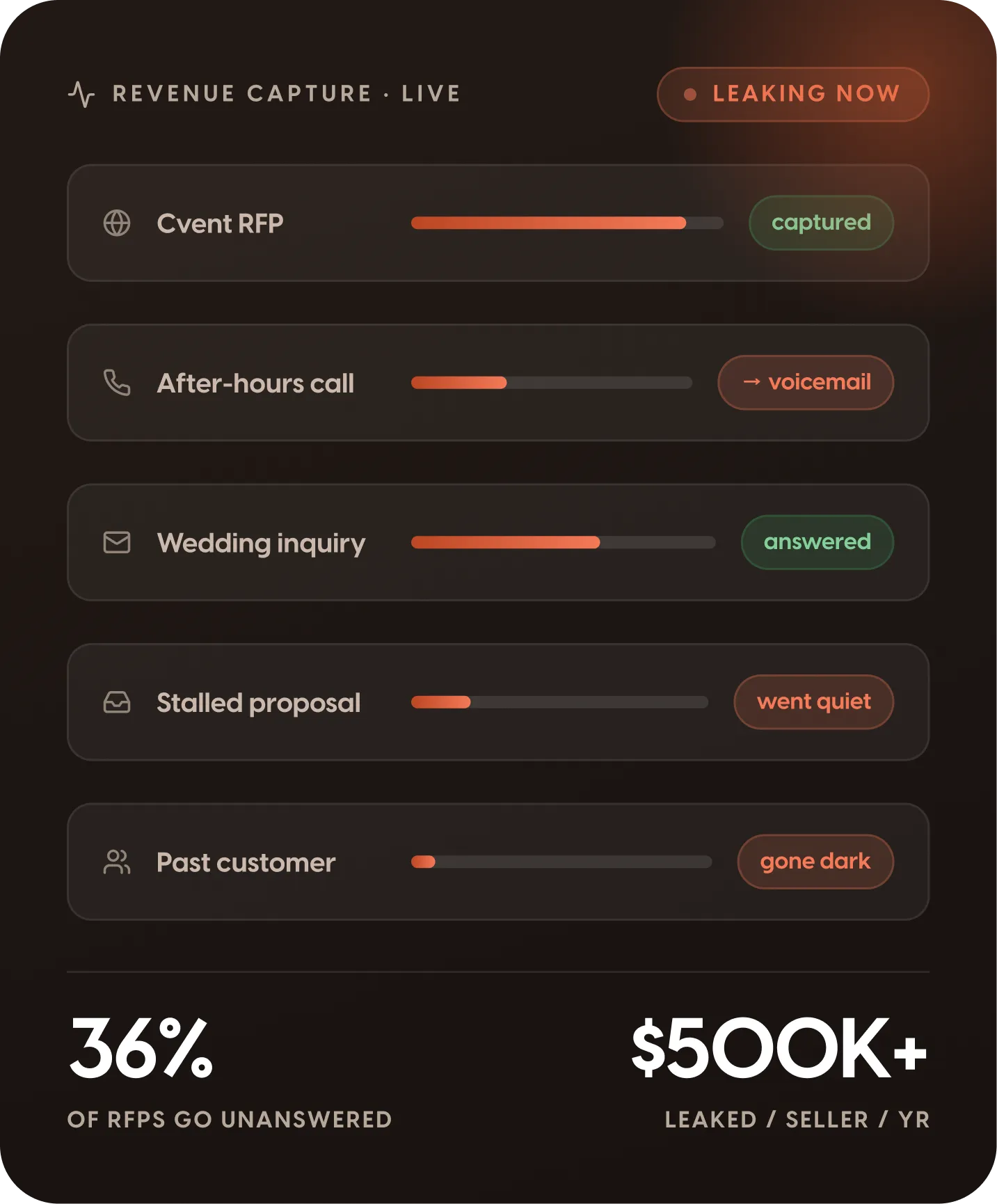
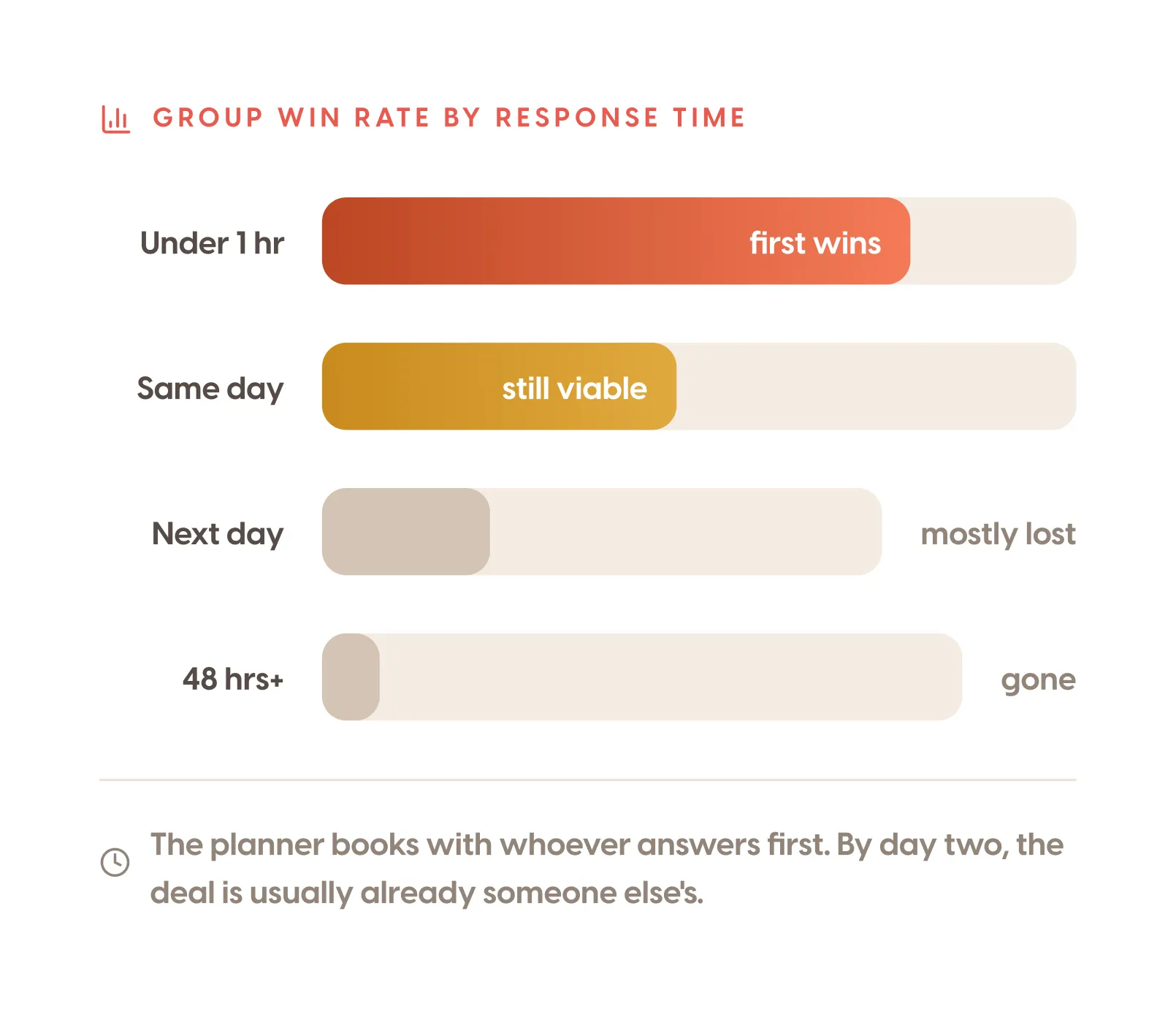
72% of the time, the first hotel to reply wins the deal.
But what if you’re too slow because you’re buried in admin work, not because you’re bad at your job?
This is the part of the revenue story that rarely gets talked about. That even great teams, with good intentions and hard working people, are losing business for reasons that have nothing to do with effort or expertise.
Behind the grand lobbies and polished pitches, hotel sales teams are drowning in invisible work. Proposal emails, missing RFP details, call logs, data entry. These are friction points eating away at the very thing salespeople are meant to do: sell.
70% of hotel sales team time goes to non-revenue generating admin work. And as a result, 55% of group RFPs go unanswered.
This is the peak of inefficiency & a revenue black hole. One that’s felt across the industry, especially as 65% of hotels report being understaffed.
Modern hotel sales teams are judged on revenue outcomes, but equipped with tools that were designed to store information, not to move work forward. CRMs record activity. Portals collect requests. Email moves messages around. None of them actually take work off the salesperson’s plate.
So teams compensate the only way they can. By working longer hours. By multitasking. By triaging. By letting some requests wait or go unresponded.
We have spent years listening to hotel sales teams describe this moment. The moment where they know a deal matters, but the system around them makes it hard to act fast.This is the problem space we have been seeing, again and again, across properties, portfolios, and markets.
And that is where this product begins.
The world didn’t always work like this.
But post-pandemic, planners expect faster answers. Guests expect digital convenience. And hotels, operating with leaner teams than ever, are being asked to do more with less.
What used to be a 4-day proposal window is now a same-day race.
Whereas, on the other hand, AI has now matured to a point where multiple specialized agents can work together to execute complex, multi-step workflows. Each agent takes on a distinct responsibility—whether it’s capturing leads, completing missing details, generating proposals, or tracking engagement—collaborating seamlessly to complete the full sales task from inquiry to close.
The collision of these forces creates an opening for something genuinely new. Not incremental improvement. A fundamental reimagining of what revenue software should do.
We believe hotel sales teams shouldn’t lose deals because of slow software or scattered systems.
We believe RFPs should be responded to in minutes, not days.
We believe every inquiry deserves a response — not just the big ones.
We believe automation should feel like having a mate working alongside you—always on, proactively handling what needs to be done without waiting to be told, and not another tool that creates more work to manage.
We built HippoRev because the current tools weren’t built for this moment. They were built for a slower world. One where a four-day turnaround was fine. One where you had three people per RFP. One where follow-ups happened because someone remembered.
That world is gone.
HippoRev isn’t a tool. It’s a teammate.
Our belief is simple and demanding.
Software should execute work, not just inform it.
If a task is repetitive, rules based, and directly tied to revenue, it should not live in a human inbox. It should live with an AI agent whose job is to do it, reliably, every time.
This is why we do not think of this product as automation in the traditional sense. Automation follows scripts. Agents take responsibility. And when multiple AI agents work together, each handling their part of the workflow, they complete the entire process end to end—from inquiry to the signed contract.
With HippoRev:
• One agent captures every inquiry the moment it arrives—no manual entry, no missed opportunities.
• Another spots missing details and reaches out proactively, so nothing stalls.
• A third assembles a complete, tailored proposal—ready for you to review and personalize in minutes.
• And yet another tracks planner engagement, signaling precisely when it’s time to jump in and close.
Together, they form an always-on sales team—working behind the scenes so your team can focus on what matters most.
In this model, multiple AI agents handle the repetitive, time-consuming tasks—each one built for a specific job, working in sync to keep the process moving. What stays human is what matters most: the judgment, the relationships, the final call. What disappears is the drudgery that never should have been human work to begin with.
The future of hotel group sales isn’t about working harder.
It’s about removing the friction that’s slowing your best people down.
With HippoRev, speed becomes your strategy. And every inquiry becomes an opportunity.
We’ve built this for the realities of modern hotel group sales.
We’ve built this for teams who care about winning the right way.
By being present. By being fast. By being more human.
Ready to see what inquiry-to-close intelligence looks like in practice?
Book a demo and experience the future of hotel group sales.That's the world we're building. And we're just getting started.

We didn’t build another tool. We built an agent that executes. Take a behind the scenes look at how HippoRev was built to remove sales drudgery and return time, focus, and craft to hotel sales teams.
There’s a moment that keeps replaying in my head.
It’s early evening. The office is quieting down. A sales manager is finally packing up for the day when an RFP lands in the inbox. A good one. High value. Tight timeline.
They know the math.
Respond late, and the deal is probably gone. Respond now, and the evening disappears.
That tradeoff felt wrong. And the longer we spent around hotel sales teams, the more we realized it wasn’t an isolated moment. It was the job.
This is the story of how HippoRev came to be. Not as a product roadmap. But as a response to something that felt fundamentally broken.
For years, we worked closely with sales teams across industries. We watched what helped them connect better. We built tools that made communication clearer, more personal, more human.
And yet, in conversation after conversation, the same frustration kept surfacing.
“I love selling. I hate everything around it.”
Hotel group sales teams were not short on effort, skill, or intent. They were drowning in process.
Inquiries arriving from everywhere. Details missing. Endless back and forth. Proposals that took hours to assemble. Follow ups that depended on memory, not signals.
The most striking part was this. None of it felt like real sales work.
It felt like people compensating for systems that were never designed for how hospitality actually works.
And somewhere in the middle of all this, a set of questions started to surface.
Why does every RFP, no matter how similar, have to be rebuilt from scratch?
Why does a sales manager need to manually call or email planners just to collect information that should have been obvious, structured, or already known?
Why does so much of a salesperson’s time go into chasing missing details instead of advancing real conversations?
None of these questions were about real effort or commitment.
At first, we tried to solve pieces of the problem.
Better visibility here. Faster creation there. Smarter reminders. More dashboards.
But every improvement felt like adding a layer on top of a shaky foundation.
Teams were already overloaded. Giving them another tool just gave them another place to check.
We realized something uncomfortable. We were optimizing the wrong thing.
The real issue was not insight. It was execution.
Hotels did not need to know what to do next. They needed the work to actually get done.
Late in the process, we asked ourselves a question that changed everything.
What if software did not just assist sales teams, but actually took responsibility for the work that slows them down?
Not suggesting. Not nudging. Not reminding.
Executing.
Capturing every inquiry. Qualifying intent early. Completing missing details. Building proposals. Tracking engagement. Triggering follow ups at the right moment.
And crucially, doing it in a way that still kept humans in control.
That question became the spine of HippoRev.
We chose to start with hotel group sales for a simple reason. The pain was visible, measurable, and urgent.
Group business is complex by nature. Multiple stakeholders. Detailed requirements. Tight timelines. High expectations.
And yet, most systems treated it like generic B2B sales.
They tried to solve individual problems—room blocks, event space constraints, planner preferences—in isolation. But group sales isn’t a series of disconnected tasks. It’s a tightly woven workflow where delay at any step breaks the whole.
Speed mattered more than most teams realized. Not speed for its own sake, but speed as a proxy for care, competence, and confidence.
When planners wait days for a response, they do not assume the hotel is busy. They assume it is disorganized.
Once we committed to the idea of execution-first software, everything changed.
We stopped asking what features to add.
We started asking what work should never require a human in the first place.
That led us to agents. Not chatbots. Not workflows. Purpose-built agents designed to own specific parts of the revenue process.
An agent that never misses an inquiry, no matter where it comes from.
An agent that sees what information is missing and goes and gets it.
An agent that understands pricing context and surfaces real options, not guesses.
An agent that watches how planners engage and knows when it is time to act.
Individually, each solves a familiar problem. Together, they remove entire categories of work from a salesperson’s day.
There were many false starts along the way.
Agents that worked in isolation but failed together. Automations that were fast but brittle. Early demos that maybe impressed technically but didn’t change how teams felt emotionally.
The breakthrough moments were not technical. They were human.
A sales manager telling us they stopped checking six systems every morning.
A director realizing no RFP had slipped through in weeks.
Someone saying they reviewed a proposal after dinner instead of building it during dinner.
Those were the signals we cared about.
Launching HippoRev is not about declaring victory. It is about opening the door.
It’s about moving from what needs to get done—capturing inquiries, qualifying leads, chasing details, building proposals, tracking engagement, triggering follow-ups—to when those things actually get done, automatically, instantly, and without slipping through the cracks.
We know this is a beginning. There is more to refine, more to learn, more to build.
But we believe deeply in the direction.
Software should remove drudgery, not add to it.
AI should execute work, not create more decisions.
Sales teams should spend their time building relationships, not fighting systems.
We are starting with hotel group sales because the need is clear and the impact is immediate.
But the idea behind HippoRev goes beyond hospitality.
Everywhere we look, talented people are trapped doing work that software should have handled years ago.
Our goal is to change that, one workflow at a time, without losing the human side of selling.
If you are a hotel sales leader reading this, thank you for trusting us early. Your feedback shaped this more than you know.
If you are just discovering HippoRev, welcome. We are building this in the open, and we plan to keep listening.
This is not about replacing people.
It is about giving them their craft back.
And this is only the first step.
You can book time with us here:
HippoRev is an AI sales agent with specialized AI Agents that handle your complete hotel sales workflow from inquiry to close. This includes capturing leads, completing missing details, generating proposals with personalized videos, and automating follow-up.
Currently, yes. We have built HippoRev specifically for hotel and hospitality sales teams. Our AI Agents understand RFPs, group business, event planning, and property-specific workflows. We will expand to other industries in the future.
Most hotel teams are up and running in 15-30 minutes. Connect your Cvent, email, and PMS. HippoRev starts working immediately.
Yes. We have integrations with Opera, Delphi, Event Temple, and other hospitality systems for real-time pricing and availability.
Absolutely. SOC 2 Type II certified, ISO 27001 certified, GDPR compliant, and enterprise-grade encryption. Your property data is never used to train AI models.
HippoRev is the only platform with AI Agents that auto-complete missing RFP details, generate video proposals with virtual tours, and provide real-time engagement intelligence. Complete workflow automation, not just a proposal tool.