


Speed & Response
Revenue Leakage in Group Sales: Why Deals Are Lost Before You Respond
Research shows that most of the buyers sign with the first company that responds to their inquiry, not the cheapest or the best-equipped. Yet the average B2B response time sits at a staggering 42 hours, and 55% of hotel RFPs are never answered at all.



.jpeg)
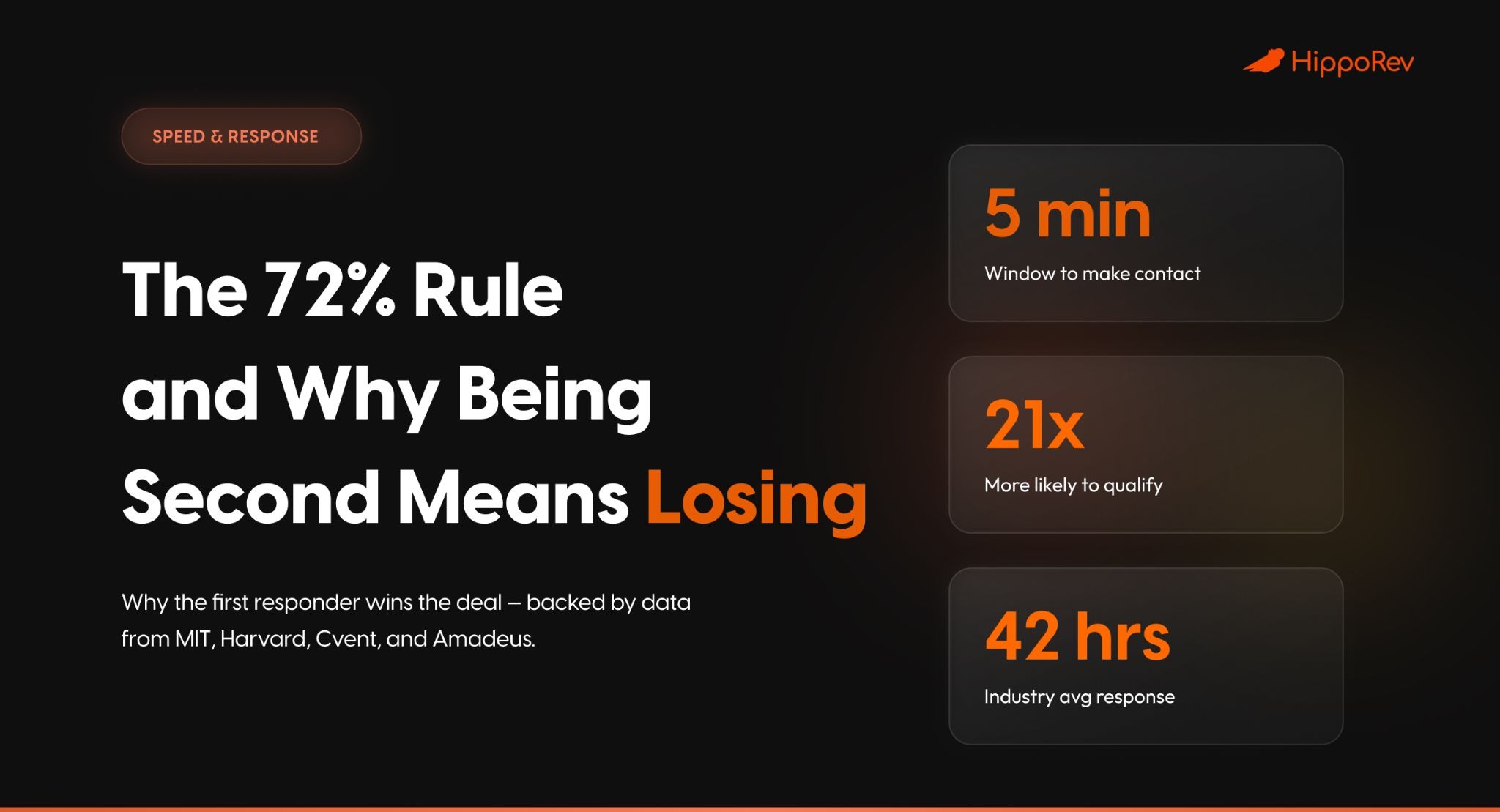
The 72% Rule and Why Being Second Means Losing
When was the last time your sales team tracked exactly how long it takes to respond to a new inbound lead or Request for Proposal (RFP)? If you are like the vast majority of hotel and B2B sales leaders, the honest answer is either "not recently" or "never". We meticulously track occupancy rates, average daily rates (ADR), RevPAR, and pipeline conversion metrics, yet response time—the very first interaction with a potential client—remains a massive blind spot.
Sales teams often operate under the assumption that they are "fast enough." They are busy, deals are closing, and the pipeline is moving. But in today’s hyper-competitive landscape, "fine" is the enemy of winning.
The reality is that you are no longer just competing on price or property. You are competing on how quickly you can capture and convert demand before it slips away. This is not sales folklore or motivational opinion; it is a proven reality backed by millions of data points and rigorous transaction data.
Welcome to the harsh truth of modern sales:
If you aren’t first to respond, that revenue is already moving to someone else.
The Rise of the Consumer-Trained Buyer
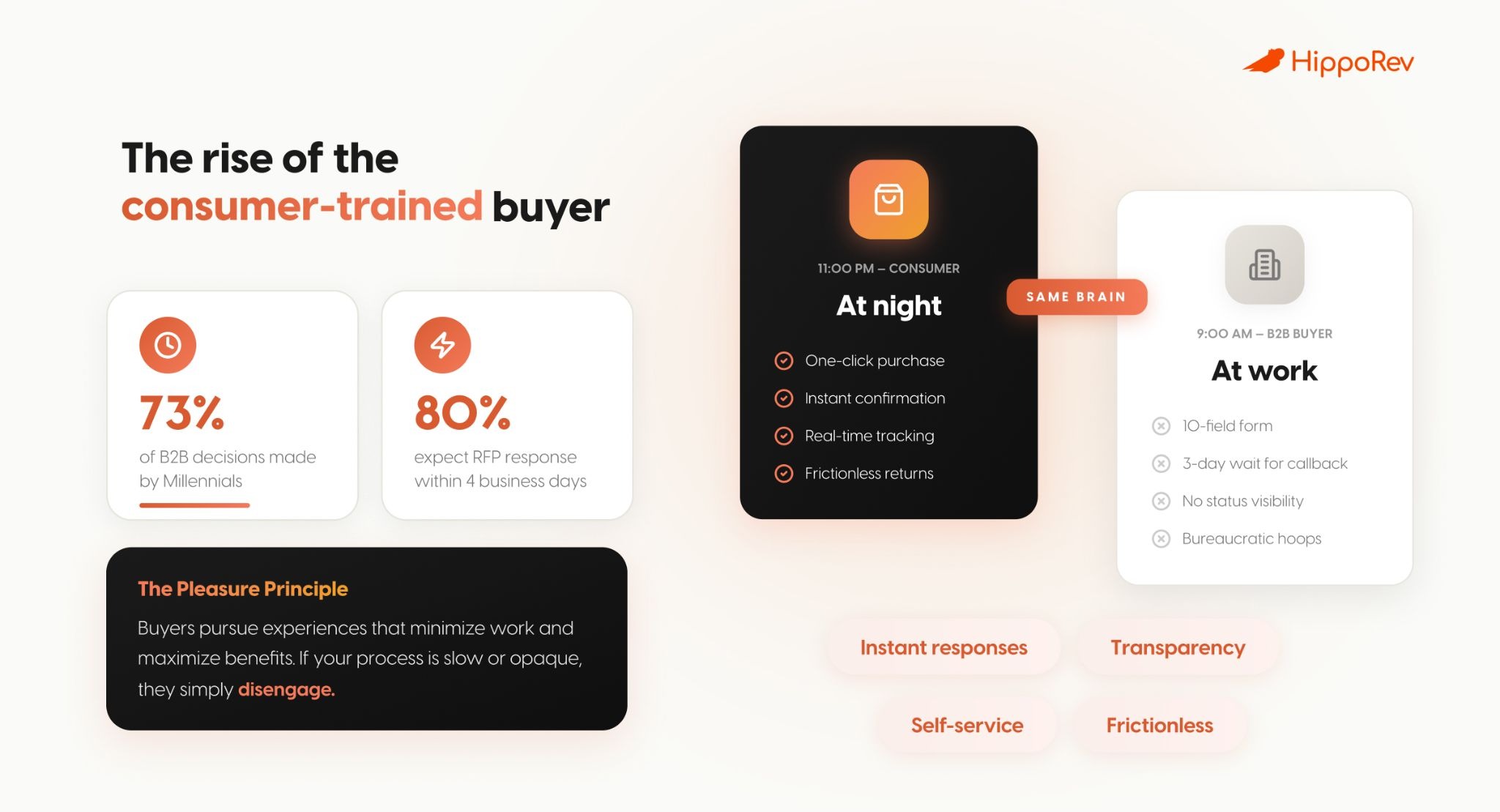
To understand why speed is so critical, we must first understand the psychology of the modern buyer. Today, 73% of all B2B buying decisions are made by Millennials. This demographic grew up in an era of frictionless, self-service digital experiences and expects the same level of ease and responsiveness in their professional lives that they enjoy as consumers.
Psychologically, buyers no longer separate their consumer selves from their professional selves. The same brain that appreciates a seamless, one-click transaction at night expects instant, frictionless engagement at work the next morning.
This is driven by the "pleasure principle," which states that people naturally pursue experiences that minimize work and maximize benefits. If your purchasing or booking process is slow, lacks transparency, or feels burdened by bureaucratic hoops, prospective buyers will simply lose interest and disengage. They do not want to fill out a 10-field demo request form and wait three days for a callback.
The Science of Speed: First Responder Research
When we look at the transaction data, the mathematics of lead response time are brutal and unforgiving.
The gold standard in speed-to-lead research is the Lead Response Management Study conducted by Dr. James Oldroyd at MIT and InsideSales.com. This peer-reviewed study analyzed over 15,000 unique leads and more than 100,000 call attempts across three years.
The researchers focused on a single, critical question: When should companies call web-generated leads for optimal contact and qualification ratios?
The findings completely shattered traditional sales timelines:
- The 5-Minute Window: Contacting a lead within the first 5 minutes versus 30 minutes makes you 100 times more likely to make successful contact.
- The 21x Multiplier: More importantly, reaching out within that 5-minute window makes you 21 times more likely to qualify the lead compared to waiting just 30 minutes.
- The Exponential Drop-Off: After the first 5 minutes, the odds of successful contact drop 10-fold within the first hour. By the time 30 minutes have passed, a prospect's interest has plummeted by more than 50%.
Why does this happen? The answer lies in the "contextual window". When a lead submits an inquiry, they are in a focused moment—actively researching, comparing options, and ready to engage. The moment they shift their attention to their inbox, their next meeting, or a new browser tab, you are no longer competing with other vendors; you are competing with the rest of their day.
The 72% Rule and The Psychological Anchor
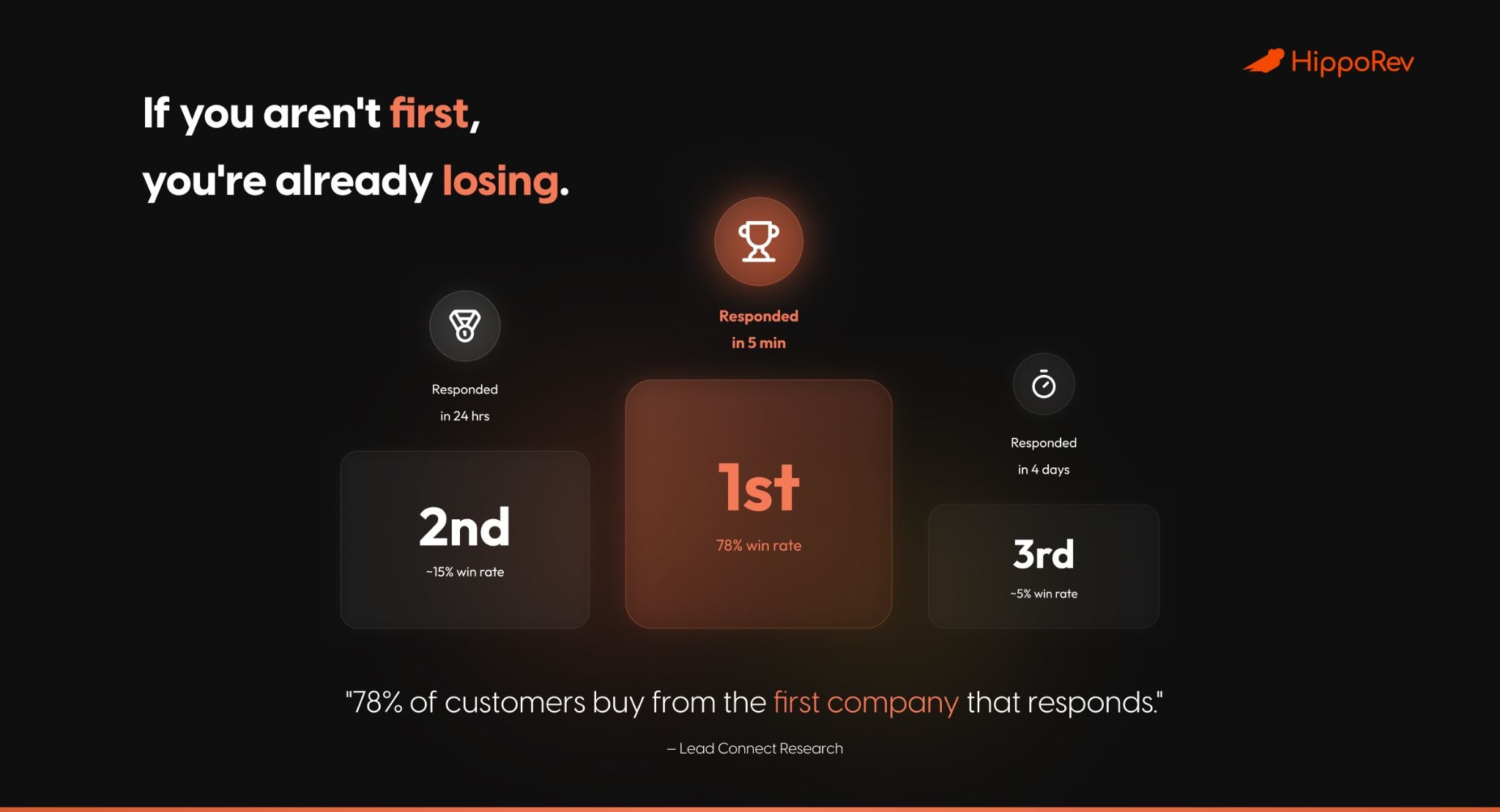
In the hospitality and B2B sectors, the "first responder advantage" is absolute. Research from Lead Connect reveals that 78% of customers end up buying from the first company that responds to their inquiry. They do not necessarily buy from the cheapest vendor, nor the one with the best product—they buy from the one that answers first.
This aligns perfectly with what we see across industry-specific platforms. While the exact metrics vary, the directional truth remains constant. Consider the 72% Amadeus stat and the 79% Thynk stat, which further reinforce that the vast majority of event planners and travel buyers overwhelmingly award their business to the properties and platforms that reply with unmatched speed.
We see this heavily reflected in Cvent’s Supplier Network data, which shows that 61% of all RFPs are awarded to one of the first three responders. Furthermore, hotels that respond to an RFP within 24 hours are 70% more likely to win the bid.
When you respond first, you create a psychological anchor. By being quick, you demonstrate that your team is organized, eager, and professional. The planner begins their mental anchoring around your early response, and any later responses from competitors are compared against your baseline—often unfavorably.
The Cost of Being Average
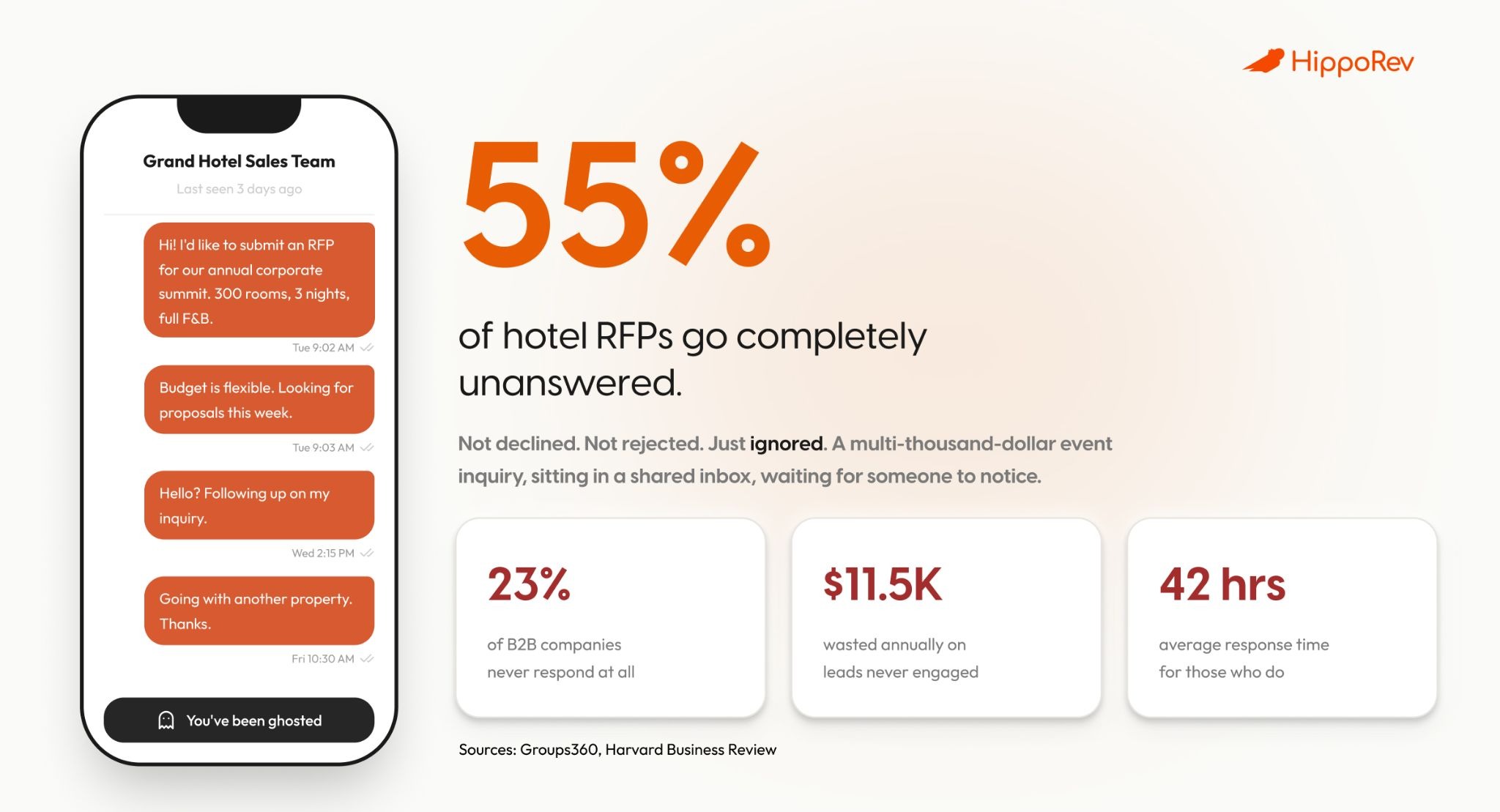
Despite this overwhelming evidence, the average B2B response time is shockingly slow. A comprehensive Harvard Business Review audit of 2,241 U.S. companies found that the average time to respond to a web-generated lead was 42 hours.
Even worse, the audit found that:
- Only 37% of companies responded within one hour.
- 24% took more than 24 hours to respond.
- 23% never responded at all.
In the hotel industry, the numbers are equally alarming. Groups360 platform data reveals that a staggering 55% of hotel RFPs go completely unanswered—they aren't declined or rejected; they are simply ignored. This represents direct revenue loss—deals that never even enter your pipeline.
If your marketing team is spending thousands of dollars generating leads through ads or platforms, every lead lost to a slow response is wasted ad spend. For example, if you generate leads at $8 each, losing 120 leads a month due to slow responses equates to nearly $11,520 wasted annually on leads you never properly engaged.
Where Your Response Time is Leaking
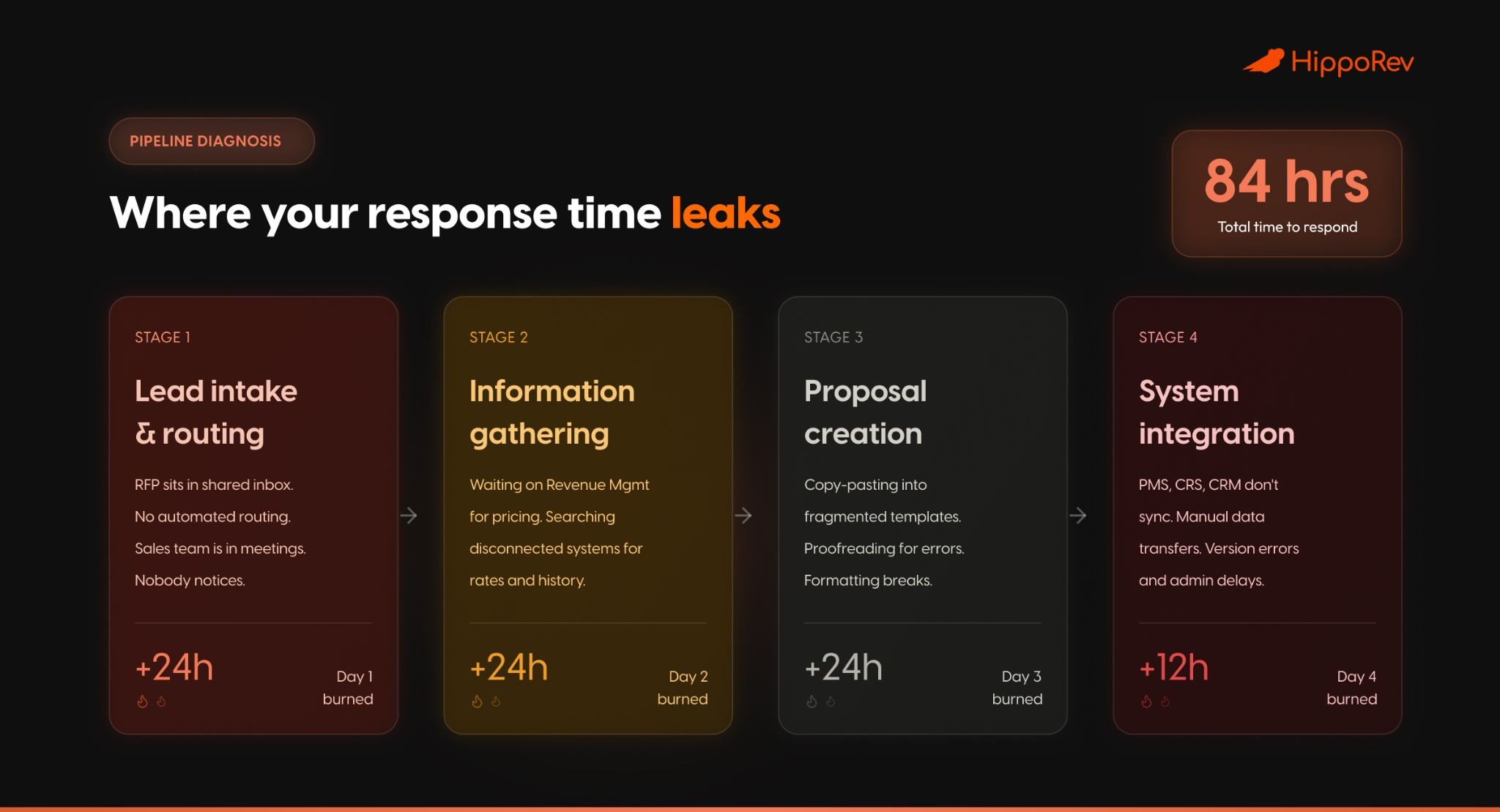
Most organizations know they aren't as fast as they should be, but they don't know why. The truth is, response time isn't a single problem; it is a chain of compounding bottlenecks.
Revenue loss doesn’t come from one failure—it happens across a chain of execution gaps that delay every deal.
When an inquiry or RFP arrives, time typically leaks at four distinct stages:
Stage 1: Lead Intake & Routing RFPs and leads pour in from multiple, disconnected sources—email, web forms, phone calls, and platforms like Cvent. Because teams manually monitor these inboxes without automated routing, hours or even days are lost simply noticing that the RFP arrived.
Stage 2: Information Gathering Once the lead is spotted, sales reps waste hours collecting missing details or searching for rates and availability across disconnected systems, researching account histories, and waiting for pricing approvals from revenue management.
Stage 3: Proposal Creation Next comes repetitive data entry. Sales managers manually customize proposal templates for each prospect, fighting with fragmented spreadsheets and outdated document versions.
Stage 4: System Integration Issues Finally, a lack of open API connections between the PMS, CRS, and CRM means manual data transfers cause version errors and severe administrative delays.
A delay at Stage 1 pushes back everything that follows. When your sales team handles 50 to 100 RFPs a month, these small delays multiply into massive aggregate time losses.
You Cannot Hire Your Way Out of This
Faced with slow response times, the traditional management reflex is to hire more people. But the math simply doesn't support adding more humans to solve a structural process problem.
Consider the current staffing reality: 65% of U.S. hotels still report staffing shortages, and hotel employment remains nearly 10% below pre-pandemic levels. Furthermore, the hospitality industry suffers from the highest turnover of any U.S. industry, sitting at 70-80% annually. Meanwhile, Salesforce data shows that salespeople spend only 29% of their actual time selling.
Human agents also have physical limitations. They have to sleep, eat, and attend meetings. Leads, however, do not stop at 5:00 PM. A European prospect might research your solution at 3:00 PM their time, which is early morning in the US. A C-suite executive might browse your offerings at 11:00 PM on a weekend. If you rely purely on human follow-up, you suffer from a massive "Experience Gap" where high-intent buyers go cold while waiting for your team to clock in.
Your current execution model has structural limitations that prevent you from capturing demand & revenue consistently.
For a behind-the-scenes look at why we built a technological solution to address this exact reality, read why HippoRev exists.
The AI Imperative: Seconds, Not Hours
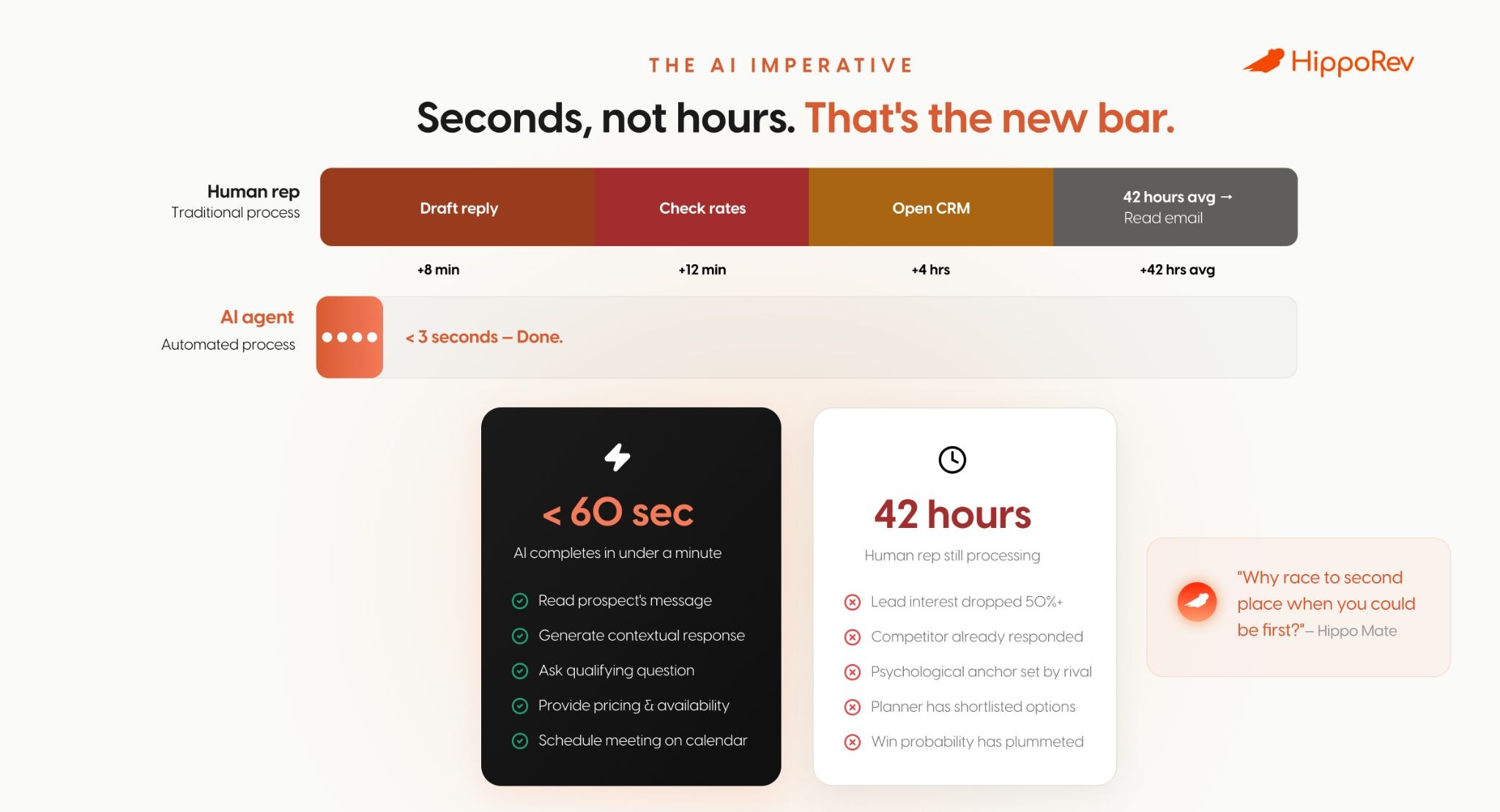
The gap between a 42-hour industry average response and a 5-minute elite response isn't closed by working harder; it is closed by working differently. Technology is the only scalable solution.
This is where Artificial Intelligence fundamentally alters the sales & revenue equation. A well-configured AI agent completely transforms response times & removes the delays that cause revenue loss:
- Constant Speed: An AI maintains a response time of less than 3 seconds, whether it is handling 5 messages or 500 simultaneously.
- Infinite Scalability: Unlike a human who gets saturated at high volumes, an AI maintains perfect quality and speed under any load.
- 24/7 Availability: AI agents operate 365 days a year without schedules, vacations, or sick leaves.
In the time it takes a human sales rep to simply read an email notification and open the CRM, an AI agent has already done the heavy lifting. Within the first 60 seconds, an AI agent can read the prospect's message, generate a contextual response, ask a qualifying question, provide pricing and availability details, and offer a concrete action—like scheduling a meeting directly on the sales rep's calendar.
By capturing the prospect exactly when their buying intent is highest, you eliminate the need for chasing cold leads.
As Hippo Mate wisely asks: "Why race to second place when you could be first? Why let revenue go to someone else when it could have been yours?"
You do not have to be the absolute best hotel or software on the market to win the deal. You just have to be in the conversation. Speed gets you in the room.
If you want to stop guessing and start measuring what speed is worth to your pipeline, it’s worth our full playbook. Download it here.
Calculate Your Cost of Being Slow
If you want to know exactly how much your slow response time is costing your business, look at the mathematics of the Speed Advantage.
Platform data shows that responding within 24 hours makes you 70% more likely to win. If your baseline win rate is 5%, a fast responder could achieve an 8.5% win rate.
Imagine you receive 100 RFPs a month, and 70% of them are responded to after the 24-hour mark. If your average deal value is $8,000, that 3.5 percentage point improvement in win rate equates to $19,600 in recoverable revenue every single month. That is over $235,000 a year that you are losing simply because you were too slow to reply.
You aren't losing deals because of price. You are losing them before you even get the chance to talk about price.
Self-Assessment: Is Your Pipeline Leaking?
The companies winning in today's market are not necessarily smarter or luckier—they are just faster. Your leads are already looking at competitor options, and the only question is whether you will be in that conversation or sitting on the sidelines because you took too long to call.
Where does your team stand? Take a moment to answer these critical audit questions honestly. Every "No" represents a massive revenue opportunity:
- [ ] Do you track average response time to RFPs as a primary KPI?
- [ ] Do you know how often your property is among the first 3 responders?
- [ ] Have you mapped out your four-stage response process and identified specific bottlenecks?
- [ ] Do you have automated alerts that trigger the exact second a new RFP arrives?
- [ ] Can your sales team access live rate and availability information instantly without waiting on revenue management?
- [ ] Are your PMS, CRS, and CRM systems fully integrated?
- [ ] Have you calculated the hard revenue impact of your current response time?
- [ ] Is response time improvement officially tied to your sales team's compensation or goals?
If you scored fewer than 5 "Yes" answers, you have a major opportunity to capture lost revenue. You cannot improve what you do not measure.
Stop losing revenue to faster competitors. It is time to map your bottlenecks, measure your baseline, and implement the automation needed to transform your sales cycle from weeks into minutes.
The Race to Now: From Lost Deals to Captured Revenue
If the real battle in modern B2B sales is speed, then the real question becomes how to respond in minutes instead of hours. Many hotel teams are now experimenting with AI-driven workflows that capture inbound inquiries instantly, qualify them, and generate proposal drafts before a sales manager even opens their inbox.
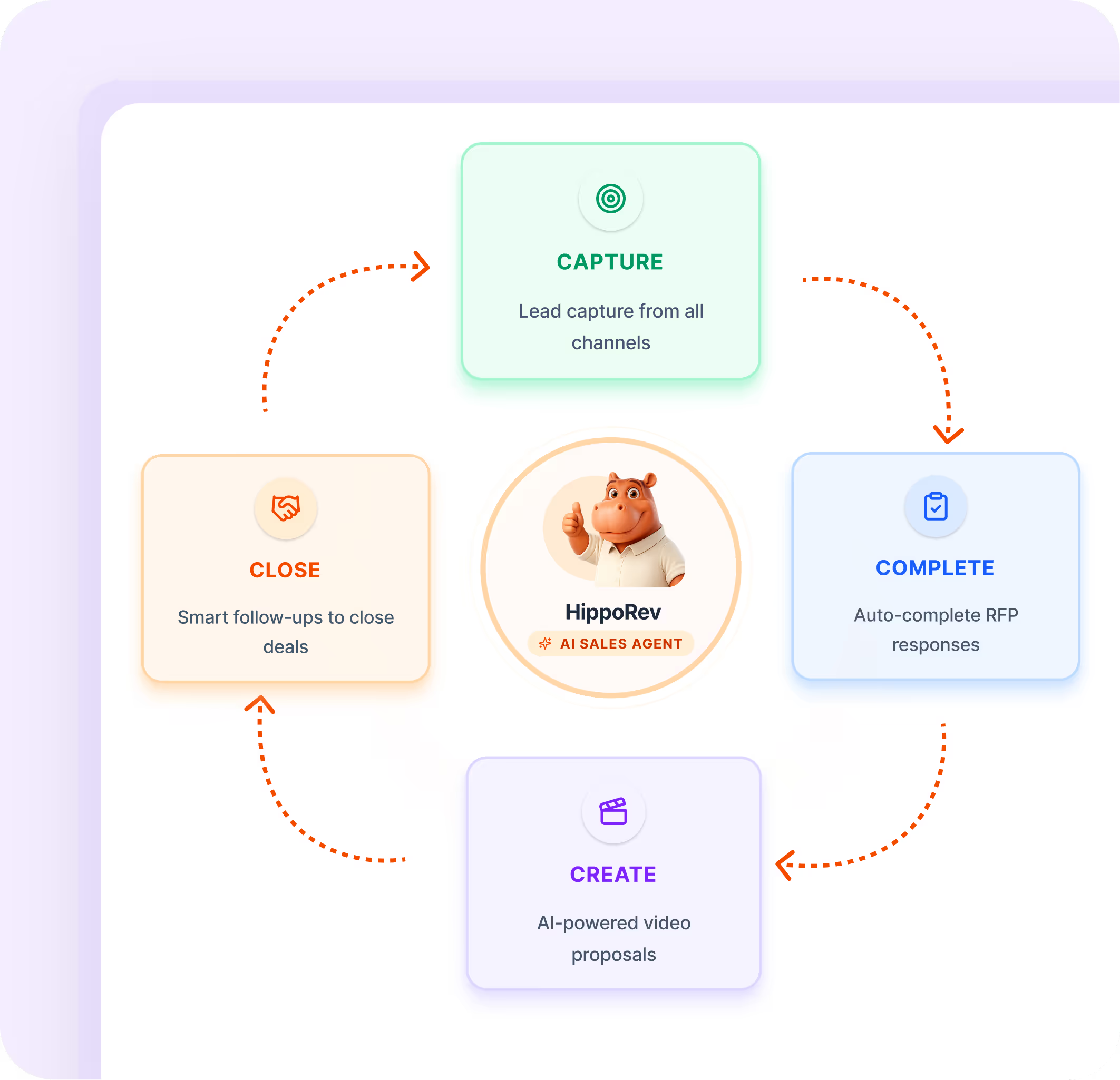
Hippo Rev, for example, is built as a revenue capture platform designed specifically for hotel group sales teams to automate RFP intake, fill in missing event details, and generate proposals within minutes rather than days, ensuring every inquiry is captured and converted before it slips away. The goal isn’t replacing human salespeople—it’s eliminating the administrative delays that cost deals before the conversation even begins.
When speed is the first signal of professionalism, tools that shorten response time can make the difference between being first in the planner’s inbox or never entering the conversation at all. If you’re curious how fast-response workflows work in practice, it’s worth exploring a demo of how Hippo Rev handles inbound RFPs & and converts every high-intent opportunity without delay.
Frequently Asked Questions
Question: What is the 5-minute rule in B2B lead response?
Answer: The 5-minute rule refers to research showing that contacting a new inbound lead within five minutes dramatically increases the chances of successful engagement. Studies from MIT and InsideSales found companies are 21 times more likely to qualify a lead when they respond within this window. This is because buyers are still actively researching when they submit inquiries.
Question: Why does responding first to an RFP increase win rates?
Answer: Responding first creates a psychological anchor for the buyer. Event planners often evaluate later responses relative to the first proposal they receive. Being the first responder positions your property as organized, attentive, and easier to work with.
Question: What is speed-to-lead in hospitality sales?
Answer: Speed-to-lead refers to how quickly a hotel or vendor responds after receiving a new inquiry or RFP. Faster response times increase engagement and qualification rates. Many hotels now track response speed as a core sales KPI.
Share this post
Ready to close more group business?
See how HippoRev can transform your hotel sales workflow in 15 minutes.

Follow us


.svg)