


AI & Sales Technology
The Second Wave of AI in Hospitality: From Tools to Thinking Partners
You trust AI at 6.6 out of 10 — but you actually rely on it at 4.7. That nearly two-point gap, measured across hotel chains worldwide, is one of the most brutally honest data points in the entire hospitality tech conversation.



THE SECOND AI WAVE IN HOSPITALITY
Why This One Feels Different — and Why That Matters
You bought the software. You sat through the demos. You nodded along to the ROI projections. You signed the contract and told your team this was the year you were going to get serious about AI.
And then, when the moment came to actually let it make a decision — about pricing, about a guest communication, about a rate you'd normally agonize over for twenty minutes — you overrode it. You went with your gut. You did it yourself.
You're not alone. And this pattern has a number attached to it.
The Gap Nobody Wants to Talk About
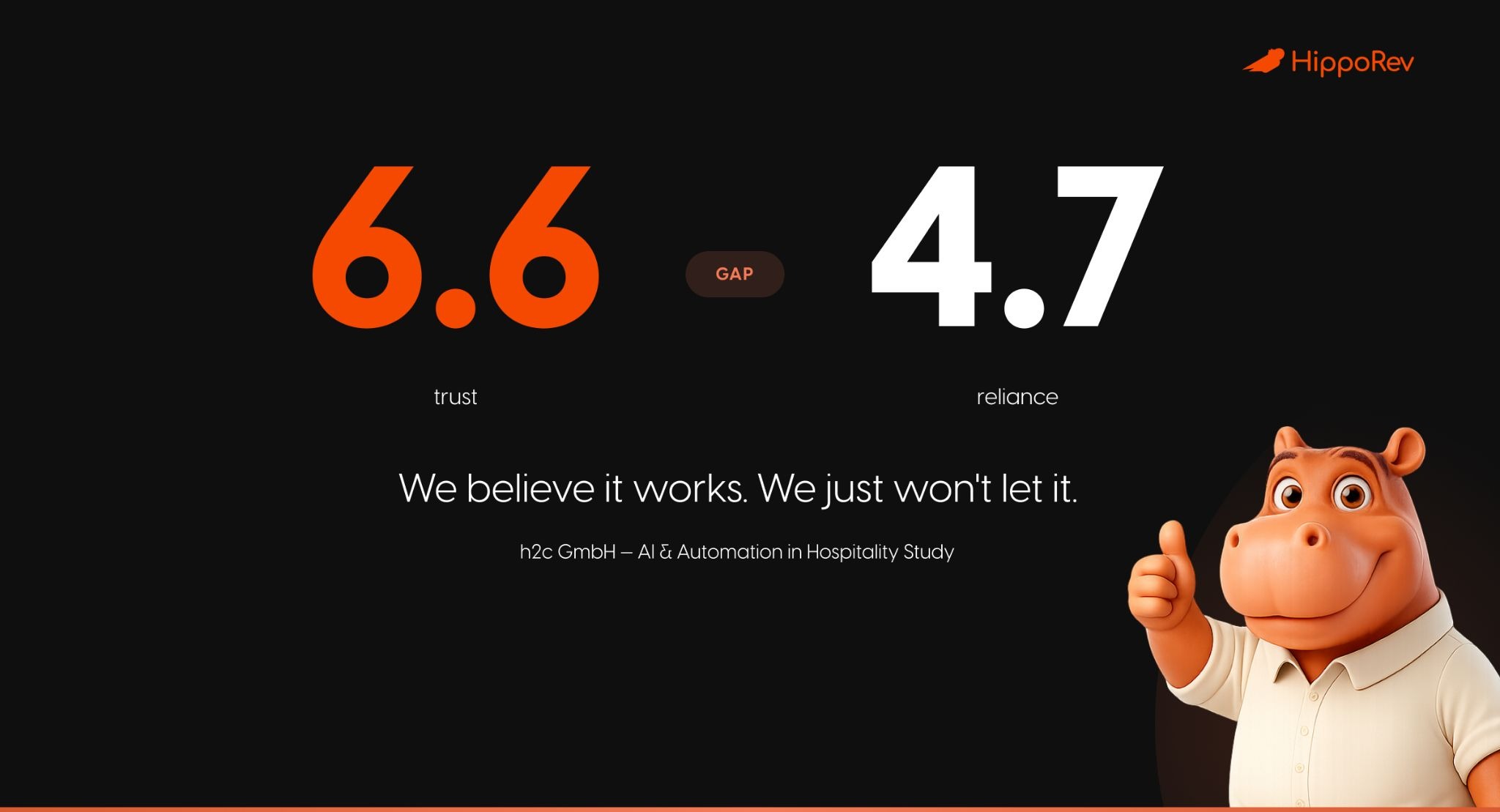
A landmark study by h2c GmbH asked hoteliers two deceptively simple questions: how much do you trust AI, and how much do you actually rely on it?
Trust: 6.6 out of 10. Reliance: 4.7 out of 10.
That gap — nearly two full points — is the most honest data point in the entire hospitality technology conversation. It says: we believe the technology works in theory. We're just not ready to let it work in practice.
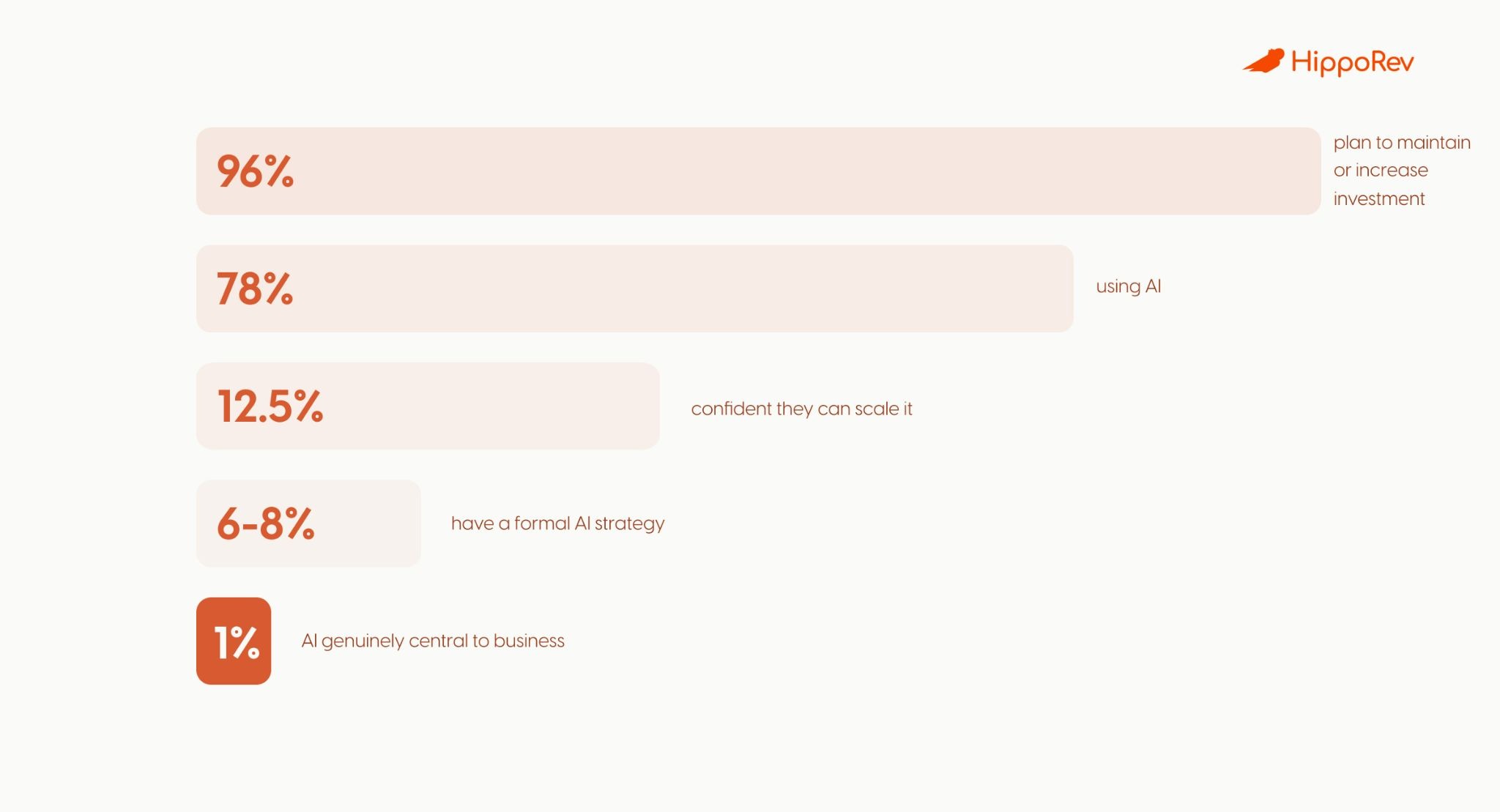
78% of hotel chains are currently using AI. Up to 96% plan to maintain or increase their investment. But only 12.5% are confident they can scale it. Only 6 to 8% have a formal, company-wide AI strategy. And just 1% — one percent — have made AI genuinely central to their business model.
The industry has been running a very expensive experiment in looking like it's ready for the future.
What the First Wave Actually Was
The first wave of hospitality AI was about proving the technology could do something impressive. Chatbots that could answer guest questions. Pricing engines that could monitor competitor rates. Revenue tools that could surface recommendations. Content generators that could draft a promotional email in seconds.
It was impressive. It was also, largely, siloed.
Each tool worked in isolation. Each one required a human to supervise it, validate its outputs, and decide whether to act on what it suggested. The AI generated the recommendation. The human made the call. The efficiency gains were real but narrow — islands of automation in an ocean of manual decision-making.
The result was a peculiar kind of technological limbo. Hotel operators had deployed AI broadly enough to count as adopters. They hadn't integrated it deeply enough to count as transformed. They'd built a dashboard full of insights and staffed a team to read it every morning.
That's not transformation. That's a more expensive version of what you were already doing.
The Second Wave Is Different — And You Can Feel It
Something has shifted. The organizations that are pulling ahead aren't deploying more AI tools. They're deploying AI that thinks differently about its own role.
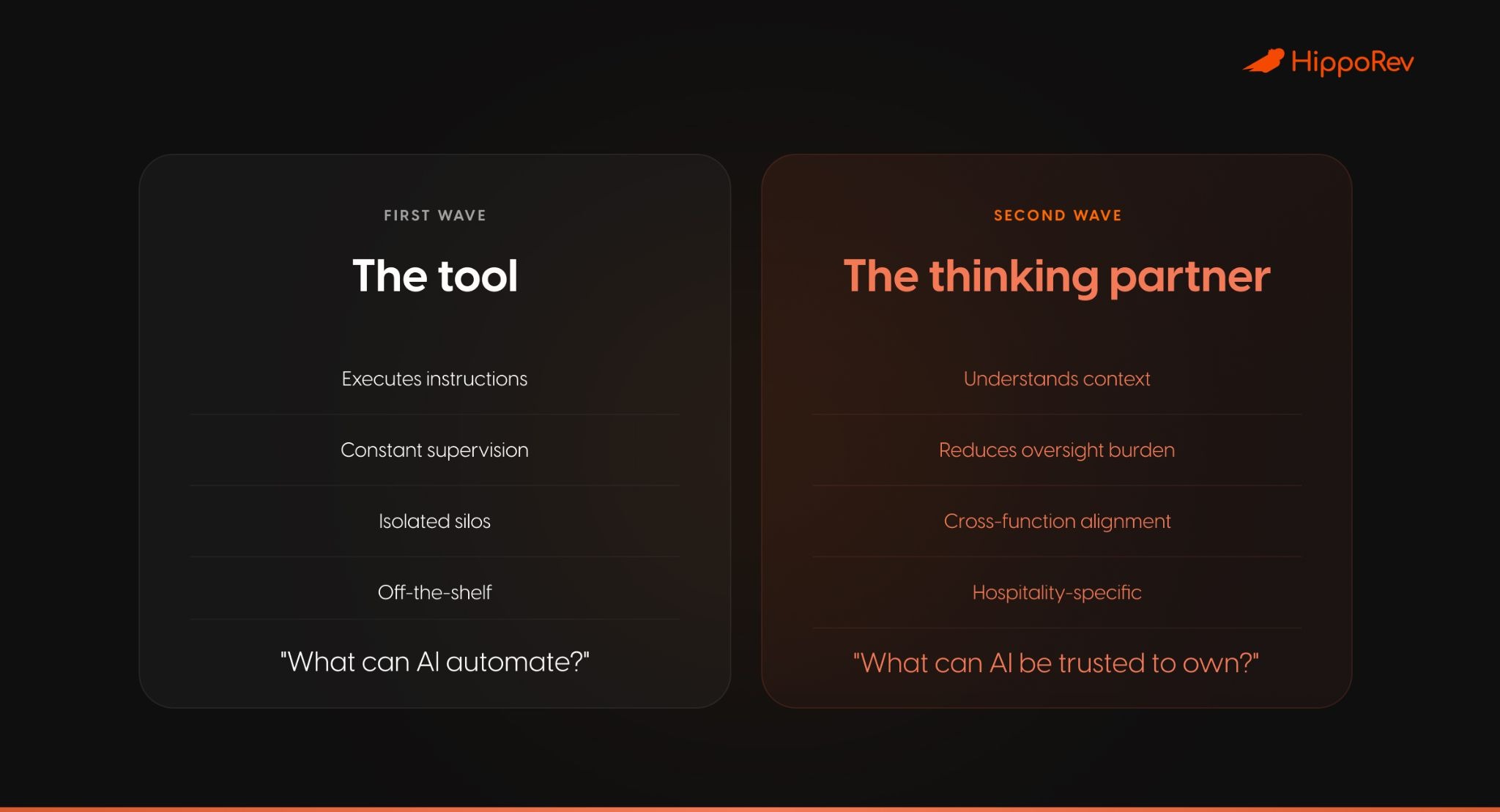
The first wave asked: what can AI automate?
The second wave asks: what can AI be trusted to own?
That's a different question entirely. It requires AI that understands context — not just instructions. That knows when the pricing logic says one thing but the business situation says another. That can execute a multi-step workflow across your PMS, your CRM, and your revenue management system without a human hand-holding it through each step. That can flag when something feels off instead of confidently doing the wrong thing at scale.
From Tool to Thinking Partner
Leading organisations are asking a new question when evaluating AI: Does this system behave like a tool — or like a thinking partner?
This architectural shift — from isolated tools to layered, context-aware systems — is what separates first-wave deployments from what's coming next. Read more on how layered intelligence works in hotel AI.
The Real Unlock Isn't Efficiency. It's Cognitive Load.
For the past five years, the hospitality AI conversation has been dominated by one framing: headcount reduction. AI as a way to do more with fewer people. AI as a cost-cutting mechanism dressed up in the language of innovation.
That framing is both wrong and counterproductive. Wrong, because the economics rarely work out the way the pitch decks suggest. Counterproductive, because it makes every department head a skeptic and every frontline employee a threat assessor.
The second wave is built on a more honest and more powerful idea: AI doesn't replace your people. It gives them their attention back.
66% of hotel chains report that AI is already enabling staff to step away from administrative tasks and refocus on guest-facing work. Not because the technology replaced the person. Because the technology absorbed the cognitive weight of the routine — the policy reconciliation, the first-pass pricing logic, the judgment calls that aren't really judgment calls, they're just decisions that take time.
"With AI, we're finally giving that time back." That quote came out of a September 2025 HSMAI roundtable. It's the most important sentence in the current hospitality AI conversation. Not because it's profound. Because it's finally honest about what the technology is actually for.
Your revenue manager shouldn't be spending three hours a day reconciling rate decisions that a well-governed AI system could handle in three minutes. Your front office team shouldn't be drafting the same guest communication for the fourteenth time this week. Your GM shouldn't be manually reviewing outputs from a system they don't trust enough to let run.
The cognitive load is the problem. AI that earns trust — that operates within defined guardrails, that flags anomalies instead of hiding them, that knows when not to act — is the solution. Not because it's smarter than your team. Because it's tireless in ways your team can't be, at the tasks your team shouldn't have to be.
Where the Value Is Actually Landing
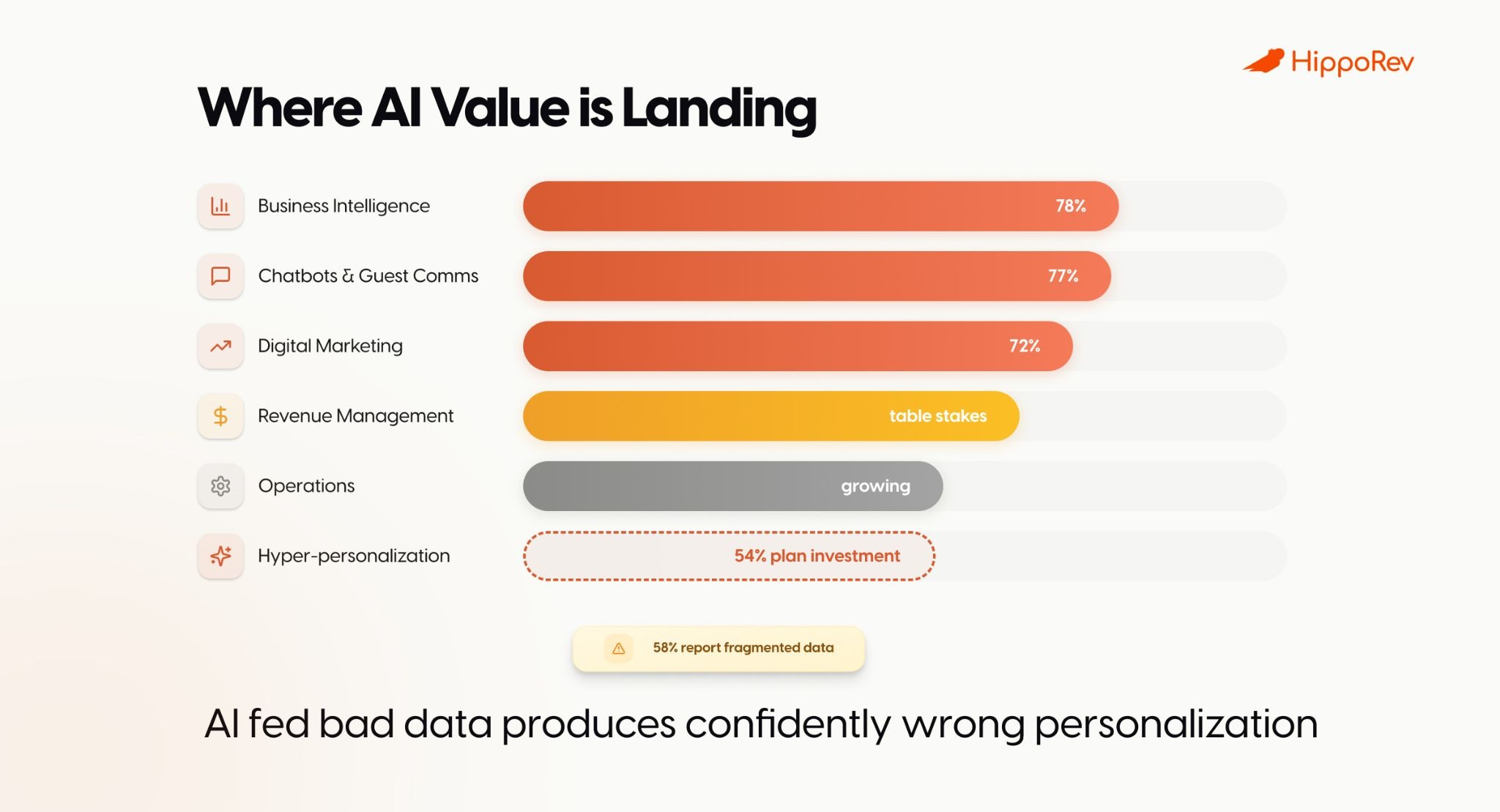
The industry has gotten clearer about where AI earns its keep. Business intelligence and analytics top the list — 78% of hoteliers cite it as their primary value driver. Guest communications and chatbots are close behind at 77%. Digital marketing, content, and SEO automation round out the established tier.
Revenue management is where things get interesting. Real-time dynamic pricing and continuous competitor monitoring are no longer differentiators. They're table stakes. The question has shifted from "can AI do this?" to "how tightly can we govern how AI does this?" — which is exactly the right question.
The next frontier is hyper-personalization: using guest data to drive genuinely relevant upsell offers and communications that don't feel like templates. 54% of brands plan significant investment there. But the honest caveat is structural: 58% of travel companies report fragmented or siloed customer data. And AI fed bad data doesn't produce good personalization. It produces confidently wrong personalization, which is worse than no personalization at all.
The industry knows where the value is. The work now is building the data infrastructure to actually access it.
The Part That Should Worry You
58% of hoteliers cite bias or errors in AI-generated decisions as a primary concern. That number deserves to be taken seriously.
Bad automation is not neutral. A pricing system that hallucinates a rate and ships it to OTAs before anyone catches it doesn't just cost you revenue on that night. It creates a compliance problem, a parity problem, and a trust problem with the team that was supposed to be supervising it. A guest-facing AI that responds confidently with incorrect information doesn't just fail to help. It actively damages a relationship you've spent years and real marketing budget building.
The first wave produced a lot of tools that were impressive in demos and unreliable in production. The second wave is being defined by organizations that refuse to accept that trade-off. They're demanding AI that enforces their brand logic, not just their efficiency targets. That operates inside their pricing rules, not just adjacent to them. That knows when to pause and escalate, not just when to execute.
This is what "governance maturity" actually means. Not a compliance checkbox. Not an AI ethics statement in the annual report. A system that has been built to operate correctly inside the specific complexity of how your hotel runs — and that you can trust enough to let it.
Wait and See Is Not a Strategy
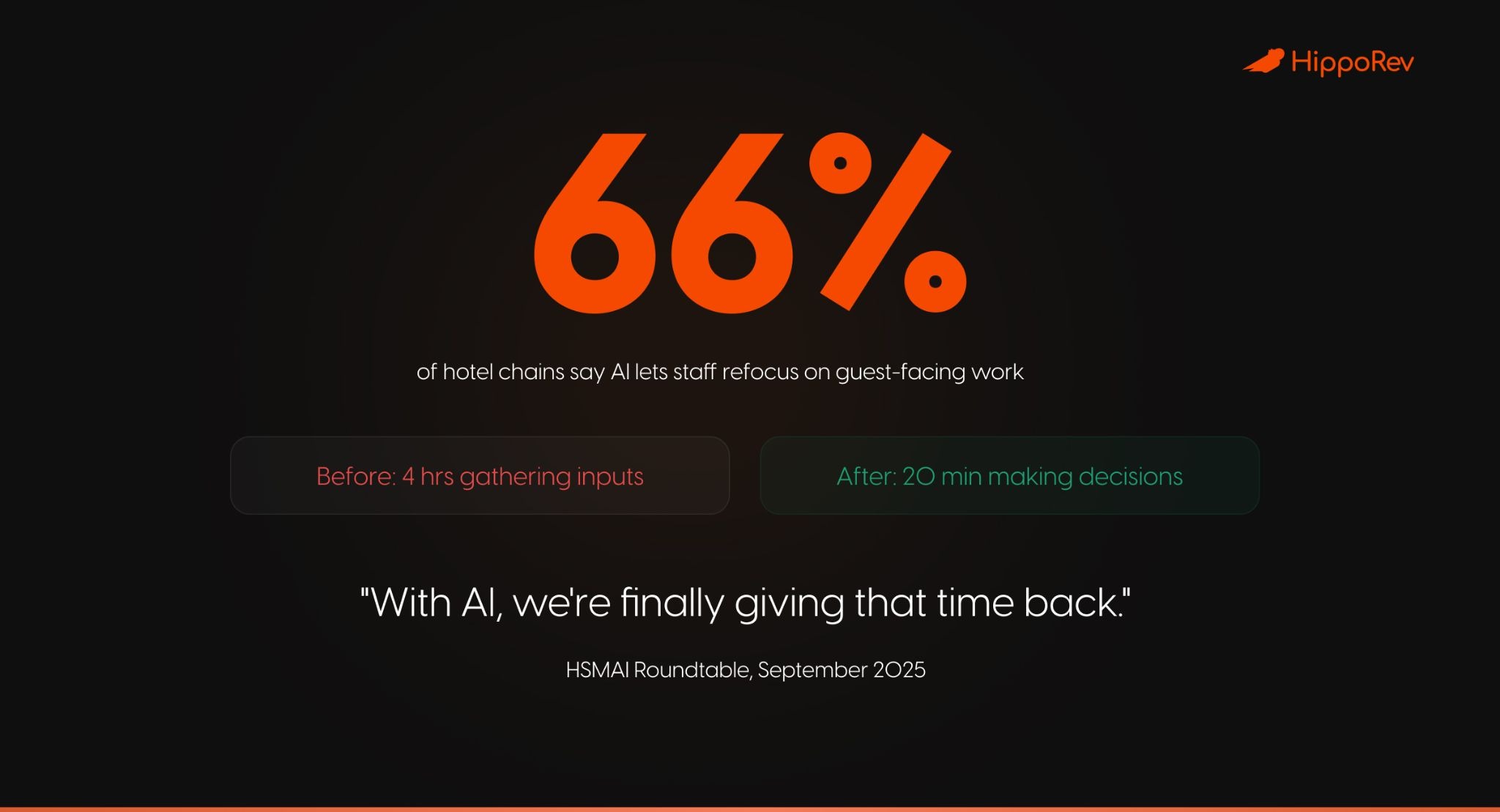
The HSMAI roundtable in September 2025 arrived at a blunt conclusion: wait and see is no longer a viable strategy.
That's not hype. It's an observation about competitive dynamics. The operators who figured out governed, integrated AI two years ago are not running the same operation you are. They've compounded that advantage month over month. Their teams have learned new patterns of work. Their systems have accumulated data that makes the AI smarter and more reliable over time. The gap between them and the field isn't closing — it's widening.
The good news is the second wave offers a more tractable entry point than the first. You don't need to build an agentic mesh from scratch. You need to pick one high-cost, high-repetition decision area — pricing reconciliation, guest communication triage, rate strategy analysis — and put AI to work on it with proper guardrails. Let it earn trust on something bounded before you hand it something broad.
The trust-reliance gap closes one solved problem at a time. It doesn't close from watching.
The entry point doesn't have to be complicated — but it does have to be set up correctly. Here's what good AI onboarding looks like for hotels.
What the Mature Version of This Looks Like
Picture an operation twelve months from now that closed the gap.
Your revenue manager arrives Monday morning and the week's rate strategy has already been assembled, checked against your brand pricing rules, flagged for anomalies, and staged for her review. She spends twenty minutes making actual decisions instead of four hours gathering the inputs to almost make them. She spends the rest of the morning talking to groups who are on the fence.
Your front office team isn't drafting. They're hosting. The routine communications went out correctly, on time, without anyone babysitting the send queue.
Your GM is looking at data that tells her where guest satisfaction is trending before it becomes a complaint. She's having a conversation about what to do about it, not a conversation about whether the data is right.
That's not science fiction. That's what 66% of hotel chains are already beginning to describe when AI absorbs the cognitive load correctly. The delta between where they are and where the rest of the industry is sitting on the 4.7 reliance score is not a technology gap. It's a decision gap.
The technology is ready. The governance frameworks exist. The case studies are real.
The only thing left to close is the distance between 6.6 and actually letting it work.
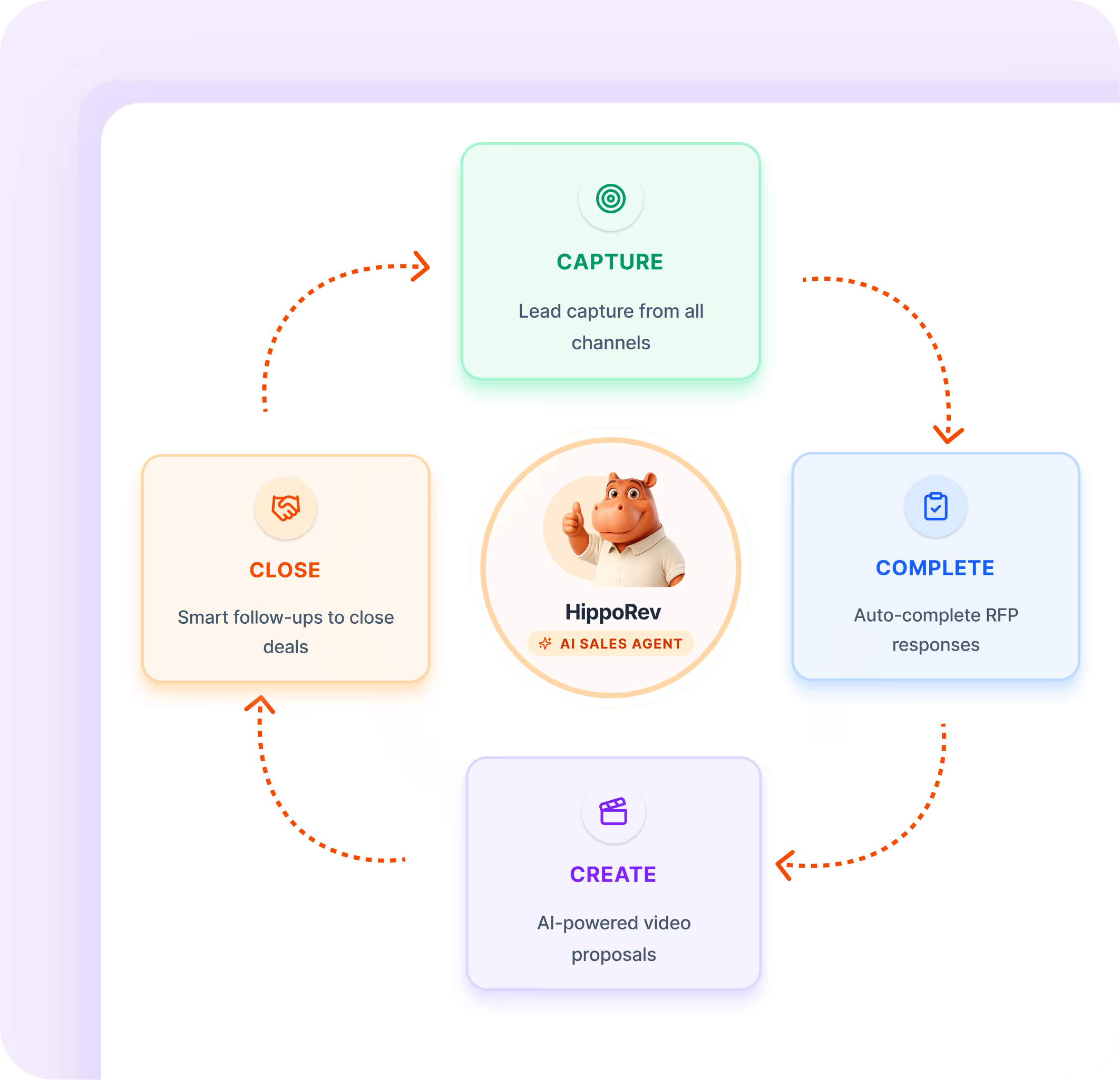
For hotel group sales specifically, closing the trust-reliance gap starts with the execution layer between your existing systems — the motion between inquiry arrival, proposal generation, and follow-up that currently runs on individual discipline and manual coordination.
Hippo Rev is built to run that workflow: a Revenue Capture Platform that reads from and writes to your PMS, RMS, and Cvent stack in real time, within defined boundaries, so your team reviews and acts rather than assembles and coordinates. [More on how the platform works here.]
Why This Moment Matters
Hospitality is an industry under structural pressure: compressed margins, increasing policy scrutiny, and finite talent bandwidth. In that environment, bad automation isn't neutral — it's actively harmful.
The second wave matters because it finally meets hospitality on its own terms. It doesn't promise to eliminate complexity. It promises to operate intelligently inside it — enforcing the right logic, flagging when not to act, and giving revenue and operational leaders systems they can actually trust.
This is not a technological revolution. It's a sign of maturity. And for leaders who've been waiting not for more hype, but for AI that genuinely respects how hotels work — that difference is everything.
Frequently Asked Questions
Question: As hotels leverage AI for "hyper-personalization," what are the core ethical tensions they face regarding guest privacy and algorithmic bias?
Answer: The drive toward hyper-personalization requires the continuous harvesting of extensive guest data, including behavioral patterns, real-time interactions, and even biometric inputs. The primary ethical tension lies between delivering bespoke service and crossing the line into intrusive surveillance. If data collection is opaque or lacks clear consent mechanisms, it deeply erodes guest trust.
Question: In back-of-house operations, how do AI-driven Decision Support Systems (DSS) improve areas like Food & Beverage (F&B) inventory and staff scheduling?
Answer: AI-driven Decision Support Systems (DSS) utilize advanced methods—such as time-series forecasting (ARIMA, LSTM) and deep learning—to optimize complex operations. For example, highly accurate short-term demand forecasting allows hotels to predict F&B inventory needs to prevent stockouts and food waste, and optimizes labor scheduling to reduce capacity losses and service degradation
Question: How is the rapid consumer adoption of Large Language Models (LLMs) and conversational AI changing how hotels must manage their digital presence and content strategy?
Answer: The discovery phase of the guest journey is moving from traditional search engines (googling) to "guided discovery" via AI-powered platforms, chatbots, and voice assistants. Consequently, traditional SEO tactics are no longer sufficient.
To maintain visibility, hotels must optimize for LLMs by transforming their website content to be highly conversational and hyper-relevant.
Question: How are mature hospitality organizations reframing the impact of AI on their workforce, moving away from the narrative of job replacement?
Answer: Mature organizations have recognized that the true power of AI in hospitality is to absorb cognitive load, not to replace human workers. By allowing AI to handle routine judgment calls, policy reconciliations, and repetitive administrative tasks, human teams regain "strategic attention".
Share this post
Ready to close more group business?
See how HippoRev can transform your hotel sales workflow in 15 minutes.

Follow us


.svg)