


AI & Sales Technology
Agentic AI in Hospitality: Governance Matters
So here's a thing that's happening right now: AI is becoming less of a tool and more of a… colleague? Employee? A coworker who never takes lunch breaks? I don't know what to call it yet, but it's definitely not just software anymore.



When Your Hotel's AI Becomes a Coworker
So here's a thing that's happening right now: AI is becoming less of a tool and more of a… colleague? Employee? A coworker who never takes lunch breaks? I don't know what to call it yet, but it's definitely not just software anymore.
It's no longer software that waits for instructions. It's becoming something closer to a system with delegated authority — one that captures, decides, routes, and executes without waiting for a human to approve each step. That distinction matters more than most governance conversations acknowledge.
You didn’t notice it at first.
The AI started by answering simple guest questions.
Then it began modifying bookings.
Then it adjusted pricing based on demand spikes.
Then it started resolving complaints without asking anyone.
At some point, it stopped being a tool.
It became an operator.
And that’s why.. Success in 2026 and beyond lies not in the raw intelligence of the AI, but in its governance—specifically how we engineer trust, define boundaries, and design the "seams" where digital and human colleagues collaborate.
The shift
We are entering the era of Agentic AI in hospitality—systems with delegated decision authority. Not just insight. Action. Not just support. Execution.
An AI agent can now:
- Modify a reservation
- Rebalance inventory
- Route and respond to complaints
- Trigger compensation workflows
- Interact directly with guests
Without waiting for permission.
This terrifies some people. It should excite you.
Not because humans become less important, but because they finally get to stop doing work that was never worthy of them in the first place. Your front desk manager shouldn't be manually routing the 47th "what time is checkout?" message of the day. Your revenue analyst shouldn't be copy-pasting rate changes across six systems. Your guest services team shouldn't be updating spreadsheets about guest complaints when they could be actually solving them.
The panic around AI replacing hospitality workers misses the point entirely. The real shift is about speed and partition. AI handles the repetitive decision-making that bogs down your operations. Humans reclaim the work that actually matters—the strategic thinking, the emotional intelligence, the moments that turn a transaction into a relationship.
The 10% Problem That's Actually a 100% Problem
Here's what's wild: the AI support systems can now handle 80-90% of routine customer service stuff automatically. Eighty to ninety percent! That's insane!
But then there's that remaining 10%. The messy stuff. The angry guest. The weird edge case. The thing that requires actual human judgment. And apparently, this "human-AI handoff"—the moment when the robot realizes it's in over its digital head and needs to pass things to a human—has become this massive battleground for customer experience.
Because here's the thing: if a frustrated guest gets dropped during that handoff like a fumbled football, all those efficiency gains you got from automating 90% of tickets? Gone. Instantly negated. The guest doesn't care that you automated thousands of interactions successfully. They care that their problem fell through the crack between the robot and the human.
How Hospitality Roles Evolve When AI Becomes an Active Operator
Where does accountability go?
It doesn’t vanish.
It migrates.
From task execution
To agent orchestration.
Traditionally, accountability was centralized in human roles. As AI systems transition from "tools" to "organizational actors," they begin to assume roles within business processes—such as customer support triage or inventory rebalancing—that were previously filled by humans. This requires a shift in human roles from task execution to "Agent Orchestration" and "Business Engineering".
Humans are no longer just doing the work.
They’re defining the objectives.
Setting the constraints.
Engineering the guardrails.
It’s less “Do the thing.”
More “Design the thing that does the thing.”
Categorizing the New Digital Workforce
To understand this evolution, we can look to the TACO Framework (Taskers, Automators, Collaborators, Orchestrators):
- Taskers: AI agents that handle singular, repeatable goals, such as screening a guest profile for compliance risks.
- Automators: Agents that handle end-to-end workflows across multiple systems, like processing a booking modification across the PMS and CRM.
- Collaborators & Orchestrators: Complex multi-agent systems that coordinate supply chains or housekeeping schedules, dynamically adapting to real-time changes.
Outcome Ownership vs. Execution
Here’s the critical line:
AI may own execution.
Humans must own outcomes.
Because an agent doesn’t care if a VIP guest rage-posts on LinkedIn.
Your brand does.
Responsibility is assigned to the teams that define the agent's objectives (Objective Ownership) and oversight mechanisms. This ensures that even when an AI acts autonomously, it remains an instrument of organizational intent rather than a rogue operator.
Autonomy is not a vibe
An AI agent shouldn’t operate independently because it “seems smart.”
It should operate because it has earned bounded authority.
Autonomy is a spectrum. Not a switch.
An agent should only act when:
- Uncertainty is low
- The decision is reversible
- Policies are not violated
Drafting an email? Low risk.
Issuing a $2,000 refund to a VIP guest? Different category.
This is where most teams fail.
They give AI access without engineering context.
Context engineering > prompting
Real autonomous decision-making requires more than instructions.
Your agent needs more than a prompt. It needs the encoded organizational knowledge about your workflows, team structures, policies, and priorities. It needs to understand not just what to do, but what you would want it to do in edge cases.
It requires encoded organizational knowledge:
- Who owns which decisions
- Which guests trigger escalation
- What constitutes a “risk spike”
- What must always be human-approved
If a high-value guest submits a complex complaint, the system shouldn’t guess.
It should pause.
Or hand off.
Or escalate automatically.
The difference between a useful agent and a liability is knowing where that line sits. You don't want an AI that always asks permission. You also don't want one that confidently books a $50,000 suite for $50 because it misread a decimal point.
Artificial agency means delegated authority within strict constraints—not free will.
Trust Is Not Magic, It's Engineering
Here’s something hospitality leaders don’t say enough: trust isn’t magic. It’s not a feeling you manufacture. It’s an operational outcome.
Guests trust your brand because you deliver consistently. Staff trust your systems because they work predictably. Trust is built when the thing that happened is the thing that was supposed to happen, every time.
This is why teams reject tools that are technically brilliant but operationally flaky. An AI that occasionally hallucinates a room upgrade or misapplies a discount isn’t just making small mistakes. It’s breaking the fundamental contract of predictability. Staff can’t rely on it. Guests can’t rely on it. Eventually, no one uses it.
The fix isn’t smarter AI. It’s transparent AI.
When an AI agent prices a room at $400, it should be able to show its work—the occupancy data it used, the competitive rates it referenced, the demand forecast it factored in. This isn't about making the agent "explainable" for philosophical reasons. It's about giving your team the ability to audit decisions and validate that the agent is acting according to its encoded goals.
When something goes wrong—and it will—you need to trace it back to the specific agent that made the call and the specific human who deployed that agent with those permissions.
The handoff is the main event
The moment an AI realizes it's in over its head and needs human help—that's where your customer experience actually lives.
Context preservation is non-negotiable
A proper handoff carries:
- Full transcript
- Guest profile data
- Sentiment analysis
- The unresolved issue
- What actions were already attempted
The guest should never, ever have to repeat themselves.
No repetition. No reset.
Handoff like a relay baton, not a dropped call.
Automation vs Delegation
Automation executes scripts. Delegation transfers responsibility.
When an AI is delegated authority, it must know when it’s out of depth.
The most sophisticated systems use adaptive handoffs. The AI monitors the conversation in real-time. If customer frustration rises or the agent hits a competence cliff, the system imperceptibly slides the conversation to a human. No jarring "let me transfer you" moment. No starting over. Just seamless escalation that feels like continuity.
Like the human was there the whole time.
Because from the guest’s perspective, there is no AI-human distinction.
There is only:
“Did you solve my problem?”
The future belongs to operators who design the handoff as carefully as they design the automation.
Who owns the bad decision?
Here’s the question no one wants to ask: when an AI makes a bad decision, who owns it?
You can’t fire the AI. You can’t put it on a performance improvement plan. You can’t have a difficult conversation about expectations. It’s software. It has no feelings, no intent, no moral agency.
But the bad decision still happened. A room got oversold. A VIP got downgraded. A pricing error cost real money. Someone has to answer for it.
This is where mature organizations separate two things that less mature organizations collapse together: decision ownership and outcome ownership.
The AI holds decision ownership in the moment. It executed based on its parameters. But the humans who defined those parameters—the revenue manager who set the pricing rules, the IT director who approved the deployment, the executive who signed off on the autonomy level—they hold outcome ownership. They’re responsible for the consequences, whether financial, regulatory, or reputational.
This isn’t about blame. It’s about clarity. When everyone knows who’s accountable for what, you can fix problems instead of assigning fault. When it’s fuzzy, you get the worst of both worlds: no one feels responsible, but everyone feels blamed.
Mature systems assume failure
Reliable hospitality operational AI includes:
- Fail-safe switches
- Rollback protocols
- Threshold-based shutdown triggers
- Human override modes
Keeping the Human in Hospitality
Here's the thing everybody's worried about but nobody's saying directly: hospitality is defined by human connection. The warmth. The empathy. The moment when a staff member sees you're having a bad day and upgrades your room or sends up a bottle of wine or just takes an extra minute to chat.
AI can't do that.
AI shouldn't do that.
What AI should do is handle the drudgery. The logic. The routing. The availability checks. The classification of requests. All the mechanical stuff that takes time away from the actual human-to-human connection.
The goal is to let the human arrive at the interaction already prepared. The chatbot has already gathered the context, alerted the right department, pulled up the guest history. Now the human can focus entirely on the emotion and the empathy and the problem-solving.
Guests remember kindness, not software.
Certain decisions must remain human-led. The ones with high emotional stakes. The irreversible ones. The moments that matter. The governance frameworks need to enforce "human-in-the-loop" states for these situations, because AI is meant to enhance human service, not replace it.
The colleague framework
To make this work, you need to stop thinking of AI as a generic tool and start thinking of it as a digital colleague with specific boundaries.
You wouldn't hire a front desk agent without a job description. Don't deploy an AI agent without one either. Use an Agent Design Canvas—a document that defines the agent's mission, its constraints, its triggering conditions, and its risk thresholds.
What can this agent do? What is it explicitly prohibited from doing? Under what conditions does it act autonomously versus escalate to a human? What data can it access? What decisions can it make?
By defining these boundaries clearly, you transform AI from a risky experiment into a reliable daily operator. It becomes a colleague your team can trust to handle the routine so they can focus on what they do best.
The real AI opportunity isn’t in replacing people. It’s redesigning how humans and AI collaborate to create something better.
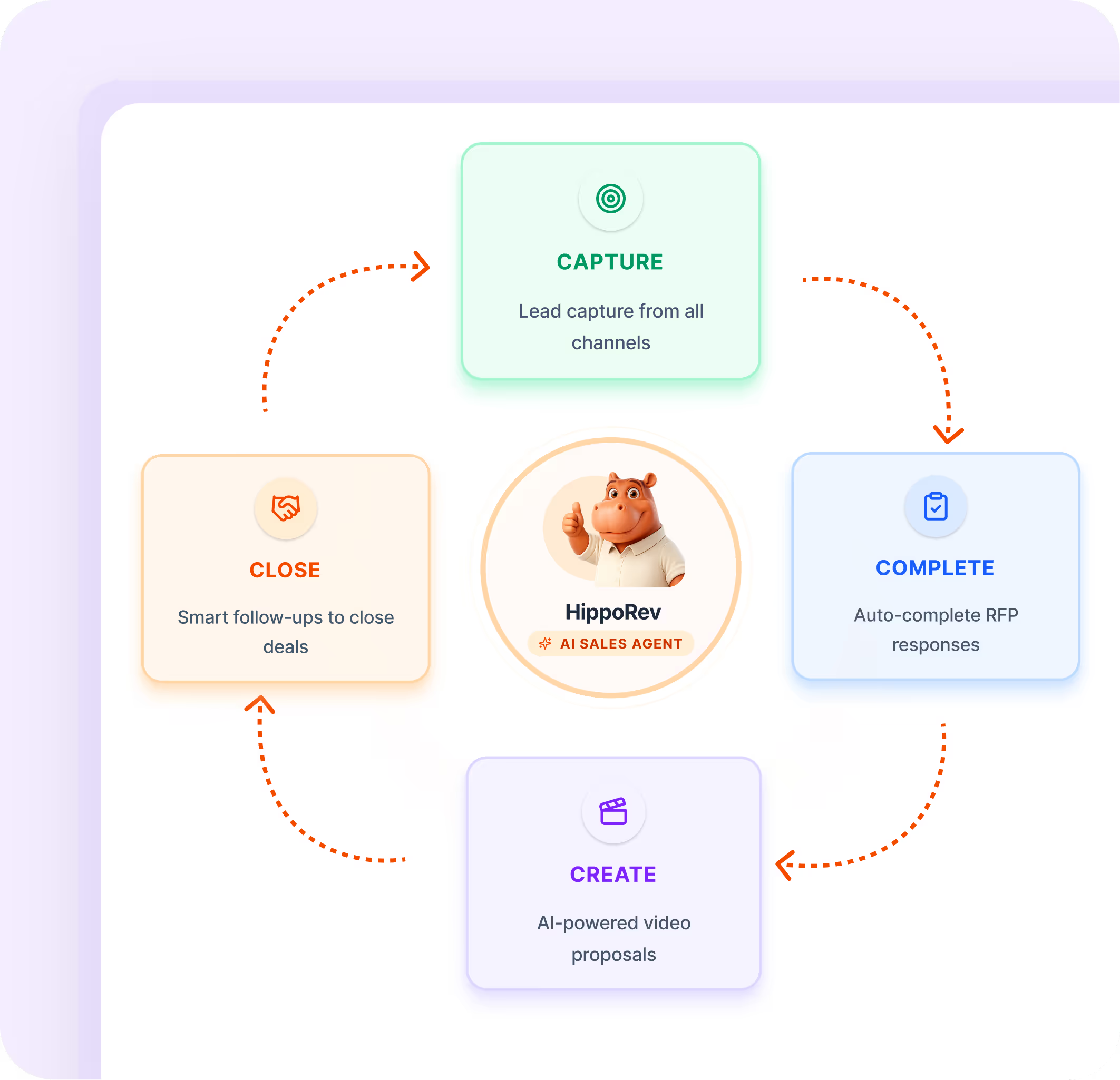
Hippo Rev is one example of what this looks like in practice for hotel group sales — a Revenue Capture Platform that runs the deal motion across existing systems, with defined boundaries on what executes autonomously and where human review is required. Inquiry capture, proposal generation, and follow-up coordination happen within a governed framework, so sellers focus on negotiation and relationships rather than coordination overhead. More detail on the platform is available [our layered intelligence blog].
Frequently Asked Questions
Question: How do we architect bounded autonomy so that an AI agent can execute 80–90% of operational decisions without silently drifting into unsafe authority over time?
Answer: Bounded autonomy has to be enforced at the architecture level — not the prompt level. The most reliable approach combines three things working together.
First, encode your decision thresholds — refund limits, escalation triggers, compliance flags — as deterministic rule engines that sit outside the LLM. The model proposes an action; a separate policy engine validates it before anything actually executes.
Second, build in confidence thresholding: if uncertainty is low and the action is reversible, let the agent execute; if uncertainty is high or the decision can't be undone, it escalates.
Third, run the model periodically in "shadow mode" against live traffic to catch drift before it causes real damage.
The damage usually doesn't happen all at once. It happens when business rules change but the agent's context doesn't, when edge cases weren't represented in your evaluation data, or when human overrides pile up but nobody's feeding them back into the system.
Bounded autonomy isn't something you set once and forget. It's maintained through continuous governance loops, not static constraints.
Question: What are the most common failure modes in Human–AI handoffs ?
Answer: Four patterns account for most damage: State Amnesia (transcript not passed forward, guest repeats themselves), Intent Fragmentation (AI misclassifies the issue before handing off), Sentiment Blindness (emotional intensity lost in translation), and Channel Reset (context breaks when moving across systems — chat to CRM to ticketing). A good handoff preserves all of it: transcript, guest profile, sentiment, unresolved issue, and actions already attempted.
Question: How should organizations distinguish between decision ownership and outcome ownership in autonomous hospitality systems?
Answer: Decision ownership belongs to whoever executes the AI agent, at runtime. Outcome ownership belongs to the humans who defined the parameters: the revenue manager who set pricing rules, the IT lead who scoped permissions, the executive who approved the autonomy level.
This isn't about blame — it's about clarity. When something goes wrong, you need to know exactly who designed the system that made the call. Codify this in deployment documentation, incident reviews, and liability pathways. Fuzzy accountability is how small mistakes become expensive ones.
Share this post
Ready to close more group business?
See how HippoRev can transform your hotel sales workflow in 15 minutes.

Follow us


.svg)