


Proposal & Differentiation
Speed vs Quality Myth: Why Automation Delivers Both
The belief that speed and quality trade off against each other in hotel sales was once a reasonable reality; today, it's only a comfortable excuse. Event planners don’t choose between speed and quality; they expect both.



.jpeg)
The Speed vs Quality Myth
Bring up the topic of "speed-to-lead" in any hotel sales or B2B revenue meeting, and you will almost certainly encounter the exact same objection from your most veteran sales managers. It usually sounds something like this:
"We are a premium brand. We don't sell fast food; we sell bespoke, multi-thousand-dollar event experiences. I can either send a generic, sloppy automated email in five minutes, or I can take my time and craft a high-quality, customized proposal tomorrow. You have to pick one."
This is the Speed vs. Quality Myth.
It is the pervasive, deeply ingrained belief that moving fast inherently requires sacrificing attention to detail, personalization, and brand standards. It operates on the assumption that a high-quality response requires hours of manual human labor—checking inventory, consulting revenue management, formatting spreadsheets, and writing a customized cover letter.
For decades, this trade-off was a reality. But in today’s digitally transformed marketplace, this binary choice is not just a myth; it is an active threat to your pipeline.
The truth is that the modern B2B buyer does not separate speed from quality. To them, speed is quality. And more importantly, with the advent of intelligent sales automation and AI, the operational trade-off between the two has been completely eliminated.
Deconstructing the Myth: What Does "Quality" Actually Mean?
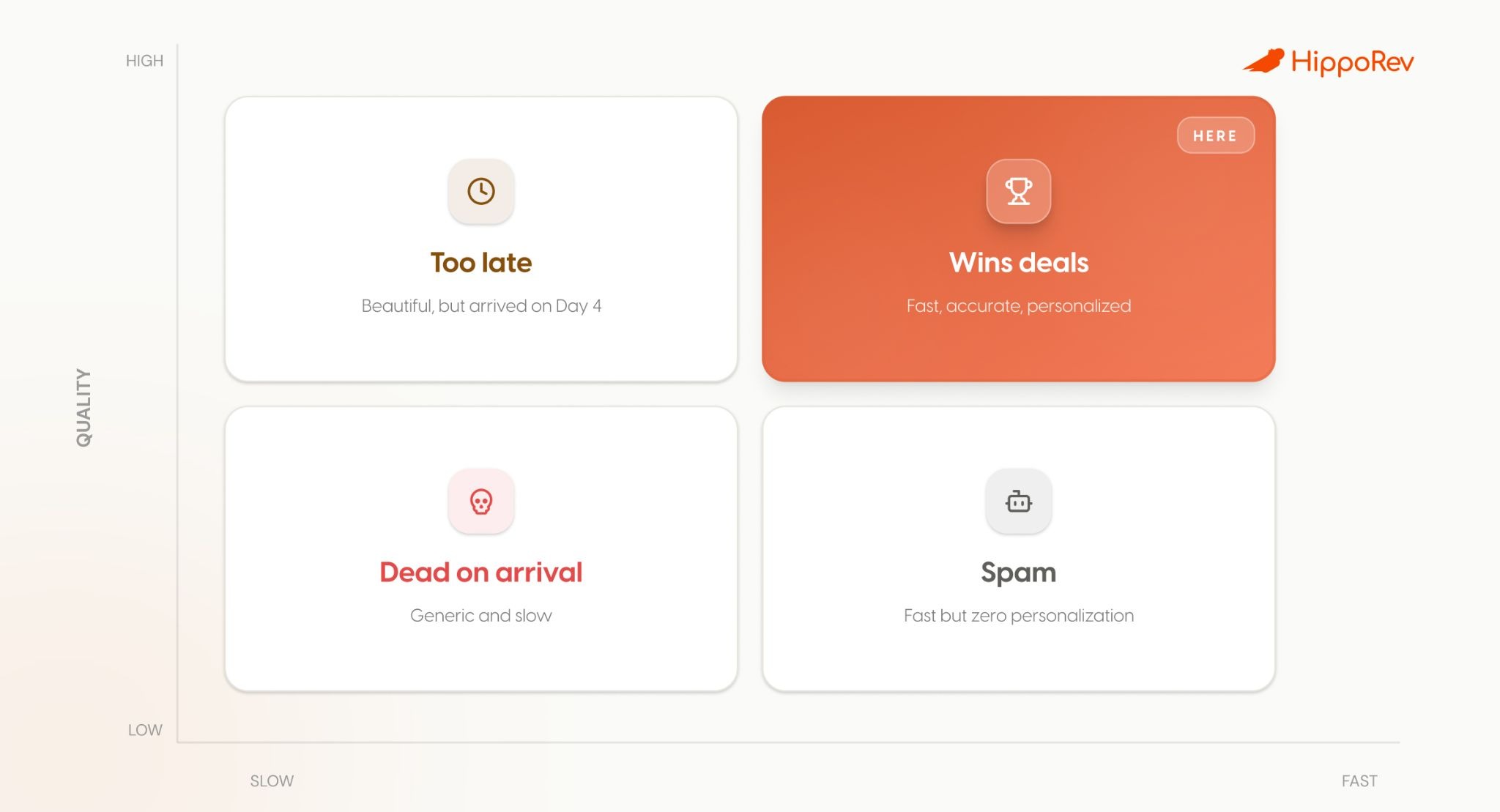
To understand why the Speed vs. Quality Myth is so damaging, we first have to redefine what a "quality" proposal actually means in the eyes of the person receiving it.
Hotel sales teams often define a high-quality proposal by its aesthetics: beautifully formatted PDFs, sweeping descriptions of the ballroom chandeliers, and perfectly manicured cover letters.
Event planners and B2B buyers define quality much differently. They are fundamentally driven by the expectation of a frictionless, instant, and transparent engagement experience. To a planner, a high-quality response is one that is accurate, answers their specific questions, provides transparent pricing, and arrives exactly when their buying intent is highest.
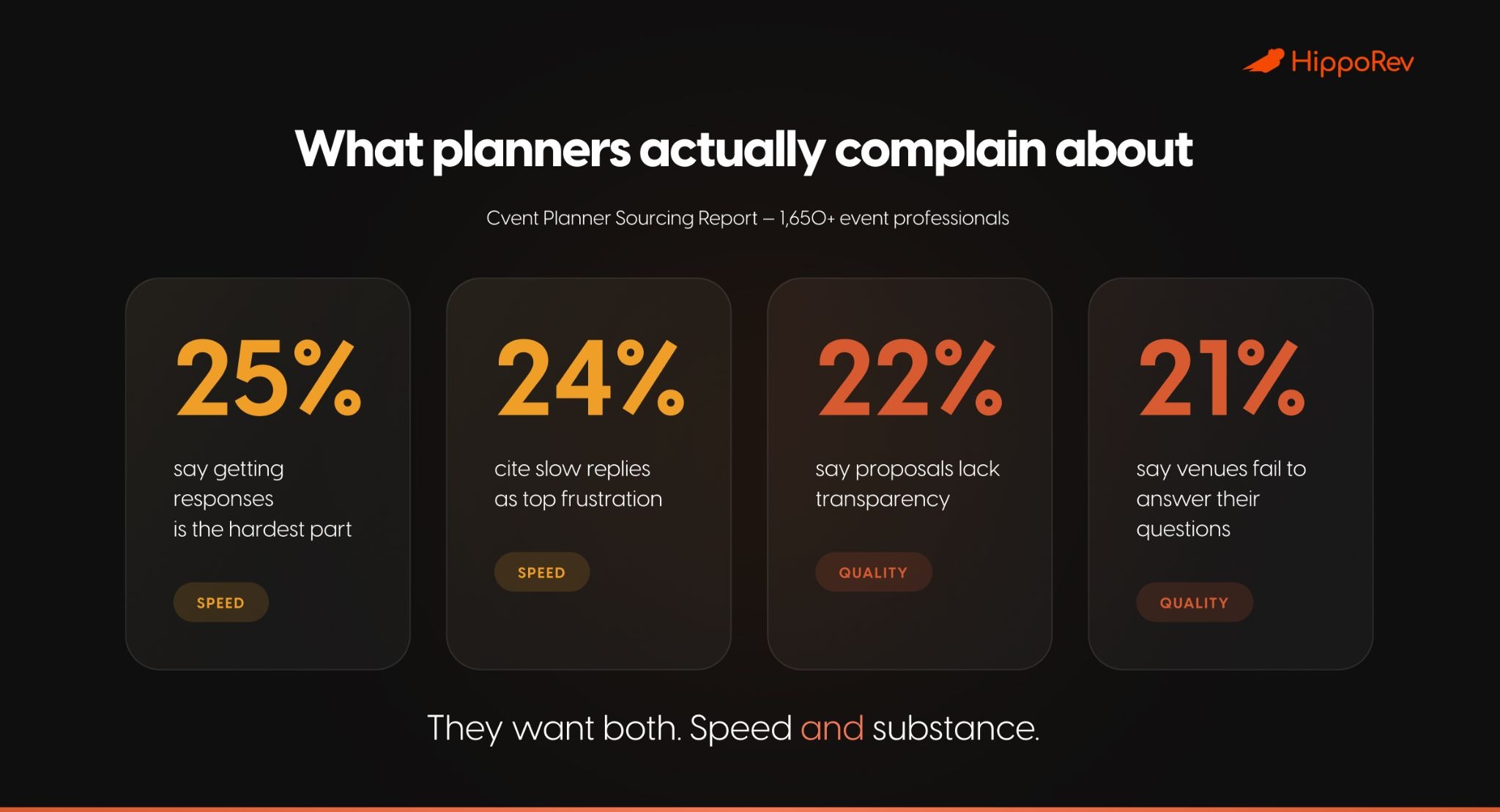
The data backs this up. The Cvent Planner Sourcing Report, which surveyed over 1,650 event professionals, identified the top sourcing frustrations for planners:
- 25% say "getting responses" is the most challenging stage of sourcing.
- 24% cite slow replies as a top frustration.
- 22% say proposals lack transparency.
- 21% say venues fail to answer custom questions.
Notice the intersection of these data points. Planners are equally frustrated by a lack of speed and a lack of substance.
If you respond in five minutes but your proposal is a generic template that ignores the planner's specific questions about dietary restrictions or breakout room AV capabilities, that is a low-quality response. As the research notes, "Being first with a bad proposal doesn't help".
However, if you spend four days meticulously crafting the "perfect" proposal, you have also failed the quality test in the eyes of the buyer. Why? Because the prospect's buying interest has a limited shelf life. When they submit an RFP, they have an active impulse to buy, and every minute that passes degrades that impulse exponentially.
By the time your "perfect" proposal arrives 96 hours later, the planner has already established a psychological anchor with the first property that responded. They have likely already shortlisted their options, and your masterpiece is simply compared against the baseline established by your faster competitor. Research shows that 61% of RFPs are awarded to one of the first three responders. Furthermore, a staggering 78% of customers ultimately buy from the first company that responds to their inquiry.
Taking days to respond doesn't prove that you are a premium brand; it communicates to the buyer that you are inefficient, disorganized, and apathetic to their business.
Read More: Our Speed Wins Playbook breaks this down even further—showing you how to identify hidden delays, calculate lost revenue, and implement faster response workflows backed by real industry data.
But being first isn't enough as well if your content misses the mark. This is precisely why generic AI RFP responses fail to work, whereas truly effective proposals answer specific questions. Read more about it our layered intelligence blog.
The Automation Breakthrough: Engineering Speed AND Substance
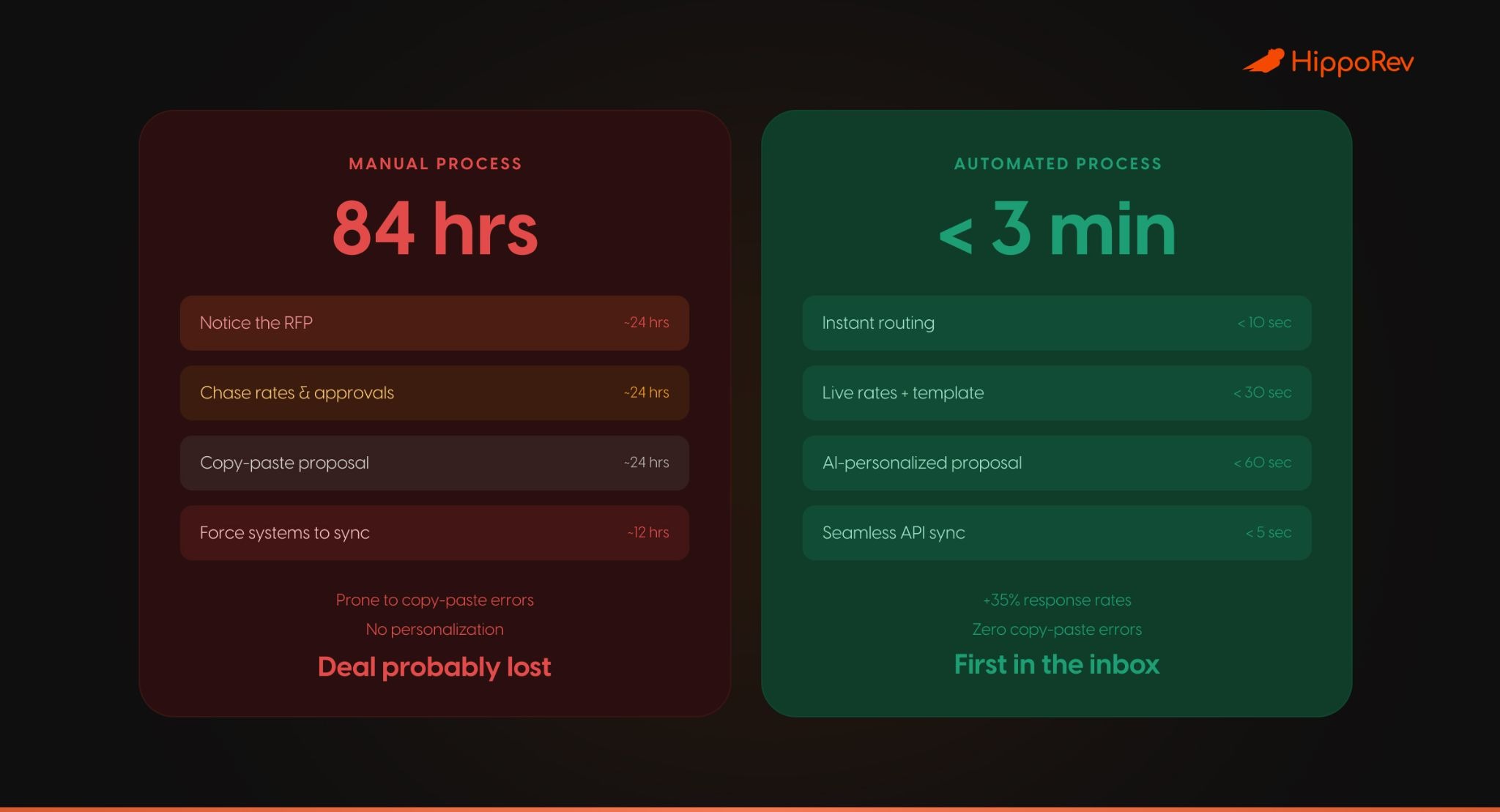
The reason sales teams feel they must choose between speed and quality is because their manual processes are fundamentally broken. Their current execution model is causing revenue to slip away at every stage.
When a typical RFP arrives, it triggers a chaotic, four-stage administrative scavenger hunt. A sales rep must manually notice the lead in a cluttered inbox, log into a disconnected Property Management System (PMS) to check availability, email Revenue Management for pricing approval, and then copy and paste all of this data into a fragmented Word document or Excel spreadsheet.
When humans do this manually, it takes days. When humans try to do this fast, they make catastrophic copy-paste errors—sending a proposal with the wrong group name or an incorrect room rate, instantly destroying the perception of quality.
This is where automation and Artificial Intelligence fundamentally change the equation. Technology removes the human variable from the speed of the first response while simultaneously increasing the accuracy and quality of the output.
When automation is correctly deployed, the process looks like this:
1. Instant Intake and Routing Instead of sitting in a shared inbox, the RFP is instantly ingested by the system. Automated lead routing assigns the lead to the correct sales manager based on territory, segment, or real-time availability in under 10 seconds.
2. Dynamic, High-Converting Templates The fear of "templates" is usually rooted in the memory of cold, robotic auto-responders. Modern automation uses dynamic, intelligent templates. Rather than starting from a blank page, the system utilizes pre-approved, brand-compliant frameworks.
The implementation of these intelligent templates actively drives engagement. In fact, utilizing customized, automated templates has been shown to yield +35% response rates from planners and prospects. Why? Because these templates are engineered for readability, transparency, and immediate value delivery, ensuring the buyer gets exactly the information they requested in a format that is easy to digest.
3. AI-Powered Personalization An AI agent does not just blast out a generic response; it reads the context of the inquiry. Within seconds, the AI can read the prospect's message, acknowledge their specific needs (e.g., "I see you require three breakout rooms with advanced AV"), query the hotel's integrated systems for live pricing and availability, and generate a contextual, highly personalized proposal.
By pulling verified data directly from the CRM and PMS through open API connections, automation eliminates the version errors and copy-paste mistakes that plague manual proposal creation. The math is flawless, the formatting is perfect, and the brand voice is rigidly maintained.
As Hippo Mate brilliantly asks: "Why choose between speed and quality when you can have both? Both directly determine whether you capture the deal revenue."
The Evidence: Automation Case Studies in Hospitality
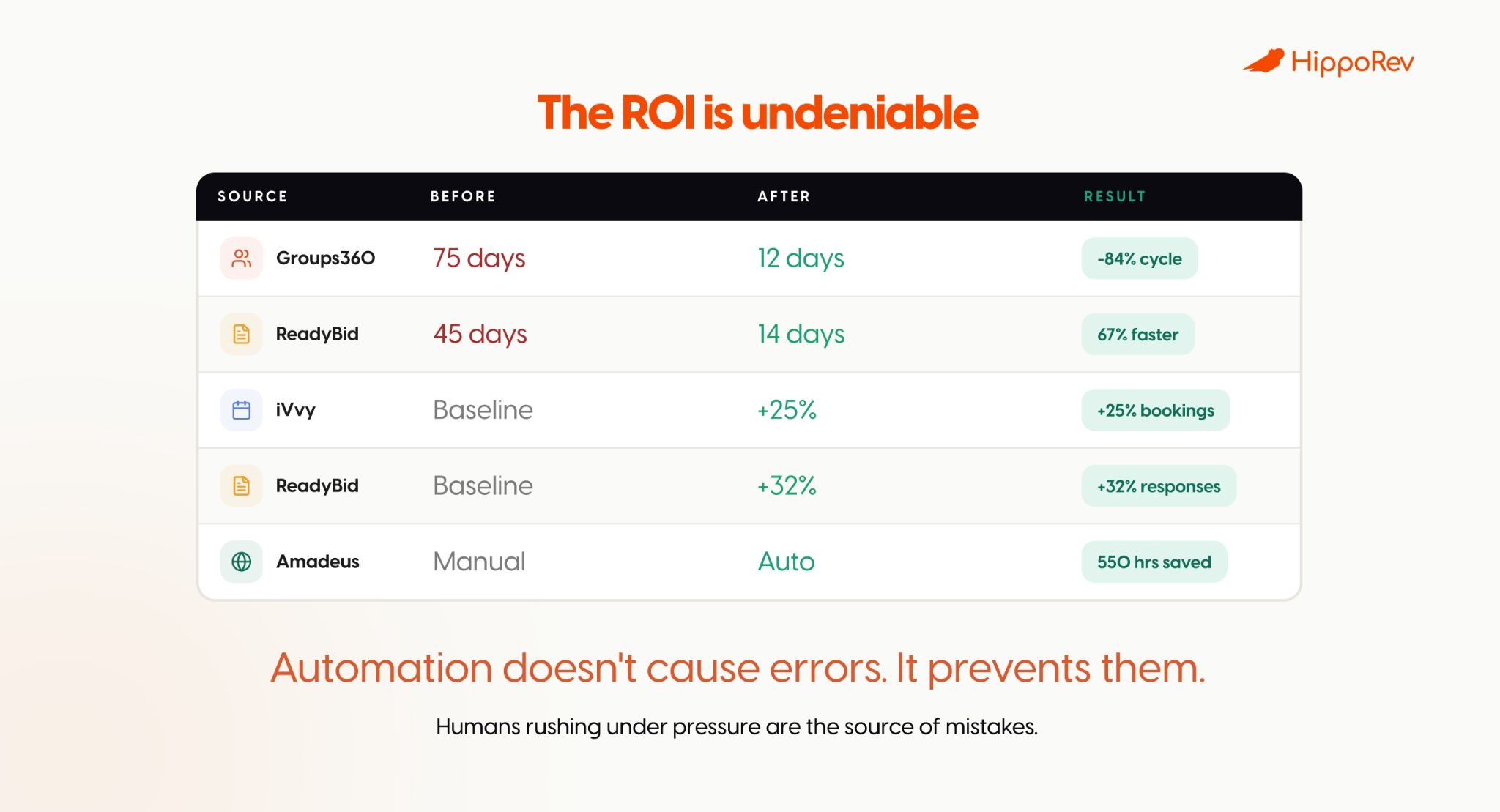
If you are still skeptical that software can accelerate your sales cycle without compromising your brand's standards, look at the verified ROI data from organizations that have already made the leap.
The implementation of sales automation and AI in the hospitality sector has yielded staggering, documented improvements across both velocity and operational quality:
- Shrinking the Sourcing Cycle: Data from Groups360's GroupSync platform reveals that implementing their automation solutions reduced the average sourcing cycle from a bloated 75 days down to just 12 days—an 84% reduction in friction.
- Faster Contract Finalization: According to 2024 data from ReadyBid, automation cut the contract finalization process from 45 days down to just 14 days, resulting in 67% faster sourcing cycle completion.
- Surging Win Rates: iVvy data demonstrates that automated proposal and booking engines resulted in 25% higher booking conversion rates. Similarly, ReadyBid reported a +32% increase in supplier response rates simply by automating the workflow.
- Massive Time Savings: Amadeus reports that deploying email and proposal automation can save a hotel sales team up to 550 hours per year.
The lesson is undeniable: Automation does not cause errors; it prevents them. Humans, rushing to meet a deadline while juggling fifty other tasks, are the source of sloppy mistakes. Algorithms operating with integrated data sources achieve a level of consistency and accuracy that manual labor simply cannot match.
The reason this trade-off between speed and quality feels real is because most sales workflows are fundamentally inefficient & structurally losing revenue. Read: What Happens in the 4 Days Before You Respond
Elevating the Human Element
There is a lingering fear among hotel sales professionals that embracing automation means replacing the "art" of sales with a machine. But this fundamentally misunderstands the purpose of AI in a commercial environment.
Currently, the average salesperson spends only 29% of their actual time selling. The remaining 71% of their week is consumed by administrative drudgery: hunting down rates, fighting with formatting in Microsoft Word, manually entering lead data into the CRM, and chasing internal approvals.
This administrative burden is exactly why 55% of hotel RFPs go completely unanswered, why a large share of revenue never gets captured at all. Sales reps filter their own pipelines, abandoning leads because the sheer weight of the manual response process is too heavy.
When you automate the initial response and proposal generation, you do not eliminate the salesperson; you liberate them.
Instead of acting as a human data-router—spending three days trying to force disconnected software platforms to talk to each other—your sales managers can instantly step into the role of strategic consultants.
Because the AI agent handled the initial 60 seconds of the interaction—delivering a flawless, branded proposal, answering basic qualification questions, and providing transparent pricing—the sales rep enters the conversation with a highly qualified, highly engaged buyer.
The human touch is no longer wasted on data entry. It is reserved for high-value activities: conducting an incredible property site tour, negotiating complex contract concessions, building genuine rapport with the event planner, and closing the deal.
As Brian Hicks, President and CEO of HSMAI, points out, "In sales, AI amplifies, rather than replaces, human talent. Predictive analytics, lead scoring, and proposal generation allow sales professionals to focus on consultative selling and relationship building".
Stop Making Excuses for Slow Revenue
The Speed vs. Quality Myth is a comfortable shield. It allows underperforming sales teams to justify their 42-hour response times by claiming they are protecting the brand's premium image.
But in a market where 80% of buyers expect a response in under four days, and where the vast majority of contracts are signed with the first property to reply, hiding behind the illusion of "bespoke quality" is a guaranteed recipe for losing market share.
Your competitors are adopting AI-first frameworks. They are consolidating their fragmented tech stacks, utilizing natural language processing to qualify leads instantly, and delivering transparent, highly customized proposals while your team is still waiting for a revenue manager to return an email.
You no longer have to choose between being the fastest or being the best. The technology exists today to be both.
It is time to audit your response protocols, tear down the administrative bottlenecks holding your team back, and deploy the automation required to answer every single RFP with flawless precision in a matter of minutes.
Many hotels are now using revenue capture platforms to generate proposals instantly while maintaining brand templates, accurate pricing, and contextual personalization. Hippo Rev is built around this principle, using automation to gather RFP data, apply property knowledge, and produce polished proposals within minutes rather than days.
Instead of sacrificing quality for speed, the technology removes the repetitive work that slows teams down in the first place & leads to lost revenue opportunity.
For sales leaders interested in seeing how faster execution helps you capture more revenue without compromising quality, booking a quick demo can provide a practical look at how these workflows operate.
Frequently Asked Questions
Is there really a trade-off between speed and quality in sales responses?
Historically, faster responses often meant sending generic messages. However, modern automation allows teams to deliver both speed and personalization simultaneously. AI systems can generate detailed responses using real-time data and templates.
What makes a high-quality hotel proposal?
A high-quality proposal answers the planner’s questions clearly, includes transparent pricing, and provides relevant details about event spaces and services. It should also be easy to review and tailored to the planner’s requirements. Speed alone isn’t enough without substance.
How does automation improve proposal accuracy?
Automation pulls data directly from integrated systems such as CRM and PMS platforms. This reduces copy-paste errors and ensures pricing, availability, and event details are consistent. Automated templates also maintain brand standards.
What technologies are used in modern hotel sales automation?
Common technologies include AI document analysis, workflow automation, CRM integration, and real-time data synchronization with property management systems. These tools streamline proposal creation and communication.
Share this post
Ready to close more group business?
See how HippoRev can transform your hotel sales workflow in 15 minutes.

Follow us


.svg)