


Proposals take hours. They should take minutes.
Pricing lives in the RMS. Availability in the PMS. Meeting space on a website. Sellers copy-paste across five systems to draft one proposal. Convert runs that motion automatically — so the seller's job is to review and send, not assemble.
Built for VP Sales and Directors of Sales at full-service hotels and management companies.


The data exists.
Sellers shouldn't be the integration layer.
Every piece of a proposal already lives somewhere in your stack. Pricing in the RMS. Availability in the PMS. Meeting space in Delphi. Planner history in the CRM. The bottleneck isn't the data — it's that a human has to assemble it across five systems for every single proposal.

Of a seller's week is lost to admin, not selling.
Most of it is context-switching across PMS, RMS, CRM, Cvent, and email to assemble a single proposal by hand.

Systems touched to build one proposal.
PMS for availability. RMS for pricing. Delphi for meeting space. Email for planner context. Word for the document. Nothing unifies it.

SLA to submit a proposal — usually missed.
Most planner RFPs require a 4- or 24-hour response. With manual assembly, the SLA is structurally impossible during business hours — let alone after 5pm.
When the seller is the integration layer, the proposal moves at the speed of a person flipping between five tabs. Convert removes that bottleneck — so the seller's job is judgment, not assembly.
Qualified lead to sent proposal, in 30 minutes.
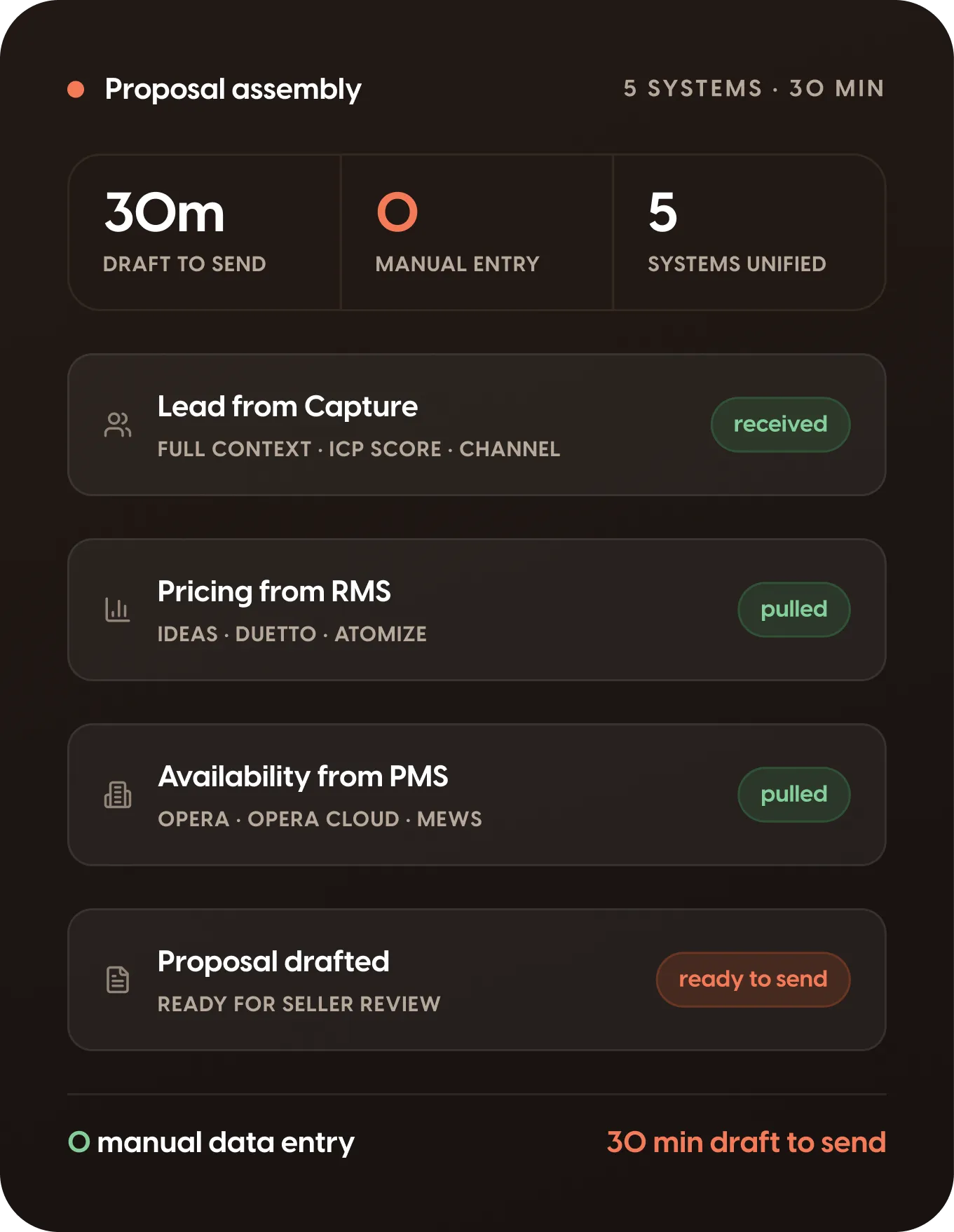
Convert receives a qualified lead from Capture with full context. The platform builds the proposal automatically — chases missing details, pulls pricing and availability, personalizes the tour. Every proposal arrives at the seller's queue ready to send.

Min 0
Lead arrives
From Capture
Qualified lead enters with channel, fit score, planner context, and missing details flagged.

Min 5
Details chased
Auto-emailed
Communication Agent emails the planner for missing F&B, room blocks, dates. Holds until complete.

Min 15
Priced
PMS + RMS
Reads availability from PMS, rates from RMS. Recommends a rate inside revenue strategy guardrails.

Min 25
Tour built
Personalized
Virtual Tour Creation builds an interactive walkthrough of meeting space, F&B, and rooms.

Min 30
Seller reviews
Adjusts. Sends.
Complete proposal lands in the queue. Seller reviews pricing, adjusts the block, clicks send.
Four agents running the proposal motion.
Each agent owns one job in the Convert workflow. They share full context with each other and with Capture and Grow — so by the time a proposal lands in the seller's queue, every detail is current and every assumption is auditable.

Agent 06
Qualification Agent
Scores every lead against your ICP.
Company size, budget signals, event type, timeline urgency, fit-to-property. Surfaces winners; flags long shots. Every lead has a numerical score the seller can challenge or trust.
Agent 07
Communication Agent
Chases missing RFP details automatically.
Identifies missing F&B preferences, dates, block details, A/V needs. Auto-emails planners and holds the proposal until details are complete. Reads from and writes to Delphi and your CRM so nothing is duplicated.
Agent 08
Competitive Pricing Agent
Recommends rates that win.
Reads PMS for availability, RMS for current rates, market data for comp-set pricing, and demand patterns for forecasting. Recommends a rate within your revenue strategy guardrails — never a guess, always defensible.
Agent 09
Virtual Tour Creation
Builds personalized walkthroughs.
Generates an interactive tour of meeting space, F&B options, and guest rooms — tailored to the event ask. A 200-person retreat sees a different walkthrough than a 40-person board meeting.
What Convert reads and writes.
Convert pulls every data point a proposal needs from your existing systems. Nothing migrates. Nothing duplicates. Every proposal is auditable back to the source system that priced or scheduled it.

PMS

Pulls room availability, meeting space configurations, F&B inventory, and event scheduling.

RMS
Pulls current group rates, demand forecasts, and revenue strategy guardrails before recommending pricing.

CRM

Reads account history and past planner relationships. Writes proposal status, pricing, and seller notes.

Sends planner follow-ups for missing details. Receives planner replies and updates the lead automatically.
Convert, before and after.
What hotels see in the first 90 days when proposals are assembled by the platform instead of by sellers flipping between five systems.

+25%
Faster proposal turnaround
Hours to minutes. Sellers go from assembling proposals to reviewing them.

24/7
Pricing aligned with strategy
Competitive Pricing Agent reads RMS guardrails. Rates are never guessed.

Live
Average proposal completion
From qualified lead to seller-reviewed proposal. SLA-compatible by design.

0
Manual data entry
Pricing, availability, meeting space, and planner context flow in automatically.

Got questions?
How Hippo Mate works.
What does Convert do?
Convert is the proposal engine of Hippo Rev. It pulls pricing from your RMS, availability from your PMS, and meeting space detail from your own content, and assembles a complete, priced proposal automatically, so a seller's job is to review and send, not build from scratch.
How does Hippo Rev generate proposals so quickly?
Hippo Rev automates the manual work involved in preparing a proposal. It gathers information from your PMS, RMS, CRM, knowledge base, and RFP details, fills in missing information, recommends pricing, builds the proposal, and prepares it for review. Instead of spending 20 to 50 minutes assembling information across multiple systems, sales teams typically review and send proposals within 3 to 7 minutes.
How is Convert different from simply using proposal templates?
Proposal templates standardize formatting, but they don't eliminate the work required to populate them with accurate information. Convert automates tasks such as retrieving current pricing, checking availability, requesting missing RFP information, recommending rates, and generating personalized property tours. Instead of accelerating document creation alone, Convert aims to automate the decision-support work that happens before a proposal can even be written.
Can Hippo Rev handle both group and corporate RFPs?
Yes. Hippo Rev supports everything from simple group bookings to complex corporate and government RFPs containing hundreds of additional questions. During onboarding, your property's knowledge base is configured with standard responses, allowing recurring questions, policies, amenities, and brand information to be completed automatically while your sales team reviews only proposal-specific details.
Does the AI automatically send proposals, or does my sales team stay in control?
Your sales team stays in control. By default, Hippo Rev prepares the proposal and notifies the salesperson when it's ready for review. Pricing approval, meeting room allocation, and final submission remain with your team. Hotels can optionally enable end-to-end automation for simple, low-value bookings with predefined pricing rules, but human review remains the default workflow.
Does Hippo Rev perform revenue management or displacement analysis?
Hippo Rev does not replace your revenue management strategy. Instead, it brings together pricing recommendations, market intelligence, and availability from your existing systems so sellers can make better decisions faster. If your property has custom displacement or pricing logic, those rules can be incorporated into the proposal workflow to help sales teams evaluate competing opportunities while maintaining full control over final pricing decisions.
Can sales teams edit proposals after the AI creates them?
Absolutely. Sales teams have complete control over every proposal before it is sent. Users can modify pricing, meeting space assignments, photos, descriptions, videos, proposal content, and other details without relying on Hippo Rev to make changes. The AI accelerates proposal creation, while your team remains responsible for the final version.
Can we create different proposal templates for different event types?
Yes. Hippo Rev supports multiple proposal templates for different markets, customer segments, and event types, such as corporate meetings, weddings, conferences, or SMERF business. The platform can automatically recommend the most appropriate template based on the inquiry while still allowing your sales team to choose a different one whenever needed.
How are proposals delivered to planners?
Hippo Rev works alongside your existing proposal process rather than replacing it. For Cvent and similar platforms, the standard proposal is submitted as usual, while Hippo Rev's interactive proposal experience can be included as an additional link. Salespeople also receive the proposal by email, allowing them to forward it directly to planners. Interactive proposals can also be converted into PDFs for procurement teams or buyers who require traditional documents.

Follow us


.svg)