


Sales Productivity
Hotel Sales Outsourcing: Benefits, Risks, and Limitations
Hotel sales outsourcing can provide immediate sales coverage, continuity, cost predictability, and access to experienced professionals when in-house staffing is difficult. The article also explains its limits, particularly that outsourcing alone does not fix fragmented RFP intake, slow response processes, or inefficient sales infrastructure.



.png)
Hotel Sales Outsourcing: What It Actually Solves (and What It Doesn't)
A hotel sales team has one job: turn inquiries into signed business before a competitor does. When that seat sits empty, which happens often in an industry with some of the highest staff turnover in the U.S. economy, group and corporate revenue is usually the first thing that slips. That's the problem hotel sales outsourcing is built to solve, and it's a big part of why the model has moved from a niche workaround to a mainstream staffing strategy heading into the 2027 group sales cycle.
This article explains what hotel sales outsourcing actually means, why more owners and general managers are evaluating it now, what it costs to leave a sales seat unfilled, and where the model has real limits that no outsourcing contract can fix on its own.
What Is Hotel Sales Outsourcing?
Hotel sales outsourcing is the practice of hiring an external company or independent sales professionals to handle some or all of a hotel's group, corporate, and event sales functions on an ongoing contract basis, instead of staffing those functions with full-time, in-house employees. The outsourced team typically works as an extension of the property, using the hotel's own systems, rates, and brand voice, rather than operating as a separate agency layer the guest or planner would notice.
It's a distinct category from two things it's sometimes confused with. It is not the same as outsourcing revenue management, which focuses on pricing and inventory rather than active selling. And it is not the same as hiring a marketing agency, which drives awareness and demand rather than closing individual accounts. Hotel sales outsourcing specifically covers the sales cycle: prospecting, RFP response, proposal negotiation, site visits, and account management for corporate, group, and MICE (meetings, incentives, conferences, and events) business.
Why More Hotels Are Considering It Now
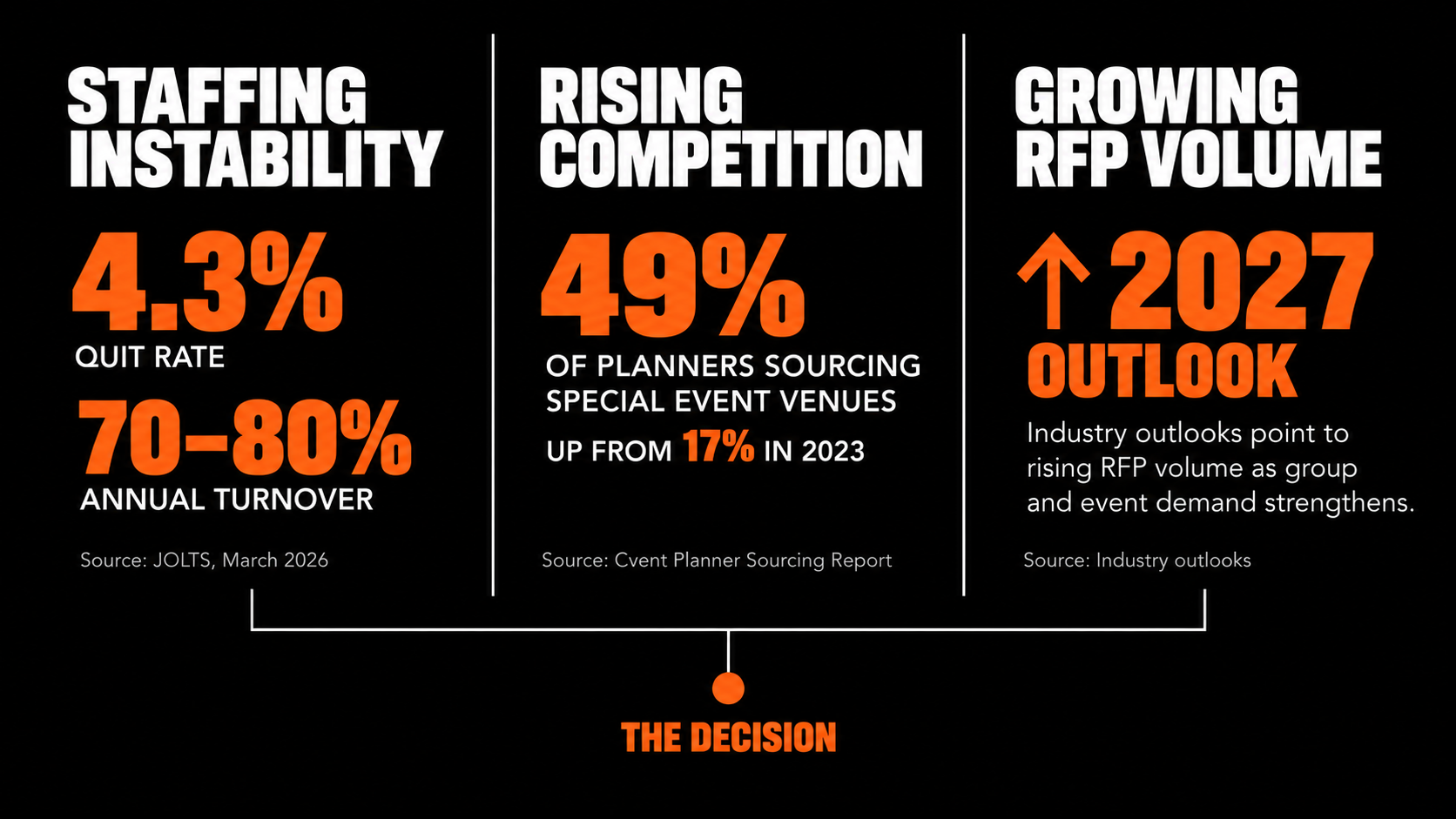
Hotel group sales pressures showing staffing instability, rising venue competition, and growing RFP volume converging on one decision
Three forces are pushing the decision at the same time: staffing instability, rising competition for group business, and growing RFP volume.
The Real Cost of an Empty Sales Seat
Hospitality has the highest turnover of any major U.S. industry. The Bureau of Labor Statistics' JOLTS data put the accommodation and food services quit rate at 4.3% in March 2026, nearly double the private-sector average, and annual turnover in the sector regularly runs between 70% and 80%. Sales and management roles are more stable than front-line positions, but they aren't immune, and a vacancy at the Director of Sales level carries a different cost profile than a vacancy at the front desk.
A separate workforce research from Gallup estimates replacement cost at roughly 40% of annual salary for front-line roles, rising to as much as 200% of salary for managers and department leaders, a range that reflects how much of a sales director's value is tied up in relationships and market knowledge that a new hire has to rebuild from zero. When a hotel loses its only sales person and takes two or three months to backfill the role, that gap doesn't just cost the salary; it costs every group inquiry that arrived and went unanswered during the vacancy.
Rising Competition for Group and Event Business
Hotels aren't just competing with other hotels anymore. According to Cvent's Planner Sourcing Report, 49% of meeting and event planners said they were sourcing special event venues such as unique spaces and coworking venues, up from 17% in 2023. That shift means hotel sales teams have to work harder and respond faster to keep pace with a wider, more agile set of competitors for the same piece of group business.
At the same time, industry outlooks heading into 2027 point to rising RFP volume as group and event demand strengthens. More inquiries sound like good news, and they are, but each one still has to be reviewed, qualified, priced, and answered, which puts direct pressure on whatever team (in-house or outsourced) is doing that work.
How Hotel Sales Outsourcing Works
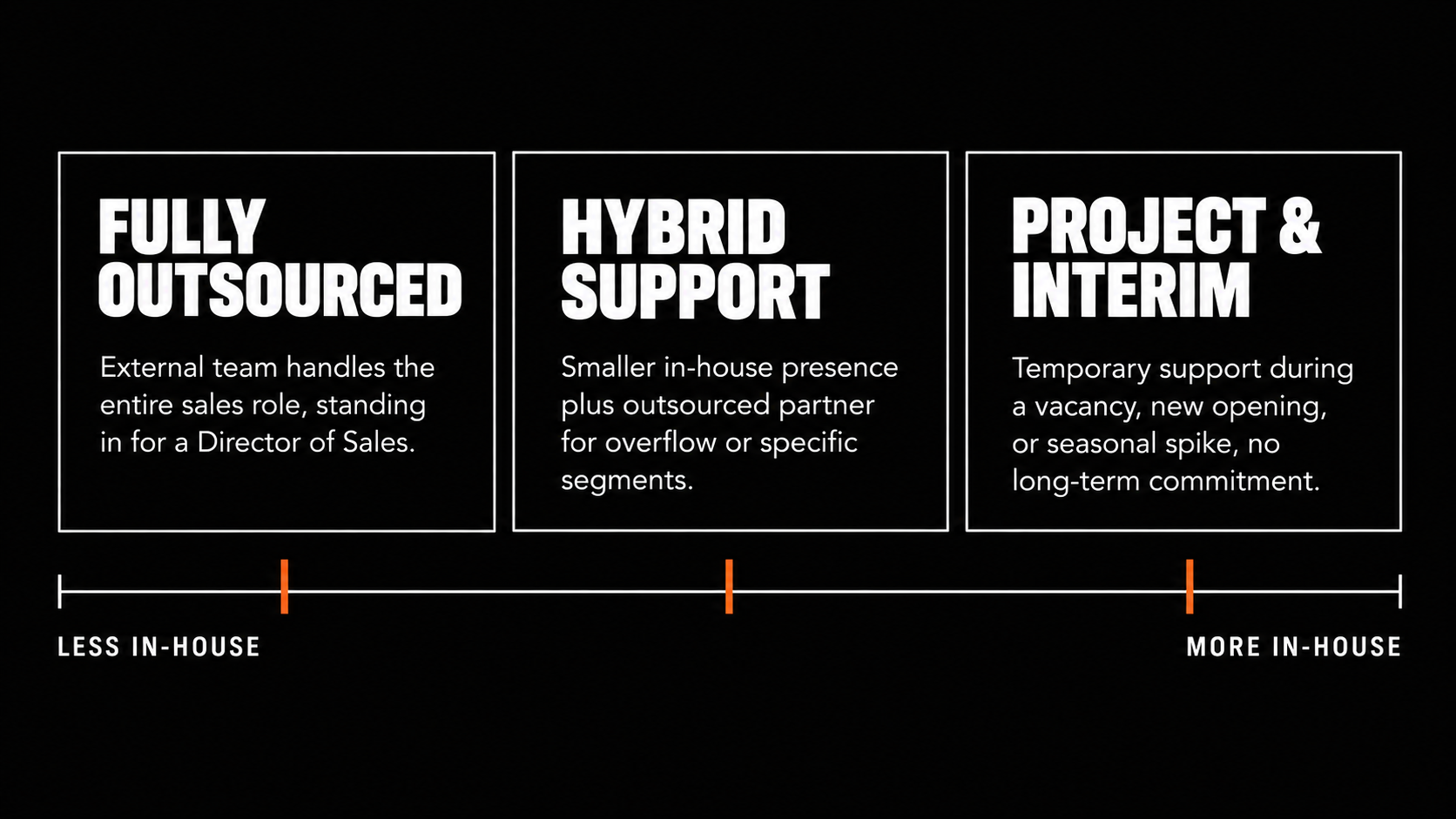
Hotel sales outsourcing framework showing three staffing models from fully outsourced teams to hybrid and temporary sales support
Outsourced hotel sales arrangements generally fall into one of three models:
- Fully outsourced sales function. An external team handles the entire sales role for the property, including prospecting, RFP response, negotiation, and account management, effectively standing in for a Director of Sales.
- Hybrid or augmented sales support. The hotel keeps a smaller in-house presence, often a single sales or catering coordinator, and brings in an outsourced partner to cover overflow, specific market segments such as corporate or MICE, or gaps during a transition.
- Project or interim coverage. A hotel brings in outsourced sales support temporarily, most often during a Director of Sales vacancy, a new property opening, or a seasonal demand spike, without committing to a long-term contract.
Most outsourced partners work inside the hotel's existing property management system, sales and catering platform, and CRM, rather than asking the property to adopt new tools, which is part of what makes the arrangement feel closer to an in-house extension than a third-party vendor relationship.
Five Benefits Hotels Typically Cite
Cost predictability. A full-time sales hire carries more than base salary: benefits, commission structures, training time, and the turnover costs outlined above. An outsourced arrangement is usually structured as a predictable monthly or contract fee, which makes sales cost easier to budget and scale.
Access to established relationships and expertise. An outsourced sales professional typically arrives with existing corporate, travel agency, and MICE network relationships rather than needing months to build them from scratch, which shortens the time to first booked business.
Scalability with demand. Group and corporate demand rarely moves in a straight line. City hotels see midweek strength and weekend softness; resorts see the reverse. Outsourced arrangements can flex sales coverage up during a need period and back down in the off-season in a way that a single full-time hire cannot.
Continuity through staffing gaps. Because the outsourced team isn't tied to one individual's employment status, a hotel avoids the "empty seat" scenario entirely: coverage continues even if a specific salesperson on the outsourced team changes.
More GM and staff time for guest-facing work. When sales prospecting, RFP response, and account management sit with a dedicated outsourced partner, general managers and operations staff spend less time covering sales gaps and more time on the guest experience that drives repeat business and reviews.
What Outsourcing Doesn't Fix
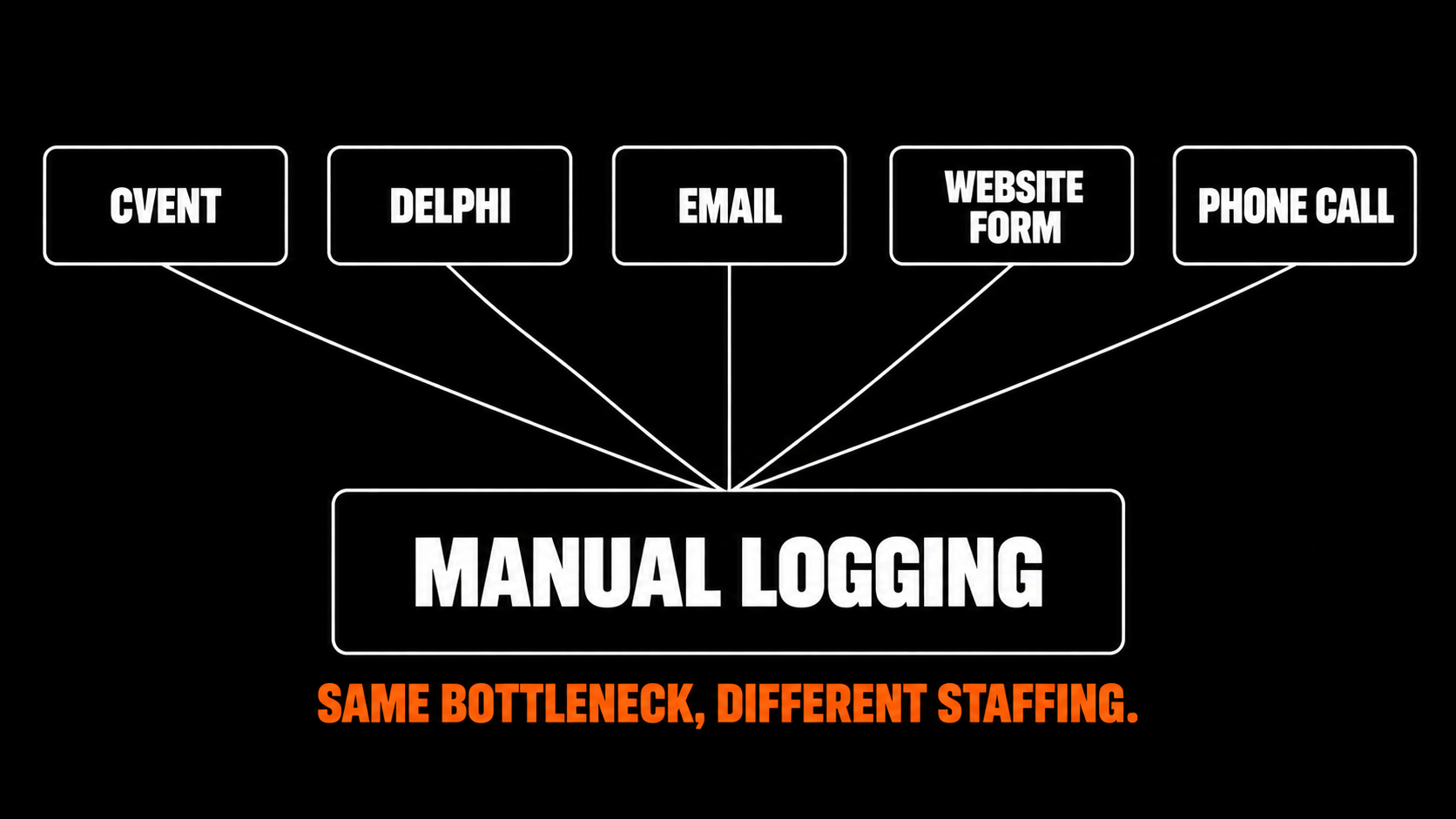
Hotel group sales process showing five RFP channels feeding the same manual logging step regardless of staffing model
Outsourcing solves a staffing and continuity problem. It does not automatically solve a speed or infrastructure problem, and it's worth being clear-eyed about that distinction before signing a contract.
An outsourced sales team is still bound by whatever systems and processes the hotel has in place for receiving, tracking, and responding to inquiries. If RFPs arrive through five different channels (Cvent, Delphi, email, a website form, a phone call) and get logged manually, an outsourced team will inherit that same fragmented intake process, just with different people doing the manual work. Outsourcing changes who answers the RFP; it doesn't necessarily change how fast the RFP gets answered, unless the underlying process improves too.
This matters because response speed is one of the more measurable drivers of group sales win rates. Planners routinely send the same RFP to multiple properties at once, and the businesses that respond fastest and most completely tend to win a disproportionate share of that business, regardless of whether the response came from an in-house or outsourced sales team. A hotel that outsources sales but keeps a slow, manual RFP intake process has traded one bottleneck for another.
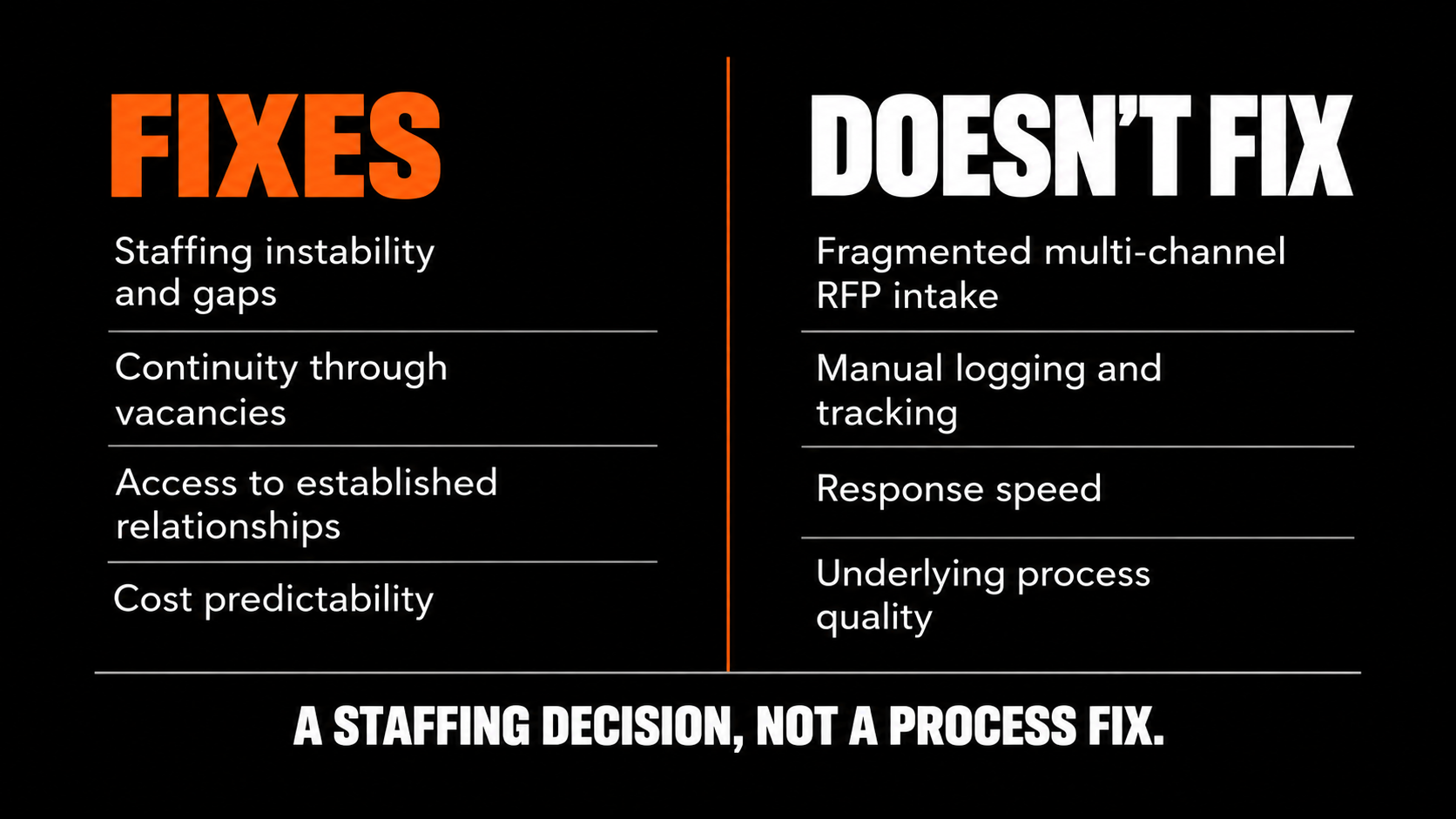
Hotel sales outsourcing comparison showing what it fixes—staffing and continuity—and what it leaves unresolved in the RFP process
Hotel Sales Outsourcing vs. Building an In-House Team
The right answer depends on property size, market complexity, and growth stage, not on which option is universally "better."
An in-house team tends to make more sense when a hotel has enough group and corporate volume to justify a full-time role or team, when brand standards or ownership require dedicated on-property presence, or when the property is part of a portfolio with centralized sales support already in place.
Outsourcing tends to make more sense for smaller or independent properties where a single-person sales department creates a single point of failure, for hotels opening new properties that need immediate sales coverage before a full-time hire can be recruited and trained, and for properties bridging a Director of Sales vacancy without letting group pipeline go cold.
Some hotels land on a middle path: an in-house sales or catering coordinator handling relationship management and site visits, paired with outsourced support for prospecting or overflow RFP volume during peak season.
What to Look For in an Outsourced Sales Partner
Not all outsourced sales arrangements are structured the same way, and the details matter more than the pitch. Before signing, hotels should get clear answers on:
- How the partner reports performance (booked room nights, conversion rate, response time) rather than just activity metrics like calls made
- Whether the partner works inside the hotel's existing CRM and sales and catering platform, or requires a separate system
- How brand voice, negotiated rate integrity, and contract terms are protected when someone outside the property is representing it
- What happens to relationships and account history if the contract ends
- Whether pricing is a flat fee, commission-based, or a hybrid, and how that aligns incentives with the hotel's actual revenue goals
The Common Thread: Speed Still Decides Who Wins
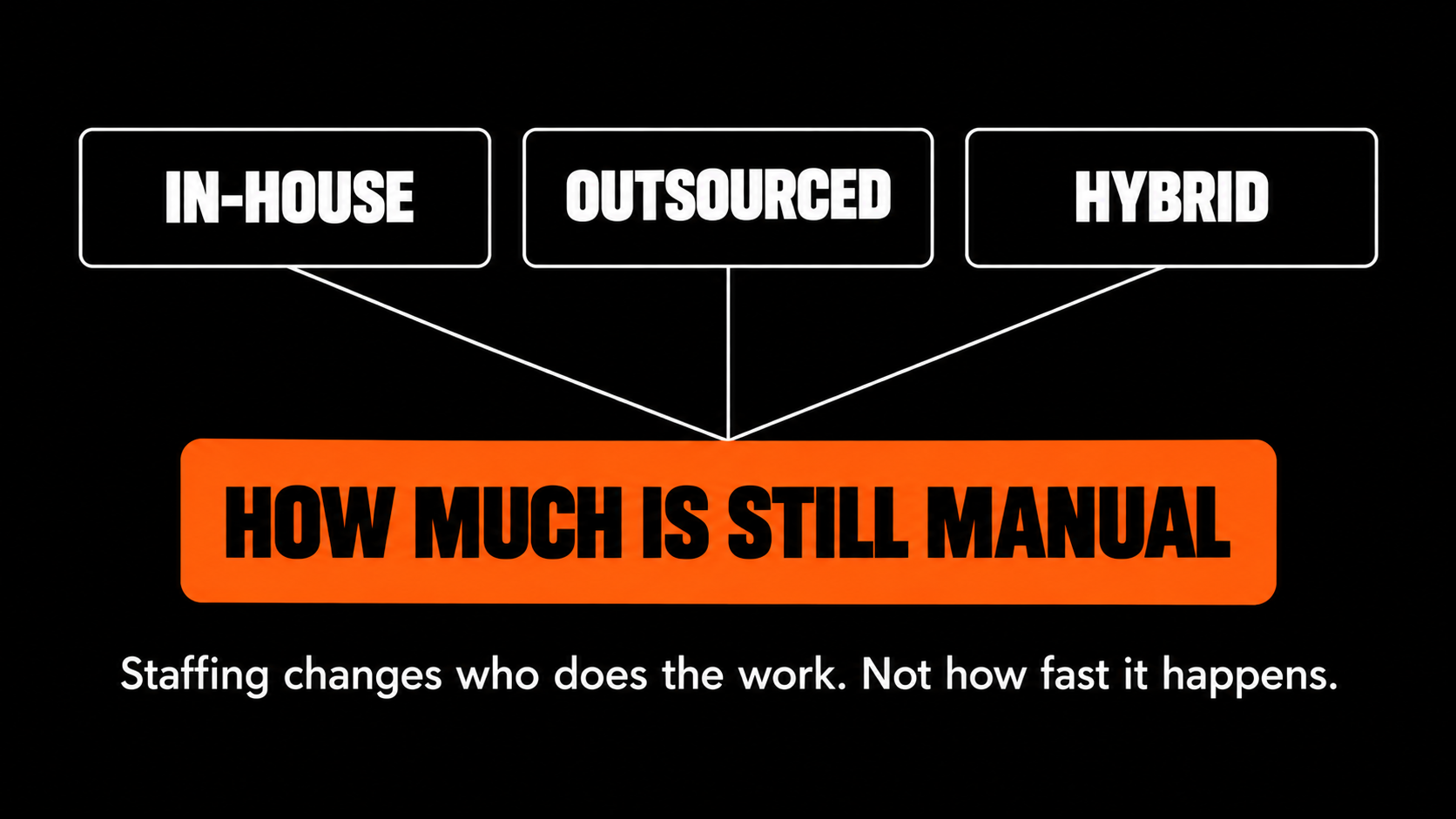
Hotel RFP framework showing staffing changes who does the work, while manual processes determine how fast proposals get completed
Whether a hotel staffs its sales function in-house, outsources it entirely, or lands somewhere in between, the underlying challenge is the same: a growing share of group and event business goes to whichever property responds first with a complete, accurate offer. Staffing model changes who is doing that work. It doesn't change how much of that work is still manual, or how long it takes to move an inquiry from inbox to signed proposal.
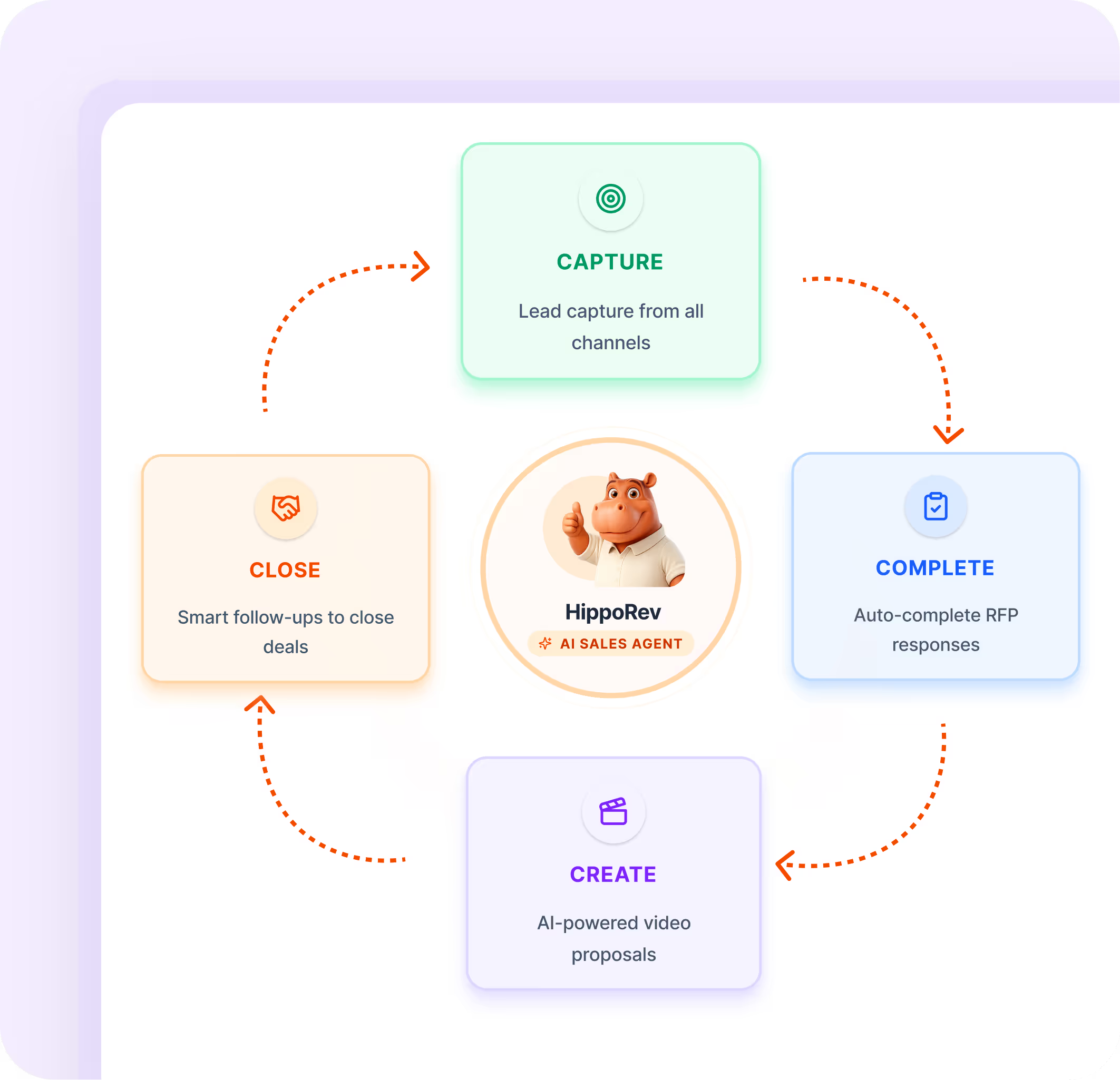
This is where a growing number of hotel sales teams, in-house and outsourced alike, are pairing their staffing decision with tools purpose-built to speed up the mechanics of RFP intake, qualification, and follow-up. Hippo Rev is built for exactly that layer of the process: a system of execution that sits alongside a hotel's existing CRM and sales and catering platforms to help group sales teams triage incoming RFPs, follow up faster, and get pricing out the door before the window closes. It's designed to complement whatever staffing model a hotel already has in place, not replace it. If your team, in-house or outsourced, is losing group business to slower response times rather than a lack of relationships, that's worth diagnosing on its own. You can get a clear read on where your RFP process is actually leaking time and revenue with a free Capture Audit; it takes about 20 minutes, uses your own numbers, and there's no sales deck involved.
Frequently Asked Questions
Does hotel sales outsourcing work for independent and boutique hotels, or only larger properties?
It works for both, but the case is strongest for independent and smaller select-service properties, where a single Director of Sales role often means the entire group sales function depends on one person's availability and tenure.
How much does hotel sales outsourcing typically cost compared to a full-time hire?
Pricing structures vary by provider and can be flat-fee, commission-based, or a hybrid of the two. The comparison that matters isn't base salary versus contract fee alone; it should include the recruiting, training, and turnover costs a full-time hire carries, which industry benchmarks put well into the thousands of dollars per departure.
Can an outsourced sales team still handle brand-specific systems like Cvent or Delphi?
Most established outsourced partners work directly inside a hotel's existing platforms rather than requiring new ones, since operating within the hotel's own PMS, CRM, and sales and catering tools is part of what makes the arrangement function as an extension of the property rather than a separate vendor.
What's the biggest risk of outsourcing hotel sales?
The most common risk is treating outsourcing as a complete fix for a slow or fragmented RFP response process. Outsourcing changes staffing; it doesn't automatically fix how inquiries are tracked, prioritized, and answered, so hotels should evaluate a partner's actual response-time performance, not just their client roster.
Share this post
Ready to close more group business?
See how HippoRev can transform your hotel sales workflow in 15 minutes.

Follow us


.svg)