


Sales Productivity
Hotel RFP Response Time: How Fast Should Hotels Reply?
How quickly should hotels respond to group RFPs? The answer depends on urgency, complexity, lead time, and internal coordination. This guide explains why immediate acknowledgment and full proposal turnaround should follow different timelines.



How Fast Should Hotels Respond to Group RFPs? A Smarter Framework for Speed, Strategy, and Higher Win Rates
Hotel group sales teams are under growing pressure to respond to RFPs faster than ever. Some sourcing platforms reward quick responses, Director of Sales scorecards track turnaround times, and planners increasingly expect acknowledgment almost immediately.
But should every hotel group RFP really be answered within two hours—or even 24 hours?
Not necessarily.
A last-minute group arriving next week and a citywide event planned five or six years in advance are fundamentally different sales opportunities. They involve different levels of risk, analysis, internal coordination, and decision-making. Yet many hotel sales teams are expected to handle both according to the same response-time standard.
That approach can create the opposite of the intended result: rushed proposals, missed details, inaccurate pricing, unnecessary declines, and qualified RFPs that never receive a response at all.
The better strategy is not choosing between RFP response speed and proposal quality. It is creating a hotel RFP response process that moves quickly where speed matters and gives sales teams enough time for thoughtful analysis when complexity demands it.
Why Hotel RFP Response Time Matters
RFP response time typically refers to the period between receiving a group request for proposal and sending a substantive response containing availability, rates, terms, concessions, meeting-space information, and other requested details.
In practice, however, there are really two response times:
- Acknowledgment time: How quickly the hotel confirms that the RFP was received and is being reviewed.
- Proposal turnaround time: How quickly the hotel delivers a complete and strategically sound proposal.
Those two activities should not always operate on the same clock.
Acknowledging an RFP is primarily administrative. A hotel can confirm receipt quickly, demonstrate responsiveness, and tell the planner when to expect a complete proposal.
Building a strong proposal is different.
Depending on the program, a hotel sales manager may need to evaluate room-block requirements, meeting-space availability, food and beverage commitments, attrition terms, historical patterns, displacement risk, future compression, concessions, renovations, and long-term rate strategy.
Complex opportunities can also require coordination with revenue management, catering, operations, finance, the general manager, ownership, or a destination organization.
Trying to compress all of that into an arbitrary two-hour deadline can produce a fast response without producing a good response.
Faster Hotel RFP Responses Can Win More Business—but Speed Is Only Part of the Equation
There is a legitimate reason hotels prioritize response speed.
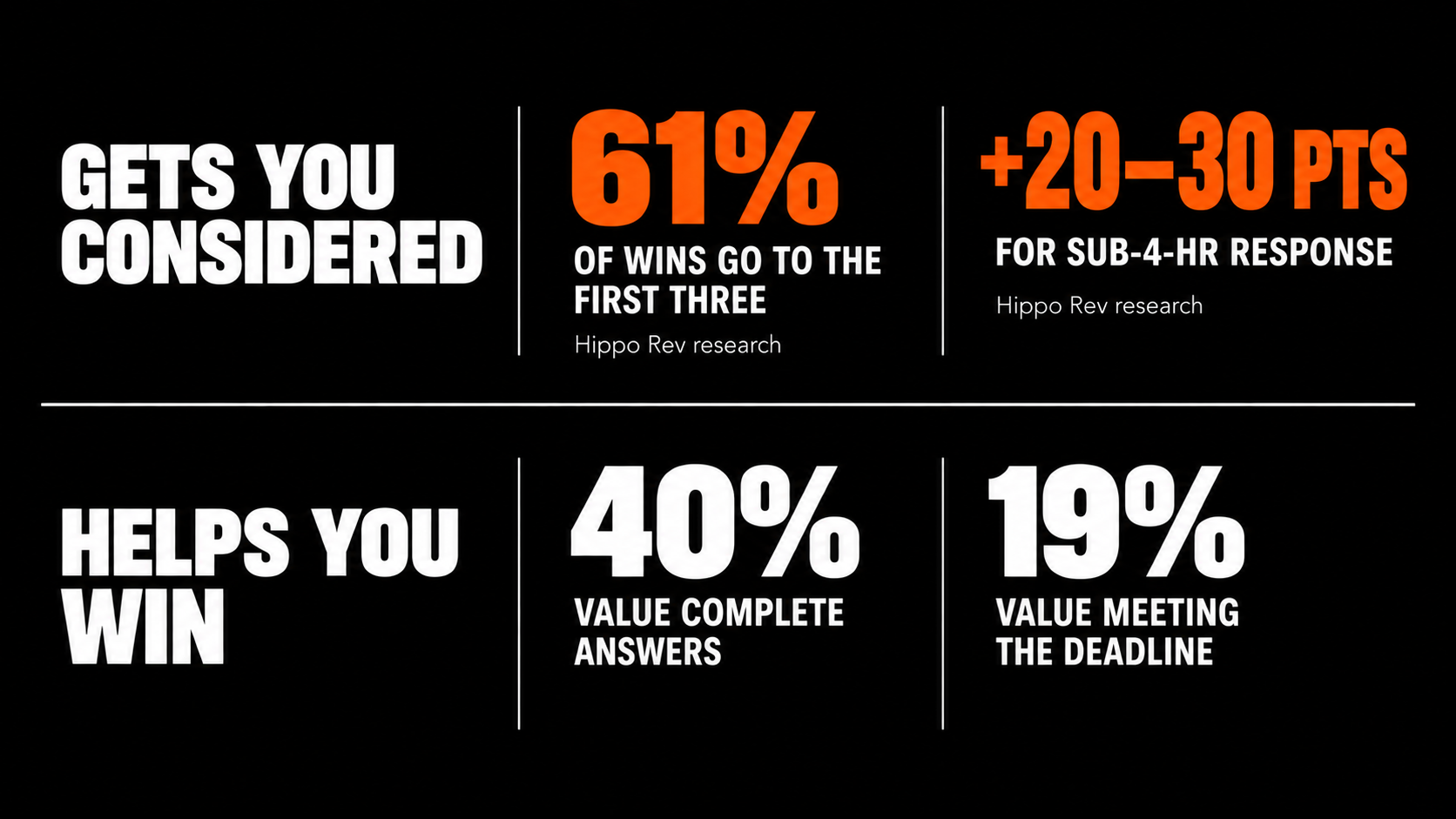
Roughly 61% of won RFPs go to one of the first three hotels to respond, while hotels responding within four hours have been associated with win-rate advantages of approximately 20 to 30 percentage points compared with slower responders.
First-mover advantage matters.
An early proposal can shape the planner's expectations and become the benchmark against which later hotel proposals are compared.
But planners also care deeply about what is actually inside the proposal.
Industrywide planner research has found that 40% of planners said hotels could improve their chances of winning by answering every question contained in the RFP, while 19% pointed to meeting the stated deadline. Accurate pricing was also identified as an important factor.
The lesson is straightforward:
Speed gets a hotel considered. Accuracy, completeness, fit, pricing, and personalization help win the business.
Responding first with an incomplete proposal is not automatically better than responding later with a stronger one.
Why a Universal Two-Hour or 24-Hour RFP Rule Does Not Work
Not all hotel RFPs require the same amount of work.
Consider two examples.
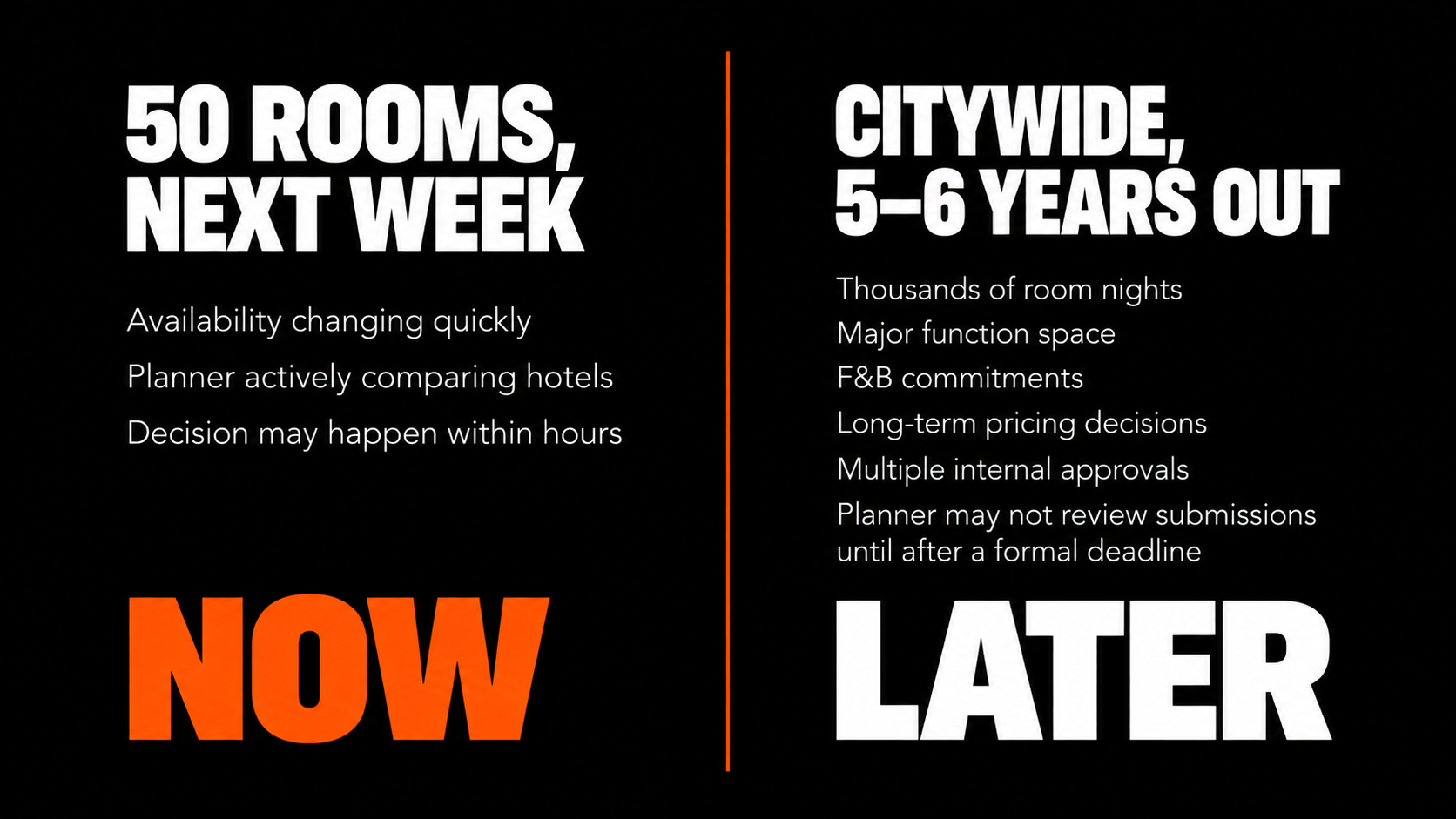
A planner needs 50 rooms and a meeting room next week. Availability is changing quickly, the planner is actively comparing hotels, and the booking decision may happen within hours.
Speed is crucial.
Now consider a future citywide requiring thousands of room nights, major function space, food and beverage commitments, long-term pricing decisions, and multiple internal approvals.
The planner may have provided a formal response window and may not review submissions until after the deadline.
Treating both opportunities as if they require an identical turnaround time ignores the actual nature of the decision.
Forcing every RFP into the same response window can push hotel sales managers toward a transactional process:
receive, price, submit, move on.
That is exactly the wrong mindset for complex group business, where creativity, strategic pricing, flexibility, and thoughtful problem-solving can differentiate one property from another.
A Better Hotel RFP Response-Time Framework
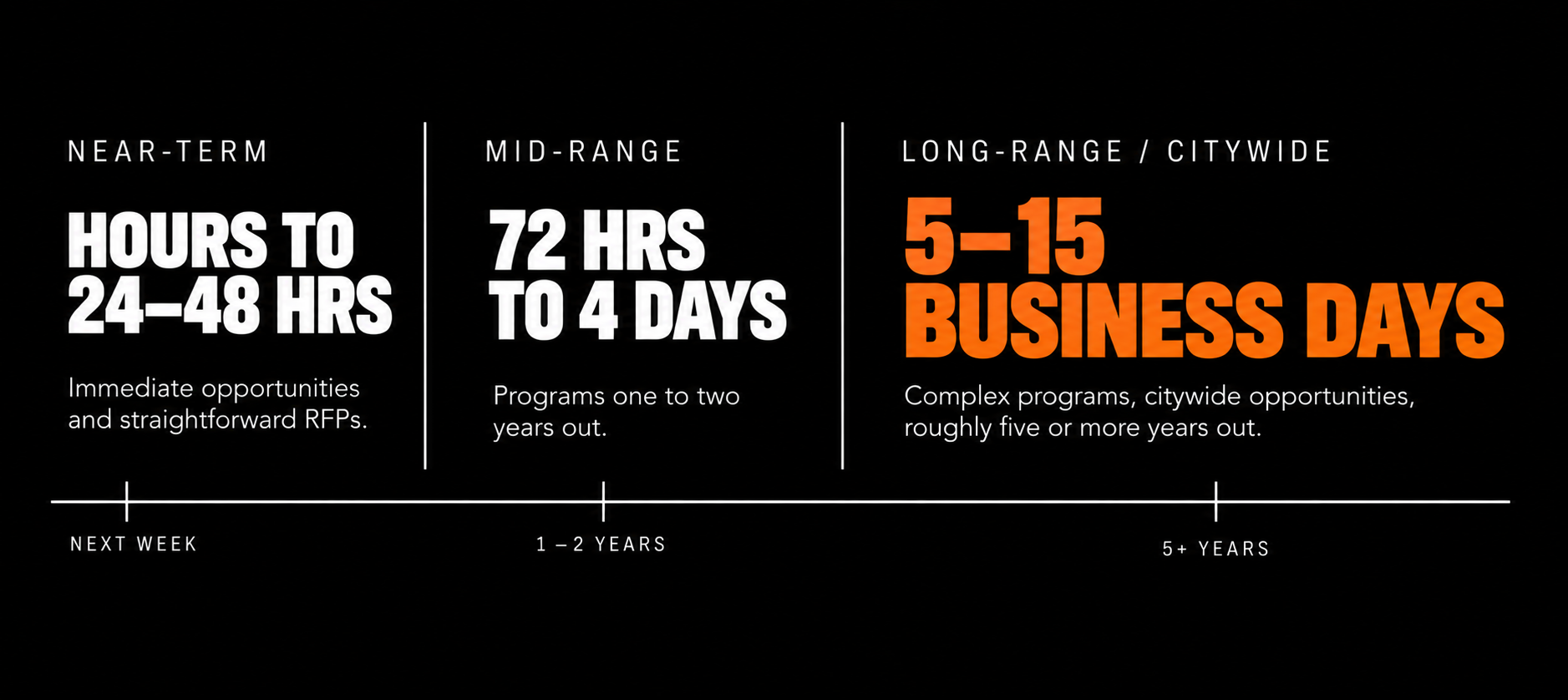
A more effective approach is to scale response expectations according to the event horizon, complexity, room-block size, meeting-space requirements, flexibility, and level of internal coordination required.
Near-Term and Straightforward Group RFPs: Respond Quickly
For urgent inquiries, short-lead bookings, and relatively straightforward programs, speed should remain a priority.
If the group is arriving soon or availability is actively changing, the planner may be making a decision while responses arrive.
These opportunities can justify responses within hours.
For straightforward programs one to two years out, a 24- to 48-hour response window can often be reasonable when dates, historical data, availability, and requirements are clear.
These are the opportunities where fast response time and planner experience can align without sacrificing strategic accuracy.
Mid-Range Group Programs: Allow Time for Analysis
As an event moves further into the future, certainty decreases.
Future city compression may not yet be clear. Event calendars may still be developing. Renovations, infrastructure changes, market conditions, and pricing strategies can evolve.
For programs several years out, approximately 72 hours to four days can provide hotel sales and revenue teams more time to produce a defensible response rather than relying on assumptions.
Long-Range, Complex, and Citywide RFPs: Strategy Requires More Time
Large citywides and long-range programs can involve significant financial and operational commitments.
These opportunities may require displacement analysis, revenue-management modeling, ownership or GM approval, meeting-space strategy, coordination with the local convention and visitors bureau, and assumptions about market conditions years in advance.
For programs roughly five or more years into the future, particularly citywide or highly complex events, five to fifteen business days may be a more realistic response period.
The precise number of days will vary.
The important principle is that the required turnaround should reflect the complexity and horizon of the decision rather than an arbitrary universal deadline.
Why Immediate Acknowledgment Can Matter More Than an Immediate Proposal
One of the most useful improvements hotel sales teams can make is separating acknowledgment from completion.
Planners do not always need a full proposal immediately.
Often, they need confirmation that someone has seen their request, intends to respond, and can provide a clear timeline.
A prompt acknowledgment tells the planner:
- The RFP was received.
- The hotel is actively reviewing the opportunity.
- The request has not disappeared into an inbox.
- A complete proposal will arrive by a specific date.
That visibility can maintain trust even when the proposal itself requires several days of work.
For complex RFPs, a fast acknowledgment combined with a realistic delivery commitment can create a better planner experience than a rushed proposal sent immediately and corrected repeatedly afterward.
What Happens When Hotel RFP Deadlines Are Too Aggressive?
Unrealistic turnaround expectations can create several predictable problems.
Hotels Decline Business They Could Potentially Accommodate
Under intense time pressure, sales managers may review an opportunity too quickly and determine that the hotel cannot accommodate it.
A more detailed analysis might reveal workable alternatives, such as date flexibility, different meeting-room configurations, catering solutions, or off-site function space.
A rushed “no” can eliminate business that better analysis might have converted into a “yes.”
Pricing Becomes Less Strategic
A hotel group proposal should consider more than availability.
Revenue management may need to analyze displacement, demand, compression, historical performance, and future market conditions.
When there is not enough time for that analysis, pricing may become overly conservative, generic, or disconnected from the true value of the opportunity.
Proposals Become Generic
If every RFP is treated as a race, customized selling becomes difficult.
Sales managers are encouraged to answer questions, complete required fields, and submit as quickly as possible rather than examining the planner's priorities and presenting creative solutions.
The result is a proposal that technically responds to the RFP but does little to differentiate the hotel.
Some RFPs Never Get Answered
Roughly 36% of inbound hotel group RFPs go unanswered entirely.
This is not always because sales teams lack interest.
Hotel sellers are also spending significant amounts of time on administrative tasks, manual data entry, follow-up, proposal formatting, status updates, and internal coordination.
Approximately 71% of seller time can be consumed by non-selling activities, contributing to significant revenue leakage.
When every inquiry is expected to move through the same urgent workflow, high-value opportunities can become buried alongside routine requests.
One especially vulnerable period is outside normal working hours, when after-hours hotel RFPs and leads can remain untouched while planners continue evaluating other properties.
The Real Hotel RFP Problem Is Often Administrative Work
Hotel sales managers generally know how to evaluate group business.
The bigger constraint is often how much administrative work stands between receiving an RFP and making a strategic decision.
A seller may need to:
- Capture information from an inbound request.
- Enter details into internal systems.
- Check inventory.
- Find historical information.
- Coordinate with revenue management.
- Request internal approvals.
- Compile meeting-space information.
- Format the proposal.
- Track deadlines.
- Follow up with the planner.
The more time sales professionals spend gathering and transferring information, the less time they can spend selling.
That is why improving hotel RFP response time should focus heavily on eliminating unnecessary administrative work rather than simply telling salespeople to work faster.
How Automation Can Improve Hotel RFP Response Times Without Sacrificing Quality
Automation has an important role in modern hotel group sales, but the goal should not be generating the fastest possible generic proposal.
The biggest opportunity is automating the repetitive work surrounding the strategic sales process.
An effective hotel RFP system can help:
- Capture inbound RFPs regardless of source.
- Prevent opportunities from sitting unnoticed in individual inboxes.
- Identify deadlines and event dates automatically.
- Route opportunities according to urgency and fit.
- Compile relevant account and inventory information.
- Reduce repetitive data entry.
- Track outstanding responses.
- Support follow-up.
- Give sales managers more time for pricing, strategy, and personalization.
Hotels have reduced manual RFP processing from roughly 37 minutes to about four minutes per request by automating administrative steps.
That difference matters because the objective is not simply sending proposals faster.
It is giving sales managers enough capacity to respond quickly and thoughtfully.
The Risk of Automating the Entire Hotel Proposal
AI and automation can generate proposal content rapidly once inventory and account information are available.
But automating the entire sales response creates another risk.
If every competing hotel relies on similar automated proposal templates, planners may receive several responses that sound almost identical.
When differentiation disappears, price becomes one of the few obvious comparison points.
That risks turning hotel group sales into a rate competition rather than a conversation about value, fit, creativity, service, and partnership.
Automation works best when it removes mechanical work while preserving human judgment.
A system can help gather the information.
The salesperson should still understand the program.
What an Effective Hotel Group RFP Process Should Look Like
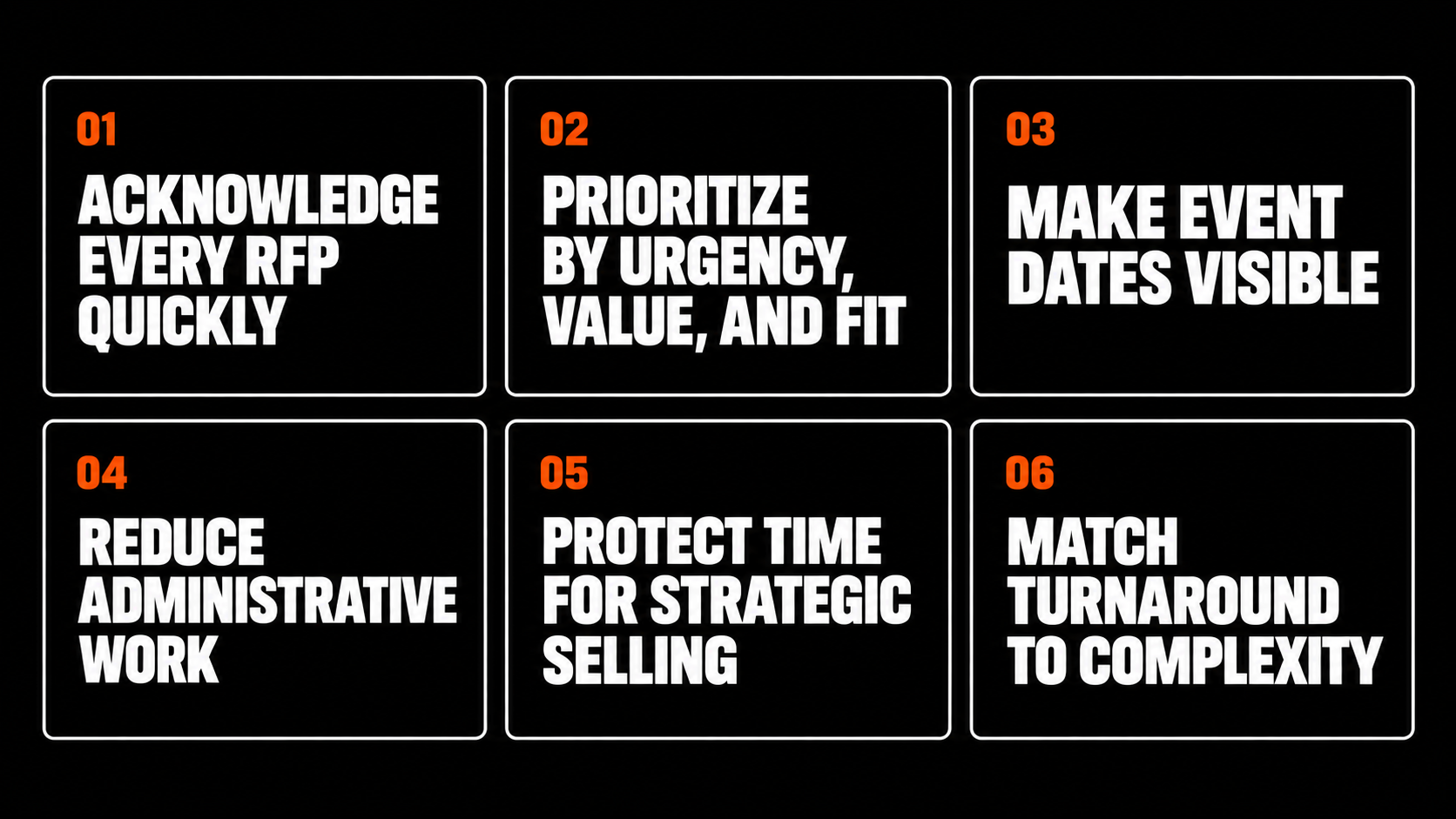
A strong RFP process should help hotel teams respond differently to different opportunities rather than forcing every request through one workflow.
An effective process should:
Acknowledge every RFP quickly.
The planner should know the request was received and understand when a full response will arrive.
Prioritize based on urgency, value, and fit.
A short-lead opportunity requiring immediate action should not compete for attention on exactly the same basis as a long-range citywide.
Make event dates and deadlines visible.
Sales teams should immediately understand whether the program is arriving next week, next year, or several years from now.
Reduce administrative work.
Technology should handle repetitive data capture, routing, tracking, and information gathering wherever possible.
Protect time for strategic selling.
Sales managers should spend their time analyzing displacement, positioning rates, developing creative solutions, and building relationships.
Match proposal turnaround to complexity.
The amount of time allocated to a response should reflect the actual work needed to produce a reliable proposal.
What Event Planners Can Do to Get Better Hotel Proposals
Hotels are not the only side responsible for creating an efficient RFP process.
Planners influence proposal quality through the way they source business.
Sending requests to a smaller group of well-matched hotels, providing realistic budget parameters, outlining priorities clearly, and setting response deadlines that reflect program complexity can produce better outcomes.
A realistic timeline gives hotels more opportunity to build strategic pricing and concessions.
When a deadline genuinely cannot be met, hotels should communicate immediately and offer a reasonable alternative timeline rather than remaining silent.
The most productive RFP process is based on mutual visibility rather than one-sided urgency.
Speed vs. Quality Is the Wrong Hotel RFP Debate
Hotel sales teams should not have to choose between answering quickly and answering well.
The real challenge is eliminating the administrative burden that makes those goals feel incompatible.
For a short-lead booking, being one of the first qualified hotels to respond can create a meaningful competitive advantage.
For a complex future citywide, the winning proposal may depend far more on accuracy, strategic pricing, capacity analysis, creative solutions, and internal alignment.
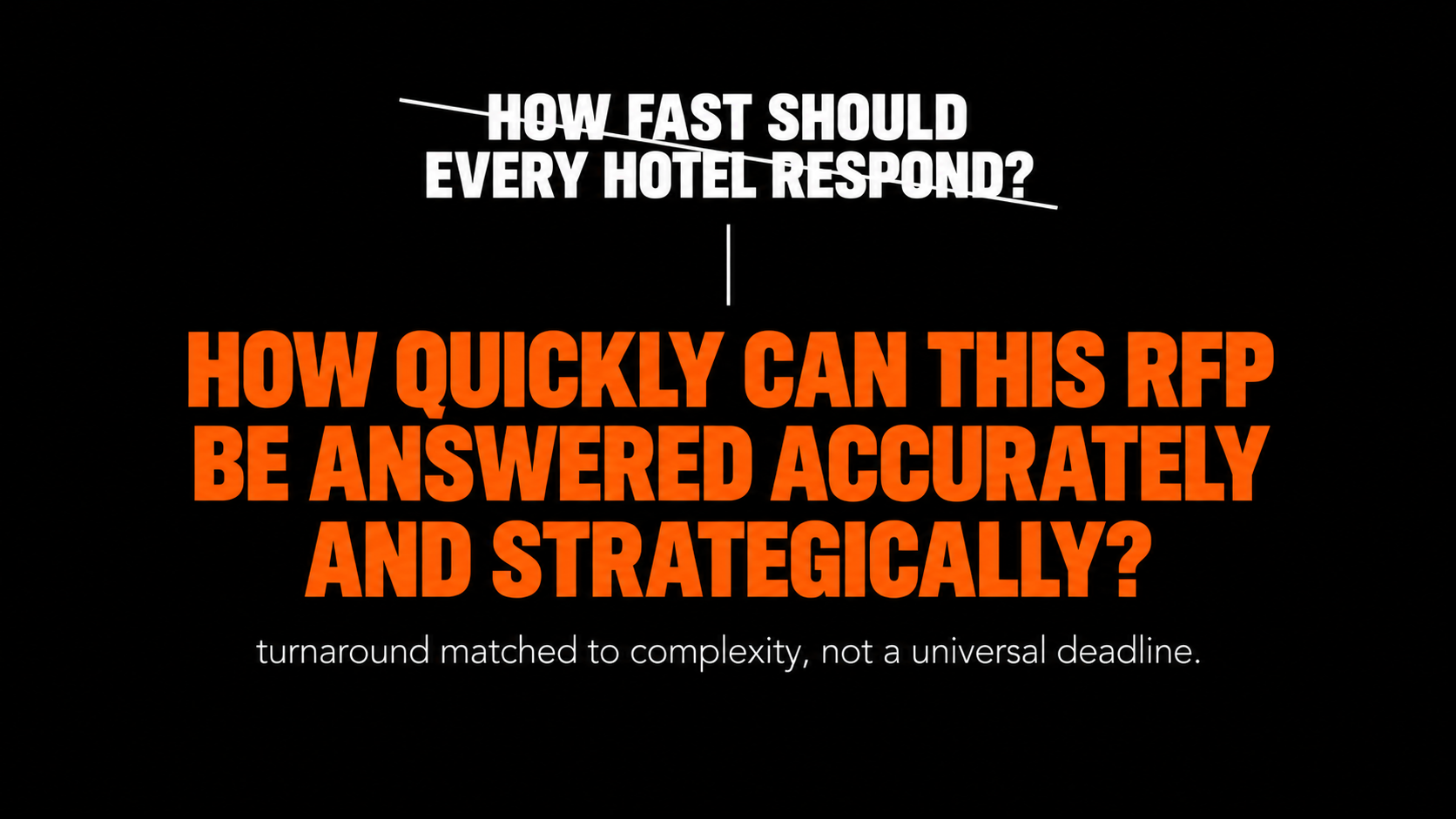
The right question is therefore not:
“How fast should every hotel respond to an RFP?”
The better question is:
“How quickly can this particular RFP be answered accurately and strategically?”
That distinction allows hotels to prioritize speed where speed genuinely influences the buying decision while protecting the analysis required for larger, longer-range opportunities.
The Bottom Line
There is no universal hotel RFP response time that works for every piece of group business.
Fast acknowledgment should be standard.
Full proposal turnaround should depend on lead time, complexity, room-block size, meeting-space requirements, internal approvals, and the planner's stated deadline.
Straightforward and near-term opportunities may justify responses within hours or 24 to 48 hours. Mid-range programs may require several days. Large citywide and long-range RFPs can reasonably require five to fifteen business days when strategic analysis and multiple stakeholders are involved.
Hotels improve their chances of winning when they stop treating response speed as an isolated KPI and start managing it as part of a broader group-sales strategy.
The goal is not to send the fastest proposal.
The goal is to send the fastest accurate, complete, competitive, and strategically sound proposal possible.
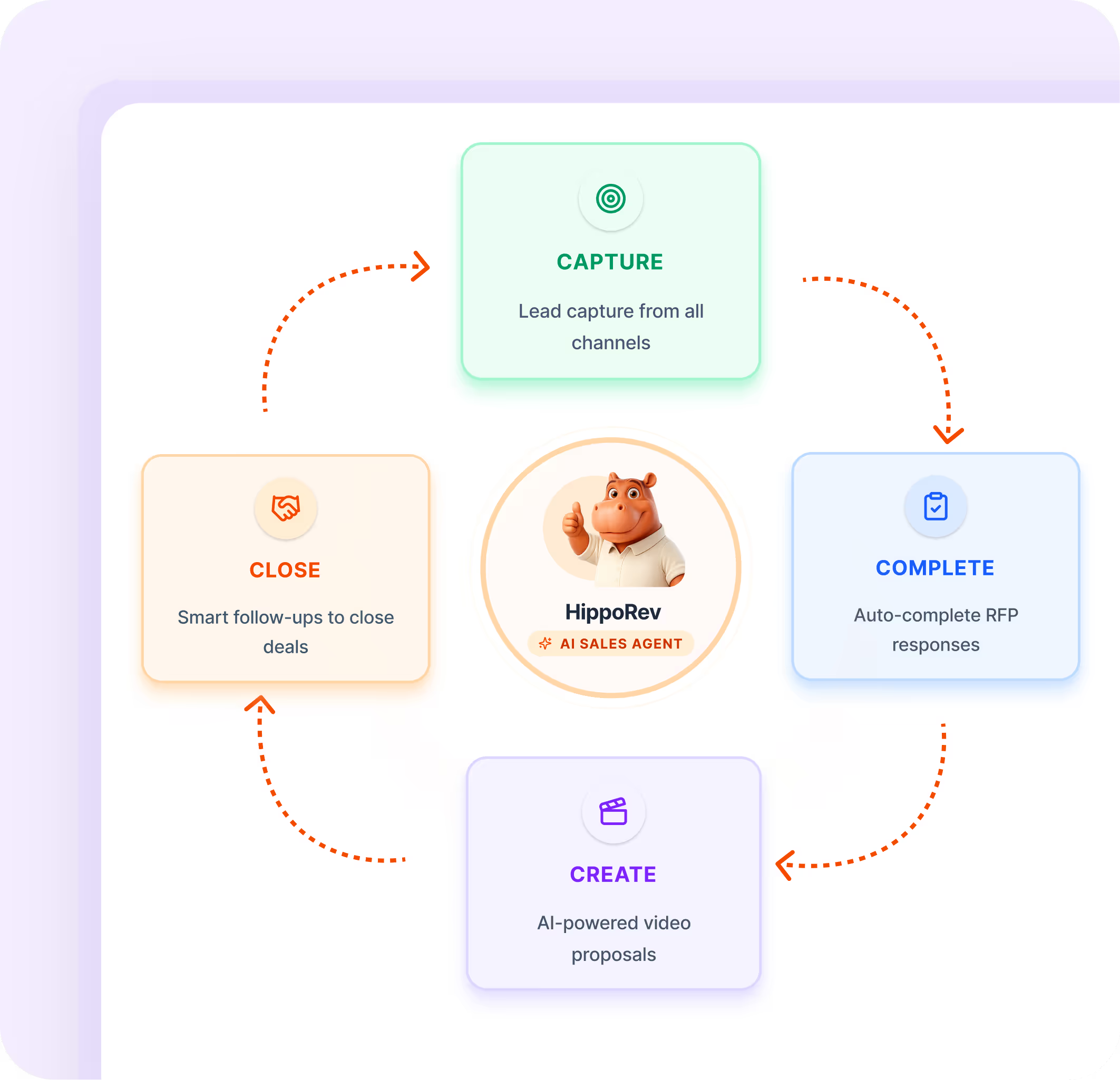
For hotel sales teams struggling with response times because manual RFP intake, tracking, follow-up, and data gathering are consuming selling hours, Hippo Rev is designed to reduce that administrative burden. By helping manage the repetitive work around RFP capture and follow-up, sales managers can spend more time on displacement analysis, rate strategy, internal coordination, personalization, and the decisions that actually influence whether a group books.
Book a free Capture Audit here.
Frequently Asked Questions
How quickly should hotels respond to group RFPs?
The appropriate hotel RFP response time depends on the program. Urgent or short-lead bookings may justify responses within hours, while straightforward future programs may reasonably receive responses within 24 to 48 hours. More complex or long-range programs can require several business days.
Should hotels respond to every RFP within 24 hours?
No single deadline is appropriate for every RFP. A 24-hour turnaround may work for a straightforward opportunity, but a complex citywide or long-range event may require significant revenue-management analysis, internal coordination, and executive approval before a reliable proposal can be submitted.
Does responding faster increase hotel RFP win rates?
Faster response can provide a competitive advantage. Industry data cited indicates that approximately 61% of won RFPs go to one of the first three responding hotels, while very fast responses have been associated with higher win rates. However, proposal completeness, pricing accuracy, personalization, and strategic fit also influence the planner's decision.
What should hotels do when they cannot meet an RFP deadline?
Hotels should acknowledge the request quickly, explain that additional analysis or approvals are required, and provide a realistic alternative delivery date. Clear communication is generally more useful than sending a rushed proposal or failing to respond.
Why do hotel group RFPs go unanswered?
High RFP volume, fragmented intake channels, manual data entry, internal coordination, follow-up responsibilities, and other administrative work can overwhelm hotel sales teams. Improving intake, routing, tracking, and automation can reduce the likelihood that qualified opportunities are missed.
How can hotels respond faster without sacrificing proposal quality?
Hotels can automate administrative tasks such as RFP intake, routing, data gathering, deadline tracking, and follow-up. Removing repetitive work allows sales managers to dedicate more time to pricing strategy, displacement analysis, customization, and relationship-building.
Is AI useful for hotel RFP responses?
AI can be useful for organizing information, automating repetitive tasks, and accelerating proposal preparation. However, the strongest approach preserves human judgment for strategic pricing, capacity decisions, creativity, personalization, and complex negotiations.
Share this post
Ready to close more group business?
See how HippoRev can transform your hotel sales workflow in 15 minutes.

Follow us


.svg)