


AI & Sales Technology
Hotel RFP Data: 8 Causes of Inconsistency
Inconsistent hotel RFP data usually begins with fragmented intake, manual re-entry, weak integrations, duplicate records, and unclear ownership. This article explains common causes, shows how poor data slows responses and costs revenue, and outlines practical steps for fixing the foundation.



.png)
What Causes Inconsistent Data in Hotel Group Sales RFP Software?
Inconsistent data in hotel group sales RFP software is caused by fragmented lead intake channels, manual re-entry between disconnected systems, unclear system-of-record ownership, weak integrations between the RFP tool and the PMS and CRM, duplicate accounts, stale content libraries, and the absence of anyone who actually owns data hygiene. The software rarely creates the inconsistency. It inherits it, then multiplies it at the speed of every proposal you send.
That is the short answer. The longer answer matters more, because every one of these causes is fixable, and each one you leave unfixed is quietly costing you group revenue. Industry analysis of RFP and proposal platforms is blunt about the stakes: delays in response, inconsistent pricing, and missed inquiries directly impact conversion rates and revenue. Here is where the inconsistency actually comes from.
Cause 1: Your Leads Arrive Through Five Different Doors

Group demand does not enter your hotel through one channel. It arrives through Cvent, brand portals, your website form, direct planner emails, phone calls, and referrals from sister properties. Each channel captures different fields in different formats. One RFP has a full room block breakdown. Another is three sentences in an email. When intake is fragmented, the data is inconsistent before a human ever touches it, and every downstream system inherits the mess.
Cause 2: Manual Re-Entry Between Systems That Do Not Talk

This is the single largest source of corruption. A seller copies details from a Cvent RFP into the sales and catering system, then re-keys rates from the revenue tool into the proposal, then updates the CRM after the fact, if there is time. Sellers already spend roughly 71 percent of their day on non-selling tasks, and re-keying is a big slice of it. Every manual hop is a chance for a transposed date, a wrong rate, or a room count that no longer matches the original request. Tired people typing under deadline pressure produce inconsistent data. That is not a character flaw. It is a process design flaw.
This is also where most of the day disappears in the first place, a pattern we quantified in our blog here.
Cause 3: Nobody Agreed on the System of Record
Ask three people at your property where the authoritative version of a group opportunity lives and you may get three answers: the sales and catering system, the CRM, or a spreadsheet someone maintains "just to be safe." When no single system is designated as the source of truth, every system holds a slightly different version of reality, and reconciliation becomes an argument instead of a process. Integration specialists consistently identify this as the root issue: the clearer it is which system controls which data, the fewer conflicts arise.
Cause 4: Weak or Broken Integrations
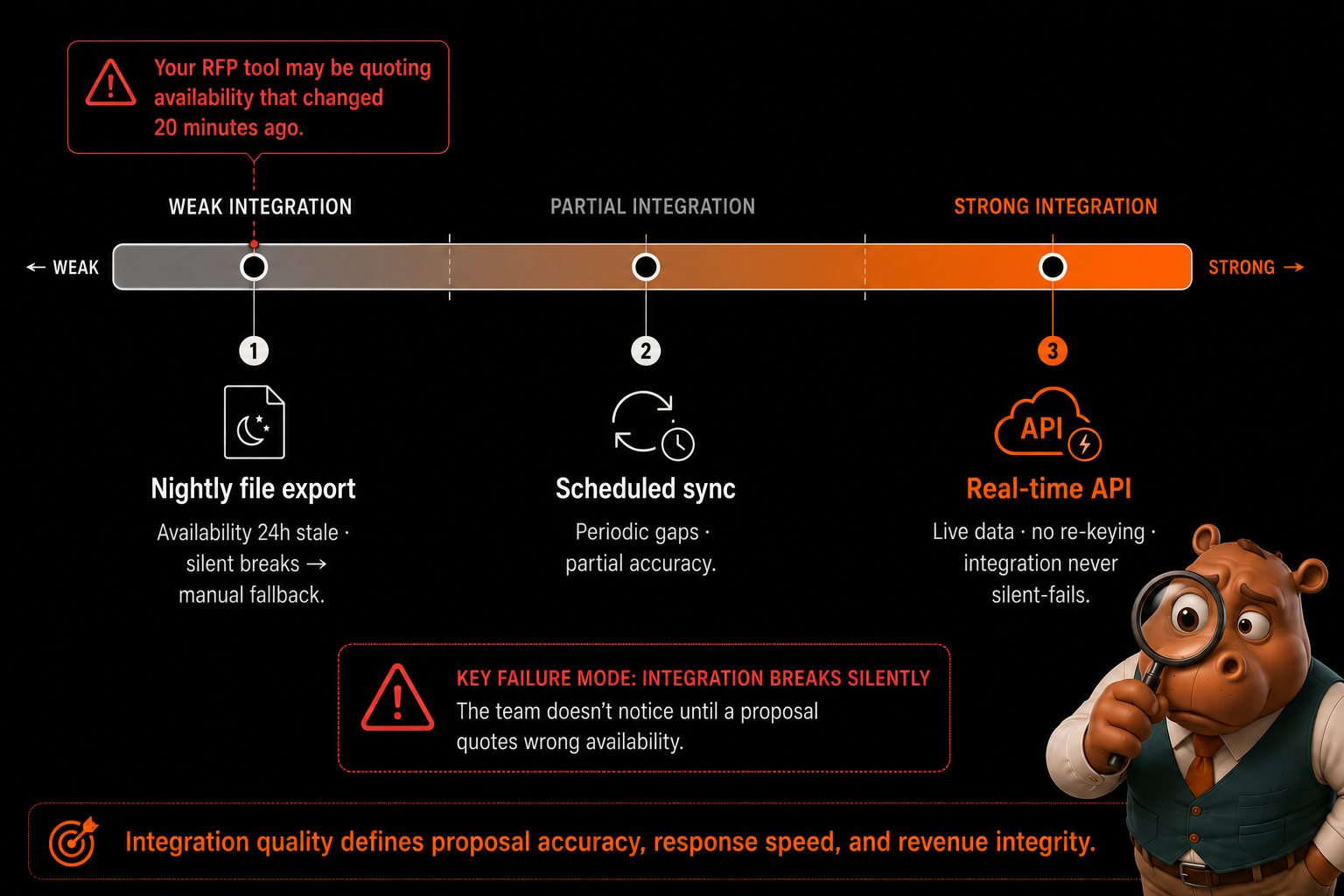
Even when systems are nominally connected, the connection quality varies wildly. Legacy platforms often sync through flat-file exports or scheduled polling rather than real-time event-driven updates, which means the RFP tool can be quoting availability that changed twenty minutes ago. When an integration silently breaks, teams fall back to manual entry, and the inconsistency compounds. A tool with a published API and an active integration ecosystem behaves very differently from one held together with nightly file transfers.
Cause 5: Duplicate Accounts and Ghost Records
The same corporate planner exists in your systems as three separate contacts: one created from a Cvent lead, one from an email inquiry last year, and one imported during a system migration. Each record holds partial history. Your response to their new RFP draws on whichever record the seller happens to open, so the proposal misses the negotiated terms from last year's program. Duplicates do not just clutter the database. They fragment relationship intelligence at the exact moment it should win you the deal.
Cause 6: Stale Content Libraries Inside the RFP Tool Itself
RFP software typically stores reusable content: meeting room capacities, F&B minimums, AV pricing, images, policies. That library is only as accurate as its last update. If your ballroom was reconfigured, your catering menus repriced, or your parking policy changed, and nobody updated the library, the software will confidently insert outdated facts into every proposal. This is inconsistency at industrial scale: one stale entry replicated across dozens of bids.
Cause 7: Portfolio Sprawl With No Common Standard

Multi-property groups face a structural version of the problem. Each property configures fields, stages, and naming conventions its own way, so portfolio-level reporting becomes painful or impossible. When property A logs a "definite" at contract signature and property B logs it at deposit, your pipeline report is comparing apples to invoices. Corporate teams end up requesting manual exports from each property and reconciling them by hand, which introduces yet another layer of manual error.
This is the exact fragmentation problem multi-property groups run into when they try to standardize RFP handling across a portfolio, something we cover in our blog here.
Cause 8: No Owner, No Hygiene
Ultimately, data stays consistent only when someone is accountable for keeping it that way. Most hotel sales operations have no designated data owner. Hygiene happens sporadically, usually right before an audit or a system migration, then decays again. Turnover accelerates the decay: each departing coordinator takes undocumented conventions with them, and each new hire invents their own.
What Inconsistent Data Actually Costs You
These causes are not cosmetic. Industry-wide, about 36 percent of hotel RFPs go unanswered, and 61 percent of won deals go to one of the first three responders. Inconsistent data attacks both numbers at once. Leads scattered across intake channels are the leads that go unanswered. Sellers who must verify every rate and capacity before sending are the sellers who respond fourth instead of first. Add it up across a year and the execution gap runs to roughly 500,000 dollars in annual revenue leakage per salesperson. Your RFP software did not cause that. Your data foundation did.
Fixing the Foundation, Then the Speed
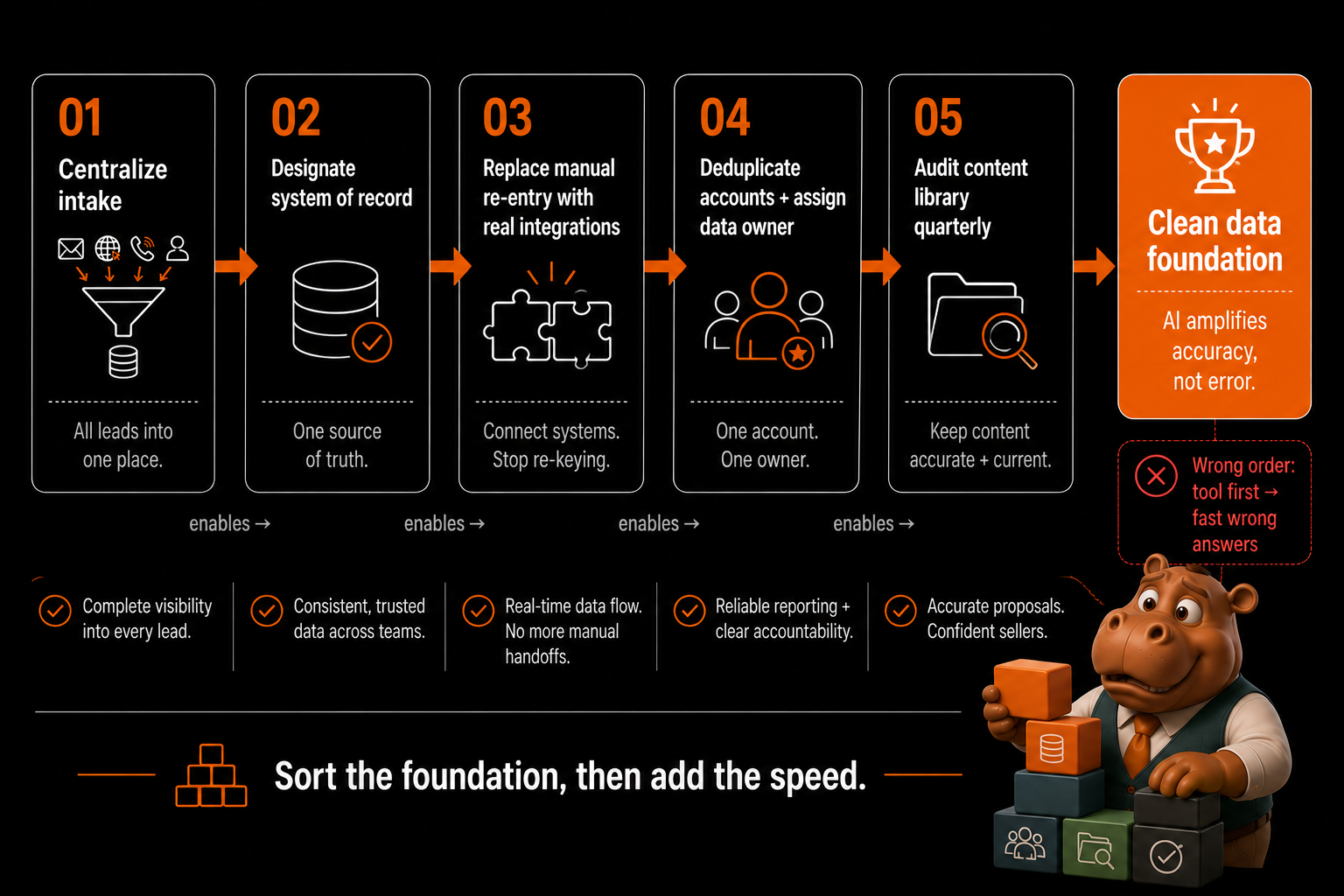
The fix follows the causes in order. Centralize intake so every lead lands in one place in one format. Designate a system of record and enforce it. Replace manual re-entry with real integrations. Deduplicate accounts and assign an owner for ongoing hygiene. Audit the content library quarterly.
This is also the honest place to mention how we think about it at Hippo Rev. The platform is built to capture every inbound group lead in one place and cut RFP processing from around 37 minutes to about 4 minutes, which removes the manual re-entry that causes most inconsistency in the first place. But we say this to every prospect: no platform, ours included, can fully compensate for data that is scattered or wrong at the source. Execution speed built on bad data just delivers wrong answers faster. Sort the foundation, then add the speed.
If you want to see where your current setup is leaking, book a Capture Audit. Twenty minutes, your numbers, no deck.
Frequently Asked Questions
1. What is the most common cause of inconsistent data in hotel RFP software?
Manual re-entry between disconnected systems. Every time a seller re-keys details from an RFP into a sales and catering system, CRM, or proposal, the data can drift. Fragmented intake channels are a close second.
2. Does the RFP software itself create data inconsistency?
Rarely. The software inherits inconsistency from fragmented intake, broken integrations, and stale content libraries, then replicates it across every proposal. The tool amplifies whatever foundation it sits on.
3. How do integration gaps cause inconsistent data?
Legacy integrations that rely on flat-file exports or scheduled polling sync data on a delay, so the RFP tool can quote rates or availability that have already changed. When integrations break silently, teams revert to manual entry, compounding the drift.
4. What is a system of record and why does it matter for group sales?
A system of record is the single designated source of truth for a data type, such as opportunities or account history. Without one, the CRM, sales and catering system, and spreadsheets each hold different versions of reality, and no report can be trusted.
5. How do duplicate planner accounts hurt RFP responses?
Duplicates fragment relationship history. A seller responding from one record misses negotiated terms, preferences, or past issues stored in another, producing proposals that contradict the client's actual history with your property.
6. Why does multi-property portfolio data get inconsistent?
Each property tends to configure fields, pipeline stages, and naming conventions differently. Portfolio reporting then requires manual reconciliation of mismatched exports, which introduces further errors and delays decisions.
7. How does inconsistent data affect RFP response speed?
Sellers must verify every rate, capacity, and term before sending, which slows responses. Since 61 percent of won deals go to one of the first three responders, that verification lag translates directly into lost business.
8. What does inconsistent group sales data cost a hotel?
Between unanswered leads and slow responses, execution failures cost roughly 500,000 dollars in annual revenue leakage per salesperson. Inconsistent data is a primary driver of both failure modes.
9. How often should the RFP content library be audited?
Quarterly at minimum, and immediately after any change to meeting space, catering pricing, policies, or renovations. One stale entry gets replicated into every proposal the software generates.
10. Should hotels fix their data before buying new RFP software?
Yes. Centralize intake, designate a system of record, and deduplicate accounts first. New software applied to a scattered data foundation produces the same inconsistencies at higher speed.
Share this post
Ready to close more group business?
See how HippoRev can transform your hotel sales workflow in 15 minutes.

Follow us


.svg)