


Sales Automation
Your Hotel Sales Team Spends 70% of Its Time on Admin | Hippo Rev
Hotel sales managers are expensive, relationship-driven professionals spending most of their day on work that does not require a human. Here is the admin audit, task by task, and what can be automated today.



Why Your Hotel Sales Team Is Spending 70% of Their Time on Admin (And How to Get It Back)
Your Director of Sales earns a senior salary. She spends a large share of her day on data entry, copy-pasting proposal templates, and chasing Cvent confirmations. Ask yourself what that time is worth, and whether you are paying for a closer or a very expensive data-router.
Across onboarding sessions and demos, from a Hilton property in Los Angeles to independent boutiques, the ratio held up with uncomfortable consistency. The people you hired for relationships and negotiation spend most of the week on tasks that software should have handled years ago. This is the execution gap, and it is measurable.
Where do hotel salespeople actually spend their time?
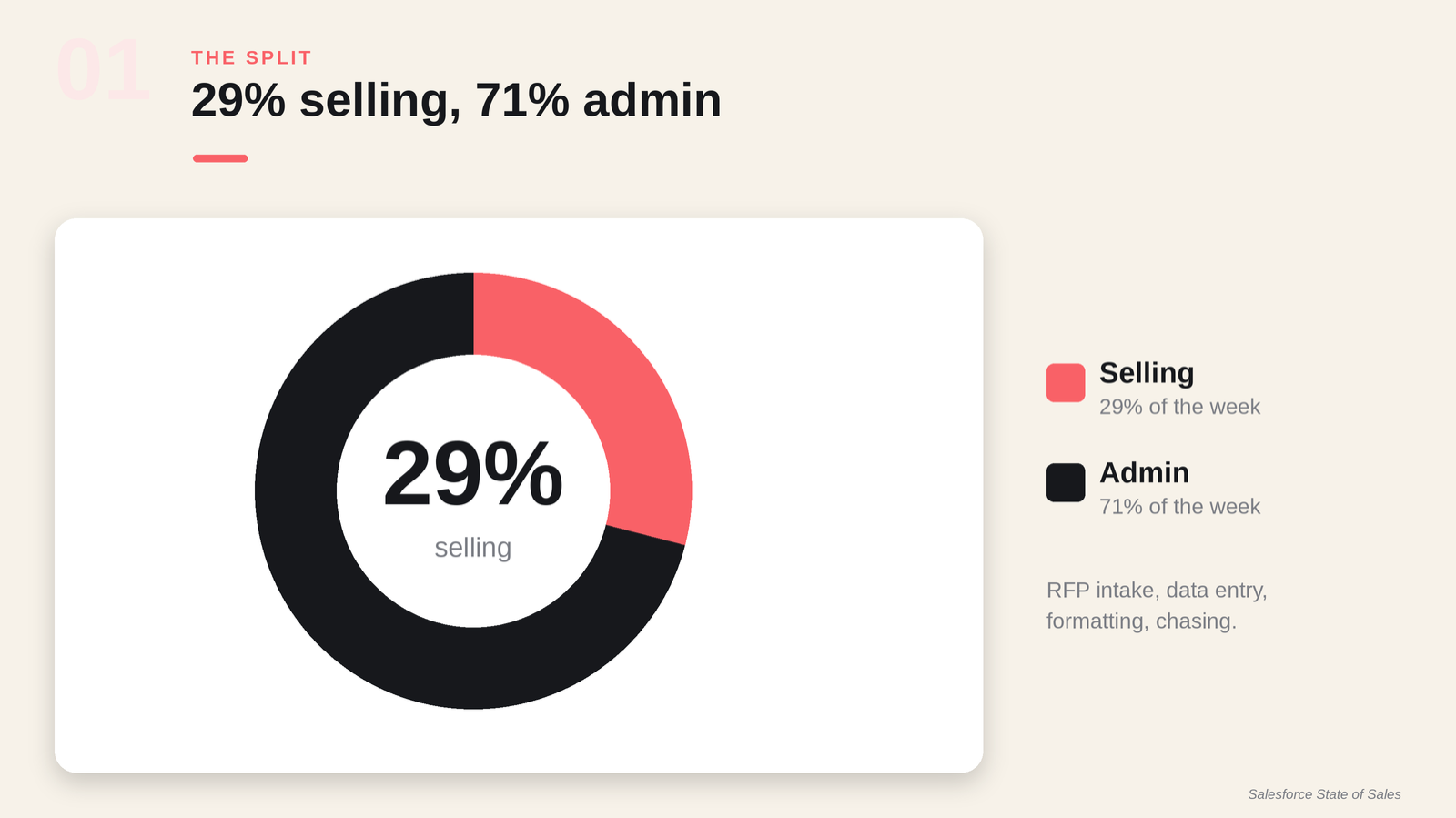
Not on selling. Salesforce data shows reps spend only about 29% of their time actively selling, which means roughly 70% goes to admin: responding to RFPs, entering data, formatting proposals, and chasing confirmations. A single RFP response, from capture to price to propose to CRM update, commonly runs 45 to 60 minutes of manual work.
Break one RFP into its stages and the leak is obvious. Capture the lead. Find the missing details. Look up pricing. Build the proposal. Send it. Update the CRM. Schedule the follow-up. Each step is small. Multiply by 50 to 100 RFPs a month and the aggregate is most of a full-time role spent on work no customer ever sees.
Why is the problem getting worse, not better?
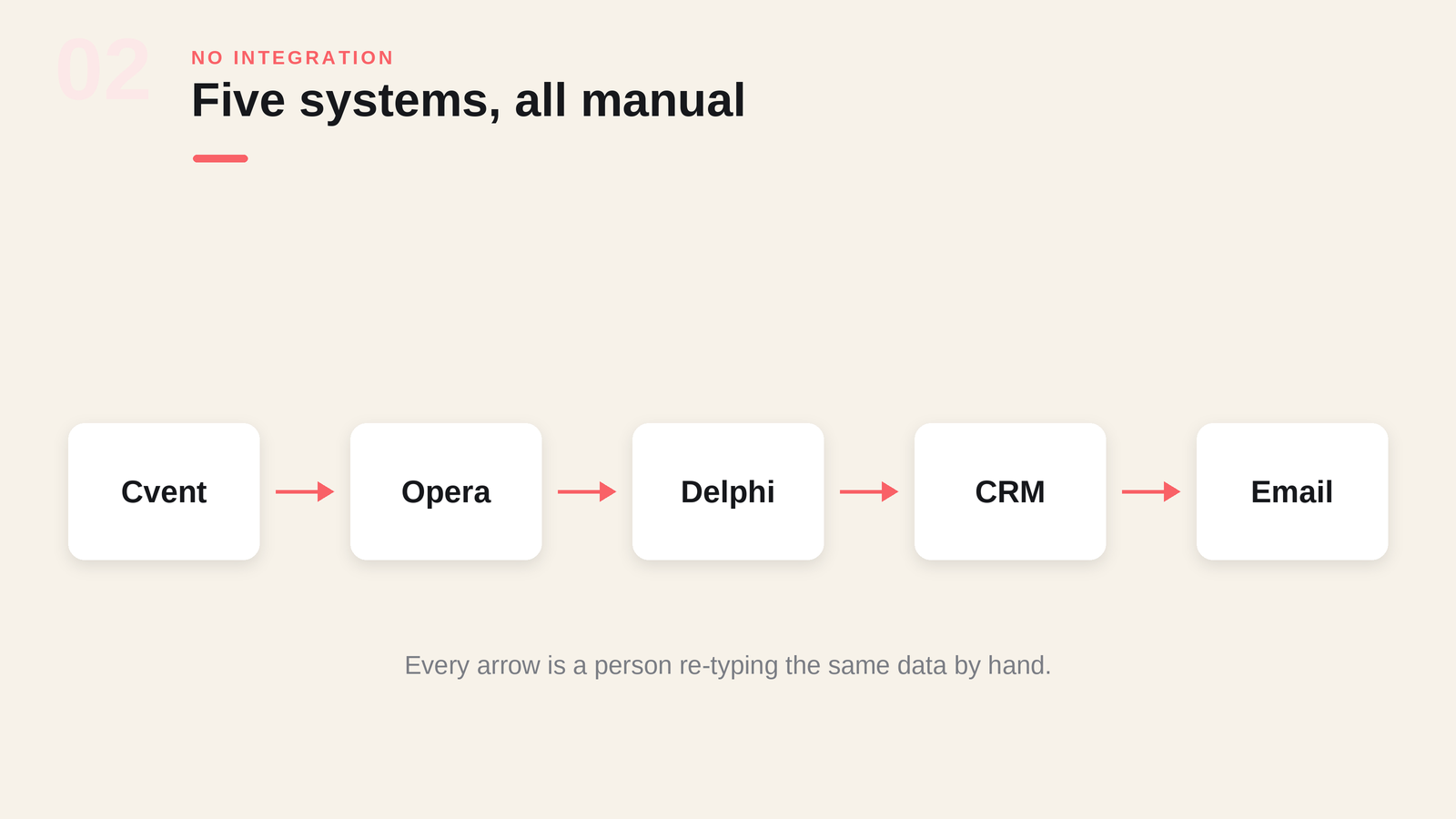
Because the systems do not talk to each other. Cvent, Opera, Delphi, Groups360, MeetingBroker, and the property CRM each hold a piece of the workflow, and none of them share it automatically. Every handoff between systems is a manual re-entry, which means more time lost and more room for version errors.
The compounding problem is integration, or the lack of it. A rep pulls a lead from Cvent, re-types it into the CRM, opens Opera or Delphi for pricing, drops that into a Word template, and emails it out, then logs the whole thing by hand. Without open API connections between the PMS, CRS, and CRM, every one of those transfers is human-powered, and every human transfer is a chance for a wrong rate or an outdated version to reach a planner.
What does 70% admin mean for revenue?
It means your capacity is capped by paperwork, not by market demand. If automation lets one rep handle three times the RFP volume at the same quality, you are not just saving hours, you are unlocking closed group revenue that currently never gets worked because the team runs out of time before it runs out of leads.
Reframe the admin tax as an opportunity cost. Every hour spent formatting a proposal is an hour not spent on a fence-sitting group that a human conversation would have closed. When you free the 70%, you are not cutting cost, you are expanding the sellable surface area of a team you already employ. That is the argument for automation as a growth lever, not a savings line.

Which tasks can be automated today, and which still need a human?
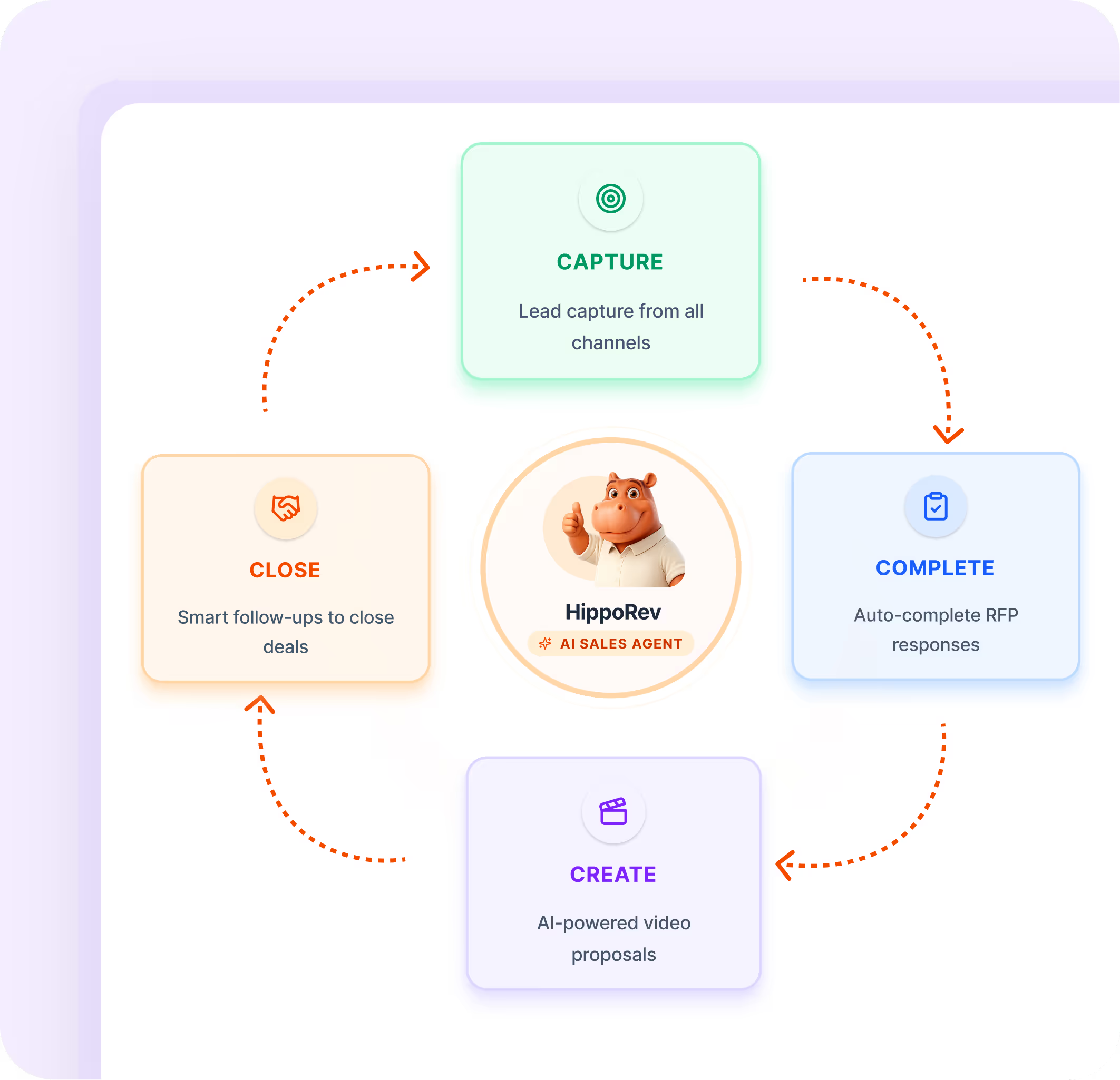
Automate the mechanical work: lead capture, missing-detail collection, pricing lookup, proposal generation, CRM updates, and follow-up scheduling. Keep the human work human: the relationship, the negotiation, the site visit, and the final call. The line is simple, if a task is judgment-free and repetitive, it should not be on a salesperson's plate.
This split is the whole design philosophy behind Hippo Rev: the Capture, Convert, and Grow agents execute the workflow, and the humans do what only humans can. It is the same principle we lay out in why we built Hippo Rev.
What does this look like in the field?
Faster proposals and a team that sells more of the week. In practice, hotels using automation have cut proposal prep from the typical 30 to 60 minutes down to a few minutes, using tools that capture the lead, auto-complete the details, and generate a branded proposal on one click. The rep's day shifts from data entry back to selling.
The clearest field example is Wyndham Indianapolis West, where RFPs that took 33 minutes now go out in 5.
Implementation is less disruptive than the fear suggests. Connect Cvent, email, and the PMS, and the system starts working, often within the first 15 to 30 minutes. Nothing about the salesperson's craft changes. What changes is that the drudgery around it disappears.
As Hippo Mate puts it: "You close the deals. I'll do the paperwork. That was always the deal."
See the full admin automation walkthrough, from lead to signed proposal in under a few minutes. Book a quick revenue audit.
Frequently Asked Questions
How much time do hotel sales reps spend on admin?
Industry research puts active selling at roughly 29% of a rep's time, meaning about 70% goes to administrative work such as RFP processing, data entry, proposal formatting, and follow-up chasing.
What hotel sales tasks can be automated?
Lead capture, missing-detail collection, live pricing lookup, proposal generation, CRM updates, and follow-up scheduling can all be automated today. Relationship building, negotiation, site visits, and the final decision should stay with the salesperson.
Does automating admin work reduce sales headcount?
Typically it increases capacity rather than cutting headcount. By removing the admin ceiling, the same team can work far more RFPs, which turns freed hours into additional closed group revenue.
Share this post
Ready to close more group business?
See how HippoRev can transform your hotel sales workflow in 15 minutes.

Follow us


.svg)