


Sales Productivity
Hotel Sales Conversion: Turn More Leads Into Bookings
Hotel sales lead conversion improves when properties identify exactly where qualified group opportunities stall. The blog breaks the process into inquiry capture, qualification, proposal development, follow-up, negotiation, contracting, technology, and measurement so teams can improve conversion without simply generating more leads.



Hotel Sales Lead Conversion: How to Turn More Group Inquiries Into Confirmed Bookings
A hotel can have a healthy pipeline of group inquiries and still struggle to turn them into confirmed bookings. Often the problem is not demand. It is what happens after the inquiry arrives.
A corporate planner emails asking for 40 rooms and two meeting spaces. The salesperson has to confirm availability, check rates, pull room specifications, build a proposal, and get approvals. Meanwhile, the planner is evaluating other properties. Every extra handoff is another chance for the sale to stall.
Hotel sales lead conversion is the process of moving a qualified inquiry through evaluation, proposal, negotiation, and contract until it becomes a definite booking. Improving it takes more than a fast reply. The most effective approach is to find where opportunities are delayed or lost, then fix those specific stages.
Why Group Leads Are Different From Individual Bookings
A transient guest compares location, price, room type, and cancellation terms, then books. Group business is a bigger purchase. An association conference may need a room block, meeting space, catering, audiovisual support, accessibility provisions, and negotiated contract terms, plus sign-off from finance, procurement, or senior leadership.
A group lead is rarely just a request for rooms. It is a potential commercial agreement involving several services, stakeholders, and operational commitments. The sales process has to establish whether the hotel can host the event, whether the business is commercially attractive, and whether the proposal fits the buyer's priorities. That makes both speed and accuracy matter.
Understand the Group Sales Funnel
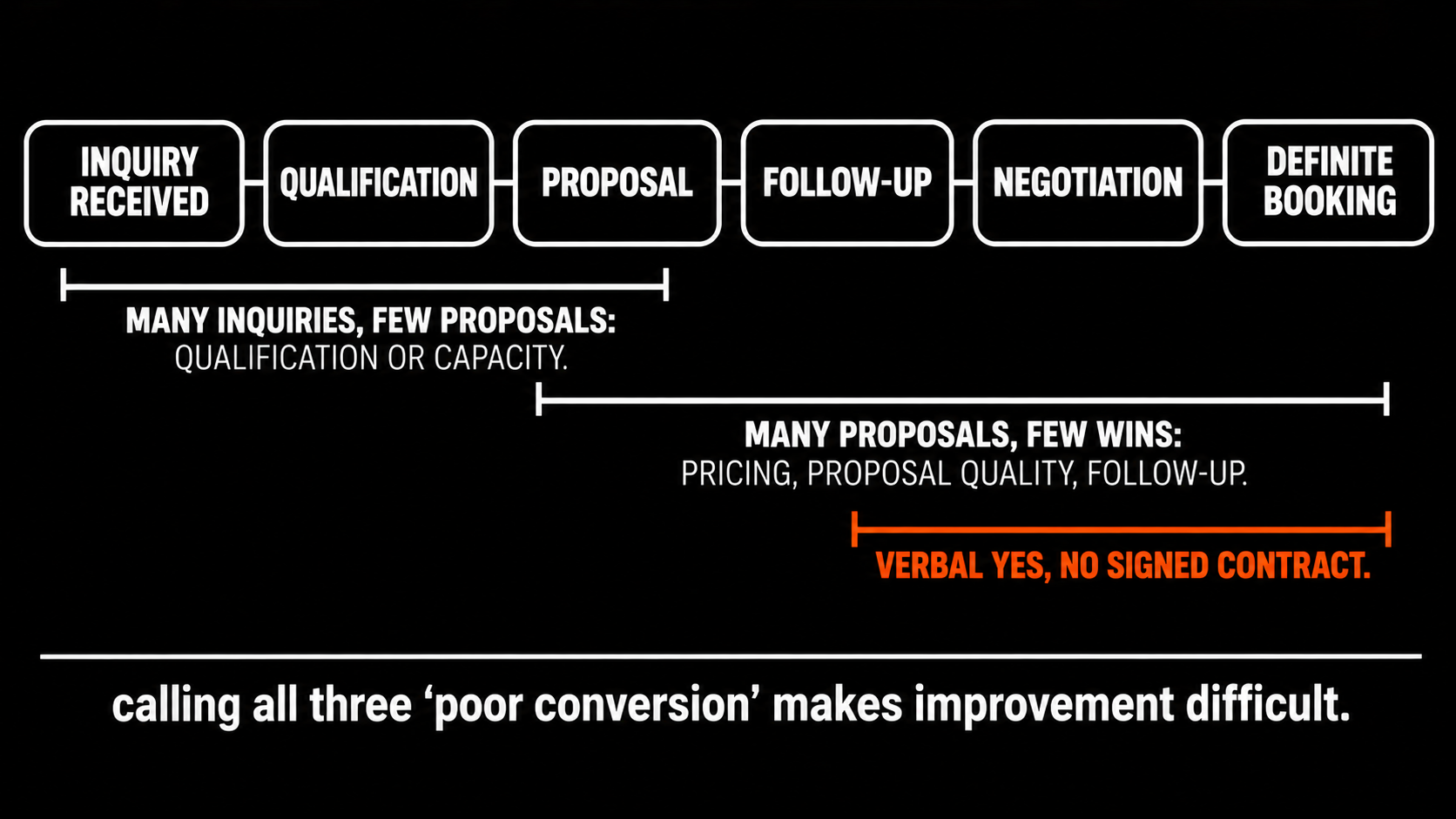
The funnel runs through six stages: inquiry received, qualification, proposal, follow-up, negotiation, and definite booking. These are conceptual stages, and opportunities can skip or move backward through them.
The funnel is useful because it separates different problems:
- Many inquiries but few proposals points to a qualification or capacity issue.
- Many proposals but few wins points to pricing, proposal quality, or follow-up.
- Verbal agreement without a signed contract is a third problem, with its own fixes.
Treating all three as "poor conversion" makes improvement difficult.
1. Capture and Respond Before Opportunities Go Cold
Group inquiries arrive through RFP platforms, direct email, website forms, phone calls, referrals, and existing accounts. These channels rarely feed one system. One inquiry lands in a sourcing platform while another sits in a shared inbox waiting for an owner.
Planners expect speed. Cvent's 2026 Global Planner Sourcing Report, which surveyed 1,650 professional event planners, found that 63% of planners sourcing events with up to 50 attendees expected a venue response within four business days. For events of 51 to 100 attendees, 55% expected a response in that window.
An automated acknowledgment is not a complete response. A useful first reply confirms receipt, names the responsible sales contact, asks for missing information, and sets an expectation for when a substantive proposal will arrive.
To reduce delays, set up one consistent intake process across all sources. Every inquiry should have an owner, a recorded receipt time, a current status, and a defined next action. Shared inboxes need clear assignment rules. Website forms should collect enough to begin qualification without a lengthy questionnaire. The aim is not instant answers to complex commercial questions. It is to make sure every opportunity enters a controlled process.
2. Qualify Before Investing in Proposals
Not every inquiry suits every hotel. A planner may want more meeting space than the property has, need dates that are sold out, or have a budget that misses the hotel's targets. Salespeople should spot these constraints before spending hours on a proposal.
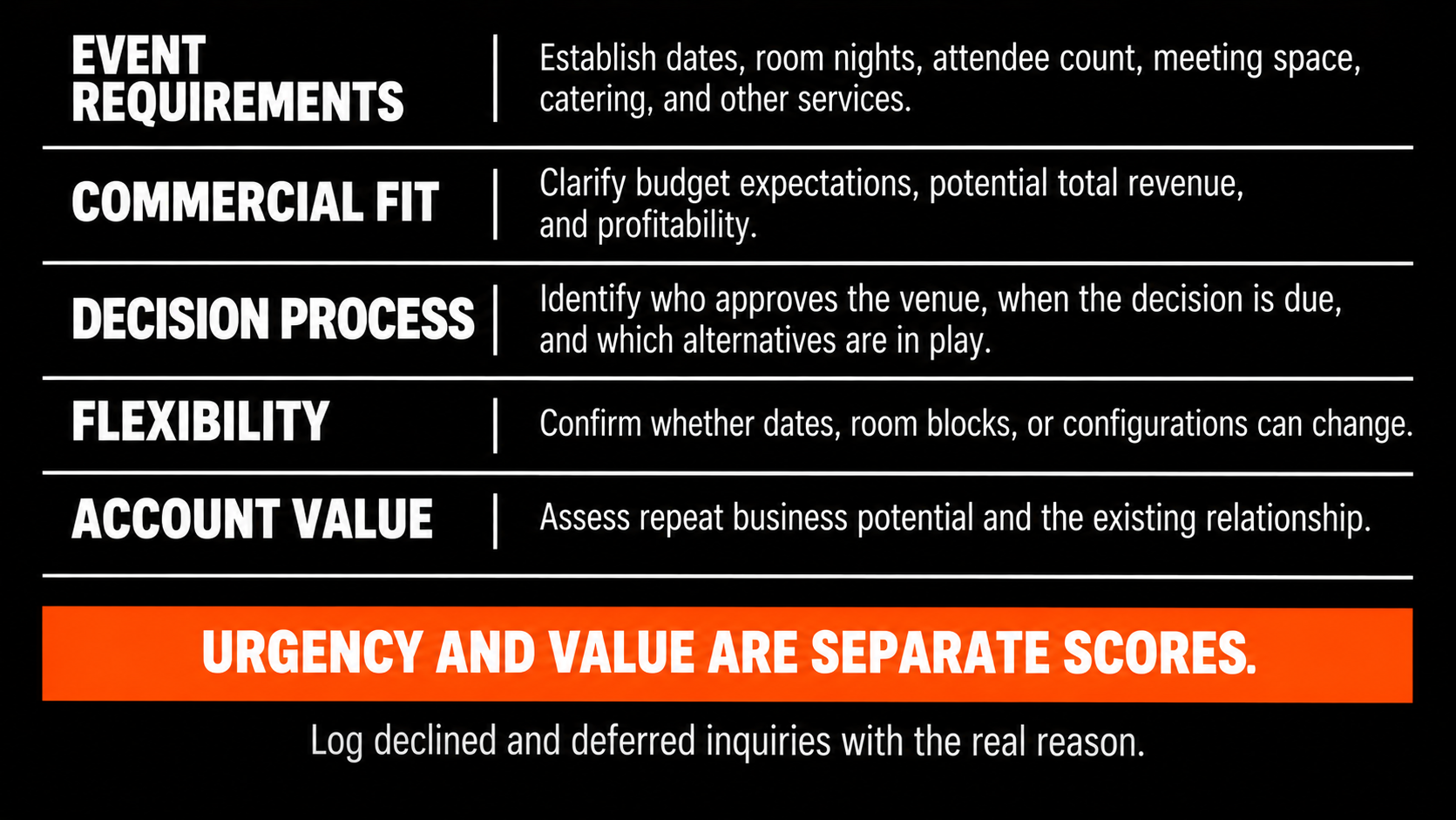
Qualification is not the same as rejecting anything difficult, though. A planner with unavailable dates may be flexible. A small room block may come with large food and beverage needs. A modest account may bring recurring business. Qualify the whole opportunity by establishing:
- Event requirements: dates, room nights, attendee count, meeting space, catering, and other services.
- Commercial fit: budget expectations, potential total revenue, and profitability.
- Decision process: who approves the venue, when the decision is due, and which alternatives are in play.
- Flexibility: whether dates, room blocks, or configurations can change.
- Account value: repeat business potential and the existing relationship.
Collect enough to make a good decision, not every operational detail before the first conversation.
When volumes are high, lead scoring helps allocate attention. Keep urgency and value separate, though. A large conference next year may be less urgent than a small meeting next week and still deserve more strategic attention. Keep declined and deferred inquiries on record with accurate reasons. They reveal demand patterns and can become viable when dates or requirements shift.
3. Build Proposals That Make the Decision Easier
A proposal should do more than list rates and amenities. It should make it easy for the planner to decide whether the property can deliver the event.
Cvent's 2026 planner research identifies meeting room specifications, photos, videos, and floor plans as influential in venue selection, and reports that 25% of planners find researching venue specifications the hardest part of sourcing. For sales teams, the lesson is practical: proposal quality depends on how accessible and reliable the underlying property information is.
Match the proposal to the event. A corporate training group cares about layouts, connectivity, and breakout space. A wedding planner cares about atmosphere, catering flexibility, and guest accommodation. An association conference needs detailed room-block terms, accessible meeting spaces, and clear contract conditions. Templates give consistency, but the content should be adapted, and the proposal should explain why the recommended spaces meet the planner's needs rather than repeat marketing copy.
Show the full price. Separate room rates, meeting space charges, food and beverage minimums, audiovisual costs, taxes, service charges, and optional extras. Identify any concessions and their conditions. Unclear pricing creates more correspondence and makes offers hard to compare.
Use visuals as support. Floor plans, photos, and short walkthrough videos help planners assess spaces they have not visited. They should supplement written specifications and terms, not replace them. A polished video cannot make up for missing capacities or inaccurate availability.
4. Follow Up With Purpose
After the proposal goes out, the planner may be comparing properties, waiting on approval, revising headcount, or rethinking the budget. Without follow-up, the hotel has no view into what is blocking the decision. But repeatedly asking whether the planner has reviewed the proposal rarely helps. Good follow-up helps the buyer move forward.
Agree the next step early. During qualification, ask about the decision timeline and approval process, then set a follow-up date that fits. A planner deciding in two days needs a different rhythm from one planning a conference six months out. Skip universal 24-hour or 48-hour rules and follow the buyer's actual timetable.
Make each touchpoint useful. Clarify a room configuration, offer a revised block, answer a catering question, or send a concise summary the planner can share with decision-makers. If budget is the obstacle, explore options that protect the event's essentials while adjusting cost.
Keep visibility when people are away. If follow-up lives only in one person's inbox, opportunities become hard for colleagues to manage. A CRM or shared sales workflow should record the last interaction, status, open questions, next action, and owner. Automated reminders help with consistency but should not replace judgment about whether the next message is timely and valuable.
5. Negotiate Around Total Value
Group negotiations involve more than the room rate. Planners may ask about meeting space charges, food and beverage minimums, cancellation terms, attrition clauses, or deposit schedules. A hotel that answers every objection with a rate discount may win the booking and lose the profit.
Find the underlying constraint. A planner asking for a lower price may have a fixed budget. Another may be unsure of attendance and need flexibility. The first might be offered a revised package or a different event configuration. The second might be better served by room-block commitments, release dates, or contract flexibility, within the property's policies.
Involve revenue management. Group business competes for limited rooms and meeting space, and a booking that looks good in isolation may displace higher-value demand on strong dates. Weigh expected room revenue, ancillary spend, contribution, displacement, and account value, especially for large blocks with limited meeting or catering revenue. The goal is not simply more bookings. It is commercially appropriate business.
6. Remove Friction Between Verbal Agreement and Definite Booking
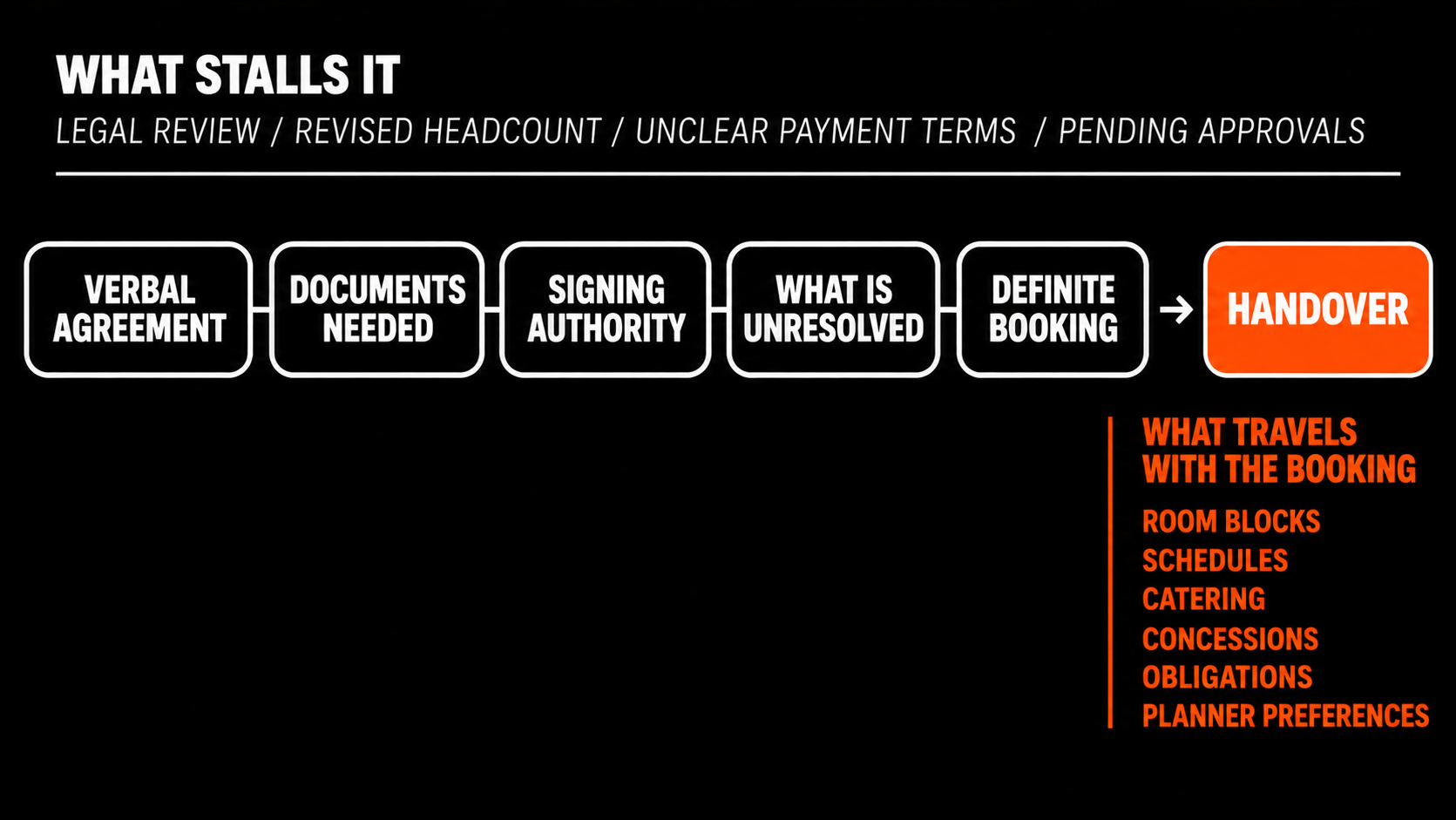
A planner can accept an offer in principle and still delay signing because of legal review, revised attendee counts, unclear payment terms, or pending approvals. Treat this as its own stage. Once terms are agreed, confirm which documents are needed, who holds signing authority, what remains unresolved, and when the booking should become definite. Electronic signatures can speed up document handling, but they do not replace clear terms or proper authorization.
The handover matters too. After signing, responsibility often shifts to events, catering, or operations. The record should capture room blocks, schedules, catering arrangements, approved concessions, contractual obligations, and planner preferences. A booking is not a lasting success if the hotel cannot deliver what was sold.
7. Use Technology to Cut Administrative Work Between Stages
Sales technology earns its place when it removes repetitive tasks that slow opportunities down: centralizing inquiries, extracting requirements from emails, retrieving approved property information, drafting proposals, tracking communication, and prompting pending actions. The key distinction is between automating administration and automating commercial judgment.
Before adopting any tool, check that it improves the flow of information rather than adding another place to re-enter details. Hotels already run CRM, property management, reservations, revenue management, and sales and catering systems. Verify integrations, supported data fields, permissions, and how data stays current. A proposal built on outdated room capacities or unapproved terms creates more work than it saves.
Most importantly, keep the salesperson in charge of the relationship. Automation can make sure inquiries are logged and information is accessible. It cannot uncover a planner's unstated concerns, weigh every commercial trade-off, or build the trust behind a long-term account.
8. Measure Conversion at Every Stage
A single conversion rate hides too much. Final booking conversion can fall because of poor lead quality, slow responses, uncompetitive pricing, weak follow-up, or contract delays, and each needs a different fix.
HSMAI defines RFP conversion rate as the number of RFPs in definite status divided by the total RFPs received. That is a useful outcome metric, and it works better alongside stage-level measures:
An illustrative example. Say a hotel receives 200 group inquiries in a quarter. 150 qualify, 120 receive proposals, and 24 become definite bookings. Overall RFP conversion is 12%. The proposal submission rate among qualified leads is 80%, and proposal-to-booking conversion is 20%. Now management can ask why 30 qualified inquiries never got a proposal, without confusing that with how well the proposals actually sent performed.
Also break results down by lead source, event type, property, and booking value. A small corporate meeting and a major conference have very different sales cycles, and averaging them hides the differences.
9. A 30-Day Improvement Plan
You do not need to replace your tech stack to start. A focused operational review can surface quick wins.
- Week 1, map the funnel: Identify inquiry sources, response delays, proposal workflows, ownership gaps, and reasons for lost deals.
- Week 2, standardize: Define required inquiry information, maintain approved property specifications, and set a consistent proposal review process.
- Week 3, improve follow-up: Assign next-action ownership, set reminders and escalation rules, and plan for inquiries when salespeople are unavailable.
- Week 4, review: Compare response times, proposal completion, qualified lead coverage, and conversion by segment. Decide which changes merit more investment.
Thirty days is enough to set a baseline and put process improvements in place. It is not enough to prove a statistically meaningful change in booking conversion, especially where sales cycles are long. Keep monitoring revenue outcomes over a suitable period.
Better Conversion Begins With a Better Sales Process
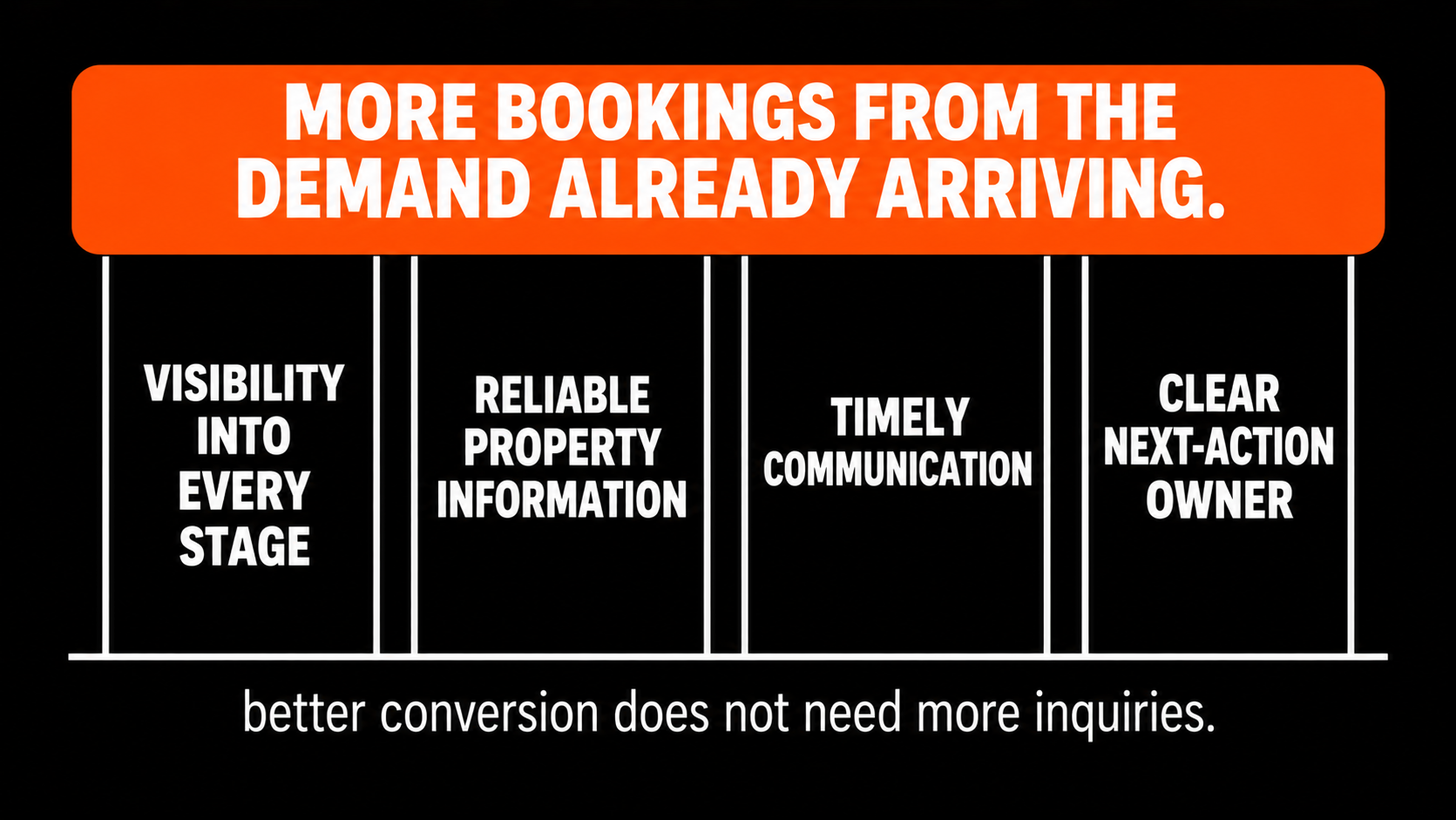
Improving conversion does not necessarily mean generating more inquiries. For many properties, the first opportunity is making better use of the demand already reaching the sales team. That takes visibility into every funnel stage, reliable property information, timely communication, and clear accountability for the next action.
Technology can cut the administrative effort. The real advantage comes from what your team can do when less of its time goes to data entry, searching across systems, and assembling routine proposals.
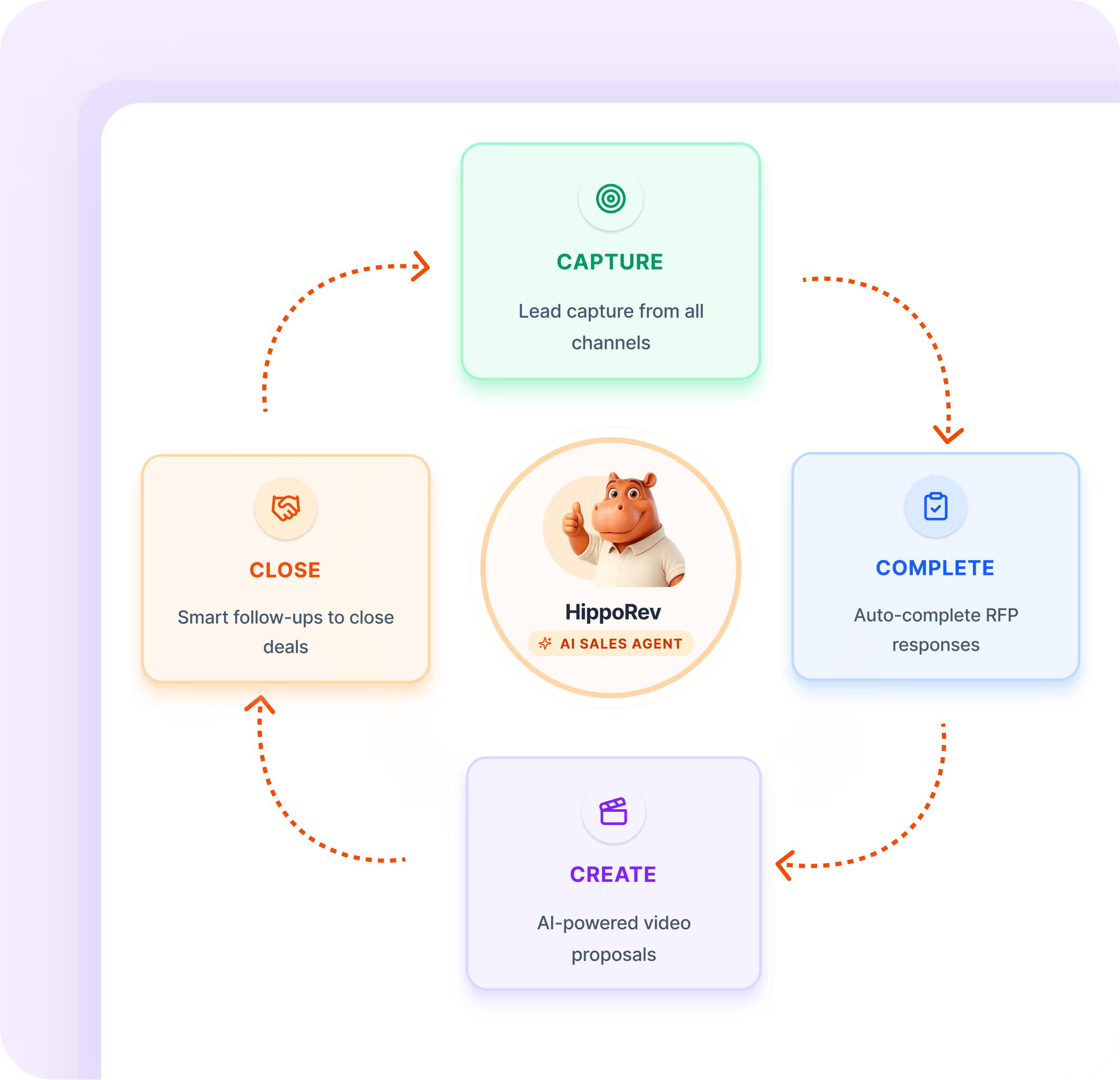
Hippo Rev is built around this idea. Its AI-powered RFP and proposal automation helps hotel sales teams reduce administrative work across the group sales process, so salespeople have more time to qualify opportunities, work with planners, and build relationships. If improving inquiry-to-booking workflows is a priority for your property, see where your process leaks revenue. [Book a Capture Audit here.]
Frequently Asked Questions
What is a good hotel sales lead conversion rate?
No universal rate applies. Performance depends on inquiry quality, event segment, property positioning, booking window, and how conversion is defined. Compare results with your own history and comparable segments rather than a generic benchmark.
How can hotels convert more group inquiries into bookings?
Capture inquiries consistently, qualify accurately, send relevant proposals, follow up on the planner's timeline, and simplify contract completion. Tracking losses at each stage shows which fixes will matter most.
Does responding faster guarantee more group bookings?
No. A faster reply lets planners evaluate you sooner, but the proposal still has to meet their needs. Accurate availability, clear pricing, suitable facilities, and commercial fit remain essential.
What is the difference between lead generation and lead conversion?
Lead generation creates opportunities. Lead conversion moves them toward definite bookings. A hotel can generate plenty of demand and still get weak results if qualification, proposals, or follow-up fall short.
Can AI replace hotel salespeople?
AI can handle administrative work such as extracting inquiry details and drafting proposals. Negotiation, relationship management, account development, and complex commercial decisions still need human judgment.
Share this post
Ready to close more group business?
See how HippoRev can transform your hotel sales workflow in 15 minutes.
Follow us


