


AI & Sales Technology
AI RFP Automation for Hotels: Standardize Group Data
AI RFP automation can standardize group inquiries from Cvent, Delphi, email, PDFs, and phone-based intake into one consistent data structure. The article explains why standardized intake improves response speed, portfolio reporting, forecasting, and group sales execution across multi-property hotel organizations.



.png)
Which AI RFP Automation Helps Hotels Standardize Group Inquiry Data?
A group inquiry for the same 150-room, two-day citywide event can arrive at a hotel portfolio's front door looking like three completely different documents. One property gets it through Cvent, pre-structured with named fields. Another gets a PDF attachment in a planner's email, with room block, F&B minimums, and meeting space requirements buried in paragraph form. A third gets it as a phone call that a sales manager types into notes after the fact. By the time all three versions land somewhere a regional director can see them, they no longer look like the same opportunity. Room counts are formatted differently, budget ranges are missing from one and estimated from another, and the decision date might not be captured at all.
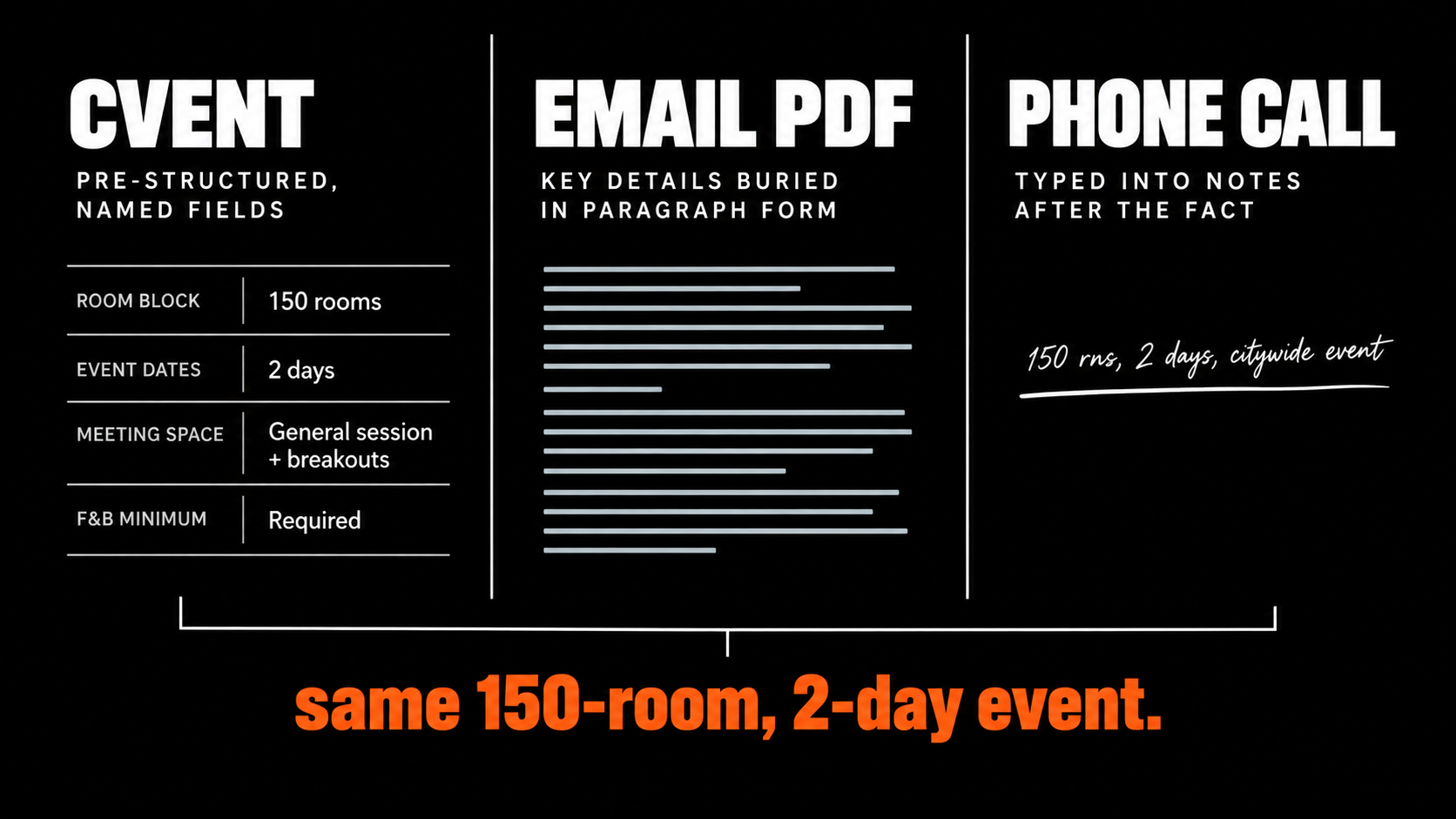
Hotel RFP data comparison showing Cvent, email PDFs, and phone calls capturing the same group event in different formats
This is the standardization problem, and it sits underneath most of the reporting, forecasting, and follow-up failures that multi-property hotel groups experience during group sales. The question worth answering isn't whether AI can respond to an RFP faster. It's whether AI RFP automation can take inconsistent inputs from Delphi, Cvent, email, and phone, and turn them into a single, comparable data structure that a hotel group can actually manage, report on, and act on at scale.
What "Standardized Group Inquiry Data" Actually Means
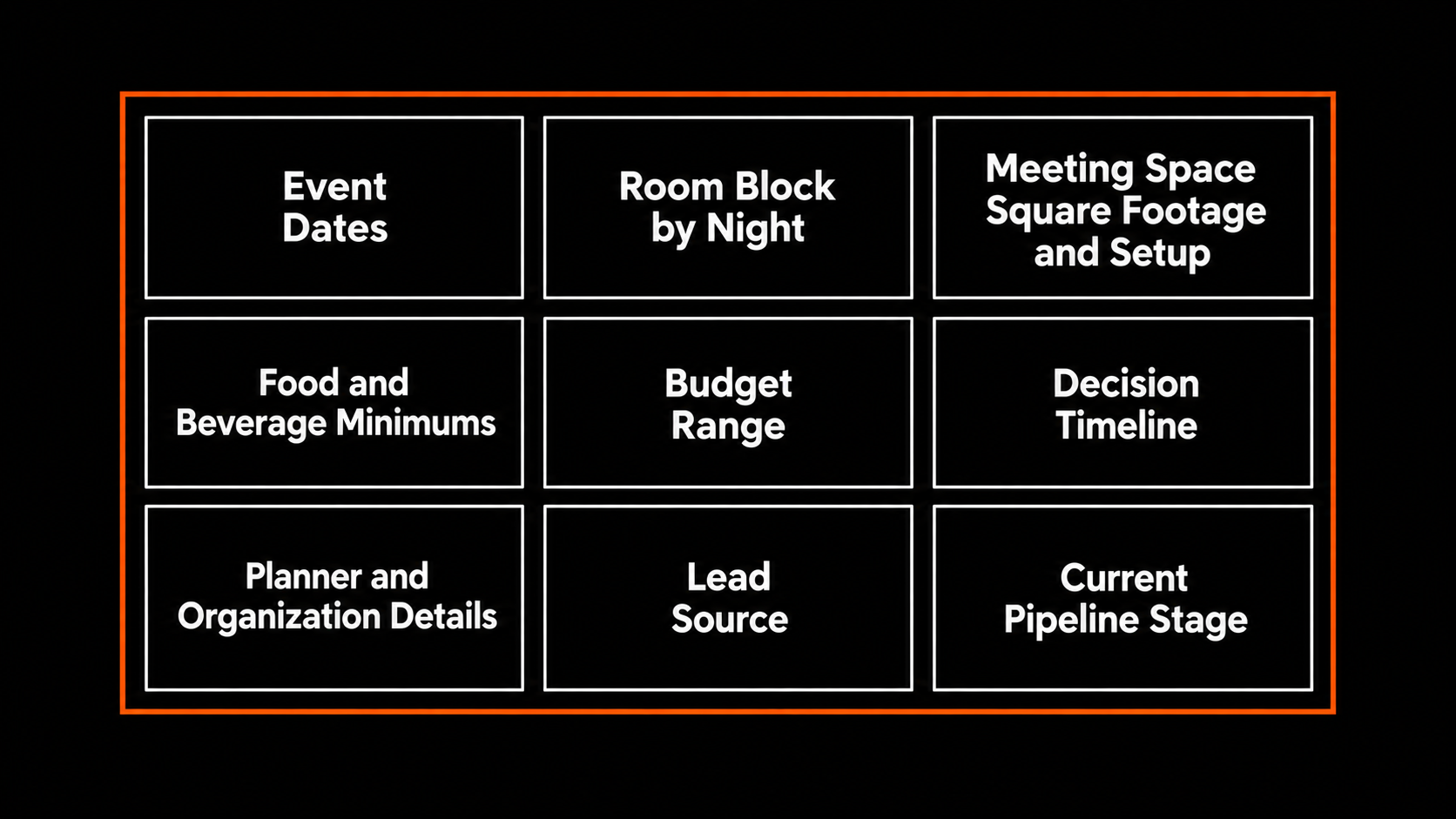
Hotel RFP standardization schema showing nine essential fields for event requirements, planner details, lead source, and pipeline stage
Standardization is often used loosely in hospitality technology conversations, so it's worth being precise. A standardized group inquiry record means every RFP, regardless of source or property, resolves to the same underlying schema: event dates, room block by night, meeting space square footage and setup, food and beverage minimums, budget range, decision timeline, planner and organization details, lead source, and current pipeline stage. It also means the vocabulary is consistent. If one property calls a stage "Tentative" and another calls the same status "Definite Pending," a portfolio-level report can't tell owners anything reliable about pipeline health.
This gap is well documented at the portfolio level. Hospitality data teams have flagged that when different properties in a management company run their own naming conventions, sales stages, and lead-source taxonomies, there is no apples-to-apples comparison between properties, and that gap tends to compound the longer a portfolio has grown through acquisition rather than organic buildout. Multi-property operators report the same pattern from the revenue side: with different properties using different systems, data consolidation across the portfolio becomes difficult, and inconsistent coding standards make it hard to get a holistic performance view.
Why Unstandardized Intake Is a Revenue Problem, Not a Reporting Problem
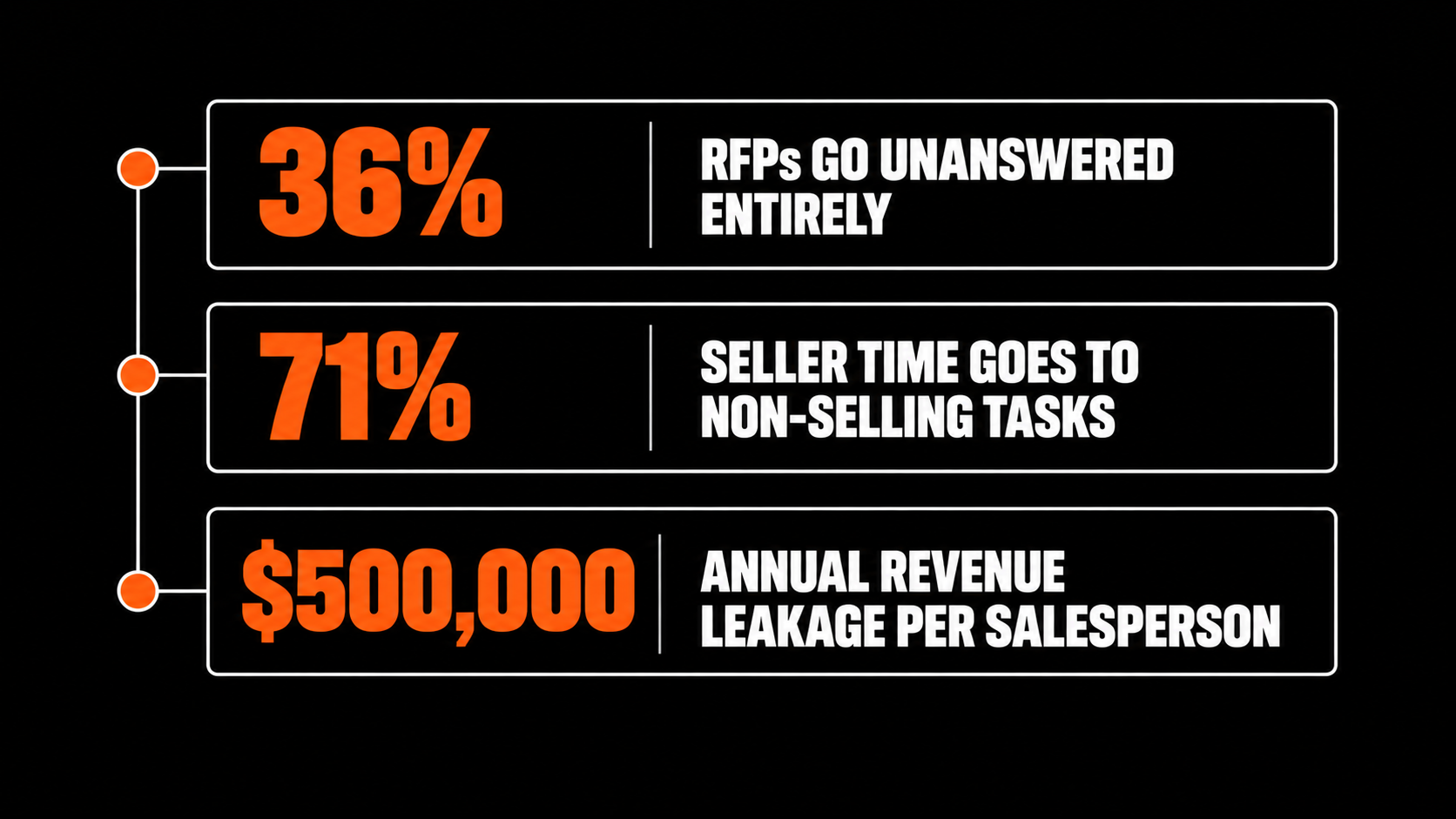
Hotel group sales framework linking unanswered RFPs and non-selling workload to roughly $500K in annual revenue leakage per seller
It's tempting to treat inconsistent RFP data as an operations nuisance, something a corporate analyst cleans up once a month before an ownership call. The numbers say otherwise.
Across group sales teams, roughly 36% of RFPs go unanswered entirely, not because the opportunity wasn't worth pursuing, but because it got lost in an inbox, buried under a manual intake process, or never routed to the right seller in a multi-property environment. Of the RFPs that do get worked, roughly 61% of won deals go to one of the first three properties or vendors to respond. Standardized, automated intake is what makes early response possible at scale. A seller can't respond quickly to an RFP that first has to be manually transcribed into a CRM field by field.
The labor cost compounds the revenue cost. Industry estimates put the average seller's time spent on non-selling tasks, including manual data entry, formatting, and chasing down missing RFP details, at around 71%. That leaves less than a third of a seller's week for the actual selling that standardized data is supposed to free up. At the portfolio level, this shows up as an estimated $500,000 in annual revenue leakage per salesperson, driven by slow response times, missed follow-ups, and inconsistent qualification rather than a lack of demand. The demand exists. The execution layer between the inquiry and the proposal is where it leaks.
How AI RFP Automation Actually Standardizes Intake
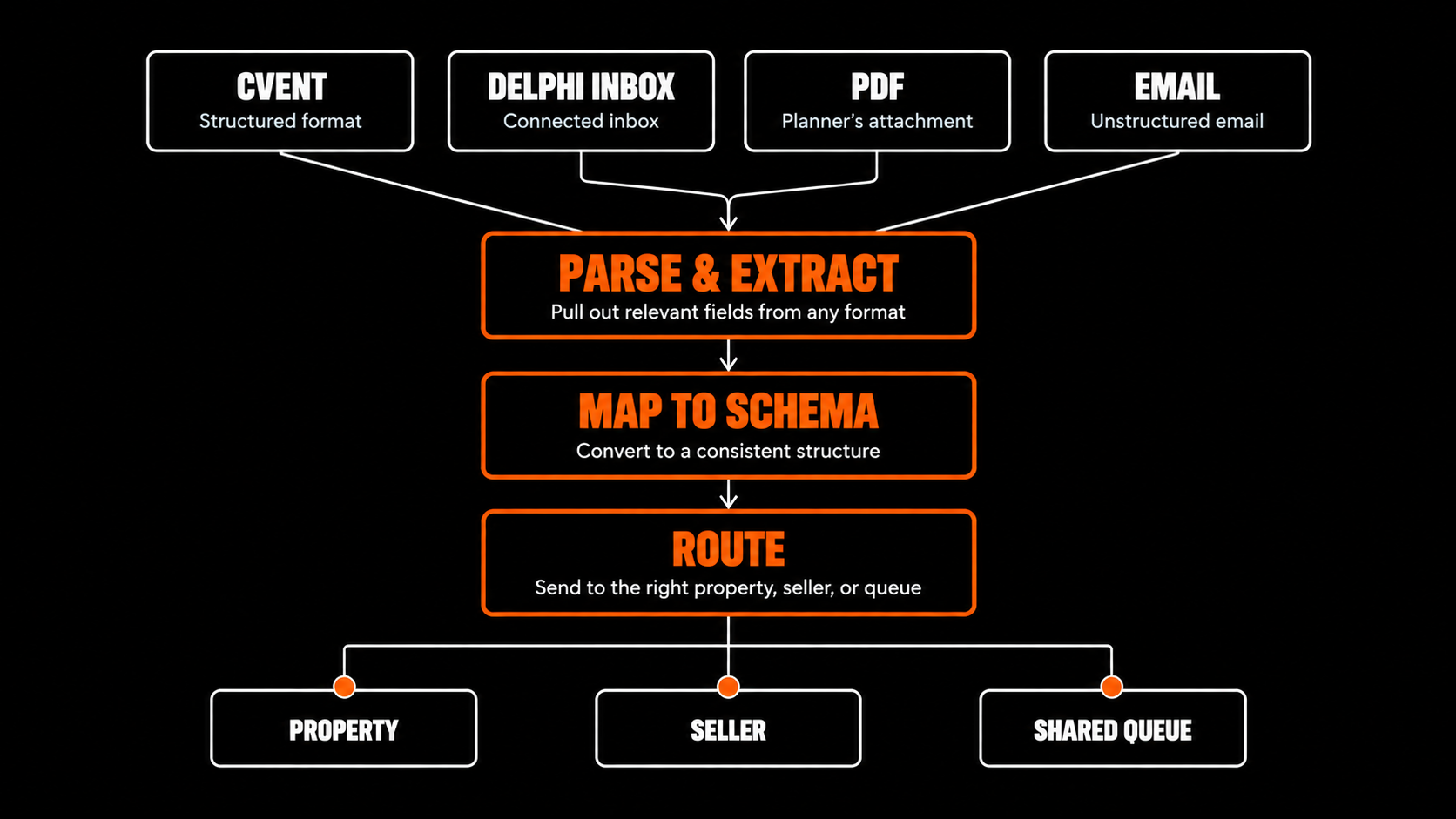
Hotel RFP standardization workflow turning Cvent, Delphi, PDF, and email inputs into structured data routed to the right sales team
AI RFP automation tools take on the standardization job by working at the point of intake, before an inquiry ever reaches a seller's desk. Regardless of whether an RFP arrives through Cvent's structured format, a Delphi-connected inbox, a planner's PDF attachment, or a direct email with no structure at all, the automation layer parses the document, extracts the relevant fields, and maps them into a consistent schema. Room block by night gets normalized into the same format whether the source document listed it as a table, a paragraph, or a range. Budget language gets extracted even when a planner writes "flexible depending on concessions" instead of a number. Meeting space requirements get tagged consistently whether the planner specified square footage, attendee count, or a named room type from a previous stay.
This is meaningfully different from what a sales and catering platform like Delphi or a sourcing platform like Cvent already does. Those systems are systems of record. They store the data once it exists in the right format. AI RFP automation operates as a system of execution sitting on top of them, doing the work of getting inconsistent inputs into that right format in the first place, then routing the standardized record to the correct property, seller, or shared queue based on portfolio rules rather than whoever happens to be monitoring an inbox that day.
The practical effect for a 20-to-80-property group is that a regional VP of sales can pull a single report and see every open RFP across the portfolio in the same fields, at the same stage definitions, regardless of which property or which channel the inquiry originated from. That is what makes portfolio-wide benchmarking, pipeline forecasting, and RevPAM (Revenue Per Available Square Metre) tracking possible in the first place. None of those measurements mean anything if the underlying inquiry data isn't standardized before it gets aggregated.
The Speed Effect of Standardized Data
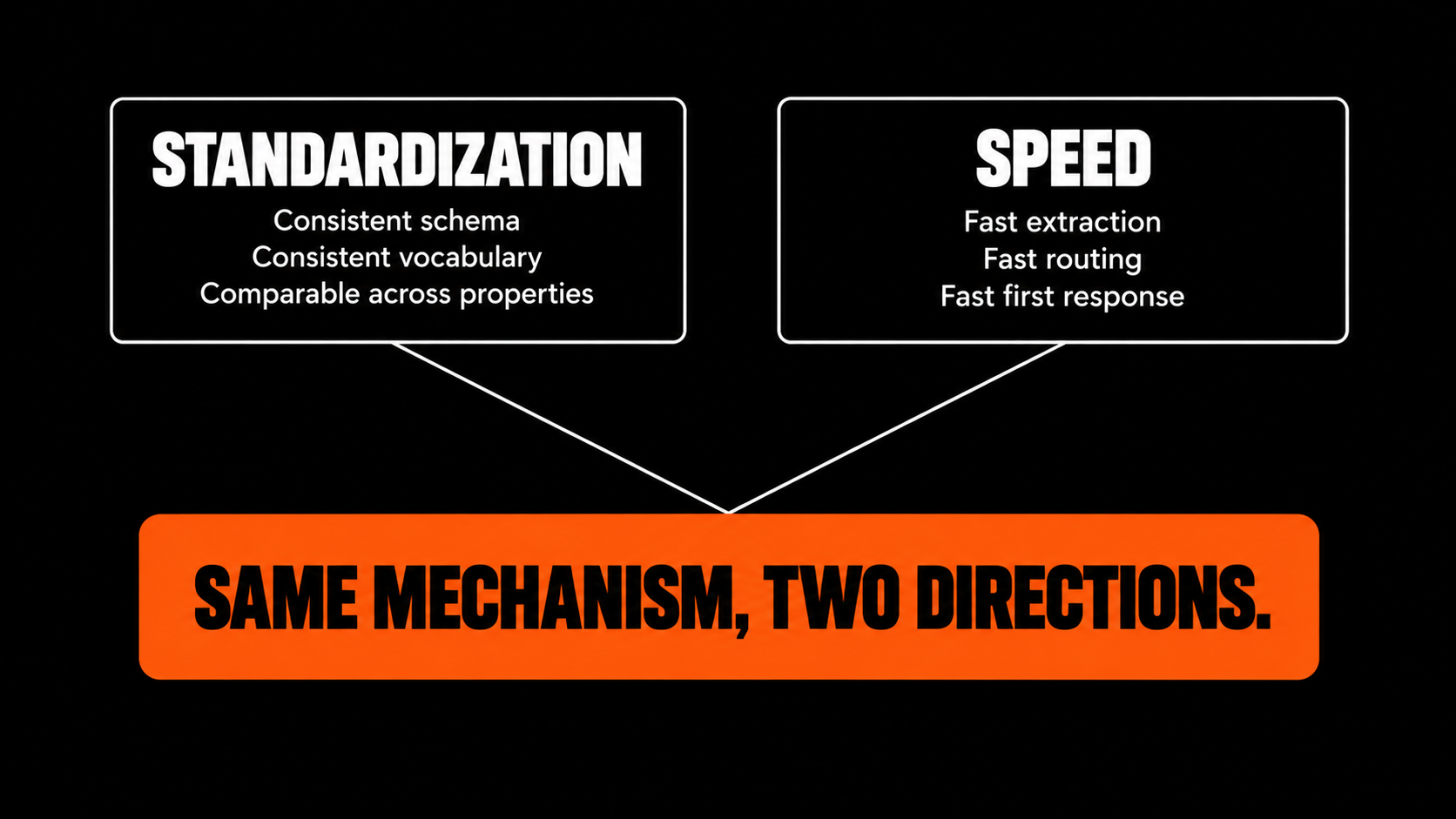
Hotel RFP framework showing standardization and response speed driven by the same consistent data-processing mechanism
Standardization and speed are the same problem approached from two directions. A hotel group that manually processes an RFP, meaning a person reads the inbound document, decides which fields matter, types them into a CRM, and formats a proposal from scratch, typically spends around 37 minutes per RFP on that intake and initial-response work. With AI RFP automation handling extraction, standardization, and first-draft proposal generation, that number drops to roughly 4 minutes. The gap isn't really about faster typing. It's that a machine doesn't need a training document to consistently apply the same field definitions across a thousand inquiries a month, and it doesn't get slower on the RFPs that arrive unstructured.
That speed has a measurable payoff. Hotels that respond within four hours of receiving an RFP see a win-rate advantage of roughly 20 to 30 percentage points over slower responders. Given that most of the value in group business goes to whichever property answers first with a complete, accurate proposal, the standardization work isn't a back-office nicety. It's the mechanism that makes fast, accurate response possible across dozens of properties at once, rather than only at the one or two properties with the most disciplined sales manager.
What to Look for When Evaluating AI RFP Automation
Not every platform marketed as "AI for hotel RFPs" is built to solve the standardization problem at the portfolio level. A few criteria separate tools that genuinely standardize group inquiry data from tools that only speed up a single property's workflow:
- Source-agnostic intake. The tool should extract and normalize data from Cvent, Delphi exports, direct email, and PDF attachments equally well, not just from one sourcing platform's structured feed.
- A consistent schema across properties. Room block, meeting space, budget, and stage definitions should map to the same fields regardless of which property received the inquiry.
- No forced system replacement. A genuine execution layer should sit on top of existing Delphi and Cvent accounts rather than requiring a hotel group to rip out and replace systems of record it has already invested in, and it should not require a lengthy IT implementation to get started.
- Portfolio-level reporting, not per-property exports. Ownership and regional leadership need one dashboard showing standardized data across every managed property, not a monthly manual roll-up.
- Data ownership and exportability. Standardized data is only useful if the hotel group can pull it out, share it with ownership, or move it to another system without a fight.
- Measurable outcomes, not just feature claims. Look for platforms willing to be measured on admin hours saved, follow-up time reduced, RFP volume worked, and revenue captured, ideally over a defined pilot period rather than a sales pitch alone.
A Practical Path to Standardization
For a hotel group heading into budget season, the lowest-friction way to test whether AI RFP automation actually solves the standardization problem is a short, bounded pilot. A six-week window is typically enough to see the pattern: whether inbound RFPs from every property and every channel start resolving into the same fields, whether response time drops, and whether a regional leader can finally pull one report instead of five.
The four outcomes worth measuring during a pilot are straightforward: admin hours saved per seller, time from inquiry to first response, total RFP volume actually worked instead of missed, and revenue tied back to standardized, fast-responded inquiries.
This is the logic behind Hippo Rev's current 6-Week Free Pilot, running for a limited window ahead of 2027 budget season.
Portfolios that get this right heading into 2027 budget planning will be the ones that can show ownership a single, standardized view of group pipeline health across every property, not five spreadsheets that a corporate analyst reconciled by hand the night before the board meeting.
If you want to see what that looks like on your own data, you can start the free 6-week pilot over here.
Frequently Asked Questions
What does "standardizing group inquiry data" mean for a hotel portfolio?
It means every RFP, regardless of which property, channel, or format it arrives in, resolves into the same set of fields (room block, meeting space, budget, decision timeline, lead source, and pipeline stage) using the same terminology across every property in the portfolio.
Does AI RFP automation replace Delphi or Cvent?
No. Delphi and Cvent remain systems of record for sales and catering data and RFP sourcing. AI RFP automation works as a layer on top of those systems, standardizing and routing inbound inquiries before they reach a seller, without requiring a hotel group to replace existing platforms.
Why do multi-property hotel groups struggle with data standardization in the first place?
Individual properties often adopt their own naming conventions, sales stages, and intake habits, especially in portfolios that grew through acquisition. Delphi's data model in particular is built around a single property, so multi-property reporting typically depends on manual consolidation by a corporate analyst rather than a native portfolio view.
How much faster is AI-assisted RFP processing compared to manual processing?
Manual RFP intake and initial response typically takes around 37 minutes per inquiry. With AI-assisted extraction, standardization, and first-draft proposal generation, that drops to roughly 4 minutes.
What happens to RFPs that never get a response?
Roughly 36% of RFPs go unanswered across group sales teams, usually because of manual intake bottlenecks or unclear routing across properties rather than a lack of genuine demand. Standardized, automated intake is what allows a hotel group to work through inbound volume instead of losing a third of it to process failure.
Is a faster response actually worth more revenue, or just more convenience?
Hotels that respond to an RFP within four hours see a win-rate advantage of roughly 20 to 30 percentage points over slower responders, and about 61% of won group deals go to one of the first three properties or vendors to respond. Standardized intake is what makes that speed achievable across an entire portfolio rather than only at the best-run individual property.
Share this post
Ready to close more group business?
See how HippoRev can transform your hotel sales workflow in 15 minutes.

Follow us


.svg)