


AI & Sales Technology
Hotel RFP Response Time: 7 Ways to Work Faster
Hotel sales teams can cut RFP completion time by fixing the workflow before simply adding more tools. These strategies cover intake, lead triage, content libraries, pricing approvals, templates, and intelligent AI automation.



.png)
How Do Hotel Sales Teams Reduce Time Spent Completing RFPs?
Hotel sales teams reduce time spent completing RFPs by doing seven things:
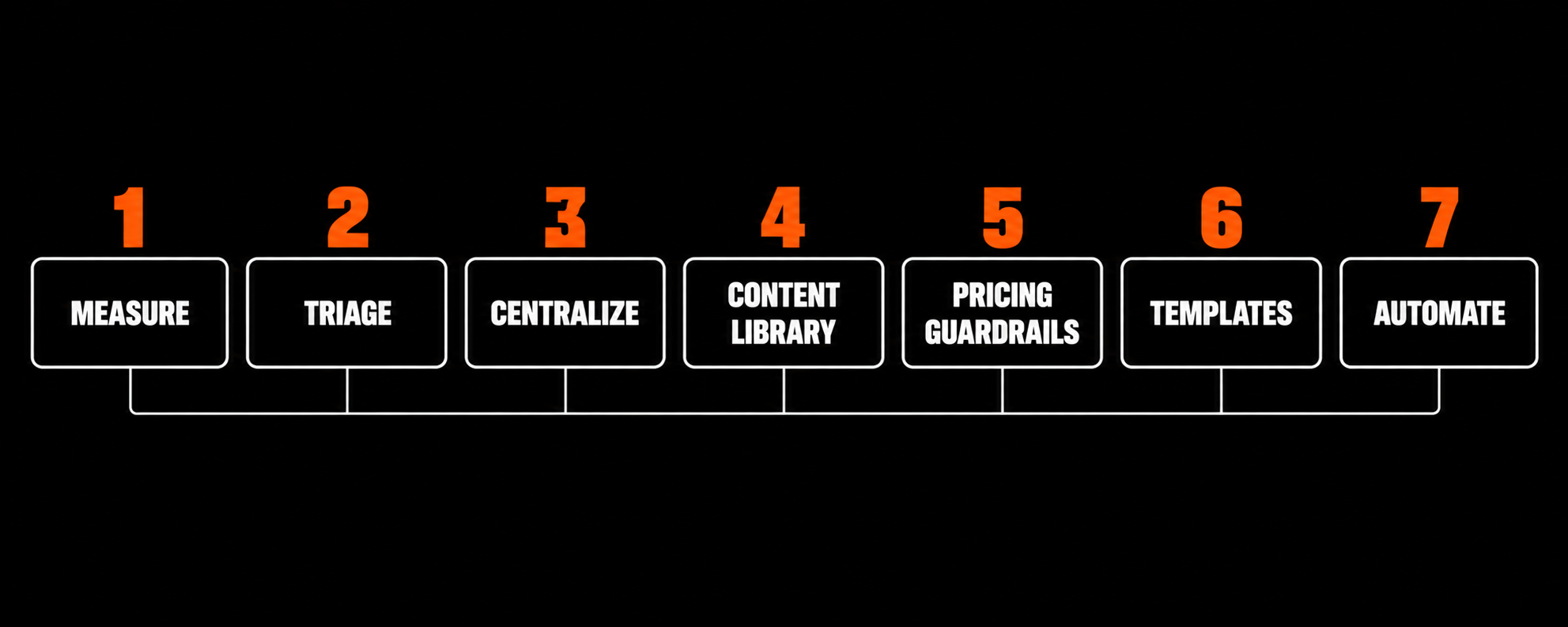
- Measure your current RFP workflow to identify the real bottlenecks.
- Triage leads before investing time in every RFP.
- Centralize all RFP intake into a single queue.
- Build a pre-approved content library for common responses.
- Set pricing guardrails to eliminate approval loops.
- Use master templates with dynamic fields.
- Automate repetitive RFP assembly work with AI.
Done together, these steps compress RFP processing from days to minutes. Done selectively, they still recover hours per response.
The time problem is worth stating precisely, because most teams underestimate it. Sellers spend roughly 71 percent of their day on non-selling tasks, and a single manual RFP response commonly consumes 37 minutes of pure processing, before counting the waiting: rate approvals over email, space checks with catering, and content hunted across shared drives. Meanwhile, over 60 percent of planners expect responses within four days, and 61 percent of won deals go to one of the first three responders. Every hour trimmed from RFP completion is not just efficiency. It is win probability. Here is how the fastest teams do it.
1. Measure the Workflow Before Changing It
You cannot compress what you have not mapped. Start by documenting every step from RFP receipt to proposal send: every touchpoint, approval, and handoff. Then time each one for a week. Most teams discover the same pattern: the writing itself is a minority of the total, and the majority is waiting and hunting. Waiting for a rate approval. Hunting for the current capacity chart. Re-checking space holds. Establish a baseline on five numbers: RFPs received, RFPs answered, average response time, proposal turnaround, and win rate. These become the scoreboard for everything that follows.
2. Triage Before You Invest Effort
Not every RFP deserves equal time, and treating them equally is itself a time sink. Group sourcing volume has hit record levels, so the fastest teams score every inquiry quickly on fit, margin potential, and decision timeline before committing to a full proposal. A standard operating procedure for qualification, applied in minutes, protects your hours for the business you can actually win. Pair it with a one-hour holding reply: even when the full proposal will take a day, an immediate acknowledgment that confirms receipt and sets expectations keeps you in the conversation while competitors sit silent. Harvard Business Review research on lead response shows the odds of qualifying a lead drop sharply as minutes pass, and the principle carries into group business.
3. Centralize Intake Into One Queue
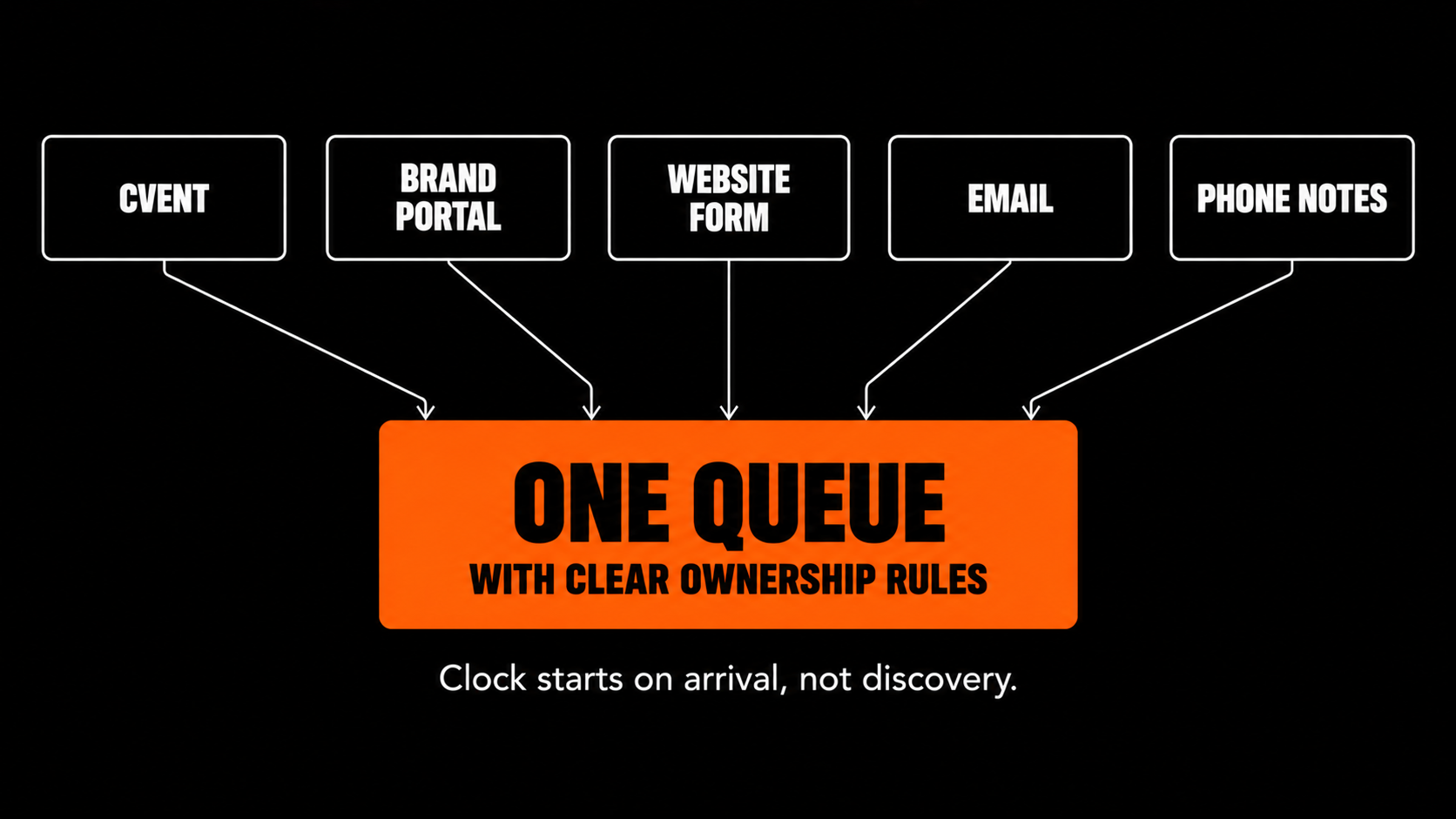
When RFPs arrive through Cvent, brand portals, website forms, direct emails, and phone notes, time dies in the gaps between channels. Leads get discovered late, claimed by nobody, or worked twice. Consolidating every source into one queue, with clear ownership rules for who claims what, removes the discovery lag entirely and gives managers visibility into what is aging. Teams that centralize consistently report faster response times for a simple reason: the clock now starts when the RFP arrives, not when someone happens to notice it. Be thorough when mapping sources, because hidden channels are common. Talk to the whole team; the catering manager who occasionally fields event inquiries by phone is an intake channel too, and every unmapped channel is a place where a lead can sit for days unseen.
4. Build a Pre-Approved Content Library
The single biggest writing-time saver is never writing the same thing twice. Assemble a version-controlled library of everything proposals reuse: floor plans, capacity charts, menus, AV kits, image sets, sustainability policies, and, critically, pre-written clauses for attrition, deposits, and blackout dates that legal and leadership have already approved. With the core content ready and current, sellers personalize instead of composing, and review cycles shrink because reviewers are checking customization, not boilerplate. One warning from our earlier work on data consistency applies here: audit the library quarterly, because a stale capacity chart replicated across every proposal is speed in the wrong direction.
5. Set Pricing Guardrails to Kill the Approval Loop
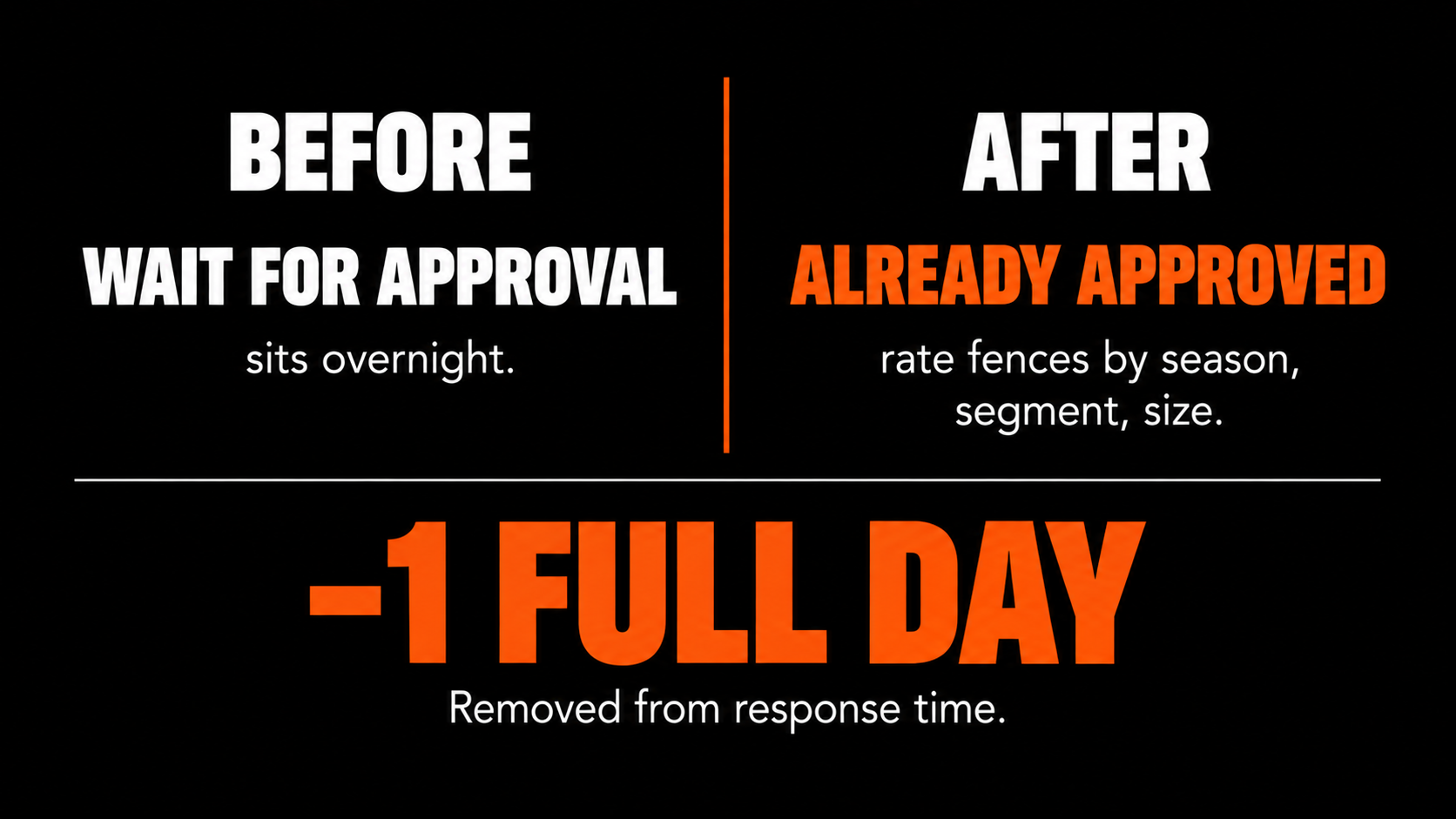
The slowest step in most RFP workflows is not writing. It is the rate approval that sits in a revenue manager's inbox overnight. The fix is pre-agreed pricing guardrails: rate fences by season, segment, and group size within which sellers can quote immediately, with approval reserved only for exceptions. This one change routinely removes a full day from response time, because it converts the most common case from "wait for approval" to "already approved."
6. Use Master Templates With Dynamic Fields
Replace the folder of forty slightly different proposal documents with a small set of master templates built around your top meeting archetypes: corporate training, association annual, SMERF weekend, wedding block. Dynamic fields pull dates, room blocks, and rates into every element at once, so the email, the PDF, and the cover note always agree, and nobody spends twenty minutes reconciling a date that was updated in one place but not another. Standardized formatting also speeds internal review, because reviewers know exactly where to look.
7. Automate the Repetitive Layer With AI
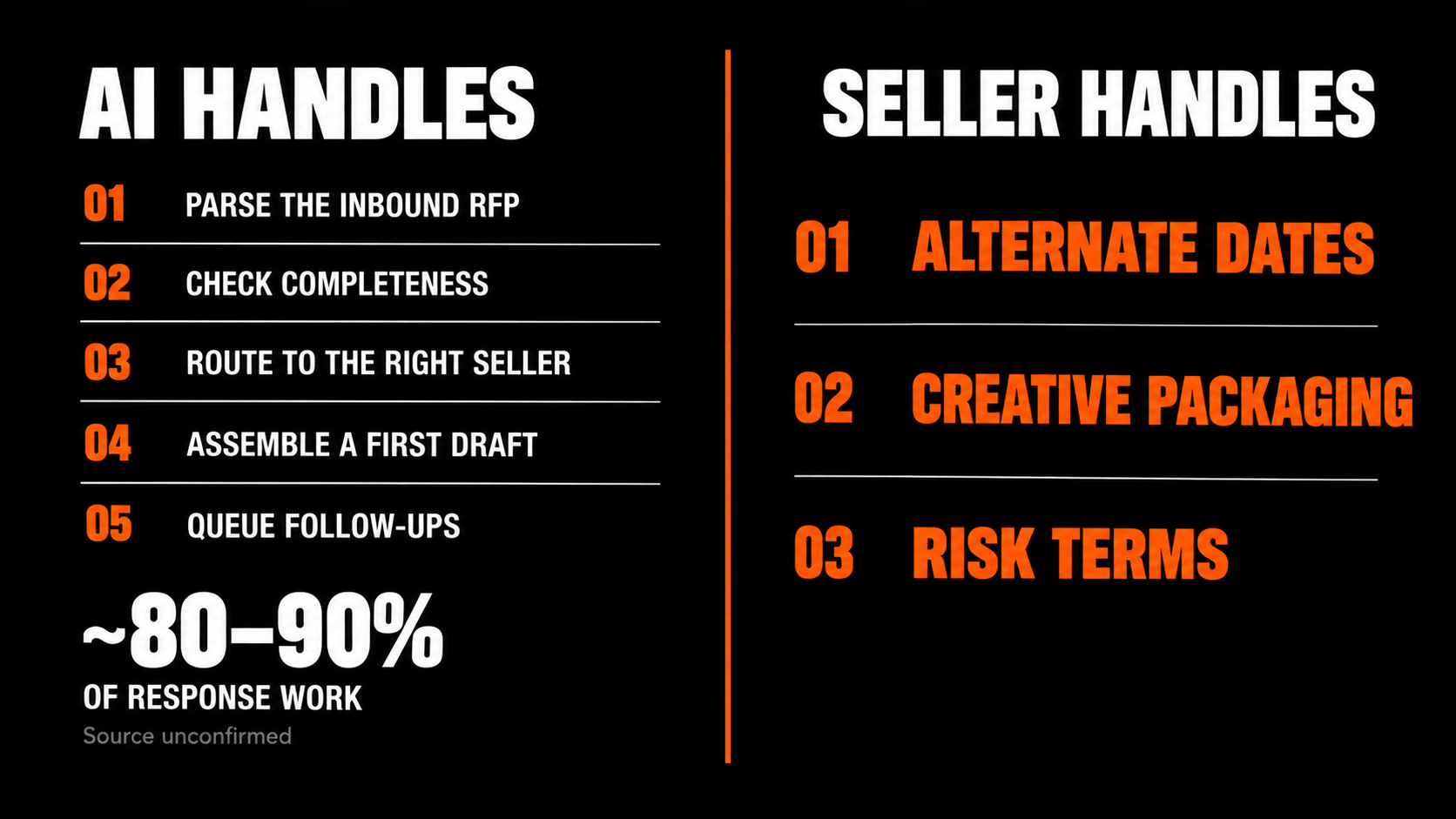
Everything above prepares you for the step that changes the scale of the number: automation. Modern AI tooling parses the inbound RFP, checks it for completeness, routes it to the right seller, assembles a first draft from your content library and live availability, and queues the follow-ups. Analysis of AI proposal workflows suggests about 80 percent of the response work can be handled automatically, leaving the seller to add judgment: the alternate-date offer, the creative packaging, the risk terms. This is the division of labor that actually protects the personal touch. The machine does the paste work. The human does the selling.
This is the layer Hippo Rev provides. It centralizes intake, grounds AI-drafted responses in your actual property data, and cuts RFP processing from roughly 37 minutes to about 4 minutes per response, which is the difference between answering everything and quietly filtering your own pipeline. The steps above are worth doing even without us; they are also exactly what makes any automation, ours included, work at full value. To find out where your hours are going today, book a Capture Audit: 20 minutes against your own numbers, no deck.
Why the Time Matters More Than the Effort
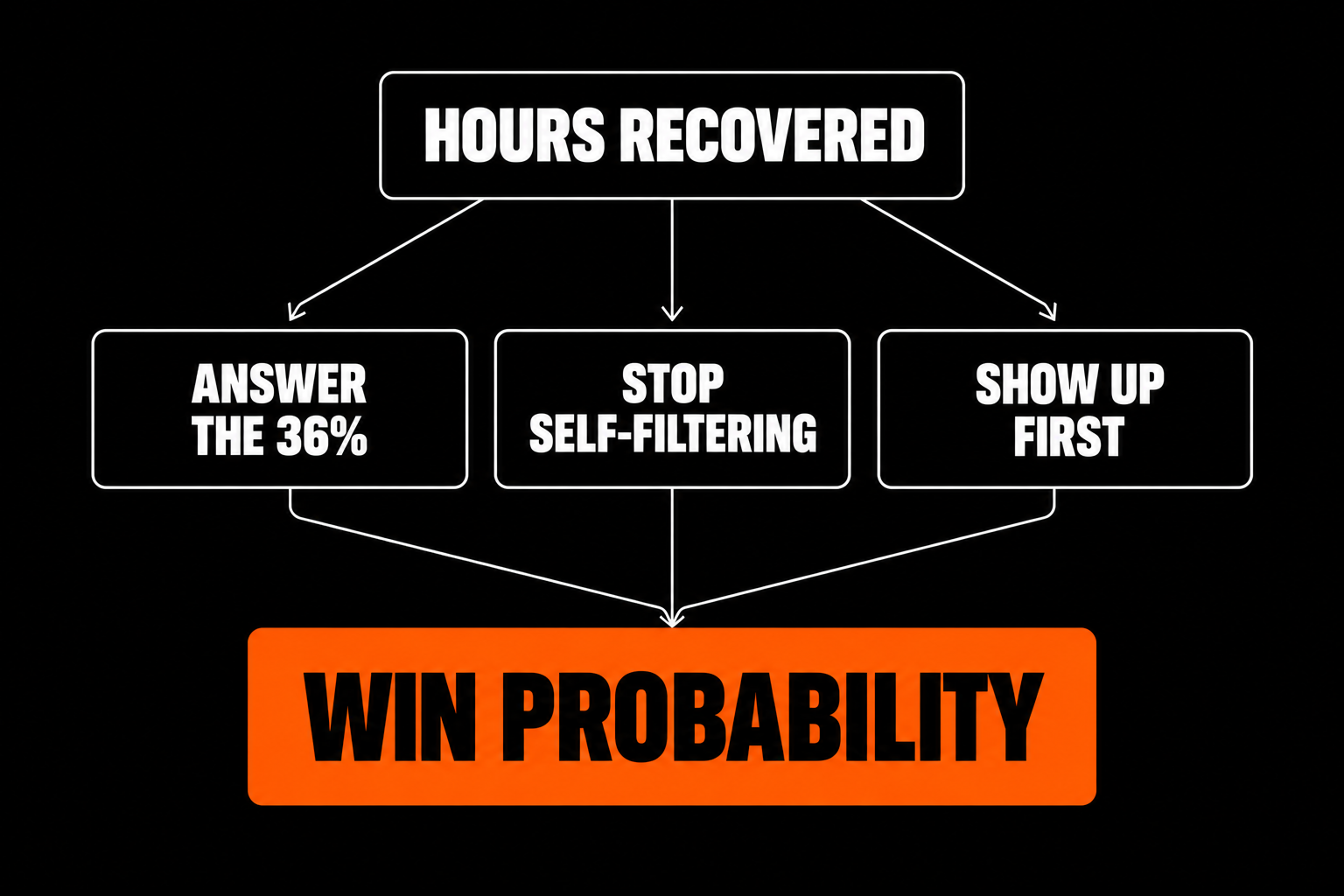
Reducing RFP completion time is not about working less. It is about where the recovered hours go. A team that answers in hours instead of days responds to the 36 percent of RFPs that currently go unanswered industry-wide, stops self-filtering the pipeline, and shows up first often enough to matter, since first responders take a disproportionate share of wins. The teams that treat speed as a system, measured, triaged, templated, and automated, convert time saved directly into group revenue.
RFP speed is a system, not a single fix. Measuring the workflow, triaging leads, centralizing intake, and setting pricing guardrails all compound before AI ever enters the picture, and they're what make automation worth trusting once it does. Hippo Rev is built on that foundation: it centralizes intake across channels, grounds every AI-drafted response in your actual property data, and cuts RFP processing from roughly 37 minutes to about 4 minutes per response, so your team spends its time on the leads worth winning instead of the paperwork around them. Book a Capture Audit to see where your hours are going today.
Frequently Asked Questions
1. How long does it take a hotel sales team to complete an RFP manually?
Pure processing commonly runs around 37 minutes per response, but the full cycle including rate approvals, space checks, and content hunting frequently stretches to two to four days.
2. What is the fastest single change to reduce RFP completion time?
Pricing guardrails. Pre-approving rate ranges by season, segment, and group size removes the overnight approval loop, which is usually the longest wait in the workflow.
3. How fast should a hotel respond to an RFP?
Acknowledge within hours and deliver a complete proposal within 24 to 48 hours where feasible. Over 60 percent of planners expect responses within four days, and early responders win disproportionately.
4. Should hotels respond to every RFP?
Every RFP deserves a response, but not a full proposal. Triage on fit, margin, and timeline, send full proposals to qualified fits, and decline the rest quickly and politely, which protects the relationship for future dates.
5. What belongs in an RFP content library?
Floor plans, capacity charts, menus, AV specifications, image sets, policies, and pre-approved clauses for attrition, deposits, and blackout dates, all version-controlled and audited quarterly.
6. How much of the RFP response can AI handle?
Analyses of AI proposal workflows put it at 80 to 90 percent of the assembly work: parsing, drafting, formatting, and follow-up scheduling. Judgment calls like alternate dates, packaging, and risk terms stay with the seller.
7. Does responding faster mean lower-quality proposals?
No, provided speed comes from removing waiting and re-work rather than skipping personalization. Templates and libraries handle accuracy; the seller's saved time goes into tailoring.
8. How do holding replies help if the full proposal still takes a day?
An immediate acknowledgment confirms receipt, sets a delivery expectation, and keeps your property in the planner's active consideration while slower competitors remain silent.
9. What metrics should sales leaders track for RFP speed?
RFPs received, response rate, average time to first response, proposal turnaround time, and win rate by segment, reviewed weekly against the baseline.
10. What should a team fix before adding RFP automation?
Map the workflow, centralize intake, and clean the content library first. Automation multiplies whatever process it is given, so a measured, centralized foundation is what turns minutes-level processing into real revenue.
Share this post
Ready to close more group business?
See how HippoRev can transform your hotel sales workflow in 15 minutes.

Follow us


.svg)