


Sales Productivity
Hotel RFP Automation: 7 Reasons Teams Stay Manual
Hotels still rely on manual RFP processes because they feel familiar, controllable, and inexpensive. This article examines seven reasons those workflows persist—and reveals how unanswered leads, slow proposals, fragmented data, and unmeasured administrative work can quietly reduce group sales revenue.



.png)
Why Do Hotels Still Use Manual RFP Processes? 7 Real Reasons
Hotels still use manual RFP processes for reasons that have little to do with technology: the illusion of control that hands-on work creates, institutional habit, software costs that are visible while manual costs stay hidden, fear of losing the personal touch, brand-mandated system constraints, scar tissue from failed past implementations, and the simple fact that nobody is measuring what the manual process loses. None of these reasons are irrational. All of them are expensive.
The scale of the problem is well documented. In LinkedIn polls of hotel professionals, 90 percent pointed to the group and meetings booking process itself, not pricing, as the main barrier to winning business. Groups360 platform data shows 55 percent of hotel RFPs go completely unanswered. And yet, walk into most hotel sales offices today and you will still find RFPs scattered across inboxes, rates approved over email, and proposals assembled by copy and paste. Here are the seven reasons why, and why each one deserves a second look.

Reason 1: Manual Feels Like Control
When your team builds every proposal by hand, tracks every lead in a spreadsheet, and manages every follow-up personally, it feels like nothing can slip through. Procurement analysts call this the illusion of control: teams believe they can see everything because they touch everything. In practice, manual control is fragmented control. Information gets trapped in individual inboxes, different people work from different file versions, and the pipeline's accuracy depends on who updated the spreadsheet last. The feeling of control and the fact of visibility are two different things, and manual processes deliver the first while quietly destroying the second.
That gap between feeling in control and actually seeing the pipeline is the same one we mapped out in our blog here.
Reason 2: The Process Has Always Worked, Sort Of
Group sales predates every tool now trying to modernize it. Many directors of sales learned the craft on paper traces and phone follow-ups, won real business that way, and built careers on it. The process they inherited became the process they teach. This is not stubbornness. It is institutional memory doing what institutional memory does: preserving what worked. The problem is that "worked" was measured against yesterday's expectations. Today, over 60 percent of planners want RFP responses in four days or fewer, while 22 percent report waiting more than eight days. The manual process did not get worse. The benchmark it competes against did.
Reason 3: Software Costs Are Visible, Manual Costs Are Not
A software subscription arrives as an invoice the owner sees every month. The cost of the manual process arrives as nothing at all: no line item, no report, no alert. An unanswered RFP does not appear on a P&L. A proposal sent on day four instead of day one does not generate an expense entry. So the comparison always looks lopsided: a concrete new cost versus an apparently free status quo. The status quo is not free. Sellers spend roughly 71 percent of their day on non-selling tasks, and execution leakage runs to about 500,000 dollars annually per salesperson. The manual process is often the most expensive item in the sales budget. It is just the only one that never gets budgeted.
Reason 4: Fear of Losing the Personal Touch
Group sales is a relationship business, and many sales leaders worry that automation will make their responses feel robotic to planners who value a human connection. The concern is legitimate but aims at the wrong target. What automation removes is not the relationship. It is the copying, pasting, chasing, and reformatting that currently consumes the seller's day, the exact administrative weight that prevents relationship work. There is an irony hiding in the current state: while the planner imagines the hotel is crafting a tailored proposal, the sales rep is usually fighting formatting errors in a spreadsheet. The personal touch is not in the paste function. It is in the conversation the seller finally has time for.
Reason 5: Brand and Franchise Constraints
Branded and franchised hotels often operate inside a mandated technology stack. Leads arrive through brand channels, the sales and catering system is prescribed, and adding tools requires approvals that can take quarters. Sales leaders in these environments frequently conclude that since they cannot replace the mandated core, there is no point improving anything around it. That conclusion overshoots. The mandated stack usually governs where data must ultimately live, not how fast the team works before it gets there. The constraint is real. The paralysis it produces is optional.
Reason 6: Scar Tissue From Past Implementations
Many hotel sales teams have lived through a system rollout that overpromised and underdelivered: months of migration, mandatory training, and a tool the team quietly abandoned within a year. Once burned, leaders treat every new platform pitch as the same movie. This skepticism is healthy in moderation, and it should shape how hotels buy, favoring tools that fit existing workflows over tools that demand new ones. But using one failed rollout as permanent proof that all automation fails is a prediction, not a fact, and it hardens into a policy of doing nothing while competitors move.
Reason 7: Nobody Is Measuring What Manual Loses
This is the reason that keeps all the others alive. Most hotels do not track how many RFPs arrive each month, how many receive responses, how fast, or what converts. Without those numbers, the manual process has no visible failure. Meanwhile, the failures compound quietly: hotels using manual lead tracking see 35 to 40 percent longer sales cycles than those on purpose-built software, and 61 percent of won deals go to one of the first three responders. When the administrative weight of responding gets heavy enough, sellers begin filtering their own pipelines, silently dropping leads that look too small or too difficult. Unmeasured, that filtering looks like a quiet month. Measured, it looks like what it is: revenue leaving the building.
This is exactly the blind spot a DOSM's Tuesday reveals once you actually track it. Read more about it here.
The Reasons Are Understandable. The Math No Longer Is

Every reason above made sense in the environment where it formed. But the environment has moved. Planners expect responses in days, 71 percent of hoteliers themselves believe automated offers and instant booking will dominate meetings and events sales within five years, and 74 percent fear that OTAs and global tech platforms are coming for the group space. The question is no longer whether the manual process can be defended. It is whether it can compete.
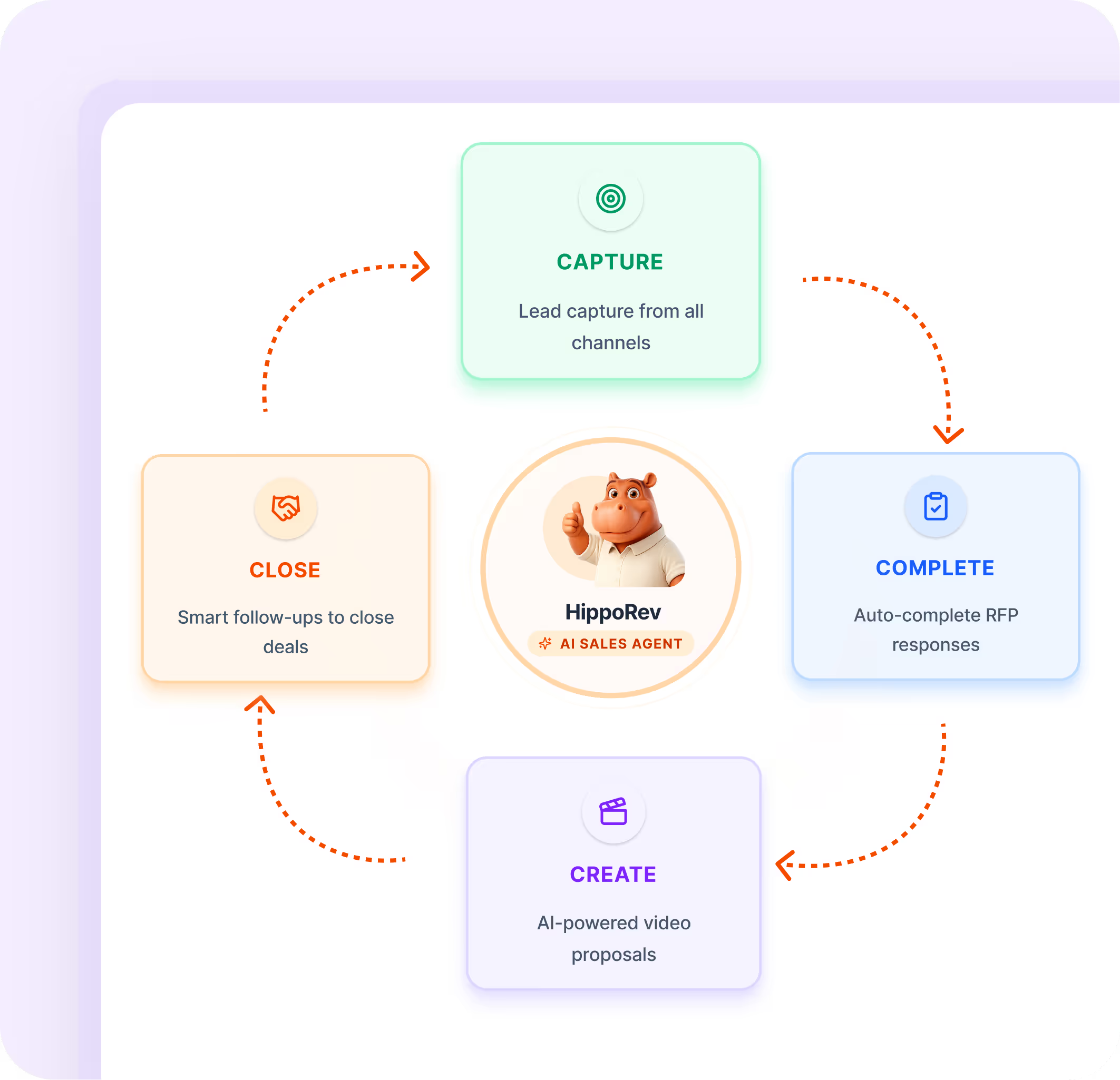
This is the gap Hippo Rev was built for. It captures every inbound group lead in one place and cuts RFP processing from roughly 37 minutes to about 4 minutes, removing the administrative weight that makes teams filter their own pipelines. And it works with the reasons above rather than against them: no rip-and-replace of a mandated stack, and the seller stays in the relationship while the platform handles the paste work. If you suspect your manual process is costing more than any subscription would, a Capture Audit will show you the number. Twenty minutes, your data, no deck.
Frequently Asked Questions
1. What is the most common reason hotels stick with manual RFP processes?
The invisibility of the cost. Software has a monthly invoice, while unanswered RFPs and slow responses never appear on a P&L, so the manual process always looks free even when it is the most expensive item in the sales operation.
2. Is the manual RFP process really that slow?
Yes. Assembling a proposal manually across disconnected systems commonly takes days, while over 60 percent of planners now expect responses within four days and 61 percent of won deals go to one of the first three responders.
3. Does automating RFP responses make proposals feel impersonal?
No. Automation removes the copying, formatting, and chasing, not the relationship. Sellers gain back the time currently lost to administration, which is where the personal touch actually lives.
4. How many hotel RFPs go unanswered?
Groups360 platform data puts it at 55 percent, and broader industry estimates run at 36 percent or higher. Either figure represents substantial group revenue abandoned before any competitor even wins it.
5. Why do sales teams trust spreadsheets more than software?
Spreadsheets feel controllable because the team touches every cell. In practice they fragment data across versions and inboxes, hiding risk rather than exposing it.
6. Can branded or franchised hotels automate if their tech stack is mandated?
Usually yes. Brand mandates typically govern the system of record, not the speed of work upstream of it. Tools that layer onto the existing stack avoid the approval battles a replacement would trigger.
7. What does a manual RFP process cost a hotel annually?
With sellers spending about 71 percent of their day on non-selling tasks, execution leakage runs to roughly 500,000 dollars per salesperson per year across missed, slow, and abandoned opportunities.
8. Why did our last sales technology rollout fail, and will a new one fail too?
Most failed rollouts demanded that teams change their workflow to fit the tool. Implementations succeed when the tool fits the existing workflow, so evaluate new platforms on adoption effort, not feature count.
9. How do I know if my hotel's manual process is losing deals?
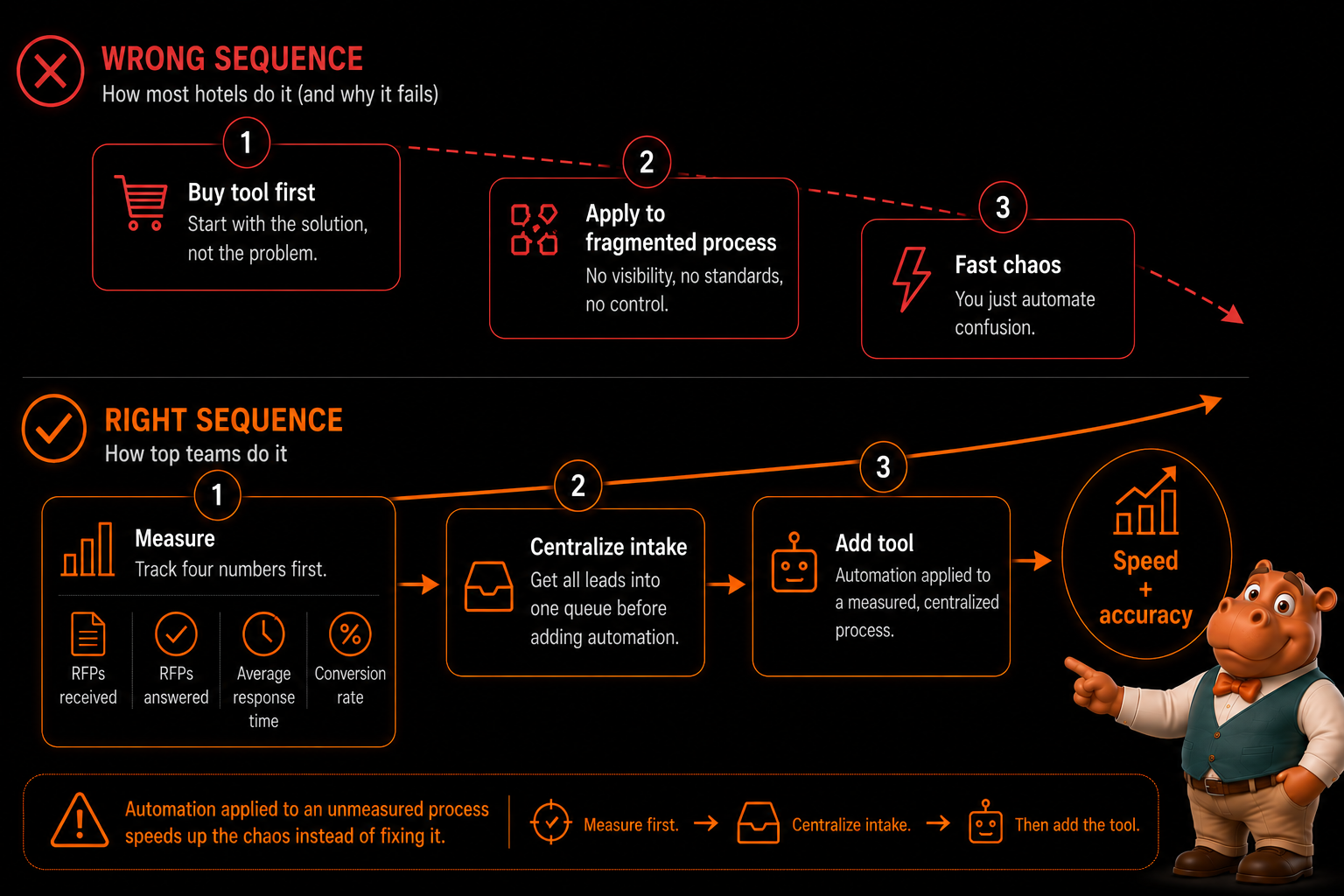
Start measuring four numbers monthly: RFPs received, RFPs answered, average response time, and conversion rate. If you cannot produce those numbers today, that absence is itself the answer.
10. What should a hotel fix first: the process or the tool?
Measure first, then centralize intake, then add the tool. Automation applied to an unmeasured, fragmented process speeds up the chaos instead of fixing it.
Share this post
Ready to close more group business?
See how HippoRev can transform your hotel sales workflow in 15 minutes.

Follow us


.svg)