


Sales Productivity
Hotel Sales Productivity Crisis: Where a DOSM's Time Really Goes
She worked a full, exhausting day. She answered emails, built a proposal, prepped a site visit, and filled in a Cvent submission by hand. At 6:30 she finally logged off. And she did not move a single deal forward. This is not a performance problem. It is a workload problem, and it is the same at almost every property in your portfolio.




Your Best DOSM Didn't Sell a Single Thing on Tuesday. Here's Where the Hours Went.
Quick answer
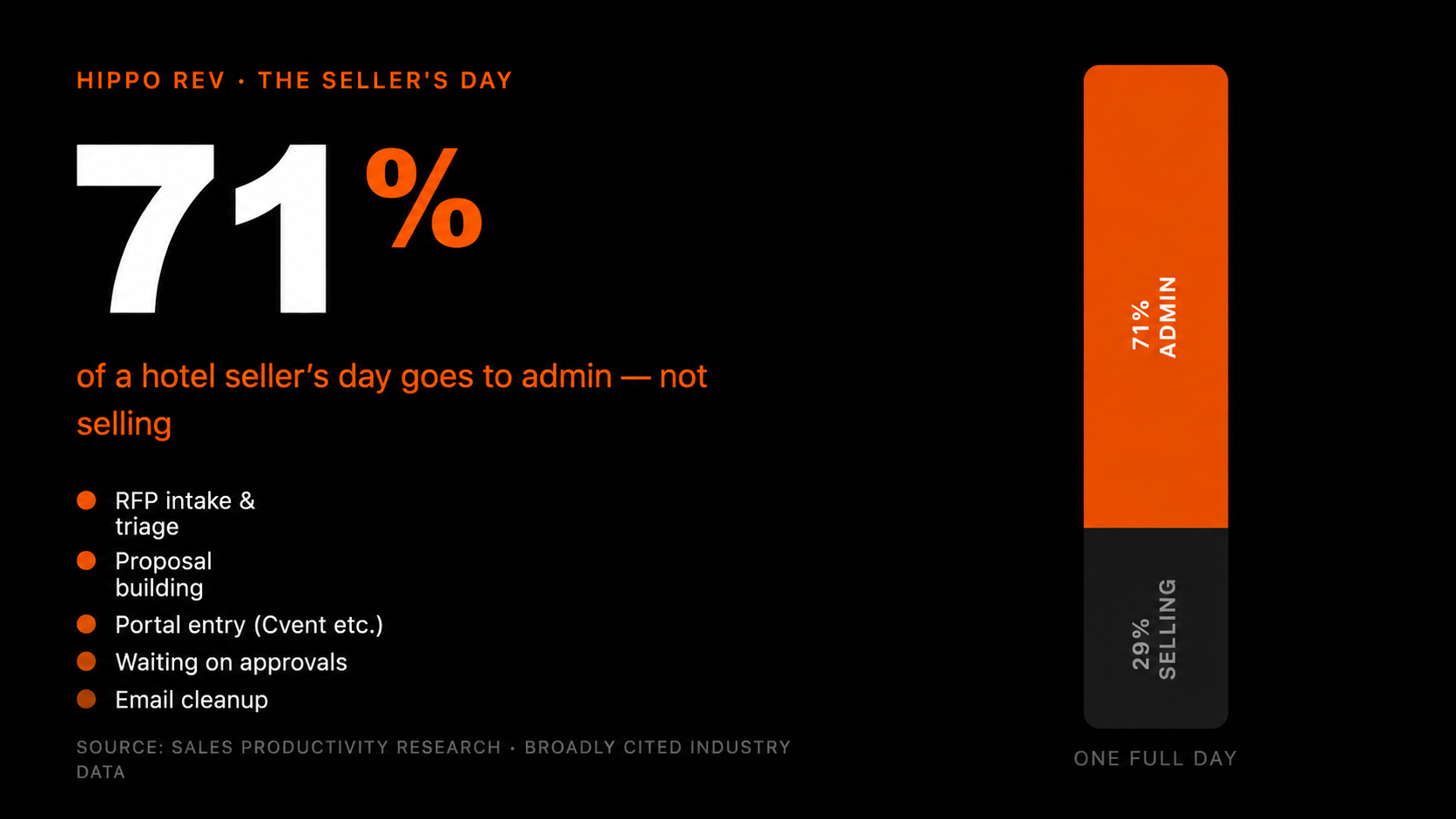
A typical hotel director of sales spends most of the day on administrative work, intake, proposal building, portal entry, and waiting on approvals, rather than selling. Research indicates roughly 71% of a seller's day goes to admin, and about 70% of hotel sellers operate as order-takers rather than hunters. The result is days of effort with zero deals advanced. The cause is workload structure, not effort, and the fix is moving repetitive machine work off the seller's plate.
Key takeaways
- A full, productive-feeling day can still advance zero deals when it is consumed by admin.
- Around 71% of a seller's day goes to non-selling work, an industry-wide pattern.
- Prospecting, account growth, and relationship-building are the first activities to disappear.
- Returning those hours, not adding headcount, is what re-enables full-cycle selling.
Meet your best seller on a completely normal day
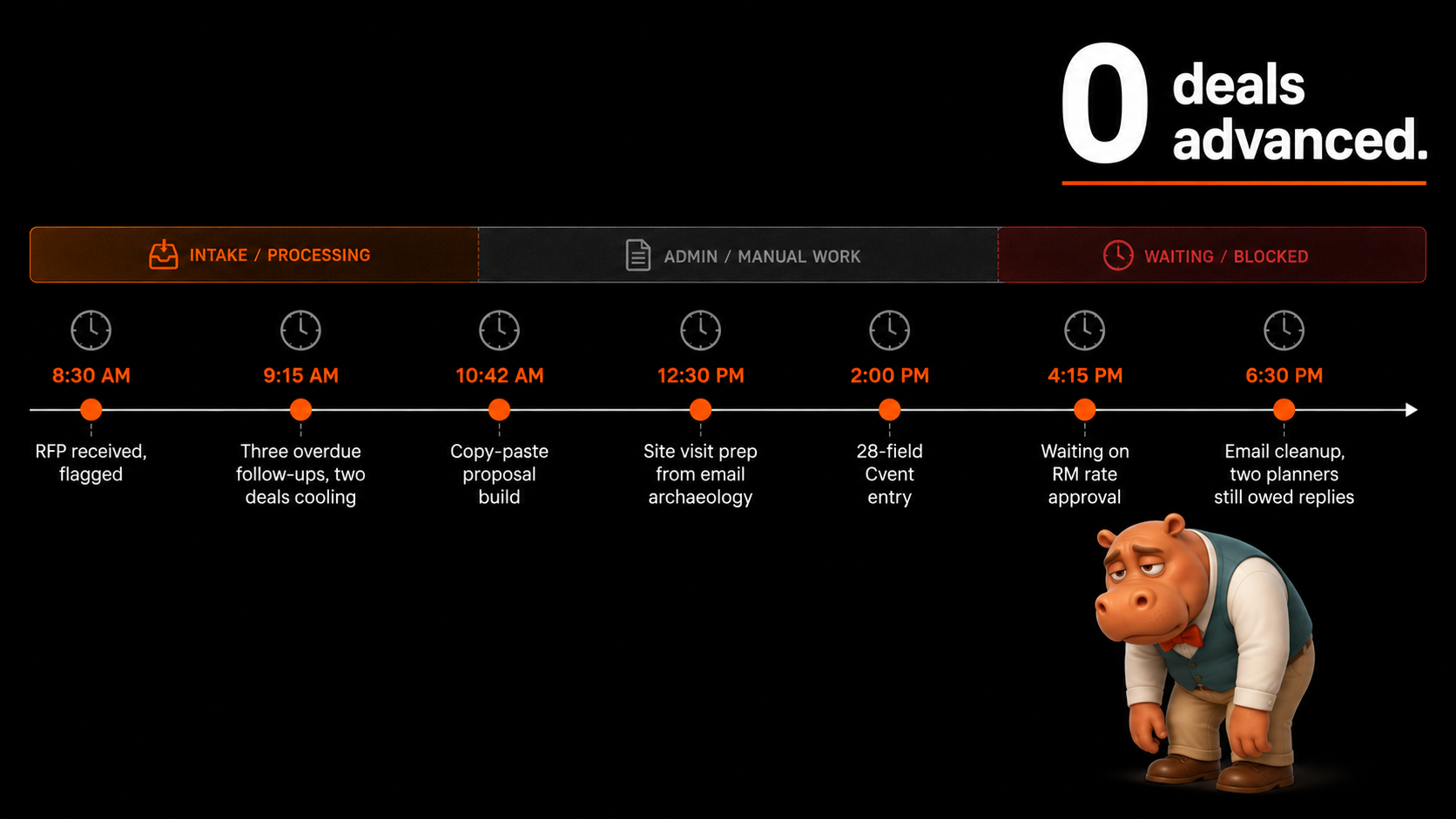
Let us follow your strongest director of sales and marketing through one ordinary Tuesday. Nothing goes wrong. There is no crisis. This is just what the job looks like now.
8:30 AM. The first RFP of the day lands. She skims it, sees it will take real work, and flags it for later. Later never quite arrives.
9:15 AM. Three follow-ups from last week are already overdue. She knows two of those deals are cooling while she watches.
10:42 AM. Proposal builder. She opens last week's template and starts copying and pasting, the group name, the dates, the room block, the F&B minimum, hoping she catches every field she needs to change.
12:30 PM. Site visit prep for a planner she met three months ago. She digs through email to reconstruct what they even discussed.
2:00 PM. A Cvent submission with twenty-eight fields to fill in by hand, because the portal does not talk to her other systems.
4:15 PM. She is waiting on Revenue Management to approve a rate before she can send anything. The request sits in someone else's inbox.
6:30 PM. Email cleanup. She still owes two planners a reply from yesterday. She closes the laptop.
Add it up. Eight hours of genuine, skilled effort. Zero deals advanced. No new account prospected. No dormant client re-engaged. No relationship deepened. She processed work. She did not sell.
The verdict, and why it is not about her
It would be easy, and wrong, to read that day as a productivity problem. She is not slow. She is not disorganized. She is doing exactly what the system around her rewards and demands.
The data says this is the norm, not the exception. Roughly 71% of a hotel seller's day goes to administrative work rather than selling, according to broadly cited sales-productivity research. And it is structural: when Kennedy Training Network and Knowland looked at how hotel sales teams actually operate, they found that about 70% of sellers function as farmers or order-takers, processing what arrives, rather than hunters who go create new business.
Read those two numbers together and Tuesday makes complete sense. If most of the day is consumed by admin, and the role has quietly been redefined around processing inbound, then a day with zero selling is not a failure. It is the predictable output of the workload. Your best person is losing deals for reasons that have nothing to do with effort or expertise.
How the job became this
The seller's day did not always look like this. It became this way through thirty years of math.
For three decades, the volume of inbound RFPs grew faster than the sales teams handling them. Cvent, HotelPlanner, Groups360, and the OTAs made it dramatically easier for planners to send inquiries to more properties at once. Inbound volume exploded. Headcount did not.
So sellers faced a quiet, daily choice: respond to the flood, or go hunt for new business. They chose respond, because that is what the comp set was doing and what the general manager was measuring. Over time, “respond to what comes in” stopped being one part of the job and became the entire job. Nobody decided the director of sales should stop selling. The arithmetic decided it for them.
The three things she was hired to do, and never gets to
When the day is fully consumed by intake and admin, three high-value activities disappear first, and they are exactly the three the role exists for.
Prospecting vanishes.
There is no cold outreach to new associations, no account-based motion at the property level, no hunting for net-new corporate business. The pipeline becomes whatever happened to show up in the inbox.
Account growth decays silently.
The client who booked in 2023 and did not come back in 2024 never gets a call to find out why. Dormant accounts sit untouched for twelve months or more, and their lifetime value quietly evaporates.
Relationships stay transactional.
The third-party planner who sends 40 RFPs a year is treated as a series of one-off requests. No quarterly business review, no pre-RFP positioning, no trust built in advance. And when that seller leaves, the relationship walks out with her, because it lived in her head, not in a system.
These are not nice-to-haves. Prospecting, growth, and relationships are where group revenue actually comes from. They are the first casualties of an admin-saturated day.
What giving the hours back actually changes
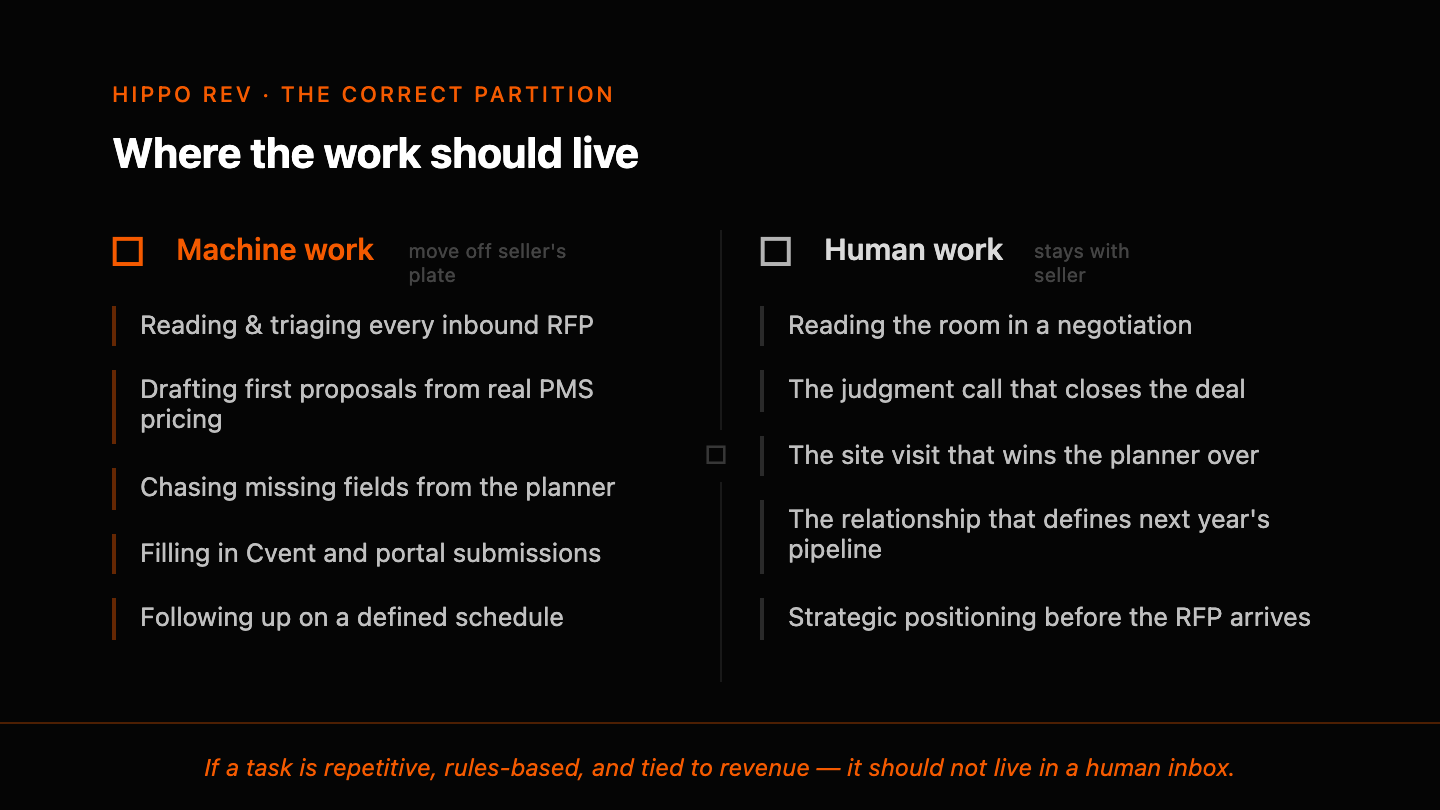
The reimagined version of this role is not a seller who works harder or faster. It is a seller whose day has a different shape, because the machine work has moved off her plate.
The principle is simple: if a task is repetitive, rules-based, and tied to revenue, it should not live in a human inbox.
Reading and triaging every inbound RFP, drafting the first proposal from real pricing, chasing missing fields from the planner, filling in the Cvent portal, following up on a schedule, that is machine work.
What stays human is the part that was always the actual job: reading the room, the judgment call in a negotiation, the site visit that closes, the relationship that brings the planner back next year.
Give her those hours back and the week reshapes itself. Inbound stops eating 70% of her time because AI absorbs it. Suddenly there is room to grow the dormant account, prospect the new association, and build the relationship that does not show up in this quarter's inbox but defines next year's pipeline.
The same person, the same headcount, finally doing the full-cycle job she was hired for.
This is what we built Hippo Rev to do
We did not build another tool for her to manage on top of the seven she already has.
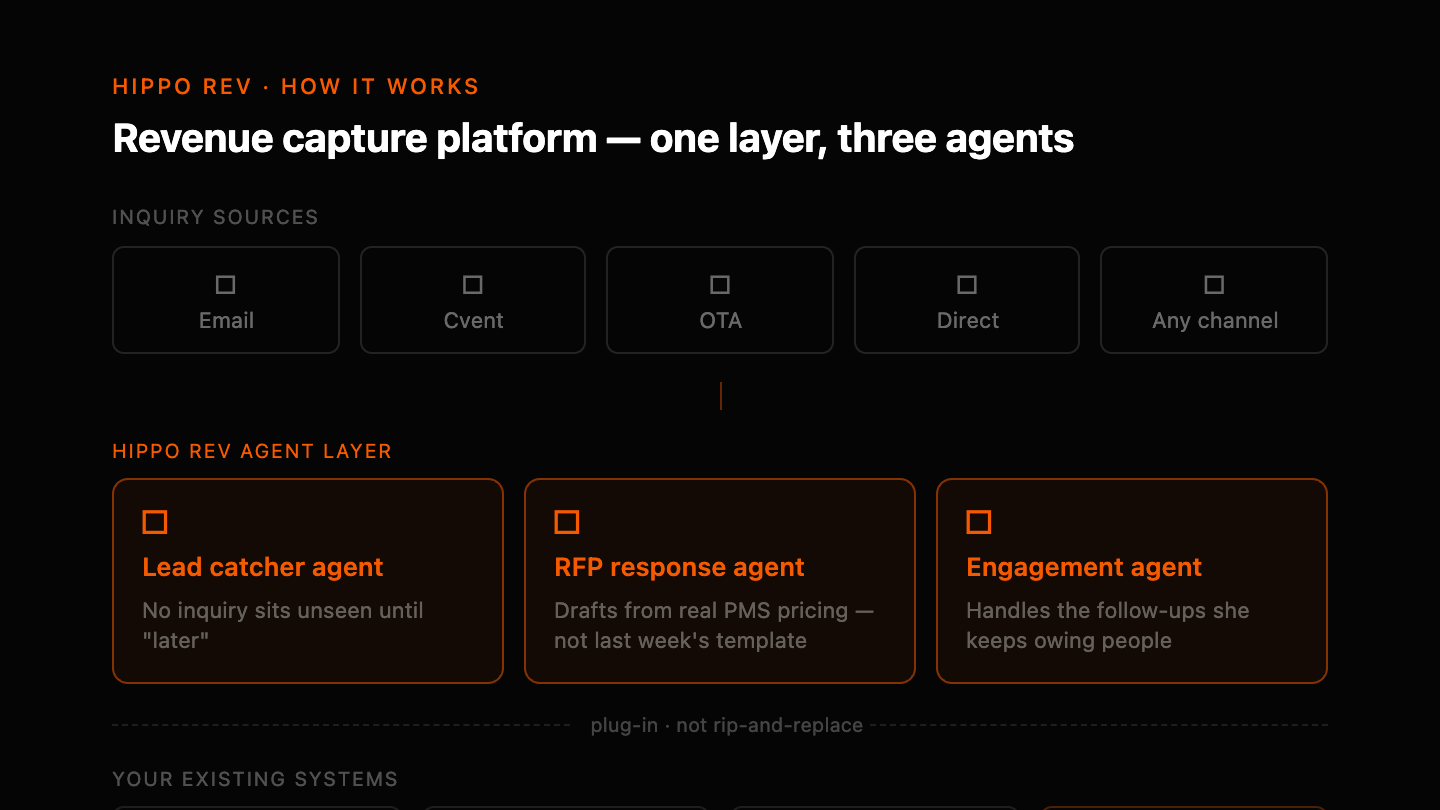
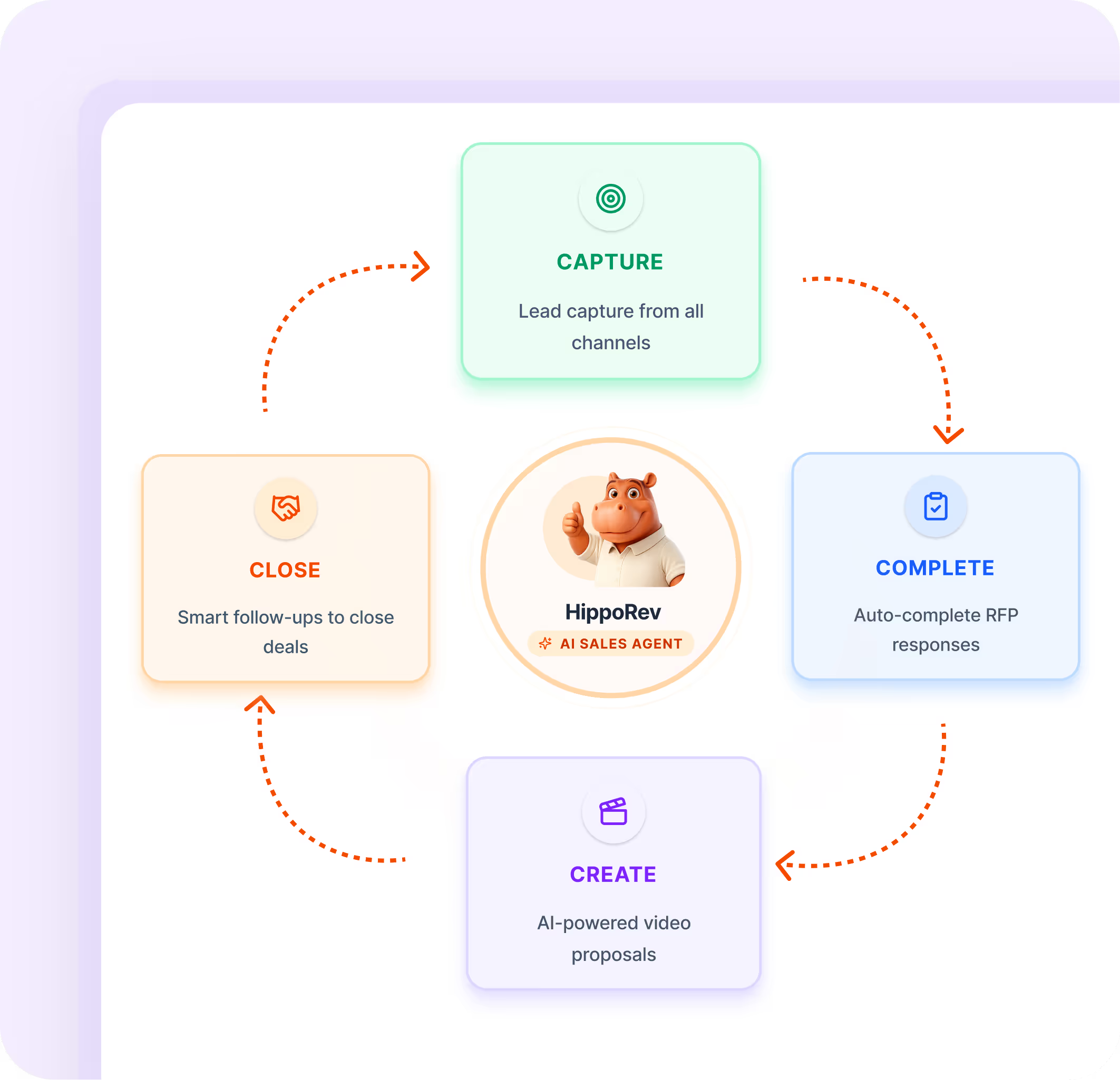
We built a Revenue Capture Platform that does the sell-side machine work and hands the time back.
The Lead Catcher Agent makes sure no inquiry from any channel sits unseen until “later.”
The RFP Response Agent drafts the proposal from your real PMS pricing instead of last week's copy-pasted template.
The Engagement Agent handles the follow-up she keeps owing people.
It sits on top of the systems you already own, so it is not a rip-and-replace and it is not one more thing to learn.
The goal is not to replace your best seller. It is to stop wasting her on Tuesdays like this one.
Ready to give your team their Tuesdays back?
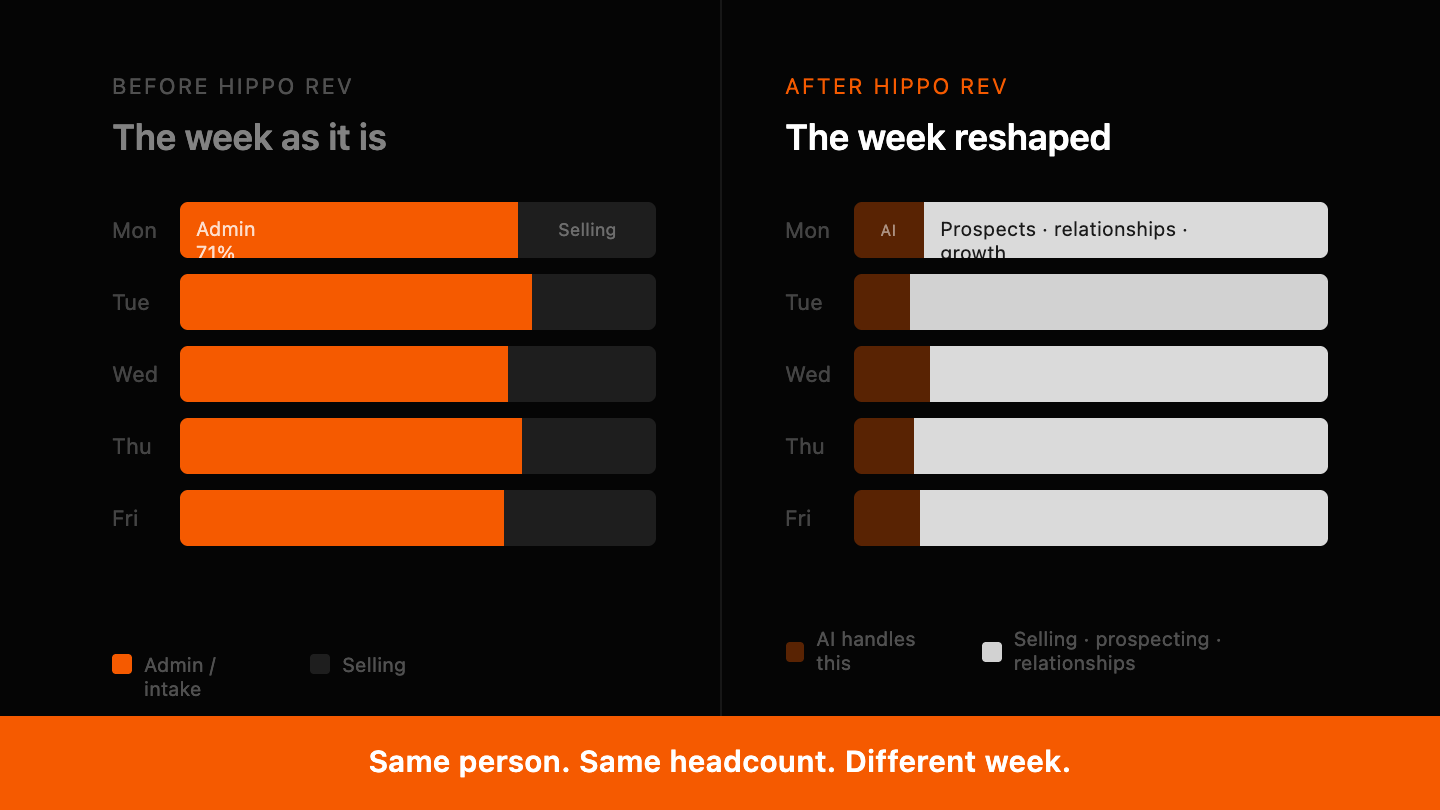
If this day looked familiar, it is because it is happening across your portfolio right now, quietly, in every seller's calendar.
See how Hippo Rev reshapes the week in a 15-minute demo, or explore the solution built for directors of sales.
Frequently asked questions
Question: Why do hotel sellers spend so little time actually selling?
Answer: Inbound RFP volume has grown faster than sales headcount for decades, so processing inquiries gradually became the entire job. Combined with administrative work like manual proposal building and portal submissions, this leaves most sellers with little or no time for prospecting, account growth, or relationship building.
Question: Does automating RFP work mean fewer sales jobs?
Answer: No. The goal is to move repetitive, rules-based tasks off the seller's plate so they can focus on the human work, negotiation, site visits, and relationships, that AI cannot do. The role becomes more strategic, not redundant.
Question: What is the difference between a farmer and a hunter in hotel sales?
Answer: A farmer or order-taker primarily processes inbound business that arrives on its own. A hunter actively prospects new accounts and grows existing ones. Research suggests about 70% of hotel sellers operate as farmers, largely because the workload leaves no room to hunt.
Question: How does Hippo Rev free up a seller's time?
Answer: Hippo Rev captures inquiries from every channel, drafts proposals from a hotel's real pricing data, chases missing details, and automates follow-up. By handling the machine work, it returns hours to the seller for the high-value activities that actually generate group revenue.
Share this post
Ready to close more group business?
See how HippoRev can transform your hotel sales workflow in 15 minutes.

Follow us


.svg)