


AI & Sales Technology
Build vs Buy AI for Hotels: Which Is Right for You?
Building AI isn't simply a software decision. It is an operational commitment involving data quality, governance, maintenance, and long-term investment. This article helps hotel leaders evaluate whether building or buying AI delivers the greatest business value for hospitality leaders.



.png)
Build vs Buy AI for Hotels: Answer These Three Questions Before You Spend a Dollar
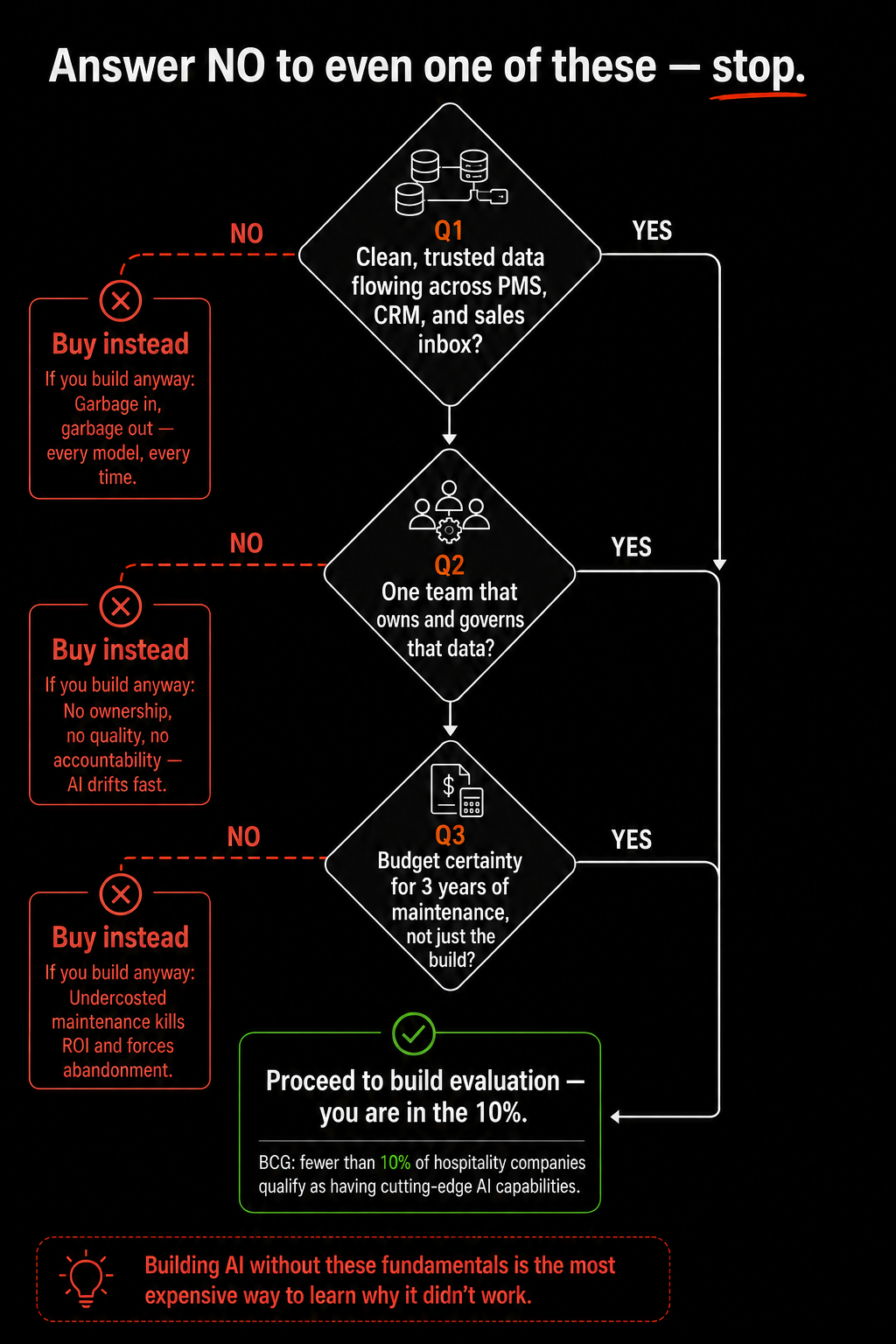
Are you thinking about building AI for your hotel? Answer these three questions first.
One. Do you have clean, trusted data flowing across every major system, from your PMS to your CRM to your sales inbox?
Two. Do you have one team that owns and governs that data?
Three. Can you afford to maintain AI for the next three years, not just build it?
If you answered "no" to even one of these, do not build it. Choose to buy instead. Here is the full case, backed by numbers.
Most Hotels Do Not Fail Because AI Is Bad
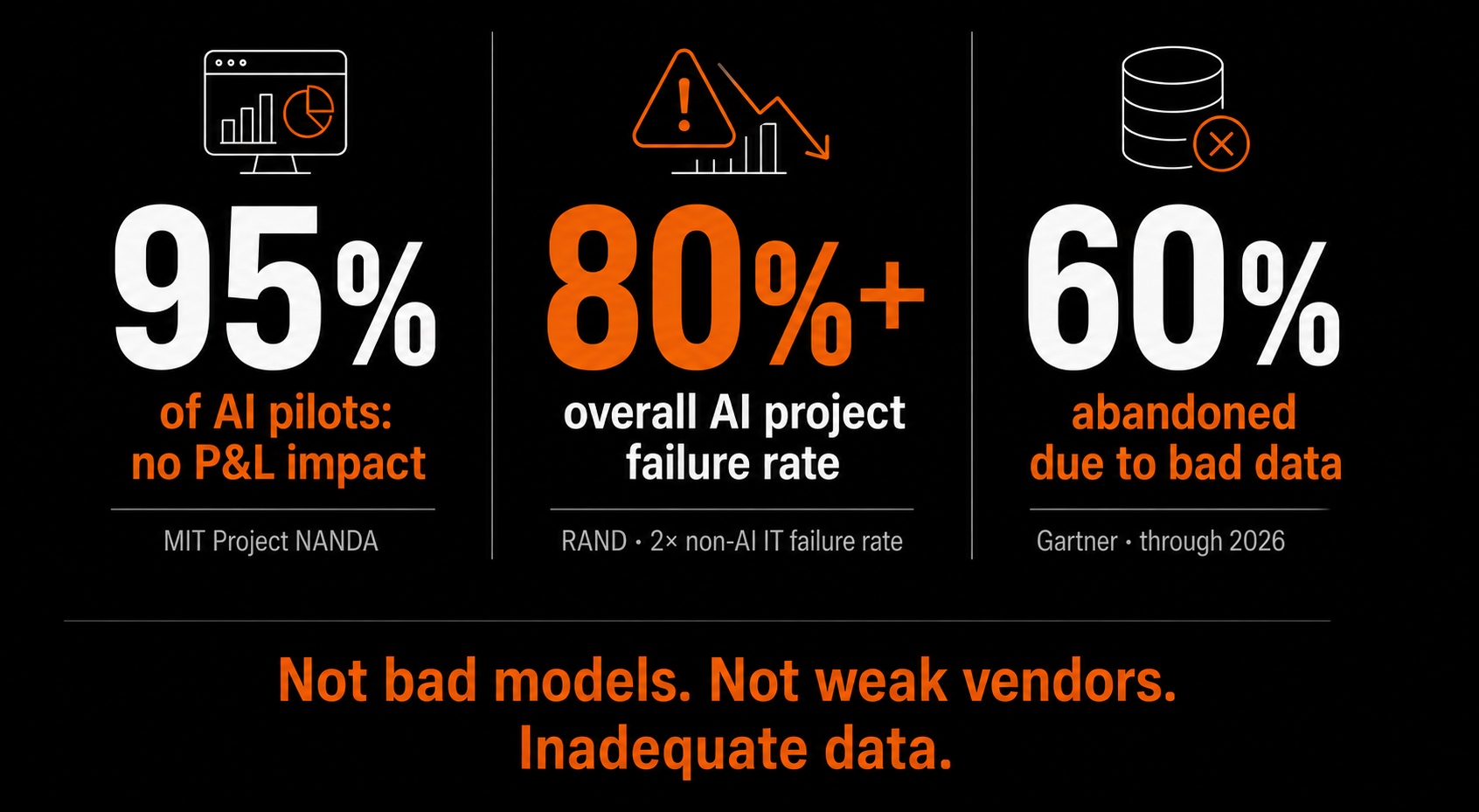
The failure data on enterprise AI is brutal. MIT's Project NANDA studied hundreds of enterprise AI deployments and found that 95 percent of generative AI pilots delivered no measurable impact on the profit and loss statement, despite companies pouring an estimated 30 to 40 billion dollars into these initiatives. RAND puts the overall AI project failure rate above 80 percent, roughly twice the failure rate of IT projects that do not involve AI. Gartner expects 30 percent of generative AI projects to be abandoned after proof of concept, and estimates that 60 percent of AI projects will be abandoned through 2026 due to inadequate AI-ready data.
Read that last line again. Not bad models. Not weak vendors. Inadequate data.
Hotels do not fail at AI because the technology is bad. They fail because they underestimate everything surrounding the technology. The data plumbing. The governance. The retraining. The three-year operating burden that starts the day the demo ends.
AI Is Not Classic Software. It Behaves Like a Living Organism
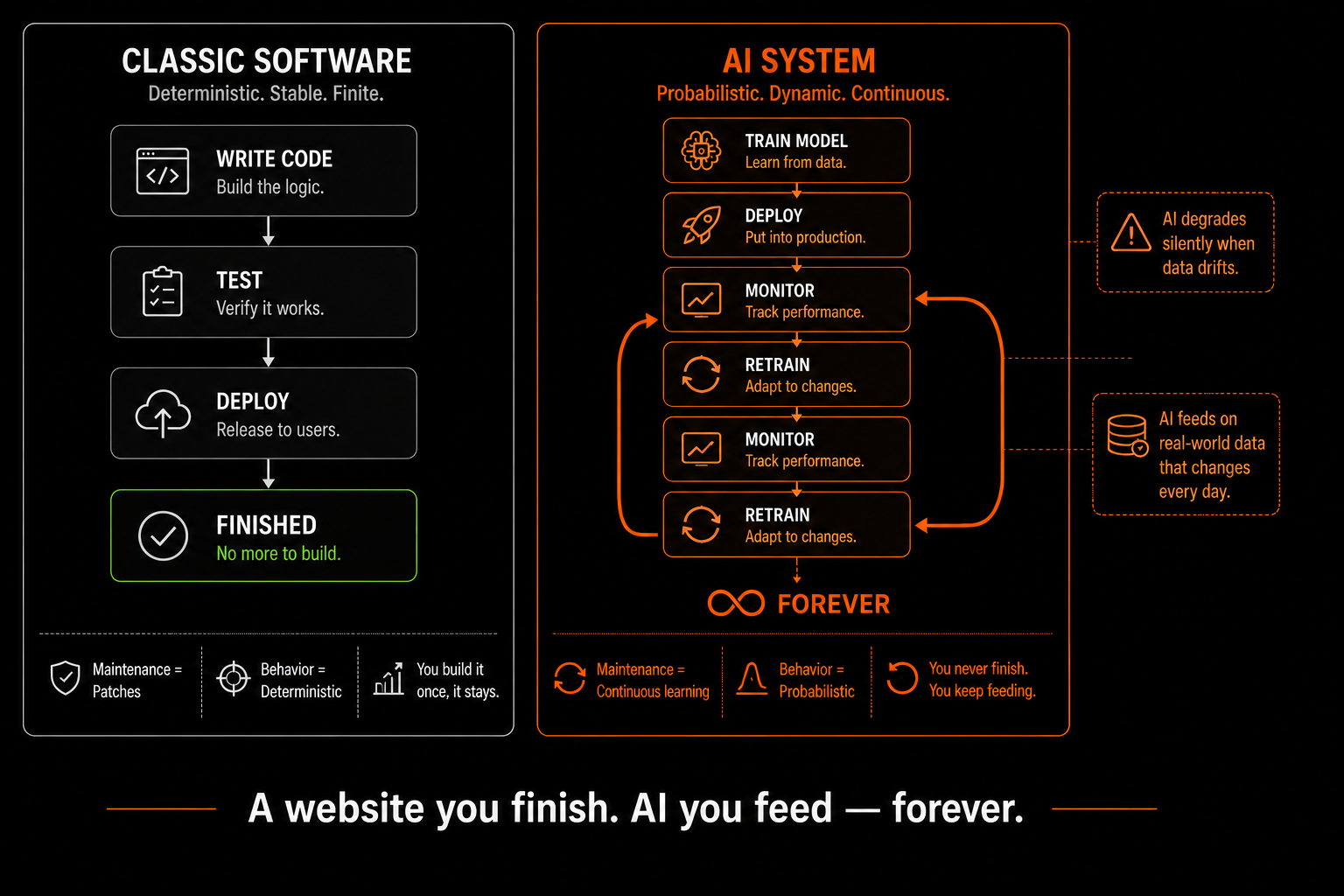
Some executives think AI is like traditional software. You write code, test it, deploy it, and you are done. AI does not work that way.
AI feeds on real-world data, and real-world data changes every single day. Guest behavior shifts. Group demand moves. Corporate travel patterns swing with the economy. A model trained on last year's booking pace starts making wrong calls the moment market conditions drift away from its training data.
If you do not continuously monitor, evaluate, and retrain the model, your brilliant internal project quietly degrades into a toxic technical liability. Nobody announces the moment it happens. You just start getting slightly worse pricing recommendations, slightly slower lead routing, slightly less accurate forecasts, until someone finally asks why the numbers stopped matching reality.
This is the core difference between building AI and building a website. A website you finish. AI you feed, forever.
The Maintenance Math Nobody Puts in the Business Case
Custom software maintenance in mature markets costs 10 to 20 percent of the initial build price every single year. Custom AI builds for hospitality typically range from 50,000 dollars for a focused single-function tool to 400,000 dollars or more for a platform that spans departments. Run the math on a 300,000 dollar build and you are committing 30,000 to 60,000 dollars annually just to keep it standing still, before you add a single improvement.
And that understates the real cost, because the biggest line item hides upstream of the model. Data preparation typically consumes 40 to 60 percent of a first-year AI budget. Cleaning duplicate guest records. Reconciling your PMS with your sales system. Building pipelines that survive a vendor API change. None of this shows up in the demo, and all of it shows up in the invoice.
Then there is the organizational cost. Traditional hotel IT teams are structured to ship projects, not to run ongoing operational pipelines. Shipping a project has an end date. Operating an AI system does not. If you build it anyway, ask yourself honestly: are you structured to run it long-term? Do you have the engineering resources? And what about the leadership headspace it will consume, headspace that could go into rate strategy, owner relations, and actual business development?
Read More: Causes of Data Inconsistency in Hotels.
The Evidence Favors Buying, and It Is Not Close
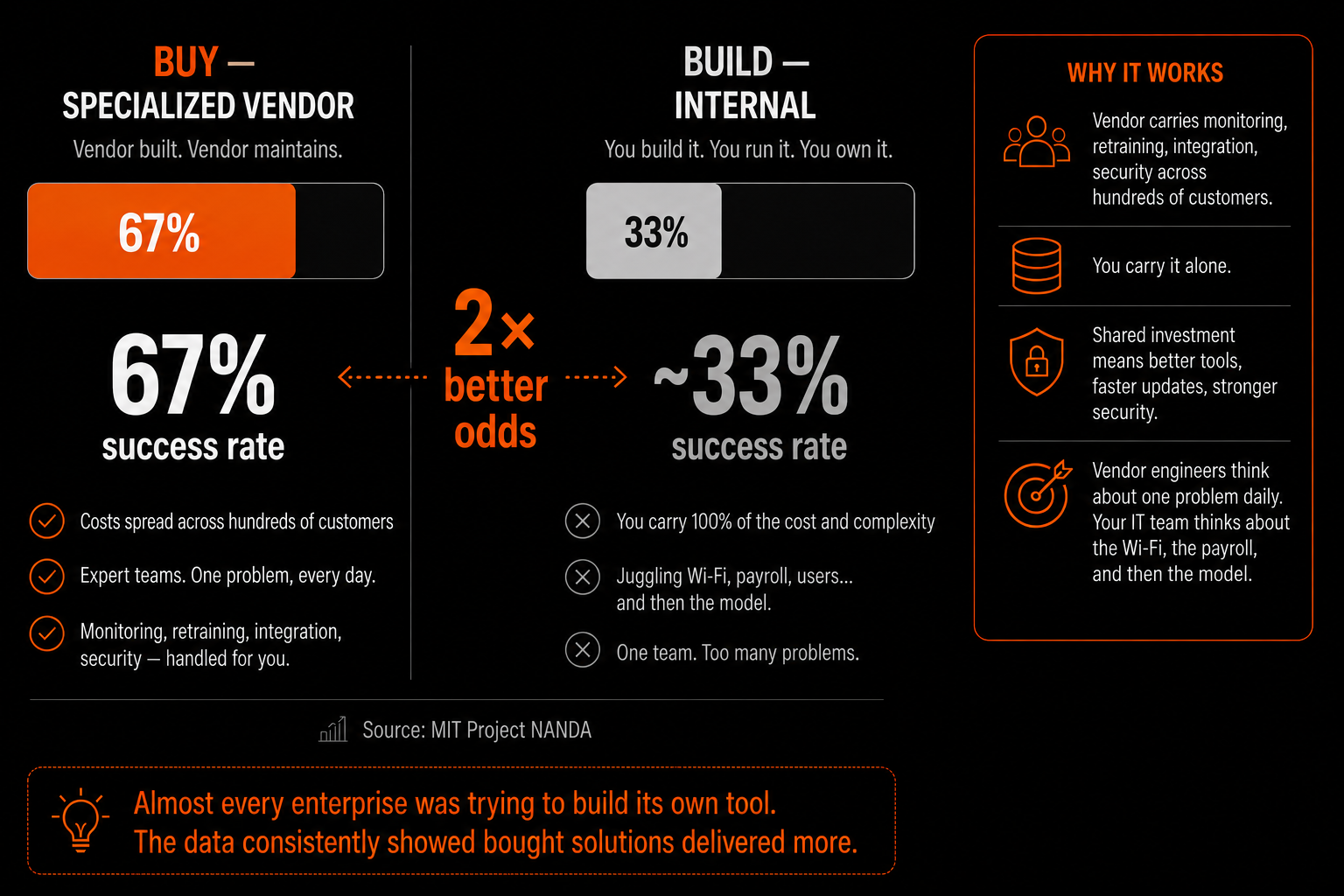
The most striking finding in the MIT research is a direct comparison between build and buy. Purchased AI solutions from specialized vendors succeeded about 67 percent of the time. Internal builds succeeded only about one third as often. The researchers noted that almost every enterprise they visited was trying to build its own tool, yet the data consistently showed that bought solutions delivered more reliable results.
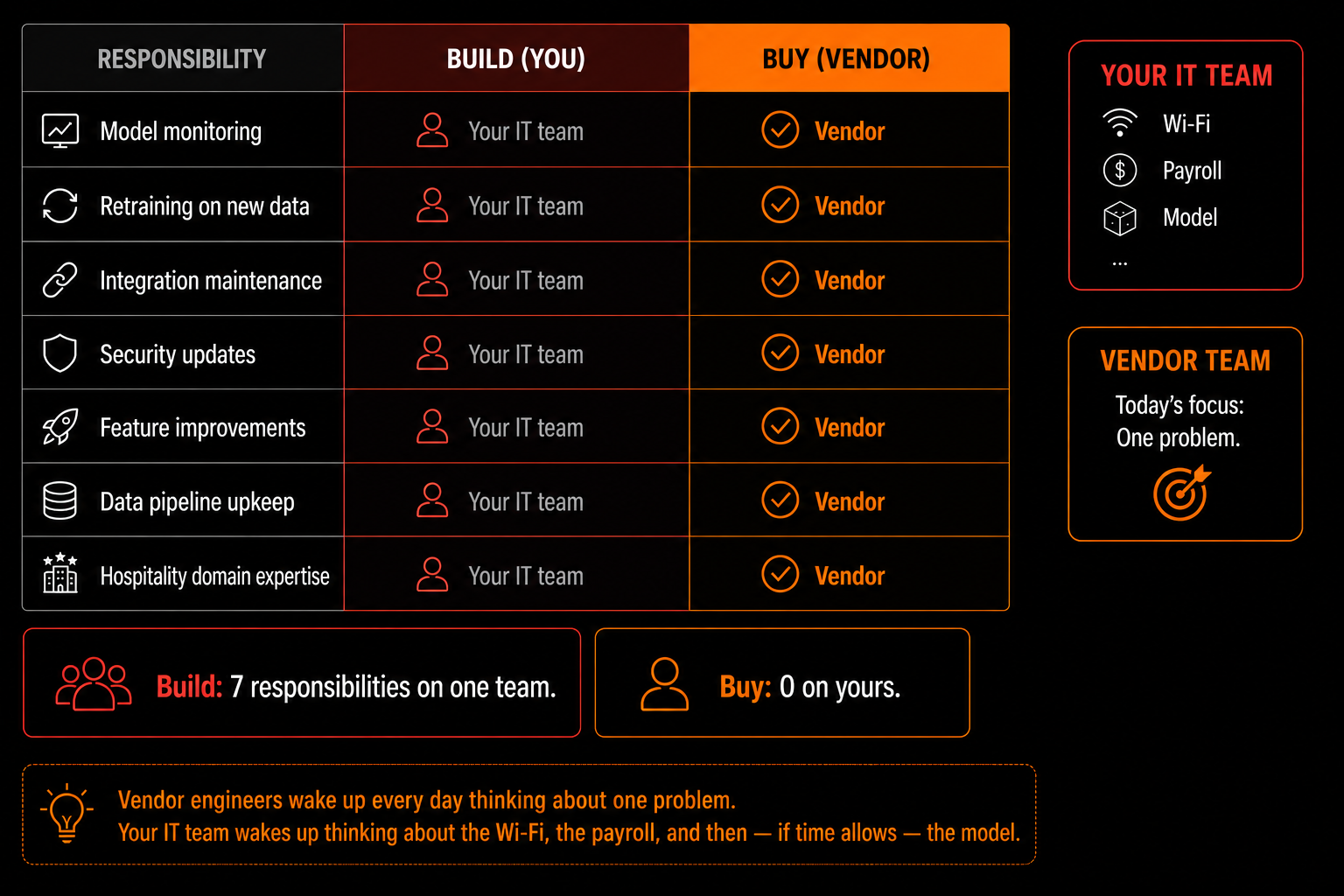
Why would that be? Because a specialized vendor spreads the cost of monitoring, retraining, security, integration upkeep, and product improvement across hundreds of customers. You carry that entire burden alone. The vendor's engineers wake up every day thinking about one problem. Your IT team wakes up thinking about the Wi-Fi outage on the fourth floor, the payroll export, and then, if there is time left, the model.
For hotels, the buy case is even stronger than for most industries. BCG's analysis of AI adoption found that fewer than 10 percent of hospitality companies qualify as having cutting-edge AI capabilities that generate substantial value. Hospitality is not an AI-native industry, and pretending otherwise is how a 300,000 dollar build becomes a two-year distraction.
The hotels seeing real success over the next few years will not be the ones that built the smartest AI. They will be the ones that made the smartest business decisions about where their team's time and capital actually belong.
Where This Decision Bites Hardest: Group Sales
Here is where the build versus buy question stops being abstract. Group sales is the part of a hotel where execution speed directly converts to revenue, and where slow, fragmented systems already cost real money. Roughly 36 percent of hotel RFPs go unanswered industry-wide, and 61 percent of won deals go to one of the first three responders. That is not a demand problem. It is an execution problem, and it is exactly the kind of problem a purpose-built platform solves faster than an internal build ever could.
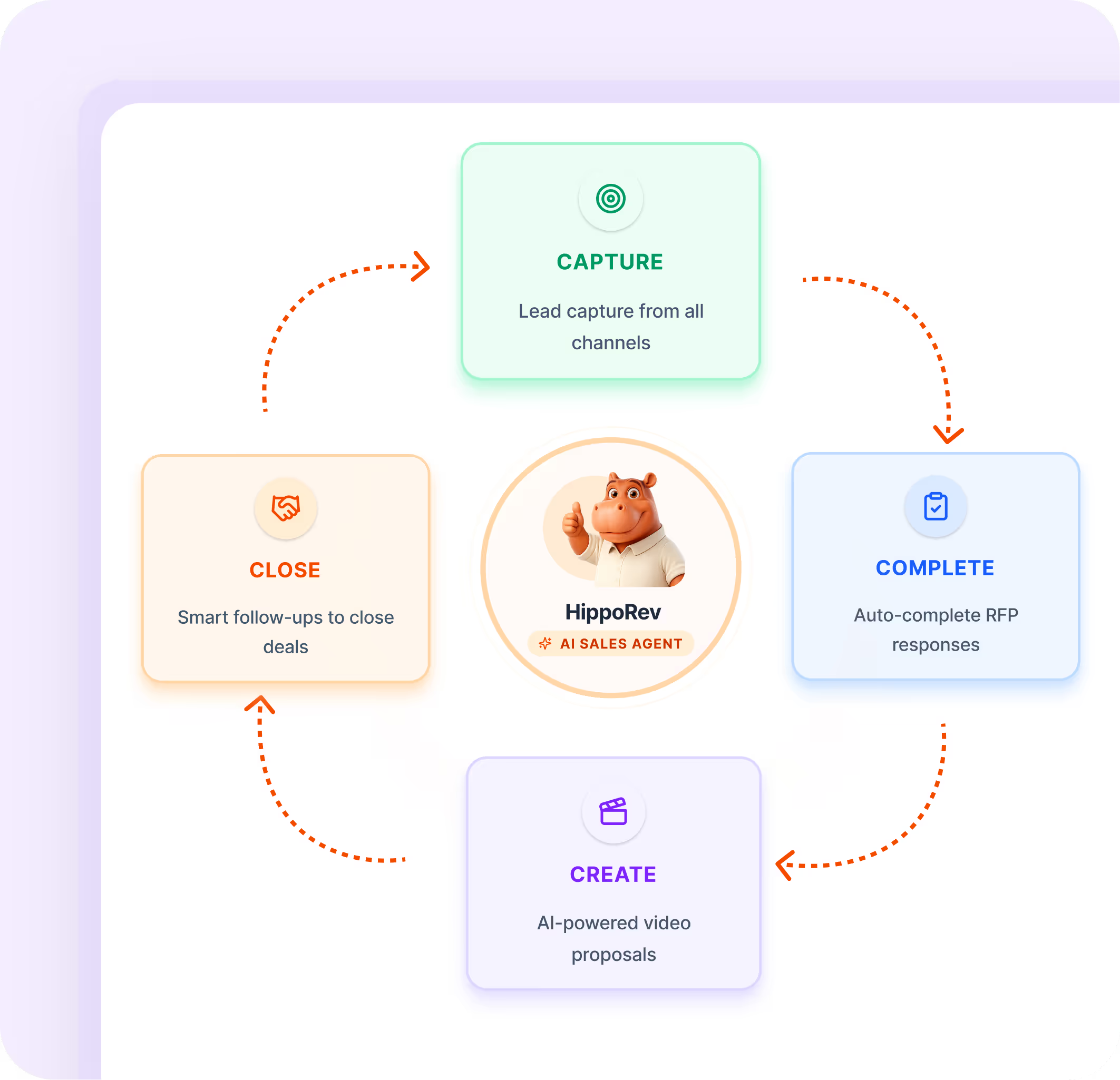
This is the problem Hippo Rev exists for. It is a Revenue Capture Platform built specifically for hotel group sales teams, handling the capture, conversion, and growth of group business without asking your IT team to become an AI operations shop. Teams using it have cut RFP processing from around 37 minutes to about 4 minutes per response. You get the AI outcome without the three-year maintenance commitment, because the monitoring, retraining, and integration upkeep are the vendor's job, not yours.
If you want to see what execution leakage is costing your specific property, book a Capture Audit. It takes 20 minutes, uses your numbers, and involves no deck.
Frequently Asked Questions
1. When does it make sense for a hotel to build AI in-house?
Only when all three conditions hold: clean, governed data across every major system, a dedicated team that owns that data, and budget certainty for at least three years of maintenance. In practice, this describes a handful of global chains, not the typical hotel group or management company.
2. How much does it cost to build custom AI for a hotel?
Custom hospitality AI builds generally range from 50,000 dollars for a single-function tool to 400,000 dollars or more for a multi-department platform, with data preparation consuming 40 to 60 percent of the first-year budget.
3. What is the ongoing cost after the build is finished?
Plan for 10 to 20 percent of the initial build cost every year in maintenance alone. That covers retraining, monitoring, integration fixes, and security updates, not new features.
4. Why do most AI projects fail?
Research from MIT, RAND, and Gartner points to the same causes: weak data foundations, poor integration into real workflows, unclear success metrics, and fading executive sponsorship. Model quality is rarely the reason.
5. Is buying AI really more successful than building it?
Yes. MIT's research found purchased solutions from specialized vendors succeeded about 67 percent of the time, while internal builds succeeded only about one third as often.
6. What does "AI-ready data" actually mean for a hotel?
It means your PMS, CRM, sales inbox, and booking channels feed consistent, deduplicated, trusted records into one governed source. If your sales team still reconciles group leads in spreadsheets, your data is not AI-ready.
7. Does buying AI mean losing control of our data?
No. Reputable vendors operate on your data under your governance, with contractual controls on usage and security. You retain ownership while offloading the operational burden.
8. Can our existing IT team maintain an AI system?
Usually not without restructuring. Hotel IT teams are built to ship projects with end dates. AI requires permanent operational pipelines: continuous monitoring, evaluation, and retraining. That is a different organizational muscle.
9. What happens if we build AI and then neglect it?
The model drifts. It keeps producing outputs, but they slowly diverge from reality as guest behavior and market conditions change. Degradation is silent, which makes it more dangerous than an outright failure.
10. How should a hotel start if it decides to buy?
Start with the highest-leakage workflow, not the flashiest one. For most properties with group business, that is the sales execution layer, where unanswered RFPs and slow response times are already costing measurable revenue. Audit that leakage first, then evaluate platforms against it.
Share this post
Ready to close more group business?
See how HippoRev can transform your hotel sales workflow in 15 minutes.

Follow us


.svg)