


AI & Sales Technology
Real Hotel AI Applications Behind the 2026 Hype
Nearly every hotel owner says they use AI, but only a third have it embedded across most of their operations. This article looks at five specific applications actually delivering value in 2026, and the operational gap AI hasn't closed yet, i.e; group sales.



.png)
How Hotels Are Actually Using AI in 2026: Real Applications Behind the Headlines
Nearly every hotel owner now says they use AI in some form. Almost none of them have it running across most of their operation. That gap between adoption and actual use is the real story of AI in hospitality this year, and it explains why so many "AI in hotels" articles feel simultaneously overhyped and vague.
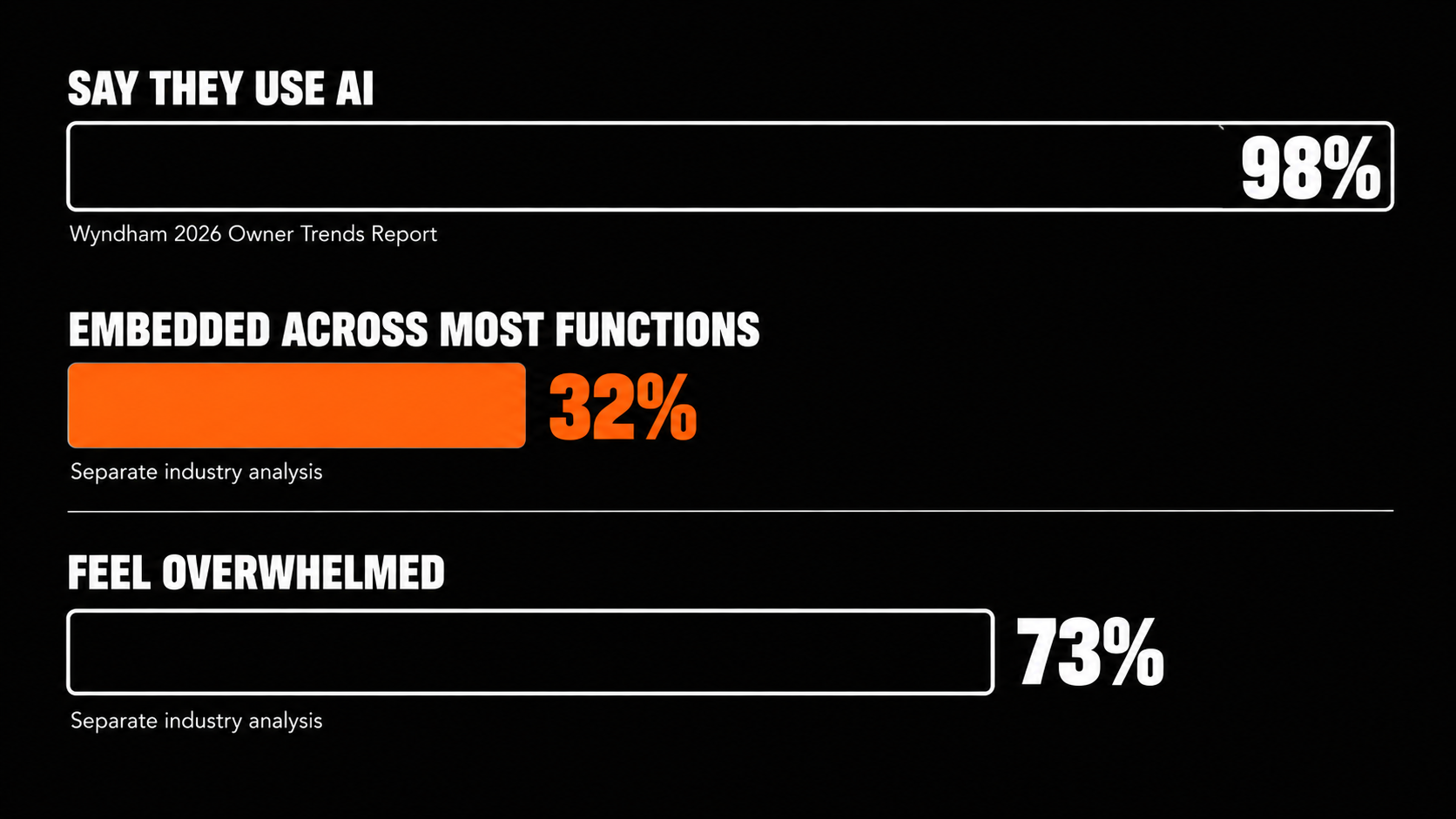
The Wyndham 2026 Owner Trends Report puts hotel AI adoption at 98%. A separate industry analysis of that same data found that only 32% of owners have AI embedded across most of their functions, and 73% say they want to do more but feel overwhelmed by where to start. So the honest answer to "how are hotels using AI" isn't a single number. It's a set of specific, narrow applications, each solving a specific operational problem, most of them still running alongside — not instead of — the people who did the job before.
This article looks at some of those applications in detail: dynamic pricing built on forward-looking demand data, AI-driven travel search, an AI commerce layer for guest interactions, back-office procurement automation, robotic housekeeping & revenue capturing execution layer. Together they show where AI in hospitality is actually delivering value in 2026, and where it still isn't.
Why Hotel AI Adoption Looks Bigger Than It Is
A hotel "using AI" can mean anything from a chatbot bolted onto a website to a fully automated revenue management system making live pricing decisions. That range is why adoption statistics vary so widely depending on how the question is asked.
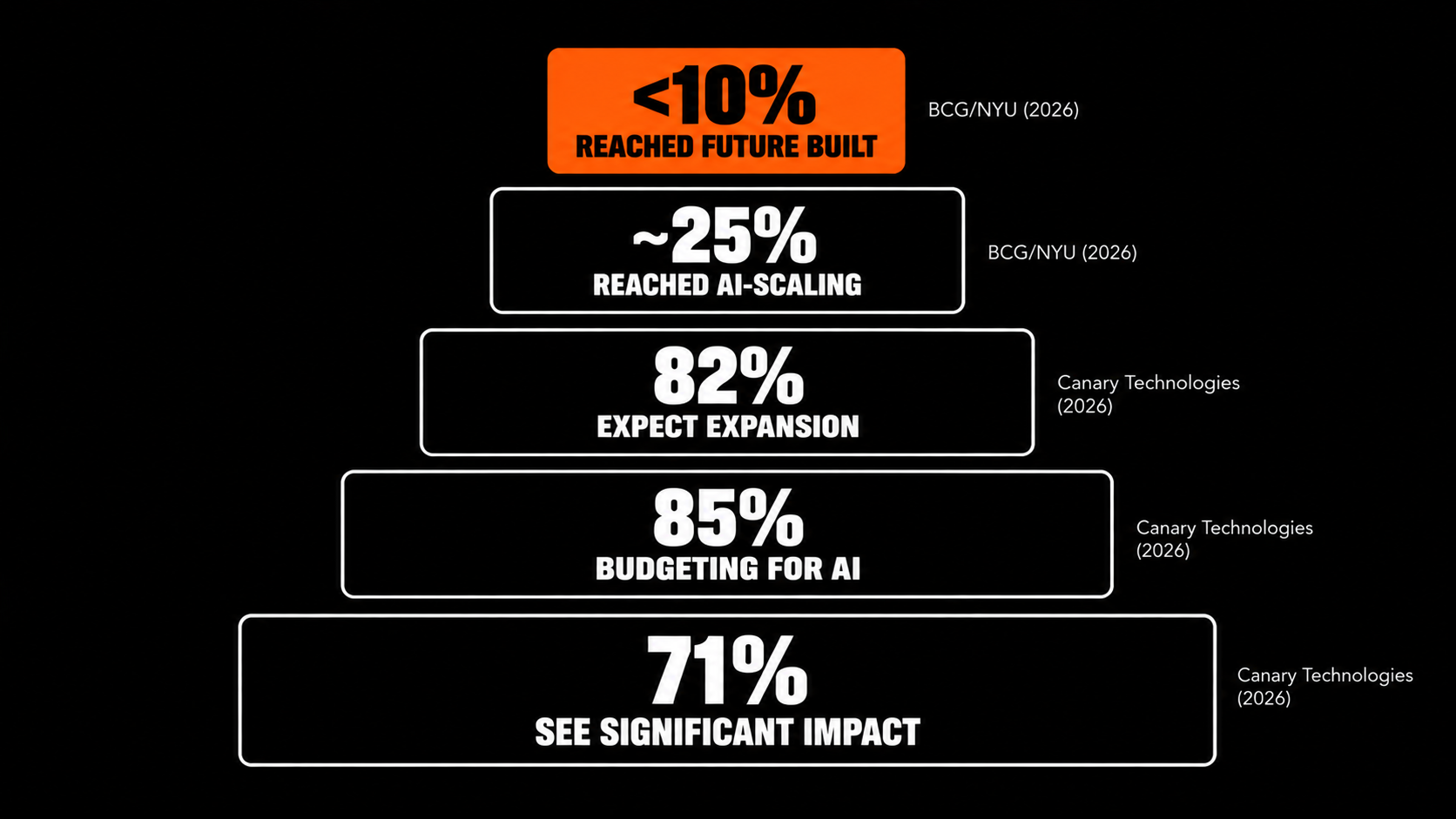
Canary Technologies' 2026 industry study, based on a survey of more than 400 hospitality technology decision-makers across North America, EMEA, and APAC, found that 71% of hospitality professionals say AI is already having a significant or transformative impact on their business, and 85% plan to allocate at least 5% of their IT budget to AI tools this year. Eighty-two percent expect their organization's AI usage to expand further within the next year. Separately, Boston Consulting Group's 2026 analysis with NYU found that fewer than 10% of hospitality companies had reached what it calls "future built" status — meaning AI capabilities mature enough to generate substantial, measurable value across the business. Only about a quarter had reached the earlier "AI-scaling" stage.
Read together, these numbers describe an industry that has decided AI matters and is spending accordingly, but where most of the actual value is still concentrated in a handful of well-defined use cases rather than spread evenly across the operation. That's consistent with what's happening on the ground at individual technology vendors serving hotels, several of which are worth examining in detail because they show what "AI in hospitality" looks like when you get past the marketing language.
Where Hotels Are Actually Deploying AI Right Now
Turning Booking Data Into Pricing Decisions
Revenue management has quietly become one of the most AI-saturated functions in a hotel, mostly because it depends on exactly the kind of structured, historical data that machine learning models handle well. Amadeus, long known as a global distribution system provider, has built much of its more recent hospitality product suite around this idea. Its Demand360 platform gives hotels forward-looking booking data to inform pricing strategy, and now includes a generative AI chatbot layer that lets revenue managers ask natural-language questions about that data and get answers back immediately, rather than building a report by hand.
"Repeatable processes are prime for AI automation, which creates an opportunity for hoteliers to redefine how they work," said Jill Boegel, head of sales, North America, hospitality, at Amadeus. She frames the shift in terms of what AI takes off a revenue manager's plate rather than what it replaces: the differentiation, in her view, still comes from human expertise and instinct applied to guest experience and loyalty, with AI handling the digital drudgery underneath it.
This is a useful pattern to notice early, because it repeats across nearly every credible AI application in hospitality: the technology is doing the data-processing work a person used to do manually, freeing that person to spend more time on judgment calls a machine can't make.
Rewriting the Front Door of Travel Search
Before a guest ever reaches a hotel's booking engine, they're increasingly starting their search inside a conversational AI interface rather than a traditional search bar. Mobi, a company founded at MIT, builds natural-language search, virtual concierge tools, and the underlying infrastructure that connects supplier content to AI-powered interfaces across travel, transportation, and logistics.
That shift matters commercially because it changes where in the travel journey a hotel or supplier can reach a traveler. "Suppliers who have typically been at the end of the travel planning journey now have the opportunity to provide travel inspiration and discovery at the beginning of the planning process," said Harriet Brown, Mobi's chief product officer. Brown also notes that conversational AI interfaces are improving quickly enough that partner platforms are already seeing first bookings originate through AI channels rather than traditional search or OTA listings.
The practical implication for hotels is less about replacing a booking engine and more about making sure a property's content, rates, and availability are structured in a way that AI systems can actually read, interpret, and recommend — a discovery-layer problem that didn't really exist five years ago.
Building an AI-Native Commerce Layer Inside the Guest Journey
A related but distinct application is happening after a guest has already engaged with a hotel directly. Agentic Hospitality has built what it calls a travel-centric Model Context Protocol (MCP) adapter, designed to connect previously siloed hotel systems — the central reservation system, property management system, point of sale, CRM, loyalty platform, and web analytics — into a single layer that can respond to guest intent in real time.
"Not every interaction leads to a funnel step, and that's the point," said Brad Brewer, founder and CEO of Agentic Hospitality. The system is built to deliver context-aware touchpoints that adapt to what a guest actually needs at that moment, rather than steering every interaction toward an immediate booking. Brewer's broader argument is that hotels which build this kind of AI-native commerce layer into their own systems now will retain more control over the guest relationship; those that don't will effectively hand that relationship off to whichever third-party AI assistant the guest happens to be using.
Whether or not that specific prediction plays out, the underlying operational challenge it points to is real and widely shared across hospitality technology: most hotels' systems of record — the PMS, the CRS, the CRM — were built to store and manage data, not to act on it in real time. Making AI genuinely useful inside a hotel almost always requires connecting those systems first.
Automating the Back Office: Procure-to-Pay
Guest-facing AI gets most of the attention, but some of the more measurable returns are showing up in back-office functions that guests never see. Reeco has focused specifically on procure-to-pay, the process by which a hotel or hotel group manages purchasing, invoicing, and payment for goods and services — one of the more fragmented and manual workflows in hospitality finance.
Reeco's accounts payable module uses optical character recognition and machine learning to extract, validate, and auto-code invoices, improving accuracy as it processes more documents over time. The platform also connects real-time inventory data to recipes, prices, and vendor catalogs, which lets hotels spot waste and overstocking and manage food costs at the menu level. "For hotels, the value is both operational and financial: tighter controls, faster workflows, and significantly improved decision-making at scale," said Omri Shalev, Reeco's co-founder and CTO. According to Shalev, hotels using the platform have reported procurement cycle times dropping by as much as 60%, with meaningful reductions in invoice-handling time as well — gains that come from removing manual data entry rather than from any guest-facing feature.
Shalev's description of how the tool actually gets adopted is instructive: "It works quietly to automate and streamline tasks, while teams continue with their familiar workflows." That's a common thread among the AI tools gaining real traction in hospitality operations — they slot into an existing workflow rather than asking staff to learn an entirely new system, which lowers the barrier to adoption considerably.
Physical Automation on the Property
Not every hospitality AI application lives in software. Tailos makes Rosie, an AI-powered commercial robot vacuum built to operate in hotel environments — navigating tight corridors, recognizing high-traffic areas, and adjusting its cleaning routes based on real usage patterns. "Think of Rosie as a mini-Waymo car that happens to focus on vacuuming," said Micah Green, Tailos's founder and CEO.
Labor cost and availability remain one of the most persistent pressures in hotel operations, and Green frames Rosie's value in exactly those terms. "In a labor-constrained industry, we're helping properties reallocate human effort toward higher-value tasks while ensuring consistency in daily cleanliness," he said. Properties using the platform have reported reductions in overtime and outsourced labor costs, faster room turnover, and more consistent adherence to brand cleanliness standards. There's also an unplanned guest-experience benefit: guests photograph the robot as it works, which Green notes tends to happen in corridors that are now, in fact, cleaner.
What These Five Applications Have in Common
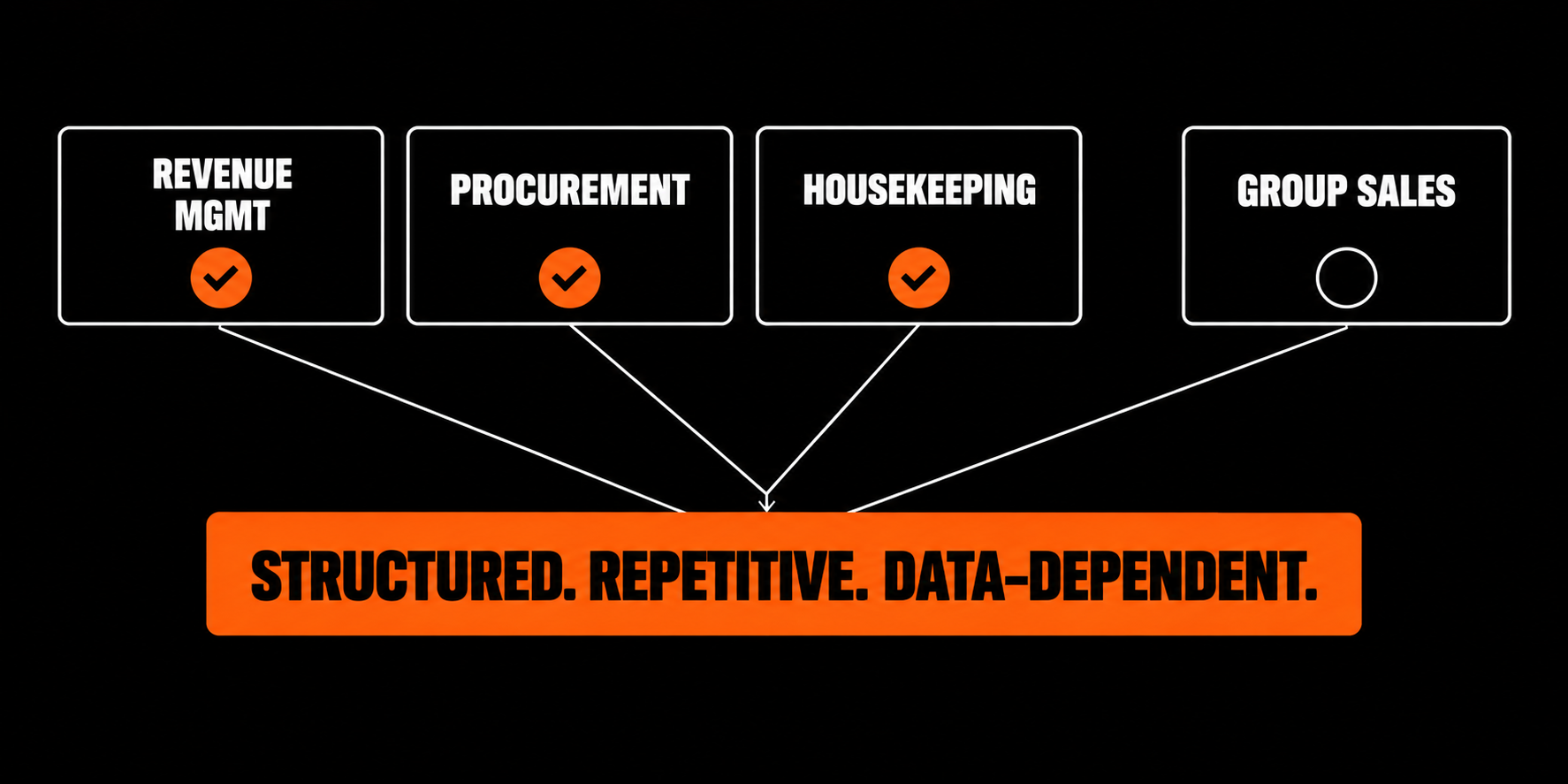
Looking at pricing automation, travel search, guest commerce, procurement, and housekeeping side by side, a consistent pattern emerges. In every case, AI is applied to a repeatable, data-heavy process rather than to a judgment call. In every case, the stated goal is reallocating staff time toward higher-value work, not eliminating roles outright. And in every case, the tool is designed to sit inside an existing workflow rather than replace it wholesale — which is very likely why these particular applications are showing measurable results while broader, more ambitious "AI transformation" efforts are still stuck at the pilot stage for most hospitality companies.
This matters for any hotel or hotel group evaluating where to apply AI next. The applications delivering real returns right now share three characteristics: they operate on structured data that already exists somewhere in the business, they automate a task that is repetitive and rules-based rather than purely relational, and they're built to integrate with — not replace — the systems a property is already running.
The Operational Gap AI Hasn't Closed Yet
Revenue management, guest messaging, procurement, and housekeeping have all attracted significant AI investment because they're high-volume, data-rich, and relatively contained. Group and event sales has generally not attracted the same level of attention, despite sharing many of the same characteristics: a hotel group sales team fields a high volume of structured requests — RFPs, rate inquiries, availability checks — that follow a repeatable process and depend on data the hotel already holds in its CRS, PMS, and CRM.
That gap shows up in the numbers. Roughly 36% of group RFPs go unanswered altogether, and the sales team's win rate correlates heavily with speed: responding within four hours of receiving an RFP is associated with a 20 to 30 point advantage in win rate over slower responses, and 61% of won deals go to one of the first three properties to respond. Processing a single RFP manually — pulling availability, checking rates, drafting a proposal — typically takes a sales manager somewhere around 37 minutes, multiplied across every inquiry a property or group receives. Industry estimates put the resulting revenue leakage, across missed and slow-handled RFPs, at roughly $500,000 per salesperson per year, while surveys of hospitality sales teams suggest more than 70% of a seller's time goes to administrative and non-selling tasks rather than actual selling.
In other words, group sales has the same underlying shape as the workflows where AI is already succeeding elsewhere in hospitality — structured, high-volume, and data-dependent — but it has largely been left out of the current wave of hotel AI adoption, which has concentrated on guest-facing and pricing use cases first.
What to Look for When Evaluating an AI Tool for Hotel Operations
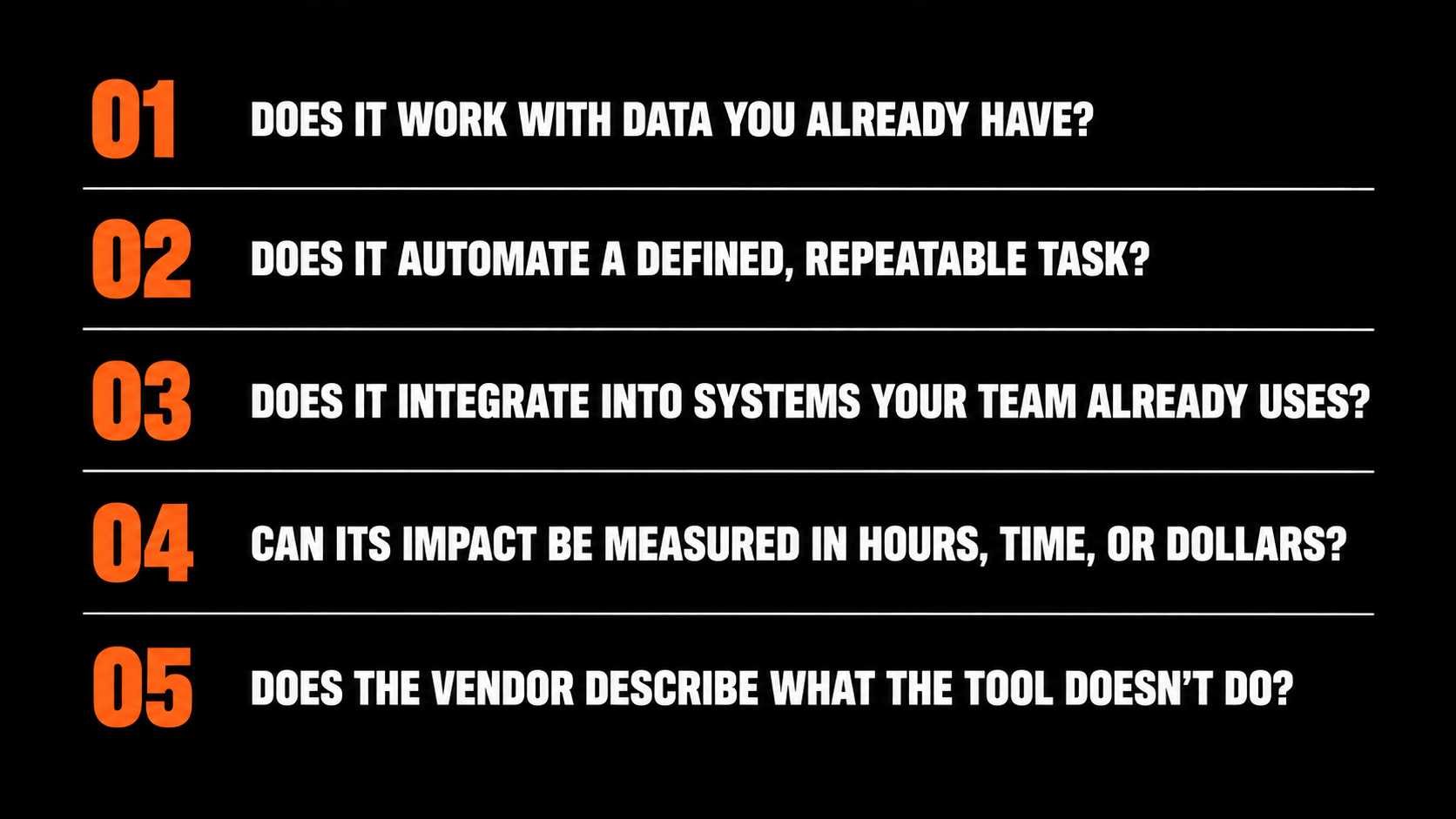
Given how uneven the results have been across the industry, a few criteria are worth applying to any AI tool under consideration, regardless of which function it targets:
- Does it work with the data you already have, or does it require a separate data-cleanup project before it delivers any value?
- Does it automate a defined, repeatable task, or is it attempting something more open-ended that's harder to measure and harder to trust?
- Does it integrate into the systems your team already uses daily — PMS, CRS, CRM — rather than asking staff to adopt an entirely new interface?
- Can its impact be measured in hours saved, response time, or dollars recovered, rather than only in vague terms like "efficiency" or "personalization"?
- Does the vendor describe what the tool doesn't do, as well as what it does? The strongest AI applications in hospitality, across every example above, are narrow by design rather than broadly promising to "transform" the business.
Those questions apply just as well to group sales technology as they do to revenue management or procurement software, and they're a reasonable filter for separating tools built around a specific operational problem from tools built primarily around the word "AI."
The Takeaway
The headline number — hotels are "using AI" almost universally — obscures a more useful and more interesting reality: a small number of specific, well-defined applications are producing real operational gains, built by companies that understood exactly which repetitive, data-heavy task they were automating. Revenue management, travel search, guest commerce, procurement, and housekeeping have all been reshaped by this approach in 2026. Group and event sales, with its high volume of structured, time-sensitive requests, fits the same pattern and represents one of the more clearly underserved areas of hospitality AI adoption today.
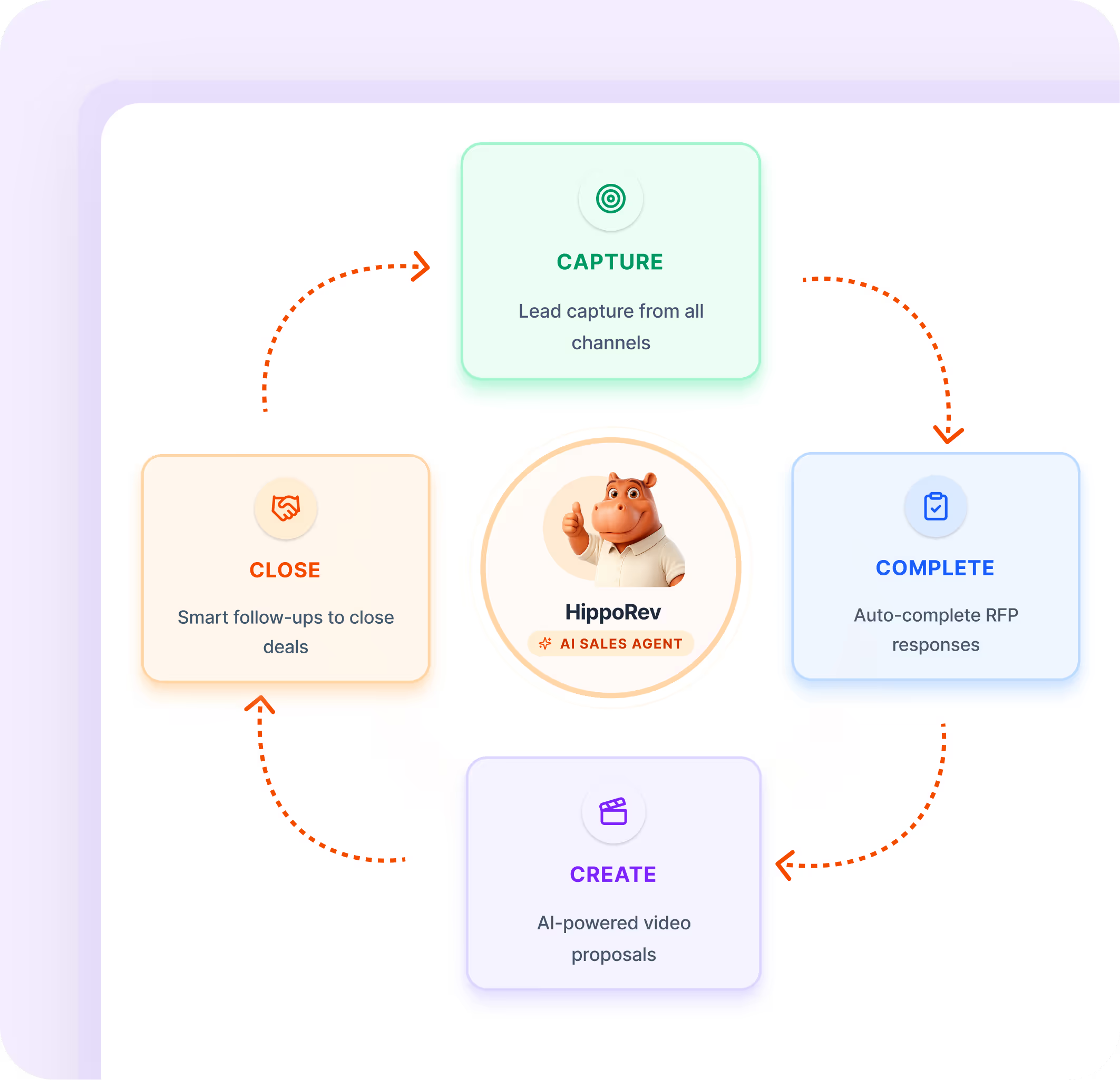
If your team is sitting on the same kind of repetitive, data-dependent workload in group sales — RFP intake, pricing lookups, follow-up, and proposal assembly — that AI has already streamlined in revenue management and procurement, Hippo Rev is built to address that specific gap. It works as a system of execution alongside your existing CRS and PMS, with Hippo Mate handling RFP intake, follow-up, and pricing so response times stop depending on how many other requests are already in a salesperson's queue. You can see how it fits into an existing sales workflow by booking a Capture Audit, a free 20-minute session built around your team's own numbers.
Frequently Asked Questions
What are hotels actually using AI for in 2026, beyond chatbots?
The most measurable applications are revenue management (using AI to interpret forward-looking booking data for pricing), procure-to-pay automation (invoice extraction and vendor management), AI-driven travel search and discovery, connected "commerce layer" systems that unify guest data across the PMS, CRS, and CRM, and physical automation like AI-guided cleaning robots.
Why is there such a big gap between hotel AI "adoption" and actual AI use?
Most adoption statistics count any use of AI, including a single chatbot or a basic automation, as "adoption." Analyses that look at how deeply AI is embedded across a hotel's operations — such as BCG's 2026 research with NYU — find that fewer than 10% of hospitality companies have reached a mature stage where AI is generating substantial, measurable value across multiple functions.
Is AI actually reducing hotel labor costs, or just shifting tasks around?
Both, depending on the function. In procurement, AI has cut invoice-processing and cycle times substantially by removing manual data entry. In housekeeping, AI-guided robots have reduced overtime and outsourced labor costs while improving consistency. In most cases, hotels report reallocating staff time toward guest-facing or higher-judgment work rather than reducing headcount outright.
Which hotel functions have seen the least AI investment so far?
Group and event sales is one of the more notable gaps. Despite handling a high volume of structured, repeatable requests — RFPs, rate checks, proposal drafting — that resemble the workflows AI has already automated in revenue management and procurement, group sales has generally not received the same level of AI investment, leaving a substantial amount of manual work and missed response-time opportunity in place.
Do hotels need to overhaul their existing systems to use AI effectively?
Not necessarily. The AI applications showing the strongest results in 2026 are generally designed to connect with a hotel's existing PMS, CRS, and CRM rather than replace them, which lowers the barrier to adoption and shortens the time to measurable results.
Share this post
Ready to close more group business?
See how HippoRev can transform your hotel sales workflow in 15 minutes.

Follow us


.svg)