


AI & Sales Technology
AI Adoption in Hotel Sales: A Low-Risk Path
Hotel commercial teams are not stalling on AI because they doubt its potential. They are blocked by ROI uncertainty, IT concerns, workflow friction and weak proof. This article explains five common barriers to AI adoption in hotel sales and how a contained pilot can turn assumptions into measurable operating evidence.



Why Hotel Commercial Teams Stall on AI
At HITEC 2026, something quietly changed. For a couple of years, every hospitality tech event ran the same script: someone said "AI" on stage, the room nodded, and everyone went back to their booth. This year the debate about whether AI matters was simply over. The harder, more useful question took its place: which parts of this are real, and how do we actually adopt them without betting the year on a promise?
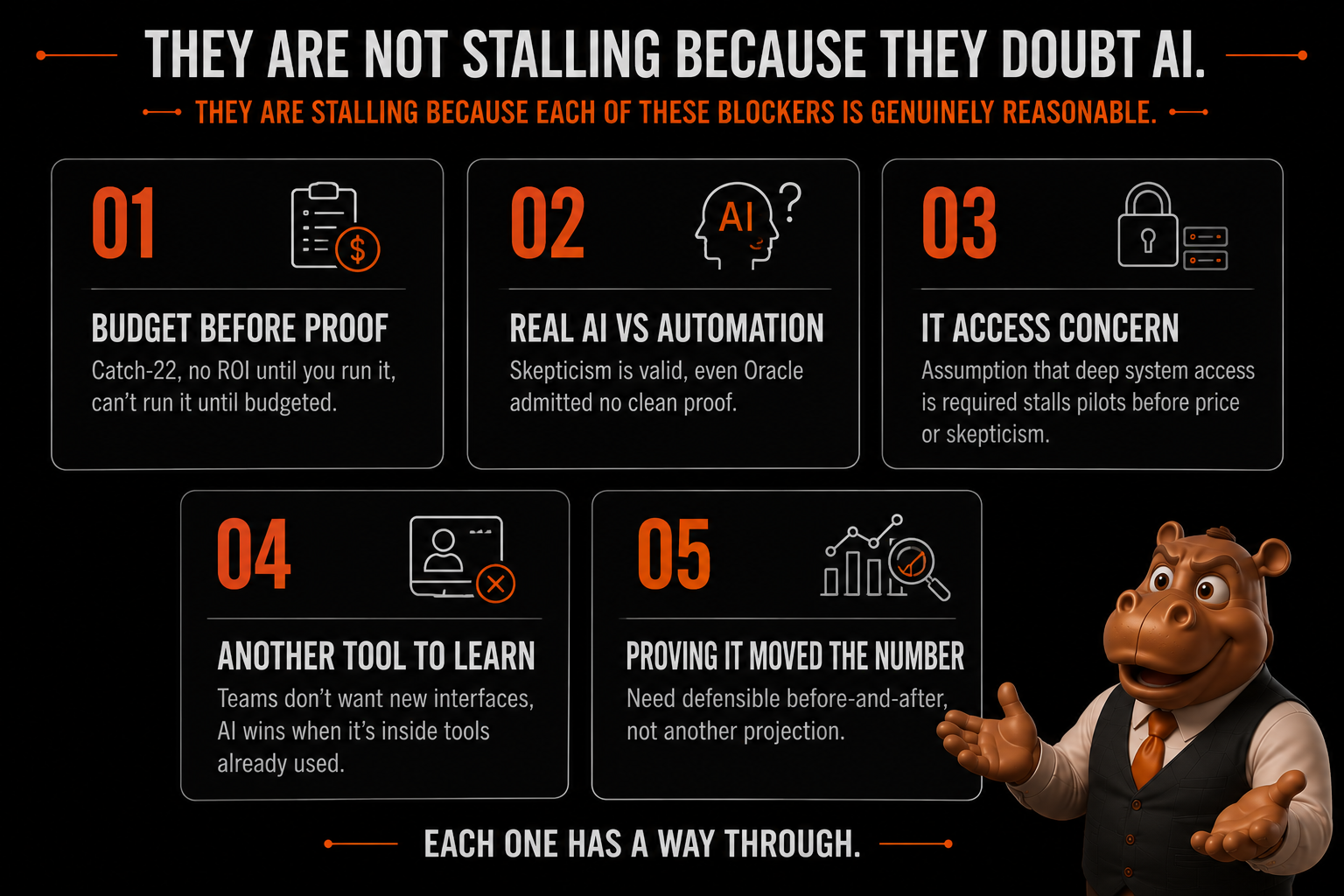
That is the question most commercial and revenue leaders are sitting with right now. And here is the honest part: they are not stalling because they doubt AI. They are stalling because bringing it in, especially during budget season, is genuinely difficult. There are five real blockers. Each one is reasonable. And each one has a way through.
Blocker 1: You have to budget for it before you can prove it
This is the catch-22 that stops more AI initiatives than any other. Leadership wants an ROI estimate before approving spend. But your team cannot produce a credible estimate until it has run the workflow on real RFPs, at your real volume, with your real win rates. You cannot know until you run it, and you cannot run it until it is budgeted.
So the initiative quietly drops out of the 2027 plan. A few months later the same team is asked to make the case through a mid-year reforecast, with less time, less evidence, and more resistance. The number that finally goes into the plan is the weakest kind of number: a guess made before anything was tested.
Blocker 2: "Is this real AI, or automation wearing a costume?"
Leaders are right to be skeptical, and the industry finally said so out loud. At HITEC 2026 even Oracle admitted it does not yet have a clean way to prove AI's value, because nobody has enough results to point to. A HotelKey executive put it plainly: payment automation is rule-based, and it should not be sold as AI just because it is automated.
A useful test is the difference between a calculator and a doctor. A calculator is fast because the problem is fully defined, one right answer, found instantly. A doctor is valuable precisely because the problem is not defined, symptoms are ambiguous, and judgment fills the gap. A lot of what gets sold as AI is a very fast calculator with a friendlier face. That is not nothing, speed has real value, but it is not judgment, and paying an AI premium for automation is how budgets get wasted. The fix is not more claims. It is proof on your own data.
Blocker 3: "AI needs our data, so IT has to clear it"
The assumption is that any AI tool needs deep access to internal systems, which means a security review and a quarter you do not have. That single assumption stalls more pilots than price or scepticism combined.
There is a second, newer data problem underneath it. HITEC surfaced that hotels typically start with about a third of their facts misaligned across the sources AI assistants pull from, and that AI models actually distrust polished marketing copy and lean on guest reviews instead. Being "AI-legible" is becoming its own advantage. Both problems point the same way: before you hand an AI system deep access, start with a version that needs no new access at all, running on the reports your team already exports.
Blocker 4: Nobody wants another tool to learn
The clearest lesson from HITEC 2026 was that AI is no longer a feature, it is becoming infrastructure, and it wins when it sits inside the tools hotels already use rather than living next to them as a separate app. Oracle built its assistant directly into OPERA Cloud. The startups that stood out read an inbox and worked across the PMS in the background, turning ten minutes of tab-switching into thirty seconds, without asking anyone to change their habits.
The practical move: if a vendor is pitching a brand-new interface your team has to be trained on, ask why it does not live inside the systems you already pay for. Sometimes there is a good answer. Often there is not.
Also read: 7 Reasons Teams Stay Manual
Blocker 5: Proving it actually moved the number
The bar the whole industry quietly agreed to at HITEC was simple and hard to dodge: show me the result. Commercial leaders do not need another projection. They need a defensible before-and-after they can take into a revenue meeting.
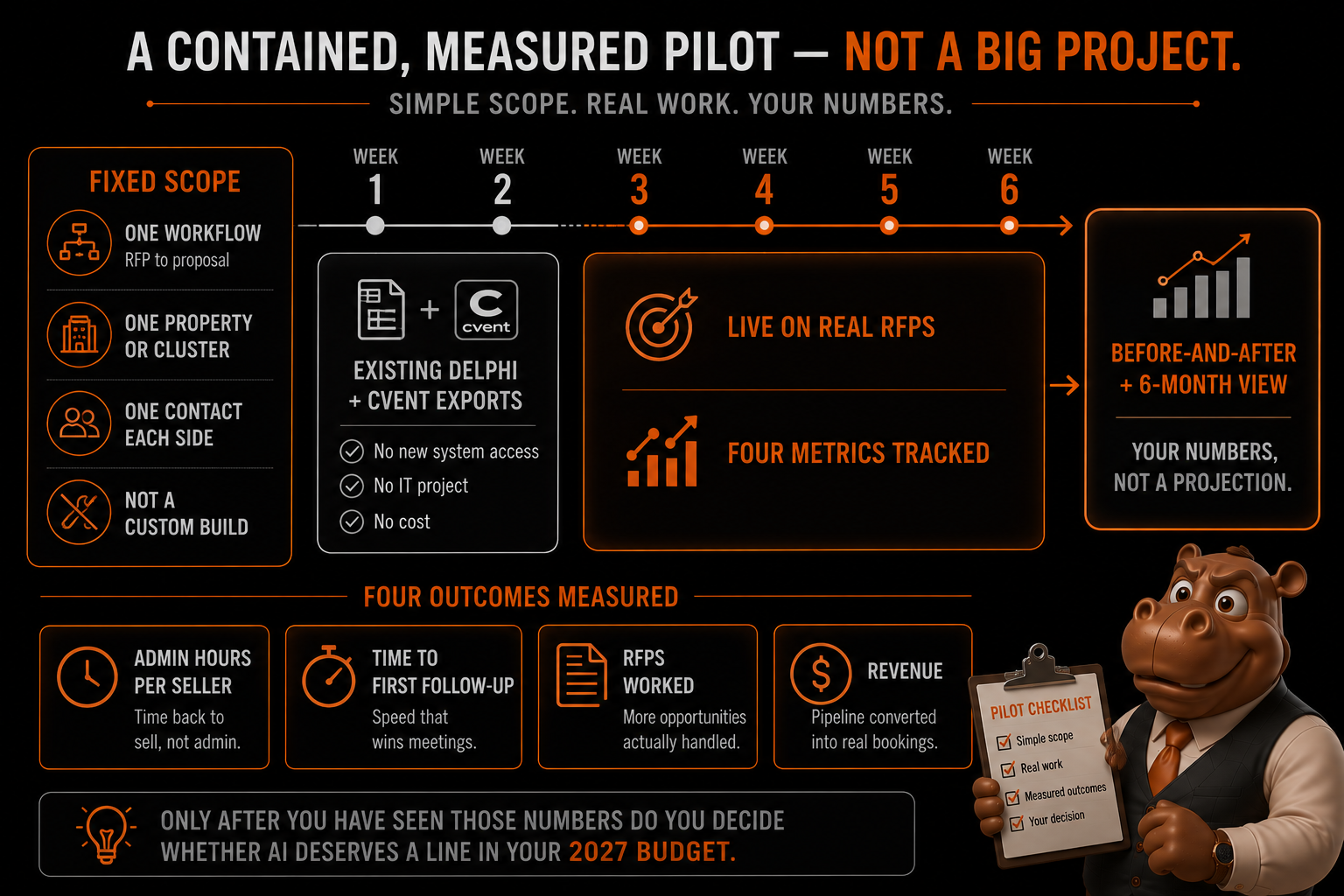
That means agreeing, up front, on the few things that matter and can be measured on your own data: admin hours per seller, time to first follow-up, RFPs worked per seller, and revenue. Measured, not modelled.
The low-risk way through: prove first, budget second
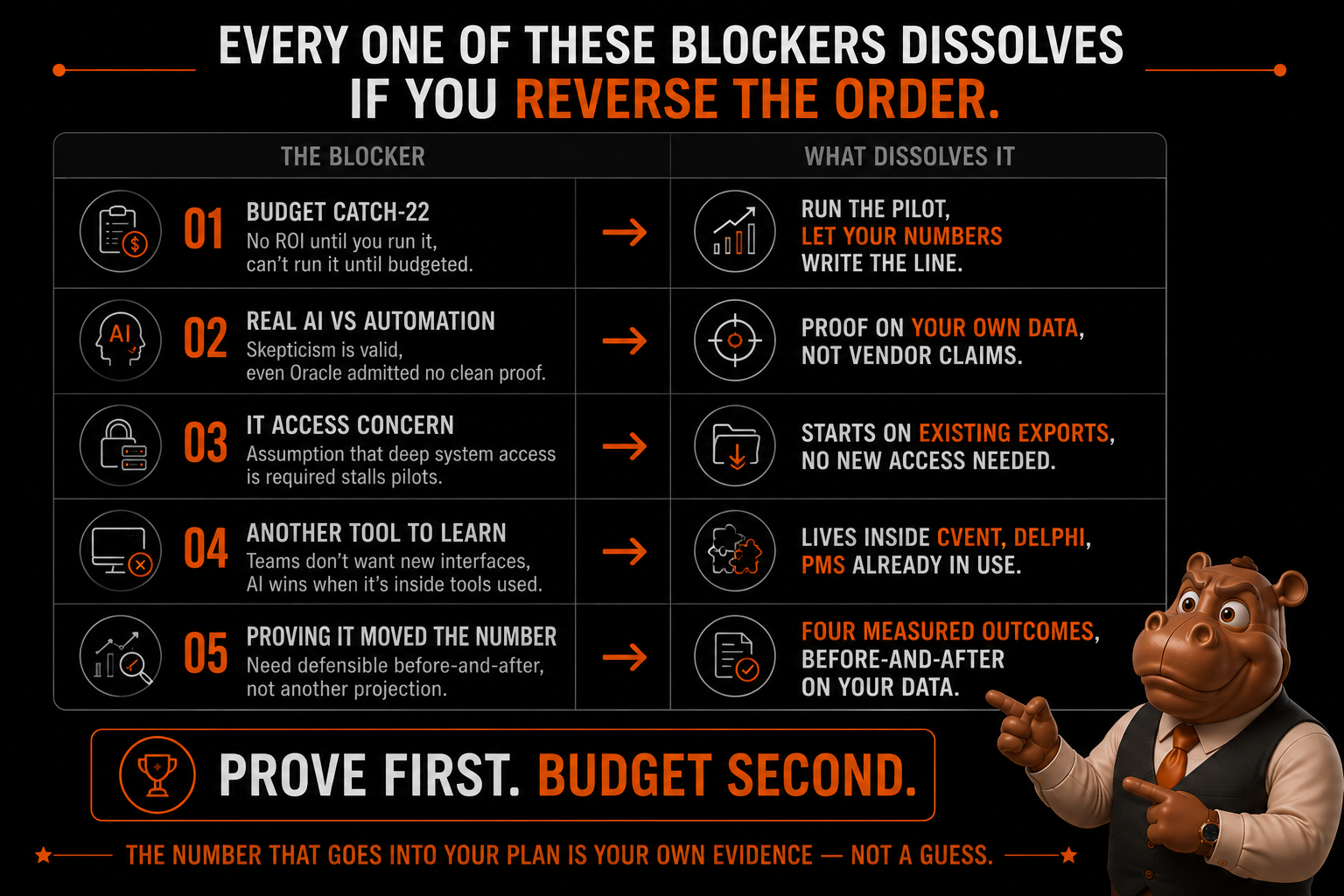
Every one of these blockers dissolves if you reverse the order. Instead of budgeting on faith and hoping the results follow, you run a small, free pilot first, and then let your own numbers write the budget line. But the words 'a pilot' mean nothing until you know exactly what it is, so here is the plain version.
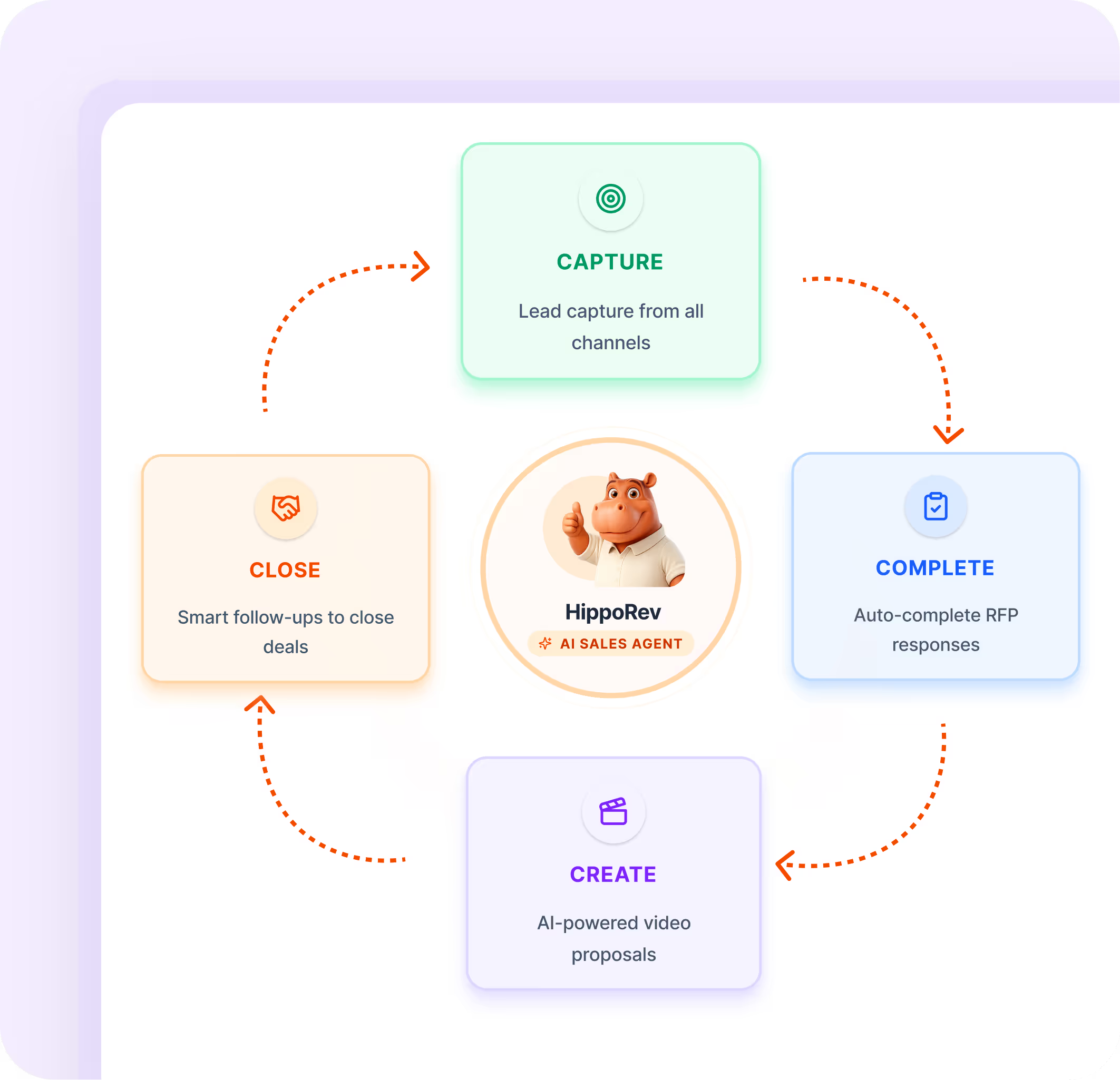
Start with what Hippo Rev actually does. It is the execution layer for hotel group sales. It sits on top of the systems you already run, Cvent, Delphi, your PMS and RMS, and it runs the group-sales workflow for you. When an RFP comes in, it captures it, fills in the missing details, pulls the pricing, drafts a priced proposal in minutes, and keeps the follow-up going so no deal goes cold. A person on your team still reviews and sends every proposal, so the judgment stays human.
The pilot is a small, contained version of exactly that, run free for six weeks. The scope is fixed, not a custom build: one workflow (RFP to proposal), one property or cluster, and one named contact on each side. Weeks one and two are onboarding, using only the Delphi and Cvent reports your team already exports, which is why there is no new system access, no IT project, and no cost. Weeks three to six run live on your real RFPs.
What it targets is the exact place group revenue leaks, your RFP process. How it helps is simple: it lifts the repetitive admin off your sellers, the intake, the chasing, the pricing pull, the first draft, and it makes follow-up instant, so the same team can work more RFPs and answer them faster. What that helps with, in order, is response time, then RFP throughput, then win rate, and finally captured group revenue.
And the numbers you walk away with are your own, not a projection. At the end you get a clear before-and-after across four measures, admin hours per seller, time to first follow-up, RFPs worked per seller, and revenue, plus a simple six-month view built from them. Only after you have seen those numbers do you decide whether AI deserves a line in your 2027 budget.
Five questions to ask any AI vendor before budgets lock
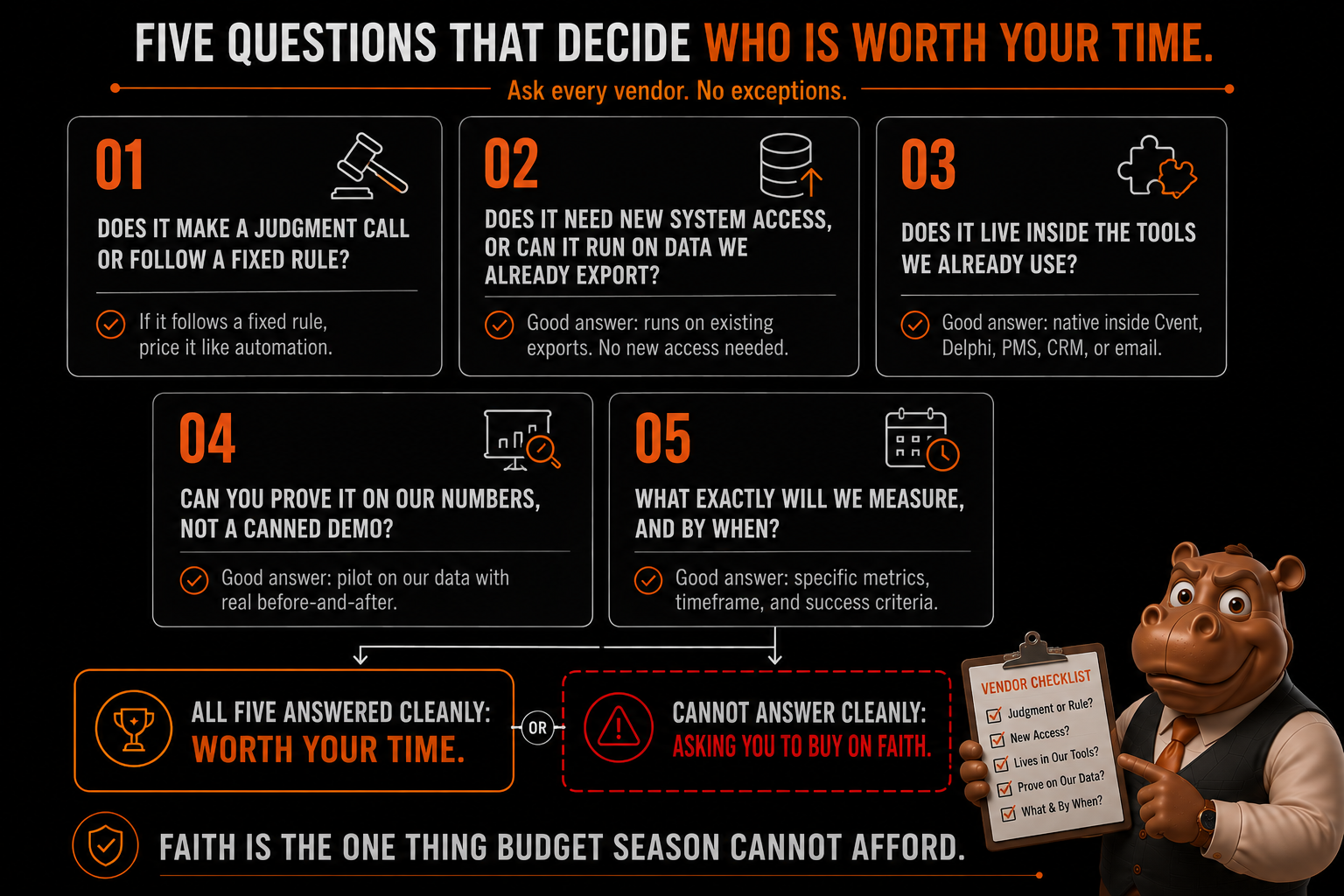
Adapt this from the posture the industry took at HITEC. First, does the system make a judgment call or follow a fixed rule? If it is a rule, price it like automation, not AI. Second, does it need new access to our systems, or can it run on data we already export? Third, does it live inside the tools we already use? Fourth, can you prove it on our numbers, not a canned demo? Fifth, what exactly will we measure, and by when? A vendor who can answer all five cleanly is worth your time. One who cannot is asking you to buy on faith, which is the one thing budget season cannot afford.
Frequently Asked Questions
How can a hotel prove the ROI of AI before putting it into the annual budget?
The strongest approach is to test the AI against a narrow, measurable workflow before committing budget. For hotel group sales, that could mean running a limited pilot on live RFPs and comparing results against the existing process.
What should a hotel actually measure during an AI pilot?
Measure outcomes that are close enough to the workflow for the AI to influence them directly. In group sales, useful measures include admin hours per seller, time to first follow-up, proposal turnaround time, RFPs worked per seller, and revenue generated from those opportunities. Broader metrics such as total hotel revenue may be too far downstream to tell you whether the AI itself worked.
How can hotel leaders tell the difference between AI and ordinary automation?
Ask whether the system is making decisions in situations where the inputs are incomplete or variable, or simply following predefined rules. A workflow that moves data from one field to another when a condition is met is automation. A system that interprets an RFP, identifies missing information, determines the next workflow step, or generates a proposal from changing inputs involves a greater degree of AI-driven reasoning. The distinction matters because hotels should not pay an AI premium for simple rules-based automation.
Can a hotel test AI without launching a full IT integration project?
Yes, the Hippo Rev pilot is deliberately designed around existing data flows. For example, a hotel can test an RFP workflow using reports its sales team already exports rather than immediately connecting the AI directly to core systems. This allows the commercial team to evaluate whether the workflow improves response time, seller capacity, and revenue outcomes before deciding whether deeper integration is justified.
Which hotel sales workflows are best suited for an AI pilot?
The best starting point is usually a workflow that is repetitive, high-volume, measurable, and still contains enough judgment that simple automation cannot solve the entire problem. Group RFP processing is one example because sellers repeatedly collect information, check pricing and availability, draft proposals, and follow up.
Share this post
Ready to close more group business?
See how HippoRev can transform your hotel sales workflow in 15 minutes.

Follow us


.svg)