


AI & Sales Technology
Hotel RFP Automation: How AI Helps Sales Teams Win Faster
AI is helping hotel group sales teams reduce RFP turnaround by automating manual intake, data gathering, proposal drafting, routing, and follow-up. The article explains why response speed affects win rates, where traditional RFP workflows lose time, and how hotels can use AI while preserving data quality, security, and human approval.



.jpg)
How AI Is Cutting Hotel RFP Response Times From Days to Hours
Hotel group sales teams lose deals for a reason that has nothing to do with rate or property quality: they simply answer too slowly. Meeting and event planners routinely send the same RFP to multiple venues at once, and the property that responds first often wins before the others have finished their pricing review. For hospitality sales teams still working through Requests for Proposals (RFPs) by hand, that speed gap is now one of the biggest controllable factors in win rate.
This article looks at what's actually driving the industry's shift from multi-day RFP turnaround to same-day and near-real-time response, what the current data says about the payoff, and what a hotel group should look for if it's evaluating AI to close that gap.
Why RFP Response Time Decides Who Wins the Deal
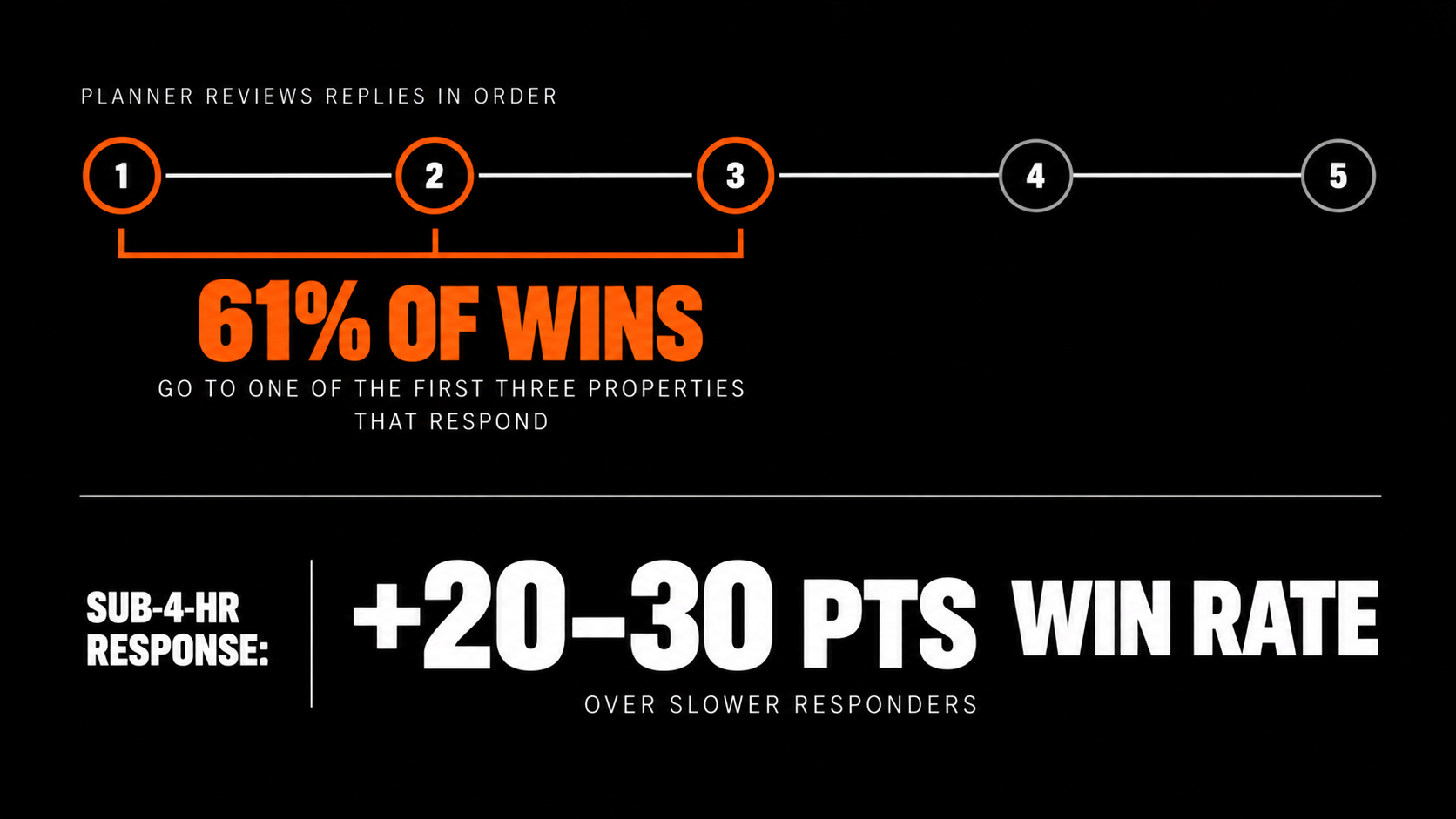
Response speed is not a minor operational metric in group sales. It's one of the clearest predictors of who wins the business. Roughly 61% of won hotel RFPs go to one of the first three properties that respond, and a sub-4-hour response time correlates with a 20 to 30 percentage point win-rate advantage over slower responders. In a category where the average hospitality RFP win rate already sits at just 5% to 7% (compared with roughly 44 to 45% across industries broadly), that gap is the difference between a sales team that competes and one that's perpetually catching up.
The math behind this is straightforward. A meeting planner sourcing a group event typically sends the RFP to several venues in parallel, then works down the list of replies as they arrive. Properties that respond within hours stay in the conversation while the planner is still actively comparing options. Properties that take a day or two often arrive after a shortlist has already formed, meaning the proposal gets a fraction of the attention it would have received earlier, if it gets read at all.
Recent industry benchmarking backs this up. According to Loopio's 2026 RFP trends analysis, the average win rate across industries climbed to 45% in 2025, up from 43% the prior year, with the improvement concentrated among teams that tightened their response process rather than teams that simply wrote more proposals. Speed and process discipline, not proposal volume alone, are what move the win rate.
What Actually Slows Down a Hotel RFP Response
Before looking at AI's role, it's worth being specific about where the time actually goes, because "slow RFP response" usually isn't one problem. It's several smaller ones stacked together:
- RFPs get missed entirely. An estimated 36% of RFPs sent to hotels go unanswered, not because the property couldn't win the business, but because the request landed in an inbox, a portal, or a shared folder that nobody checked in time.
- Manual intake and triage eats the clock. Processing a single RFP by hand, pulling it from email or a sourcing platform, checking dates against group inventory, routing it to the right salesperson, takes about 37 minutes on average when done manually.
- Sellers spend most of their time on work that isn't selling. Industry data puts the share of a seller's week spent on non-selling tasks, data entry, searching for past proposal language, chasing internal approvals, at roughly 71%.
Analysts estimate this combination of missed, delayed, or under-resourced RFP response costs a hotel salesperson roughly $500,000 in annual revenue leakage, primarily through business that goes to a faster-responding competitor.
None of this is really about writing quality. It's about how much of the "before the writing starts" process, finding the RFP, pulling the right rates and past answers, checking availability across systems, is manual. That's the part AI has started to compress.
From Days to Minutes: What AI Actually Changes
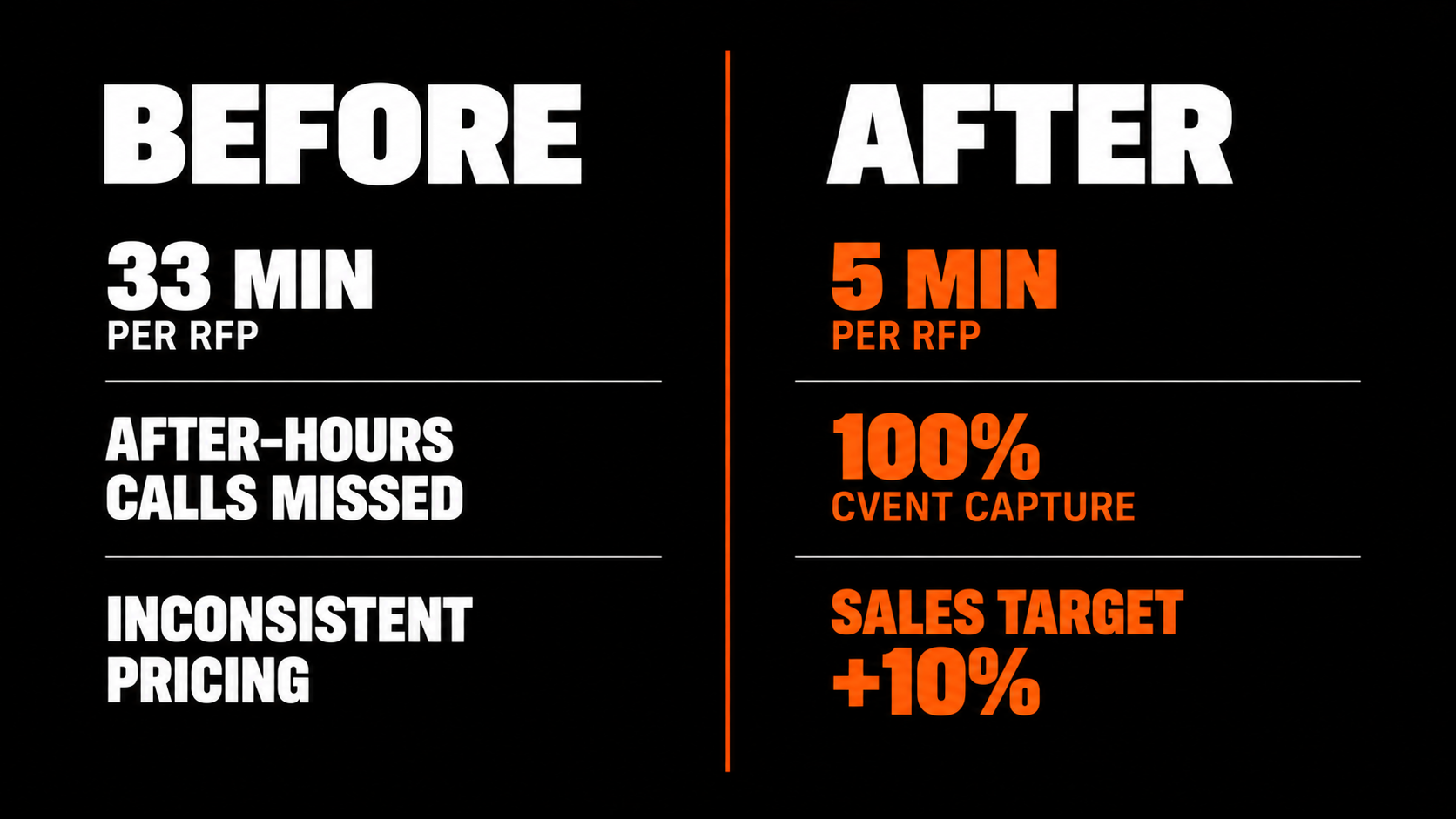
A useful illustration of how this plays out comes from Wyndham Indianapolis West, a 407-room property with roughly 37,000 sq ft of meeting space, which deployed Hippo Rev in 2026. The hotel's group sales demand came from Cvent, VisitIndy, Eventective, Wyndham Community, and direct email and phone, with 312 Cvent RFPs alone in the prior twelve months. Every one of them triggered the same manual sequence: check availability in Opera, pull current rates from Lighthouse, check planner history in Delphi, build the proposal in a Word template, review, send. That process took about 33 minutes per RFP, and with roughly 26 Cvent RFPs a month before counting other channels, a single rep was losing the better part of two days a week to admin. After-hours calls rolled to voicemail, and pricing varied rep to rep since it came down to whoever happened to be handling the request.
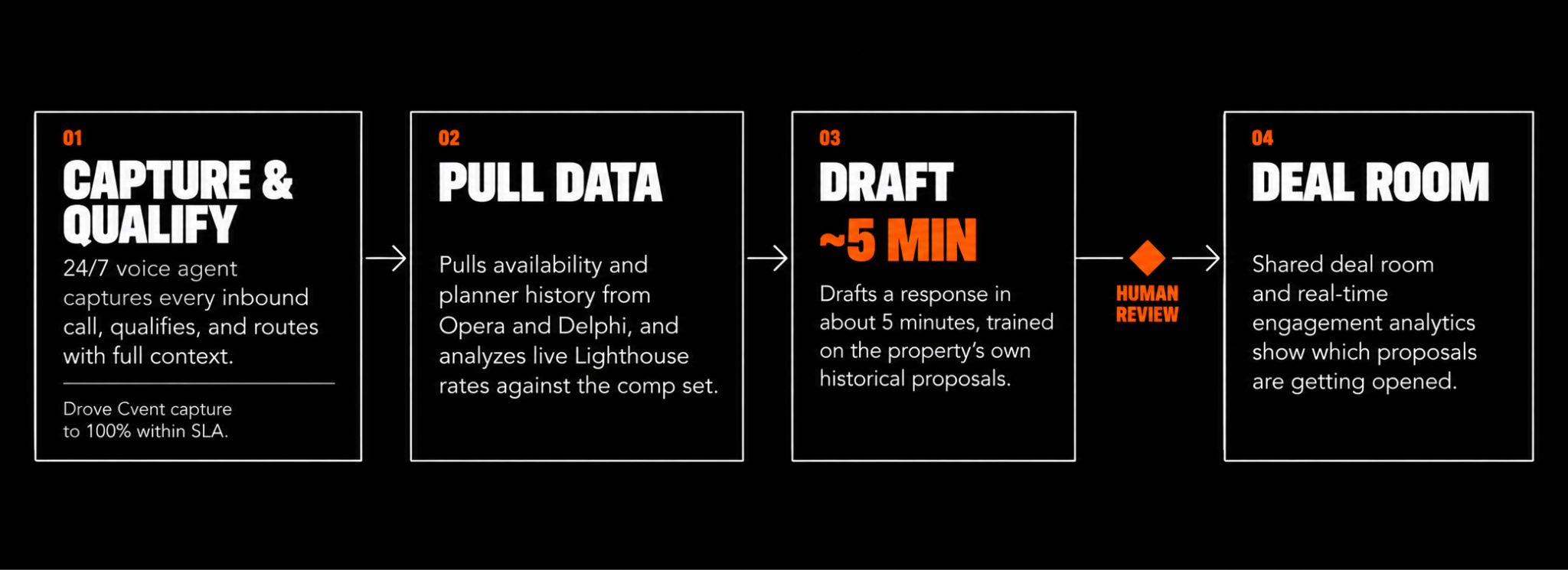
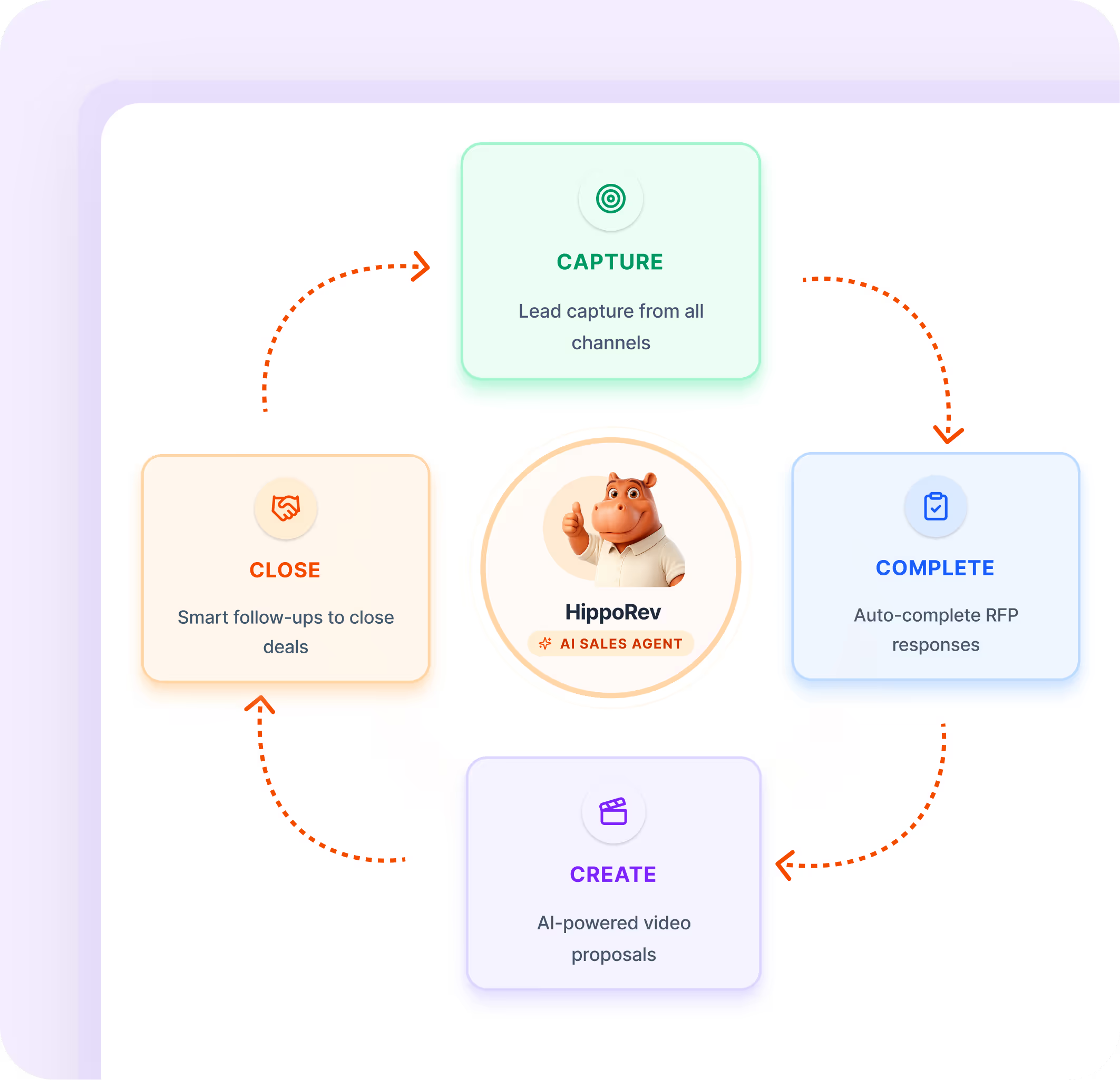
Hippo Rev went live as an overlay on the property's existing systems, no migration, no new tools to learn, in 10 days, and now runs across all three stages of the lifecycle. A 24/7 voice agent captures and qualifies every inbound call and routes it with full context, which brought Cvent capture to 100% within SLA. For proposals, the system pulls availability and planner history from Opera and Delphi, analyzes live Lighthouse rates against the comp set, and drafts a response in about 5 minutes, trained on the property's own historical proposals so it reads in the team's voice. A shared deal room and real-time engagement analytics show which proposals are actually getting opened.
Owner Rita Patel-Chevere put it plainly: "My team is finally doing what they should be doing. Not typing RFPs. Closing deals." The results: RFP turnaround cut 85%, from 33 minutes to 5, 100% Cvent capture, and a property sales target raised 10% on the strength of the new run rate.
Why Speed Alone Isn't the Whole Story
It's worth being precise here: faster is not automatically better if it comes at the cost of accuracy. Wyndham's pricing recommendations are built directly from the property's own comp set and proposal history specifically to prevent the kind of plausible-sounding but incorrect output that's a well-documented risk with generative systems operating outside a controlled data set.
In all such cases of successful AI adoption, consistent property data is especially important, because hotel RFP data inconsistency can undermine automation when different systems, documents, or team members are working from conflicting information. Read more about it here.
What a Hotel Sales Team Should Look For in AI-Assisted RFP Tools
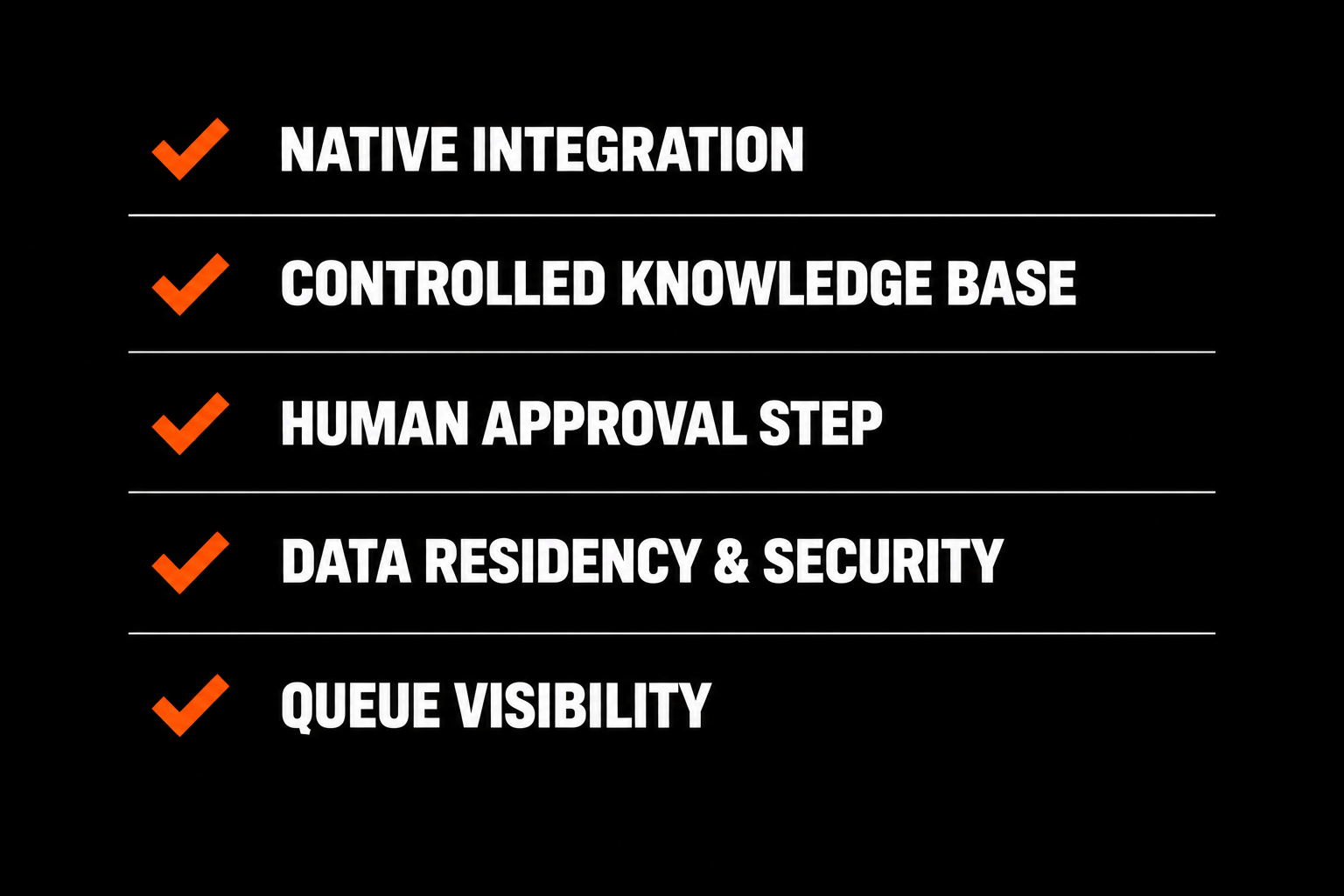
Given the operational and governance complexity involved, a few criteria separate tools that genuinely close the response-time gap from ones that add another disconnected system:
- Native integration with existing group sales infrastructure. A tool that requires manually re-keying data from Delphi, Cvent, or Opera into a separate system reintroduces the manual step it's supposed to remove.
- A controlled, brand-approved knowledge base. Answers should be drawn from a hotel's own past proposals, rate sheets, and property data, not generated from general web knowledge, to avoid the hallucination risk described above.
- A human approval step before anything reaches a planner. Speed shouldn't come at the cost of a final quality and accuracy check.
- Data residency and security controls appropriate to sensitive pricing and client information. RFP content includes competitive rate data and client details that shouldn't be processed by, or used to train, public AI models.
- Visibility into where RFPs stall. Teams benefit from knowing not just how fast they're responding on average, but which specific requests are sitting unanswered, so nothing falls through simply because no one was watching the queue.
The Bottom Line
The shift from multi-day RFP turnaround to same-day, and in many cases sub-hour, response is no longer an aspirational benchmark. It's what current AI-assisted proposal workflows are already delivering, provided the underlying data is well-governed and a human stays in the approval loop. For hotel group sales teams operating in a category where win rates already run far below the cross-industry average, and where the first three responders capture the large majority of won business, response speed is one of the few levers that's both fully within a sales team's control and directly tied to revenue outcomes.
The RFPs that get answered fastest and most accurately aren't necessarily coming from the largest sales teams. They're coming from teams whose intake, drafting, and follow-up no longer depend on someone manually checking an inbox, cross-referencing three different systems, and starting a proposal from a blank template.
That gap, between RFPs that get a fast, accurate answer and RFPs that quietly go unanswered or arrive too late to matter, is exactly what Hippo Rev is built to close for hotel group sales teams. It's designed to sit on top of the systems teams already use, catching and triaging incoming RFPs, pulling from a property's own approved content to draft a first response, and surfacing the requests at risk of going unanswered, all with a human still reviewing before anything is sent. If missed or slow RFP responses are costing your team business, you can see what that looks like against your own numbers with a free Capture Audit.
Frequently Asked Questions
How much faster can AI make hotel RFP response times?
Industry benchmarking shows average manual drafting time of roughly 25 hours per RFP, with AI-assisted teams cutting that to under 5 hours for standard requests. Hospitality-specific processing tasks that take about 37 minutes manually can drop to roughly 4 minutes when intake and drafting are automated.
Why does RFP response speed matter so much for hotels specifically?
Meeting planners typically send the same RFP to several venues at once and often work through responses in the order they arrive. About 61% of won deals go to one of the first three properties that respond, and hospitality's average win rate of 5-7% is already well below the roughly 44-45% average across other industries, making speed one of the few controllable factors that meaningfully moves the outcome.
Does faster AI-generated response mean lower quality?
Not when the AI draws only from a hotel's own approved content and a human reviews every proposal before it's sent. The risk of inaccurate or generic-sounding output comes from letting AI generate answers outside a controlled knowledge base, not from automation itself.
What's the biggest hidden cost of slow RFP handling?
Beyond lost individual deals, the combination of missed RFPs, manual triage time, and non-selling administrative work is estimated to cost a hotel salesperson roughly $500,000 in annual revenue leakage, mostly to competitors who simply responded first.
Is AI adoption for RFP response actually common yet, or still early?
It's moved past early-adopter territory. Generative AI use among proposal teams roughly doubled between 2023 and 2025, from about 34% to 68%, with nearly a third of adopters using it daily rather than occasionally.
Share this post
Ready to close more group business?
See how HippoRev can transform your hotel sales workflow in 15 minutes.

Follow us


.svg)