


Multi-Property & Portfolio Management
Scaling Group Sales Across a Multi-Property Hotel Portfolio
Group sales break down as a hotel portfolio grows, with lost overflow leads, cross-property bidding wars, and inconsistent contract terms. This article covers how to treat group demand as a portfolio-wide asset with lead sharing, fit-based routing, displacement-driven pricing, and one connected pipeline with shared KPIs.



Scaling Group Sales Across a Multi-Property Hotel Portfolio
Revenue management gets harder as a hotel portfolio grows, and most of the industry conversation about that problem focuses on pricing and forecasting: keeping rate strategy consistent across properties, centralizing demand data, coordinating a revenue management system at portfolio scale. That's a real and well-documented challenge. It's also not the only place multi-property growth breaks down, and it's arguably not the place breaking down fastest right now.
Group and event sales has its own version of the multi-property problem, and it gets far less attention. A single group RFP can land at three or four properties in the same market on the same day, handled by three or four different salespeople who have no idea they're quoting the same planner. A 200-room RFP that one property can't accommodate often just gets declined, rather than routed to a sister property down the road that could have taken it. Contract terms drift property to property until a customer plays one hotel against another inside the same ownership group. And a management company running twenty properties often has no reliable way to see, across the whole portfolio, which RFPs are stalling, which properties are responding fast, and which are quietly losing business nobody's tracking. That's a distinct problem from pricing consistency, and it compounds just as fast.
Why Multi-Property Group Sales Breaks Down Differently Than Pricing Does
Revenue management strategy typically fragments across a growing portfolio because pricing guidelines get set centrally while day-to-day rate decisions get made locally, with uneven tooling and manual overrides pulling execution away from intent. Group sales fragments for a related but distinct reason: RFPs arrive at individual properties through separate inboxes, so a planner sourcing three markets in the same portfolio gets treated as three unconnected leads, handled by three sales managers who never compare notes.
Each property typically configures its own sales process, its own pipeline stages, its own response habits, so portfolio-level reporting becomes an exercise in reconciling mismatched exports rather than reading a single dashboard. Response speed varies wildly by property staffing and workload, which means from a planner's perspective, the entire portfolio can look disorganized even when most individual properties are actually performing well. Hotels relying on manual lead tracking see sales cycles run 35 to 40 percent longer than teams using purpose-built group sales software, and at portfolio scale, that gap doesn't stay isolated to one property. It compounds across every property running the same manual process.
Treating Group Demand as a Portfolio Asset, Not a Property Asset
The fundamental shift that separates high-performing management companies from the rest is a change in the question being asked. A single hotel asks "how do I fill my rooms." A portfolio should be asking "how do I maximize the value of every group lead across every hotel we operate." Those are different questions with different answers, and the gap between them is where a meaningful amount of group revenue quietly disappears.
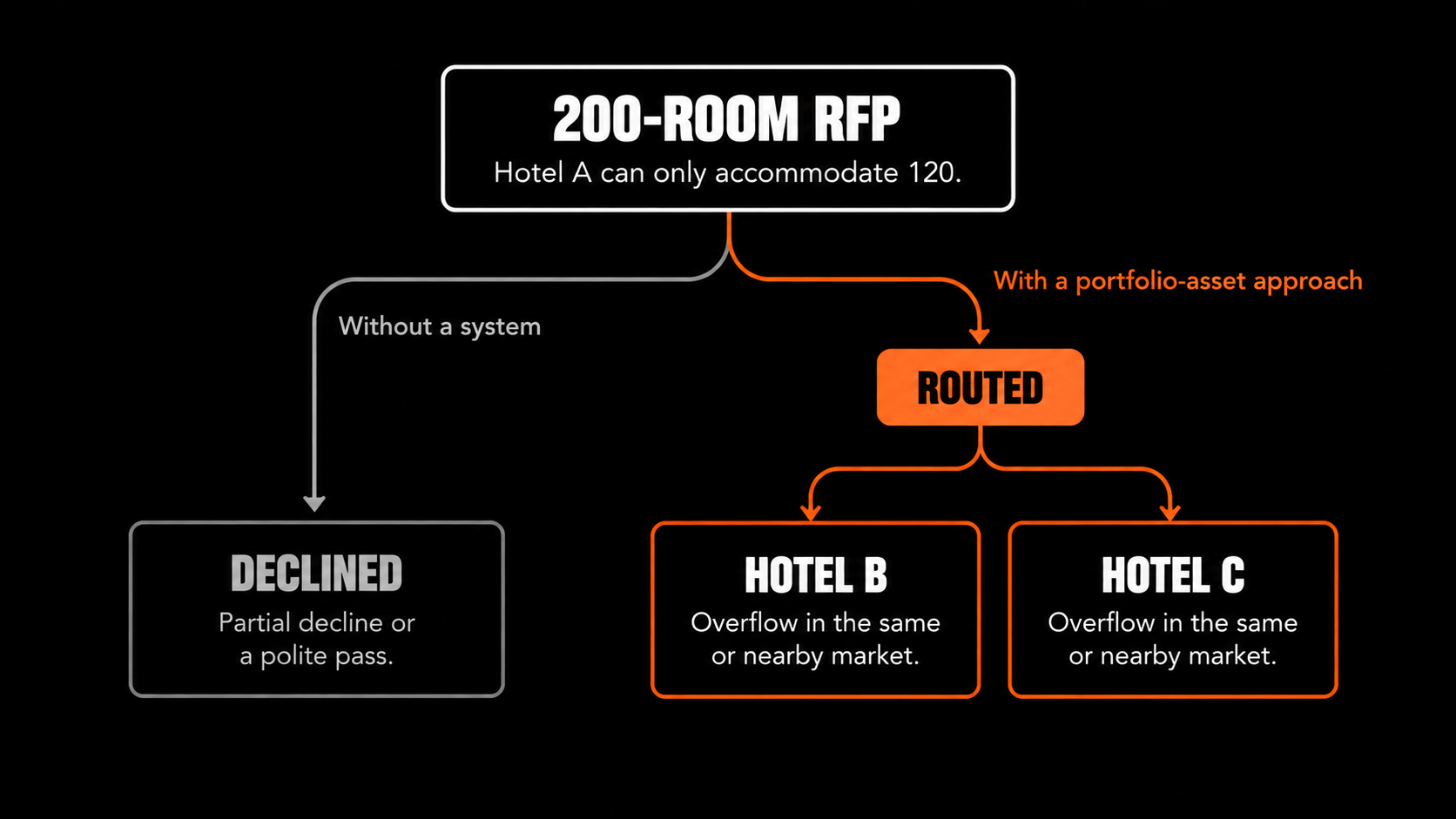
The clearest example is overflow. If Hotel A receives an RFP for 200 rooms but can only accommodate 120, the default outcome at most portfolios is a partial decline or a polite pass, full stop. A portfolio treating group demand as a shared asset instead routes the overflow, or the whole opportunity, to Hotels B and C in the same market or a nearby one. That sounds obvious stated plainly, but most management companies have historically lacked any centralized process for actually doing it, which is why portfolio-level lead sharing keeps showing up in industry analysis as an underused opportunity rather than a solved problem.
Making that work requires tracking more than just the RFP itself: the lead source, the account or planner identity, dates and room-night requirements, which hotels were considered, which ones declined and why, what revenue was ultimately booked, and whether the lead was successfully referred cross-property. Without that record, "we'll pass it to another property" is a one-off favor between sales managers who happen to know each other, not a repeatable system. With it, the operating principle becomes explicit: never lose a qualified group simply because the first property a planner happened to contact couldn't take it.
Centralizing Strategic Accounts Without Losing Local Relationships
A related inefficiency shows up on the outbound side. When twenty individual hotels are each independently prospecting the same category of accounts, national corporate clients, association meetings, sports groups, multi-city conference series, a portfolio is spending redundant effort chasing overlapping business rather than coordinating a single, better-resourced push.
The structure that solves this without flattening local expertise looks like a funnel: a corporate account or large-group opportunity gets identified at the portfolio level, portfolio sales matches it to the best-fit hotel or hotels, and the local property team takes over relationship management and day-to-day execution from there. National accounts, associations, sports groups, SMERF business, weddings, tour and travel, government, and large conferences are all reasonable categories for centralized prospecting, while the actual site visits, contract negotiation nuance, and ongoing relationship stay with the people who know the property. That combination, centralized intelligence and prospecting paired with decentralized relationship ownership, is generally where a management company can produce revenue an individual property working alone simply couldn't reach on its own.
Routing by Fit, Not Just by Whoever Has Availability
Even with lead sharing and centralized prospecting in place, a portfolio still needs a disciplined way to decide which property a given opportunity should actually go to. The instinct is to route by geography or plain availability, whichever hotel happens to have open dates. That's a weaker filter than routing by fit.
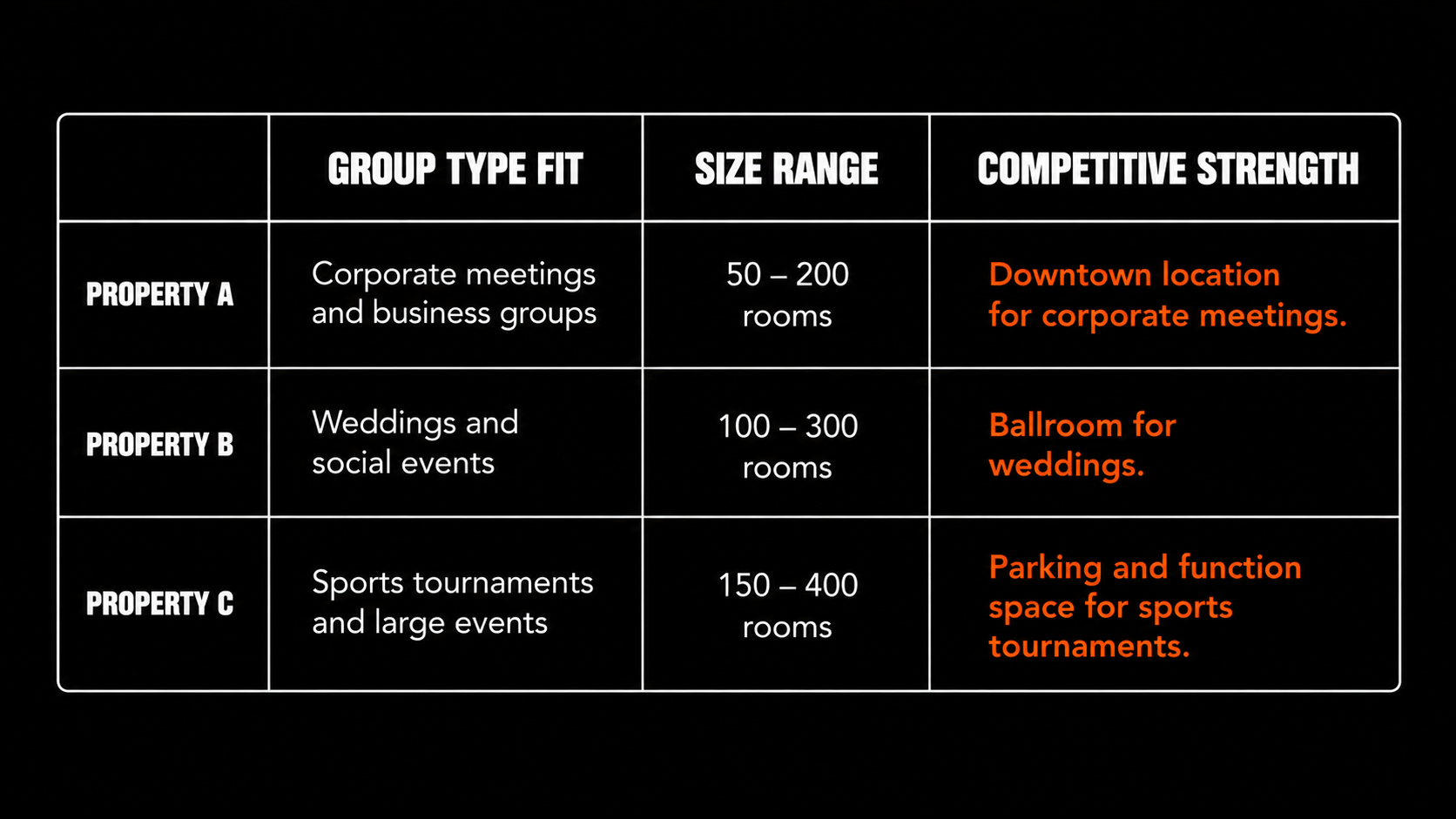
A useful tool here is a simple hotel-by-hotel group positioning matrix: for each property, its strongest group types, its ideal group size range, and its real competitive strength, whether that's a downtown location suited to corporate meetings, a ballroom suited to weddings, ample parking and large function space suited to sports tournaments, or dedicated meeting space suited to association business. Routing an RFP against that matrix, rather than against a simple availability calendar, tends to produce both a better guest experience and a better-fitting group for the property's actual product, which matters for repeat business as much as for the initial booking.
Why Group ADR Is the Wrong Number to Chase
This is probably the single most consequential revenue-management lever in portfolio group sales, and it's a decision that should sit with a property's revenue management discipline, not with the group sales process itself. A $150 group rate isn't inherently good or bad in isolation. The real question is what those rooms would have generated if the group hadn't taken them, which is displacement analysis: comparing the group's total value against expected transient demand for the same dates, accounting for room revenue plus food and beverage, meeting space, and ancillary spend, against the relevant costs of servicing the group.
That analysis is what lets a portfolio set real, defensible parameters: a minimum acceptable group rate, a maximum group size for a given property and date range, blackout dates where group business should never be accepted regardless of rate, shoulder-night requirements, minimum food and beverage spend thresholds, and attrition or cancellation terms that protect the property rather than just the booking. Sales, under this model, isn't rewarded simply for filling rooms. It's rewarded for producing profitable group revenue, which is a meaningfully different incentive and, over a full year, a meaningfully different number.
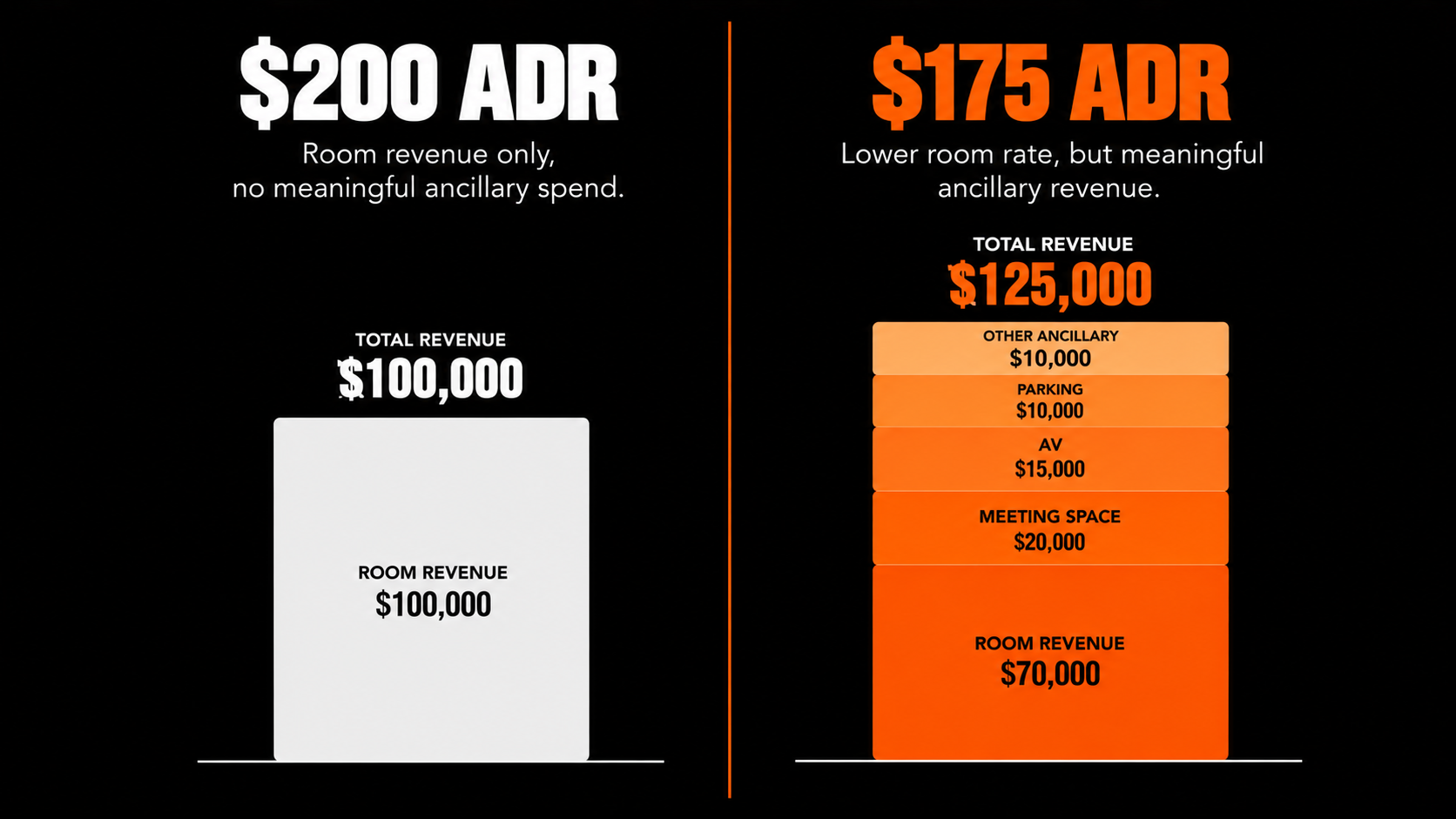
The related discipline is measuring the right total. A group paying $175 average daily rate can easily be worth more than one paying $200, if the first group is also producing meaningful food and beverage spend, meeting room rental, AV revenue, parking, and other ancillary income the second group isn't. Portfolio reporting that only tracks group ADR misses this consistently, which is why the more useful figure is something closer to total group revenue, rooms plus F&B plus meeting space plus ancillary spend, and ultimately group contribution once incremental costs are subtracted out. Chasing the highest room rate alone, without that fuller picture, routinely leads a portfolio to prefer the less profitable group.
Selling Shoulder Nights and Cross-Selling the Relationship
Group business can do more than fill rooms on the nights a planner originally requests. If a group wants Thursday through Saturday but Saturday is already projected to sell out on its own, the useful move isn't a flat yes or no. It's a negotiation: offering the group's preferred rate contingent on the block extending to include Wednesday and Thursday, with a smaller commitment on the already-strong Saturday night. Used deliberately, group sales becomes a tool for shaping demand on a property's actual weak nights, rather than simply accepting whatever dates a planner happens to name.
A second lever available only to multi-property operators, not independent hotels, is cross-selling the relationship rather than just the property. An account producing 300 room nights in one market, 150 in a second, and 100 in a third can be managed as a single portfolio relationship rather than three disconnected bookings, with the management company negotiating multi-property volume terms, preferred rates tied to portfolio-wide commitment, annual room-night targets, and a repeat-event calendar across markets. That increases share of wallet with an account that already trusts the brand, while reducing the cost of acquiring the next comparable account from scratch.
Standardizing the Commercial Playbook
Just as pricing guardrails set centrally tend to drift into inconsistent local execution across a growing portfolio, group sales contract terms and process drift the same way without active management. One property might charge attrition penalties a sister property waives entirely. One might bundle meeting room rental into a package while another charges separately for the identical thing. Planners working with a portfolio across multiple properties notice this quickly, and it erodes trust in the same way inconsistent pricing does: it signals the organization doesn't actually operate as one coordinated group, whatever its brand story claims.
The strongest management companies turn what already works at their best-performing properties into portfolio-wide standards rather than leaving each hotel to reinvent its own version: standard RFP response time targets, standard group pricing rules and displacement thresholds, sales-call activity targets, consistent account-management procedures, shared lead-routing rules, common proposal templates, clear concession guidelines, and consistent group cancellation and attrition standards, reinforced with a regular cross-property sales and revenue meeting. This matters more, not less, as a portfolio grows, since forecasting, pricing, and visibility all get structurally harder to manage consistently the more properties are added.
Building One Pipeline and One Set of KPIs
None of the levers above work well in isolation if group sales and revenue management are running from separate pipelines that don't talk to each other. Every opportunity in a portfolio's group pipeline should move through a consistent set of stages, inquiry, tentative, proposal, negotiation, definite, pickup, and actual, with probability of conversion, expected room nights, expected ADR, expected F&B and meeting-room revenue, wash, cancellation risk, displacement impact, and expected contribution attached at each stage. Sales pipeline information materially improves revenue forecasting and pricing decisions specifically when sales and revenue management are connected on shared data rather than working from separate systems and reconciling numbers after the fact.
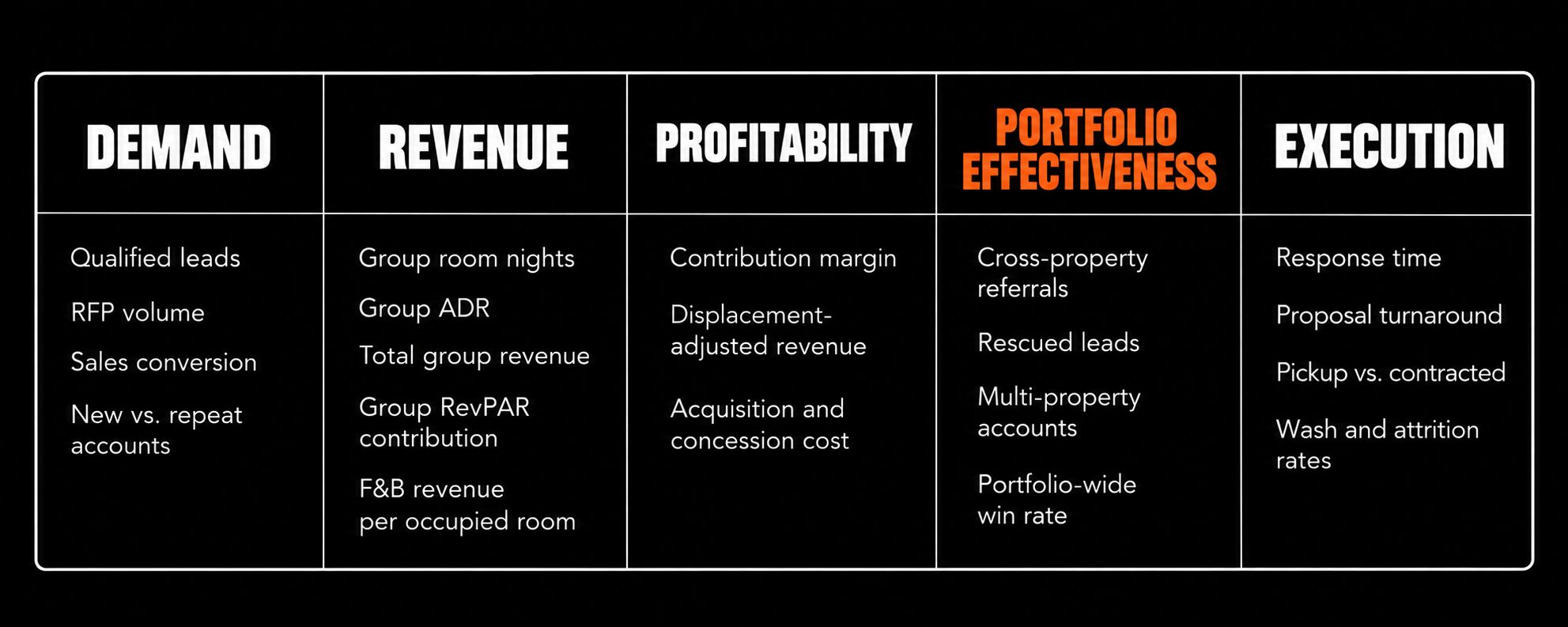
At the reporting level, a portfolio group sales dashboard is generally more useful organized around five distinct buckets rather than one long list of metrics. Demand generation covers qualified leads, RFP volume, sales conversion, and new versus repeat accounts. Revenue covers group room nights, group ADR, total group revenue, group RevPAR contribution, and F&B revenue per occupied room. Profitability covers contribution margin, displacement-adjusted revenue, and acquisition and concession cost. Portfolio effectiveness, the bucket most property-level reporting misses entirely, covers cross-property referrals, leads rescued from a property that couldn't take them, multi-property accounts, and portfolio-wide win rate. And execution covers response time, proposal turnaround, pickup versus what was originally contracted, and wash and attrition rates.
That "portfolio effectiveness" bucket is worth calling out specifically, because it's the one most directly tied to whether the lead-sharing and cross-selling levers above are actually working, rather than existing as policy on paper. A portfolio can look busy on demand generation and revenue metrics while its cross-property referral rate sits at zero, which is a strong signal that group demand is still being treated as a property-level asset in practice, whatever the strategy document says.
The Cross-Property Bidding Problem
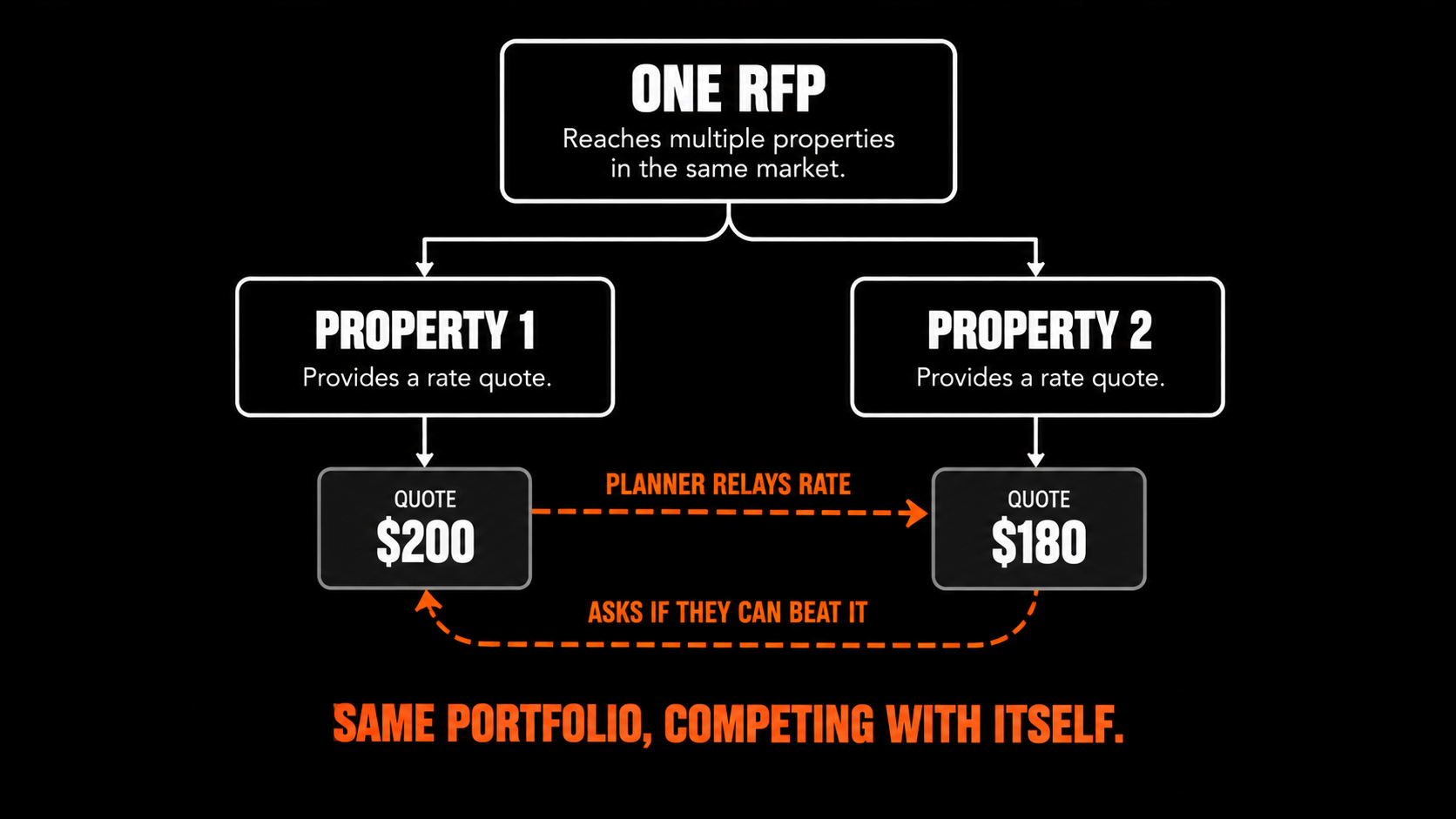
One failure mode is specific to multi-property groups and rarely comes up in single-hotel discussions of group sales: internal competition. When a brand distributes a group RFP to every property it operates in a market, and a portfolio owner has three or four hotels clustered within a mile of each other, that single inquiry can quietly become an internal bidding war. One property quotes a rate. The planner, working several venues at once as planners typically do, mentions that rate to a sister property down the street and asks if they can beat it. Neither sales manager realizes they're competing against their own portfolio, and the group's average daily rate erodes against itself rather than against any actual competitor.
That failure isn't a training problem or a discipline problem at the property level. It's a structural visibility gap, the same one that makes overflow lead sharing and cross-property routing difficult: nothing in most portfolios flags that two properties are working the same account at the same time, because each property's pipeline lives in its own version of the sales system, checked by its own sales manager, with no shared view across the group.
Why More Tools Rarely Solves This
The instinct at portfolio scale, in both revenue management and group sales, is often to add more reporting, more oversight, more manual reconciliation between disconnected systems. That approach reliably increases operational burden rather than reducing it, because it doesn't address the underlying structural problem: each property's tools were adopted independently to solve a local problem, not designed to coordinate across a portfolio.
A technology stack for group sales that was never built to work across multiple properties struggles for the same reasons a single-property revenue management system struggles at portfolio scale: it assumes decisions can be made independently, with limited coordination between hotels, and that assumption breaks down as soon as the same customer, the same market, or the same brand-distributed RFP touches more than one property in the group.
What a Portfolio-Ready Group Sales Approach Actually Requires
A scalable approach to multi-property group sales needs a small number of things working together rather than a longer list of individual tools.
Centralized intake across every property, so an RFP arriving at one hotel and a related inquiry arriving at a sister property in the same market can actually be recognized as connected rather than processed as unrelated leads, and so overflow business has somewhere real to go instead of a default decline.
Shared account records, so a planner's history with one property in a portfolio is visible to sales managers at other properties working the same account, and a multi-property relationship can be managed as one account rather than three coincidental bookings.
Consistent pipeline stages and standardized response templates and contract terms, so portfolio-level reporting reflects real performance differences rather than differences in how each property happens to label its own process.
Cross-property lead routing, so a multi-market RFP reaches the right person at each relevant property rather than defaulting to whichever sales manager happened to open the email first.
And portfolio-level reporting that surfaces response time, conversion, cross-property referral activity, and pipeline health by property without requiring someone to manually reconcile mismatched exports every month.
None of that requires replacing whatever system of record a portfolio already runs on, whether that's a brand-mandated CRM like Delphi or a property-by-property mix of tools inherited through acquisition. It requires a layer that coordinates across those systems rather than adding another disconnected one on top.
Hippo Rev: A Revenue Capture Platform for Group Sales Across a Portfolio
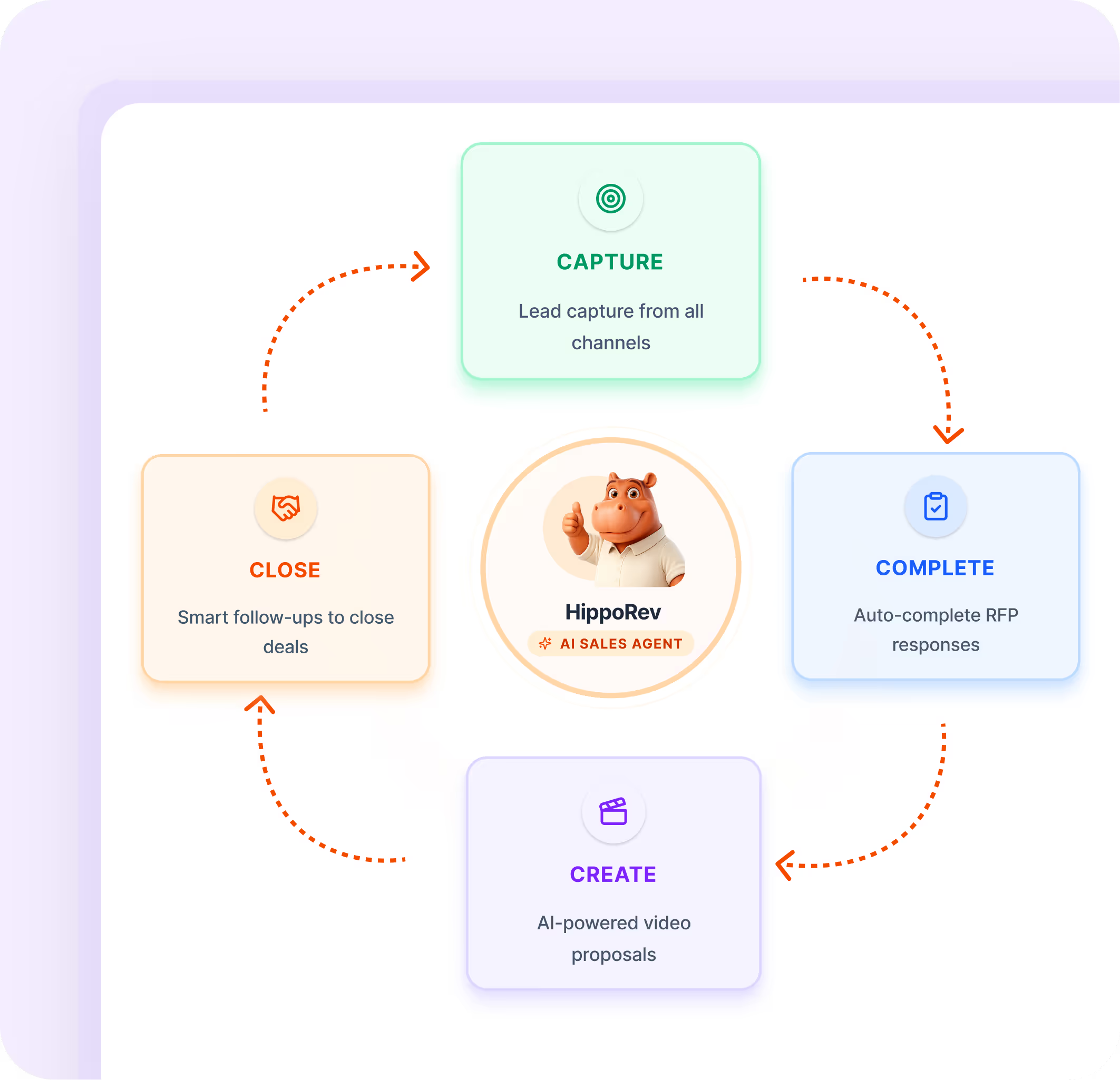
Hippo Rev is a revenue capture platform for hotel group sales, designed to sit on top of the systems a property or portfolio already runs, Cvent, Delphi, Meeting Broker, Lighthouse, and a property's PMS, rather than replacing any of them. It organizes the group sales lifecycle into three stages: Capture, which brings inbound RFPs and inquiries in from every channel a property uses (Cvent, direct email, phone, and other RFP portals) into a single point of visibility instead of scattered property-by-property inboxes; Convert, which helps a sales manager assemble a complete, accurately priced proposal faster by pulling rate, availability, and space data from a property's existing systems into one review window rather than requiring manual lookups across several tools; and Grow, which keeps a record of proposal engagement and follow-up so deals don't stall silently once they've been sent.
At single-property scale, that combination addresses the manual coordination tax on an individual sales team. At portfolio scale, it's the same underlying architecture that makes real coordination possible: because inquiries can be captured and tracked in one connected system rather than reconstructed after the fact from separate property exports, a portfolio gains the kind of shared visibility that group demand sharing, cross-property lead routing, and consistent response-time reporting all depend on.
It's worth being precise about scope here: the strategic decisions, which groups to accept based on displacement value, what the positioning matrix looks like property by property, where the minimum acceptable group rate sits, stay with a portfolio's sales and revenue leadership. What Hippo Rev addresses is the execution layer underneath those decisions: getting every inquiry captured and visible across the properties that could serve it, keeping proposals accurate and fast regardless of which property is responding, and giving leadership a real-time view of where the pipeline is stalling rather than a monthly reconciliation exercise. A sales manager still makes every pricing and space decision, and nothing goes out to a planner without their review.
If cross-property visibility, inconsistent execution across properties, or the kind of internal bidding that comes from running group sales property by property is a problem your portfolio is dealing with, you can see how Hippo Rev works by booking a Capture Audit with us here.
Frequently Asked Questions
Why does group sales get harder to manage as a hotel portfolio grows, separately from pricing and revenue management?
Because RFPs and planner relationships increasingly span multiple properties in a portfolio, while each property's sales process, pipeline, and reporting typically remain independent, creating coordination gaps that don't show up in single-property sales operations.
What is portfolio-level lead sharing, and why do most management companies struggle to do it?
It's the practice of routing a group RFP a property can't fully accommodate, or can't accommodate at all, to a sister property rather than declining it outright. Most portfolios lack a centralized system for tracking which hotels were considered for a lead, which declined, and why, which makes lead sharing an occasional favor between sales managers rather than a repeatable process.
Why is group ADR the wrong metric to optimize for a hotel portfolio?
Because it ignores displacement value and total group revenue. A lower-ADR group generating strong food and beverage, meeting space, and ancillary spend can be substantially more valuable than a higher-ADR group without that spend, and a portfolio optimizing purely for room rate will systematically prefer the less profitable option.
What is cross-property bidding, and how common is it in multi-property hotel groups?
It happens when the same group RFP reaches multiple properties within one ownership or management group, and sales managers at each property, unaware they're competing against their own portfolio, quote against each other and erode rate rather than compete against an actual outside competitor. It's a specific and recurring risk wherever properties are clustered in the same market.
Share this post
Ready to close more group business?
See how HippoRev can transform your hotel sales workflow in 15 minutes.

Follow us


.svg)