


Volume & Automation
Hotel RFP Automation: Why Teams Are Leaving Spreadsheets
Hotel RFP automation is replacing spreadsheets on both sides of the hotel sourcing process. The article explains how corporate travel buyers use automation to standardize sourcing and monitor negotiated rates, while hotel sales teams use it to centralize inquiries, reduce manual proposal work, and respond faster.



.png)
Hotel RFP Automation: Why Buyers and Sellers Are Both Moving Off Spreadsheets
A hotel RFP looks like a single document, but it triggers two very different workflows depending on which side of the desk you sit on. For a corporate travel manager, it's the start of an annual sourcing cycle that sets negotiated rates for the whole company. For a hotel sales team, it's one of hundreds of inbound requests competing for attention in the same week. Both groups have relied on spreadsheets and email threads to manage this process for decades, and both are now finding that approach breaks down as programs get larger and more complex.
That shared breaking point is why RFP automation has become a genuine software category rather than a niche tool. Understanding how it works on each side of the transaction, and where the two sides actually intersect, explains why the shift away from spreadsheets is happening now rather than five years ago.
What Is a Hotel RFP, and Why Are There Actually Two Kinds?
A hotel RFP (Request for Proposal) is a formal document a buyer sends to one or more hotels asking for pricing, availability, and terms for a stay, meeting, or group event. The hotel responds with a proposal, and the buyer selects, negotiates, and contracts based on the responses received.
In practice, this covers two distinct processes that often get discussed as if they were one.
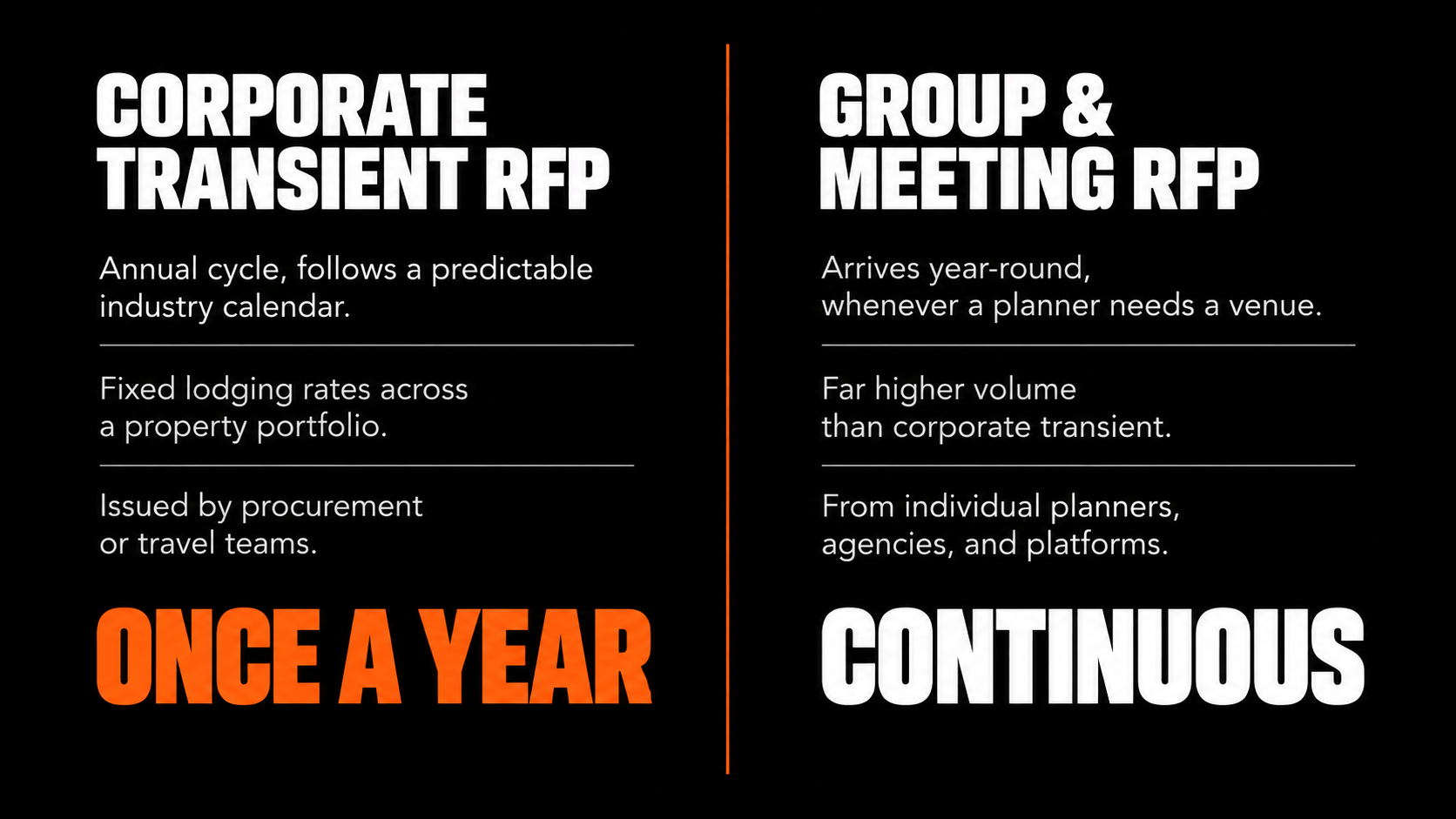
The first is the annual corporate transient RFP, run by a company's travel or procurement team to negotiate fixed lodging rates for the coming year across a portfolio of properties their employees stay in regularly. This follows a predictable industry calendar: buyers typically issue RFPs between June and August, hotels respond in September and October, and negotiated rates load into global distribution systems for a January 1 effective date, a cadence supported by the GBTA Hotel RFP Workgroup.
The second is the group and meeting RFP, sent whenever a planner needs a venue for a conference, event, or block of rooms. These arrive year-round, in far higher volume, from individual planners, meeting agencies, and platforms rather than a single procurement department on a fixed schedule.
Both processes ultimately land on hotel property or sales teams, which is why automation is being adopted on both the buyer side that issues these RFPs and the seller side that has to respond to them, often at the same time within the same sales office.
The Buyer Side: Why Corporate Travel Procurement Is Automating Hotel Sourcing
Corporate lodging is the largest single line item in most business travel budgets. According to GBTA's Business Travel Index, business travelers spend roughly $461 billion annually on accommodation, and a large share of that spend runs through negotiated RFP programs. Cvent's sourcing platform alone processed about $16.5 billion in corporate hotel sourcing volume in 2024, which gives a sense of how much money moves through this single annual exercise.
Running that process on spreadsheets creates three specific problems that scale badly as a program grows.
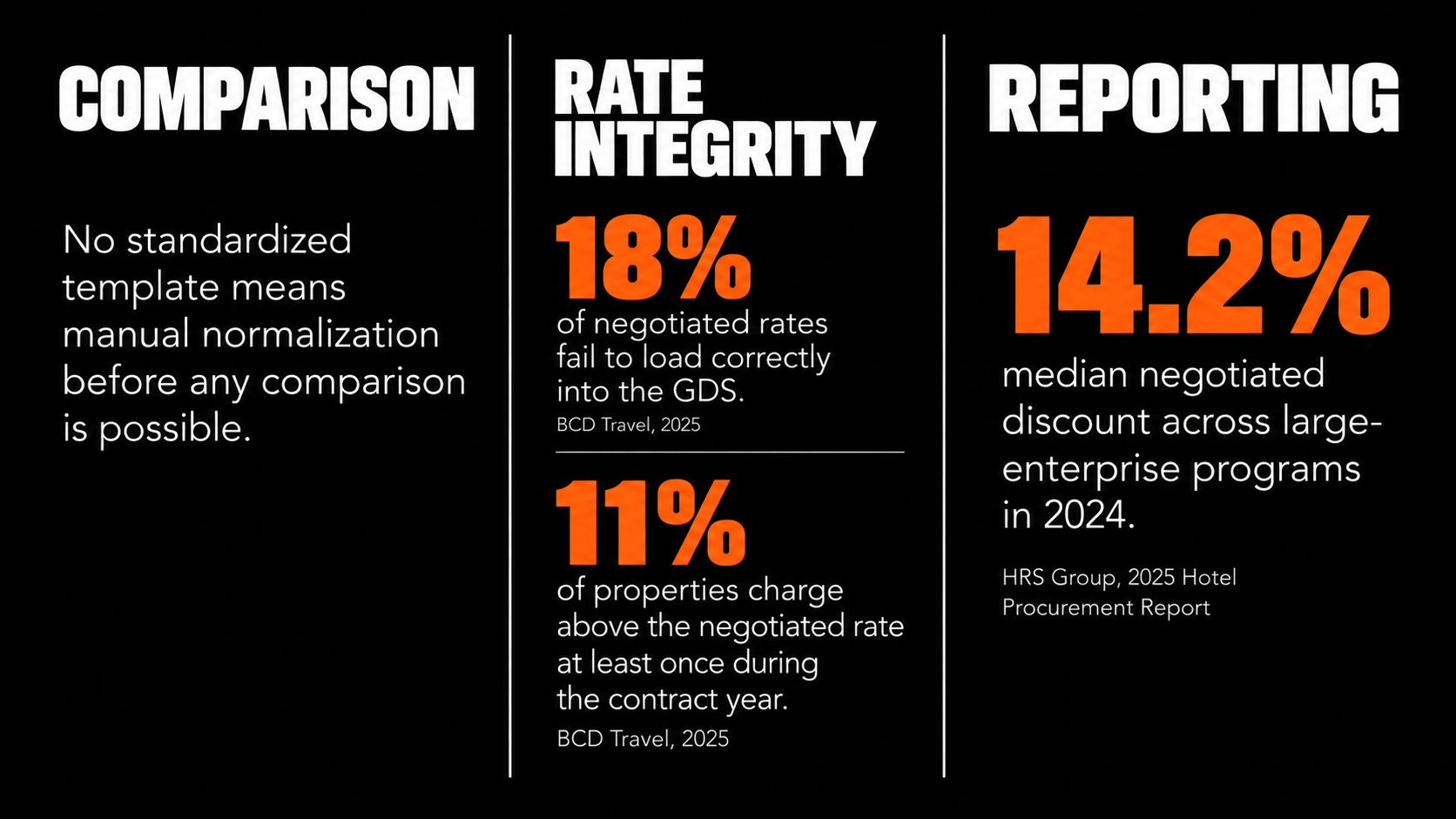
Comparing proposals is genuinely hard when every hotel responds differently. Without a standardized template, one hotel's proposal lists an all-inclusive nightly rate, another separates out resort fees, and a third quotes seasonal bands with different blackout dates. A travel manager sourcing dozens or hundreds of properties has to manually normalize every one of these before an apples-to-apples comparison is even possible. Research from GBTA and Cvent, based on a survey of corporate travel managers and hotel professionals across the U.S., Canada, and Europe, found that structured RFPs remain the preferred sourcing method for managed hotel and meetings programs, precisely because structure is what makes comparison possible at all.
Rate integrity breaks down after the RFP closes. Negotiating a rate is only half the job. That rate then has to load correctly into the global distribution system, hold for the full contract year, and be enforced at the front desk. A 2025 industry report from BCD Travel found that 18 percent of negotiated rates fail to load correctly into the GDS at the start of a contract, and 11 percent of properties charge above the negotiated rate at least once during the contract year. Spreadsheets have no way to catch either failure; someone has to notice the discrepancy on an expense report months later, if anyone notices at all.
Reporting to finance and leadership takes real effort to assemble. Per HRS Group's 2025 Hotel Procurement Report, the median negotiated discount across large-enterprise programs was 14.2 percent in 2024, which is a meaningful number for a CFO to see, but pulling it together from scattered proposal PDFs and email chains is its own project every renewal cycle.
Automated sourcing platforms address these by standardizing intake into comparable formats, tracking negotiated terms in a structured record rather than a document trail, and generating reports directly from that record instead of reconstructing them after the fact. This is also why fixed, pre-negotiated rates remain dominant in corporate programs despite years of discussion about dynamic pricing: the same GBTA-Cvent research confirmed that roughly four out of five travel managers always or regularly negotiate fixed rates, and fixed rates are much easier to audit and forecast against when the underlying data is organized.
The Seller Side: Why Hotel Sales Teams Are Automating RFP Response
On the hotel side of the same relationship, the pressure point isn't sourcing complexity, it's volume and speed. A hotel sales team doesn't run one RFP cycle a year; it processes a continuous stream of group and meeting inquiries arriving from Cvent, email, web forms, and phone calls, often into the same shared inbox.
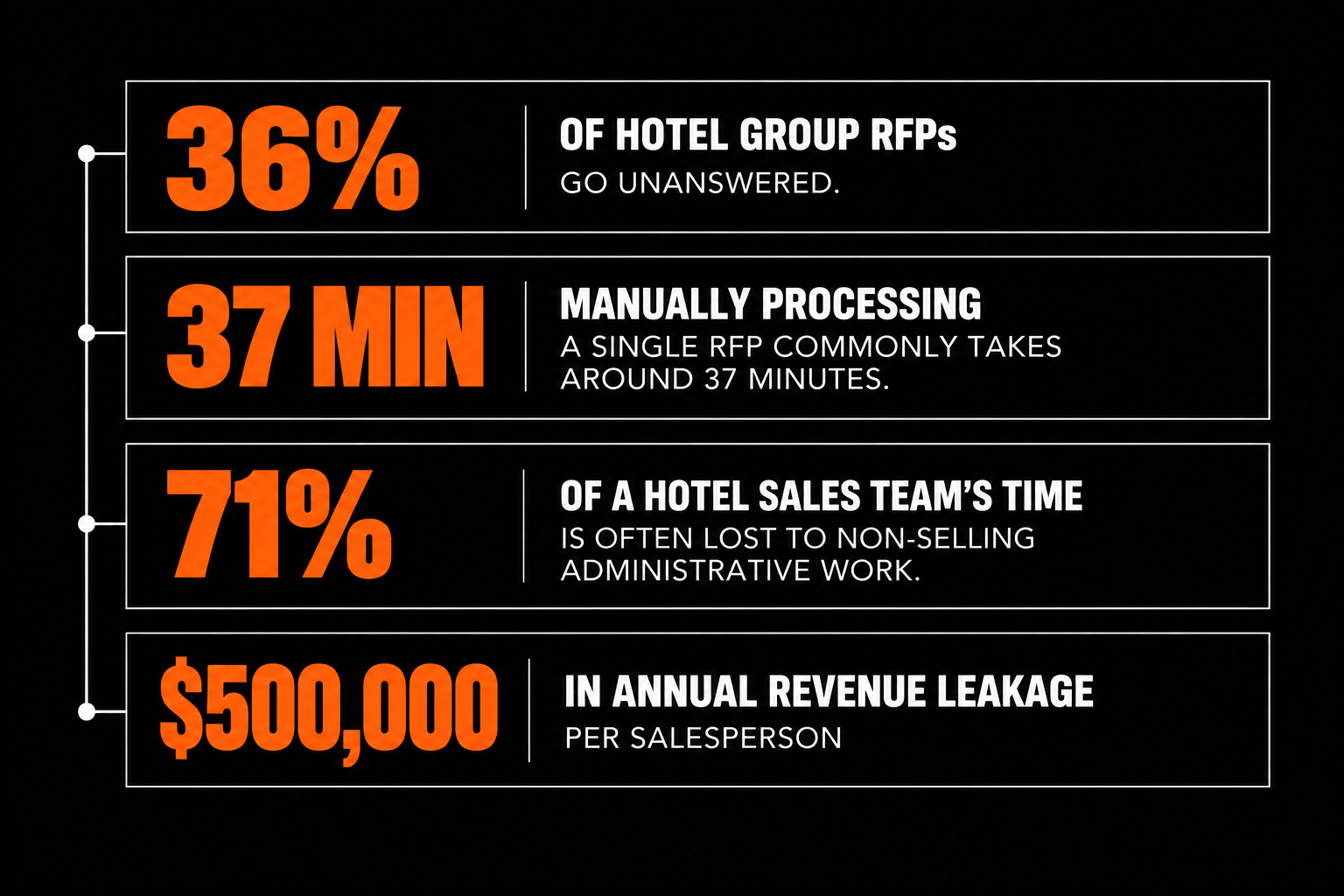
Industry analysis of RFP response patterns points to a persistent gap between how much business arrives and how much actually gets a reply. Roughly 36 percent of hotel group RFPs go unanswered, not because the business is unwanted but because it gets lost in the volume of manual intake and follow-up. That gap matters because speed compounds: 61 percent of won deals go to whichever hotel is among the first three to respond, and research from Cvent and industry operators consistently shows that hotels responding within four hours win at materially higher rates than those responding in 24 to 48 hours, with the advantage running 20 to 30 points in some analyses.
The administrative side of the job is a large part of why response times slip. Manually processing a single RFP, pulling availability, checking rates, drafting a proposal, and routing it for approval, commonly takes around 37 minutes per inquiry when done by hand across disconnected systems. Multiplied across a full pipeline, that adds up to a meaningful share of a salesperson's week spent on data entry rather than selling, and estimates of time lost to non-selling administrative work run as high as 71 percent of a hotel sales team's total hours. On average, companies source roughly a third of their sales revenue through deals that involve an RFP, which means a slow, manual process isn't a minor inefficiency; it's sitting directly on top of a major revenue channel. The cumulative effect on an individual salesperson's book of business is often estimated at around $500,000 in annual revenue leakage once missed and delayed RFPs are added up over a year. A survey of hoteliers found that 90 percent believe the group booking process itself is fundamentally broken, and most attributed the problem to the clunky, manual workflow rather than pricing.
Automated RFP response tools address the mechanical bottlenecks directly: pulling multi-channel RFPs into one queue, auto-populating proposals from existing rate and availability data, and flagging aging inquiries before they go cold. That doesn't replace the judgment a sales manager brings to a negotiation, but it removes the copy-and-paste work that currently stands between an inquiry landing in an inbox and a proposal reaching the planner.
Where the Two Sides Actually Meet
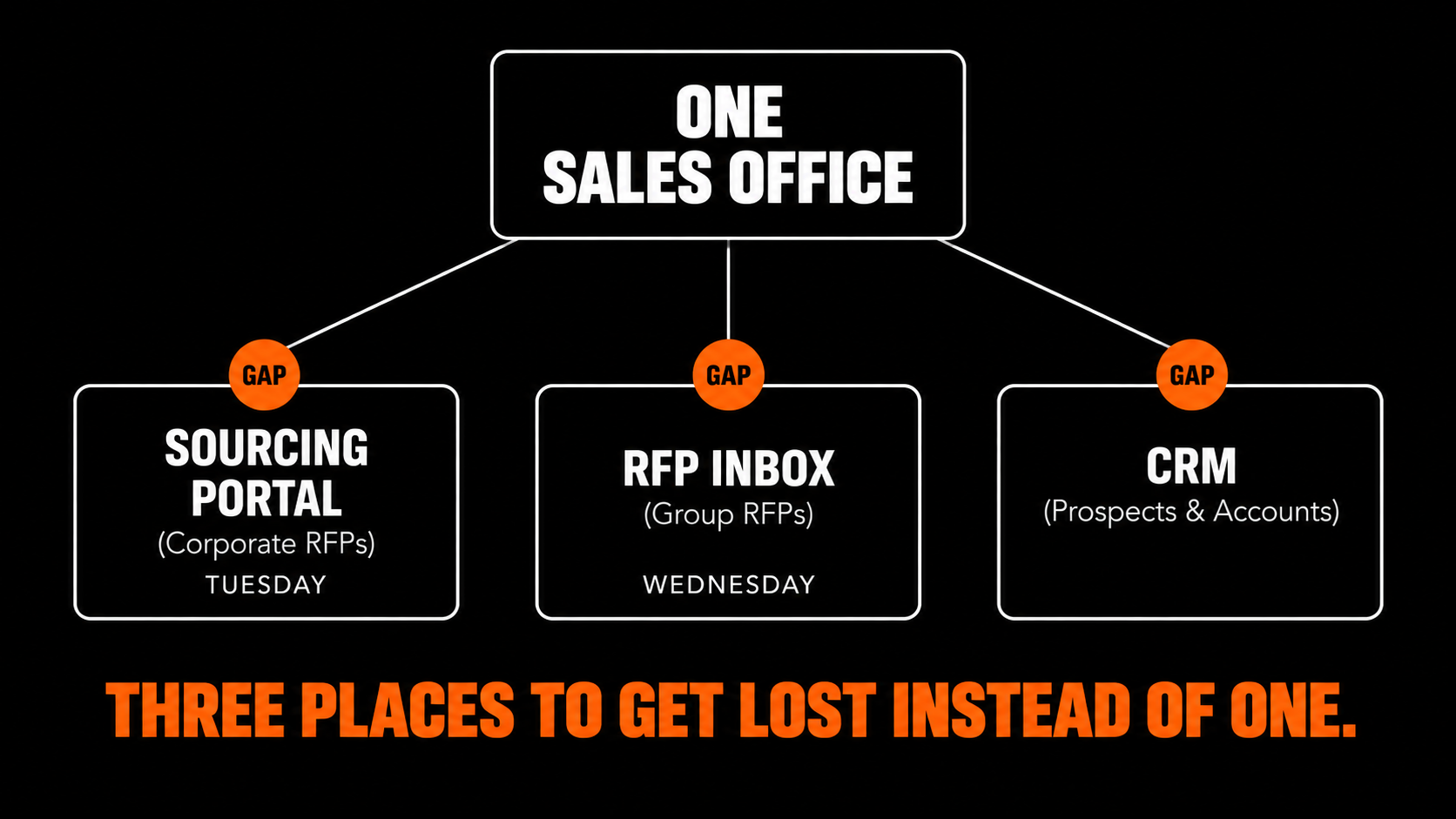
The buyer-side and seller-side processes look separate on paper, but they converge inside the same hotel sales office. The person fielding an annual corporate RFP from a Fortune 500 procurement team on Tuesday may be fielding a 200-room conference RFP from a meeting planner on Wednesday, often using entirely different tools for each. That fragmentation is part of why response times and rate accuracy both suffer: a sales team juggling a corporate sourcing portal, a group RFP inbox, and a separate CRM has three places for a request to get lost instead of one.
This is also where automation on each side reinforces the other. A hotel with clean, structured availability and rate data (built to satisfy corporate procurement's need for accurate, comparable proposals) has the same underlying data infrastructure needed to respond quickly and accurately to a group RFP. Conversely, a hotel that has automated its group RFP response process, so pricing and availability are already centralized and current, is better positioned to respond credibly to a large corporate RFP without a scramble. The investment a hotel makes in organizing its RFP data for one side of the business tends to pay off on the other.
What to Look for in an RFP Automation Platform
Whether the goal is sourcing hotels or responding to inquiries, the core capabilities that matter are largely the same:
- Centralized intake. One queue for RFPs arriving from multiple channels, rather than a mix of inboxes and portals.
- Standardized comparison or proposal formats. So responses (or offers) can be evaluated or generated consistently instead of being reformatted by hand.
- A structured negotiation record. A full history of terms offered, countered, and agreed to, so nothing depends on someone's memory of an email thread from three months ago.
- Built-in reporting. Metrics on response time, win rate, participation, or compliance available on demand instead of assembled manually before a leadership review.
- Room to scale. A workflow that holds up whether a program covers ten properties or a thousand, or whether a hotel handles ten RFPs a month or several hundred.
These aren't features specific to one vendor; they're the baseline a spreadsheet-based process simply cannot deliver once volume passes a certain point, which is why both buyers and sellers in this market are converging on similar automation logic even though they're solving different problems.
The Takeaway
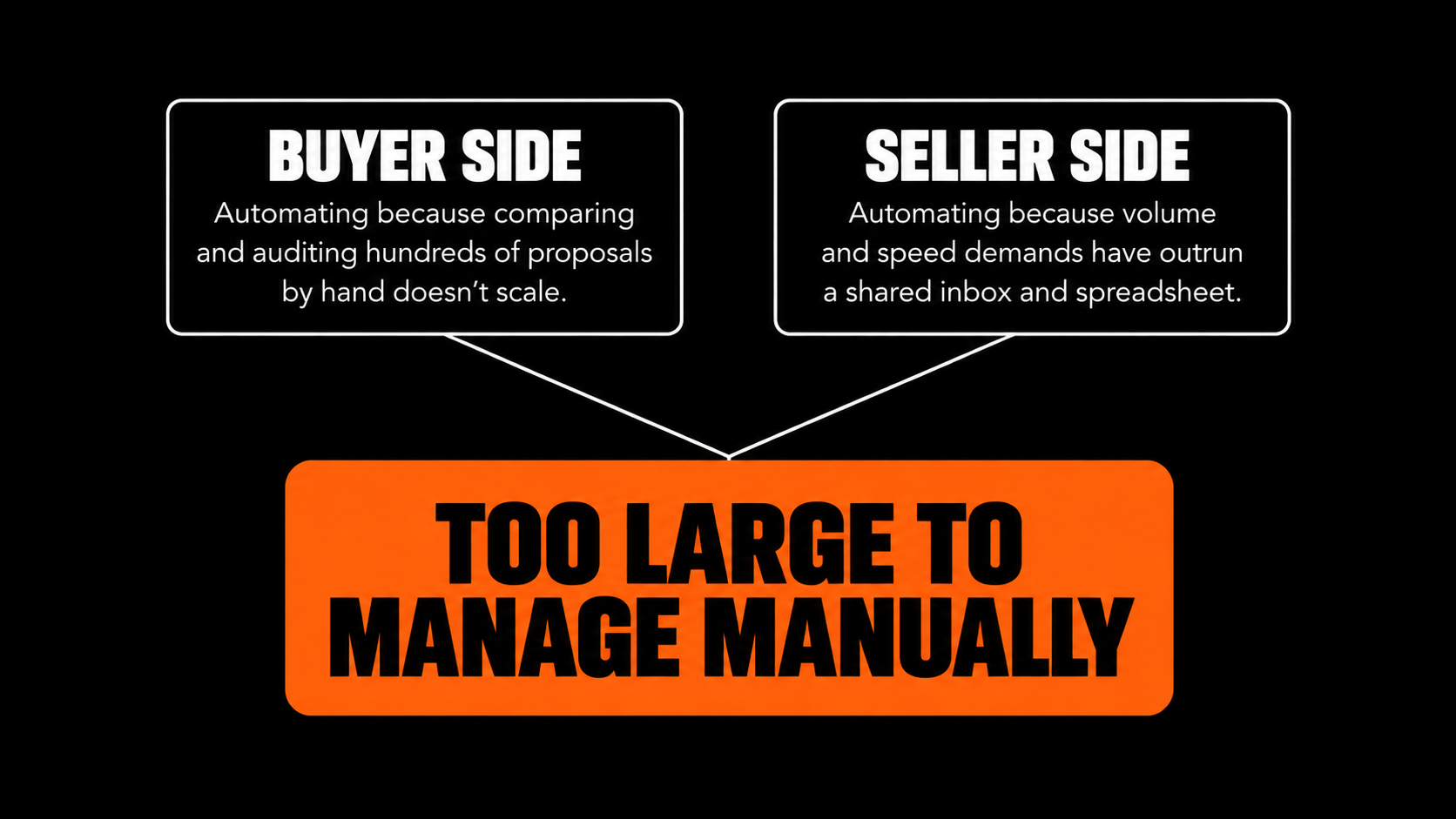
Hotel RFP automation isn't a single trend; it's two related shifts happening on opposite sides of the same transaction. Corporate travel procurement teams are automating because comparing hundreds of proposals and auditing negotiated rates by hand doesn't scale with modern program size. Hotel sales teams are automating because the volume and speed demands of group and meeting RFPs have outrun what a shared inbox and a spreadsheet can reasonably handle. Both are responding to the same underlying reality: RFP-driven revenue is too large a share of the business to keep managing manually.
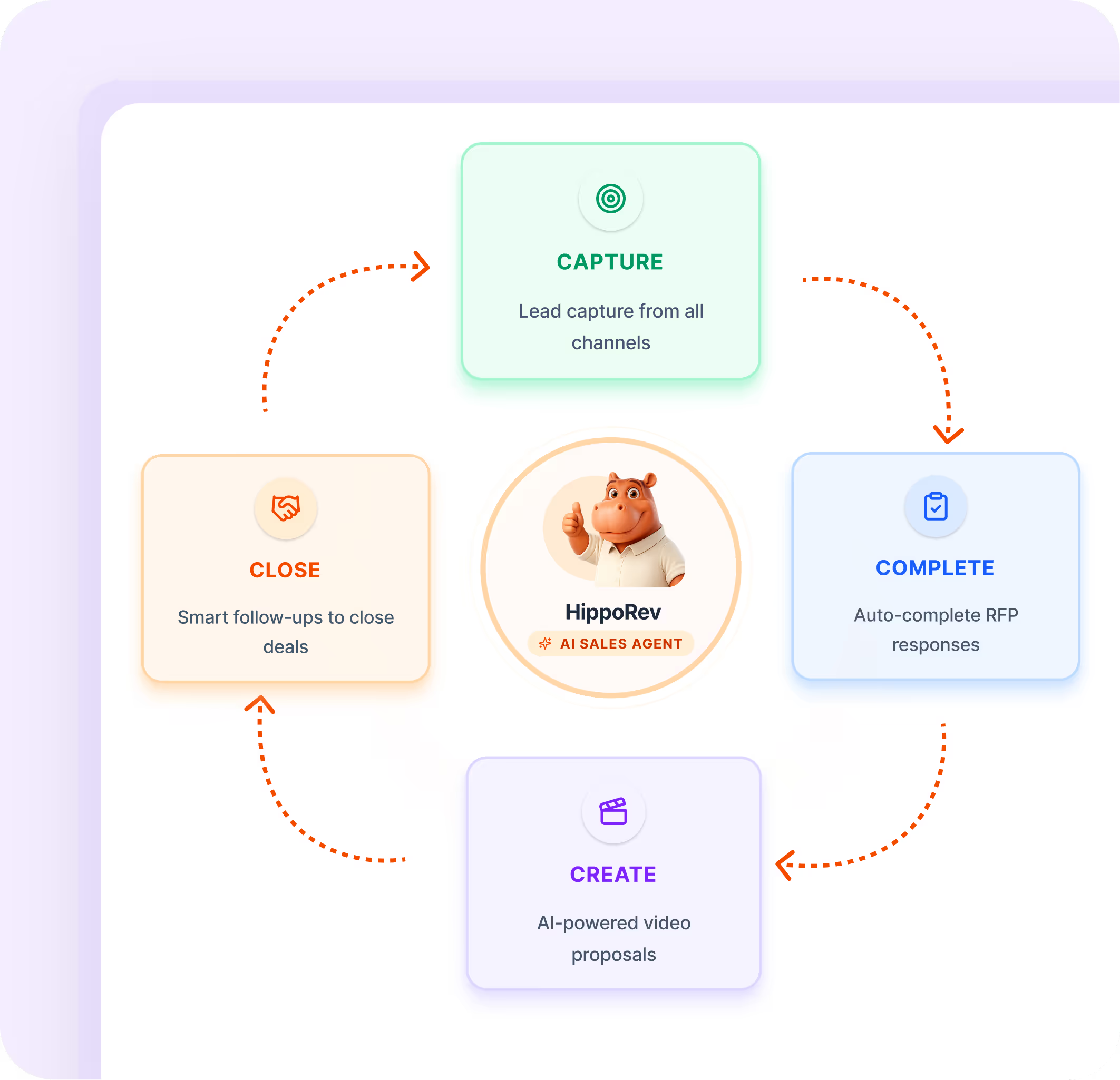
If slow or missed RFP responses are costing your hotel sales team booked business, Hippo Rev is built specifically for that side of the equation. It centralizes RFP and lead intake from channels like Cvent, email, and web forms into a single system, and helps sales teams cut the time spent on manual proposal work so more inquiries get a fast, accurate response. You can see how it works by getting a free Hippo Rev demo here.
Frequently Asked Questions
What's the difference between a corporate hotel RFP and a group hotel RFP?
A corporate RFP is issued once a year by a company's travel or procurement team to negotiate fixed lodging rates across a portfolio of hotels for the coming year. A group RFP is issued whenever a planner needs a venue for a specific meeting or event, and these arrive continuously throughout the year rather than on a fixed annual schedule.
Why do so many hotel RFPs go unanswered?
It's rarely a deliberate decision to decline the business. Most unanswered RFPs get lost in the volume of manual intake, since requests arrive from multiple disconnected channels and sales teams without a centralized queue can't reliably track and prioritize every one.
How much does response speed actually affect win rate?
Meaningfully. Research from Cvent and industry operators consistently shows hotels responding within four hours win at materially higher rates than those responding in 24 to 48 hours, and planners evaluating several properties at once tend to anchor their comparison around whoever responds first.
Do smaller hotel programs or independent hotels need RFP automation?
The need scales with volume rather than company size. A property or program handling a small, manageable number of RFPs a month may do fine with a well-organized spreadsheet. Once volume grows to the point where requests are being missed or reporting takes real effort to assemble, automation starts to pay for itself.
Does automating the RFP process remove the negotiation and relationship-building parts of the job?
No. Automation is best suited to the repetitive, administrative parts of the process, intake, data entry, proposal drafting, and reporting. The judgment involved in negotiating terms and building supplier or planner relationships still depends on experienced people; automation is meant to free up more of their time for that work, not replace it.
Share this post
Ready to close more group business?
See how HippoRev can transform your hotel sales workflow in 15 minutes.

Follow us


.svg)