


Hotel Marketing
Hotel Content Marketing Strategy
Event planners choose venues on suitability, budget, and attendee experience, not amenity lists. This blog shows how to build hotel content around planner decisions, from SEO and visuals to email and case studies. It also shows how to connect content to qualified RFPs and group revenue.



Hotel Content Marketing Strategy: How to Attract More Event Planners in 2026
A successful hotel content marketing strategy does more than attract website visitors. It helps potential guests and event planners discover your property, evaluate its suitability, and make confident booking decisions.
For hotels targeting meetings, incentives, conferences, and exhibitions (MICE), this distinction is particularly important. Event planners aren't simply looking for attractive venues. They're evaluating whether a property can accommodate their event requirements, deliver a positive attendee experience, and operate within budget.
According to the 2026 Global Planner Sourcing Report, which surveyed more than 1,650 event planners worldwide, 63% identify attendee engagement as their primary measure of event success.
This reveals an important opportunity for hotel marketers: content that helps planners understand how a venue supports their event objectives can be more useful than content that simply promotes its amenities.
This blog explains how to build a hotel content marketing strategy around the needs of event planners, choose effective content formats, improve organic visibility, and connect marketing activity to group sales revenue.
What Is Hotel Content Marketing?
Hotel content marketing is the process of creating and distributing useful information that attracts potential customers, builds trust, and influences booking decisions.
Unlike traditional advertising, which primarily promotes a property's offerings, content marketing helps customers answer questions and make decisions.
For example, a hotel advertising its 500-person ballroom communicates a feature. A guide explaining how the ballroom can accommodate different conference layouts helps an event planner determine whether the venue is suitable.
Both approaches have value, but they serve different purposes.
A hotel content marketing strategy typically combines search engine optimization (SEO), website content, social media, email marketing, videos, virtual tours, case studies, and other educational resources.
The objective is to make relevant information available throughout the customer's decision-making journey.
For event planners, that journey often begins long before an RFP reaches the hotel's sales team.
1. Understand What Event Planners Actually Need
The foundation of an effective hotel content marketing strategy is understanding the audience's challenges.
Event planners have responsibilities that extend far beyond finding available meeting space. They must coordinate budgets, logistics, accessibility, attendee experiences, accommodation, transportation, and stakeholder expectations.
Content should help them manage these responsibilities.
Budgeting and Cost Transparency
Budget management remains a major concern.
The 2026 Global Planner Sourcing Report found that 35% of planners identify staying within budget as their biggest challenge.
Hotels can address this concern through content explaining meeting packages, pricing structures, potential additional charges, and ways to optimize event budgets.
For example, an article titled "How to Budget for a Three-Day Corporate Conference" could explain accommodation, catering, audiovisual equipment, meeting-space requirements, and transportation considerations.
Such content attracts planners who are actively evaluating event costs.
Venue Selection and Logistics
Planners also need practical information to determine whether a venue can accommodate their event.
Useful content includes room capacities, floor plans, seating configurations, accessibility information, audiovisual capabilities, parking arrangements, and transportation options.
Rather than simply stating that a hotel has flexible meeting spaces, show how those spaces can support different event formats.
Attendee Experience
Hotels should also demonstrate how their properties contribute to successful events.
According to the 2026 planner research, 48% of planners are sourcing non-hotel venues, with flexibility and attendee experience among the major reasons.
Hotels therefore compete on more than accommodation and meeting-space capacity.
Content can demonstrate opportunities for networking, breakout discussions, interactive sessions, local experiences, and personalized event arrangements.
The central principle is simple: organize content around the planner's decisions, not merely the hotel's features.
2. Build a Content Calendar Around the Event Planning Journey
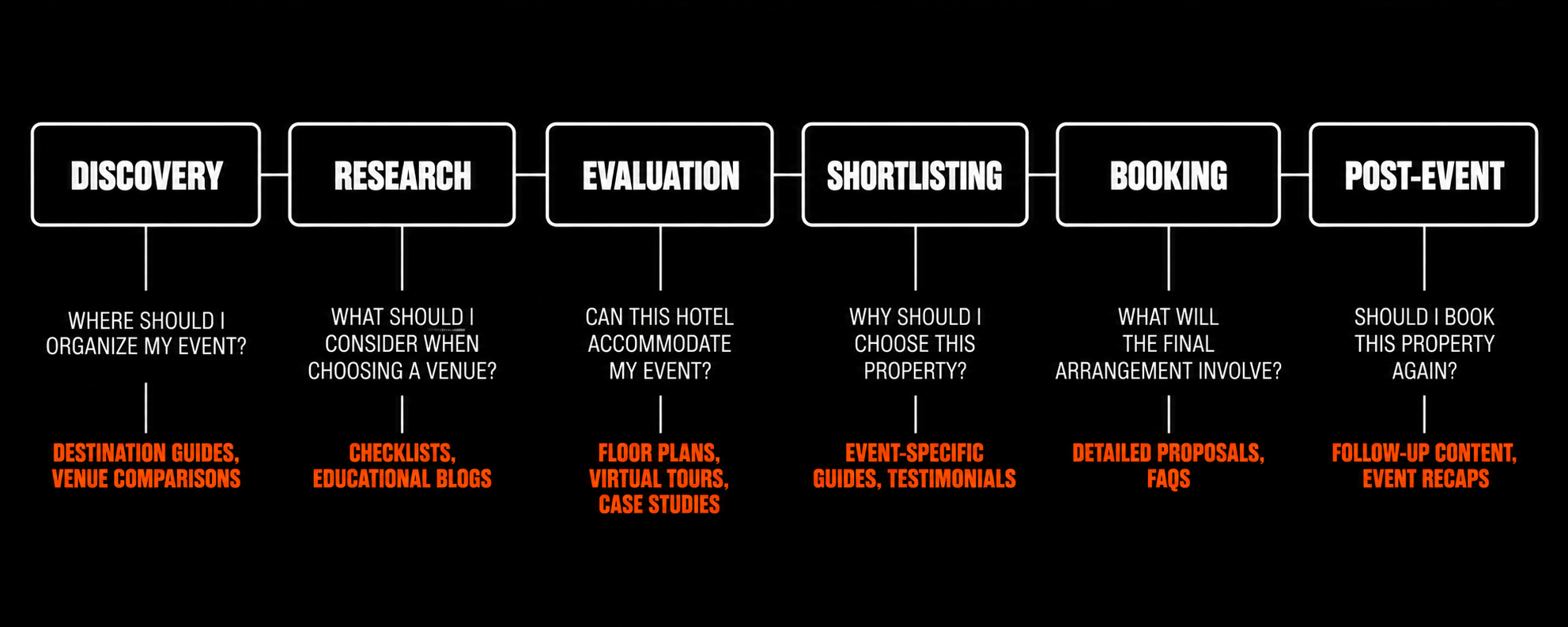
Once the audience's challenges are understood, the next step is developing a content calendar.
A useful calendar should reflect the different stages of venue selection.
This structure ensures that content supports the entire buying journey rather than concentrating exclusively on awareness.
Research Topics Before Creating Content
Start with questions that planners regularly ask your sales team.
Review:
- Questions appearing in incoming RFPs
- Common objections during venue negotiations
- Information repeatedly requested before site visits
- Frequently discussed event requirements
- Search queries bringing visitors to your website
- Feedback from previous event organizers
These sources reveal content opportunities grounded in actual customer demand.
For instance, if planners repeatedly ask whether your ballroom supports hybrid conferences, create a dedicated resource explaining its technical capabilities, equipment, connectivity, and possible configurations.
That resource can support both marketing and sales.
Prioritize Content by Commercial Relevance
Not every topic deserves equal investment.
A broad article about tourism in your city may generate substantial traffic but attract relatively few qualified event planners.
A detailed guide to organizing a corporate conference in your city may attract fewer visitors but reach an audience much closer to booking.
Evaluate topics using three factors: search demand, relevance to your target planners, and proximity to a booking decision.
The strongest content opportunities often satisfy all three.
3. Use SEO to Reach Planners During Venue Research
Search engine optimization helps hotels become discoverable when potential customers research destinations, meeting facilities, and event planning requirements.
An effective hotel SEO strategy should address both informational and commercial searches.
Target Keywords Based on Search Intent
Consider the difference between these searches:
Informational: "How to choose a conference venue"
Commercial: "Conference hotels in New York"
Specific requirement: "Hotels with meeting rooms for 200 people in New York"
Each represents a different stage of the decision-making process.
Informational articles can introduce your hotel to planners early in their research. Commercial landing pages should help them evaluate your property and submit an inquiry.
Both are necessary.
Create Useful, Search-Optimized Content
Relevant content formats include destination guides, event planning articles, venue comparison guides, case studies, and practical checklists.
For example, a hotel targeting corporate events could publish:
"How to Plan a Corporate Offsite: Venue, Budget, and Logistics Checklist"
The article could explain how to estimate attendance, select accommodation, organize meeting spaces, and coordinate transportation.
It could also demonstrate how the hotel's facilities support those requirements without turning the entire article into a sales pitch.
Don't Ignore Technical SEO
Strong content also requires a website that search engines can access and understand.
Important considerations include page loading performance, mobile usability, crawlability, internal linking, descriptive page titles, image alt text, and structured data where appropriate.
Venue pages should provide accurate addresses, facilities, contact information, and relevant visual content.
Google's May 2025 guidance on generative AI search emphasizes original, useful content while reaffirming the importance of established SEO practices.
This means hotels should prioritize useful information rather than creating content solely to target AI-generated search results.
4. Create Content That Helps Planners Visualize Their Events
For event planners, seeing a venue is often more informative than reading a description.
High-quality photography, videos, floor plans, and virtual tours can help communicate how spaces look, function, and accommodate different event requirements.
The 2026 Global Planner Sourcing Report identifies meeting-room specifications, images, videos, and floor plans among the influential factors in venue evaluation.
Use Photography to Demonstrate Functionality
A photograph of an empty ballroom establishes its appearance.
However, photographs showing the same ballroom configured for a conference, banquet, exhibition, and networking event communicate its versatility.
Hotels should therefore build visual libraries around real event use cases.
Include details such as seating arrangements, stage configurations, lighting, food and beverage setups, and attendee circulation.
Offer Virtual Tours
Virtual tours allow planners to explore a property remotely.
They can be particularly useful for international planners, large corporate events, and customers who cannot immediately schedule a physical site visit.
A useful virtual tour should allow viewers to understand spatial relationships between meeting rooms, accommodation areas, entrances, and other facilities.
It should complement accurate specifications rather than replace them.
Create Event-Specific Videos
Hotels can also produce short videos demonstrating how their facilities support different event formats.
Examples include executive meetings, conferences, weddings, incentive programs, and association events.
These videos should answer practical questions.
Can the space accommodate breakout sessions? How easily can attendees move between rooms? What audiovisual arrangements are possible?
Visual storytelling becomes more persuasive when it helps planners evaluate real requirements.
5. Use Social Media to Build Awareness and Credibility
Social media provides opportunities to showcase a hotel's event capabilities and reach potential customers before they begin actively sourcing venues.
However, different platforms serve different purposes.
Professional audiences may respond to event case studies, operational insights, and corporate event content. Visually oriented audiences may engage more with venue photography, event transformations, and behind-the-scenes videos.
The objective should be to match content to the audience and platform.
Share More Than Property Photographs
A hotel social media calendar can include completed event setups, planning tips, testimonials, venue transformations, seasonal event ideas, and behind-the-scenes preparation.
For example, a short video showing how a ballroom changes from a conference setup to an evening reception demonstrates operational flexibility.
That is more informative than repeatedly posting photographs of the same room.
Use Real Events as Content Opportunities
Completed events provide valuable marketing material.
With appropriate customer permissions, hotels can document the event's objectives, venue configuration, logistical challenges, and outcomes.
These stories help potential customers understand what the property can deliver.
They also create reusable material for website case studies, social media posts, sales presentations, and email campaigns.
Consider Paid Distribution
Organic social media helps build familiarity, but paid campaigns can reach specific audiences.
Hotels may use paid distribution to promote event planning resources, destination guides, or relevant venue information.
Campaign performance should be evaluated based on qualified inquiries and commercial outcomes rather than impressions alone.
6. Use Email Marketing to Nurture Planner Relationships
Email marketing is particularly useful for maintaining relationships with planners who have previously contacted or booked a property.
Unlike broad promotional campaigns, effective email marketing should reflect the recipient's interests and planning requirements.
Segment Your Audience
Different event planners have different needs.
A corporate meeting planner may prioritize meeting technology, accommodation convenience, and budget predictability.
A wedding planner may prioritize aesthetics, catering flexibility, and guest experience.
An association event organizer may focus on accessibility, room capacity, and delegate logistics.
Sending identical content to all three audiences reduces relevance.
Instead, organize contacts by event type, customer relationship, location, and other useful criteria.
Make Emails Useful
A planner-focused email might share a new meeting-space configuration, updated event facilities, a relevant case study, or a practical event planning guide.
The purpose is to remain useful between booking cycles.
For previous customers, communication can also support repeat business by highlighting relevant opportunities for upcoming events.
Ensure campaigns respect applicable privacy and marketing consent requirements.
7. Use Case Studies to Demonstrate Event Capabilities
Case studies are especially valuable because they provide evidence of what a hotel has successfully delivered.
Instead of claiming that a property is suitable for large corporate events, a case study can demonstrate how the hotel supported one.
An effective event case study should explain four elements.
The requirement: What was the customer trying to accomplish?
The challenge: What logistical, operational, or commercial constraints existed?
The solution: How did the hotel organize its spaces, services, and resources?
The outcome: What measurable or observable results followed?
For example, a case study could describe how a property accommodated a three-day conference with multiple breakout sessions and evening networking events.
Where available, include actual attendance figures, customer feedback, operational outcomes, and event photographs.
Avoid inventing performance results or implying that customer satisfaction was measured when it wasn't.
The strongest case studies help future planners assess whether the hotel can handle comparable requirements.
8. Connect Content Marketing With Hotel Sales
A common weakness in hotel content marketing is treating lead generation as the final objective.
Marketing attracts interest, but group sales teams must convert that interest into bookings.
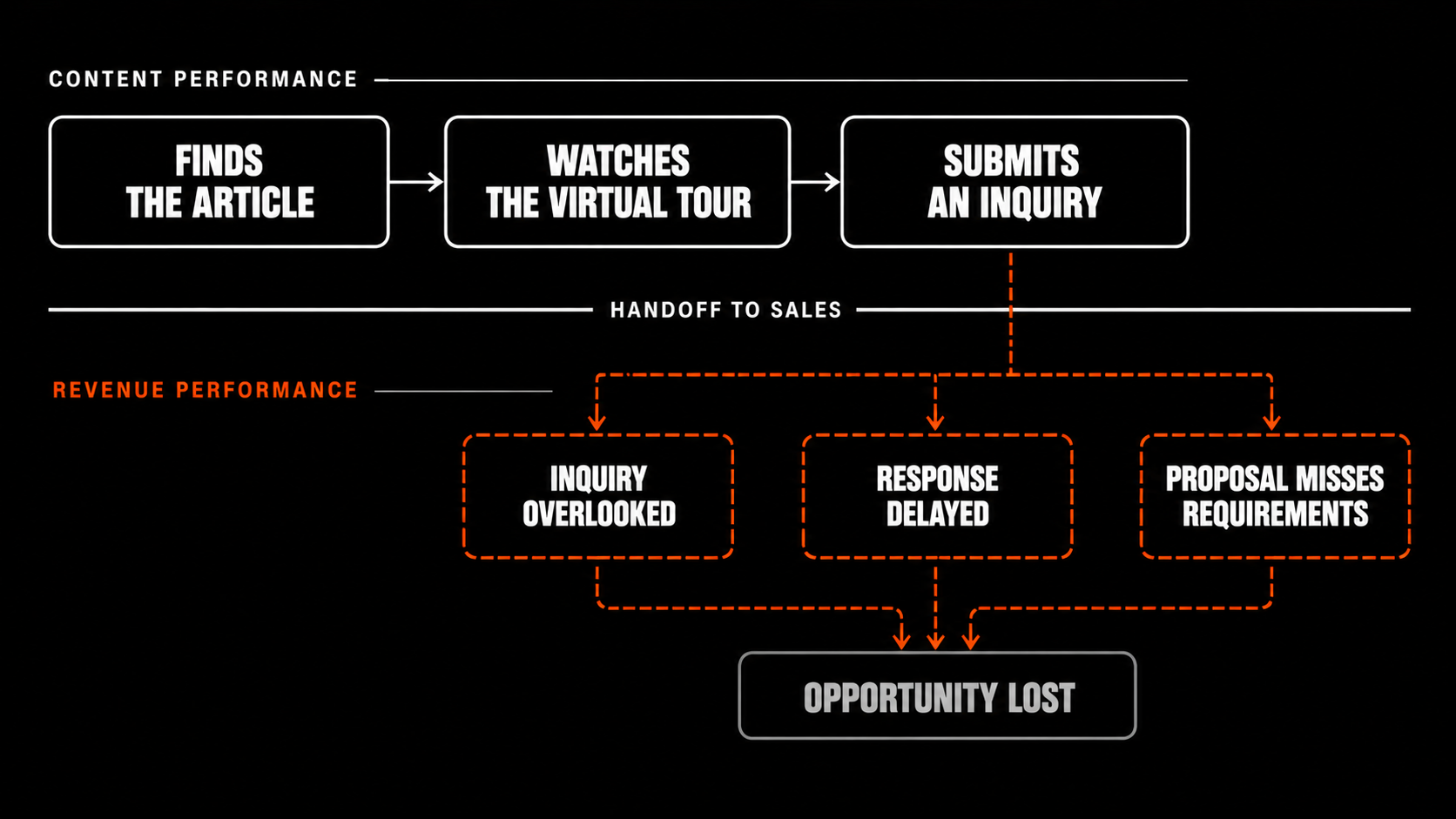
Consider a planner who discovers a hotel's conference facilities through a search article, watches a virtual tour, and submits an inquiry.
The content has successfully generated demand.
However, if the inquiry is overlooked, the response is delayed, or the proposal fails to address the planner's requirements, the commercial opportunity may still be lost.
This reveals an important distinction between content performance and revenue performance.
Make Marketing Content Available to Sales Teams
Content created for marketing can also support proposal development.
Property videos, meeting-space specifications, testimonials, event photographs, and case studies are valuable during the sales process.
A well-organized content library allows sellers to reuse these materials when responding to relevant inquiries.
For example, a planner requesting a leadership retreat may benefit from receiving a case study of a previous retreat, relevant meeting-space photographs, and a short venue walkthrough.
The content becomes part of the sales conversation rather than remaining confined to the website.
Align Content With Common RFP Questions
Hotels can also use incoming RFPs to improve their content strategy.
If planners repeatedly request the same information, that information may deserve a permanent place on the website or in the hotel's sales content library.
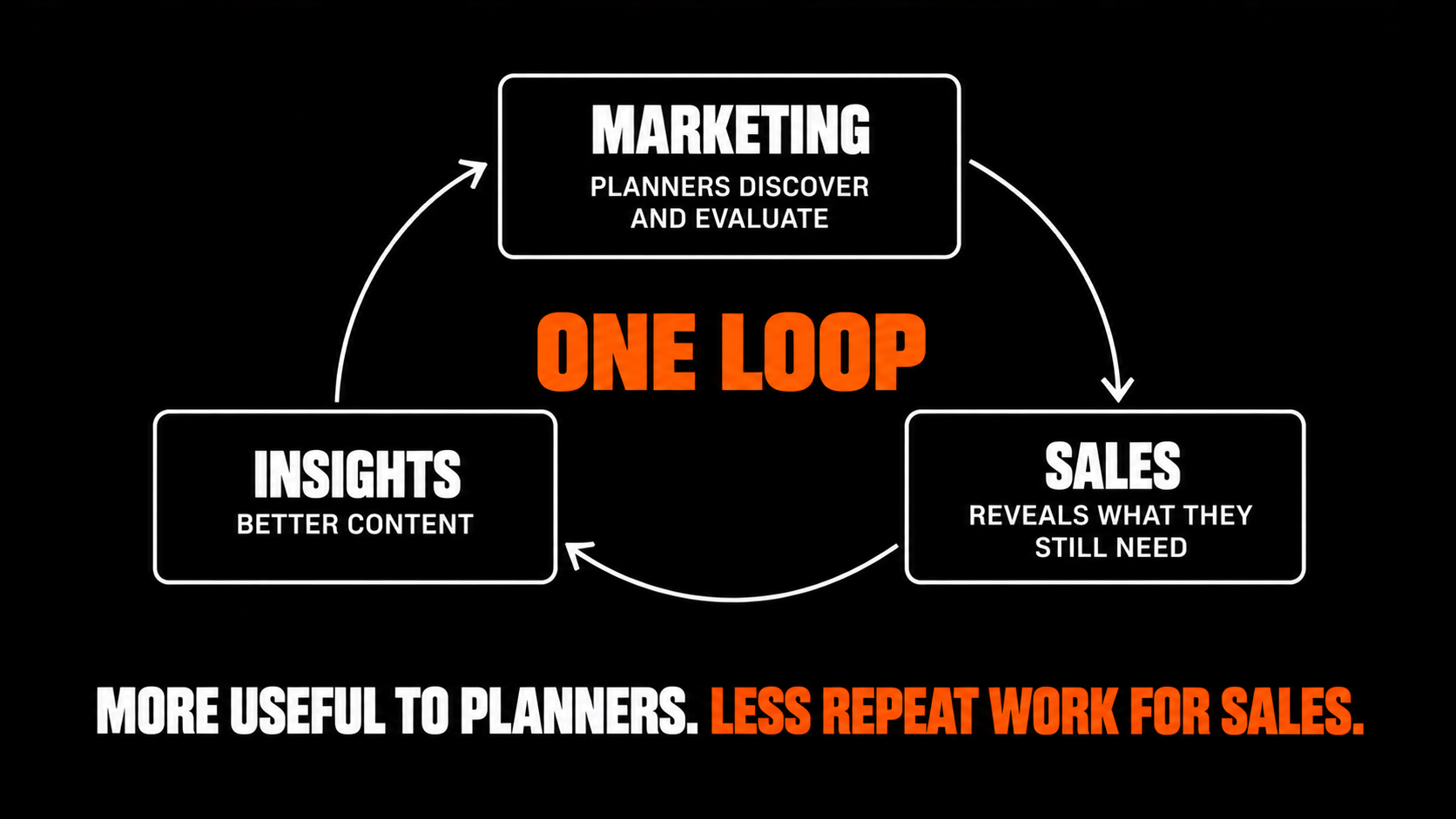
This creates a feedback loop.
Marketing helps planners discover and evaluate the property. Sales interactions reveal what information planners still need. Those insights then improve future content.
The result is a more useful experience for prospective customers and less repetitive information gathering for sales teams.
9. Measure the Revenue Impact of Hotel Content Marketing
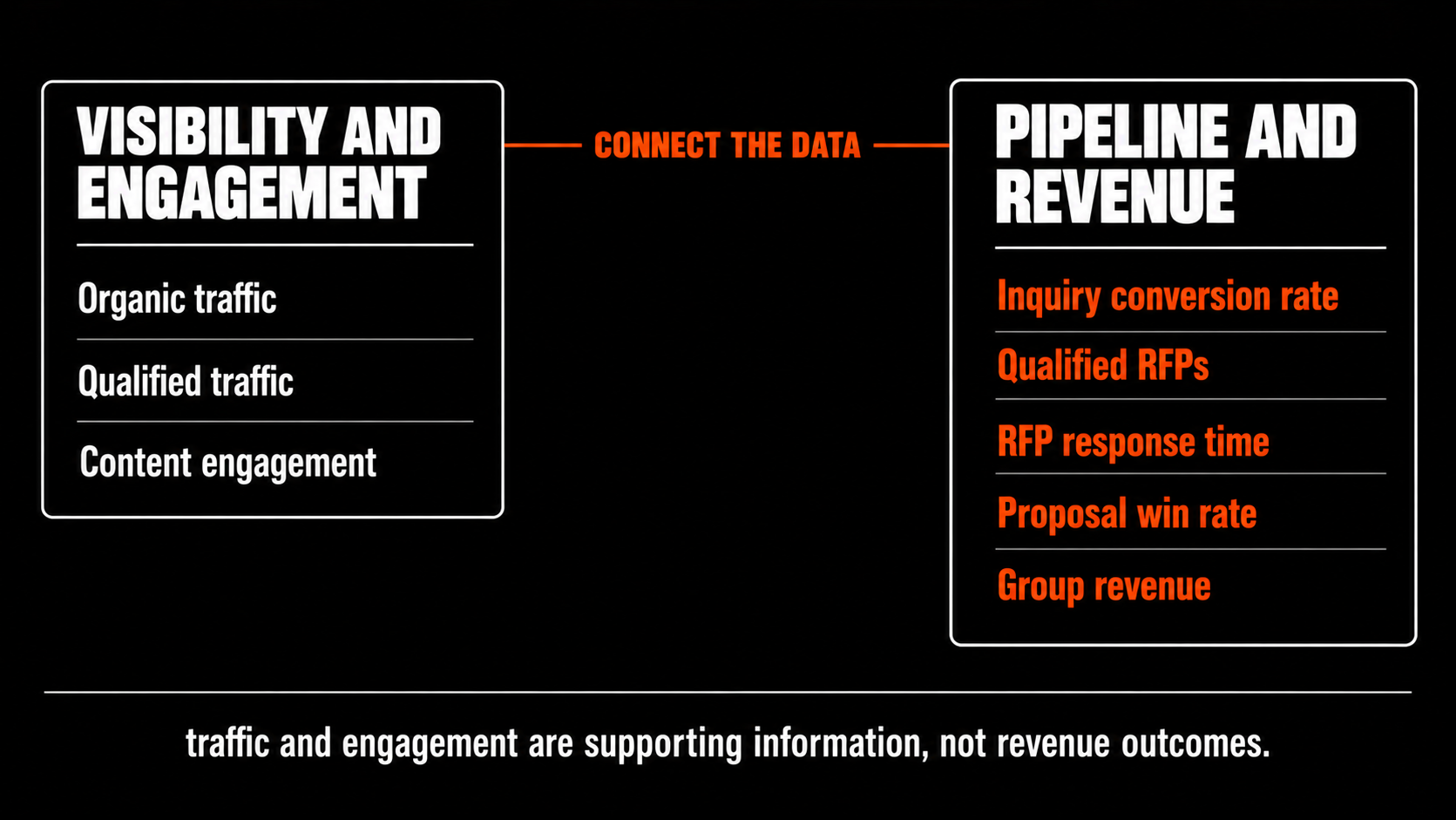
Website traffic and social engagement are useful indicators, but they do not fully explain whether content marketing contributes to group revenue.
A stronger measurement framework connects marketing activity to qualified inquiries, sales opportunities, and bookings.
Evaluate Content by Its Role in the Buying Journey
Not every article will directly generate an inquiry.
A destination guide may introduce a planner to the hotel months before the booking decision.
A meeting-space page may influence the final shortlist.
A case study may provide reassurance immediately before contract negotiations.
Measurement should account for these different roles rather than expecting every piece of content to generate immediate conversions.
Connect Marketing and Sales Data
Where possible, connect website analytics, inquiry records, and sales outcomes.
This can help identify which content attracts qualified planners, which pages contribute to inquiries, and which opportunities eventually become bookings.
Avoid assuming that a booking was caused by one article simply because the customer visited it.
Instead, use available data to understand how different content assets contribute to the overall decision-making journey.
10. Build a Practical Hotel Content Marketing Plan
An effective strategy does not require producing large volumes of content immediately.
Start with a focused plan that addresses your most important customer segments and commercial objectives.
Month 1: Research and Audit
Identify your target planner segments, review existing content, examine search performance, and collect common questions from the sales team.
Audit important venue pages for missing specifications, outdated photographs, unclear information, and weak inquiry pathways.
Month 2: Create Core Content
Prioritize high-value resources that directly support venue evaluation.
These may include detailed meeting-space pages, event planning guides, updated photography, virtual tours, and case studies.
Build content around the requirements most frequently raised by your target customers.
Month 3: Distribute and Measure
Promote the content through relevant search, social media, email, and sales channels.
Measure engagement, qualified inquiries, and sales feedback.
Identify which resources help planners progress toward booking decisions.
Use those findings to guide the next content cycle.
The objective is to establish a repeatable process in which customer research informs content creation, content supports sales, and performance data improves future decisions.
Common Hotel Content Marketing Mistakes
Even well-funded content programs can underperform when they focus on activity rather than customer needs.
One common mistake is creating content primarily about the property. Articles repeatedly describing luxurious rooms, exceptional service, and modern facilities may offer little practical information to planners comparing venues.
Another is prioritizing traffic without considering audience relevance. High visitor numbers are less valuable when those visitors have no realistic interest in booking the hotel's event facilities.
Hotels also sometimes invest heavily in content production while neglecting distribution. An excellent case study has limited commercial value if relevant planners never encounter it.
Finally, marketing and sales teams may operate independently, creating a disconnect between the information published online and the information required during proposal development.
Avoiding these mistakes requires a strategy that connects customer questions, content creation, distribution, and commercial outcomes.
The Goal: Help Planners Make Better Booking Decisions
An effective hotel content marketing strategy should make it easier for event planners to discover, understand, evaluate, and choose your property.
That requires moving beyond promotional content toward resources that answer practical questions, demonstrate event capabilities, and reduce uncertainty during venue selection.
Frequently Asked Questions
What is the best content marketing strategy for hotels?
The best hotel content marketing strategy addresses the needs of the hotel's target customers throughout their decision-making journey. For hotels targeting event planners, this typically involves educational articles, detailed venue information, case studies, videos, SEO, and relevant email campaigns.
What types of content attract event planners?
Event planners benefit from venue specifications, floor plans, event planning guides, destination information, case studies, photographs, videos, and virtual tours. Content that helps planners evaluate suitability, costs, logistics, and attendee experience is particularly useful.
How does SEO help hotels generate event bookings?
SEO improves the visibility of hotel websites when planners search for venues, destinations, and event planning information. Relevant content can attract potential customers and direct them toward venue pages or inquiry forms.
Are virtual tours useful for hotel marketing?
Yes. Virtual tours can help planners understand a property's layout and facilities without immediately visiting the venue. They are especially useful for customers evaluating multiple properties or organizing events remotely.
How can hotels measure content marketing ROI?
Hotels can assess content marketing ROI by examining qualified inquiries, RFP generation, inquiry-to-booking conversion, attributed revenue, and marketing costs. Traffic and engagement metrics provide supporting information but should not be treated as revenue outcomes.
How often should hotels publish new content?
Publishing frequency should depend on customer demand, available resources, and the quality of existing content. Updating important venue pages and maintaining accurate information may provide more value than publishing new articles that do not address meaningful customer questions.
Share this post
Ready to close more group business?
See how HippoRev can transform your hotel sales workflow in 15 minutes.

Follow us


