


Sales Productivity
AI Agents vs Automation: Why Humans Still Matter
AI agents are changing how work gets done, not by replacing people but by eliminating repetitive administrative tasks. Learn how agentic AI augments human expertise, improves productivity, and enables professionals to focus on higher-value work.



.png)
AI Isn't Trying to Steal Your Job
Most fears about AI come from misunderstanding how these systems actually behave.
There's no single way people start working with AI. Some try one prompt, then another, and one day it's simply clear they're using it for everything. Others start with a few small automations and keep them quiet until a "So are we really doing this?" conversation with their boss makes it official.
But over time, things change. The AI assistant that seemed perfect begins making imperfect suggestions and the occasional hallucination. And you start to wonder: am I working with a tool, or with something that sounds confident but can't be trusted?
Then there's the flip side, where it sounds smarter than you expected, and you catch yourself asking, "Is it coming for my job?"
For the past two years, conversations about AI have swung between excitement and existential dread. Every headline, every demo, every new model announcement seems to provoke the same anxious questions.
It's an understandable reaction. Historically, each major automation milestone, from factory robotics to Deep Blue to Siri to ChatGPT, has triggered the same worry.
Let's unpack why.
The Old Question: "Can AI Do My Job?"
Work is shifting from comparing humans and AI to expanding what humans can do with AI.
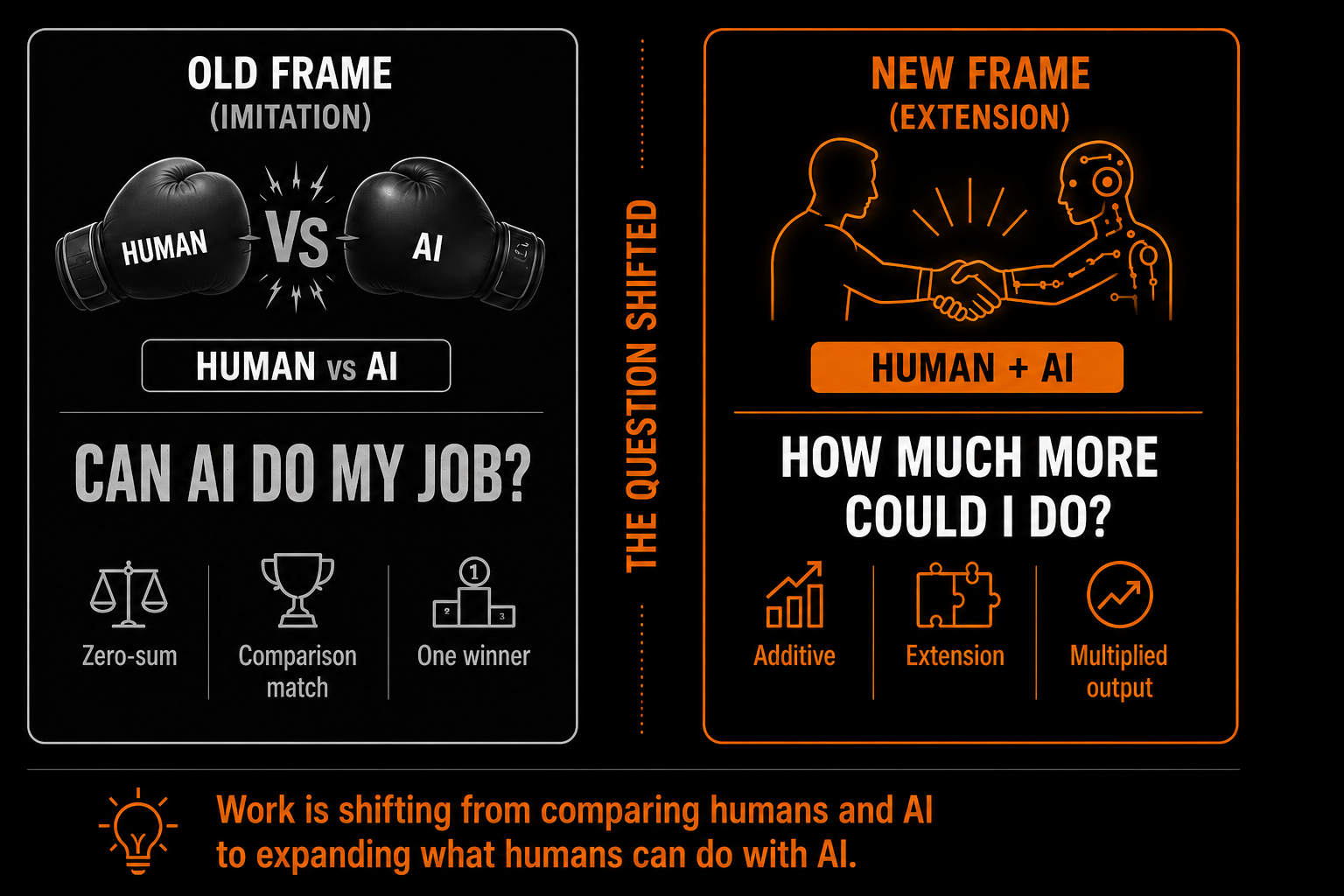
For decades, AI progress was evaluated on one dimension: how well can it imitate human performance?
- Could it solve problems?
- Could it answer questions?
- Could it write coherent sentences?
- Could it "think"?
That framing naturally put humans and AI into a comparison match neither side asked for.
But today's agentic systems aren't trying to imitate humans. They're trying to work with humans by handling the parts of work that require precision, persistence, and high-volume pattern processing, the work humans find tedious, slow, or simply exhausting.
The question is shifting from imitation to extension. Not "Can AI do what I do?" but "How much more could I do with AI?"
The Background Noise of Modern Work
Modern knowledge work is overloaded with tedious, low-value tasks that drain energy.
If you're a typical knowledge worker, your job slowly transformed into a scavenger hunt of inefficiencies.
You spend your day bouncing between:
- pulling data from six tools,
- rewriting the same paragraphs,
- filling forms that only exist because other forms exist,
- crafting updates that vanish into dashboard oblivion,
- replying to messages about messages about previous messages.
By 6pm, you feel like you worked hard, but you can't point to much meaningful work you actually produced.
How AI Agents Are Quietly Eliminating the Drudgery
Agents automate multi-step workflows across tools.
AI isn't here to take your job. AI is here to take the parts of your job that take you away from your actual job.
And to understand why that matters, we need to look at what modern AI agents actually do. Not the hype, but the mechanics.
Traditional AI answered questions. Traditional automation, like simple macros or email rules, can handle a single, repetitive step. An AI agent, as defined in the Introduction to Agents whitepaper, is fundamentally different. It is a goal-oriented system capable of planning, reasoning, and executing multi-step workflows across different tools and interfaces.
Here's what that looks like in practice.
1. Agents eliminate tool-hopping
Most professionals spend a shocking amount of time switching between systems: CRM to inbox to spreadsheets to PMS to dashboards to two browser tabs you forgot you opened.
AI agents remove this by calling these systems directly. According to Google's agent architecture, an agent can use APIs, databases, search tools, and UI actions as part of its workflow, pulling information without you ever touching five different tabs.
2. Agents draft the "first 80%" of everything
In many jobs, the first version of a task, whether a draft, summary, proposal, follow-up, checklist, or data extraction, is the most time-consuming part.
AI agents handle this upfront work by ingesting documents, synthesizing context, and producing structured, ready-to-edit outputs.
3. Agents remove the burden of remembering everything
Humans are terrible at short-term memory. Agents are built for it.
Through state, context windows, and long-term retrieval (RAG), they maintain continuity across tasks:
- what happened earlier in the workflow
- what tools were used
- which data was retrieved
- which failures or conflicts occurred
You're freed from the cognitive overhead of tracking dozens of tiny details that don't require expertise, just persistence.
4. Agents handle the "micro-decisions" humans resent
Every complex task contains dozens of tiny decisions:
- Which field is missing?
- Which source of truth should I use?
- How should this be formatted?
- Should I escalate or proceed?
- Is this similar to something I solved last week?
AI agents use planning, tool reasoning, and context engineering to make these decisions efficiently. They escalate only when logic, policy, or confidence thresholds tell them to.
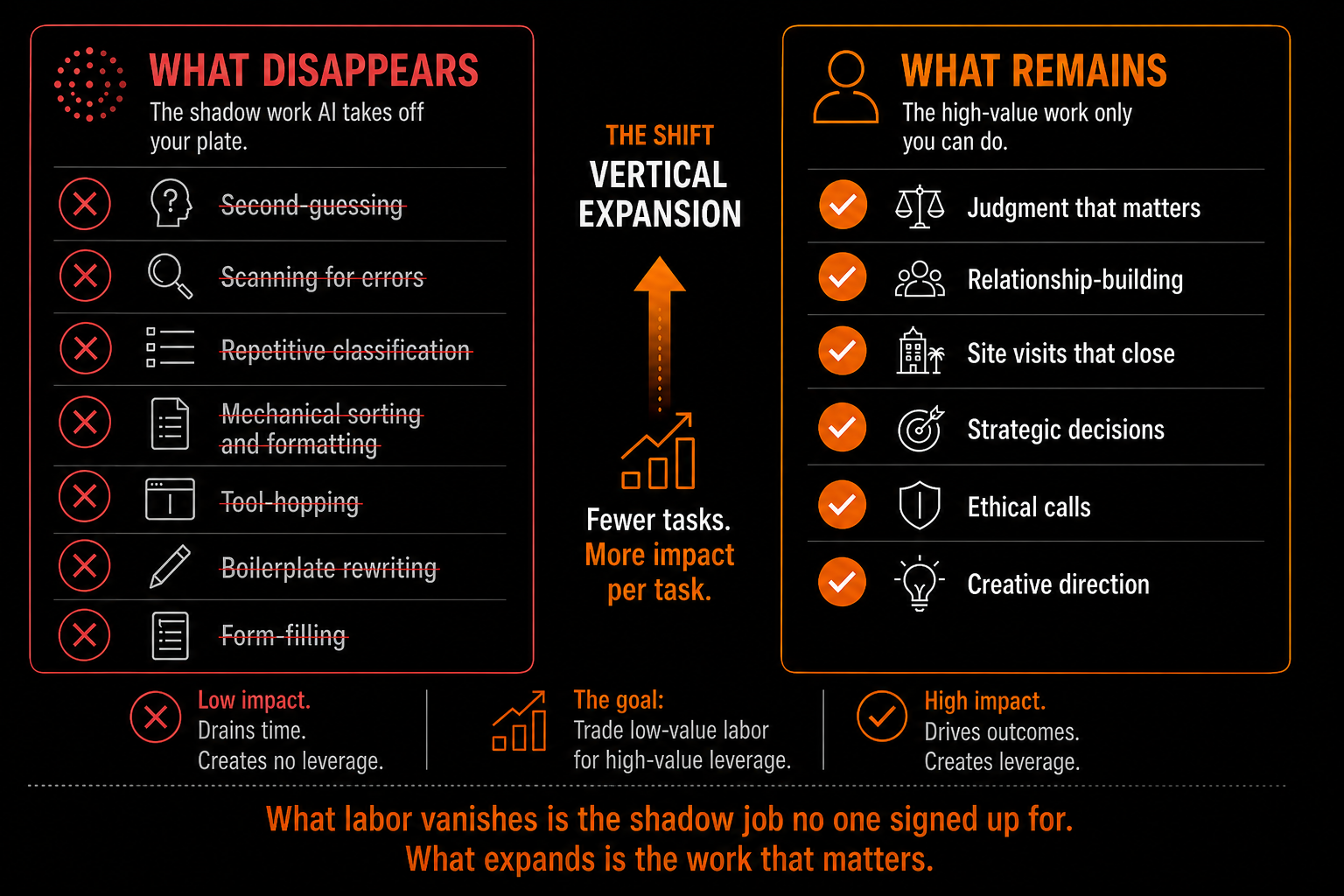
What disappears for humans: second-guessing, scanning for errors, repetitive classification, mechanical sorting and formatting.
What remains for humans: the decisions that actually need human judgment.
The Great Flip: From Replacement to Reinforcement
Let's be honest: early AI was often a zero-sum game. Factory robots replaced assembly line workers. Chatbots replaced basic customer service reps. The narrative was clear: humans versus machines.
But look at what's happening now:
AlphaFold 3 (2024) isn't replacing biologists. It's giving them the ability to predict complex molecular interactions, accelerating drug discovery from years to days.
Beethoven X (2021) didn't replace composers. AI collaborated with musicologists to complete Beethoven's unfinished 10th symphony.
Sony's Flow Machines doesn't replace musicians. It helps artists explore new creative directions, like the AI-assisted pop track "Daddy's Car" (2016).
The paradigm has flipped. We're no longer building our replacements. We're building our reinforcements.
The Co-Creation Contract: The Centaur Model
AI breakthroughs are giving professionals new capabilities instead of taking their roles.
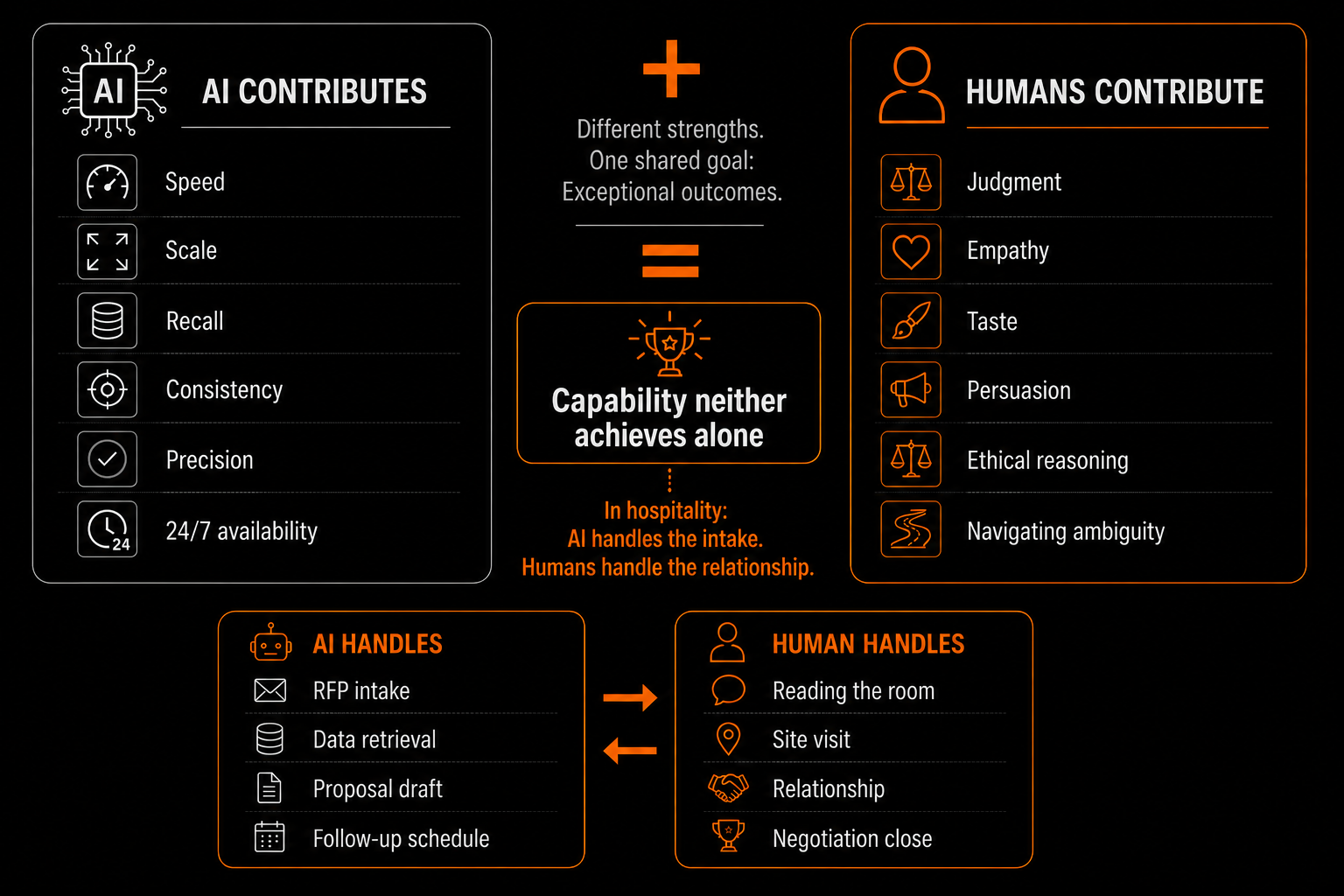
The most powerful framework emerging is what some call the Centaur Principle: half human, half AI, working as one integrated system.
AI excels at: speed, scale, recall, consistency, precision, 24/7 availability.
Humans excel at: judgment, empathy, taste, persuasion, ethical reasoning, navigating ambiguity.
Put together, you get a combined capability that neither side could achieve alone.
Why This Shift Matters (A Lot) in Hospitality
AI agents are becoming the operational backbone that restores time for human service.
If any industry needs this transformation, it's hospitality.
Right now:
- 65% of U.S. hotels report staffing shortages (Feb 2025).
- Sales teams spend only 28 to 30% of their time actually selling.
- Planners expect RFP responses in under four days.
- Cvent sourced $16.5B in group business in 2024 alone.
That's a high-intensity, high-volume workload on teams already stretched thin.
Agentic AI fits naturally into this gap. Not as a replacement for staff, but as administrative reinforcement, giving sales professionals time back for the human parts of the job.
Examples already emerging in hospitality:
- RFP handling: agents that ingest, analyze, summarize, draft, route, and follow up
- Lead qualification: agents that de-duplicate inquiries, qualify them, and auto-request missing information
- Pricing support: agents that evaluate comp sets, blackout dates, and pace, then suggest ranges
- BEO preparation: agents that pull PMS, CRM, and event data and flag conflicts
- Prospect research: agents that summarize verified data before a sales conversation
No one went into hospitality because they dreamed of formatting spreadsheets. Agents help staff return to the relationship-driven core of the industry.
To explore how this looks in practice, read our full breakdown here.
The Accuracy Trap: What Humans Misunderstand About AI
A common objection is: "AI isn't perfect."
True. But also: neither are humans.
More importantly, the goal isn't perfection. It's acceleration.
Consider this comparison. An AI agent may complete a task at around 70% accuracy in minutes. A human may push it to 85% accuracy, but only after spending several hours. In many workflows, that extra 15% offers diminishing returns, while the lost time harms productivity, responsiveness, and customer experience.
Agents don't eliminate human review; they eliminate human overuse. Humans step in where nuance matters. AI handles the grunt work that prevents humans from getting to nuance in the first place.
The Path Forward: Practical Adoption
The future belongs to teams that leverage AI as a partner, not a threat.
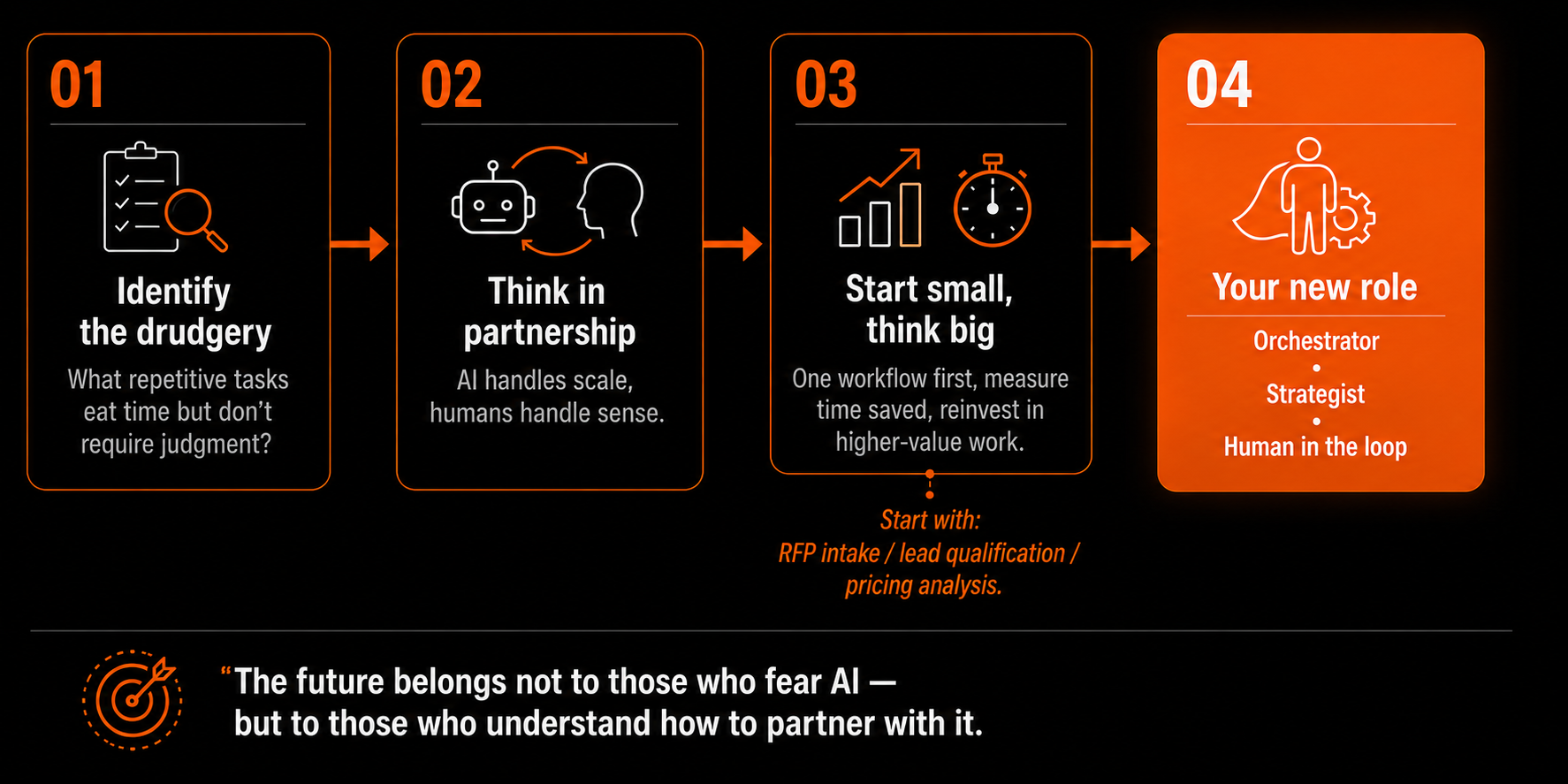
So how do you move from anxiety to augmentation? Start with the framework, not the fear.
Identify the drudgery: What repetitive tasks eat up your team's time but don't require human judgment? Start there.
Think in terms of partnership, not replacement: Look for opportunities where AI handles the scale while humans handle the sense.
Start small, think big: Begin with one workflow, whether that's RFP intake, lead qualification, or pricing analysis. Measure the time saved, then reinvest that time in higher-value work.
Embrace the new role: Your job isn't disappearing. It's evolving. You're becoming an orchestrator, a strategist, a human in the loop where it matters most.
The Bottom Line
We've spent decades asking the wrong question. The issue was never whether AI would replace us. It was whether we'd learn to work alongside it in ways that amplify our humanity rather than diminish it.
The evidence is now clear: when designed thoughtfully, AI doesn't make us obsolete. It makes us better. It handles the tedious so we can focus on the meaningful. It analyzes the data so we can make the decisions. It manages the routine so we can build the relationships.
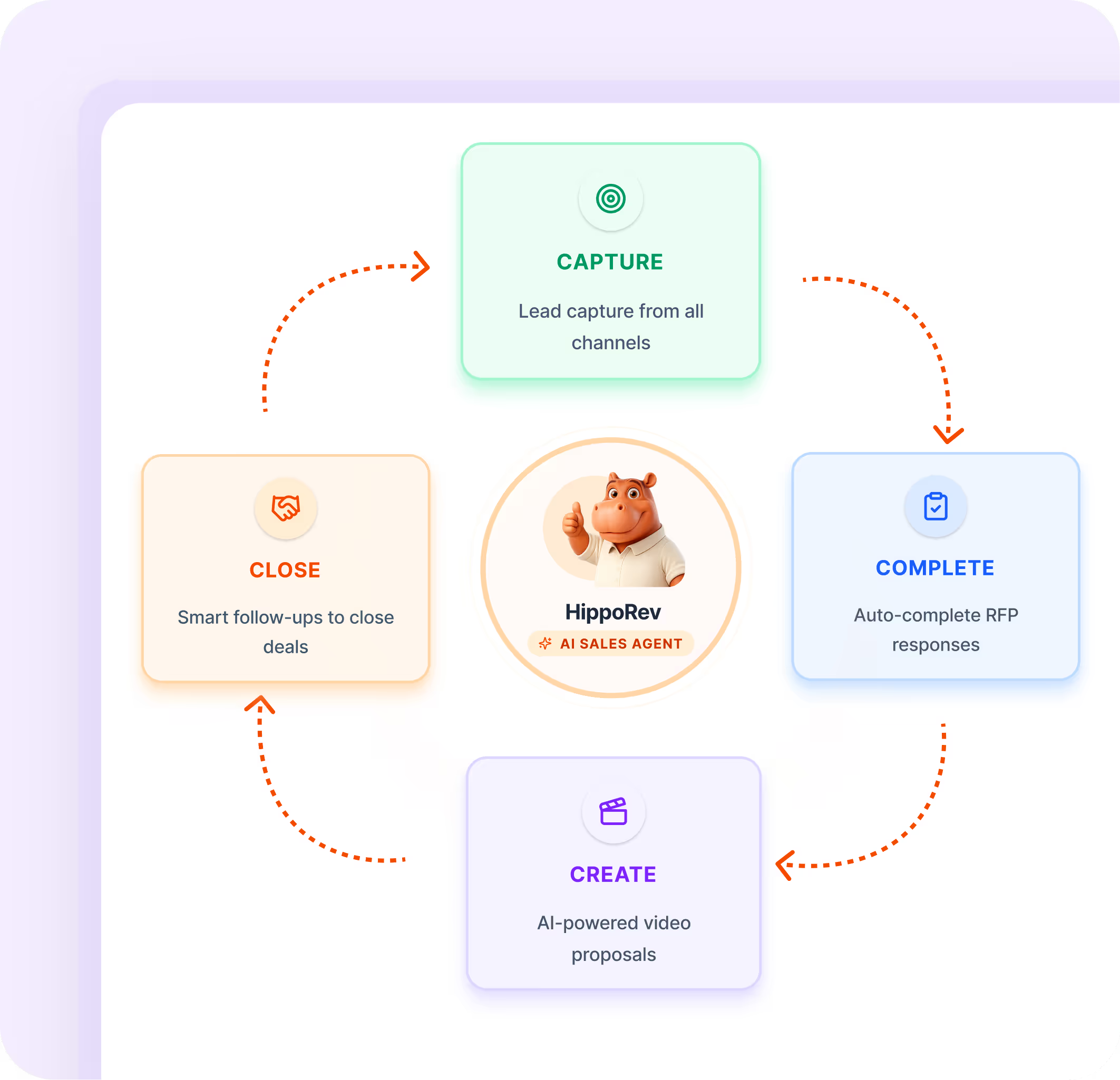
This is the thinking behind how we built Hippo Rev for hotel group sales teams: a system of execution that handles the capture, qualification, and follow-up work so sellers can spend their day selling. If you want to see what that looks like against your own numbers, book a Capture Audit. 20 minutes, your numbers, no deck.
The future belongs not to those who fear AI, but to those who understand how to partner with it.
Frequently Asked Questions
What specific types of work are AI agents best suited to take over, and why those tasks first?
AI agents are most effective at tasks that are high-volume, rule-based, context-dependent, and multi-step, such as data entry, information retrieval, formatting, error-checking, and workflow routing. These tasks require consistency and patience, two things humans are famously terrible at when performed repetitively. Agents excel here because they can plan steps, call tools and APIs, observe the results, and iterate without fatigue, distraction, or cognitive overload. This frees humans to focus on ambiguous, relational, or strategic work that agents cannot reliably handle.
If improving hotel RFP response speed is your priority, you might find this resource on converting hotel sales leads especially useful.
How do AI agents avoid becoming "hallucination machines" when given operational responsibility?
Hallucinations decrease significantly when the agentic system is grounded in verifiable data sources such as RAG pipelines, enterprise databases, APIs, and controlled tool outputs. Instead of guessing, agents look things up. The orchestration layer also enforces planning steps, memory usage, and validation logic. When uncertainty persists, well-designed agents escalate to humans with a concise summary of what's missing, preventing errors from reaching production.
If agents handle so much administrative work, how do human roles evolve rather than shrink?
Human roles shift toward the parts of work that were always the real value: relationship-building, negotiation, judgment-based decisions, ethical calls, context-sensitive creativity, and cross-functional collaboration. The labor that vanishes is the shadow job no one signed up for, the hours spent reconciling data, rewriting boilerplate, cleaning spreadsheets, crafting repetitive emails, or switching between systems. As drudgery compresses, human contribution expands vertically: fewer tasks, more impact.
What prevents AI agents from overstepping human boundaries or making harmful decisions?
Modern agentic systems use multiple layers of safety:
- Deterministic guardrails (policies, access controls, tool limits)
- AI-powered guard models that screen intent, outputs, and risk
- Confidence thresholds and uncertainty detection
- Human-in-the-loop escalation at key decision points
- Role, identity, and permission constraints via agent identity frameworks
These constraints ensure agents cannot unilaterally execute high-impact actions without approval.
Why is hospitality such a strong early fit for AI agents compared to other industries?
Hospitality has three unique characteristics:
- High task volume: RFPs, emails, BEOs, lead qualification, follow-ups.
- High stakes and high speed: planners expect responses in days; competition is fierce.
- Chronic staffing shortages: 65% of U.S. hotels report ongoing shortages.
Agents thrive in environments where administrative load is heavy and consistency matters, but human warmth and relationships are still central. Hospitality fits this profile perfectly and stands to benefit disproportionately.
Share this post
Ready to close more group business?
See how HippoRev can transform your hotel sales workflow in 15 minutes.

Follow us


.svg)