


Sales Automation
Hotel RFP Automation: An 8-Point Buyer's Checklist
Feature lists will not tell you which RFP automation platform actually wins business. This eight-point checklist covers intake, response speed, integrations, AI accuracy, lifecycle coverage, adoption, multi-property support, and reporting, with a specific vendor question for each so you can run a rigorous evaluation instead of a demo tour.



.png)
What to Look for in Hotel RFP Automation: An 8-Point Buyer's Checklist
When evaluating hotel RFP automation, look for eight things: centralized lead intake across every channel, measurable speed to first response, deep integrations with your PMS and CRM, accuracy safeguards on AI-generated content, coverage of the full deal lifecycle rather than just proposal creation, low adoption effort for your team, multi-property support if you run a portfolio, and reporting that proves the tool is actually winning you business. Feature lists will not tell you which platform delivers these. The questions below will.
The stakes justify the diligence. Industry-wide, roughly 36 percent of hotel RFPs go unanswered, 62 percent of won deals go to one of the first three responders, and over 60 percent of planners now expect a response within four days. RFP automation exists to close that gap. A tool that merely makes prettier proposals does not. Here is how to tell the difference.

1. Centralized Intake, Not Just Prettier Proposals
The first distinction in this category separates lightweight proposal builders from platforms that manage the full workflow. Hotel Tech Report's evaluation framework makes intake model a primary vector: does the system aggregate demand from every channel, or does it only format documents after a human has already gathered everything manually? Your group leads arrive through Cvent, brand portals, website forms, and direct planner emails. If the tool cannot capture all of them in one queue, your team is still doing the most error-prone work by hand, and the automation starts too late to matter.
Ask the vendor: show me how a lead from each of my intake channels lands in the system without anyone re-keying it.
2. Speed to First Response, Measured in Minutes
Since 61 percent of won deals go to an early responder, response speed is the single metric your automation must move. Do not accept "faster" as an answer. Demand a number. How long from RFP arrival to a complete, accurate, sendable proposal? Manual processes commonly take days once rate approvals and space checks are included. Strong automation compresses the processing itself to minutes. Anything that still requires your seller to assemble rates, availability, and content from three systems has automated the formatting, not the response.
Ask the vendor: time a real RFP from my inbox to a sendable proposal, live, during the demo.
Also Read: Why being the first responder consistently wins more hotel group business.
3. Integration Depth With Your PMS, CRM, and Revenue Tools
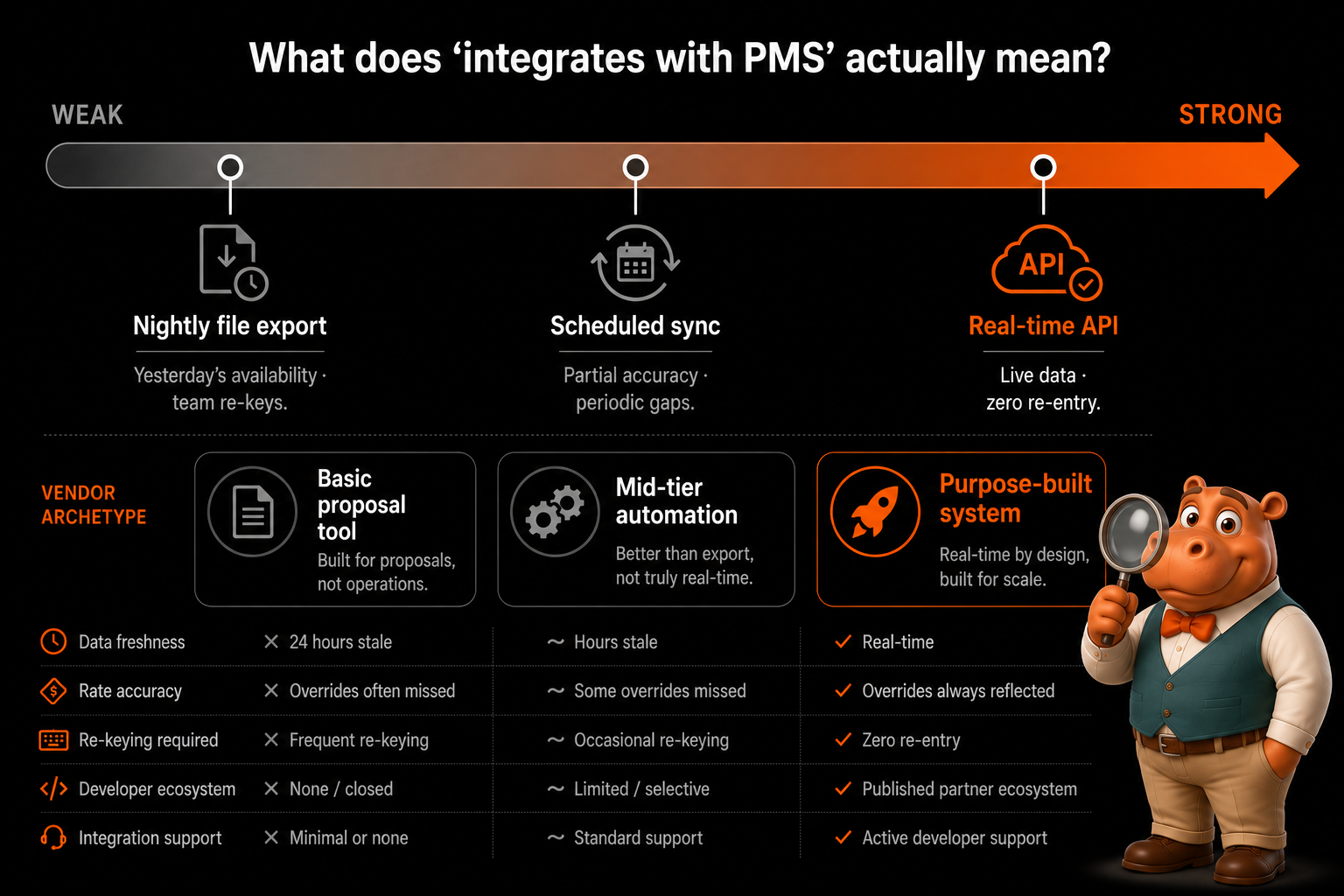
An RFP tool is only as accurate as the data feeding it. Integrations with the property management system ensure availability and rates are current; CRM integration brings account history and negotiated terms into every response. But integration quality varies enormously. Platforms with published APIs and active partner ecosystems connect reliably; platforms that sync through nightly file exports quote yesterday's availability. If your team ends up re-keying data because the integration keeps breaking, the tool is creating work instead of removing it.
Ask the vendor: which of my exact systems do you integrate with, is the sync real-time or scheduled, and can I speak to a customer running the same stack?
4. Accuracy Safeguards on AI-Generated Content
Most modern RFP tools now generate response content with AI, which makes accuracy the number one evaluation factor. Buyer guides in this space are direct about it: responses must draw on sources you trust, with strong protections against incorrect output, and a slow accurate response beats a fast hallucination. A proposal that confidently quotes the wrong ballroom capacity or an expired rate does more damage than a late one. Also confirm the data handling: your customer and rate data should never be used to train the vendor's models, and SOC 2 compliance is table stakes, not a differentiator.
Ask the vendor: where does each fact in a generated proposal come from, what happens when the system is not sure, and what is your policy on training models with my data?
5. Coverage of the Full Deal Lifecycle
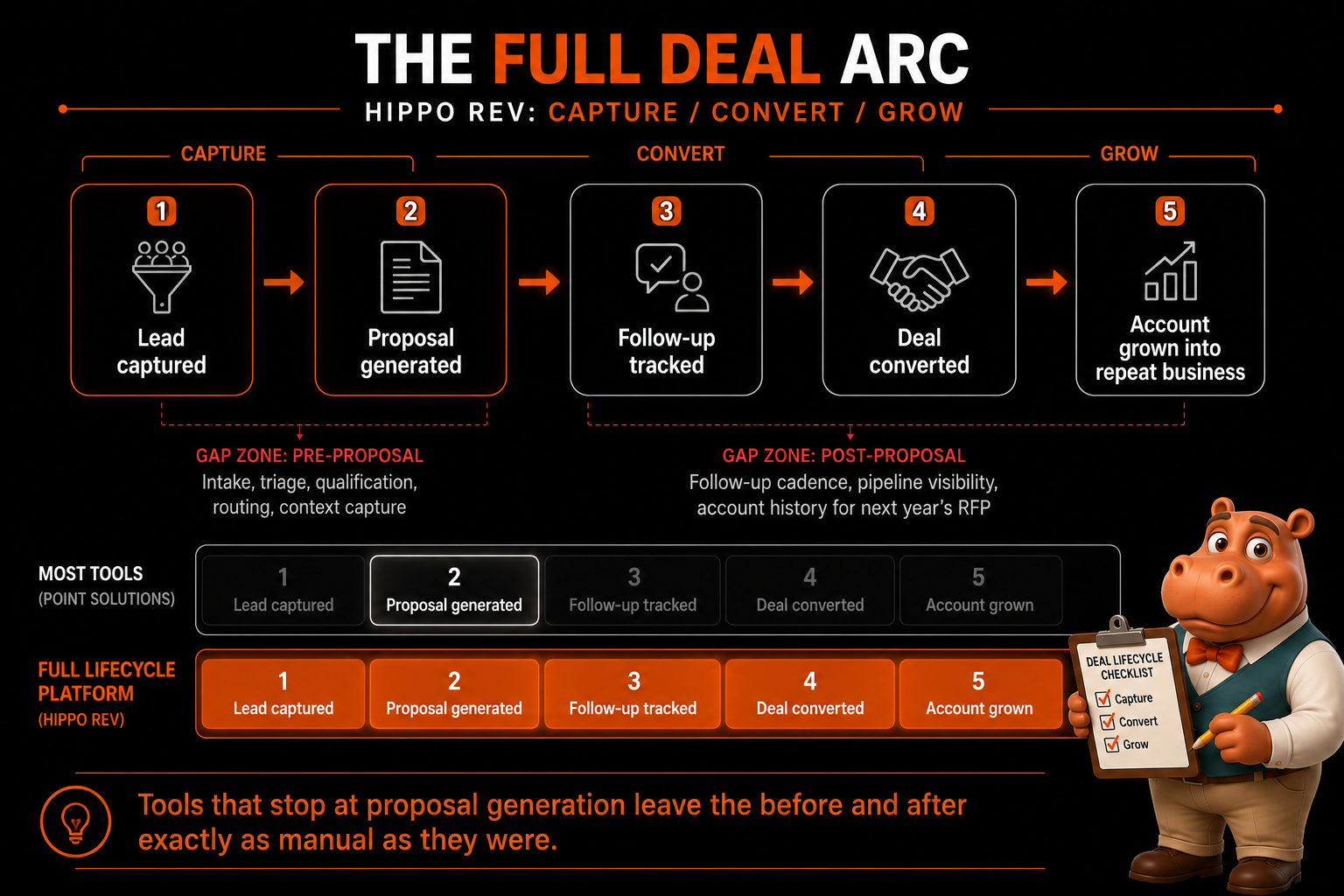
An RFP response is one moment in a longer arc: the lead must be captured, the deal converted, and the account grown into repeat business. Evaluate whether the platform covers that arc or just the middle of it. Does it track follow-ups and reminders so proposals do not die in silence? Does it maintain pipeline visibility so sales leadership sees pace and conversion in real time? Does it preserve account history so next year's RFP from the same planner starts from relationship intelligence instead of a blank page? Tools that stop at proposal generation leave the before and after exactly as manual as they were.
Ask the vendor: walk me through what happens after the proposal is sent.
6. Adoption Effort Your Team Will Actually Survive
The most common failure mode in hotel sales technology is not bad software. It is good software the team stops using. Platforms that demand a new workflow, months of migration, and mandatory retraining get quietly abandoned within a year. Evaluate the adoption path as rigorously as the features: does it layer onto your existing systems or replace them? Can a coordinator learn it in a day? Does it work on multiple devices, since your sellers respond from site tours and airports, not just desks?
Ask the vendor: what does week one look like for my team, and what is your customer adoption rate at the six-month mark?
Also Read: What successful AI onboarding looks like for hotel commercial teams.
7. Multi-Property Support If You Run a Portfolio

For management companies and groups, single-property tools break at scale. You need shared account records so a planner sourcing three of your markets is recognized as one relationship, consistent pipeline stages so portfolio reporting compares like with like, and lead routing so an RFP touching multiple properties reaches every relevant seller at once instead of surfacing in a hallway conversation four days later.
Ask the vendor: show me a portfolio pipeline view and how a multi-property RFP gets routed.
8. Reporting That Proves the Money
Finally, the tool must make its own case in numbers. At minimum: RFPs received, response rate, average response time, conversion rate, and revenue won, trended over time. These are the same numbers that expose what your manual process was losing, and they are how you will defend the subscription at budget season. A platform that cannot report its own impact is asking you to take ROI on faith.
Ask the vendor: show me the report I would put in front of ownership after ninety days.
How Hippo Rev Answers This Checklist
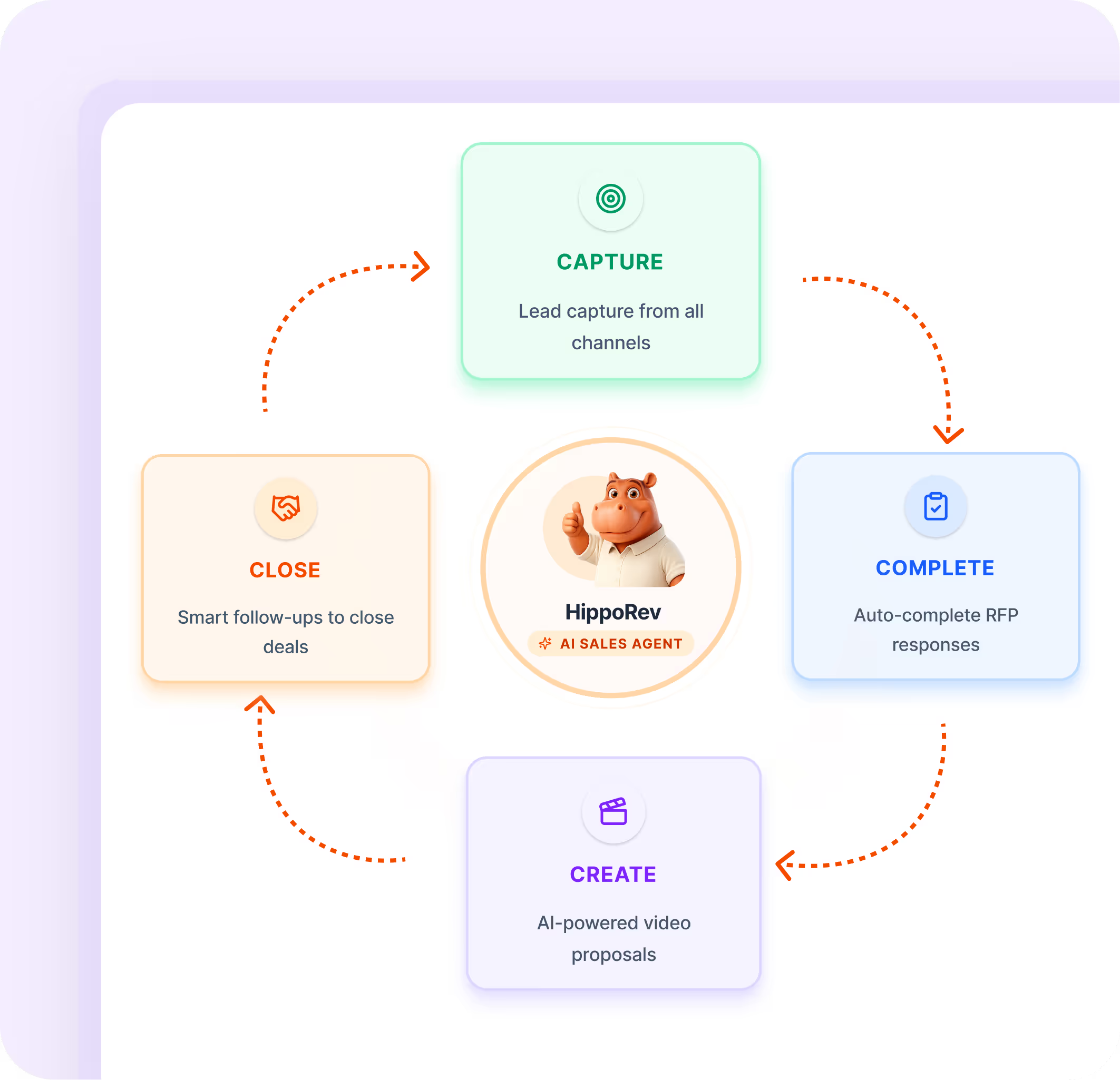
We built Hippo Rev against this exact list, so we will state our answers plainly. It captures every inbound group lead in one place, cuts RFP processing from roughly 37 minutes to about 4 minutes, grounds every generated response in your actual property data, covers the full Capture, Convert, Grow lifecycle, and layers onto your existing stack rather than replacing it. And consistent with what we tell every buyer: run the live test with us. If you want the baseline numbers first, a Capture Audit will surface them from your own pipeline in 20 minutes, with no deck involved.
Frequently Asked Questions
What is the most important feature in hotel RFP automation?
Centralized intake. If the platform cannot capture leads from every channel into one queue automatically, everything downstream still depends on manual re-entry, which is where speed and accuracy are lost.
How fast should automated RFP responses be?
Processing should take minutes, not days. Since 62 percent of won deals go to one of the first three responders, measure vendors on time from RFP arrival to sendable proposal.
Which integrations matter most for RFP automation?
PMS integration for live rates and availability, CRM integration for account history, and revenue management integration for pricing alignment. Prefer real-time API connections over scheduled file exports.
How do I evaluate the AI in an RFP automation tool?
Test accuracy, not fluency. Ask where each generated fact comes from, how the system behaves when uncertain, and confirm your data is never used to train the vendor's models.
Is proposal generation software the same as RFP automation?
No. Proposal builders format documents after a human gathers the inputs. True RFP automation covers intake, data assembly, response, follow-up, and pipeline tracking across the deal lifecycle.
What causes hotel RFP software implementations to fail?
Adoption, not features. Tools that force new workflows, long migrations, or heavy training get abandoned. Evaluate week-one experience and six-month adoption rates before buying.
Do small hotels with low RFP volume need automation?
It depends on volume and leakage. A property handling a few RFPs a month may manage manually, but once leads go unanswered or responses slip past two days, the lost revenue typically exceeds any subscription cost.
What should multi-property groups look for specifically?
Shared account records, consistent pipeline stages across properties, portfolio-level reporting, and automatic routing of multi-property RFPs to every relevant seller.
What reports should RFP automation provide?
RFPs received, response rate, average response time, conversion rate, and revenue won, trended monthly. These prove ROI and expose remaining leaks.
What should I do before buying RFP automation?
Baseline your current numbers: monthly RFP volume, response rate, and average response time. Clean and centralize your data. Automation amplifies the foundation it sits on, so measure and fix the foundation first.
Share this post
Ready to close more group business?
See how HippoRev can transform your hotel sales workflow in 15 minutes.

Follow us


.svg)