


Hotel Budgeting
Hotel Budget 2027: Start With Revenue and Profit Leaks
The 2027 hotel budget should begin with economic leakage, not last year’s spreadsheet. This article shows how hotels can examine demand capture, sales capacity, labor, distribution, space productivity and technology through a profit lens.



Hotel Budget 2027: Start With Revenue and Profit Leaks
Hotel budget season has a familiar pattern.
Last year’s spreadsheet gets opened. Revenue assumptions move up or down. Payroll gets challenged. Department heads defend familiar lines. Technology requests arrive with ROI slides attached. Eventually, the workbook becomes next year’s plan.
The problem is that 2027 does not look like a year in which simply adjusting last year’s assumptions will tell management where future profit will come from.
The research points to a more uncomfortable picture. Hotel demand is proving relatively resilient in several important markets, while operating costs remain stubborn. Travel pricing is moderating without becoming cheap. Group buyers are moving faster and behaving more selectively. Sales teams are still losing time to administration. And technology adoption is accelerating quickly enough that simply owning another system will not create much of an advantage.
Put those forces together and a different budget question emerges:
Where is the hotel already generating demand but failing to capture its full economic value?
That is the question worth taking into the budgeting room.
Because if 2027 is defined by reasonable demand and pressured margins, the best budget may not be the one with the most ambitious revenue forecast. It may be the one that identifies the operating constraints between demand and profit—and funds the removal of those constraints with evidence rather than optimism.
A stronger top line can still produce a disappointing year
The macro outlook contains an important contradiction.
STR and Tourism Economics have revised their U.S. expectations upward, with the research pointing to record room-night demand in the first half of 2026 and expectations for a stronger 2027 than earlier forecasts suggested. U.S. RevPAR growth is cited at 1.6% for 2027, while Asia Pacific is projected at 2.2%.
Globally, hotel ADR is expected to rise another 1.8% in 2027 after 3.7% growth in 2026.
That sounds constructive.
But it is not the same thing as saying hotel economics are becoming easier.
CBRE’s view in the supplied research is more cautious: soft top-line growth, sticky inflation and continued margin pressure. Gross operating profit per available room may rise, but expenses are expected to keep taking a meaningful share of the gain.
That distinction should shape the budget.
When demand is weak, management naturally focuses on stimulating demand. When demand is reasonably healthy but margins remain tight, the emphasis has to change. The question becomes how efficiently each piece of demand is acquired, processed, converted and served.
A hotel can budget 2% more revenue and still become economically weaker if acquiring that revenue requires more labor, more commissions, more administrative handling and more operating expense.
That is why 2027 budgets need to be read from the bottom up as well as the top down.
The revenue forecast tells you what you expect the market to give you.
The rest of the budget reveals how much of it you expect to keep.
The dangerous assumption is that demand is the bottleneck
Group business makes this especially clear.
The supplied research cites independent industry findings indicating that hotels responding to group RFPs within four hours report win rates 20 to 30 percentage points higher than properties responding later that day or the next. It also notes that booking windows have compressed sharply in some segments, in some cases toward 30 days.
Against that backdrop, speed stops being a service metric and starts becoming an economic variable.
The research also suggests that roughly 36% of RFPs go unanswered, while 61% of won deals go to one of the first three hotels that respond. Manual RFP processing is estimated at about 37 minutes per RFP versus roughly four minutes with automated processing.
Those figures should not automatically be treated as universal industry benchmarks. But they point to a problem hotel groups can—and should—measure for themselves.
Consider what an unanswered RFP looks like in a conventional sales report.
Often, it does not look like a lost deal at all.
There may be no formal decline, no recorded competitor win and no clean lost-business reason. The opportunity simply disappears before the hotel meaningfully enters the competition.
That is a dangerous kind of leakage because traditional reporting can make it almost invisible.
If management budgets primarily from converted business and documented losses, it may be building next year’s sales plan on an artificially small view of the addressable opportunity.
The real constraint may not be lead generation.
It may be the hotel’s capacity to work the leads it already receives.
That changes where the next dollar should go.
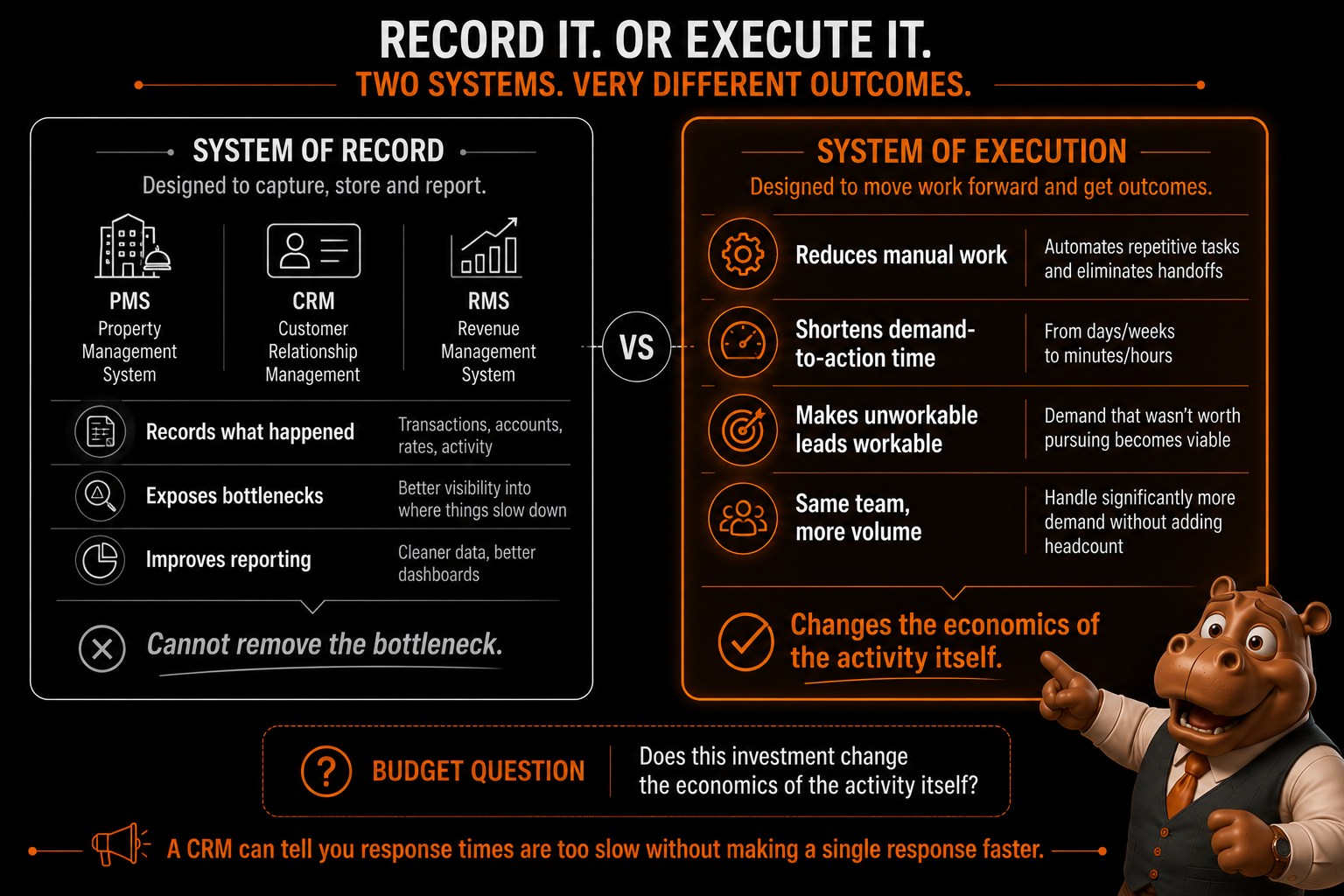
Stop confusing systems that remember with systems that act
This is also where many technology discussions become muddled.
Most established hotel groups already have systems of record: PMS, CRM, revenue management platforms and other applications that record transactions, accounts, rates, activity and results.
Those systems matter enormously.
But a record of what happened yesterday does not necessarily solve an execution problem happening at 10:14 this morning.
An RFP arrives.
Someone needs to notice it. Qualify it. Gather information. Price it. Prepare a response. Send it. Follow up. Update the system. Coordinate internally. Repeat.
The supplied research describes the emerging distinction as one between a system of record and a system of execution.
That is a useful budgeting distinction because it helps clarify what management is actually buying.
A CRM may be perfectly capable of showing that response times are too slow without materially reducing the work required to respond faster. Better reporting can expose a bottleneck. It does not automatically remove it.
The same principle applies far beyond group sales.
Hotels should be asking which technology lines primarily document activity and which ones actually change the economics of the activity itself.
Does the investment reduce manual work?
Does it shorten the time between demand signal and commercial action?
Does it make a previously unworkable piece of demand economically worth pursuing?
Does it allow the same team to handle more volume without simply increasing payroll?
Those are stronger budget questions than, “Do we need another platform?”
AI enthusiasm makes proof more important, not less
Hospitality’s appetite for AI makes this distinction even more important.
In a 2026 survey of more than 400 hotel technology decision-makers, 85% expected to allocate at least 5% of their IT budgets to AI, while more than half expected AI allocations to exceed 10%. Separate industry tracking found that 82% of hotels were expanding their use of AI in 2026, up from 63% in 2024.
The obvious conclusion would be that AI investments are becoming easier to approve.
In one sense, yes. The category itself requires less explanation.
But that can make the individual investment harder to defend.
Once almost every department can produce an AI-related proposal, finance is no longer choosing between “AI” and “no AI.” It is choosing among several competing claims on the same limited pool of capital.
The winning proposal therefore needs more than a broad industry statistic.
It needs a baseline.
If a commercial team says automation will save time, finance should know how much time the current process consumes.
If faster responses are supposed to improve conversion, management should know its current response-time distribution and conversion rate.
If the tool is expected to capture neglected RFPs, the hotel should first count how many RFPs are currently receiving no meaningful response.
That is what makes the “proof before budget” principle so powerful.
In a margin-sensitive year, that is a much stronger basis for allocating capital.
The same logic should be applied to the entire P&L
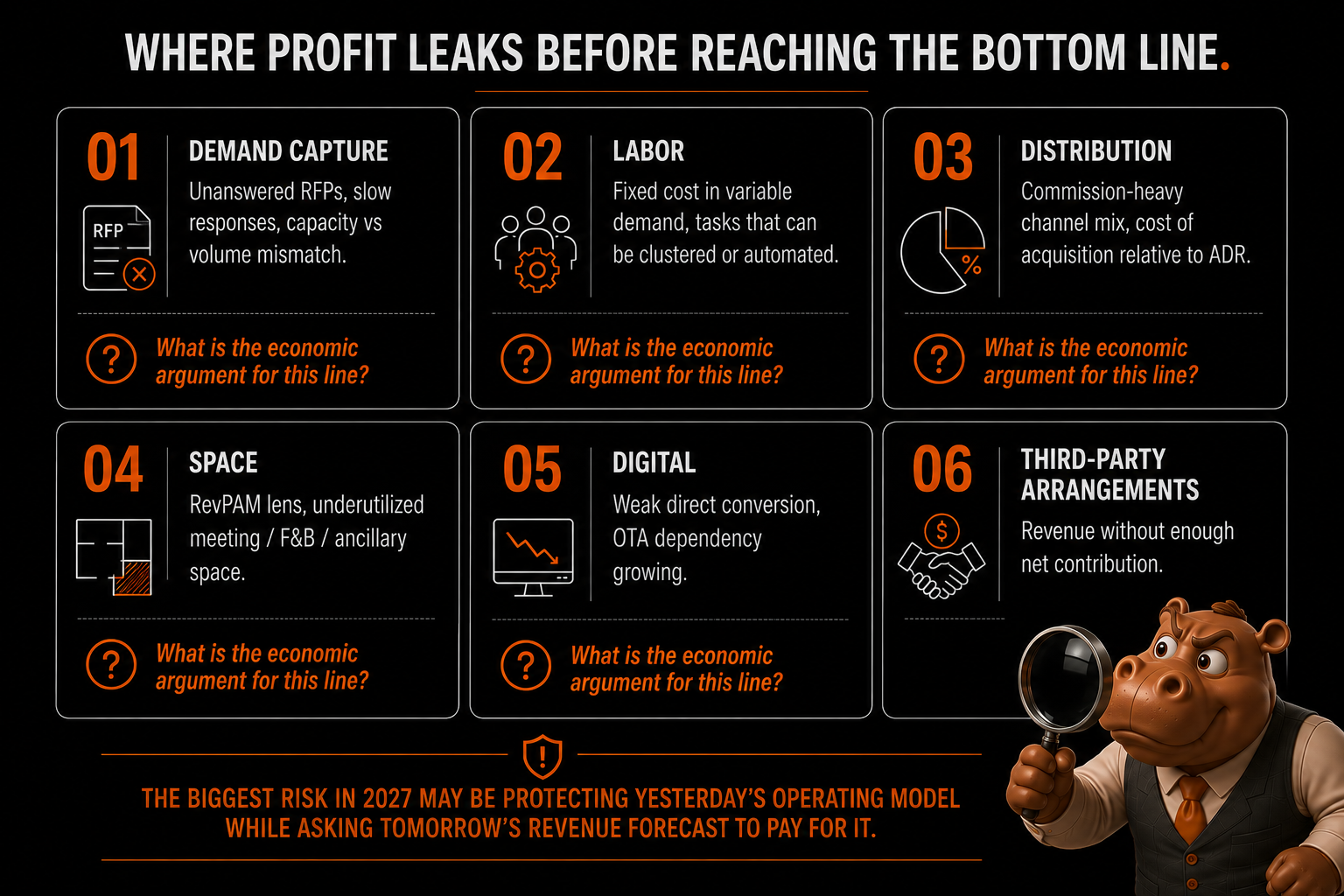
This proof-first mindset should not stop with sales technology.
Take payroll.
The research argues that hotels are exploring clustered leadership, hybrid roles, selective outsourcing and greater automation because labor remains the largest controllable expense.
A traditional budget might begin with departmental headcount and ask how much it can be reduced.
A more useful approach begins with work.
What work must be done?
Which tasks vary with occupancy?
Which require property-level presence?
Which can be clustered?
Which are repetitive enough to automate?
Which are genuinely revenue producing?
That produces a different organizational conversation than simply asking every department to cut 5%.
The same applies to physical space.
RevPAR remains essential, but the supplied research introduces RevPAM—Revenue Per Available Square Metre—as a broader way to think about the productivity of the asset.
A ballroom, rooftop, spa, restaurant or retail area consumes capital and often operating expense whether it is well monetized or not.
That creates a budgeting question that room-centric reporting can miss: are we protecting cost structures attached to spaces that are not producing enough economic value?
Third-party leases deserve the same treatment. A restaurant or salon may generate rent or revenue share while the hotel absorbs utilities and back-of-house support. Looking only at the revenue line can make an arrangement appear healthier than it is. The relevant view is closer to the net contribution.
Once again, the principle is consistent:
Budget the economics of the activity, not merely the historical department that owns the line.
Distribution deserves a profit lens too
The research’s emphasis on direct booking makes a related point.
A room booked through an OTA and a room booked through brand.com may contribute to the same occupancy number. They do not necessarily contribute the same economics.
In a year of margin pressure, that difference matters.
A budget that celebrates room revenue growth without examining the cost of acquiring that revenue risks optimizing the visible metric while allowing profit to deteriorate underneath it.
This is not an argument that every booking must be direct or that intermediaries have no role.
It is an argument for making distribution economics explicit.
If the budget assumes ADR growth, what does it assume about channel mix?
If direct conversion is a strategic priority, has the hotel actually funded the digital experience, personalization and commercial intelligence needed to support it?
If commissions rise alongside revenue, is management comfortable with that trade?
Every revenue assumption has an acquisition-cost assumption hiding behind it.
2027 is a good year to make those assumptions visible.
Buyer behavior belongs in the hotel budget too
Let’s look at corporate meeting economics from the buyer’s side.
For a 2027 domestic sales kickoff, the benchmark ranges from roughly $650 to $1,400 per attendee per day before airfare. Premium Tier-1 destinations contrast with more cost-efficient Tier-2 markets such as Indianapolis, Salt Lake City and San Antonio, where group ADRs can sit in the $110 to $185 range.
Hoteliers do not need to become corporate travel managers to understand the implication.
Their customers are budgeting too.
A corporate buyer looking at the total cost of room, F&B, meeting space, AV and transportation may make a very different destination decision from a buyer comparing ADR alone.
That means hotel sales budgets and demand calendars should reflect where buyers themselves are likely to feel pressure.
The same is true of timing.
The research highlights shoulder periods, major convention weeks and an unusually early Easter in 2027—March 28—as factors capable of compressing or redirecting demand. In Australia, fragmented school-holiday schedules could stretch family travel pressure from late March through late April.
These are not trivia for the strategy deck.
They belong in the assumptions behind monthly revenue plans, staffing grids, group need dates and pricing strategy.
An annual budget built as twelve equal portions of a market-growth forecast will miss exactly the kinds of calendar distortions that determine whether individual months outperform or disappoint.
Regional averages are becoming less useful as operating instructions
The geopolitical section of the research reinforces the same idea at a larger scale.
Global hotel ADR may rise modestly in 2027, but the recent research points towards sharply different regional trajectories: Asia Pacific leading growth, Europe nearly flat, the U.S. modestly positive and parts of the Middle East facing a much slower recovery following severe disruption described in the research.
Whether every regional projection ultimately lands exactly as forecast is less important to the budgeting lesson.
A global average is an input.
It is not an operating plan.
Properties exposed to different source markets, air routes, corporate accounts and event calendars can experience completely different years while the global average appears remarkably calm.
That is why simply adding the industry forecast to last year’s budget can create false precision.
The budget should reflect the demand drivers the hotel can actually observe.
What should survive the budget meeting?
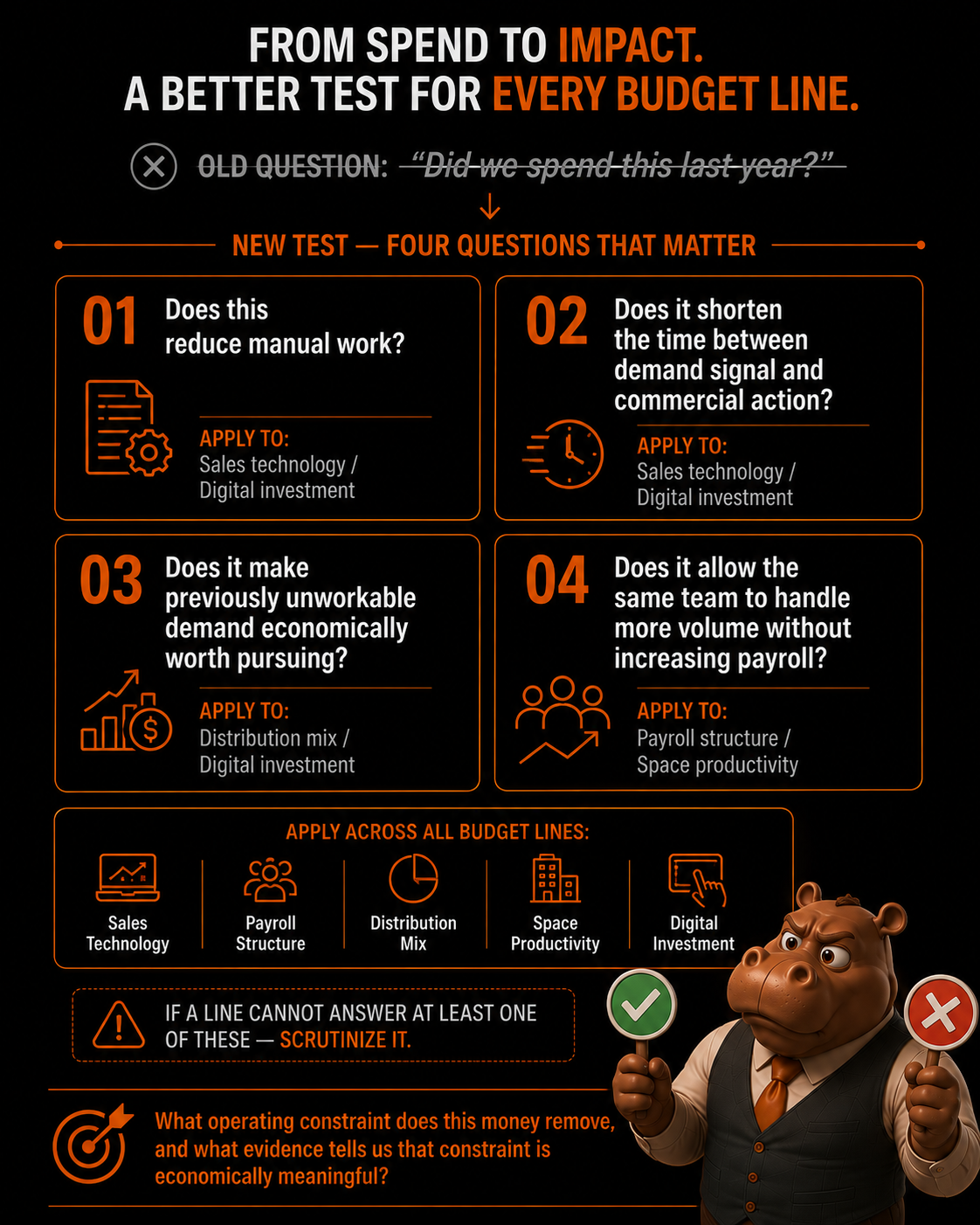
This leads to a useful test for almost every contested 2027 line item.
Not: “Did we spend this last year?”
Not even: “Is this strategically important?”
Ask instead:
What operating constraint does this money remove, and what evidence tells us that constraint is economically meaningful?
For sales technology, the constraint might be response capacity.
For payroll, it might be a staffing structure that keeps too much cost fixed when demand moves.
For distribution, it might be an expensive channel mix.
For underused space, it might be a room-centric view of asset productivity.
For digital investment, it might be weak direct conversion.
For a third-party lease, it might be an arrangement that produces revenue without enough net contribution.
And for some long-standing budget lines, the answer may simply be that no one has tested the assumption in years.
Those are the lines most deserving of scrutiny.
Because the biggest risk in 2027 may not be budgeting too cautiously.
It may be protecting yesterday’s operating model while asking tomorrow’s revenue forecast to pay for it.
Proof is more useful before the budget is locked
There is one practical problem with all of this: most teams are being asked to make these decisions before they have enough evidence.
That is especially true with newer sales technology. Finance wants to know what the return will be. Commercial leaders want to know whether the workflow will actually change. IT does not want to start a lengthy implementation for something the business has not yet proved. Everyone is asking reasonable questions, but the normal buying process often asks those questions in the wrong order.
The better sequence is to measure first and decide second.
That is the thinking behind Hippo Rev’s free six-week pilot for hotel groups. The first two weeks use the Delphi and Cvent reports the commercial team already produces, without requiring a new integration, migration or provisioning project. The following four weeks run against the live RFP workflow. At the end, the group gets a before-and-after view across four measures: administrative hours, time to first follow-up, RFPs worked and revenue associated with the workflow. There is no pilot fee and no performance target that has to be agreed in advance. The numbers either support the investment case or they do not.
That matters during budget season because it changes the nature of the conversation. Instead of asking ownership to approve a line based on an industry benchmark, a projected ROI or someone else’s case study, the commercial team can bring its own operating evidence into the room. The question becomes less, “Do we believe this could work?” and more, “Here is what changed in our portfolio. Is that worth funding?”
For groups still deciding what belongs in the 2027 plan, that may be the most useful role a pilot can play. Not as a shortcut to approval, and not as another technology demo, but as a way to replace one more assumption in the budget with something observed.
A budget is ultimately a theory of how profit will be made
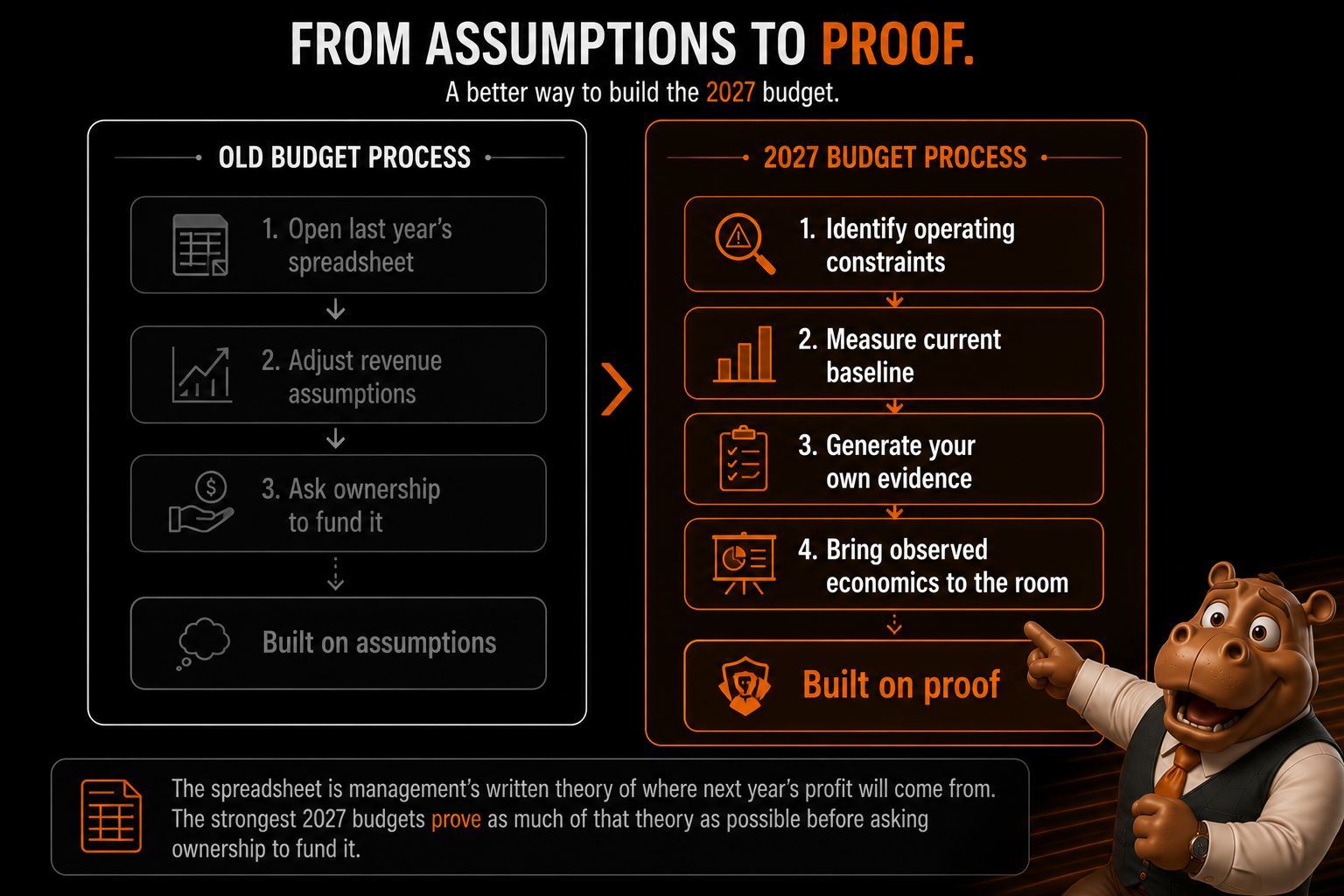
There is a temptation in every budgeting cycle to treat uncertainty as a reason to stay close to last year.
The research suggests the opposite.
Moderating price growth, resilient demand, uneven regional conditions, compressed booking windows, rising costs and rapid technology adoption make historical continuity a weaker assumption, not a safer one.
The most defensible 2027 budgets will therefore be built from a more granular understanding of the business: what demand is arriving, what prevents the hotel from capturing it, what it costs to process and serve, where money leaks before reaching the bottom line, and which investments can show measurable improvement.
That does not mean every pilot deserves a rollout, every role should be redesigned or every traditional expense should disappear.
It means every important line should have an economic argument behind it—and, wherever possible, evidence from the hotel’s own operation.
Because the spreadsheet is not merely a forecast of next year’s performance. It is management’s written theory of where next year’s profit will come from. The strongest 2027 budgets will be the ones that prove as much of that theory as possible before asking ownership to fund it.
Frequently Asked Questions
How should hotels approach budgeting differently for 2027?
Hotels should start by identifying where economic value is leaking rather than simply adjusting last year's budget lines. That means looking at where demand is generated but not fully captured, where labor is being consumed without creating proportional value, where distribution costs are eroding revenue, and where existing workflows limit commercial capacity. The 2027 budget should fund the removal of measurable constraints rather than assume that higher revenue alone will produce higher profit.
How should hotels evaluate AI investments during budget season?
Start with the current operating baseline. Measure how much time the existing process takes, where delays occur, how much demand goes unworked, and what outcomes the hotel currently achieves. Then test whether the AI investment materially changes those numbers. As AI proposals become more common across hotel departments, a specific investment should be justified by measurable improvements in a defined workflow rather than by the general argument that AI is strategically important.
How should hotels budget for distribution when revenue growth is expected to remain modest?
Hotels should evaluate the cost of acquiring revenue alongside the revenue itself. Two bookings with the same ADR can have different profit contributions depending on commissions, marketing costs, loyalty costs, and channel economics. A 2027 budget should therefore include assumptions about channel mix, direct conversion, acquisition costs, and the investment required to support profitable demand capture rather than focusing only on occupancy, ADR, and room revenue.
What evidence should a new technology investment have before it receives a 2027 budget line?
Ideally, the hotel should have evidence from its own operation rather than relying only on vendor benchmarks or projected ROI. A contained pilot can establish the current baseline, run the technology against a real workflow, and measure the change. For a group-sales workflow, that could include administrative hours, time to first follow-up, RFPs worked, and revenue associated with the process. The budget decision can then be based on observed economics rather than assumptions.
Share this post
Ready to close more group business?
See how HippoRev can transform your hotel sales workflow in 15 minutes.

Follow us


.svg)