


AI & Sales Technology
AI in Hospitality 2027: From Pilots to Operating Model
AI in hospitality is moving from experimentation to accountability and into the operating model. This article explains why 2027 puts hotel commercial and revenue teams at the center of AI strategy, how to redeploy capacity created by automation, and why testing workflows before budgeting can produce stronger investment decisions.



Hotel AI Strategy 2027: Why Commercial Teams Must Act
If you draw the last three years of AI in hospitality as a line, the direction is hard to miss.
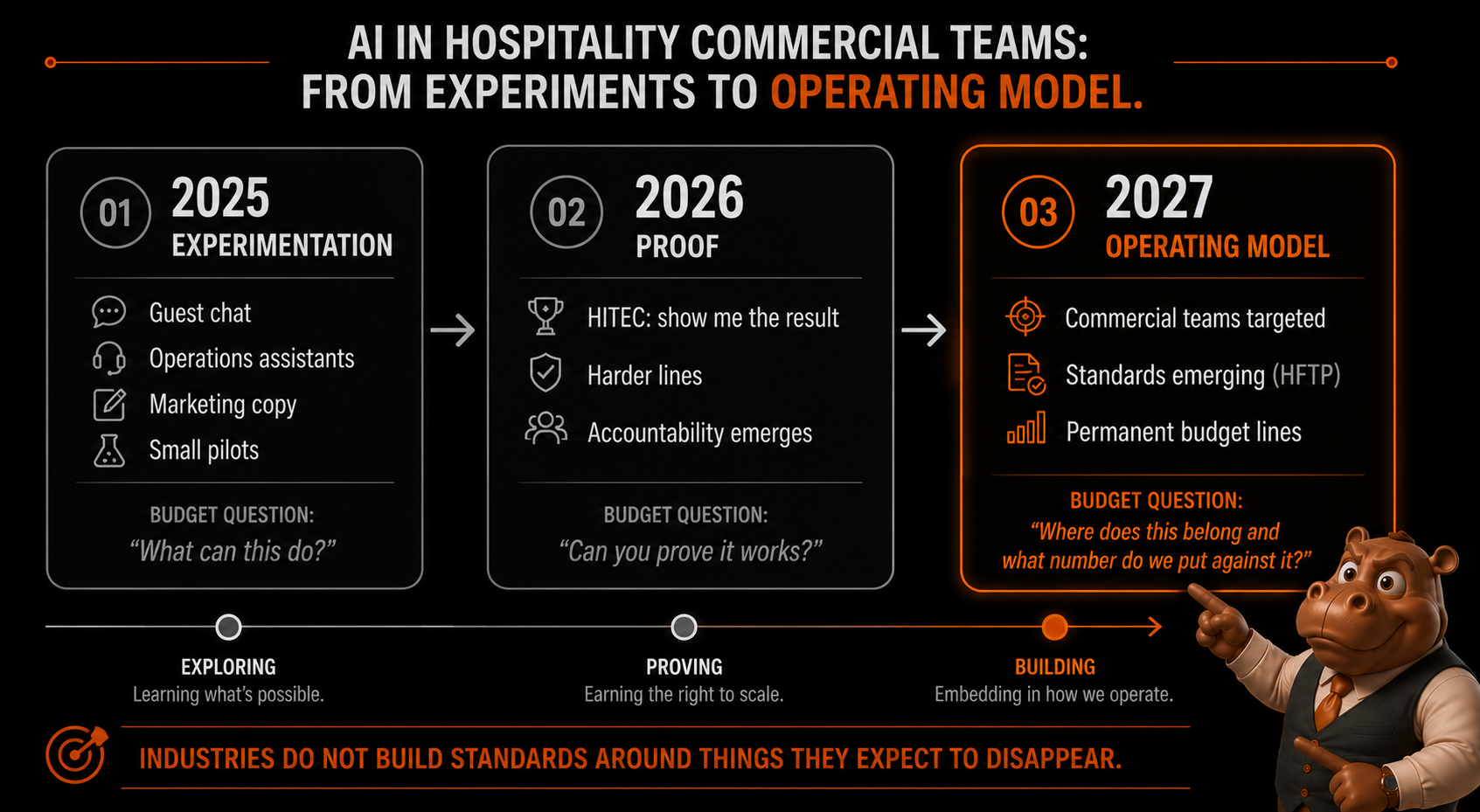
2025 was the year of experimentation.
2026 became the year of proof.
2027 is shaping up to be the year AI becomes part of the operating model.
That progression matters because each stage asks a very different question.
In 2025, hotel leaders were asking, What can this technology do?
By 2026, the question had changed to, Can you prove it actually works?
And as teams build 2027 budgets, the question is becoming more practical still: Where does this belong in the business, what does it replace or improve, and what number do we put against it?
You could hear that change clearly at HITEC 2026. The conversation had moved well beyond AI novelty. The mood was closer to: show me the result. Oracle, on its own keynote stage, acknowledged that it does not yet have a clean way to prove AI’s value.
That admission is more important than it sounds.
It tells us the industry has crossed from excitement into accountability. And accountability is where technology stops being an interesting experiment and starts competing for permanent budget.
There is another shift happening underneath that one.
The first wave of hotel AI concentrated heavily on the guest experience and operations. The next wave is moving toward the commercial floor.
For sales and revenue leaders, that is where things get interesting.
From experiments to proof to infrastructure
In 2025, most hotel AI lived around the edges of the operation.
Guest chat. Operations assistants. Marketing copy. Small pilots that could be started without redesigning the business around them.
Some of those uses created real value. But the value was fragmented. AI was something teams tried. Few organizations were building the annual plan around it.
Then came 2026, and the tone changed.
At HITEC, operators began drawing much harder lines around what AI could and could not do.
The point was not that AI is limited. It was that the industry was starting to separate useful automation from magical thinking.
Bonafide brought an uncomfortable issue into view: hotels typically begin with roughly one-third of their facts misaligned across the sources AI assistants read from. Meanwhile, Frank Trampert of Revinate pointed out something that should make every hotel marketer pay attention: AI models may place less trust in polished marketing language and lean instead on what guests are actually saying in reviews.
Different problem. Same lesson.
AI becomes much less forgiving once it leaves the demo environment.
If the underlying information is inconsistent, AI exposes it. If the value cannot be measured, leadership questions it. If the workflow still relies on people to patch every gap manually, the promise looks considerably smaller in practice than it did on the slide.
That is why 2027 looks different again.
HFTP, the organization behind HITEC, is working on an industry standard for how hotel data should be structured so AI systems can represent properties accurately.
That is a significant signal.
Industries do not spend time creating standards around things they expect to disappear next year. Standards emerge when a technology begins moving from optional tool to shared infrastructure.
And once something becomes infrastructure, the budget conversation changes.
The question is no longer whether somebody in the hotel should experiment with AI.
It becomes: where does AI belong in the operating model, and what should it be accountable for?
Also Read: The Second Wave of AI in Hospitality
The spotlight is moving to sales, revenue and commercial teams
The first wave of hotel AI had an obvious home in operations and guest service.
The next wave has an equally obvious target: commercial work.
Why?
Because that is where some of the most expensive manual friction still sits.
Approximately 55% of hotel RFPs go unanswered, according to Groups360. And 72% of group business goes to whoever responds first, according to Amadeus.
Put those two figures next to each other and the problem becomes very concrete.
Hotels are receiving demand they have already paid to generate, only to lose part of it because the commercial team cannot process it quickly enough.
That is not primarily a lead-generation problem.
It is a throughput problem.
No amount of sophisticated guest-facing AI fixes a group-sales desk where qualified inbound business sits waiting while someone gathers information, checks systems, prepares pricing, formats a proposal and works through a queue of follow-ups.
The industry’s own strategists see the pressure moving toward commercial functions as well.
At HITEC, Floor Bleeker of In2 Consulting argued that AI will “change everything” and push hotel brands back toward competing on the actual guest experience. Natalie Kimball of Shiji expects the distribution battle to intensify and has even predicted the emergence of a higher OTA commission tier for AI-agent bookings.
The specific future may unfold differently from any one prediction.
But the direction is clear.
Distribution, pricing, demand capture, sales productivity and commercial execution are moving closer to the center of the AI conversation.
That means AI is no longer something the IT team evaluates on behalf of everyone else.
For commercial leaders, it has become a strategy question with direct revenue consequences.
The hotel seller was always a farmer. What happens when the field starts tending itself?
For decades, the group-sales job has looked remarkably similar to farming.
Demand arrives.
The seller tends it.
Gather the details. Check availability. Find the right pricing. Prepare the proposal. Format it. Send it. Follow up. Keep working the opportunity until it either closes or disappears.
A great deal of the job has never really been selling.
It has been processing the conditions required for selling to happen.
That distinction becomes much more important when AI enters the workflow.
If software can capture the inquiry, qualify it, pull together the relevant pricing inputs, prepare a proposal draft and keep basic follow-up moving, what exactly should the seller spend the day doing?
That question sounds threatening only if we assume the administrative portion of the job was the source of its value.
It wasn’t.
The more useful answer coming out of HITEC 2026 was narrower and more reassuring: AI takes on the mechanical layers—the sorting, drafting and routing—while people remain responsible for the things that always required a person.
Judgment.
Identity.
Accountability.
Keryn McNamara of Aimbridge took the idea further, predicting new jobs such as “agent supervisors”: people responsible for overseeing AI systems and holding their outputs accountable.
Adam Tuttle made the brand version of the same argument.
AI can scale a standard remarkably well.
But it cannot invent a standard worth scaling.
A person still has to decide what good looks like.
That is the real shift for hotel sales teams.
The farmer does not disappear.
The farmer becomes more of a hunter and a closer.
Time that once disappeared into chasing, formatting and routine preparation can move toward proactive prospecting, strategic account development, negotiation, larger group pursuits and the relationships that actually decide complex events.
The role moves closer to where its economic value was always supposed to be.
The redeployment math is where the strategy gets real
Most conversations about AI productivity stop at “hours saved.”
That is not enough.
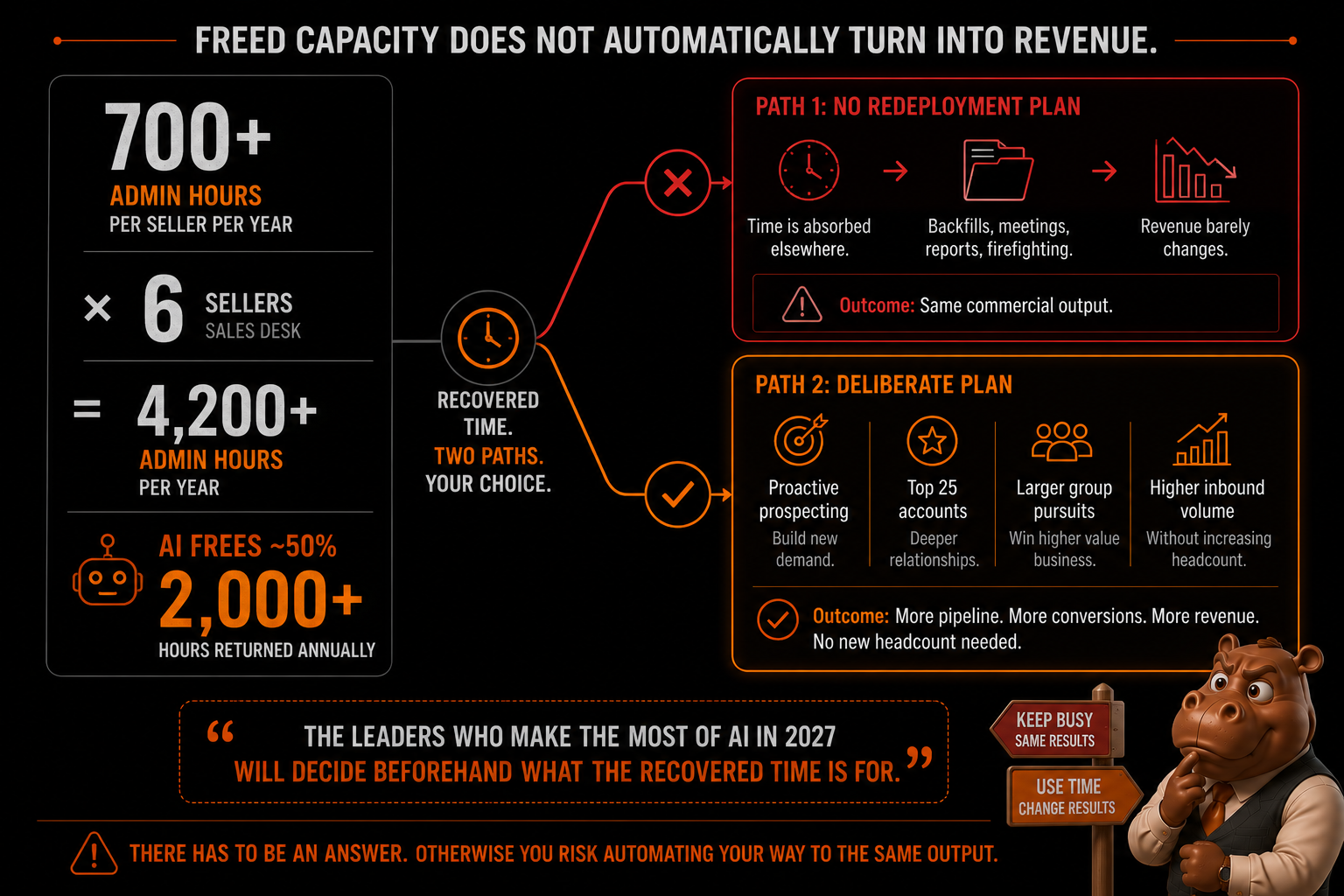
Salesforce data puts the average seller at only 29% of the working week spent actually selling. Industry estimates place the administrative burden at more than 700 hours per seller per year.
If a strong AI-supported workflow gives back even half of those hours, the result is roughly 350 to 400 hours per seller, per year returned to the business.
On a six-person sales desk, that is well over 2,000 hours annually.
Now comes the part leaders should care about.
What happens to those hours?
Because freed capacity does not automatically turn into revenue.
Imagine clearing 2,000 hours of administrative work from a sales team and then changing nothing else about how the team operates. No new account strategy. No prospecting expectation. No reassignment of higher-value opportunities. No deliberate focus on larger group business.
You may have made the workflow much more efficient while barely changing the commercial result.
The time simply gets absorbed elsewhere.
That is why the leaders who make the most of AI in 2027 will not be the ones who merely remove administrative work.
They will decide beforehand what the recovered time is for.
Maybe it goes toward proactive prospecting.
Maybe toward the top 25 accounts that always deserved more attention but rarely received it.
Maybe it lets sellers pursue larger and more complex group opportunities that were previously too time-consuming.
Maybe it means a team can handle higher inbound volume without immediately adding another position.
The exact answer will differ by hotel and portfolio.
But there has to be an answer.
Otherwise you risk automating your way to the same output.
Why waiting until 2028 is not a neutral choice
There is a reasonable instinct among hotel leaders to wait.
AI is moving quickly. Vendors are still sorting themselves out. Proof is uneven. Why not let the market mature for another year, learn from other operators and put the serious budget behind it in 2028?
Because waiting has a cost too.
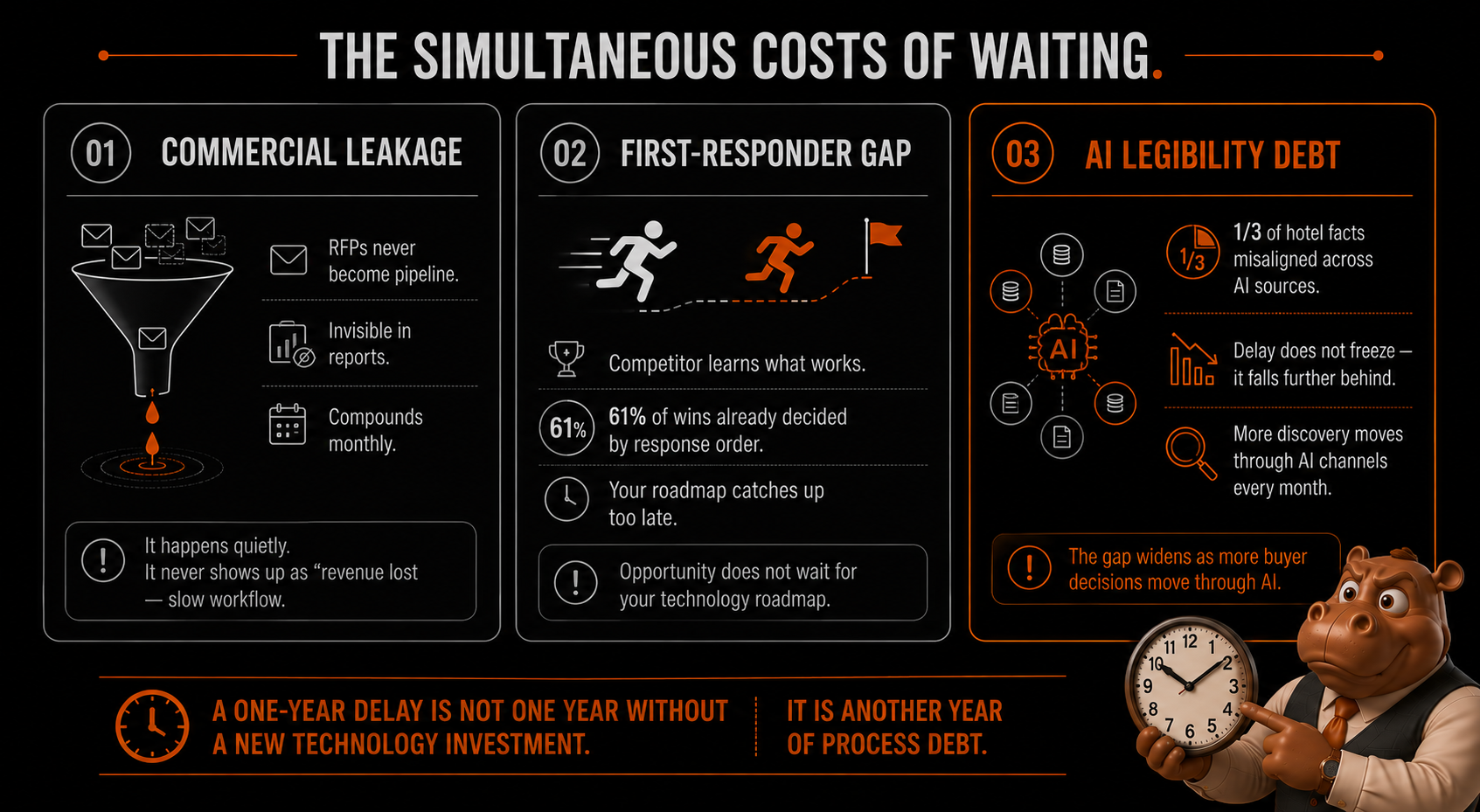
Every month a group-sales desk remains heavily manual, some portion of inbound business still arrives faster than the team can work it.
Those RFPs do not necessarily appear later in a report marked “Revenue lost because our workflow was too slow.”
They simply never become meaningful pipeline.
That is what makes the leakage easy to underestimate.
At the same time, the first-responder advantage continues working in somebody’s favor. If your competitor reaches the buyer first, the opportunity does not wait politely for your technology roadmap to catch up.
There is a second form of delay too: AI legibility.
If roughly one-third of hotel facts can begin misaligned across the sources AI assistants use, postponing the work of cleaning, structuring and governing that information does not freeze the situation in place. It leaves the hotel less prepared as more discovery and decision-making moves through AI-assisted channels.
So a one-year delay is not simply one year without a new technology investment.
It can mean another year of commercial leakage, another year of process debt and another year in which competitors learn what works while your team waits for certainty.
By the time the evidence feels undeniable, the budgeting window may already have passed.
Then the same investment has to fight its way into a mid-year reforecast.
Anyone who has done that knows it is the harder conversation.
But you cannot budget confidently for a game you have never played
This is the legitimate objection.
Commercial leaders are being asked to budget for technology whose actual structural effect on their own team may still be unclear.
How many administrative hours will disappear?
How much faster will first follow-up become?
How many more RFPs will the existing team be able to work?
Where will the released selling time actually go?
What does any of that mean in revenue?
You cannot answer those questions credibly from somebody else’s case study.
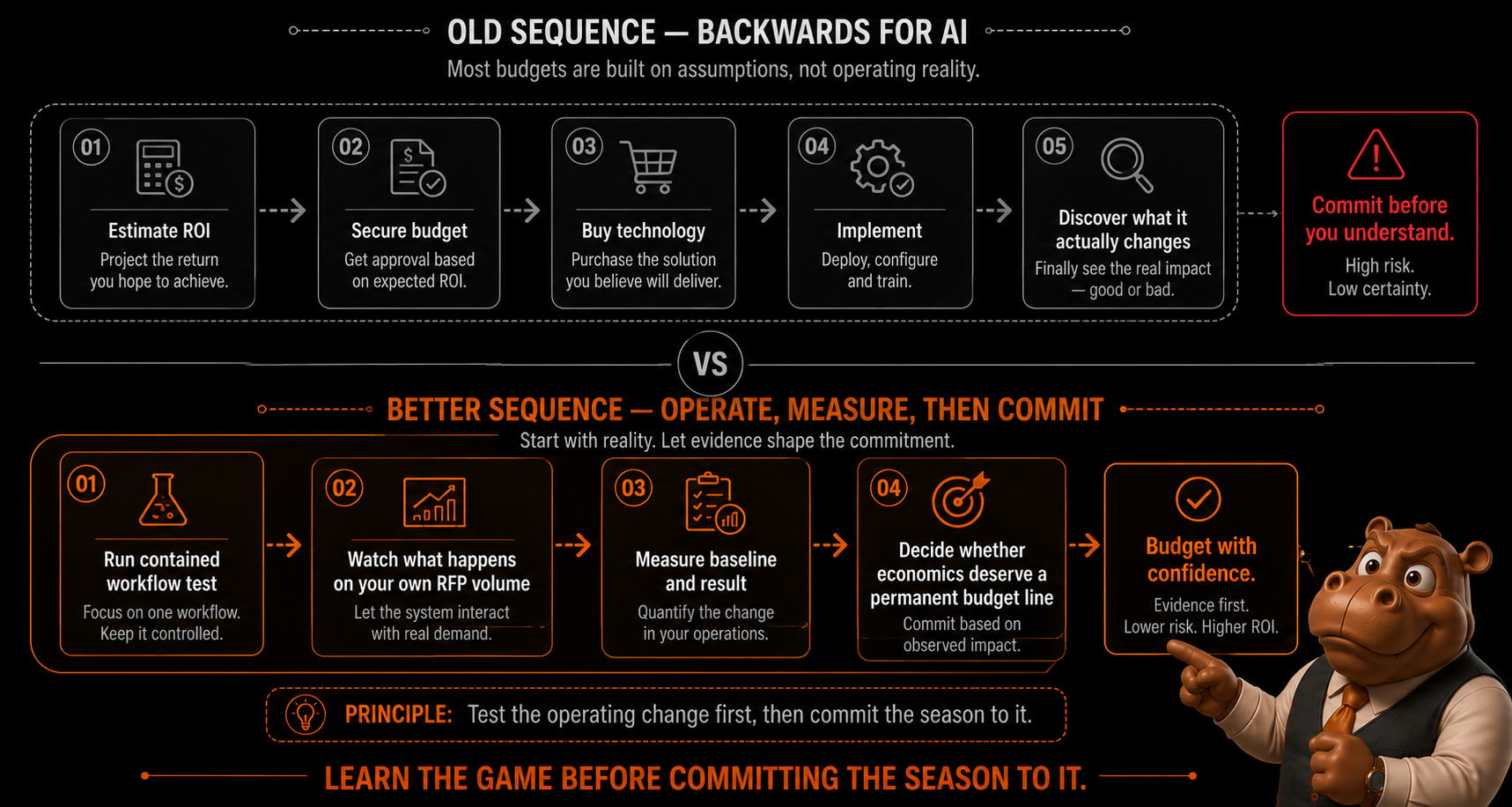
And that is why the traditional software-buying sequence feels backwards for AI.
Normally, the process looks something like this:
Estimate the ROI.
Secure the budget.
Buy the technology.
Implement it.
Then discover what it actually changes.
For a workflow technology that can alter how people spend their time, a more sensible sequence is to test the operating change first.
Run a contained version of the workflow.
Watch what happens on your own RFP volume.
Measure the baseline and the result.
Then decide whether the economics deserve a permanent budget line.
That is the real purpose of a pilot.
Not to create a prettier demo.
To learn the game before committing the season to it.
What a six-week test actually needs to prove
That thinking is behind Hippo Rev’s free six-week pilot for hotel group sales.
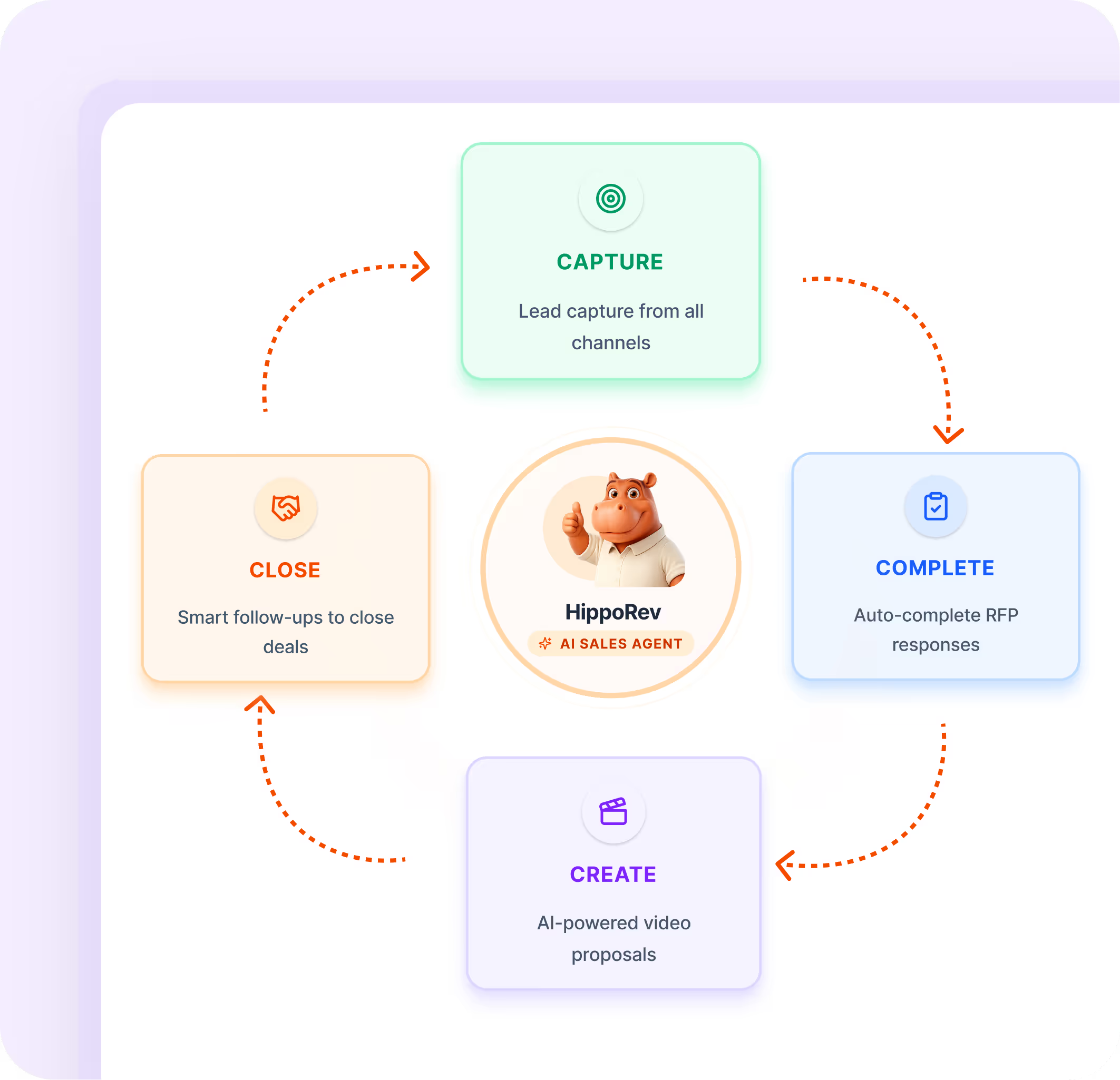
Hippo Rev acts as an execution layer around the group-sales RFP workflow. It captures incoming RFPs, prepares priced proposal drafts using the systems and information the hotel already works with, and keeps follow-up moving, while the seller remains responsible for approving what goes out.
The pilot deliberately keeps the scope narrow.
The first two weeks are used to onboard using the hotel’s existing Delphi and Cvent reports, without a new IT integration and without pilot cost.
The next four weeks run live against one group-sales workflow at a single property or cluster.
The point is not to ask the team to believe a projected ROI.
It is to measure what happens.
At the end, the hotel receives its own before-and-after view across four practical measures:
Administrative hours per seller.
Time to first follow-up.
RFPs worked.
Revenue associated with the workflow.
Those results are then used to build a six-month projection from the hotel’s own operating data.
That distinction matters.
A vendor benchmark can tell you what might be possible.
Your own workflow tells you whether it is worth budgeting for.
And the pilot does not have to prove that AI is universally valuable. It only has to answer a much more useful question:
Does changing this particular workflow create enough commercial value in this particular hotel or portfolio to deserve a place in the 2027 plan?
If the answer is yes, the budget case becomes much easier to defend.
If the answer is no, that is useful information too.
Either way, leadership is no longer guessing.
Bottom line
2027 is the year AI begins moving from experiment to operating model for hotel commercial teams.
That does not mean the winners will be the hotel groups with the longest list of AI tools.
The advantage will go to the teams that understand exactly where AI removes friction, what the released capacity is worth, and—most importantly—what they intend to do with the time it gives back.
The farmer is becoming more of a hunter.
But that transition does not happen because a piece of software appears in the budget.
It happens when a commercial leader can say: Here is the work we no longer need sellers doing. Here is the capacity that gives us back. Here is where those hours will go. And here is what happened when we tested it on our own business.
That is a much stronger 2027 AI strategy than simply buying a tool.
And it is a much stronger budget conversation than waiting another year for somebody else to prove it first.
Frequently Asked Questions
What should hotel commercial teams actually budget for when planning AI adoption in 2027?
Hotels should budget around specific workflows and measurable outcomes rather than creating a generic “AI” line item. For group sales, that could mean identifying where AI can reduce administrative work, improve time to first follow-up, increase the number of RFPs the team can process, or improve revenue associated with the workflow.
How can a hotel decide which commercial workflows are ready for AI?
Start with workflows that combine high administrative effort, meaningful volume, and measurable commercial consequences. Group-sales RFP processing is one example because sellers repeatedly gather information, check systems, prepare proposals, and manage follow-up. A good AI candidate is a workflow where removing mechanical work gives people more time for judgment, prospecting, negotiation, account development, or closing.
Can AI improve hotel sales productivity without reducing headcount?
Yes. Productivity gains do not have to translate into fewer people. They can translate into greater capacity from the same team. If AI reduces time spent on RFP preparation, information gathering, and routine follow-up, sellers can potentially work more opportunities or spend more time on high-value selling activities.
Why is waiting another year to adopt AI not necessarily the low-risk option for hotels?
Waiting avoids an immediate technology decision, but it does not eliminate the cost of the current workflow. If RFPs continue to sit unworked, response times remain slow, or competitors learn to operate more efficiently, the hotel may continue losing opportunities that never appear clearly as lost revenue. Delaying also means postponing work around data quality, workflow design, and organizational learning that may become increasingly important as AI becomes more embedded in hospitality.
Why is hotel data quality becoming more important as AI adoption grows?
AI systems depend on the information available to them. If hotel facts are inconsistent across different sources, the output produced by AI-assisted systems can reflect those inconsistencies. As more discovery, representation, and workflow decisions involve AI, hotels need clearer and more structured information across their systems and external sources.
Share this post
Ready to close more group business?
See how HippoRev can transform your hotel sales workflow in 15 minutes.

Follow us


.svg)