


Proposals and Conversion
How to Rank on Cvent's Top Meeting Hotels List in 2026
Cvent's Top Meeting Hotels lists are not editorial picks. They are built entirely on planner sourcing data: RFP volume, response rates, room nights, and conversion. This guide unpacks the methodology and the six practices top-ranked properties use to engineer their visibility.



.png)
Cracking the Code: How Hotels Earn a Spot on Cvent's Top Meeting Lists
Behind every top-ranked meeting hotel lies a formula built on speed, strategy, and flawless execution.
Every year, the hospitality industry eagerly awaits the release of Cvent's Top Meeting Destinations and Top Meeting Hotels lists. For planners, these rankings serve as a trusted directory of properties that deliver exceptional experiences. For hoteliers, securing a spot is a badge of honor that signals market dominance.
But how exactly does a hotel land on this prestigious list?
Contrary to common belief, these rankings are not based on editorial opinion, pay-to-play schemes, or marketing awards. They are strictly data-driven, built on the raw sourcing behaviors of thousands of planners and billions of dollars in RFP value flowing through the Cvent Supplier Network.
If you want to understand what top-tier hotels do to engineer their visibility and performance, you have to look at the math behind the magic. Here is what the world's top meeting hotels do to win.
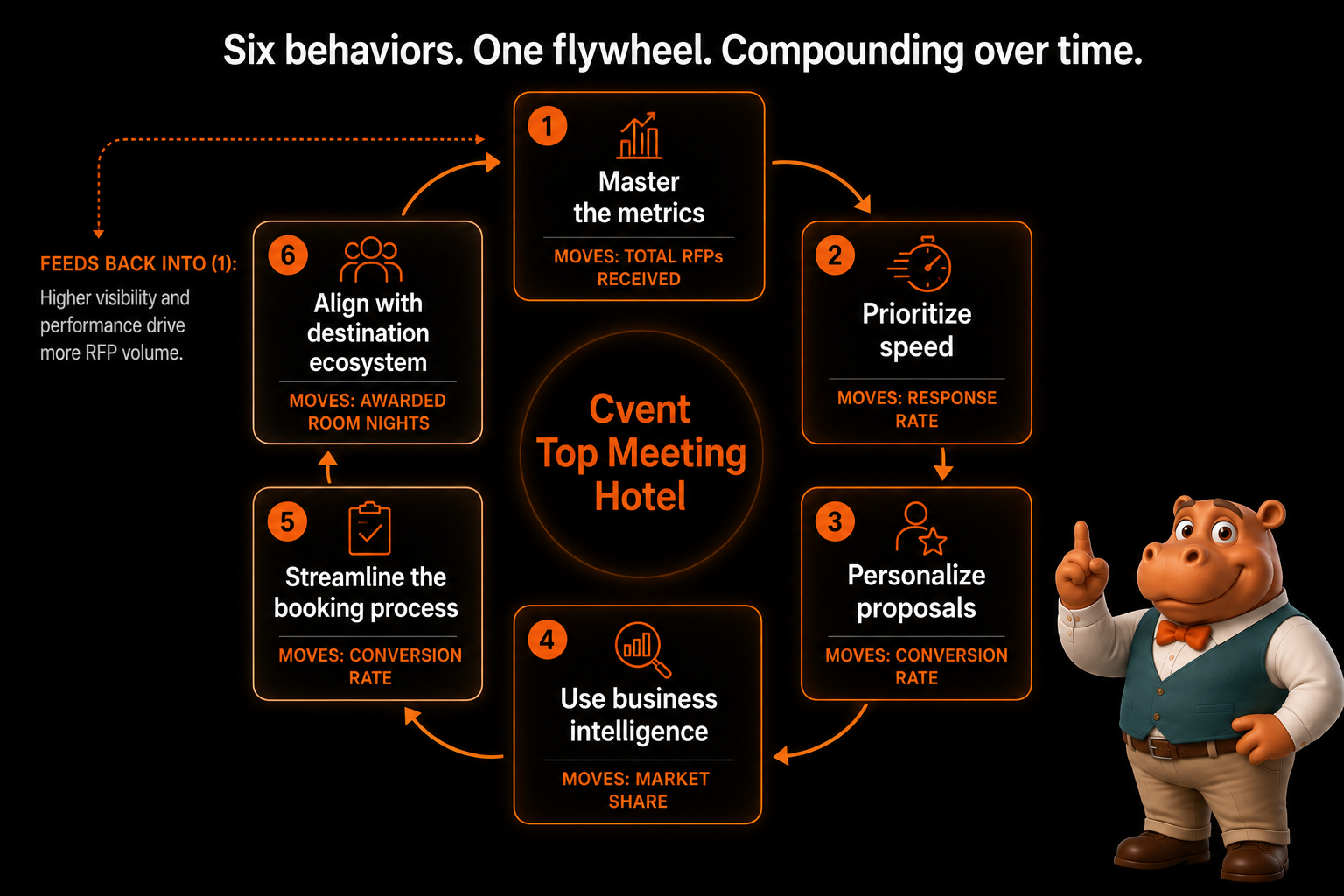
1. They Master the Metrics
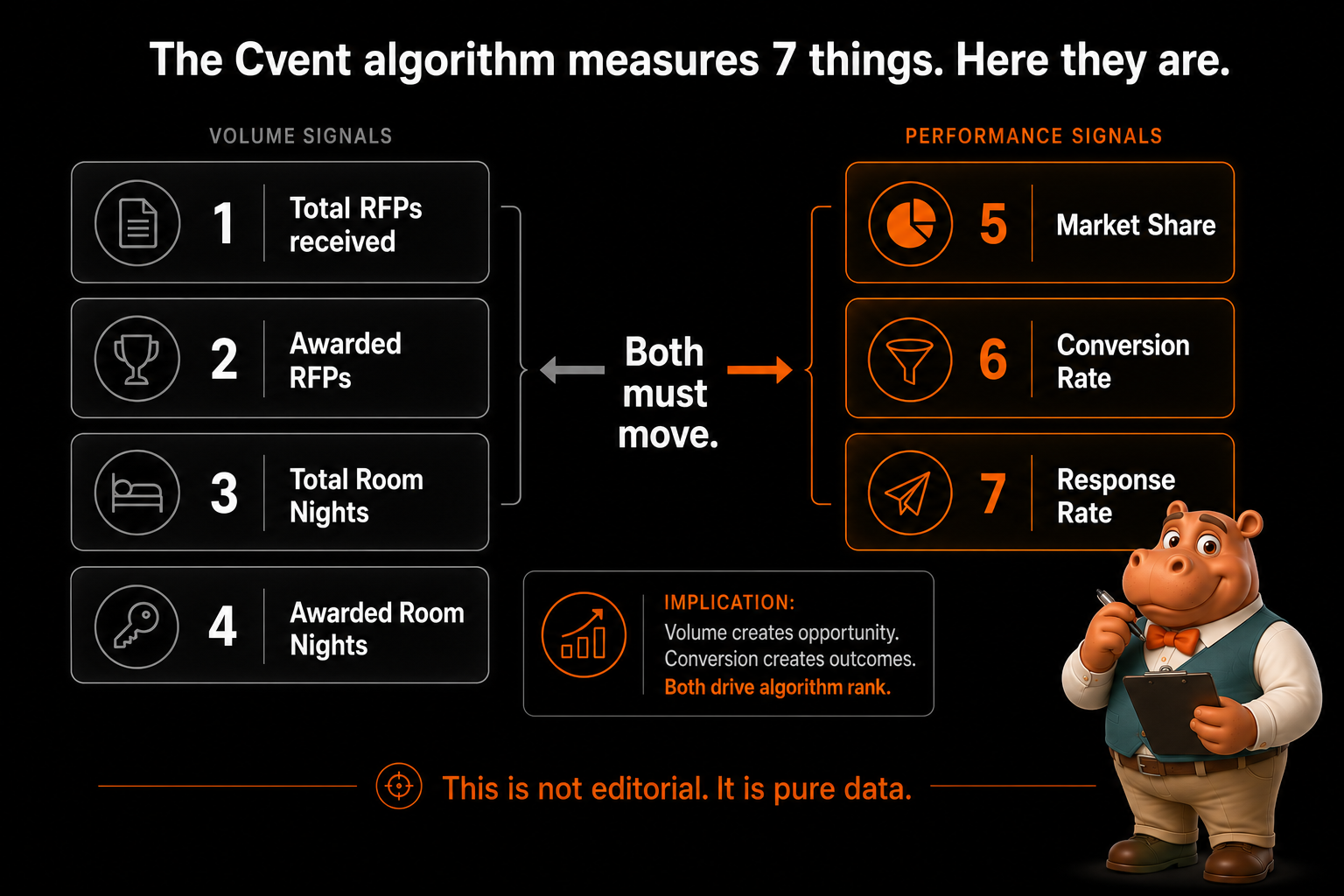
Winning begins with mastering the numbers that drive visibility and market share.
To feature in the rankings, a hotel must excel across specific quantitative criteria. Cvent analyzes sourcing activity from the entire calendar year, evaluating properties on Total Requests for Proposals (RFPs), Awarded RFPs, Total Room Nights, Awarded Room Nights, Market Share, Conversion Rate, and Response Rate.
Top-performing hotels understand that this is a volume and conversion game. They don't just wait for leads; they actively drive demand in its purest form. By consistently showing up, receiving a high volume of RFPs, and converting that interest into confirmed business, they climb the statistical ladder.
2. They Prioritize Speed and Responsiveness
Early responders capture the largest share of group business on Cvent.
In the race for group business, speed is a decisive factor. The methodology reveals that planners award a disproportionate amount of business to early responders.
Take the Ritz-Carlton Laguna Niguel, a success story in leveraging Cvent's tools. Their team operates with a clear strategy: if they see a Cvent lead, their priority is to open it immediately. In an industry where 80% of planners expect a response in four days or less, top performers aim much higher. The Ritz-Carlton sales team, for example, answers 24% of their RFPs in under four hours to maintain high service standards.
Hotels that rank high recognize that a swift, accurate response can outrun a larger competitor that is slow to reply.
Also read: Why the first responder advantage has become one of the biggest competitive edges in hotel sales.
3. They Move Beyond "Rates, Dates, and Space"
Creativity and customization turn a simple RFP into a lasting relationship.
The era of generic responses is over. Winners in 2026 understand that personalization is no longer optional. It is expected.
Top hotels customize their proposals to match the specific vision of the planner. Instead of sending templates, they use AI-powered tools to tailor responses efficiently. They treat every RFP as the start of a relationship, often picking up the phone to walk planners through the process or offer alternate dates.
As Andrea Greene, a senior sales manager at a top-performing property, notes, "You can't be generic anymore... You are doing creative selling with the destination, not just the hotel." This approach builds Return on Relationships (ROR), ensuring that planners trust the venue enough to return repeatedly.
4. They Leverage Business Intelligence
High-performing hotels refine strategy using real-time competitive insights.
You cannot improve what you do not measure. Hotels that feature on the Top Meeting Hotels lists rely heavily on data to refine their strategies.
Leading properties use tools like Cvent's CSN Business Intelligence to audit their performance against competitors. They review report cards to see where they rank in their competitive set regarding response rates and market share, allowing them to pivot their sales strategies instantly.
For example, the Grand Hyatt Nashville, consistently ranked in the top tier, credits business intelligence solutions with allowing them to improve internal sales strategies throughout the year.
Also read: The hidden costs of relying only on Cvent.
5. They Collaborate and Streamline
Efficiency is a hallmark of top-ranked hotels. The 2026 rankings highlight properties that make the booking process simple, capitalizing on the trend where 84% of planners are more likely to select a venue for simple meetings if it can be booked online.
Furthermore, top hotels use collaborative technology, such as diagramming tools, to share event space layouts with planners visually. This transparency helps planners visualize their event, whether it's a ballroom setup or an accessible room layout, building confidence in the venue's capabilities before a contract is even signed.
6. They Align with Their Destination
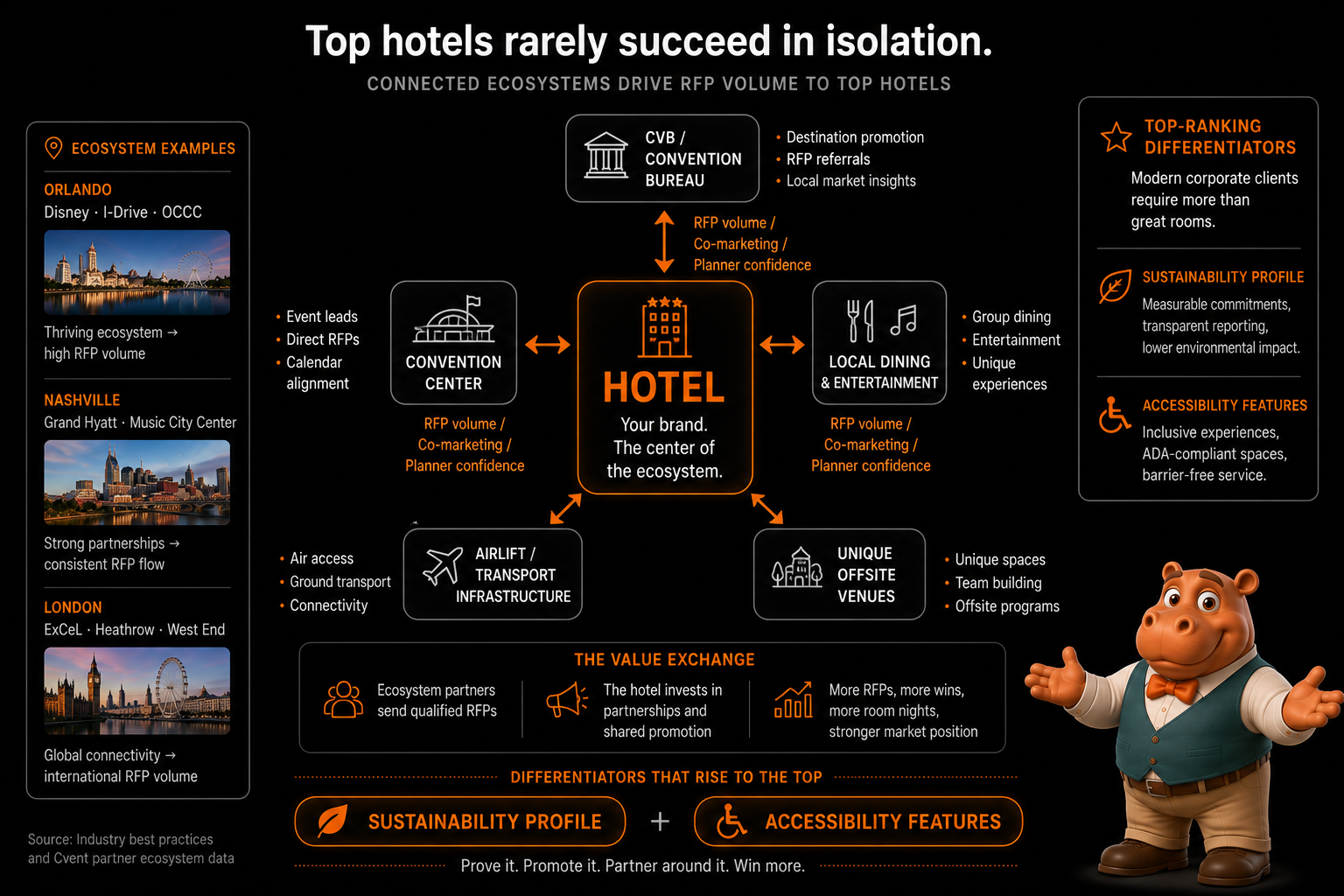
Top hotels amplify their ranking by leveraging the strength of their city ecosystem.
Finally, top hotels rarely succeed in isolation; they thrive as part of a successful destination ecosystem. Cities like Orlando, Nashville, and London dominate the Top Meeting Destinations lists because their hotels, convention bureaus, and venues work in tandem.
Successful hotels leverage their destination's strengths, selling the airlift, the local dining scene (like Orlando's Restaurant Row), and unique offsite venues, to create a cohesive package for the planner. They polish their profiles to highlight sustainability and accessibility, knowing these are key differentiators for modern corporate clients.
Earning a spot on Cvent's top lists isn't about luck. It is the result of a deliberate, data-backed strategy. It requires a hotel to operate like a high-performance engine: fueled by rapid response times, tuned with personalized service, and navigated by precise market data. When these elements fire in sync, a hotel doesn't just look good on paper. It becomes a partner that planners trust with their most critical business.
How Hippo Rev Accelerates Your Path to Becoming a Top Meeting Hotel
The Cvent algorithm rewards execution. Hippo Rev is built to deliver it.
If the Cvent Top Meeting Hotels lists are built on measurable planner behavior, then hotels aiming for those rankings need to strengthen exactly those signals: volume, speed, personalization, and conversion.
Here is the problem. Executing all of these simultaneously with a human team alone is nearly impossible. Industry-wide, 36% of RFPs go unanswered, and 71% of a seller's day goes to non-selling tasks. The metrics Cvent measures are precisely where most sales teams leak revenue.
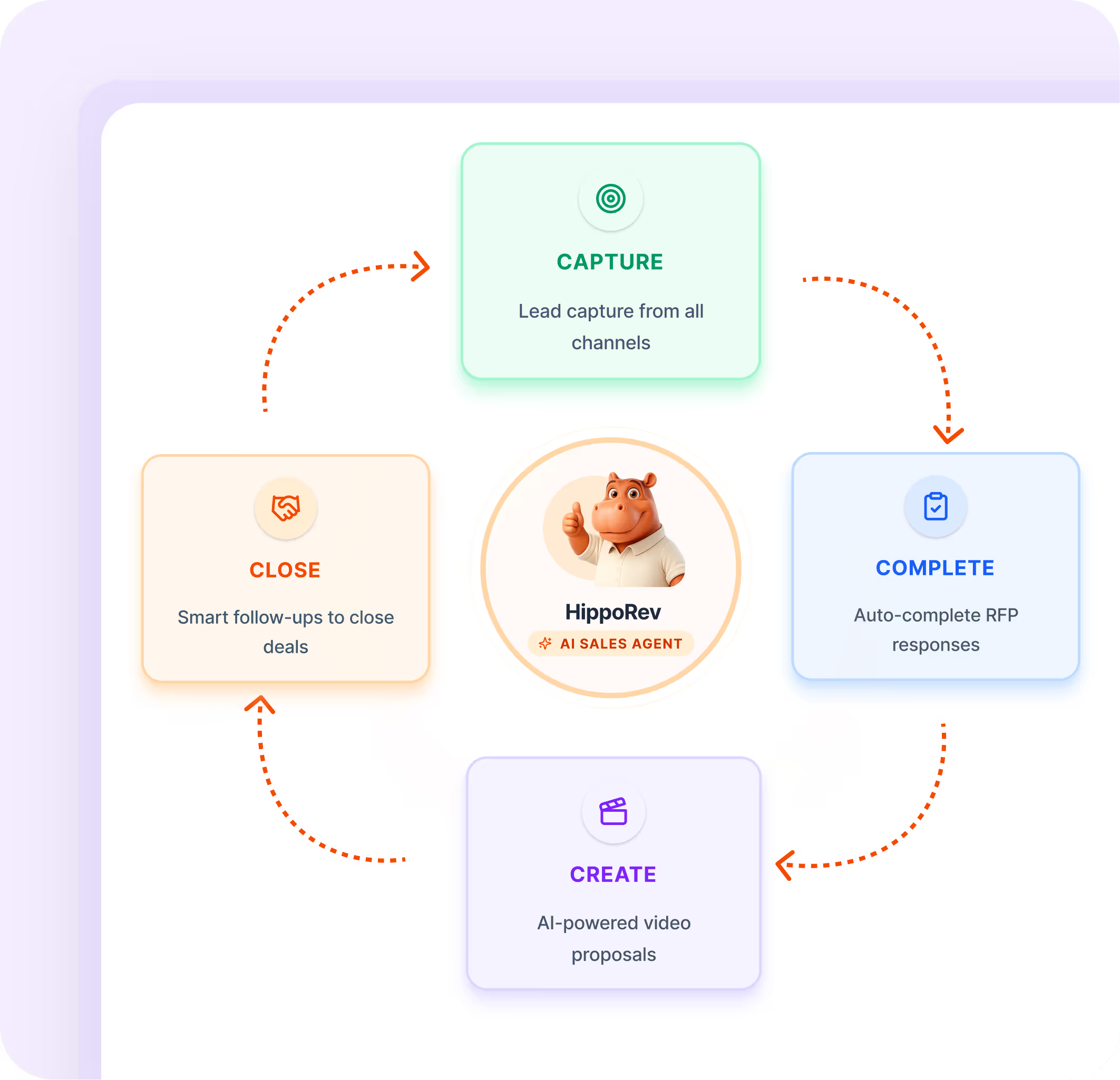
Hippo Rev is a Revenue Capture Platform built for hotel group sales teams. It works as a system of execution alongside your systems of record, your CRM, PMS, and Cvent itself, and strengthens every ranking signal through three stages:
Capture: Win the first-responder race. Every RFP from Cvent, email, web forms, and calls lands in one pipeline the moment it arrives, with key details extracted and availability checked instantly. RFP processing drops from around 37 minutes to about 4, which means your team responds while competitors are still opening the lead. When 62% of won deals go to one of the first three responders, that speed shows up directly in your Response Rate and Awarded RFPs.
Convert: Personalize at scale. Generic templates lose. Hippo Rev helps your team build proposals tailored to each planner's specific event, and engagement analytics show you which sections a planner spent time on, so follow-up conversations start where their interest actually is. That is how personalization becomes a conversion metric instead of a talking point.
Grow: Keep every deal warm through to contract. Automated follow-ups run on a consistent rhythm so momentum never dies in an inbox, and clean handoffs to your PMS and CRM keep the booking process simple, the exact behavior 84% of planners reward. Won groups get nurtured into repeat business, which compounds your RFP volume year over year.
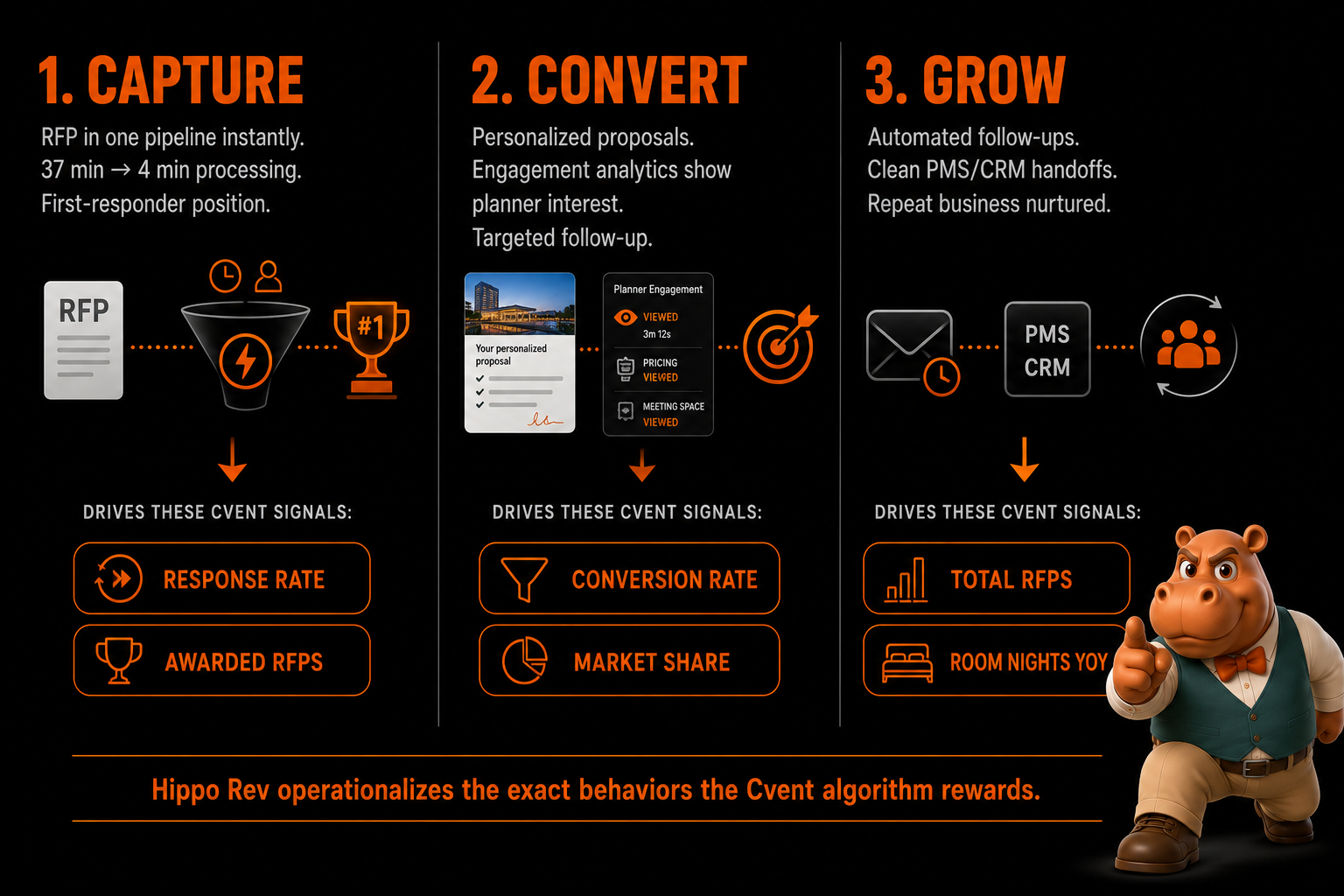
The math is straightforward. The average salesperson leaks roughly $500K in annual revenue to slow responses and dropped follow-ups. Hippo Rev operationalizes the very behaviors the Cvent algorithm rewards: respond faster, personalize better, convert consistently.
If you want to see where your property stands on these signals today, book a Capture Audit. 20 minutes, your numbers, no deck.
Frequently Asked Questions
How does the Cvent list account for emerging markets, or is it dominated solely by North American and European cities?
Cvent issues regional lists to ensure fair comparisons, and in 2025, it expanded to include a specific ranking for Latin America & Caribbean for the first time. This allows emerging powerhouses like Cancun and Riviera Maya (Mexico) to be recognized for their high volume of incentive travel and all-inclusive resort business. Meanwhile, in the Middle East, Dubai dominates due to its infrastructure of sky-high venues and high-capacity convention centers, while Singapore leads Asia Pacific due to its efficiency and infrastructure. This regional segmentation ensures that different markets are judged against their direct competitive sets.
Do "soft" factors like sustainability and accessibility actually impact the quantitative rankings, or are they just marketing buzzwords?
While the rankings are based on math (RFPs and bookings), sustainability and accessibility are now critical drivers of that math because they influence planner selection. Planners are increasingly mandated to choose inclusive and sustainable venues. Top destinations win business by highlighting accessibility features, such as using diagramming tools to ensure wheelchair-accessible layouts, and sustainability initiatives like net-zero goals.
Orlando has been the #1 meeting destination for years. Beyond just having many hotels, how does the destination's "ecosystem" contribute to this ranking?
Orlando's ranking is sustained by a cohesive ecosystem where the Convention Bureau (Visit Orlando), the massive Orange County Convention Center, and local hotels work in tandem. The destination leverages its unique assets, such as theme parks (Disney, Universal) and strong airlift, to create turnkey experiences for planners. Furthermore, the ecosystem creates a convention corridor where dining, entertainment (like I-Drive 360), and varied hotel price points are concentrated, simplifying logistics for planners. This alignment ensures that when a planner sources Orlando, they aren't just booking a room; they are booking a fully supported city-wide experience, which drives high RFP volume and conversion.
The sources mention that speed is a decisive factor. Is there a quantified benchmark for how fast a hotel needs to respond to an RFP to be considered a "top performer"?
Yes. Data indicates that 80% of planners expect a response in four days or less, but top performers aim for significantly faster turnaround times. The Ritz-Carlton Laguna Niguel, a featured success story in this aspect, notes that waiting even four to eight hours can result in lost opportunities. Their sales team answers 24% of RFPs in under four hours.
Share this post
Ready to close more group business?
See how HippoRev can transform your hotel sales workflow in 15 minutes.

Follow us


.svg)