


AI & Sales Technology
Why Hotel Sellers Can't Keep Up With AI-Powered Meeting Planners
Planners got a published, distributed handbook for using AI to source and pressure-test hotels. Sellers got AI features buried inside the same platforms, with no equivalent guide for the full sell-side workflow. One side was handed a method. The other was handed a login. That asymmetry, not demand, is what is quietly costing you group business.




Your Buyers Got an AI Upgrade. Your Sellers Got a Browser Tab.
Quick answer
Event planners now have AI tools and published guidance for sourcing and negotiating with hotels, while hotel sales teams have no equivalent, system-connected AI for the sell-side workflow. This buyer-seller AI capability gap, not a shortage of demand, is the root cause of slow RFP responses and lost group revenue. Closing it requires AI wired into a hotel's own systems (PMS, CRM, rate guidelines), not a general-purpose chatbot.
Key takeaways
- The buy side of every group deal is now AI-assisted; the sell side mostly is not.
- A general chatbot cannot close the gap because it has no access to a hotel's availability, pricing, or account history.
- Roughly 55% of hotel RFPs go unanswered and most won deals go to the first responders, both symptoms of the seller-side speed gap.
- The fix is a Revenue Capture Platform that connects AI to the systems a hotel already owns.
The day the negotiation stopped being even
For thirty years, the hotel seller and the meeting planner sat across a table that was, more or less, level. Both worked from email. Both worked from spreadsheets. Both worked at human speed. Whoever knew the market better, built the better relationship, and priced the block more sharply tended to win.
That table is no longer level.
Cvent publishes a planner-facing handbook, “Mastering AI for Events,” that walks event organizers through using AI across the planning lifecycle, including how they source, compare, and pressure-test the hotels bidding for their business. It is gated, distributed, and updated. The buy side has had a documented operating manual for getting more out of you since 2024, and planners are using it: Cvent's own data puts roughly half of meeting planners already using AI to plan and execute events.
The sell side has no equivalent of that kind. Hotels do get AI, but mostly as features buried inside the same sourcing platforms, not as a craft anyone teaches a director of sales to use across the whole workflow. There is no widely distributed, vendor-neutral guide showing your seller how to use AI to respond faster, price smarter, and hold the line in a negotiation. One side was handed a method. The other was handed a set of logins.
This is not a story about demand. It is a story about a capability gap that widens every month one side trains and the other does not.
What “armed” actually looks like on the buyer side
It helps to be specific about what the planner can now do that they could not do two years ago.
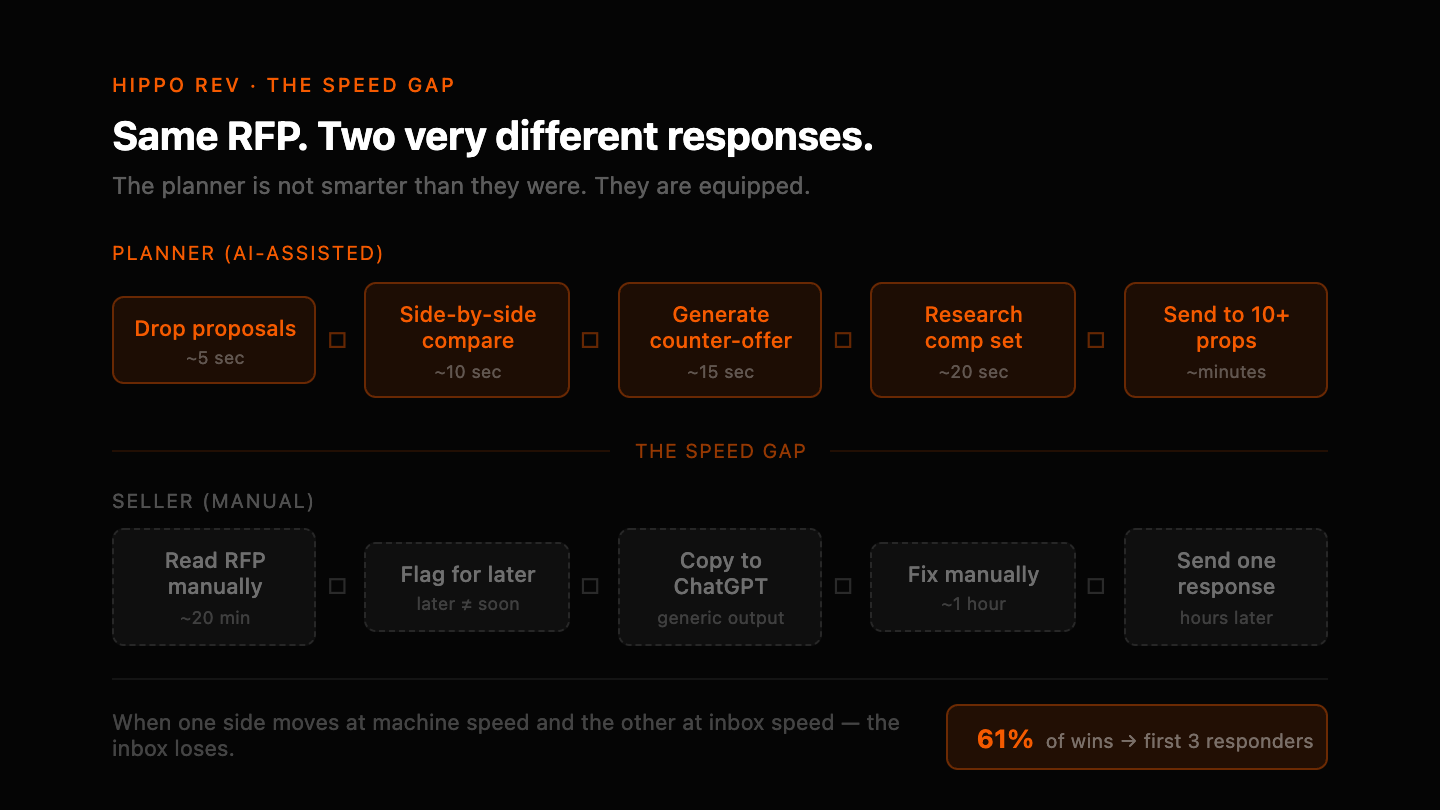
They can drop your proposal and three competing proposals into a model and get a side-by-side comparison of rates, concessions, and attrition clauses in seconds. They can generate counter-offer language calibrated to the exact gaps in your bid. They can research your property's recent reviews, your comp set's published rates, and your group's historical pricing before they ever reply to you. They can draft, in one pass, the kind of detailed, requirement-heavy RFP that used to take an afternoon, which means they can send more of them, to more properties, with less effort.
The planner is not smarter than they were. They are equipped. Every advantage compounds against a seller who is still reading the RFP for the first time on a phone between site visits.
What “still on a browser tab” actually looks like on the sell side
Now look at the other chair.
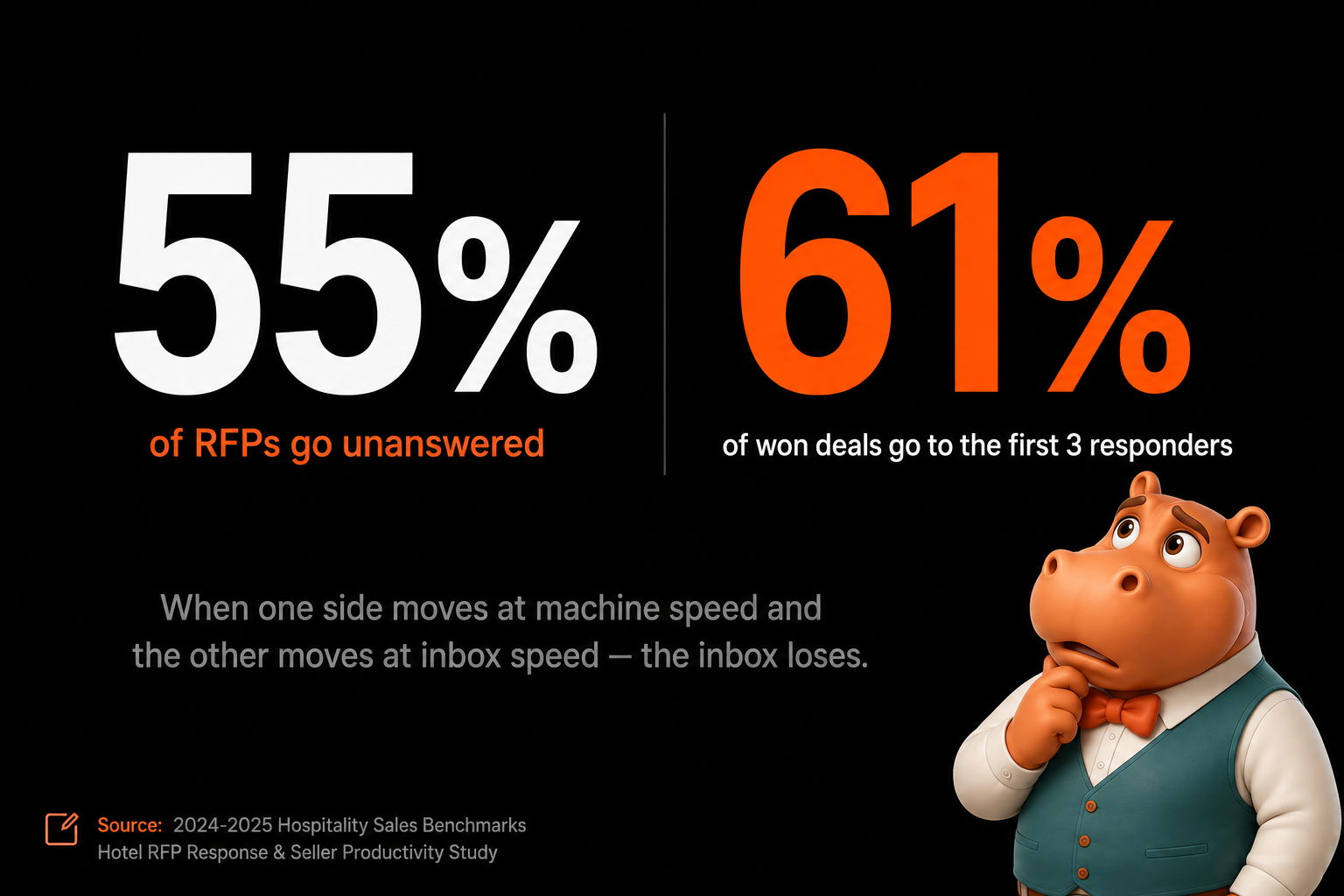
A qualified RFP lands at 4:15 on a Tuesday. Your best seller already owes two planners a reply from yesterday. She skims the new one, flags it for later, and gets pulled into a revenue meeting. When she finally opens it, she copies the requirements into ChatGPT, gets a generic draft that does not know your room types, your F&B minimums, or what Revenue Management will approve, and then spends an hour fixing it by hand anyway.
She is not behind because she is bad at her job. She is behind because roughly 71% of a hotel seller's day goes to administrative work rather than selling, and the one AI tool she has access to does not actually know anything about her hotel. A general model can write a polite paragraph. It cannot pull your pricing, check your availability, or remember that this planner sent you 40 RFPs last year.
The buyer's AI is purpose-built for getting a better deal. The seller's AI is a blank chat window. That is not a fair fight, and the results show up exactly where you would expect: 55% of hotel RFPs go unanswered entirely, and 61% of the ones that do get answered are awarded to one of the first three responders. When one side moves at machine speed and the other moves at inbox speed, the inbox loses.
Why a general chatbot will never close the gap
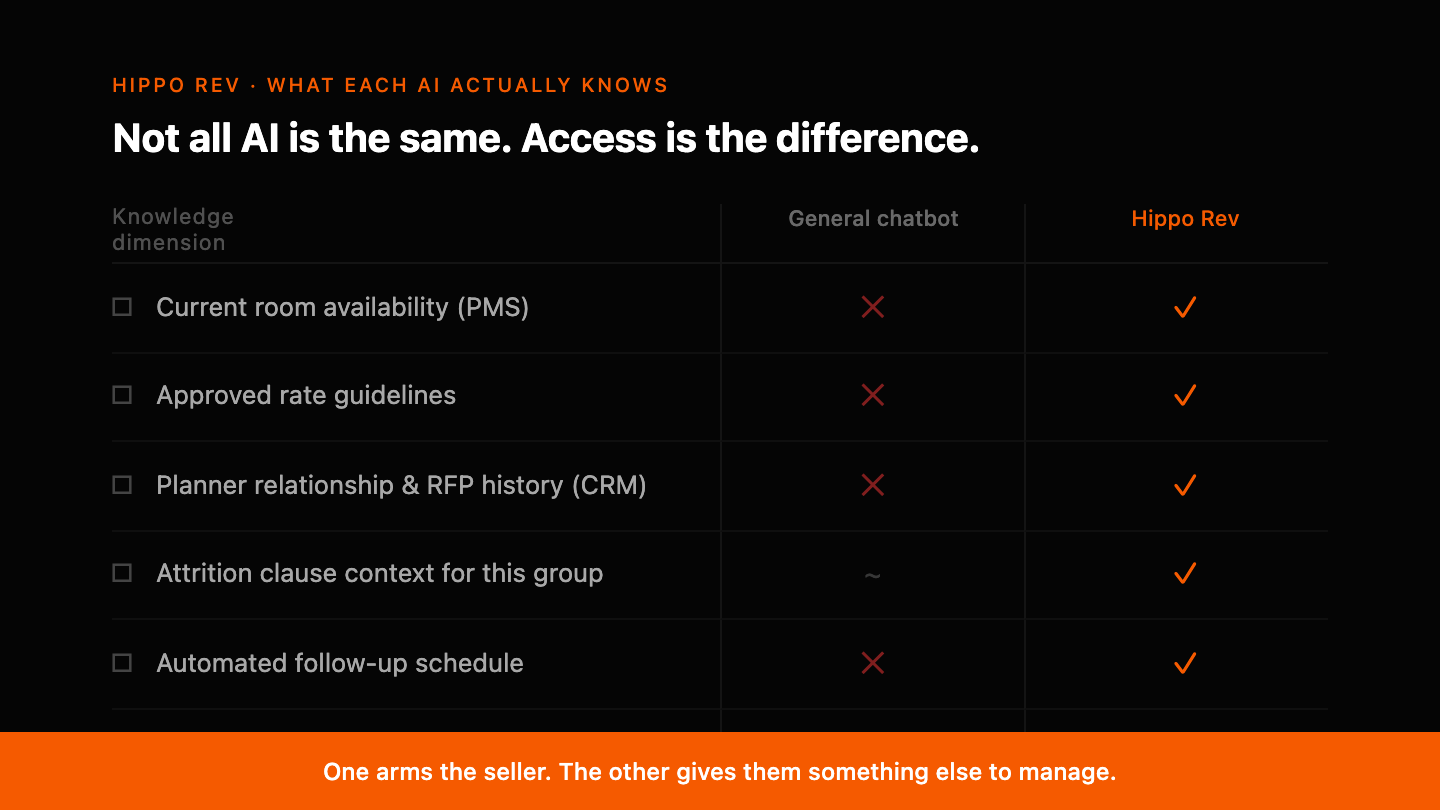
The instinct, once leaders see this, is to “give the team AI.” But handing a seller a consumer chatbot is not the same as arming them, for one structural reason: a general model has no access to the systems where your hotel's truth lives.
It cannot see your PMS, so it does not know what is available. It cannot see your rate guidelines, so it invents pricing you would never approve. It cannot see your CRM, so it treats a 40-RFP-a-year planner like a stranger. It produces something that reads like a proposal but is disconnected from every fact that makes a proposal real. The seller still has to do the actual work, which means the tool saved her a paragraph and cost her the time to check it.
Closing the capability gap requires the opposite of a generic chatbot. It requires AI that is wired into the systems you already own, so it works from your availability, your pricing logic, and your account history, not from a guess. This is the difference between layered, hotel-specific intelligence and a generic model dressed up for hospitality. One arms the seller. The other just gives them something else to manage.
Re-arming the sell side
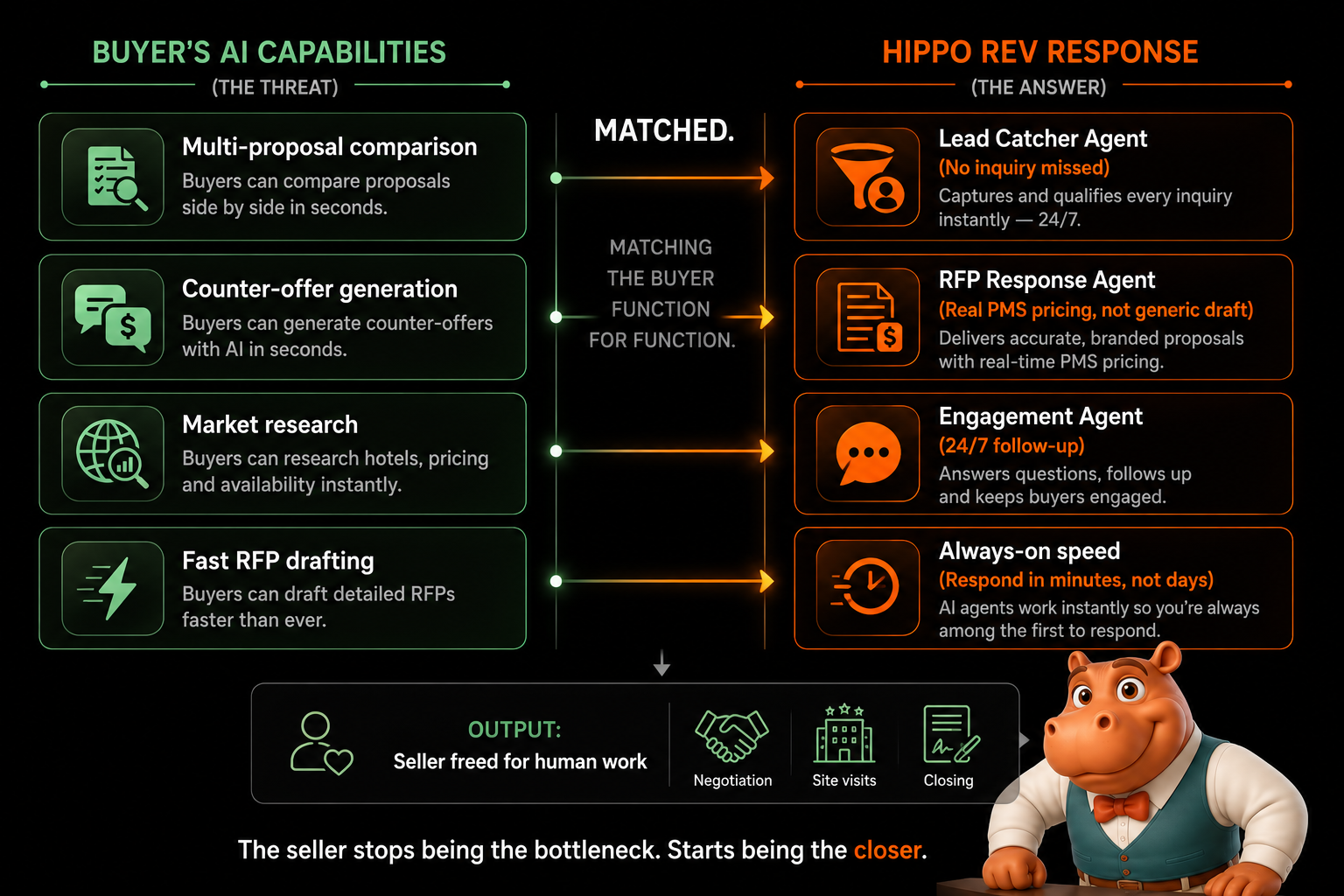
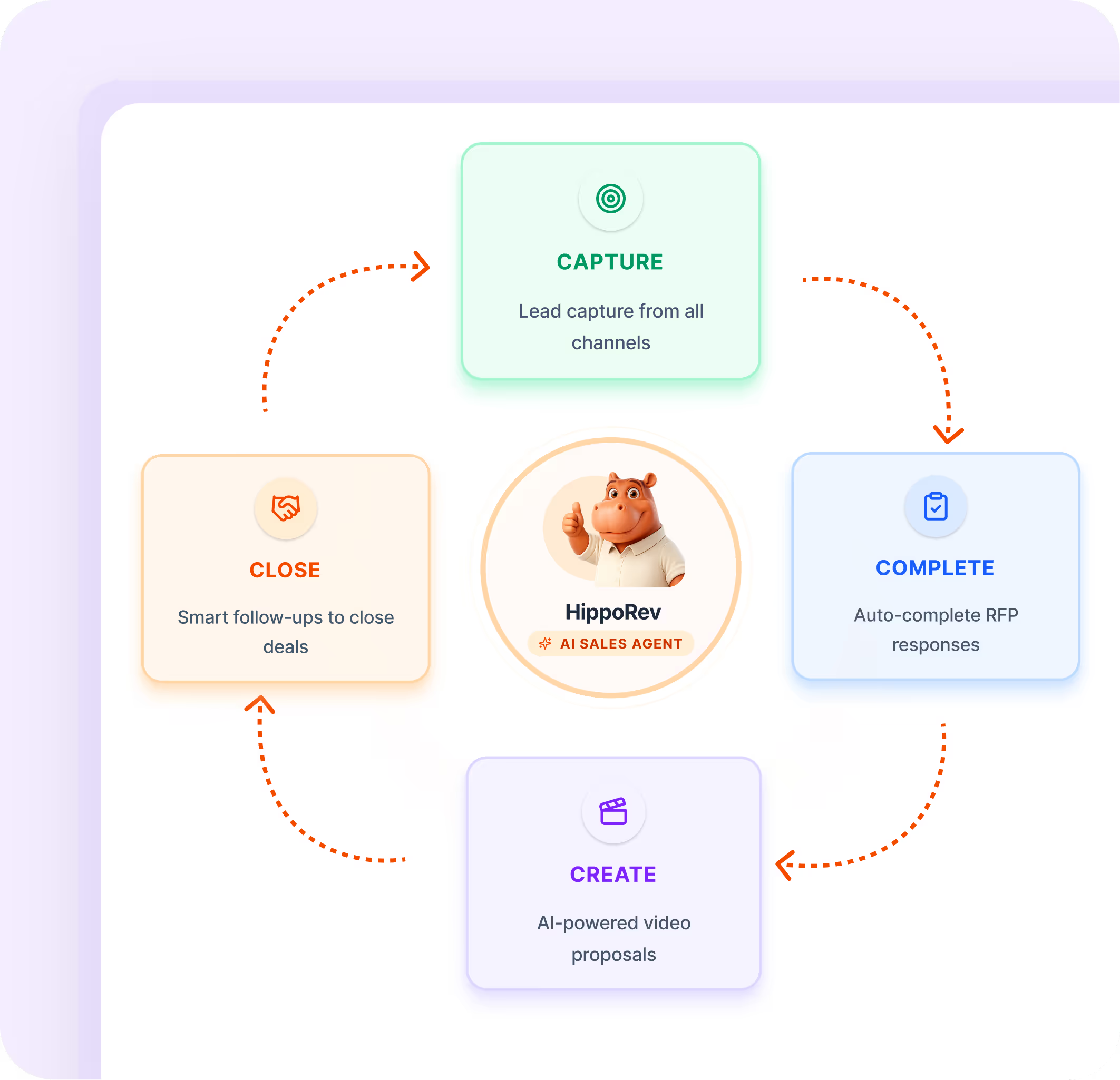
The fix is not to ask sellers to type faster into a chat window. It is to put a system of execution on the seller's side of the table, one that matches the buyer's AI capability by capturing every inquiry, drafting accurate proposals from your real data, chasing missing details, and following up around the clock.
That is the category we are building. Not a CRM that records what happened. Not a chatbot that talks to guests. A Revenue Capture Platform that does the sell-side machine work so your people can do the human work: reading the room, negotiating, and closing. The RFP Response Agent builds the proposal from your PMS pricing. The Lead Catcher Agent makes sure no inquiry from any channel sits unseen. The seller stops being the bottleneck and starts being the closer again.
The buyers got their handbook in 2024. The question for 2026 is whether your sellers get their equivalent before your comp set arms first.
Ready to re-arm your sell side?
The buyer-seller capability gap is not going to close on its own, and it will not close by working your team harder. It closes when your sellers get AI that knows your hotel as well as the planner's AI knows the market.
See what that looks like in a 15-minute demo of Hippo Rev, or download the Speed Wins Playbook for the framework behind a same-day response.
Frequently asked questions
Question: What is the Cvent AI playbook, and why does it matter to hotels?
Answer: “Mastering AI for Events” is a handbook Cvent published in 2024 to teach event planners how to use AI throughout the sourcing and planning process. It matters because it equips the buy side of every group negotiation with documented AI techniques, while no comparable, widely distributed guide exists for the sell side. The result is a growing capability gap between planners and the hotels bidding for their business.
Question: Can sellers just use ChatGPT to respond to RFPs?
Answer: They can, but a general-purpose model has no access to a hotel's PMS, rate guidelines, or CRM history. It can draft polite language, but it cannot produce accurate pricing or availability, which means the seller still does most of the work by hand. Purpose-built, system-connected AI closes the gap that a generic chatbot cannot.
Question: Is slow group revenue a demand problem or a capability problem?
Answer: For most hotels it is a capability problem. The inquiries are already arriving. The revenue is lost because the team cannot respond fast enough or often enough to capture demand it already has, especially now that buyers are using AI to move faster.
Question: What is a Revenue Capture Platform?
Answer: It is a system of execution that sits on top of the systems hotels already own and does the sell-side work of capturing inquiries, generating accurate proposals, and following up automatically. It is distinct from a CRM, which records data, and a revenue management system, which sets pricing.
Share this post
Ready to close more group business?
See how HippoRev can transform your hotel sales workflow in 15 minutes.

Follow us


.svg)