


Pipeline Recovery
Can AI Increase Hotel RGI? The Revenue Math Every HMC Should See
Most arguments for sales technology are about efficiency. This one is about timing. There is a window open right now where the first management company to put AI on the sell side builds a measurable revenue advantage over its comp set, and that window is already closing.



The Window Math: Why the First HMC to Wire AI Into Sell-Side Wins
Quick answer
An illustrative 15-property hotel management company has roughly $5 to 9M in recoverable group revenue per year across inbound uplift, outbound prospecting, account re-engagement, and strategic relationships, capturable without new headcount. Because RGI is measured against a comp set, the first management company to wire AI into its sell side gains an estimated 2 to 3 point RGI advantage. That edge compresses once competitors adopt similar capability, which is why timing, not just technology, drives the decision.
Key takeaways
- Recoverable group revenue for a mid-market 15-property HMC is roughly $5 to 9M per year.
- It is demand the portfolio already has, not new demand it must create.
- First-mover sell-side AI can produce a 2 to 3 point RGI advantage over the comp set.
- The advantage is temporary; waiting forfeits the head start, not the eventual efficiency.
The number most portfolios never put on the table
Start with a portfolio you can picture: a 15-property hotel management company, mid-market and independent properties with active group business, the same DOSMs and the same headcount you have today.
Run the recoverable revenue, line by line, against published industry benchmarks.
Inbound uplift. Better win rate, sharper group ADR, and faster response on the demand you already receive. Conservatively, +$1 to 2M across the portfolio per year.
Outbound prospecting. Net-new corporate accounts and associations that nobody currently has time to chase. +$2 to 3M.
Account growth and re-engagement. Dormant clients with real lifetime value who simply never got a call. +$1 to 2M.
Strategic relationships. Deeper, expanded work with the third-party planners who already send you volume. +$1 to 2M.
Total recoverable group revenue, portfolio-wide: roughly $5 to 9M per year.
Without adding headcount. Without renegotiating brand standards. Without renovating a single property.
This is not new demand you have to go create. It is demand you already have and cannot currently capture, because the team is buried in the admin we walked through above.
That is the prize. The more important point is that it does not sit there waiting for you indefinitely.
Why this is a timing decision, not just a technology decision
Most sell-side technology decisions can wait, because the advantage they offer is permanent and equally available to everyone. This one is different, for three reasons, and all three are time-sensitive.
One: the buyers already got armed.
Cvent published its planner-facing handbook, “Mastering AI for Events,” back in 2024, and its own data shows roughly half of meeting planners now use AI to plan and execute events. The baseline expectation planners bring to every negotiation rises every month. The longer your sell side stays manual, the wider that capability gap grows.
Two: no one has armed the sell side yet.
There is no category leader who has published the sell-side equivalent of Cvent's playbook. No major incumbent has wired AI into the execution layer of group sales. The seat is empty. That will not be true for long, but it is true right now.
Three: comp sets will move, and then the advantage normalizes.
This is the part that makes it a window rather than an open door.
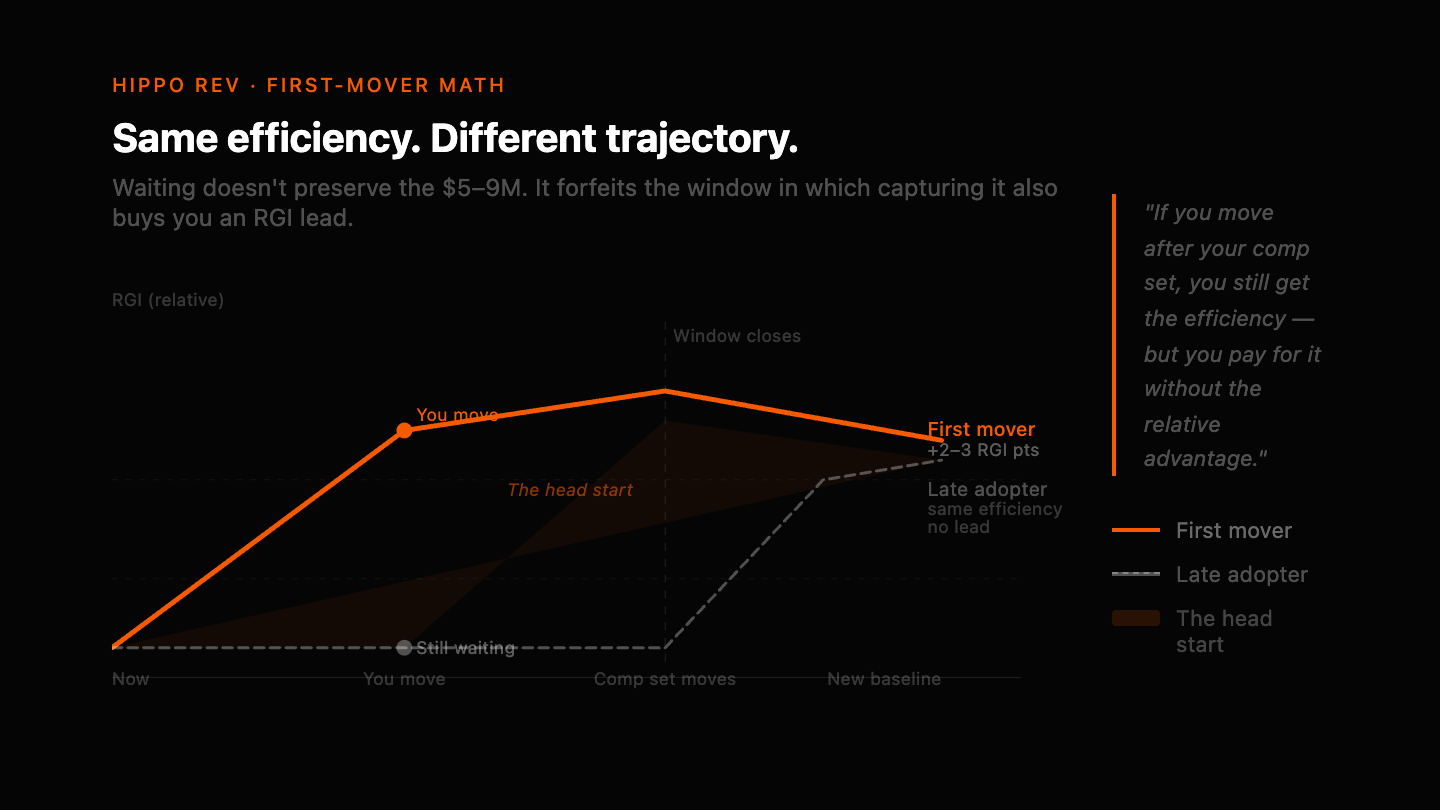
Whichever management company wires AI into the sell side first will respond faster, answer more RFPs, and price more consistently than its comp set, and that shows up in the rankings.
We estimate a 2 to 3 point RGI advantage for the first mover, built before the rest of the market figures out how.
Once the comp set catches up, response speed and answer rate become table stakes again, and the edge compresses back to zero.
First-mover advantage in a comp set is real precisely because it is temporary.
Where the RGI points actually come from
It is worth being concrete about why sell-side AI moves a ranking metric and not just an efficiency metric.
RGI is relative.
You do not win on absolute performance, you win on performance against your comp set.
So the question is not “are we good?” but “are we faster and more consistent than the hotels we are ranked against?”
Today, across the comp set, 55% of hotel RFPs go unanswered and the answered ones are usually won by one of the first responders. That is the ambient condition you are all operating in.
Now imagine one management company in that set quietly fixes its answer rate and its response time.
It starts capturing the 55% that were being ignored.
It starts being the first complete responder instead of the third.
It starts pricing every proposal with the same discipline because the system, not a tired seller at 6:30 PM, is building it.
Each of those is a relative gain against the comp set, and relative gains are exactly what RGI measures.
The comp set has not changed its behavior yet, so the gap is pure advantage.
That is the 2 to 3 points.
The advantage holds only until the others move.
Which is the entire argument for moving first.
“Too risky to change” is the objection that costs the most
The reflex inside a portfolio is caution: changing systems across 15 properties sounds like risk, disruption, and IT pain.
It is the most reasonable-sounding objection in the room, and in this case it is the expensive one, for two reasons.
First, the risk framing is backwards.
A Revenue Capture Platform does not replace your PMS, your CRM, or your revenue management system.
It sits on top of the systems you already own and absorbs the execution work between them.
There is no rip-and-replace, no migration of records, no retraining your team onto a new system of record.
You overlay, you do not uproot.
You can start with one or two workflows on a few properties and expand on proof.
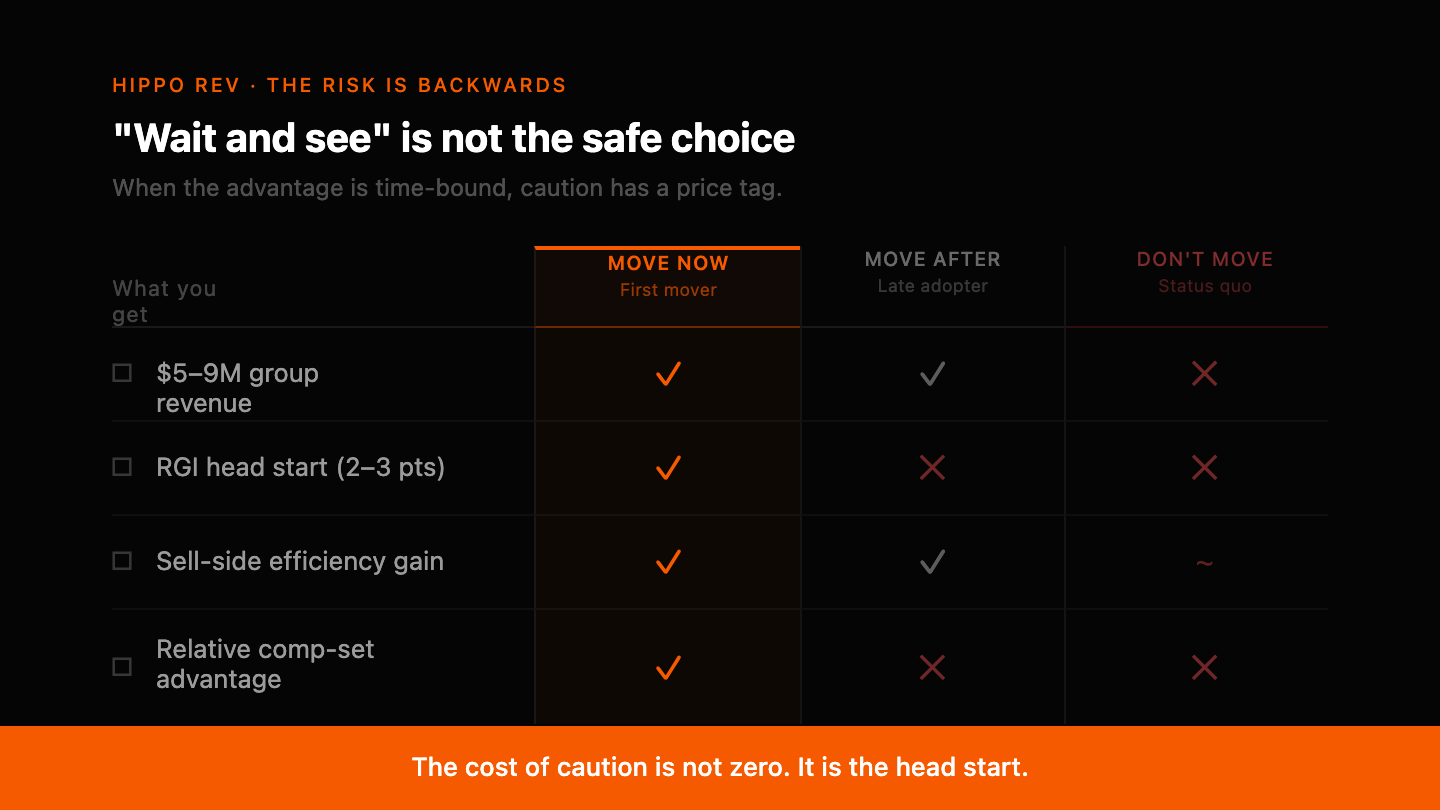
Second, “wait and see” is not actually the safe choice when the advantage is time-bound.
Waiting does not preserve the $5 to 9M, it forfeits the window in which capturing it also buys you an RGI lead.
If you move after your comp set, you still get the efficiency, but you pay for it without the relative advantage, because by then fast response and high answer rates are just the new normal.
The cost of caution is not zero.
It is the head start.
What moving first looks like in practice
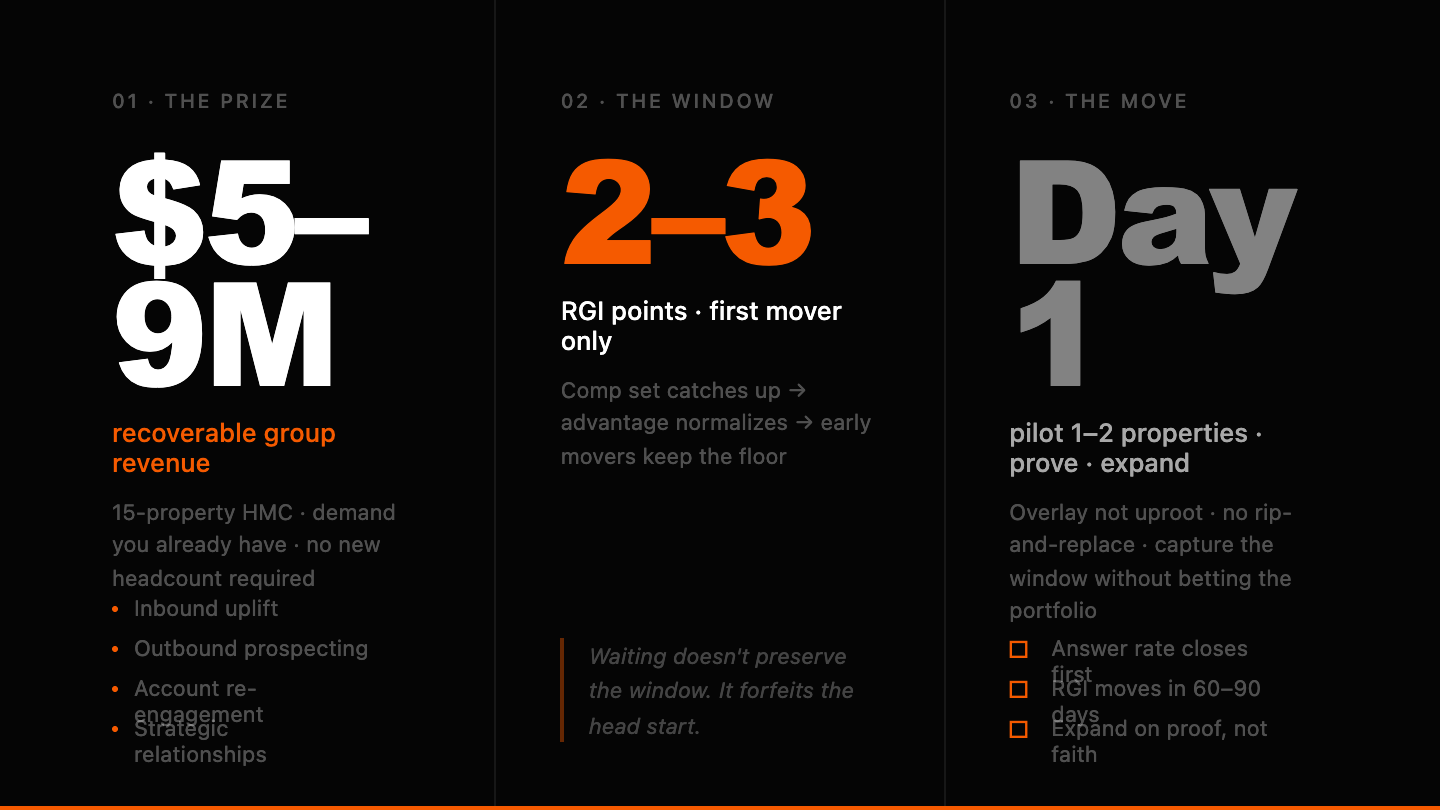
Moving first does not mean a portfolio-wide, big-bang rollout.
It means a structured pilot with the metrics that matter to a portfolio:
- Answer rate
- Response time
- Win rate
- ADR discipline
- SLA compliance
With role-based permissions, template governance, and an audit trail so execution is standardized rather than left to seller-by-seller variation.
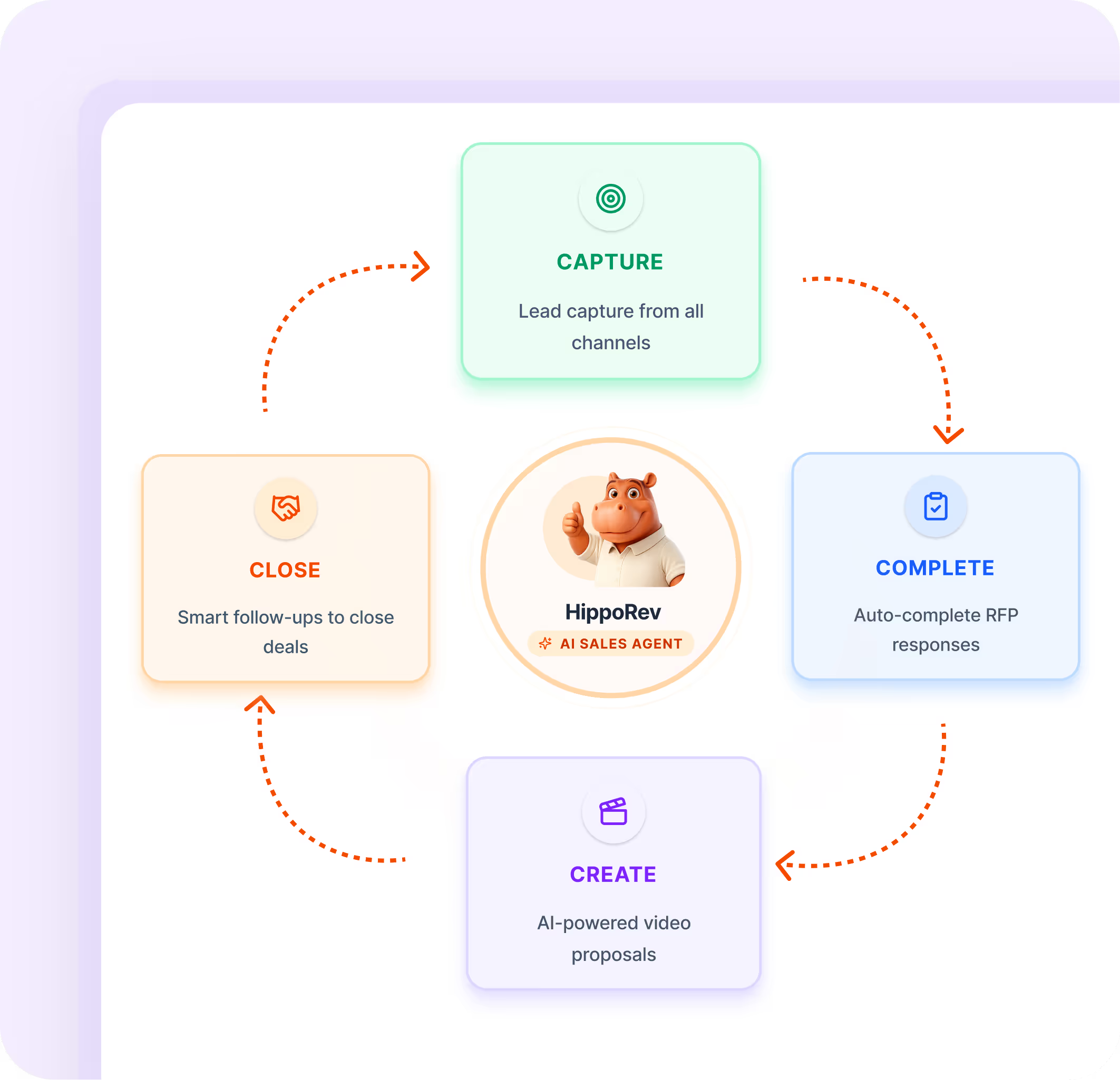
The Lead Catcher Agent closes the answer-rate gap by ensuring no inquiry from any channel goes unseen.
The RFP Response Agent closes the speed and consistency gap by drafting from your real pricing.
The Engagement Agent recovers the dormant-account and relationship revenue that nobody currently has time to chase.
You prove it on a slice of the portfolio, you watch the comp-set metrics move, and you expand.
The whole point is that you can capture the window without betting the portfolio to do it.
Ready to see your portfolio's number?
The $5 to 9M figure is a model.
Your number is specific to your properties, your channels, and your current answer rate, and it is worth knowing before your comp set does.
Bring us your portfolio numbers and we will show you what is recoverable, or see the platform built for VPs of sales.
Frequently asked questions
Question: How much group revenue can a hotel management company actually recover?
Answer: For an illustrative 15-property mid-market HMC, the recoverable group revenue across inbound uplift, outbound prospecting, account re-engagement, and strategic relationships is roughly $5 to 9M per year, based on published industry benchmarks. The actual figure depends on a portfolio's current answer rate, response time, and channel mix.
Question: Why is wiring AI into the sell side a first-mover advantage?
Answer: RGI is a relative metric measured against a comp set. The first management company to improve its answer rate and response time gains ground against competitors who have not, producing an estimated 2 to 3 point RGI advantage. Once the comp set adopts similar capability, fast response becomes table stakes and the relative edge compresses.
Question: Does a Revenue Capture Platform require replacing our existing systems?
Answer: No. It sits on top of the PMS, CRM, and revenue management systems a portfolio already owns and handles the execution work between them. There is no rip-and-replace, and a portfolio can start with one or two workflows before expanding.
Question: What is the risk of waiting to adopt sell-side AI?
Answer: The recoverable revenue remains available later, but the window to capture it as a relative advantage over the comp set does not. Adopting after competitors means gaining the efficiency without the first-mover RGI lead, because faster response and higher answer rates will have become the market baseline.
Share this post
Ready to close more group business?
See how HippoRev can transform your hotel sales workflow in 15 minutes.

Follow us


.svg)