


Event Insights
Hotel AI Lessons from HITEC 2026
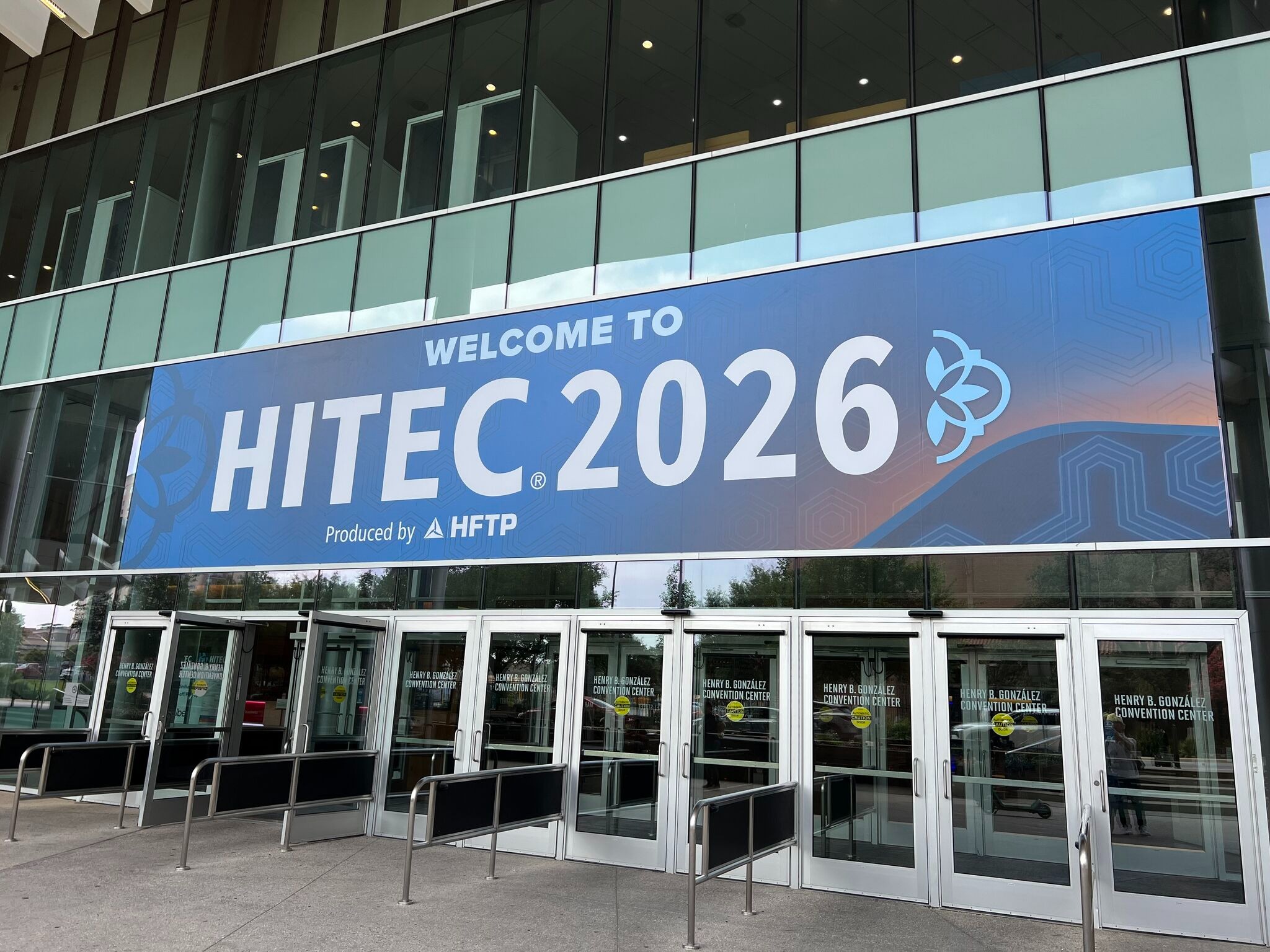
HITEC 2026 brought more than 6,100 hospitality technology leaders together in San Antonio and shifted the conversation from AI excitement to AI accountability. This breakdown covers what actually surfaced across keynotes, startup pitches, and closed-door sessions, and what operators should do before buying the next tool.



.png)
What HITEC 2026 Actually Taught Us About AI in Hospitality
Introduction
Here's a number worth sitting with: 360 companies, 83,000 square feet of exhibit space, sold out. Not "mostly full." Sold out. More than 6,100 people showed up in San Antonio for HITEC 2026, and if you've been to a few of these shows over the years, you know that scale alone doesn't make a conference matter. What made this one matter was the conversation underneath the conversation.
For the last couple of years, hospitality tech events have followed a predictable script: someone says "AI" on stage, the room nods, everyone goes back to their booth and slaps "AI-powered" on a banner. HITEC 2026 broke that script. The question on everyone's mind wasn't will AI change hospitality. That debate is over. The real question — asked bluntly, on stage and at the bar — was: which parts of this AI wave are actually real, and which parts are just expensive automation wearing a costume?
That question showed up everywhere. In Oracle's own admission that they don't yet have a clean way to prove AI's value. In a HotelKey executive flatly saying that moving water bottles is not a job for AI. In a closed-door room of hotel CIOs who, for 90 minutes, talked without anyone trying to sell anything. This piece pulls together everything that surfaced across the week — the keynotes, the startup pitches, the booth conversations nobody planned to have — into the ideas that actually matter if you're building, buying, or operating in this space.
The Big Idea Running Through Everything
If you remember nothing else from this article, remember this: AI is no longer a feature. It's becoming infrastructure. And infrastructure gets judged differently than features do. A feature gets forgiven if it's a little rough around the edges — you're trying something new, fair enough. Infrastructure doesn't get that grace. If the plumbing breaks, nobody cares how innovative the pipes were.
That's the lens for everything that follows. Five things stood out as the real story of the week:
- AI is moving inside the tools hotels already use, not living next to them as a separate app.
- The industry is finally willing to ask, out loud, "is this actually AI, or just automation with better branding?"
- Your data — how clean, accurate, and well-structured it is — is quietly becoming your biggest competitive advantage or your biggest liability.
- Nobody agrees on who wins the next distribution war: independent hotels, big brands, or the OTAs. And that disagreement is itself important.
- Even with all this automation, the humans didn't get pushed out of the room. They got pushed into a different, more important seat.
Let's walk through each one, because each one comes with a story that makes it click.
AI Is Sneaking Into the Plumbing, Not Standing at the Front Door
Think about how you actually use technology at work. Do you love opening a new app for every single task? Of course not. You tolerate it when you have to, but the tools that actually become part of your routine are the ones that show up inside the software you already have open.
That's exactly the pattern HITEC 2026 made impossible to miss. Oracle didn't launch a separate "AI app" that hotel staff need to learn. They built the OPERA Cloud Assistant directly into OPERA Cloud — the system front desk, revenue, and operations teams are already living in all day. It helps assign rooms intelligently, writes rate descriptions, and lets staff ask plain-language questions about procedures instead of digging through a binder. The thinking here is simple and smart: hotel teams don't need more places to look. They need fewer, faster, and more consistent ones.
The startups on the E20X stage told the same story from a different angle. Altek AI, a team out of Oslo, built software that reads an incoming guest email, works across the PMS and booking systems in the background, and drafts a reply — turning what used to be ten minutes of tab-switching into about thirty seconds. Lobby does something similar for the messy 70% of reservations that involve group requests, contracts, and invoices bouncing around in email and PDFs — it sits quietly between the inbox and the PMS, doing the unglamorous work nobody wanted to automate because it seemed too tangled to touch.
Here's the rule worth remembering: the AI tools winning right now are the ones that disappear. Not literally — they're doing real work — but in the sense that nobody has to change their habits to benefit from them. If a vendor is pitching you on a brand-new interface you'll need to train your team on, ask yourself why it isn't living inside the system you already pay for. Sometimes there's a good answer. Often, there isn't.
"Wait — Is That Actually AI?"
This is the question that gave the week its edge, and it came from people you'd expect to be cheerleading for the technology, not interrogating it.
Fareed Ahmad from HotelKey put it about as plainly as anyone could. Payment automation, he said, is rule-based — if X happens, do Y — and it shouldn't be marketed as AI just because it's automated. But deciding whether a returning guest who had a bad experience last time deserves an upgrade this time? That's a judgment call based on messy, incomplete information. That's the real thing. He went further, splitting guest recognition the same way: the CRM and loyalty system decides what a guest should get, and the PMS just carries it out — because, as he put it, "AI isn't going to move the water bottles."
This wasn't a one-off comment. A separate panel — engineers and vendors talking through how AI handles maintenance and work orders — landed on almost identical language. The real AI, one of them said, is helping a stressed, possibly inexperienced front-line employee describe a broken thermostat without making them fill out a confusing form; the system just asks the right follow-up questions and routes the problem correctly. The hype is the idea that you can hand an AI agent the entire workflow and no longer need a facilities manager. Nobody on that panel believed that was close to happening, and they were the ones building the tools.
Even Oracle, mid-keynote, was refreshingly honest about this. They've built around 50 different agentic tools, with several already live in real hotels. But when asked about the payoff, their own team admitted: cloud computing had an obvious, sellable value story. AI doesn't — yet — because nobody has the results to point to that would show everyone else exactly how to capture that value.
Think of it like the difference between a calculator and a doctor. A calculator is fast and reliable because the problem is fully defined — there's one right answer, and the machine finds it instantly. A doctor is valuable precisely because the problem usually isn't fully defined — symptoms are ambiguous, histories are messy, and judgment fills the gap. A lot of what's being sold as "AI" in hospitality right now is really just a very fast calculator with a friendlier interface. That's not nothing. Speed has value. But it's not the same thing as judgment, and conflating the two is how budgets get wasted.
The practical move: before you sign anything, ask the vendor to walk you through one specific decision the system makes. If the answer is "it follows this rule," you're buying automation — which is fine, just price it like automation. If the answer involves weighing ambiguous, conflicting information the way a person would, you're buying something closer to real AI. Both are useful. Only one of them deserves the premium.
Your Data Is Either Your Best Asset or Your Biggest Liability — And Most Hotels Don't Know Which
Here's a thought experiment. Imagine a guest asks ChatGPT or Gemini whether your hotel has a rooftop pool, what time check-in is, and whether you allow pets. The AI doesn't call your front desk to ask. It pulls from whatever scattered, possibly outdated information about your property exists online — your website, a listing site, a review from three years ago, a directory that hasn't been updated since before the renovation. If that information is wrong, the AI doesn't know it's wrong. It just answers confidently. And the guest believes it, because why wouldn't they?
This is the quiet crisis nobody saw coming, and three completely separate parts of HITEC 2026 converged on it independently — which is exactly why it's worth paying attention to.
First, HFTP itself is building a formal industry standard for how hotels structure their data, specifically so AI systems can find, interpret, and represent a property's offerings accurately. That's not a small administrative project. That's an industry-level acknowledgment that this is now a foundational problem, not a nice-to-have.
Second, a startup called Bonafide pitched exactly this problem on the E20X stage, and the founder shared a number that should make every GM a little uncomfortable: hotels typically start with about a third of their facts misaligned across the sources AI assistants pull from. A third. Clean that up, and accuracy jumps past 80%. Think about what that means in practice — roughly one in three things a curious traveler's AI assistant tells them about your hotel right now is probably wrong, and you have no idea which third.
Third — and this is the part that connects everything — Frank Trampert from Revinate pointed out that AI models actually distrust a brand's own marketing copy. They lean on guest reviews instead, because reviews are real experiences shared by real people, not curated brand language. That's a fascinating inversion: the words you spent the most money polishing are the words the AI trusts the least. The messy, unfiltered guest review you've been quietly managing for reputation reasons is, to an AI system, the more credible source.
Put those three things together and you get a genuinely new competitive idea: being "AI-legible" is becoming its own competitive advantage, separate from being good at hospitality. You can run a wonderful hotel and still lose bookings to a mediocre one next door simply because the AI assistant a traveler is using describes your competitor more accurately and more favorably. That's a strange new kind of unfairness, and it's not going away.
The takeaway: before you spend another dollar on AI tools, spend a few hours auditing what AI systems currently say about your property. You might not like what you find. And start treating your guest reviews less like a reputation chore and more like the raw material AI systems use to decide whether you exist.
Nobody Agrees Who Wins the Next Distribution War — And That Disagreement Is the Real Story
If there was one moment at HITEC 2026 that felt like watching two smart people genuinely disagree about something that matters, it was this.
On the headliner stage, Floor Bleeker from In2 Consulting made a bold case: AI is going to "change everything," and it'll hurt the big brands the most. His logic — big hotel chains currently benefit from a distribution system built around their scale. If AI-powered discovery routes around that system, the advantage of being big partially evaporates, and brands get pushed back toward competing the old-fashioned way: by actually delivering a great guest experience, because that's the one thing AI can't fake for them. "They'll have to go inside the hotel again," he said, which is a great way of putting it — like the curtain gets pulled back and suddenly the actual product matters more than the marketing around it.
Other panelists weren't so sure things would move that fast. Lennert de Jong thought loyalty programs specifically would shift — AI making it easier to book within a loyalty relationship — but that most of hospitality would stay recognizably the same. Wyndham's Scott Strickland zoomed in on something concrete: right now, if you're chatting with an AI assistant about a trip, you have to leave that conversation and go to a brand's website to actually earn your loyalty points. That friction won't last. Once it disappears, bookings might happen entirely inside the AI conversation itself — which means brands need to be paying very close attention to which AI platforms guests are actually using, the same way they once had to pay attention to which search engines and travel sites mattered.
Then, separately, on the show floor — not on a stage, just in a booth conversation — Natalie Kimball from Shiji said something that should make every independent hotel owner sit up. Her view: the OTAs have already won this fight, the same way they won search years ago, because individual hotels simply can't outspend an OTA to stay visible in an AI-powered discovery layer. She thinks the window to prevent that outcome has already closed. Her specific prediction is worth writing down: she expects OTAs to introduce a new, higher commission tier specifically for AI-agent-driven bookings — maybe 20% instead of the current roughly 15% — the same way bundled vacation packages already cost hotels more than standalone bookings. That's not a vague worry. That's a number you can watch for.
But — and this matters — Kimball also offered the one genuinely hopeful idea in the whole debate, and it connects directly back to the data point above: she believes guest reviews, in large enough volume, become exactly the kind of content AI trusts and turns into something bookable. Which means independent hotels aren't necessarily locked out. They just need to win on a different battlefield than the one they're used to fighting on — not ad spend, but review volume and review quality.
Here's the honest summary: nobody at HITEC 2026 knows for certain who wins this. And that uncertainty is itself useful information. It means the smart move isn't to wait for clarity before acting — by the time there's clarity, the window will likely have closed. The defensive moves work regardless of which future arrives: clean data, strong reviews, and real investment in direct guest relationships that don't depend on winning a bidding war for visibility.
AI Didn't Push Humans Out of the Room — It Pushed Them Into a Different Seat
There's a version of the AI conversation that gets people anxious: machines taking over, judgment becoming obsolete, humans becoming spectators in their own industry. That version did not show up at HITEC 2026. What showed up instead was something more interesting and, frankly, more reassuring.
Richard Bradberry, talking through how AI handles maintenance work orders, said something simple but important: AI is genuinely good at taking a pile of messy, disconnected information and compiling it into something a person can actually understand. What it can't do is evaluate whether the outcome was actually good. Did the repair actually fix the problem? Was the vendor relationship worth keeping? That's still a human call, every time.
Adam Tuttle made the version of this point that should worry every brand operator paying attention: if you just ask an AI system to generate your service standards for you, you'll get the same generic standards as every other hotel that asked the same question. You won't lose efficiency — you'll lose identity. The thing that makes your property feel like your property, rather than a slightly different building with the same playbook as everyone else, has to come from a human who decided what that identity should be. AI can scale a standard brilliantly. It cannot invent one worth scaling.
Keryn McNamara from Aimbridge offered the most useful forward-looking idea on this front: she expects entirely new job titles to emerge, specifically "agent supervisors" — people whose job is to oversee what the AI agents are doing and hold them accountable. That's a genuinely different prediction than the tired "robots are taking our jobs" narrative. It's closer to what happened when factories got automated: you didn't end up with zero people on the floor, you ended up with fewer people doing repetitive tasks and more people watching, calibrating, and catching the mistakes the machines couldn't see themselves making.
AI recommends an action by checking it against the standards a hotel has already written down, and a human verifies the recommendation before anything happens. The real win isn't replacing the person. It's making the loop between recommendation and action so fast that the work actually gets done before the guest even notices there was a problem.
So the honest picture isn't "AI versus humans." It's AI handling the parts of the job that were always more mechanical than they felt — sorting, compiling, drafting, routing — while humans hold onto the parts that were always more human than they looked: judgment, identity, and accountability. That's not a smaller role for people. In a lot of ways, it's a more important one, because it's the part of the job that's harder to fake.
The Stuff That Wasn't About AI (And Mattered Just As Much)
It would be easy to walk away from HITEC 2026 thinking the entire show was an AI conference. It wasn't, and some of the most useful announcements of the week barely touched the topic.
Take tipping. It sounds almost too simple to be a real problem, but think about it: fewer guests carry cash than ever, and gratuity has always depended on cash being available. Housekeepers, valets, and spa staff have quietly been losing income not because their service got worse, but because the payment habits of travelers changed underneath them. Tipmo solved this with something refreshingly low-tech — an NFC tag a guest taps with their phone to tip instantly through Apple Pay or Google Pay, no app required. Sometimes the most important fix isn't artificial intelligence. It's just removing a piece of friction that's been quietly costing real people real money.
Group and event sales had a similar story. Hotel sales teams drown in inquiries — some serious, many not — and spend hours sorting through them while the genuinely good leads sit in the same queue as the dead ends. Canary's Agentic Sales Coordinator doesn't try to close the sale. It just gets the sorting right, so a human salesperson spends their limited time on the leads actually worth chasing. That's a smaller, less flashy promise than "AI sells your rooms for you" — and it's exactly why it's more believable.
And then there's the loyalty problem independent hotels have always quietly resented: a 35-room boutique property with a couple hundred annual repeat guests simply doesn't have enough transaction volume to make a points program feel meaningful to anyone. Cloudbeds and Journey's new partnership pools guest relationships across many independent properties at once, so those same loyal guests suddenly have redemption options across markets they might actually visit. It's a clever fix for a real structural disadvantage — though it comes with an honest risk worth asking about before signing up: if your brand voice gets buried inside someone else's shared loyalty interface, are your guests loyal to you, or just collecting points in a program that happens to include you?
What To Actually Do With All This
If you operate, build, or invest in this space, here's the practical version of everything above:
Check your own data before buying anything new. Search for your hotel the way a guest using AI would. If a third of what comes back is wrong — and statistically, it probably is — that's the first fire to put out, not the tenth.
Ask vendors the HotelKey question. Is this system making a judgment call with incomplete information, or following a fixed rule? There's nothing wrong with buying smart automation. Just don't pay an AI premium for it.
Literally call your own front desk during a busy shift. See what actually happens. The friction you notice as an insider is the friction your best guests are quietly absorbing every day.
Write your standards down before you hand anything to AI. AI will scale whatever standard you give it — including a vague or mediocre one. Garbage in, scaled garbage out.
Start treating reviews as discovery infrastructure, not just reputation management. AI systems trust them more than your marketing copy. That alone should change how seriously you take them.
Watch for the OTA agentic commission tier. It's a specific, testable prediction. If it shows up, it'll tell you a lot about how the distribution fight is actually going.
Think now about who "supervises" your AI tools. Someone needs to own the gap between what the system recommends and what actually happens. That role barely exists yet on most org charts. It will.
Don't sleep on the boring fixes. Cashless tipping, smarter lead sorting, pooled loyalty — none of it requires a leap of faith in unproven AI judgment, and all of it solves a real, specific, currently-costing-you-money problem.
The Bottom Line
The most useful thing that happened at HITEC 2026 wasn't a product launch. It was a shift in posture. The industry stopped asking whether AI matters — that question is settled — and started asking the much harder, much more useful question: which parts of this actually work, who benefits when they don't, and what do we lose if we move faster than our own standards can keep up with?
The hotels and companies that come out ahead from here won't be the ones with the longest list of AI tools bolted on. They'll be the ones who got their data right before chasing the next feature, who kept brand identity and guest judgment in human hands even as everything around them got faster, and who demanded proof instead of accepting promises.
Next year, the question worth asking every vendor on the floor won't be "what does your AI do?" It'll be simpler, and harder to dodge: "show me the result." That's the bar the whole industry quietly agreed to at HITEC 2026, whether everyone realizes it yet or not.
A Closing Thought on Execution
With Hippo Rev, A few threads from this week tie together more than they first appear to.
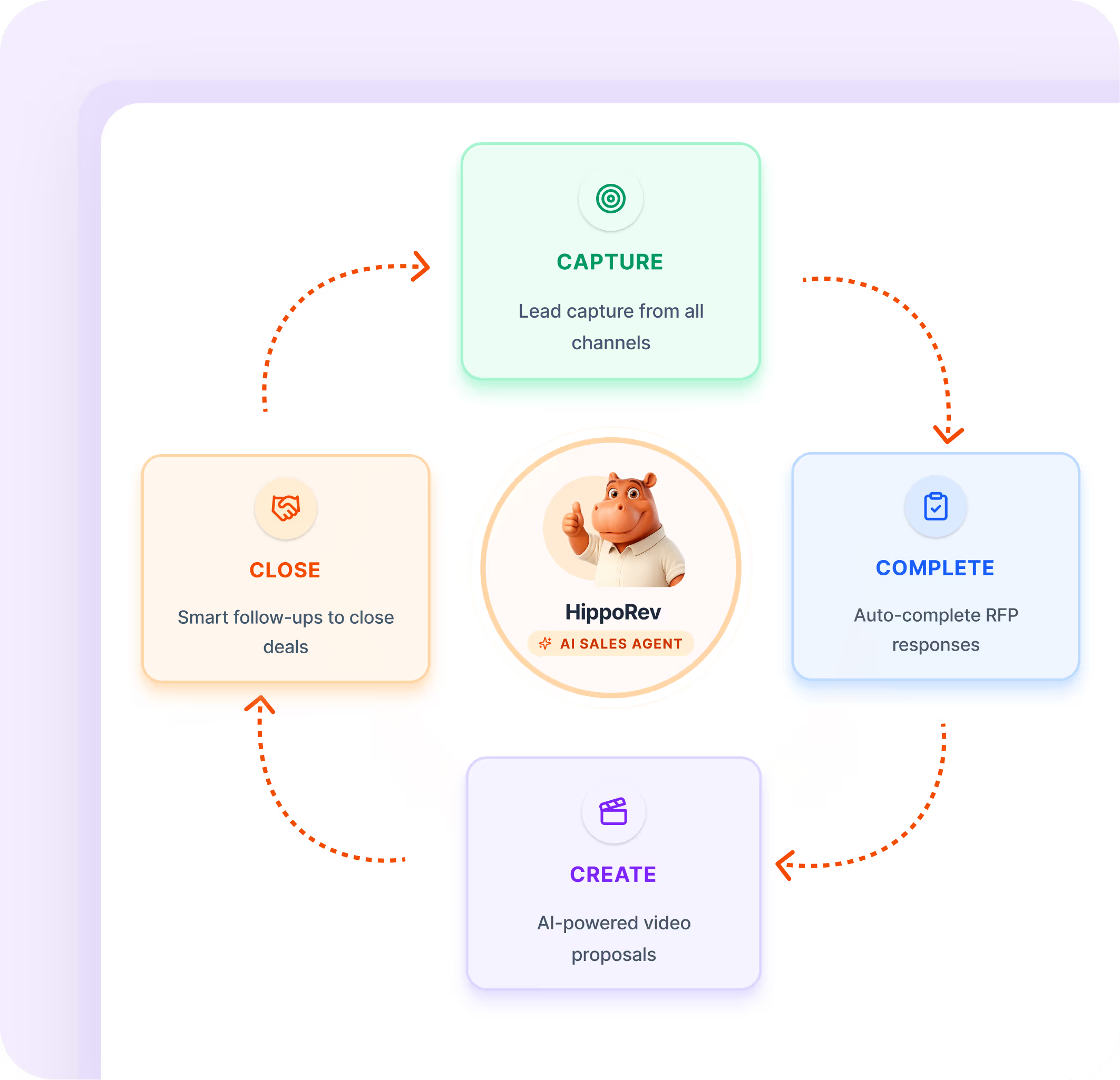
Hippo Rev's agents qualify, price, and draft, but every proposal still gets reviewed by a seller before it leaves — judgment stays human, the way Adam Tuttle insisted it should.
The "AI sits inside your existing tools" pattern is noted too: Hippo Rev reads and writes across the PMS, RMS, and Cvent stack hotels already run, rather than asking anyone to learn something new.
A lot of what Canary's sales coordinator tackled on stage — messy inbound, slow qualification, good leads buried under bad ones — is the same execution gap showing up across the industry's group sales desks generally. Hippo Rev solves this, crossing the gap between inbox, Cvent, PMS, and RMS before a seller even wakes up.
On distribution, the fix is less about winning a visibility war and more about not losing deals already in hand — Hippo Rev ensures capturing every inquiry across all possible-odd channels group business arrives through, instead of letting a third of RFPs die unanswered before a seller sees them.
And on follow-up, the same discipline follows — it gets handled structurally, with engagement tracked and follow-ups triggered automatically. None of it replaces the seller. It just clears the inbox they were drowning in, so the part of the job that was always human — reading the room, building the relationship, closing with empathy — gets the time it actually needs.
Share this post
Ready to close more group business?
See how HippoRev can transform your hotel sales workflow in 15 minutes.

Follow us


.svg)